

ASTM D7579-09(2019)
(Test Method)Standard Test Method for Pyrolysis Solids Content in Pyrolysis Liquids by Filtration of Solids in Methanol
General Information
- Abstract
SIGNIFICANCE AND USE
5.1 Pyrolysis liquid can be produced to various char concentrations. Increasing pyrolysis solids content can affect the pyrolysis liquid biofuel handling, atomization and storage stability in a negative manner.
SCOPE
1.1 This test method describes a filtration procedure for determining the pyrolysis solids content of pyrolysis liquid. It is intended for the analysis of pyrolysis liquid with all ranges of pyrolysis solids concentrations.
1.2 The values stated in SI units are to be regarded as standard. No other units of measurement are included in this standard.
1.3 This standard does not purport to address all of the safety concerns, if any, associated with its use. It is the responsibility of the user of this standard to establish appropriate safety, health, and environmental practices and determine the applicability of regulatory limitations prior to use. Material Safety Data Sheets are available for reagents and materials. Review them for hazards prior to usage. For specific warning statements, see 7.2, 7.3, and 7.4.
1.4 This international standard was developed in accordance with internationally recognized principles on standardization established in the Decision on Principles for the Development of International Standards, Guides and Recommendations issued by the World Trade Organization Technical Barriers to Trade (TBT) Committee.
- Status
- Published
- Publication Date
- 30-Apr-2019
- Technical Committee
- D02 - Petroleum Products, Liquid Fuels, and Lubricants
- Drafting Committee
- D02.06 - Analysis of Liquid Fuels and Lubricants

Overview
ASTM D7579-09(2019) is the internationally recognized standard test method for determining pyrolysis solids content in pyrolysis liquids through filtration of solids in methanol. Published by ASTM International, this method is crucial for measuring the concentration of solid particles, such as char and ash, suspended in bio-oil or pyrolysis liquid produced from biomass pyrolysis. Understanding solids content is essential because elevated solids can negatively impact the handling, atomization, and storage stability of pyrolysis-based biofuels.
The test method covers a filtration procedure using a methanol-dichloromethane solvent system and quantifies solids retained on a filter membrane. It applies across the full range of solids concentrations found in fast pyrolysis bio-oils and related products. All measurements are performed in SI units.
Key Topics
Purpose and Scope:
- Determines solids content in pyrolysis liquids derived from biomass.
- Suitable for all concentrations of pyrolysis solids, from low to high.
- Focuses on solids such as char and ash in the bio-oil matrix.
Test Procedure Summary:
- A sample of well-mixed pyrolysis liquid is dissolved in a methanol and dichloromethane solution.
- The mixture is filtered using a vacuum filtration system with a 1 µm glass microfiber membrane.
- The filter is washed, dried, and weighed to calculate the content of retained solids.
Significance of Solids Measurement:
- High solids content affects biofuel processability, leading to operational challenges such as pipeline blockage, burner fouling, and unstable storage.
- Quantitative knowledge of solids aids in quality control and compliance with industry requirements for biofuel applications.
Safety and Compliance:
- Emphasizes the need for proper laboratory safety measures, including the use of Material Safety Data Sheets (MSDS) for all reagents.
Applications
Biofuel Quality Assurance:
- Used by bio-refineries and biomass conversion facilities to certify the consistency and quality of pyrolysis liquids.
Fuel Handling and Engine Testing:
- Essential for R&D teams testing combustion properties in engines, burners, and industrial furnaces, where solids can affect atomization and clogging.
Process Optimization:
- Supports engineers and process operators to monitor and adjust pyrolysis process parameters for cleaner bio-oil production.
Regulatory and Market Access:
- Required for documentation in product certification, regulatory submissions, and meeting international fuel standards for export or trading.
Laboratory Analysis:
- Standardizes procedures among independent and in-house labs, enabling reliable, repeatable measurement of pyrolysis solids.
Related Standards
- ASTM D4057 – Practice for Manual Sampling of Petroleum and Petroleum Products
- ASTM D4175 – Terminology Relating to Petroleum Products, Liquid Fuels, and Lubricants
- ASTM D4177 – Practice for Automatic Sampling of Petroleum and Petroleum Products
- ESPOO 2001 – Guide to Physical Property Characterization of Biomass-Derived Fast Pyrolysis Liquids
By adhering to ASTM D7579-09(2019), practitioners ensure consistent, accurate assessment of pyrolysis solids content in bio-oils, supporting the development of reliable biofuel applications and compliance with global standards. This test method strengthens laboratory quality assurance and underpins safe, effective use of pyrolysis liquids in energy production and research.
Relations
- Effective Date
- 01-May-2019
- Refers
ASTM D4175-23a - Standard Terminology Relating to Petroleum Products, Liquid Fuels, and Lubricants - Effective Date
- 15-Dec-2023
- Refers
ASTM D4175-23e1 - Standard Terminology Relating to Petroleum Products, Liquid Fuels, and Lubricants - Effective Date
- 01-Jul-2023
- Refers
ASTM D4057-06(2011) - Standard Practice for Manual Sampling of Petroleum and Petroleum Products - Effective Date
- 01-Jun-2011
- Refers
ASTM D4057-95(2000) - Standard Practice for Manual Sampling of Petroleum and Petroleum Products - Effective Date
- 10-Apr-2000
- Effective Date
- 01-May-2019
Get Certified
Connect with accredited certification bodies for this standard

ECOCERT
Organic and sustainability certification.

Eurofins Food Testing Global
Global leader in food, environment, and pharmaceutical product testing.

Intertek Bangladesh
Intertek certification and testing services in Bangladesh.
Sponsored listings
Frequently Asked Questions
ASTM D7579-09(2019) is a standard published by ASTM International. Its full title is "Standard Test Method for Pyrolysis Solids Content in Pyrolysis Liquids by Filtration of Solids in Methanol". This standard covers: SIGNIFICANCE AND USE 5.1 Pyrolysis liquid can be produced to various char concentrations. Increasing pyrolysis solids content can affect the pyrolysis liquid biofuel handling, atomization and storage stability in a negative manner. SCOPE 1.1 This test method describes a filtration procedure for determining the pyrolysis solids content of pyrolysis liquid. It is intended for the analysis of pyrolysis liquid with all ranges of pyrolysis solids concentrations. 1.2 The values stated in SI units are to be regarded as standard. No other units of measurement are included in this standard. 1.3 This standard does not purport to address all of the safety concerns, if any, associated with its use. It is the responsibility of the user of this standard to establish appropriate safety, health, and environmental practices and determine the applicability of regulatory limitations prior to use. Material Safety Data Sheets are available for reagents and materials. Review them for hazards prior to usage. For specific warning statements, see 7.2, 7.3, and 7.4. 1.4 This international standard was developed in accordance with internationally recognized principles on standardization established in the Decision on Principles for the Development of International Standards, Guides and Recommendations issued by the World Trade Organization Technical Barriers to Trade (TBT) Committee.
SIGNIFICANCE AND USE 5.1 Pyrolysis liquid can be produced to various char concentrations. Increasing pyrolysis solids content can affect the pyrolysis liquid biofuel handling, atomization and storage stability in a negative manner. SCOPE 1.1 This test method describes a filtration procedure for determining the pyrolysis solids content of pyrolysis liquid. It is intended for the analysis of pyrolysis liquid with all ranges of pyrolysis solids concentrations. 1.2 The values stated in SI units are to be regarded as standard. No other units of measurement are included in this standard. 1.3 This standard does not purport to address all of the safety concerns, if any, associated with its use. It is the responsibility of the user of this standard to establish appropriate safety, health, and environmental practices and determine the applicability of regulatory limitations prior to use. Material Safety Data Sheets are available for reagents and materials. Review them for hazards prior to usage. For specific warning statements, see 7.2, 7.3, and 7.4. 1.4 This international standard was developed in accordance with internationally recognized principles on standardization established in the Decision on Principles for the Development of International Standards, Guides and Recommendations issued by the World Trade Organization Technical Barriers to Trade (TBT) Committee.
ASTM D7579-09(2019) is classified under the following ICS (International Classification for Standards) categories: 71.040.40 - Chemical analysis. The ICS classification helps identify the subject area and facilitates finding related standards.
ASTM D7579-09(2019) has the following relationships with other standards: It is inter standard links to ASTM D7579-09(2013), ASTM D4175-23a, ASTM D4175-23e1, ASTM D4057-06(2011), ASTM D4057-95(2000), ASTM D7544-23. Understanding these relationships helps ensure you are using the most current and applicable version of the standard.
ASTM D7579-09(2019) is available in PDF format for immediate download after purchase. The document can be added to your cart and obtained through the secure checkout process. Digital delivery ensures instant access to the complete standard document.
Standards Content (Sample)
This international standard was developed in accordance with internationally recognized principles on standardization established in the Decision on Principles for the
Development of International Standards, Guides and Recommendations issued by the World Trade Organization Technical Barriers to Trade (TBT) Committee.
Designation: D7579 − 09 (Reapproved 2019)
Standard Test Method for
Pyrolysis Solids Content in Pyrolysis Liquids by Filtration
of Solids in Methanol
This standard is issued under the fixed designation D7579; the number immediately following the designation indicates the year of
original adoption or, in the case of revision, the year of last revision. A number in parentheses indicates the year of last reapproval. A
superscript epsilon (´) indicates an editorial change since the last revision or reapproval.
1. Scope 2.2 Other Standards:
ESPOO 2001 A guide to physical property characterisation
1.1 This test method describes a filtration procedure for
of biomass-derived fast pyrolysis liquids
determining the pyrolysis solids content of pyrolysis liquid. It
is intended for the analysis of pyrolysis liquid with all ranges
3. Terminology
of pyrolysis solids concentrations.
3.1 Definitions:
1.2 The values stated in SI units are to be regarded as
3.1.1 See also Terminology D4175.
standard. No other units of measurement are included in this
3.1.2 char, n—fine carbonaceous powder that is separated
standard.
from the vapors of biomass during pyrolysis.
1.3 This standard does not purport to address all of the 3.1.2.1 Discussion—Pyrolysis liquid biofuel contains uni-
safety concerns, if any, associated with its use. It is the formly suspended char at varying concentrations.
responsibility of the user of this standard to establish appro-
3.1.3 pyrolysis, n—chemical decomposition of organic ma-
priate safety, health, and environmental practices and deter-
terials by heating in the absence of oxygen.
mine the applicability of regulatory limitations prior to use.
3.1.4 pyrolysis liquid biofuel, n—liquid product from the
Material Safety Data Sheets are available for reagents and
pyrolysis of biomass.
materials. Review them for hazards prior to usage. For specific
3.1.4.1 Discussion—Pyrolysisliquidbiofueliscomprisedof
warning statements, see 7.2, 7.3, and 7.4.
a complex mixture of the decomposition products of ligno-
1.4 This international standard was developed in accor-
cellulosic biomass including highly oxygenated organic com-
dance with internationally recognized principles on standard-
pounds. It is produced from the pyrolysis of biomass, followed
ization established in the Decision on Principles for the
by the rapid condensation of its vapors.
Development of International Standards, Guides and Recom-
3.1.5 pyrolysis solids, n—solid particles contained within
mendations issued by the World Trade Organization Technical
the pyrolysis liquid biofuel.
Barriers to Trade (TBT) Committee.
3.1.5.1 Discussion—Pyrolysis solids consists of ash and
char.
2. Referenced Documents
2.1 ASTM Standards: 4. Summary of Test Method
D4057 Practice for Manual Sampling of Petroleum and
4.1 Apyrolysis liquid sample is dissolved in a methanol and
Petroleum Products
dichloromethane solution (1:1), which is then filtered through
D4175 Terminology Relating to Petroleum Products, Liquid
a vacuum filter system. After filtering, the filtrand is washed
Fuels, and Lubricants
with the solvent until the filtrate is clear. The filter is removed,
D4177 Practice for Automatic Sampling of Petroleum and
dried and weighed. The pyrolysis solids content is calculated
Petroleum Products
based on the original pyrolysis liquid sample.
5. Significance and Use
This test method is under the jurisdiction of ASTM Committee D02 on
5.1 Pyrolysis liquid can be produced to various char con-
Petroleum Products, Liquid Fuels, and Lubricants and is the direct responsibility of
centrations. Increasing pyrolysis solids content can affect the
Subcommittee D02.06 on Analysis of Liquid Fuels and Lubricants.
pyrolysis liquid biofuel handling, atomization and storage
CurrenteditionapprovedMay1,2019.PublishedJuly2019.Originallyapproved
in 2009. Last previous edition approved in 2013 as D7579 – 09 (2013). DOI: stability in a negative manner.
10.1520/D7579-09R19.
For referenced ASTM standards, visit the ASTM website, www.astm.org, or
contact ASTM Customer Service at service@astm.org. For Annual Book of ASTM AvailablefromVTTEnergy,NewEnergyTechnologies,Biologinkuja3–5,P.O.
Standards volume information, refer to the standard’s Document Summary page on Box 1601, FIN-02044 VTT, Finland. http://www.vtt.fi/inf/pdf/publications/2001/
the ASTM website. P450.pdf
Copyright © ASTM International, 100 Barr Harbor Drive, PO Box C700, West Conshohocken, PA 19428-2959. United States
D7579 − 09 (2019)
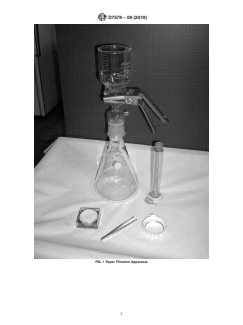
6. Apparatus (see Fig. 1) 9.2 Place a 400 mL beaker on the balance, and tare it.
9.3 Vigorously shake the sample by hand for a minimum of
6.1 Smooth-tip Forceps.
15 s.
6.2 Beaker, 400 mL.
9.4 Using a disposable pipette, weigh approximately 15 g of
6.3 Glass Stirring Rod.
pyrolysis liquid sample into the beaker. Record the weight to
6.4 Oven, explosion-proof, capable of maintaining a tem-
the nearest 0.1 mg.
perature of 105 °C 6 3 °C.
9.5 Add approximately 100 mL to 200 mL MeOH-DCM
6.5 Filtering Flask,1L.
solution (1:1) into the beaker and stir the mixture vigorously to
dissolve the pyrolysis liquid in the solvent.
6.6 Filter Holders, borosilicate glass.
9.6 Mount the filter on a dry holder and apply a vacuum.
6.7 Filter Membrane, binder free glass microfiber, 1 µm.
Mount and securely clamp the filter funnel to the filter holder.
6.8 Weighing Dish, aluminum.
9.7 Use methanol to wash the filter paper to properly seal
6.9 Balance, capable of weighing to the nearest 0.0001 g
the latter to the bottom of the funnel.
(0.1 mg) with a range of 300 g.
9.8 Filter the solution through the vacuum filter sy
...