

ASTM D5984-23
(Test Method)Standard Test Method for Semi-Quantitative Field Test Method for Base Number in New and Used Lubricants by Color-Indicator Titration
General Information
- Abstract
SIGNIFICANCE AND USE
5.1 New and used petroleum products can contain basic constituents that are present as additives or as degradation products formed during service. The amount of these additives in an oil can be determined by titrating against an acid. The base number is a measure of the amount of basic substance in the oil, always under the conditions of the test. A decrease in base number is often used as a measure of lubricant degradation, but any condemning limits must be empirically established.
5.2 This test method uses reagents that are considered less hazardous than most reagents used in alternate base number methods. It uses pre-packaged reagents to facilitate base number determinations in the field where scientific equipment is unavailable and quick results are at a premium.
Note 1: Results obtained by this test method3 are similar to those obtained by Test Method D2896.
SCOPE
1.1 This test method covers a procedure for determining the basic constituents in petroleum products in the field or laboratory using a pre-packaged test kit. The test uses a micro-titration resulting in a visual endpoint facilitated by a color indicator.
1.1.1 This test method covers base numbers from 0 to 20. It can be extended to higher ranges by diluting the sample or by using a smaller sample size; however, the precision data were obtained for base numbers up to 20.
1.2 This test method can be used to indicate relative changes that occur in an oil during use under oxidizing conditions. Although the test is performed under closely specified conditions with standardized reagents, the test method does not measure an absolute basic property that can be used to predict performance of an oil under service conditions. No general relationship between bearing corrosion and base number is known.
1.3 The values stated in SI units are to be regarded as the standard.
1.3.1 Exception—The values given in parentheses are for information only.
1.4 This standard does not purport to address all of the safety concerns, if any, associated with its use. It is the responsibility of the user of this standard to establish appropriate safety, health, and environmental practices and determine the applicability of regulatory limitations prior to use.
1.5 This international standard was developed in accordance with internationally recognized principles on standardization established in the Decision on Principles for the Development of International Standards, Guides and Recommendations issued by the World Trade Organization Technical Barriers to Trade (TBT) Committee.
- Status
- Published
- Publication Date
- 30-Jun-2023
- Technical Committee
- D02 - Petroleum Products, Liquid Fuels, and Lubricants
- Drafting Committee
- D02.06 - Analysis of Liquid Fuels and Lubricants
Buy Documents
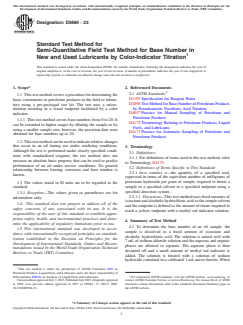
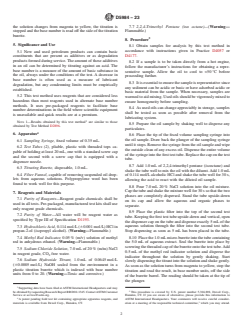


ASTM D5984-23 - Standard Test Method for Semi-Quantitative Field Test Method for Base Number in New and Used Lubricants by Color-Indicator Titration

REDLINE ASTM D5984-23 - Standard Test Method for Semi-Quantitative Field Test Method for Base Number in New and Used Lubricants by Color-Indicator Titration
Overview
ASTM D5984-23: Standard Test Method for Semi-Quantitative Field Test Method for Base Number in New and Used Lubricants by Color-Indicator Titration specifies a practical procedure for determining the basic constituents in both new and used petroleum-based lubricants. This semi-quantitative method employs a pre-packaged test kit, enabling effective field or laboratory analysis using color-indicator titration. Accurate measurement of the base number is crucial as it reflects the sum of basic additives and degradation products in an oil sample, commonly used to monitor lubricant health, particularly under oxidizing conditions.
Key Topics
- Base Number Determination: The base number, a critical indicator of a lubricant's reserve alkalinity, is determined by titration with acid. A decrease in base number can signal lubricant degradation and loss of protective properties.
- Semi-Quantitative Titration: This method utilizes micro-titration and a color change (magenta to yellow) with methyl red indicator to mark the titration endpoint, allowing rapid visual assessment of lubricant condition.
- Field-Ready Test Kit: The procedure employs a pre-packaged kit with less hazardous, reagent-grade chemicals, specifically designed for use outside laboratory environments. The kit covers a base number range from 0 to 20, suitable for most industrial and automotive lubricants.
- Safety and Standardization: Users must adhere to established safety, health, and environmental practices. This standard follows internationally recognized principles of standardization, ensuring consistency and compatibility worldwide.
Applications
ASTM D5984-23 is highly valued for its efficiency and simplicity in a wide range of practical applications, including:
- Field Analysis and Routine Monitoring: Especially useful where quick decision-making is required and laboratory resources are unavailable. Maintenance teams use this method to monitor lubricant health in vehicles, machinery, and industrial equipment.
- Lubricant Quality Control: Producers and service providers rely on this standardized test method to compare the base number of new and in-service lubricants, ensuring the additive package remains effective.
- Troubleshooting and Diagnostics: Used extensively in predictive maintenance programs, allowing operators to track base number trends and assess potential degradation, thereby minimizing the risk of equipment failure.
Related Standards
Effective lubricant testing often involves complementary methods and terminology. Relevant ASTM standards include:
- ASTM D2896: Test Method for Base Number of Petroleum Products by Potentiometric Perchloric Acid Titration. Results from D5984-23 are similar to those obtained by D2896, offering a useful reference or alternative.
- ASTM D4057 & D4177: Practices for manual and automatic sampling of petroleum and petroleum products, ensuring representative samples for accurate analysis.
- ASTM D1193: Specification for Reagent Water, dictating water quality requirements for testing.
- ASTM D4175: Terminology relating to petroleum products, liquid fuels, and lubricants.
Practical Value
Adopting ASTM D5984-23 helps organizations maintain optimal performance of lubricated machinery, optimize maintenance intervals, and avoid unplanned outages due to lube oil degradation. Its field-oriented approach enables prompt assessment, supporting on-the-spot decisions where time and resources are constrained. The standard's compatibility with international best practices also facilitates global consistency in lubricant analysis procedures.
Keywords: base number, lubricants, field test kit, color-indicator titration, lubricant degradation, ASTM D5984-23, petroleum products, oil analysis, maintenance, additive monitoring.
Relations
- Refers
ASTM D4175-23a - Standard Terminology Relating to Petroleum Products, Liquid Fuels, and Lubricants - Effective Date
- 15-Dec-2023
- Refers
ASTM D4175-23e1 - Standard Terminology Relating to Petroleum Products, Liquid Fuels, and Lubricants - Effective Date
- 01-Jul-2023
- Refers
ASTM D4057-06(2011) - Standard Practice for Manual Sampling of Petroleum and Petroleum Products - Effective Date
- 01-Jun-2011
- Effective Date
- 15-Jul-2007
- Effective Date
- 15-Jan-2007
- Effective Date
- 01-Mar-2006
- Effective Date
- 01-Jan-2006
- Effective Date
- 01-May-2005
- Effective Date
- 01-Nov-2003
- Effective Date
- 10-Nov-2001
- Effective Date
- 10-Nov-2001
- Refers
ASTM D4057-95(2000) - Standard Practice for Manual Sampling of Petroleum and Petroleum Products - Effective Date
- 10-Apr-2000
- Effective Date
- 10-Feb-1999
- Effective Date
- 10-Feb-1999
Buy Documents
ASTM D5984-23 - Standard Test Method for Semi-Quantitative Field Test Method for Base Number in New and Used Lubricants by Color-Indicator Titration
REDLINE ASTM D5984-23 - Standard Test Method for Semi-Quantitative Field Test Method for Base Number in New and Used Lubricants by Color-Indicator Titration
Get Certified
Connect with accredited certification bodies for this standard

ECOCERT
Organic and sustainability certification.

Eurofins Food Testing Global
Global leader in food, environment, and pharmaceutical product testing.

Intertek Bangladesh
Intertek certification and testing services in Bangladesh.
Sponsored listings
Frequently Asked Questions
ASTM D5984-23 is a standard published by ASTM International. Its full title is "Standard Test Method for Semi-Quantitative Field Test Method for Base Number in New and Used Lubricants by Color-Indicator Titration". This standard covers: SIGNIFICANCE AND USE 5.1 New and used petroleum products can contain basic constituents that are present as additives or as degradation products formed during service. The amount of these additives in an oil can be determined by titrating against an acid. The base number is a measure of the amount of basic substance in the oil, always under the conditions of the test. A decrease in base number is often used as a measure of lubricant degradation, but any condemning limits must be empirically established. 5.2 This test method uses reagents that are considered less hazardous than most reagents used in alternate base number methods. It uses pre-packaged reagents to facilitate base number determinations in the field where scientific equipment is unavailable and quick results are at a premium. Note 1: Results obtained by this test method3 are similar to those obtained by Test Method D2896. SCOPE 1.1 This test method covers a procedure for determining the basic constituents in petroleum products in the field or laboratory using a pre-packaged test kit. The test uses a micro-titration resulting in a visual endpoint facilitated by a color indicator. 1.1.1 This test method covers base numbers from 0 to 20. It can be extended to higher ranges by diluting the sample or by using a smaller sample size; however, the precision data were obtained for base numbers up to 20. 1.2 This test method can be used to indicate relative changes that occur in an oil during use under oxidizing conditions. Although the test is performed under closely specified conditions with standardized reagents, the test method does not measure an absolute basic property that can be used to predict performance of an oil under service conditions. No general relationship between bearing corrosion and base number is known. 1.3 The values stated in SI units are to be regarded as the standard. 1.3.1 Exception—The values given in parentheses are for information only. 1.4 This standard does not purport to address all of the safety concerns, if any, associated with its use. It is the responsibility of the user of this standard to establish appropriate safety, health, and environmental practices and determine the applicability of regulatory limitations prior to use. 1.5 This international standard was developed in accordance with internationally recognized principles on standardization established in the Decision on Principles for the Development of International Standards, Guides and Recommendations issued by the World Trade Organization Technical Barriers to Trade (TBT) Committee.
SIGNIFICANCE AND USE 5.1 New and used petroleum products can contain basic constituents that are present as additives or as degradation products formed during service. The amount of these additives in an oil can be determined by titrating against an acid. The base number is a measure of the amount of basic substance in the oil, always under the conditions of the test. A decrease in base number is often used as a measure of lubricant degradation, but any condemning limits must be empirically established. 5.2 This test method uses reagents that are considered less hazardous than most reagents used in alternate base number methods. It uses pre-packaged reagents to facilitate base number determinations in the field where scientific equipment is unavailable and quick results are at a premium. Note 1: Results obtained by this test method3 are similar to those obtained by Test Method D2896. SCOPE 1.1 This test method covers a procedure for determining the basic constituents in petroleum products in the field or laboratory using a pre-packaged test kit. The test uses a micro-titration resulting in a visual endpoint facilitated by a color indicator. 1.1.1 This test method covers base numbers from 0 to 20. It can be extended to higher ranges by diluting the sample or by using a smaller sample size; however, the precision data were obtained for base numbers up to 20. 1.2 This test method can be used to indicate relative changes that occur in an oil during use under oxidizing conditions. Although the test is performed under closely specified conditions with standardized reagents, the test method does not measure an absolute basic property that can be used to predict performance of an oil under service conditions. No general relationship between bearing corrosion and base number is known. 1.3 The values stated in SI units are to be regarded as the standard. 1.3.1 Exception—The values given in parentheses are for information only. 1.4 This standard does not purport to address all of the safety concerns, if any, associated with its use. It is the responsibility of the user of this standard to establish appropriate safety, health, and environmental practices and determine the applicability of regulatory limitations prior to use. 1.5 This international standard was developed in accordance with internationally recognized principles on standardization established in the Decision on Principles for the Development of International Standards, Guides and Recommendations issued by the World Trade Organization Technical Barriers to Trade (TBT) Committee.
ASTM D5984-23 is classified under the following ICS (International Classification for Standards) categories: 71.040.40 - Chemical analysis. The ICS classification helps identify the subject area and facilitates finding related standards.
ASTM D5984-23 has the following relationships with other standards: It is inter standard links to ASTM D4175-23a, ASTM D4175-23e1, ASTM D4057-06(2011), ASTM D2896-07a, ASTM D2896-07, ASTM D1193-06, ASTM D2896-06, ASTM D2896-05, ASTM D2896-03, ASTM D2896-01, ASTM D2896-01e1, ASTM D4057-95(2000), ASTM D1193-99, ASTM D1193-99e1. Understanding these relationships helps ensure you are using the most current and applicable version of the standard.
ASTM D5984-23 is available in PDF format for immediate download after purchase. The document can be added to your cart and obtained through the secure checkout process. Digital delivery ensures instant access to the complete standard document.
Standards Content (Sample)
This international standard was developed in accordance with internationally recognized principles on standardization established in the Decision on Principles for the
Development of International Standards, Guides and Recommendations issued by the World Trade Organization Technical Barriers to Trade (TBT) Committee.
Designation: D5984 − 23
Standard Test Method for
Semi-Quantitative Field Test Method for Base Number in
New and Used Lubricants by Color-Indicator Titration
This standard is issued under the fixed designation D5984; the number immediately following the designation indicates the year of
original adoption or, in the case of revision, the year of last revision. A number in parentheses indicates the year of last reapproval. A
superscript epsilon (´) indicates an editorial change since the last revision or reapproval.
1. Scope* 2. Referenced Documents
2.1 ASTM Standards:
1.1 This test method covers a procedure for determining the
D1193 Specification for Reagent Water
basic constituents in petroleum products in the field or labora-
D2896 Test Method for Base Number of Petroleum Products
tory using a pre-packaged test kit. The test uses a micro-
by Potentiometric Perchloric Acid Titration
titration resulting in a visual endpoint facilitated by a color
D4057 Practice for Manual Sampling of Petroleum and
indicator.
Petroleum Products
1.1.1 This test method covers base numbers from 0 to 20. It
D4175 Terminology Relating to Petroleum Products, Liquid
can be extended to higher ranges by diluting the sample or by
Fuels, and Lubricants
using a smaller sample size; however, the precision data were
D4177 Practice for Automatic Sampling of Petroleum and
obtained for base numbers up to 20.
Petroleum Products
1.2 This test method can be used to indicate relative changes
that occur in an oil during use under oxidizing conditions.
3. Terminology
Although the test is performed under closely specified condi-
3.1 Definitions:
tions with standardized reagents, the test method does not
3.1.1 For definitions of terms used in this test method, refer
measure an absolute basic property that can be used to predict
to Terminology D4175.
performance of an oil under service conditions. No general
3.2 Definitions of Terms Specific to This Standard:
relationship between bearing corrosion and base number is
3.2.1 base number, n—the quantity of a specified acid,
known.
expressed in terms of the equivalent number of milligrams of
potassium hydroxide per gram of sample, required to titrate a
1.3 The values stated in SI units are to be regarded as the
sample in a specified solvent to a specified endpoint using a
standard.
specified detection system.
1.3.1 Exception—The values given in parentheses are for
3.2.1.1 Discussion—This test method uses fixed amounts of
information only.
isooctane and alcoholic hydrochloric acid as the sample solvent
1.4 This standard does not purport to address all of the
and the endpoint is defined as the amount of titrant required to
safety concerns, if any, associated with its use. It is the
reach a yellow endpoint with a methyl red indicator solution.
responsibility of the user of this standard to establish appro-
priate safety, health, and environmental practices and deter-
4. Summary of Test Method
mine the applicability of regulatory limitations prior to use.
4.1 To determine the base number of an oil sample, the
1.5 This international standard was developed in accor-
sample is dissolved in a fixed amount of isooctane and
dance with internationally recognized principles on standard-
alcoholic hydrochloric acid. The solution is mixed well with
ization established in the Decision on Principles for the
7 mL of sodium chloride solution and the aqueous and organic
Development of International Standards, Guides and Recom-
phases are allowed to separate. The aqueous phase is then
mendations issued by the World Trade Organization Technical
decanted off and a small amount of methyl red indicator is
Barriers to Trade (TBT) Committee.
added. The solution is titrated with a solution of sodium
hydroxide contained in a calibrated 1 mL micro-burette. When
This test method is under the jurisdiction of ASTM Committee D02 on
Petroleum Products, Liquid Fuels, and Lubricants and is the direct responsibility of
Subcommittee D02.06 on Analysis of Liquid Fuels and Lubricants. For referenced ASTM standards, visit the ASTM website, www.astm.org, or
Current edition approved July 1, 2023. Published July 2023. Originally approved contact ASTM Customer Service at service@astm.org. For Annual Book of ASTM
in 1996. Last previous edition approved in 2017 as D5984 – 11 (2017). DOI: Standards volume information, refer to the standard’s Document Summary page on
10.1520/D5984-23. the ASTM website.
*A Summary of Changes section appears at the end of this standard
Copyright © ASTM International, 100 Barr Harbor Drive, PO Box C700, West Conshohocken, PA 19428-2959. United States
D5984 − 23
the solution changes from magenta to yellow, the titration is 7.7 2,2,4-Trimethyl Pentane (iso octane)—(Warning—
stopped and the base number is read off the side of the titration Flammable.)
burette.
8. Procedure
5. Significance and Use
8.1 Obtain samples for analysis by this test method in
accordance with instructions given in Practice D4057 or
5.1 New and used petroleum products can contain basic
D4177.
constituents that are present as additives or as degradation
products formed during service. The amount of these additives
8.2 If a sample is to be taken directly from a hot engine,
in an oil can be determined by titrating against an acid. The
follow the manufacturer’s instructions for obtaining a repre-
base number is a measure of the amount of basic substance in
sentative sample. Allow the oil to cool to <50 °C before
the oil, always under the conditions of the test. A decrease in
proceeding further.
base number is often used as a measure of lubricant
8.3 It is essential to ensure the sample is representative since
degradation, but any condemning limits must be empirically
any sediment can be acidic or basic or have adsorbed acidic or
established.
basic material from the sample. When necessary, samples are
5.2 This test method uses reagents that are considered less
warmed to aid mixing. Used oils should be vigorously mixed to
hazardous than most reagents used in alternate base number
ensure homogeneity before sampling.
methods. It uses pre-packaged reagents to facilitate base
8.4 As used oils can change appreciably in storage, samples
number determinations in the field where scientific equipment
shall be tested as soon as possible after removal from the
is unavailable and quick results are at a premium.
lubricating system.
NOTE 1—Results obtained by this test method are similar to
...
This document is not an ASTM standard and is intended only to provide the user of an ASTM standard an indication of what changes have been made to the previous version. Because
it may not be technically possible to adequately depict all changes accurately, ASTM recommends that users consult prior editions as appropriate. In all cases only the current version
of the standard as published by ASTM is to be considered the official document.
Designation: D5984 − 11 (Reapproved 2017) D5984 − 23
Standard Test Method for
Semi-Quantitative Field Test Method for Base Number in
New and Used Lubricants by Color-Indicator Titration
This standard is issued under the fixed designation D5984; the number immediately following the designation indicates the year of
original adoption or, in the case of revision, the year of last revision. A number in parentheses indicates the year of last reapproval. A
superscript epsilon (´) indicates an editorial change since the last revision or reapproval.
1. Scope Scope*
1.1 This test method covers a procedure for determining the basic constituents in petroleum products in the field or laboratory
using a pre-packaged test kit. The test uses a micro-titration resulting in a visual endpoint facilitated by a color indicator.
1.1.1 This test method covers base numbers from 0 to 20. It can be extended to higher ranges by diluting the sample or by using
a smaller sample size; however, the precision data were obtained for base numbers up to 20.
1.2 This test method can be used to indicate relative changes that occur in an oil during use under oxidizing conditions. Although
the test is performed under closely specified conditions with standardized reagents, the test method does not measure an absolute
basic property that can be used to predict performance of an oil under service conditions. No general relationship between bearing
corrosion and base number is known.
1.3 The values stated in SI units are to be regarded as the standard.
1.3.1 Exception—The values given in parentheses are for information only.
1.4 This standard does not purport to address all of the safety concerns, if any, associated with its use. It is the responsibility
of the user of this standard to establish appropriate safety and healthsafety, health, and environmental practices and determine
the applicability of regulatory limitations prior to use.
1.5 This international standard was developed in accordance with internationally recognized principles on standardization
established in the Decision on Principles for the Development of International Standards, Guides and Recommendations issued
by the World Trade Organization Technical Barriers to Trade (TBT) Committee.
2. Referenced Documents
2.1 ASTM Standards:
D1193 Specification for Reagent Water
D2896 Test Method for Base Number of Petroleum Products by Potentiometric Perchloric Acid Titration
D4057 Practice for Manual Sampling of Petroleum and Petroleum Products
D4175 Terminology Relating to Petroleum Products, Liquid Fuels, and Lubricants
D4177 Practice for Automatic Sampling of Petroleum and Petroleum Products
This test method is under the jurisdiction of ASTM Committee D02 on Petroleum Products, Liquid Fuels, and Lubricants and is the direct responsibility of Subcommittee
D02.06 on Analysis of Liquid Fuels and Lubricants.
Current edition approved May 1, 2017July 1, 2023. Published July 2017July 2023. Originally approved in 1996. Last previous edition approved in 20112017 as
D5984 – 11.D5984 – 11 (2017). DOI: 10.1520/D5984-11R17.10.1520/D5984-23.
For referenced ASTM standards, visit the ASTM website, www.astm.org, or contact ASTM Customer Service at service@astm.org. For Annual Book of ASTM Standards
volume information, refer to the standard’s Document Summary page on the ASTM website.
*A Summary of Changes section appears at the end of this standard
Copyright © ASTM International, 100 Barr Harbor Drive, PO Box C700, West Conshohocken, PA 19428-2959. United States
D5984 − 23
3. Terminology
3.1 Definitions:
3.1.1 For definitions of terms used in this test method, refer to Terminology D4175.
3.2 Definitions:Definitions of Terms Specific to This Standard:
3.2.1 base number, n—the quantity of a specified acid, expressed in terms of the equivalent number of milligrams of potassium
hydroxide per gram of sample, required to titrate a sample in a specified solvent to a specified endpoint using a specified detection
system.
3.2.1.1 Discussion—
This test method uses fixed amounts of isooctane and alcoholic hydrochloric acid as the sample solvent and the endpoint is defined
as the amount of titrant required to reach a yellow endpoint with a methyl red indicator solution.
4. Summary of Test Method
4.1 To determine the base number of an oil sample, the sample is dissolved in a fixed amount of isooctane and alcoholic
hydrochloric acid. The solution is mixed well with 7 mL of sodium chloride solution and the aqueous and organic phases are
allowed to separate. The aqueous phase is then decanted off and a small amount of methyl red indicator is added. The solution is
titrated with a solution of sodium hydroxide contained in a calibrated 1 mL micro-burette. When the solution changes from
magenta to yellow, the titration is stopped and the base number is read off the side of the titration burette.
5. Significance and Use
5.1 New and used petroleum products can contain basic constituents that are present as additives or as degradation products
formed during service. The amount of these additives in an oil can be determined by titrating against an acid. The base number
is a measure of the amount of basic substance in the oil, always under the conditions of the test. A decrease in base number is often
used as a measure of lubricant degradation, but any condemning limits must be empirically established.
5.2 This test method uses reagents that are considered less hazardous than most reagents used in alternate base number methods.
It uses pre-packaged reagents to facilitate base number determinations in the field where scientific equipment is unavailable and
quick results are at a premium.
NOTE 1—Results obtained by this test method are similar to those obtained by Test Method D2896.
6. Apparatus
6.1 Sampling Syringe, fixed volume of 0.35 mL.
6.2 Test Tubes (2), pliable, plastic with threaded tops capable of holding at least 20 mL, one with a standard screw cap and the
second with a screw cap that is equipped with a dispenser nozzle.
6.3 Titrating Burette, disposable, 1.0 mL.
6.4 Filter Funnel, capable of removing suspended oil droplets from aqueous solutions. Polypropylene wool has been found to
work well for this purpose.
7. Reagents and Materials
7.1 Purity of Reagents—Reagent grade chemicals shall be used in all tests. Pre-packaged, manufactured test kits shall use only
reagent grade chemicals.
7.2 Purity of Water—All water will be reagent water as specified by Ty
...