

ASTM D1636-21
(Specification)Standard Specification for Allyl Molding Compounds
General Information
- Abstract
ABSTRACT
This specification provides for the identification of three types of allyl molding compounds, based on the general type of filler employed in their manufacture: Type I - High-strength materials, glass-fiber reinforced; Type II - General-purpose mineral filled; and Type III - General-purpose synthetic fiber filler. Types I and II may be subdivided into four classes according to resin composition and use as follows: Class A - Diallyl ortho-phthalate resin, nonflame-retardant; Class B - Diallyl ortho-phthalate resin, flame-retardant; Class C - Diallyl meta-phthalate resin nonflame-retardant; and Class D - Diallyl meta-phthalate resin, flame-retardant. Materials shall be compression molded, conditioned, and tested; and the individual grades shall conform to specified values of impact resistance, flexural strength, permittivity and dissipation factor, insulation resistance, flame resistance, and oxygen index.
SCOPE
1.1 This specification covers compression molding, thermosetting, allyl compounds as further defined in Section 4.
1.2 The values stated in SI units are to be regarded as standard. No other units of measurement are included in this standard.
Note 1: The properties included in this specification are those required to identify the molding compounds covered. There may be other requirements necessary to identify particular characteristics. These will be added to the specification as their inclusion becomes generally desirable and the necessary test data and methods become available.
Note 2: There is no known ISO equivalent to this standard.
1.3 This international standard was developed in accordance with internationally recognized principles on standardization established in the Decision on Principles for the Development of International Standards, Guides and Recommendations issued by the World Trade Organization Technical Barriers to Trade (TBT) Committee.
- Status
- Published
- Publication Date
- 30-Jun-2021
- Technical Committee
- D20 - Plastics
- Drafting Committee
- D20.16 - Thermosetting Materials


Overview
ASTM D1636-21: Standard Specification for Allyl Molding Compounds establishes comprehensive requirements for the classification, testing, and performance evaluation of compression-molded thermosetting allyl compounds. Published by ASTM International, this specification is intended to standardize the identification of three major types of allyl molding compounds used across industries, based on their filler materials and resin types. These materials play a crucial role in electrical insulation, flame resistance, and mechanical performance, making the standard critical for manufacturers, suppliers, and end-users of molded plastic components.
Key Topics
Types and Classes of Allyl Molding Compounds:
- Type I: High-strength, glass-fiber reinforced compounds, divided into Classes A-D based on the resin type and flame-retardant properties.
- Type II: General-purpose, mineral-filled molding compounds, also classified as Classes A-D.
- Type III: General-purpose, synthetic fiber-filled compounds, available only in Class A.
Class and Grade System:
- Classes reflect resin composition (diallyl ortho-phthalate or diallyl meta-phthalate) and whether the compound is flame-retardant or not.
- Grades further specify reinforcement or filler details, such as fiber length or filler type.
Material Requirements:
- Uniform composition is required, with the majority of the resin content being diallyl ortho-phthalate or diallyl meta-phthalate.
- Physical properties, color, and form are determined through agreement between supplier and purchaser.
Testing and Compliance:
- Properties measured include impact resistance, flexural strength, permittivity, dissipation factor, insulation resistance, flame resistance, and oxygen index.
- Standardized test methods and conditioning procedures ensure reproducible and reliable results.
Applications
Allyl molding compounds specified under ASTM D1636-21 are widely used in diverse industrial and commercial sectors due to their robust mechanical, electrical, and flame-resistant properties. Key applications include:
- Electrical Industry: Ideal for manufacturing parts requiring high dielectric strength and insulation, such as connectors, switches, and circuit breakers.
- Automotive: Used in components where both high strength and electrical insulation are vital, including motor housings and electronic modules.
- Aerospace and Defense: Deployed in advanced applications that demand lightweight, strong, and reliable insulating materials.
- Consumer Electronics: Essential for producing high-performance insulated enclosures and parts exposed to elevated temperatures or requiring flame resistance.
- Industrial Equipment: Utilized in panels, housings, and insulation barriers for high-voltage equipment.
The standard’s clear classification and testing procedures help manufacturers ensure reliable quality and performance, while giving end-users assurance of material suitability for demanding environments.
Related Standards
The following ASTM standards are often referenced alongside ASTM D1636-21 for allyl molding compounds:
- ASTM D150 - Test Methods for AC Loss Characteristics and Permittivity of Solid Electrical Insulation
- ASTM D229 - Test Methods for Rigid Sheet and Plate Materials Used for Electrical Insulation
- ASTM D256 - Test Methods for Determining the Izod Impact Resistance of Plastics
- ASTM D257 - Test Methods for DC Resistance or Conductance of Insulating Materials
- ASTM D618 - Conditioning Plastics for Testing
- ASTM D790 - Flexural Properties of Unreinforced and Reinforced Plastics
- ASTM D883 - Terminology Relating to Plastics
- ASTM D2863 - Oxygen Index for Measuring Candle-Like Combustion of Plastics
- ASTM D3892 - Packaging and Packing of Plastics
- ASTM D5224 - Compression Molding Test Specimens of Thermosetting Molding Compounds
By adhering to ASTM D1636-21 and its related standards, organizations ensure consistent quality, interoperability, and regulatory compliance for compression-molded allyl compounds used in critical applications.
Keywords: allyl molding compounds, ASTM D1636-21, thermosetting plastics, flame resistance, electrical insulation, diallyl phthalate, compression molding, industry standard.
Relations
- Effective Date
- 01-Feb-2024
- Effective Date
- 01-Nov-2023
- Effective Date
- 01-Oct-2023
- Effective Date
- 29-Sep-2023
- Effective Date
- 01-Jan-2020
- Effective Date
- 01-Oct-2019
- Effective Date
- 01-Aug-2019
- Effective Date
- 01-May-2019
- Effective Date
- 15-Apr-2019
- Effective Date
- 01-Mar-2019
- Effective Date
- 01-Feb-2019
- Effective Date
- 01-Dec-2018
- Effective Date
- 01-Nov-2018
- Effective Date
- 01-Dec-2017
- Effective Date
- 15-Aug-2017
Get Certified
Connect with accredited certification bodies for this standard

DIN CERTCO
DIN Group product certification.

Smithers Quality Assessments
US management systems and product certification.
Sponsored listings
Frequently Asked Questions
ASTM D1636-21 is a technical specification published by ASTM International. Its full title is "Standard Specification for Allyl Molding Compounds". This standard covers: ABSTRACT This specification provides for the identification of three types of allyl molding compounds, based on the general type of filler employed in their manufacture: Type I - High-strength materials, glass-fiber reinforced; Type II - General-purpose mineral filled; and Type III - General-purpose synthetic fiber filler. Types I and II may be subdivided into four classes according to resin composition and use as follows: Class A - Diallyl ortho-phthalate resin, nonflame-retardant; Class B - Diallyl ortho-phthalate resin, flame-retardant; Class C - Diallyl meta-phthalate resin nonflame-retardant; and Class D - Diallyl meta-phthalate resin, flame-retardant. Materials shall be compression molded, conditioned, and tested; and the individual grades shall conform to specified values of impact resistance, flexural strength, permittivity and dissipation factor, insulation resistance, flame resistance, and oxygen index. SCOPE 1.1 This specification covers compression molding, thermosetting, allyl compounds as further defined in Section 4. 1.2 The values stated in SI units are to be regarded as standard. No other units of measurement are included in this standard. Note 1: The properties included in this specification are those required to identify the molding compounds covered. There may be other requirements necessary to identify particular characteristics. These will be added to the specification as their inclusion becomes generally desirable and the necessary test data and methods become available. Note 2: There is no known ISO equivalent to this standard. 1.3 This international standard was developed in accordance with internationally recognized principles on standardization established in the Decision on Principles for the Development of International Standards, Guides and Recommendations issued by the World Trade Organization Technical Barriers to Trade (TBT) Committee.
ABSTRACT This specification provides for the identification of three types of allyl molding compounds, based on the general type of filler employed in their manufacture: Type I - High-strength materials, glass-fiber reinforced; Type II - General-purpose mineral filled; and Type III - General-purpose synthetic fiber filler. Types I and II may be subdivided into four classes according to resin composition and use as follows: Class A - Diallyl ortho-phthalate resin, nonflame-retardant; Class B - Diallyl ortho-phthalate resin, flame-retardant; Class C - Diallyl meta-phthalate resin nonflame-retardant; and Class D - Diallyl meta-phthalate resin, flame-retardant. Materials shall be compression molded, conditioned, and tested; and the individual grades shall conform to specified values of impact resistance, flexural strength, permittivity and dissipation factor, insulation resistance, flame resistance, and oxygen index. SCOPE 1.1 This specification covers compression molding, thermosetting, allyl compounds as further defined in Section 4. 1.2 The values stated in SI units are to be regarded as standard. No other units of measurement are included in this standard. Note 1: The properties included in this specification are those required to identify the molding compounds covered. There may be other requirements necessary to identify particular characteristics. These will be added to the specification as their inclusion becomes generally desirable and the necessary test data and methods become available. Note 2: There is no known ISO equivalent to this standard. 1.3 This international standard was developed in accordance with internationally recognized principles on standardization established in the Decision on Principles for the Development of International Standards, Guides and Recommendations issued by the World Trade Organization Technical Barriers to Trade (TBT) Committee.
ASTM D1636-21 is classified under the following ICS (International Classification for Standards) categories: 83.140.99 - Other rubber and plastics products. The ICS classification helps identify the subject area and facilitates finding related standards.
ASTM D1636-21 has the following relationships with other standards: It is inter standard links to ASTM D883-24, ASTM D883-23, ASTM D2863-23, ASTM D2863-95, ASTM D883-20, ASTM D2863-19, ASTM D883-19c, ASTM D5224-12(2019), ASTM D883-19a, ASTM D229-19, ASTM D883-19, ASTM D883-18a, ASTM D883-18, ASTM D2863-17a, ASTM D883-17. Understanding these relationships helps ensure you are using the most current and applicable version of the standard.
ASTM D1636-21 is available in PDF format for immediate download after purchase. The document can be added to your cart and obtained through the secure checkout process. Digital delivery ensures instant access to the complete standard document.
Standards Content (Sample)
This international standard was developed in accordance with internationally recognized principles on standardization established in the Decision on Principles for the
Development of International Standards, Guides and Recommendations issued by the World Trade Organization Technical Barriers to Trade (TBT) Committee.
Designation:D1636 −21
Standard Specification for
Allyl Molding Compounds
This standard is issued under the fixed designation D1636; the number immediately following the designation indicates the year of
original adoption or, in the case of revision, the year of last revision. A number in parentheses indicates the year of last reapproval. A
superscript epsilon (´) indicates an editorial change since the last revision or reapproval.
1. Scope* D2863 Test Method for Measuring the Minimum Oxygen
Concentration to Support Candle-Like Combustion of
1.1 This specification covers compression molding,
Plastics (Oxygen Index)
thermosetting, allyl compounds as further defined in Section 4.
D3892 Practice for Packaging/Packing of Plastics
1.2 The values stated in SI units are to be regarded as
D5224 PracticeforCompressionMoldingTestSpecimensof
standard. No other units of measurement are included in this
Thermosetting Molding Compounds
standard.
3. Terminology
NOTE1—Thepropertiesincludedinthisspecificationarethoserequired
to identify the molding compounds covered. There may be other require-
3.1 Definitions—Definitions of terms used in this specifica-
ments necessary to identify particular characteristics. These will be added
tion are in accordance with Terminology D883.
to the specification as their inclusion becomes generally desirable and the
necessary test data and methods become available.
NOTE 2—There is no known ISO equivalent to this standard. 4. Classification
1.3 This international standard was developed in accor-
4.1 This specification provides for the identification of three
dance with internationally recognized principles on standard-
typesofallylmoldingcompounds,basedonthegeneraltypeof
ization established in the Decision on Principles for the
filler employed in their manufacture, which shall be distin-
Development of International Standards, Guides and Recom-
guished by the requirements prescribed in Table 1.
mendations issued by the World Trade Organization Technical
Type I—High-strength materials, glass-fiber reinforced.
Barriers to Trade (TBT) Committee.
Type II—General-purpose mineral filled.
Type III—General-purpose synthetic fiber filler.
2. Referenced Documents
4.2 Types I and II may be subdivided into four classes
2.1 ASTM Standards:
according to resin composition and use as follows:
D150 Test Methods forAC Loss Characteristics and Permit-
Class A—Diallyl ortho-phthalate resin, nonflame-retardant.
tivity (Dielectric Constant) of Solid Electrical Insulation
Class B—Diallyl ortho-phthalate resin, flame-retardant.
D229 Test Methods for Rigid Sheet and Plate Materials
Class C—Diallyl meta-phthalate resin nonflame-retardant.
Used for Electrical Insulation
Class D—Diallyl meta-phthalate resin, flame-retardant.
D256 Test Methods for Determining the Izod Pendulum
4.3 The four classes of Type I are subdivided as follows:
Impact Resistance of Plastics
ClassesA, B, C, and D into four grades. ForType II each of the
D257 Test Methods for DC Resistance or Conductance of
four classes is subdivided into two grades. For Type III only
Insulating Materials
Class A compounds are produced and are available in three
D618 Practice for Conditioning Plastics for Testing
grades.
D790 Test Methods for Flexural Properties of Unreinforced
and Reinforced Plastics and Electrical Insulating Materi-
5. General Requirements
als
D883 Terminology Relating to Plastics
5.1 Themoldingcompoundshallbeofuniformcomposition
and so compounded as to conform to the requirements of this
specification.
This specification is under the jurisdiction of ASTM Committee D20 on
5.2 Although other than allyl resin may be added for flame
Plastics and is the direct responsibility of Subcommittee D20.16 on Thermosetting
Materials.
resistance and other purposes, the major part of the resin
Current edition approved July 1, 2021. Published August 2021. Originally
portion shall be diallyl ortho-phthalate or diallyl meta-
approved in 1959. Last previous edition approved in 2013 as D1636 - 13. DOI:
phthalate.
10.1520/D1636-21.
For referenced ASTM standards, visit the ASTM website, www.astm.org, or
5.3 The apparent density, bulk factor, particle size, physical
contact ASTM Customer Service at service@astm.org. For Annual Book of ASTM
form, and color of the compounds shall be as agreed upon
Standards volume information, refer to the standard’s Document Summary page on
the ASTM website. between the purchaser and supplier.
*A Summary of Changes section appears at the end of this standard
Copyright © ASTM International, 100 Barr Harbor Drive, PO Box C700, West Conshohocken, PA 19428-2959. United States
D1636−21
TABLE 1 Types, Classes, and Grades of Allyl Molding
9.2 Tests shall be conducted in the standard laboratory
Compounds
atmosphere of 23 6 2°C and 50 6 10 % relative humidity,
Type Class Grade Description
unless otherwise specified in the test methods or in this
I A, B, C, D 1 Long-glass fiber reinforcement
specification.
2 Medium-glass fiber reinforcement
3 Short-glass fiber reinforcement
10. Test Methods
II A, B, C, D 4 High-impact, long-glass fiber reinforcement
10.1 The properties enumerated in this specification shall be
III A 1 Mineral-filled
determined in accordance with the following methods:
2 Mineral and organic fiber-filled
10.2 Impact Resistance (Izod)—Test Method D256, Method
1 Acrylic fiber reinforcement, short fiber
2 Polyester fiber reinforcement, long fiber A. Test specimens shall be 12.7 by 12.7 by 63.5 mm.
3 Polyester fiber reinforcement, milled fiber
10.3 Flexural Strength—Test Methods D790 Procedure A.
Test specimens shall be 6.4 by 12.7 by 127-mm bars tested
parallel to molding pressure.
10.4 Permittivity and Dissipation Factor—Test Methods
6. Detail Requirements
D150. Measure the permittivity and dissipation factor at 1 kHz
6.1 Average results obtained on test specimens, each
and 1 MHz after conditioning by Procedure B of Practice
compression-molded using the manufacturer’s recommended
D618. Determine permittivity and dissipation factor after
techniques, shall conform to the requirements listed in Table 2.
conditioning 48 h at 50°C followed by Procedure D of Practice
D618.Use102by3.2-mmdisksfor1kHzfrequencyand51by
7. Sampling
3.2-mm disks for 1 MHz frequency.
7.1 Adequate statistical sampling shall be used.
10.5 Insulation Resistance—Test Methods D257, using a
7.2 Abatch of molding compound shall be considered a unit 3.2-mm thick by 102-mm diameter disk fitted with binding
post electrodes of the type shown in the figure illustrating
of manufacture and may consist of a blend of two
...
This document is not an ASTM standard and is intended only to provide the user of an ASTM standard an indication of what changes have been made to the previous version. Because
it may not be technically possible to adequately depict all changes accurately, ASTM recommends that users consult prior editions as appropriate. In all cases only the current version
of the standard as published by ASTM is to be considered the official document.
Designation: D1636 − 13 D1636 − 21
Standard Specification for
Allyl Molding Compounds
This standard is issued under the fixed designation D1636; the number immediately following the designation indicates the year of
original adoption or, in the case of revision, the year of last revision. A number in parentheses indicates the year of last reapproval. A
superscript epsilon (´) indicates an editorial change since the last revision or reapproval.
1. Scope*
1.1 This specification covers compression molding, thermosetting, allyl compounds as further defined in Section 34.
1.2 The values stated in SI units are to be regarded as standard. No other units of measurement are included in this standard.
NOTE 1—The properties included in this specification are those required to identify the molding compounds covered. There may be other requirements
necessary to identify particular characteristics. These will be added to the specification as their inclusion becomes generally desirable and the necessary
test data and methods become available.
NOTE 2—There is no known ISO equivalent to this standard.
NOTE 2—There is no known ISO equivalent to this standard.
1.3 This international standard was developed in accordance with internationally recognized principles on standardization
established in the Decision on Principles for the Development of International Standards, Guides and Recommendations issued
by the World Trade Organization Technical Barriers to Trade (TBT) Committee.
2. Referenced Documents
2.1 ASTM Standards:
D150 Test Methods for AC Loss Characteristics and Permittivity (Dielectric Constant) of Solid Electrical Insulation
D229 Test Methods for Rigid Sheet and Plate Materials Used for Electrical Insulation
D256 Test Methods for Determining the Izod Pendulum Impact Resistance of Plastics
D257 Test Methods for DC Resistance or Conductance of Insulating Materials
D618 Practice for Conditioning Plastics for Testing
D790 Test Methods for Flexural Properties of Unreinforced and Reinforced Plastics and Electrical Insulating Materials
D883 Terminology Relating to Plastics
D2863 Test Method for Measuring the Minimum Oxygen Concentration to Support Candle-Like Combustion of Plastics
(Oxygen Index)
D3892 Practice for Packaging/Packing of Plastics
D5224 Practice for Compression Molding Test Specimens of Thermosetting Molding Compounds
3. Terminology
3.1 Definitions—Definitions of terms used in this specification are in accordance with Terminology D883.
This specification is under the jurisdiction of ASTM Committee D20 on Plastics and is the direct responsibility of Subcommittee D20.16 on Thermosetting Materials.
Current edition approved Oct. 1, 2013July 1, 2021. Published October 2013August 2021. Originally approved in 1959. Last previous edition approved in 20122013 as
D1636 - 99D1636 - 13.(2012). DOI: 10.1520/D1636-13.10.1520/D1636-21.
For referenced ASTM standards, visit the ASTM website, www.astm.org, or contact ASTM Customer Service at service@astm.org. For Annual Book of ASTM Standards
volume information, refer to the standard’s Document Summary page on the ASTM website.
*A Summary of Changes section appears at the end of this standard
Copyright © ASTM International, 100 Barr Harbor Drive, PO Box C700, West Conshohocken, PA 19428-2959. United States
D1636 − 21
4. Classification
4.1 This specification provides for the identification of three types of allyl molding compounds, based on the general type of filler
employed in their manufacture, which shall be distinguished by the requirements prescribed in Table 1.
Type I—High-strength materials, glass-fiber reinforced.
Type II—General-purpose mineral filled.
Type III—General-purpose synthetic fiber filler.
4.2 Types I and II may be subdivided into four classes according to resin composition and use as follows:
Class A—Diallyl ortho-phthalate resin, nonflame-retardant.
Class B—Diallyl ortho-phthalate resin, flame-retardant.
Class C—Diallyl meta-phthalate resin nonflame-retardant.
Class D—Diallyl meta-phthalate resin, flame-retardant.
4.3 The four classes of Type I are subdivided as follows: Classes A, B, C, and D into four grades. For Type II each of the four
classes is subdivided into two grades. For Type III only Class A compounds are produced and are available in three grades.
5. General Requirements
5.1 The molding compound shall be of uniform composition and so compounded as to conform to the requirements of this
specification.
5.2 Although other than allyl resin may be added for flame resistance and other purposes, the major part of the resin portion shall
be diallyl ortho-phthalate or diallyl meta-phthalate.
5.3 The apparent density, bulk factor, particle size, physical form, and color of the compounds shall be as agreed upon between
the purchaser and supplier.
6. Detail Requirements
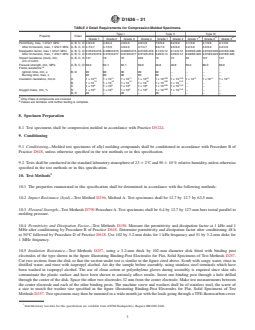
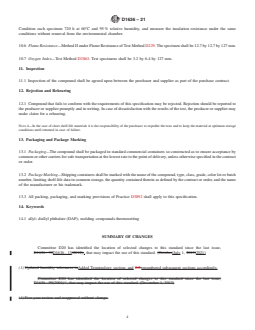
6.1 Average results obtained on test specimens, each compression-molded using the manufacturer’s recommended techniques,
shall conform to the requirements listed in Table 2.
7. Sampling
7.1 Adequate statistical sampling shall be used.
7.2 A batch of molding compound shall be considered a unit of manufacture and may consist of a blend of two or more production
runs of the same material.
NOTE 3—Some molding compounds are light and fluffy. The resin may have a tendency to separate out to a degree and should be thoroughly mixed before
sampling.
TABLE 1 Types, Classes, and Grades of Allyl Molding
Compounds
Type Class Grade Description
I A, B, C, D 1 Long-glass fiber reinforcement
2 Medium-glass fiber reinforcement
3 Short-glass fiber reinforcement
II A, B, C, D 4 High-impact, long-glass fiber reinforcement
III A 1 Mineral-filled
2 Mineral and organic fiber-filled
1 Acrylic fiber reinforcement, short fiber
2 Polyester fiber reinforcement, long fiber
3 Polyester fiber reinforcement, milled fiber
D1636 − 21
TABLE 2 Detail Requirements for Compression-Molded Specimens
Type I Type II Type III
Property Class
A A A
Grade 1 Grade 2 Grade 3 Grade 4 Grade 1 Grade 2 Grade 1 Grade 2 Grade 3
Permittivity, max, 1 kHz/1 MHz A, B, C, D 4.6/4.6 4.6/4.4 4.6/4.5 4.6/4.6 7.0/6.0 8.2/6.0 4.1/3.8 4.1/3.8 4.1/3.8
After immersion, max, 1 kHz/1 MHz A, B, C, D 4.7/4.7 4.7/4.5 4.6/4.5 4.7/4.7 8.0/7.0 9.5/6.0 4.2/3.9 4.2/3.9 4.2/3.9
Dissipation factor, max 1 kHz/1 MHz A, B, C, D 0.010/0.018 0.009/0.015 0.009/0.015 0.010/0.018 0.14/0.12 0.14/0.12 0.025/0.020 0.016/0.020 0.016/0.020
After immersion, max, 1 kHz/1 MHz A, B, C, D 0.012/0.019 0.013/0.017 0.013/0.017 0.012/0.019 0.20/0.14 0.20/0.14 0.028/0.023 0.018/0.023 0.018/0.023
Impact resistance (Izod), min, A, B, C, D 147 16 16 320 15 15 32 147 147
J/m of notch
Flexural strength, min, MPa A, B, C, D 69.0 62.1 62.1 69.0 46.8 46.8 55.2 69.0 69.0
B
Flame resistance:
Ignition time, min, s B, D 90 90 90 90 90 . . . .
...