

ASTM D2893-19
(Test Method)Standard Test Methods for Oxidation Characteristics of Extreme-Pressure Lubrication Oils
General Information
- Abstract
SIGNIFICANCE AND USE
4.1 These test methods have been widely used to measure the oxidation stability of extreme pressure lubricating fluids, gear oils, and mineral oils.
SCOPE
1.1 These test methods (A and B) cover the determination of the oxidation characteristics of extreme-pressure fluid lubricants, gear oils, or mineral oils.
Note 1: The changes in the lubricant resulting from these test methods are not always necessarily associated with oxidation of the lubricant. Some changes may be due to thermal degradation.
1.2 The values stated in SI units are to be regarded as standard. No other units of measurement are included in this standard.
1.3 This standard does not purport to address all of the safety concerns, if any, associated with its use. It is the responsibility of the user of this standard to establish appropriate safety, health, and environmental practices and determine the applicability of regulatory limitations prior to use.
1.4 This international standard was developed in accordance with internationally recognized principles on standardization established in the Decision on Principles for the Development of International Standards, Guides and Recommendations issued by the World Trade Organization Technical Barriers to Trade (TBT) Committee.
- Status
- Published
- Publication Date
- 30-Nov-2019
- Technical Committee
- D02 - Petroleum Products, Liquid Fuels, and Lubricants
- Drafting Committee
- D02.09.0D - Oxidation of Lubricants
Buy Documents

ASTM D2893-19 - Standard Test Methods for Oxidation Characteristics of Extreme-Pressure Lubrication Oils

REDLINE ASTM D2893-19 - Standard Test Methods for Oxidation Characteristics of Extreme-Pressure Lubrication Oils
Overview
ASTM D2893-19: Standard Test Methods for Oxidation Characteristics of Extreme-Pressure Lubrication Oils provides globally recognized procedures for determining the oxidation stability of extreme-pressure lubricating oils, gear oils, and mineral oils. Designed by ASTM International, this standard offers significant guidance for industries that require reliable evaluation of lubricant oxidation characteristics and degradation under controlled conditions.
Measuring the oxidation stability of lubrication oils is critical for ensuring optimal performance, protecting metal surfaces, and prolonging the service life of machinery in demanding environments. The test methods detailed in ASTM D2893-19 are widely used in lubricant quality control, formulation development, and comparative analysis.
Key Topics
- Test Methods A and B: The standard outlines two principal test methods for evaluating oxidation characteristics by exposing oil samples to raised temperatures (95 °C or 121 °C) in the presence of dry air for a set period (312 hours).
- Parameters Evaluated: The standard focuses on the increases in kinematic viscosity and precipitation number after oxidation, which reflect changes in the oil due to both oxidation and possible thermal degradation.
- Equipment and Apparatus: Requirements for heating baths or blocks, precision thermometers, flowmeters, and air dryers are specified to ensure accurate and reproducible test conditions.
- Precision and Bias: Guidance is included for assessing test repeatability and reproducibility, ensuring reliable and consistent results.
- Health & Safety Considerations: The standard notes the importance of establishing suitable safety, health, and environmental practices when conducting the tests.
- International Harmonization: Developed according to WTO Technical Barriers to Trade (TBT) principles, ensuring global applicability and acceptance.
Applications
ASTM D2893-19 is essential for a variety of practical applications, particularly in industries that depend on reliable gear oils, extreme-pressure lubricants, or mineral oils. Key uses include:
- Lubricant Quality Assurance: Evaluating the oxidation stability of lubricants during routine quality control to verify they meet industry and manufacturer specifications.
- Product Development: Assisting formulators in developing new lubricants with improved oxidation and thermal stability tailored for high-stress or high-temperature environments.
- Comparative Product Testing: Supporting side-by-side testing of lubricants to benchmark performance and identify suitable options for specific operational requirements.
- Regulatory Compliance: Providing test data required to certify oils for use under international standards and regulatory frameworks.
- Machinery Maintenance Optimization: Enabling predictive maintenance by helping users select lubricants known for long-term stability, reducing downtime and extending machine life.
Related Standards
ASTM D2893-19 refers to and is often used alongside several other ASTM standards and guidance documents related to petroleum products and lubricants:
- ASTM D91: Test Method for Precipitation Number of Lubricating Oils
- ASTM D445: Test Method for Kinematic Viscosity of Transparent and Opaque Liquids
- ASTM D943: Test Method for Oxidation Characteristics of Inhibited Mineral Oils
- ASTM E1: Specification for ASTM Liquid-in-Glass Thermometers
- ASTM E2877: Guide for Digital Contact Thermometers
These related standards enhance the precision, applicability, and interoperability of testing processes in lubricant analysis.
Summary: Adopting ASTM D2893-19 ensures consistent and reliable assessment of the oxidation stability of extreme-pressure lubrication oils, making it an indispensable resource for laboratories, manufacturers, and equipment operators focused on lubricant quality and machinery reliability. This standard underpins robust quality control, supports innovation in lubricant formulation, and is central to regulatory compliance worldwide.
Relations
- Effective Date
- 01-Dec-2019
- Effective Date
- 01-Apr-2024
- Effective Date
- 01-Nov-2023
- Effective Date
- 01-May-2019
- Effective Date
- 01-Jul-2017
- Effective Date
- 15-Jun-2017
- Effective Date
- 15-Dec-2016
- Effective Date
- 01-Jul-2014
- Effective Date
- 01-Jul-2014
- Effective Date
- 01-May-2013
- Effective Date
- 01-Nov-2012
- Effective Date
- 01-Nov-2012
- Effective Date
- 01-Nov-2012
- Effective Date
- 01-Nov-2012
- Effective Date
- 15-Apr-2012
Buy Documents
ASTM D2893-19 - Standard Test Methods for Oxidation Characteristics of Extreme-Pressure Lubrication Oils
REDLINE ASTM D2893-19 - Standard Test Methods for Oxidation Characteristics of Extreme-Pressure Lubrication Oils
Get Certified
Connect with accredited certification bodies for this standard

Element Materials Technology
Materials testing and product certification.

ABS Group Brazil
ABS Group certification services in Brazil.

ABS Quality Evaluations Inc.
American Bureau of Shipping quality certification.
Sponsored listings
Frequently Asked Questions
ASTM D2893-19 is a standard published by ASTM International. Its full title is "Standard Test Methods for Oxidation Characteristics of Extreme-Pressure Lubrication Oils". This standard covers: SIGNIFICANCE AND USE 4.1 These test methods have been widely used to measure the oxidation stability of extreme pressure lubricating fluids, gear oils, and mineral oils. SCOPE 1.1 These test methods (A and B) cover the determination of the oxidation characteristics of extreme-pressure fluid lubricants, gear oils, or mineral oils. Note 1: The changes in the lubricant resulting from these test methods are not always necessarily associated with oxidation of the lubricant. Some changes may be due to thermal degradation. 1.2 The values stated in SI units are to be regarded as standard. No other units of measurement are included in this standard. 1.3 This standard does not purport to address all of the safety concerns, if any, associated with its use. It is the responsibility of the user of this standard to establish appropriate safety, health, and environmental practices and determine the applicability of regulatory limitations prior to use. 1.4 This international standard was developed in accordance with internationally recognized principles on standardization established in the Decision on Principles for the Development of International Standards, Guides and Recommendations issued by the World Trade Organization Technical Barriers to Trade (TBT) Committee.
SIGNIFICANCE AND USE 4.1 These test methods have been widely used to measure the oxidation stability of extreme pressure lubricating fluids, gear oils, and mineral oils. SCOPE 1.1 These test methods (A and B) cover the determination of the oxidation characteristics of extreme-pressure fluid lubricants, gear oils, or mineral oils. Note 1: The changes in the lubricant resulting from these test methods are not always necessarily associated with oxidation of the lubricant. Some changes may be due to thermal degradation. 1.2 The values stated in SI units are to be regarded as standard. No other units of measurement are included in this standard. 1.3 This standard does not purport to address all of the safety concerns, if any, associated with its use. It is the responsibility of the user of this standard to establish appropriate safety, health, and environmental practices and determine the applicability of regulatory limitations prior to use. 1.4 This international standard was developed in accordance with internationally recognized principles on standardization established in the Decision on Principles for the Development of International Standards, Guides and Recommendations issued by the World Trade Organization Technical Barriers to Trade (TBT) Committee.
ASTM D2893-19 is classified under the following ICS (International Classification for Standards) categories: 75.100 - Lubricants, industrial oils and related products. The ICS classification helps identify the subject area and facilitates finding related standards.
ASTM D2893-19 has the following relationships with other standards: It is inter standard links to ASTM D2893-04(2014)e1, ASTM D445-24, ASTM D445-23, ASTM E2877-12(2019), ASTM D91-02(2017), ASTM D943-17, ASTM D445-16, ASTM D445-14e1, ASTM D445-14, ASTM E1-13, ASTM E2877-12e1, ASTM D91-02(2012), ASTM E2877-12, ASTM D91-02(2012)e1, ASTM D445-12. Understanding these relationships helps ensure you are using the most current and applicable version of the standard.
ASTM D2893-19 is available in PDF format for immediate download after purchase. The document can be added to your cart and obtained through the secure checkout process. Digital delivery ensures instant access to the complete standard document.
Standards Content (Sample)
This international standard was developed in accordance with internationally recognized principles on standardization established in the Decision on Principles for the
Development of International Standards, Guides and Recommendations issued by the World Trade Organization Technical Barriers to Trade (TBT) Committee.
Designation: D2893 − 19
Standard Test Methods for
Oxidation Characteristics of Extreme-Pressure Lubrication
Oils
This standard is issued under the fixed designation D2893; the number immediately following the designation indicates the year of
original adoption or, in the case of revision, the year of last revision. A number in parentheses indicates the year of last reapproval. A
superscript epsilon (´) indicates an editorial change since the last revision or reapproval.
1. Scope* E2877 Guide for Digital Contact Thermometers
1.1 Thesetestmethods(AandB)coverthedeterminationof
3. Summary of Test Method
the oxidation characteristics of extreme-pressure fluid
lubricants, gear oils, or mineral oils.
3.1 The oil sample is subjected to a temperature of 95 °C
(Test MethodA) or 121 °C (Test Method B) in the presence of
NOTE 1—The changes in the lubricant resulting from these test methods
dry air for 312 h.
are not always necessarily associated with oxidation of the lubricant.
Some changes may be due to thermal degradation.
3.2 The oil is then tested for precipitation number and
1.2 The values stated in SI units are to be regarded as
increase in kinematic viscosity.
standard. No other units of measurement are included in this
standard.
4. Significance and Use
1.3 This standard does not purport to address all of the
4.1 These test methods have been widely used to measure
safety concerns, if any, associated with its use. It is the
the oxidation stability of extreme pressure lubricating fluids,
responsibility of the user of this standard to establish appro-
gear oils, and mineral oils.
priate safety, health, and environmental practices and deter-
mine the applicability of regulatory limitations prior to use.
5. Apparatus
1.4 This international standard was developed in accor-
5.1 Heating Bath or Block, thermostatically controlled,
dance with internationally recognized principles on standard-
capable of maintaining the oil sample in the test tube at a
ization established in the Decision on Principles for the
temperature of 95 °C 6 0.2 °C (Test Method A), or 121 °C 6
Development of International Standards, Guides and Recom-
1.0 °C (Test Method B) and large enough to hold the desired
mendations issued by the World Trade Organization Technical
number of oxidation cells immersed in the heating bath or
Barriers to Trade (TBT) Committee.
block to a depth of approximately 350 mm. The liquid heating
bath shall be fitted with a suitable stirring device to provide a
2. Referenced Documents
uniform temperature throughout the bath.
2.1 ASTM Standards:
5.2 Test Tubes, of borosilicate glass, 41 mm 6 0.5 mm
D91 Test Method for Precipitation Number of Lubricating
inside diameter and 600 mm in length are required, each fitted
Oils
withaslottedcork(Note2)stopperintowhichshallbeinserted
D445 Test Method for Kinematic Viscosity of Transparent
a glass air delivery tube of 4 mm to 5 mm of inside diameter.
and Opaque Liquids (and Calculation of Dynamic Viscos-
The length of the air delivery tube shall be such that one end
ity)
reaches to within 6 mm of the bottom of the tube and the other
D943 Test Method for Oxidation Characteristics of Inhibited
end projects 60 mm to 80 mm from the cork stopper.
Mineral Oils
E1 Specification for ASTM Liquid-in-Glass Thermometers
NOTE 2—New corks should be used for each run.
5.3 Flowmeter, one to each test tube, capable of measuring
an air flow of 10 L/h with an accuracy of 6 0.5 L/h.
These test methods are under the jurisdiction of ASTM Committee D02 on
Petroleum Products, Liquid Fuels, and Lubricants and is the direct responsibility of
5.4 Thermometer—ASTM Solvent Distillation Thermom-
Subcommittee D02.09.0D on Oxidation of Lubricants.
eter having a range from 76 °C to 126 °C and conforming to
Current edition approved Dec. 1, 2019. Published December 2019. Originally
the requirement for Thermometer 40C as prescribed in Speci-
approved in 1970. Last previous edition approved in 2014 as D2893 – 04 (2014).
DOI: 10.1520/D2893-19.
fication E1. Alternatively, calibrated digital contact thermom-
For referenced ASTM standards, visit the ASTM website, www.astm.org, or
eters such as PRTs (platinum resistance thermometers),
contact ASTM Customer Service at service@astm.org. For Annual Book of ASTM
thermistors,orthermocouplesinaccordancewithGuideE2877
Standards volume information, refer to the standard’s Document Summary page on
the ASTM website. of equal or better accuracy may be used.
*A Summary of Changes section appears at the end of this standard
Copyright © ASTM International, 100 Barr Harbor Drive, PO Box C700, West Conshohocken, PA 19428-2959. United States
D2893 − 19
5.5 Air Supply—Oil-free, dried air at constant pressure shall
be supplied to each flowmeter.
5.6 AirDryer—Before being supplied to the flowmeters, the
air shall be passed through a drying tower packed with
indicating grade of anhydrous calcium sulfate or equivalent.
The quantity of desiccant should be sufficient to last for the
entire test.
6. Preparation of Apparatus
6.1 Cleaning of Oxidation Cells—Clean glassware with a
suitablecleaningsolution.(Warning—Chromicacid(seeNote
3) causes severe burns. A recognized carcinogen. Strong
oxidizer, contact with other material may cause fire. Hygro-
scopic.)
NOTE 3—While other suitable cleaning solutions are now available, the
round robin used glassware cleaned with chromic acid. Other cleaning
solutions such as NoChromix and Micro Clean have been found suitable.
In a referee situation, glassware shall be cleaned by a cleaning solution
satisfactory to all parties involved.
7. Procedure
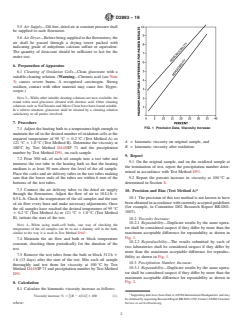
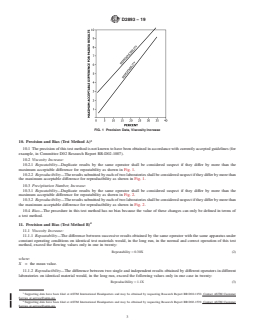
FIG. 1 Precision Data, Viscosity Increase
7.1 Adjust the heating bath to a temperature high enough to
maintain the oil in the desired number of oxidation cells at the
required temperature of 95 °C 6 0.2 °C (Test Method A) or
A = kinematic viscosity on original sample, and
121 °C 6 1.0 °C (Test Method B). Determine the viscosity at
B = kinematic viscosity after oxidation.
100°C by Test Method D445/IP 71 and the precipitation
number by Test Method D91, on each sample.
9. Report
7.2 Pour 300 mL of e
...
This document is not an ASTM standard and is intended only to provide the user of an ASTM standard an indication of what changes have been made to the previous version. Because
it may not be technically possible to adequately depict all changes accurately, ASTM recommends that users consult prior editions as appropriate. In all cases only the current version
of the standard as published by ASTM is to be considered the official document.
´1
Designation: D2893 − 04 (Reapproved 2014) D2893 − 19
Standard Test Methods for
Oxidation Characteristics of Extreme-Pressure Lubrication
Oils
This standard is issued under the fixed designation D2893; the number immediately following the designation indicates the year of
original adoption or, in the case of revision, the year of last revision. A number in parentheses indicates the year of last reapproval. A
superscript epsilon (´) indicates an editorial change since the last revision or reapproval.
ε NOTE—Subsection 6.1 was updated editorially in July 2014.
1. Scope Scope*
1.1 These test methods (A and B) cover the determination of the oxidation characteristics of extreme-pressure fluid lubricants,
gear oils, or mineral oils.
NOTE 1—The changes in the lubricant resulting from these test methods are not always necessarily associated with oxidation of the lubricant. Some
changes may be due to thermal degradation.
1.2 The values stated in SI units are to be regarded as standard. No other units of measurement are included in this standard.
1.3 This standard does not purport to address all of the safety concerns, if any, associated with its use. It is the responsibility
of the user of this standard to establish appropriate safety safety, health, and healthenvironmental practices and determine the
applicability of regulatory limitations prior to use.
1.4 This international standard was developed in accordance with internationally recognized principles on standardization
established in the Decision on Principles for the Development of International Standards, Guides and Recommendations issued
by the World Trade Organization Technical Barriers to Trade (TBT) Committee.
2. Referenced Documents
2.1 ASTM Standards:
D91 Test Method for Precipitation Number of Lubricating Oils
D445 Test Method for Kinematic Viscosity of Transparent and Opaque Liquids (and Calculation of Dynamic Viscosity)
D943 Test Method for Oxidation Characteristics of Inhibited Mineral Oils
E1 Specification for ASTM Liquid-in-Glass Thermometers
E2877 Guide for Digital Contact Thermometers
3. Summary of Test Method
3.1 The oil sample is subjected to a temperature of 95°C95 °C (Test Method A) or 121°C121 °C (Test Method B) in the presence
of dry air for 312 h.
3.2 The oil is then tested for precipitation number and increase in kinematic viscosity.
4. Significance and Use
4.1 These test methods have been widely used to measure the oxidation stability of extreme pressure lubricating fluids, gear oils,
and mineral oils.
5. Apparatus
5.1 Heating Bath or Block, thermostatically controlled, capable of maintaining the oil sample in the test tube at a temperature
of 9595 °C 6 0.2°C0.2 °C (Test Method A), or 121121 °C 6 1.0°C1.0 °C (Test Method B) and large enough to hold the desired
These test methods are under the jurisdiction of ASTM Committee D02 on Petroleum Products, Liquid Fuels, and Lubricants and is the direct responsibility of
Subcommittee D02.09.0D on Oxidation of Lubricants.
Current edition approved June 1, 2014Dec. 1, 2019. Published July 2014December 2019. Originally approved in 1970. Last previous edition approved in 20092014 as
D2893 – 04 (2009).(2014). DOI: 10.1520/D2893-04R14E01.10.1520/D2893-19.
For referenced ASTM standards, visit the ASTM website, www.astm.org, or contact ASTM Customer Service at service@astm.org. For Annual Book of ASTM Standards
volume information, refer to the standard’s Document Summary page on the ASTM website.
*A Summary of Changes section appears at the end of this standard
Copyright © ASTM International, 100 Barr Harbor Drive, PO Box C700, West Conshohocken, PA 19428-2959. United States
D2893 − 19
number of oxidation cells immersed in the heating bath or block to a depth of approximately 350 mm. The liquid heating bath shall
be fitted with a suitable stirring device to provide a uniform temperature throughout the bath.
5.2 Test Tubes, of borosilicate glass, 4141 mm 6 0.5 mm 0.5 mm inside diameter and 600 mm in length are required, each fitted
with a slotted cork (Note 2) stopper into which shall be inserted a glass air delivery tube of 44 mm to 5 mm 5 mm of inside
diameter. The length of the air delivery tube shall be such that one end reaches to within 6 mm of the bottom of the tube and the
other end projects 6060 mm to 80 mm 80 mm from the cork stopper.
NOTE 2—New corks should be used for each run.
5.3 Flowmeter, one to each test tube, capable of measuring an air flow of 10 L/h with an accuracy of 60.56 0.5 L/h.
5.4 Thermometer—ASTM Solvent Distillation Thermometer having a range from 7676 °C to 126°C126 °C and conforming to
the requirement for Thermometer 40C as prescribed in Specification E1. Alternatively, calibrated thermocouples digital contact
thermometers such as PRTs (platinum resistance thermometers), thermistors, or thermocouples in accordance with Guide E2877
of equal or better accuracy may be used.
5.5 Air Supply—Oil-free, dried air at constant pressure shall be supplied to each flowmeter.
5.6 Air Dryer—Before being supplied to the flowmeters, the air shall be passed through a drying tower packed with indicating
grade of anhydrous calcium sulfate or equivalent. The quantity of dessicantdesiccant should be sufficient to last for the entire test.
6. Preparation of Apparatus
6.1 Cleaning of Oxidation Cells—Clean glassware with a suitable cleaning solution. (Warning—Chromic acid (see Note 3)
causes severe burns. A recognized carcinogen. Strong oxidizer, contact with other material may cause fire. Hygroscopic.)
NOTE 3—While other suitable cleaning solutions are now available, the round robin used glassware cleaned with chromic acid. Other cleaning solutions
such as NoChromix and Micro Clean have been found suitable. In a referee situation, glassware shall be cleaned by a cleaning solution satisfactory to
all parties involved.
7. Procedure
7.1 Adjust the heating bath to a temperature high enough to maintain the oil in the desired number of oxidation cells at the
required temperature of 9595 °C 6 0.2°C0.2 °C (Test Method A) or 121121 °C 6 1.0°C1.0 °C (Test Method B). Determine the
viscosity at 100°C by Test Method D445/IP 71 and the precipitation number by Test Method D91, on each sample.
7.2 Pour 300 mL of
...