

ASTM E1755-01(2020)
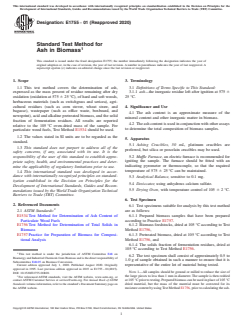
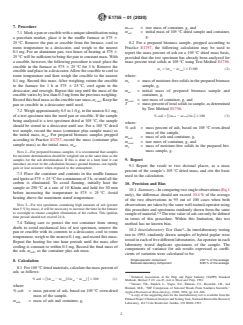
(Test Method)Standard Test Method for Ash in Biomass
General Information
- Abstract
SIGNIFICANCE AND USE
4.1 The ash content is an approximate measure of the mineral content and other inorganic matter in biomass.
4.2 The ash content is used in conjunction with other assays to determine the total composition of biomass samples.
SCOPE
1.1 This test method covers the determination of ash, expressed as the mass percent of residue remaining after dry oxidation (oxidation at 575 ± 25 °C), of hard and soft woods, herbaceous materials (such as switchgrass and sericea), agricultural residues (such as corn stover, wheat straw, and bagasse), wastepaper (such as office waste, boxboard, and newsprint), acid and alkaline pretreated biomass, and the solid fraction of fermentation residues. All results are reported relative to the 105 °C oven-dried mass of the sample. For particulate wood fuels, Test Method E1534 should be used.
1.2 The values stated in SI units are to be regarded as the standard.
1.3 This standard does not purport to address all of the safety concerns, if any, associated with its use. It is the responsibility of the user of this standard to establish appropriate safety, health, and environmental practices and determine the applicability of regulatory limitations prior to use.
1.4 This international standard was developed in accordance with internationally recognized principles on standardization established in the Decision on Principles for the Development of International Standards, Guides and Recommendations issued by the World Trade Organization Technical Barriers to Trade (TBT) Committee.
- Status
- Published
- Publication Date
- 30-Jun-2020
- Technical Committee
- E48 - Bioenergy and Industrial Chemicals from Biomass
- Drafting Committee
- E48.05 - Biomass Conversion


Overview
ASTM E1755-01(2020): Standard Test Method for Ash in Biomass is an internationally recognized standard developed by ASTM International. This test method specifies a procedure to determine the ash content-defined as the inorganic residue remaining after dry oxidation-of various types of biomass. The method is widely applied in industries concerned with bioenergy, biomass conversion, and compositional analysis, ensuring the accurate and consistent determination of mineral and inorganic matter in biomass materials. The ash content is a key metric in evaluating fuel quality, process suitability, and overall composition of biomass resources.
Key Topics
- Ash Content Determination: The standard describes the process of quantifying the mass percent of ash in biomass by igniting samples at 575 ± 25 °C and measuring the residue.
- Sample Types: Applicable to hard and soft woods, herbaceous materials (e.g., switchgrass), agricultural residues (e.g., corn stover, wheat straw, bagasse), wastepaper (office waste, boxboard, newsprint), pretreated biomass, and fermentation residues.
- Reporting Basis: Results are expressed relative to the oven-dried mass of samples, dried at 105 °C.
- Instrumentation and Apparatus: The standard details required equipment, such as ashing crucibles, muffle furnaces with temperature control, analytical balances, and desiccators.
- Precision and Consistency: Internally validated for reproducibility both within single operators and between laboratories, helping ensure reliable ash measurements.
- Safety and Best Practices: Users are responsible for observing suitable safety, health, and environmental practices when applying the standard.
Applications
ASTM E1755-01(2020) is essential in several practical contexts within the bioenergy, agricultural, and waste management sectors:
- Biomass Fuel Evaluation: Assessing mineral and inorganic content to determine combustion suitability and anticipated residue after burning.
- Feedstock Selection and Quality Control: Comparing ash content across various biomass sources to guide procurement and processing decisions.
- Compositional Analysis: Used alongside other assays for holistic characterization of biomass, supporting research, process optimization, and regulatory compliance.
- Pretreatment Assessment: Evaluates the effectiveness and impact of acid/alkaline pretreatment on biomass for conversion to fuels and chemicals.
- Fermentation Residue Management: Assesses the inorganic matter remaining after biofermentation processes, supporting residue disposal and valorization strategies.
Related Standards
Several related ASTM standards complement or augment the guidance provided in ASTM E1755-01(2020):
- ASTM E1534 - Test Method for Determination of Ash Content of Particulate Wood Fuels: Specifically recommended for particulate wood materials.
- ASTM E1756 - Test Method for Determination of Total Solids in Biomass: Establishes the oven-drying protocol for determining sample mass.
- ASTM E1757 - Practice for Preparation of Biomass for Compositional Analysis: Outlines the sample preparation procedures that feed into the ash determination process.
Practical Value
Implementing ASTM E1755-01(2020) provides:
- Standardization and Comparability: Uniform procedures that enhance consistency and comparability of ash measurements across organizations.
- Process Optimization: Data that help refine conversion technologies by identifying problematic feedstocks with excessive inorganic content.
- Environmental Compliance: Supports adherence to local and international guidelines for biomass fuel quality and emission management.
- Research and Development: Facilitates rigorous analysis in development pipelines for biofuels and biobased products.
Keywords
ash content, biomass, bioenergy, agricultural residue, fermentation residue, herbaceous materials, wastepaper, wood, ASTM standards, biomass composition analysis
Relations
- Effective Date
- 01-Jul-2020
- Effective Date
- 01-Jul-2020
- Effective Date
- 01-Apr-2019
- Effective Date
- 01-Apr-2019
- Effective Date
- 01-Jun-2015
- Effective Date
- 01-Jun-2015
- Effective Date
- 15-Aug-2013
- Effective Date
- 01-May-2008
- Effective Date
- 15-Nov-2007
- Effective Date
- 01-Nov-2006
- Effective Date
- 10-Nov-2001
- Effective Date
- 10-Nov-2001
- Effective Date
- 10-Nov-2001
- Effective Date
- 10-Nov-2001
- Effective Date
- 01-Jan-1998
Get Certified
Connect with accredited certification bodies for this standard

Control Union Certifications
Global certification for agriculture and sustainability.

ECOCERT
Organic and sustainability certification.

FSC International
Forest Stewardship Council certification.
Sponsored listings
Frequently Asked Questions
ASTM E1755-01(2020) is a standard published by ASTM International. Its full title is "Standard Test Method for Ash in Biomass". This standard covers: SIGNIFICANCE AND USE 4.1 The ash content is an approximate measure of the mineral content and other inorganic matter in biomass. 4.2 The ash content is used in conjunction with other assays to determine the total composition of biomass samples. SCOPE 1.1 This test method covers the determination of ash, expressed as the mass percent of residue remaining after dry oxidation (oxidation at 575 ± 25 °C), of hard and soft woods, herbaceous materials (such as switchgrass and sericea), agricultural residues (such as corn stover, wheat straw, and bagasse), wastepaper (such as office waste, boxboard, and newsprint), acid and alkaline pretreated biomass, and the solid fraction of fermentation residues. All results are reported relative to the 105 °C oven-dried mass of the sample. For particulate wood fuels, Test Method E1534 should be used. 1.2 The values stated in SI units are to be regarded as the standard. 1.3 This standard does not purport to address all of the safety concerns, if any, associated with its use. It is the responsibility of the user of this standard to establish appropriate safety, health, and environmental practices and determine the applicability of regulatory limitations prior to use. 1.4 This international standard was developed in accordance with internationally recognized principles on standardization established in the Decision on Principles for the Development of International Standards, Guides and Recommendations issued by the World Trade Organization Technical Barriers to Trade (TBT) Committee.
SIGNIFICANCE AND USE 4.1 The ash content is an approximate measure of the mineral content and other inorganic matter in biomass. 4.2 The ash content is used in conjunction with other assays to determine the total composition of biomass samples. SCOPE 1.1 This test method covers the determination of ash, expressed as the mass percent of residue remaining after dry oxidation (oxidation at 575 ± 25 °C), of hard and soft woods, herbaceous materials (such as switchgrass and sericea), agricultural residues (such as corn stover, wheat straw, and bagasse), wastepaper (such as office waste, boxboard, and newsprint), acid and alkaline pretreated biomass, and the solid fraction of fermentation residues. All results are reported relative to the 105 °C oven-dried mass of the sample. For particulate wood fuels, Test Method E1534 should be used. 1.2 The values stated in SI units are to be regarded as the standard. 1.3 This standard does not purport to address all of the safety concerns, if any, associated with its use. It is the responsibility of the user of this standard to establish appropriate safety, health, and environmental practices and determine the applicability of regulatory limitations prior to use. 1.4 This international standard was developed in accordance with internationally recognized principles on standardization established in the Decision on Principles for the Development of International Standards, Guides and Recommendations issued by the World Trade Organization Technical Barriers to Trade (TBT) Committee.
ASTM E1755-01(2020) is classified under the following ICS (International Classification for Standards) categories: 65.040.20 - Buildings and installations for processing and storage of agricultural produce. The ICS classification helps identify the subject area and facilitates finding related standards.
ASTM E1755-01(2020) has the following relationships with other standards: It is inter standard links to ASTM E1755-01(2015), ASTM E1756-08(2020), ASTM E1534-93(2019), ASTM E1757-19, ASTM E1757-01(2015), ASTM E1756-08(2015), ASTM E1534-93(2013), ASTM E1756-08, ASTM E1757-01(2007), ASTM E1534-93(2006), ASTM E1756-95, ASTM E1756-01, ASTM E1757-01, ASTM E1757-95, ASTM E1534-93(1998). Understanding these relationships helps ensure you are using the most current and applicable version of the standard.
ASTM E1755-01(2020) is available in PDF format for immediate download after purchase. The document can be added to your cart and obtained through the secure checkout process. Digital delivery ensures instant access to the complete standard document.
Standards Content (Sample)
This international standard was developed in accordance with internationally recognized principles on standardization established in the Decision on Principles for the
Development of International Standards, Guides and Recommendations issued by the World Trade Organization Technical Barriers to Trade (TBT) Committee.
Designation: E1755 − 01 (Reapproved 2020)
Standard Test Method for
Ash in Biomass
This standard is issued under the fixed designation E1755; the number immediately following the designation indicates the year of
original adoption or, in the case of revision, the year of last revision. A number in parentheses indicates the year of last reapproval. A
superscript epsilon (´) indicates an editorial change since the last revision or reapproval.
1. Scope 3. Terminology
1.1 This test method covers the determination of ash, 3.1 Definitions of Terms Specific to This Standard:
expressed as the mass percent of residue remaining after dry 3.1.1 ash—the inorganic residue left after ignition at 575 6
oxidation (oxidation at 575 6 25 °C), of hard and soft woods, 25 °C.
herbaceous materials (such as switchgrass and sericea), agri-
cultural residues (such as corn stover, wheat straw, and
4. Significance and Use
bagasse), wastepaper (such as office waste, boxboard, and
4.1 The ash content is an approximate measure of the
newsprint), acid and alkaline pretreated biomass, and the solid
mineral content and other inorganic matter in biomass.
fraction of fermentation residues. All results are reported
4.2 The ash content is used in conjunction with other assays
relative to the 105 °C oven-dried mass of the sample. For
to determine the total composition of biomass samples.
particulate wood fuels, Test Method E1534 should be used.
1.2 The values stated in SI units are to be regarded as the
5. Apparatus
standard.
5.1 Ashing Crucibles, 50 mL, platinum crucibles are
1.3 This standard does not purport to address all of the
preferred, but silica or porcelain crucibles may be used.
safety concerns, if any, associated with its use. It is the
5.2 Muffle Furnace, an electric furnace is recommended for
responsibility of the user of this standard to establish appro-
igniting the sample. The furnace should be fitted with an
priate safety, health, and environmental practices and deter-
indicating pyrometer or thermocouple, so that the required
mine the applicability of regulatory limitations prior to use.
temperature of 575 6 25 °C can be maintained.
1.4 This international standard was developed in accor-
dance with internationally recognized principles on standard-
5.3 Analytical Balance, sensitive to 0.1 mg.
ization established in the Decision on Principles for the
5.4 Desiccator, using anhydrous calcium sulfate.
Development of International Standards, Guides and Recom-
5.5 Drying Oven, with temperature control of 105 6 2 °C.
mendations issued by the World Trade Organization Technical
Barriers to Trade (TBT) Committee.
6. Test Specimen
2. Referenced Documents
6.1 Test specimens suitable for analysis by this test method
2.1 ASTM Standards: are as follows:
E1534 Test Method for Determination of Ash Content of 6.1.1 Prepared biomass samples that have been prepared
Particulate Wood Fuels
according to Practice E1757.
E1756 Test Method for Determination of Total Solids in 6.1.2 Biomass feedstocks, dried at 105 °C according to Test
Biomass Method E1756,
E1757 Practice for Preparation of Biomass for Composi- 6.1.3 Pretreated biomass, dried at 105 °C according to Test
tional Analysis Method E1756, and
6.1.4 The solids fraction of fermentation residues, dried at
105 °C according to Test Method E1756.
This test method is under the jurisdiction of ASTM Committee E48 on
6.2 The test specimen shall consist of approximately 0.5 to
Bioenergy and Industrial Chemicals from Biomass and is the direct responsibility of
1.0 g of sample obtained in such a manner to ensure that it is
Subcommittee E48.05 on Biomass Conversion.
Current edition approved July 1, 2020. Published August 2020. Originally representative of the entire lot of material being tested.
approved in 1995. Last previous edition approved in 2015 as E1755 – 01(2015).
NOTE 1—All samples should be ground or milled to reduce the size of
DOI: 10.1520/E1755-01R20.
the large pieces to less than 1 mm in diameter. The sample is then redried
For referenced ASTM standards, visit the ASTM website, www.astm.org, or
at105 °Cpriortotesting.Preparedbiomasscanbeusedinplaceof105 °C
contact ASTM Customer Service at service@astm.org. For Annual Book of ASTM
Standards volume information, refer to the standard’s Document Summary page on dried material, but the mass of the material must be corrected for its
the ASTM website. moisturecontentbyusingTestMethodE1756,priortocalculatingtheash.
Copyright © ASTM International, 100 Barr Harbor Drive, PO Box C700, West Conshohocken, PA 19428-2959. United States
E1755 − 01 (2020)
7. Procedure
m = tare mass of container, g, and
cont
m = initial mass of 105 °C dried sample and container,
od
7.1 Markapanorcruciblewithauniqueidentificationusing
g.
a porcelain marker, place it in the muffle furnace at 575 6
25 °C. Remove the pan or crucible from the furnace, cool to
8.2 For a prepared biomass sample, prepped according to
room temperature in a desiccator, and weigh to the nearest
Practice E1757, the following calculation may be used to
0.1 mg. For an aluminum pan, two hours of heating at 575 6
report the mass percent of ash on a 105 °C dried mass basis,
25 °C will be sufficient to bring the pan to constant mass. With
provided that the test specimen has already been analyzed for
a crucible, however, the following procedure is used: place the
mass percent total solids at 105 °C using Test Method E1756.
crucible in the furnace at 575 6 25 °C for 3 h. Remove the
m 5 m 2 m 3T/100 (2)
~ !
s ar cont
crucible and place in a desiccator.Allow the crucible to cool to
where:
room temperature and then weigh the crucible to the nearest
0.1 mg. Record this mass. After weighing, return the crucible
m = mass of moisture-free solids in the prepared biomass
s
to the furnace for1hat575 6 25 °C, cool again in the
sample, g,
desiccator, and reweigh. Repeat this step until the mass of the m = initial mass of prepared biomass sample and
ar
cruciblevariesbylessthan0.3mgfromthepreviousweighing.
container, g,
m = tare mass of container, g, and
Recordthisfinalmassasthecrucibletaremass, m .Keepthe
cont
cont
T = mass percent of total solids in sample, as determined
pan or crucible in a desiccator until used.
by Test Method E1756.
7.2 Weigh approximately 0.5 to 1.0 g, to the nearest 0.1 mg,
% ash 5 @~m 2 m !/m # 3100 (3)
of a test specimen into the tared pan or crucible. If the sample ash cont s
being analyzed is a test specimen dried at 105 °C, the sample
where:
should be stored in a desiccator until use. For a 105 °C dried
% ash = mass percent of ash, based on 105 °C oven-dried
test sample, record the mass (container plus sample mass) as
mass of the sample,
the initial mass, m . For prepared biomass samples prepped
od
m = mass of ash and container, g,
ash
according to Practice E1757, record the mass (container plus
m = tare mass of container, g, and
cont
sample mass) as the initial mass, m .
ar
m = mass of moisture-free solids in the prepared bio-
s
mass sample, g.
NOTE 2—
...