

ASTM D1742-20
(Test Method)Standard Test Method for Oil Separation from Lubricating Grease During Storage
General Information
- Abstract
SIGNIFICANCE AND USE
5.1 When a lubricating grease separates oil, the remaining composition increases in consistency. This can affect the ability of the product to function as designed.
5.2 It has been found that the results of this test correlate directly with the oil separation that occurs in 35 lb pails of grease during storage.
5.3 This test method is not intended to predict oil separation tendencies of the grease under dynamic conditions.
SCOPE
1.1 This test method covers the determination of the tendency of a lubricating grease to separate oil during storage in both normally filled and partially filled containers.
1.2 This test method is not suitable for greases softer than NLGI No. 1 grade.
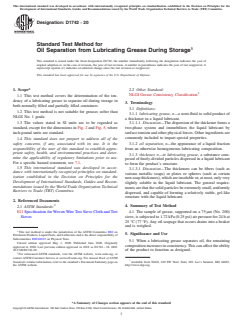
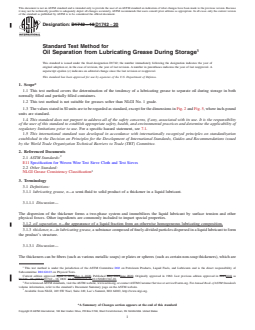
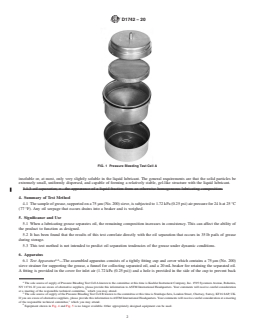
FIG. 1 Pressure Bleeding Test Cell A
1.3 The values stated in SI units are to be regarded as standard, except for the dimensions in Fig. 2 and Fig. 5, where inch-pound units are standard.
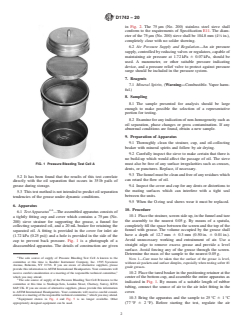
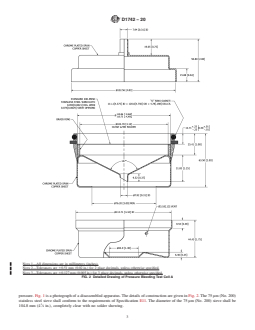
FIG. 2 Detailed Drawing of Pressure Bleeding Test Cell A
Note 1: All dimensions are in millimeters (inches).
Note 2: Tolerances are ±0.51 mm (0.02 in.) for 2 place decimals, unless otherwise specified.
Note 3: Tolerances are ±0.127 mm (0.005 in.) for 3 place decimals, unless otherwise specified.
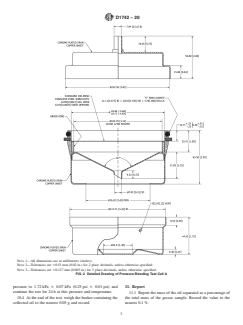
FIG. 3 Pressure Bleeding Test Cell B
FIG. 4 Pressure Bleeding Test Cell C
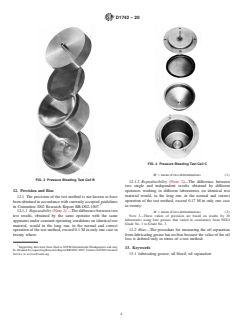
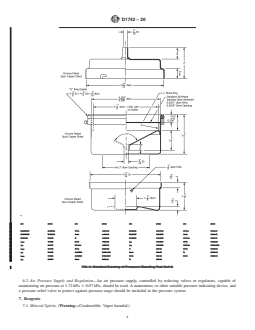
FIG. 5 Detailed Drawing of Pressure Bleeding Test Cell C—Strainer Assembly
Note 1: All dimensions are in millimeters (inches).
Note 2: Tolerances are ±0.51 mm (0.02 in.) for 2 place decimals, unless otherwise specified.
Note 3: Tolerances are ±0.127 mm (0.005 in.) for 3 place decimals, unless otherwise specified.
1.4 This standard does not purport to address all of the safety concerns, if any, associated with its use. It is the responsibility of the user of this standard to establish appropriate safety, health, and environmental practices and determine the applicability of regulatory limitations prior to use. For a specific hazard statement, see 7.1.
1.5 This international standard was developed in accordance with internationally recognized principles on standardization established in the Decision on Principles for the Development of International Standards, Guides and Recommendations issued by the World Trade Organization Technical Barriers to Trade (TBT) Committee.
- Status
- Published
- Publication Date
- 30-Apr-2020
- Technical Committee
- D02 - Petroleum Products, Liquid Fuels, and Lubricants
- Drafting Committee
- D02.G0.03 - Physical Tests
Buy Documents
ASTM D1742-20 - Standard Test Method for Oil Separation from Lubricating Grease During Storage
REDLINE ASTM D1742-20 - Standard Test Method for Oil Separation from Lubricating Grease During Storage
Overview
ASTM D1742-20: Standard Test Method for Oil Separation from Lubricating Grease During Storage is an internationally recognized standard developed by ASTM International. This test method establishes procedures to determine the tendency of lubricating greases to separate oil during storage, particularly in both normally filled and partially filled containers. Managing oil separation is crucial to maintain the performance and consistency of lubricating greases, ensuring they function as designed and meet quality requirements across various applications.
This standard is widely used by manufacturers, quality control laboratories, and industries that rely on lubricating greases for operational efficiency and equipment reliability.
Key Topics
- Purpose of the Test: The primary aim is to quantify the amount of oil that a lubricating grease may separate under controlled conditions during storage.
- Scope and Limitations:
- Applicable to greases of NLGI No. 1 grade or firmer.
- Not suitable for softer greases (those below NLGI No. 1).
- Not designed to predict oil separation under dynamic (in-use) conditions.
- Test Method Summary:
- A specified amount of grease is placed on a 75 μm (No. 200) sieve and exposed to 1.72 kPa (0.25 psi) air pressure for 24 hours at 25°C (77°F).
- Any oil that separates is collected, measured, and reported as a percentage of the total grease sample.
- Test Apparatus: Use of specialized pressure bleeding test cells, designed to support the sample and collect separated oil, while maintaining the required test conditions.
- Significance:
- Results correlate with oil separation observed in storage, specifically in large commercial containers.
- Excessive oil separation can lead to increased grease consistency, negatively impacting lubrication performance.
Applications
The ASTM D1742-20 standard is vital for several practical applications, including:
- Quality Assurance in Grease Manufacturing: Used for product development, formulation optimization, and ensuring batch-to-batch consistency to minimize oil bleeding during storage.
- Supply Chain and Logistics: Assists in evaluating the stability of greases during transportation and warehousing, helping to predict shelf life and storage behavior.
- Industry Compliance: Key for industries such as automotive, aerospace, heavy machinery, and manufacturing where lubricating grease stability is essential for equipment reliability.
- Container and Packaging Evaluation: Guides the selection and design of packaging materials that best protect against oil separation in storage.
- End-User Assurance: Provides customers with standardized data to select the most suitable lubricating grease for applications demanding consistent performance over time.
Related Standards
For comprehensive lubrication quality control and product specification, the following standards are closely related:
- ASTM E11 - Specification for Woven Wire Test Sieve Cloth and Test Sieves, referenced for the sieve used in this test.
- NLGI Grease Consistency Classification - Used to determine grease grade suitability for this method.
- Other relevant ASTM standards dealing with lubricant performance, stability, and testing procedures.
Summary
By using ASTM D1742-20 to determine oil separation from lubricating grease during storage, manufacturers and end-users gain valuable insight into product stability and performance. This standard is integral in supporting quality control processes, regulatory compliance, and supply chain integrity within industries relying on high-performance greases. For complete details and the most up-to-date procedures, users should always consult the latest official publication from ASTM International.
Relations
- Replaces
ASTM D1742-18 - Standard Test Method for Oil Separation from Lubricating Grease During Storage - Effective Date
- 01-May-2020
- Effective Date
- 01-Oct-2013
- Effective Date
- 01-May-2009
- Effective Date
- 01-May-2004
- Effective Date
- 10-May-2001
- Effective Date
- 10-May-2001
- Effective Date
- 01-May-2020
- Referred By
ASTM F2489-06(2022) - Standard Guide for Instrument and Precision Bearing Lubricants-Part 2 Greases - Effective Date
- 01-May-2020
- Effective Date
- 01-May-2020
- Effective Date
- 01-May-2020
- Effective Date
- 01-May-2020
- Effective Date
- 01-May-2020
Buy Documents
ASTM D1742-20 - Standard Test Method for Oil Separation from Lubricating Grease During Storage
REDLINE ASTM D1742-20 - Standard Test Method for Oil Separation from Lubricating Grease During Storage
Get Certified
Connect with accredited certification bodies for this standard

Element Materials Technology
Materials testing and product certification.

ABS Group Brazil
ABS Group certification services in Brazil.

ABS Quality Evaluations Inc.
American Bureau of Shipping quality certification.
Sponsored listings
Frequently Asked Questions
ASTM D1742-20 is a standard published by ASTM International. Its full title is "Standard Test Method for Oil Separation from Lubricating Grease During Storage". This standard covers: SIGNIFICANCE AND USE 5.1 When a lubricating grease separates oil, the remaining composition increases in consistency. This can affect the ability of the product to function as designed. 5.2 It has been found that the results of this test correlate directly with the oil separation that occurs in 35 lb pails of grease during storage. 5.3 This test method is not intended to predict oil separation tendencies of the grease under dynamic conditions. SCOPE 1.1 This test method covers the determination of the tendency of a lubricating grease to separate oil during storage in both normally filled and partially filled containers. 1.2 This test method is not suitable for greases softer than NLGI No. 1 grade. FIG. 1 Pressure Bleeding Test Cell A 1.3 The values stated in SI units are to be regarded as standard, except for the dimensions in Fig. 2 and Fig. 5, where inch-pound units are standard. FIG. 2 Detailed Drawing of Pressure Bleeding Test Cell A Note 1: All dimensions are in millimeters (inches). Note 2: Tolerances are ±0.51 mm (0.02 in.) for 2 place decimals, unless otherwise specified. Note 3: Tolerances are ±0.127 mm (0.005 in.) for 3 place decimals, unless otherwise specified. FIG. 3 Pressure Bleeding Test Cell B FIG. 4 Pressure Bleeding Test Cell C FIG. 5 Detailed Drawing of Pressure Bleeding Test Cell C—Strainer Assembly Note 1: All dimensions are in millimeters (inches). Note 2: Tolerances are ±0.51 mm (0.02 in.) for 2 place decimals, unless otherwise specified. Note 3: Tolerances are ±0.127 mm (0.005 in.) for 3 place decimals, unless otherwise specified. 1.4 This standard does not purport to address all of the safety concerns, if any, associated with its use. It is the responsibility of the user of this standard to establish appropriate safety, health, and environmental practices and determine the applicability of regulatory limitations prior to use. For a specific hazard statement, see 7.1. 1.5 This international standard was developed in accordance with internationally recognized principles on standardization established in the Decision on Principles for the Development of International Standards, Guides and Recommendations issued by the World Trade Organization Technical Barriers to Trade (TBT) Committee.
SIGNIFICANCE AND USE 5.1 When a lubricating grease separates oil, the remaining composition increases in consistency. This can affect the ability of the product to function as designed. 5.2 It has been found that the results of this test correlate directly with the oil separation that occurs in 35 lb pails of grease during storage. 5.3 This test method is not intended to predict oil separation tendencies of the grease under dynamic conditions. SCOPE 1.1 This test method covers the determination of the tendency of a lubricating grease to separate oil during storage in both normally filled and partially filled containers. 1.2 This test method is not suitable for greases softer than NLGI No. 1 grade. FIG. 1 Pressure Bleeding Test Cell A 1.3 The values stated in SI units are to be regarded as standard, except for the dimensions in Fig. 2 and Fig. 5, where inch-pound units are standard. FIG. 2 Detailed Drawing of Pressure Bleeding Test Cell A Note 1: All dimensions are in millimeters (inches). Note 2: Tolerances are ±0.51 mm (0.02 in.) for 2 place decimals, unless otherwise specified. Note 3: Tolerances are ±0.127 mm (0.005 in.) for 3 place decimals, unless otherwise specified. FIG. 3 Pressure Bleeding Test Cell B FIG. 4 Pressure Bleeding Test Cell C FIG. 5 Detailed Drawing of Pressure Bleeding Test Cell C—Strainer Assembly Note 1: All dimensions are in millimeters (inches). Note 2: Tolerances are ±0.51 mm (0.02 in.) for 2 place decimals, unless otherwise specified. Note 3: Tolerances are ±0.127 mm (0.005 in.) for 3 place decimals, unless otherwise specified. 1.4 This standard does not purport to address all of the safety concerns, if any, associated with its use. It is the responsibility of the user of this standard to establish appropriate safety, health, and environmental practices and determine the applicability of regulatory limitations prior to use. For a specific hazard statement, see 7.1. 1.5 This international standard was developed in accordance with internationally recognized principles on standardization established in the Decision on Principles for the Development of International Standards, Guides and Recommendations issued by the World Trade Organization Technical Barriers to Trade (TBT) Committee.
ASTM D1742-20 is classified under the following ICS (International Classification for Standards) categories: 75.100 - Lubricants, industrial oils and related products. The ICS classification helps identify the subject area and facilitates finding related standards.
ASTM D1742-20 has the following relationships with other standards: It is inter standard links to ASTM D1742-18, ASTM E11-13, ASTM E11-09e1, ASTM E11-04, ASTM E11-95, ASTM E11-01, ASTM D8324-21, ASTM F2489-06(2022), ASTM D4732-13(2020), ASTM D4049-20, ASTM D4950-22, ASTM D6185-11(2017). Understanding these relationships helps ensure you are using the most current and applicable version of the standard.
ASTM D1742-20 is available in PDF format for immediate download after purchase. The document can be added to your cart and obtained through the secure checkout process. Digital delivery ensures instant access to the complete standard document.
Standards Content (Sample)
This international standard was developed in accordance with internationally recognized principles on standardization established in the Decision on Principles for the
Development of International Standards, Guides and Recommendations issued by the World Trade Organization Technical Barriers to Trade (TBT) Committee.
Designation: D1742 − 20
Standard Test Method for
Oil Separation from Lubricating Grease During Storage
This standard is issued under the fixed designation D1742; the number immediately following the designation indicates the year of
original adoption or, in the case of revision, the year of last revision. A number in parentheses indicates the year of last reapproval. A
superscript epsilon (´) indicates an editorial change since the last revision or reapproval.
This standard has been approved for use by agencies of the U.S. Department of Defense.
1. Scope* 2.2 Other Standard:
NLGI Grease Consistency Classification
1.1 This test method covers the determination of the ten-
dency of a lubricating grease to separate oil during storage in
3. Terminology
both normally filled and partially filled containers.
3.1 Definitions:
1.2 This test method is not suitable for greases softer than
3.1.1 lubricating grease, n—a semi-fluid to solid product of
NLGI No. 1 grade.
a thickener in a liquid lubricant.
1.3 The values stated in SI units are to be regarded as 3.1.1.1 Discussion—The dispersion of the thickener forms a
standard, except for the dimensions in Fig. 2 and Fig. 5, where two-phase system and immobilizes the liquid lubricant by
inch-pound units are standard. surface tension and other physical forces. Other ingredients are
commonly included to impart special properties.
1.4 This standard does not purport to address all of the
safety concerns, if any, associated with its use. It is the 3.1.2 oil separation, n—the appearance of a liquid fraction
responsibility of the user of this standard to establish appro- from an otherwise homogeneous lubricating composition.
priate safety, health, and environmental practices and deter-
3.1.3 thickener, n—in lubricating grease, a substance com-
mine the applicability of regulatory limitations prior to use.
posed of finely-divided particles dispersed in a liquid lubricant
For a specific hazard statement, see 7.1.
to form the product’s structure.
1.5 This international standard was developed in accor-
3.1.3.1 Discussion—The thickeners can be fibers (such as
dance with internationally recognized principles on standard-
various metallic soaps) or plates or spheres (such as certain
ization established in the Decision on Principles for the
non-soapthickeners),whichareinsolubleor,atmost,onlyvery
Development of International Standards, Guides and Recom-
slightly soluble in the liquid lubricant. The general require-
mendations issued by the World Trade Organization Technical
ments are that the solid particles be extremely small, uniformly
Barriers to Trade (TBT) Committee.
dispersed, and capable of forming a relatively stable, gel-like
structure with the liquid lubricant.
2. Referenced Documents
2 4. Summary of Test Method
2.1 ASTM Standards:
E11 Specification for Woven Wire Test Sieve Cloth and Test 4.1 The sample of grease, supported on a 75 µm (No. 200)
Sieves sieve,issubjectedto1.72 kPa(0.25 psi)airpressurefor24 hat
25 °C (77 °F).Any oil seepage that occurs drains into a beaker
and is weighed.
This test method is under the jurisdiction of the ASTM Committee D02 on
5. Significance and Use
Petroleum Products, Liquid Fuels, and Lubricants and is the direct responsibility of
Subcommittee D02.G0.03 on Physical Tests.
5.1 When a lubricating grease separates oil, the remaining
Current edition approved May 1, 2020. Published June 2020. Originally
compositionincreasesinconsistency.Thiscanaffecttheability
approved in 1960. Last previous edition approved in 2018 as D1742 – 18. DOI:
10.1520/D1742-20. of the product to function as designed.
For referenced ASTM standards, visit the ASTM website, www.astm.org, or
contact ASTM Customer Service at service@astm.org. For Annual Book of ASTM
Standards volume information, refer to the standard’s Document Summary page on Available from NLGI, 249 SW Noel, Suite 249, Lee’s Summit, MO 64063,
the ASTM website. http://www.nlgi.org.
*A Summary of Changes section appears at the end of this standard
Copyright © ASTM International, 100 Barr Harbor Drive, PO Box C700, West Conshohocken, PA 19428-2959. United States
D1742 − 20
in Fig. 2. The 75 µm (No. 200) stainless steel sieve shall
conform to the requirements of Specification E11. The diam-
eter of the 75 µm (No. 200) sieve shall be 104.8 mm (4 ⁄8 in.),
completely clear with no solder showing.
6.2 Air Pressure Supply and Regulation—An air pressure
supply, controlled by reducing valves or regulators, capable of
maintaining air pressure at 1.72 kPa 6 0.07 kPa, should be
used. A manometer, or other suitable pressure indicating
device, and a pressure relief valve to protect against pressure
surge should be included in the pressure system.
7. Reagents
7.1 Mineral Spirits, (Warning—Combustible. Vapor harm-
ful.)
8. Sampling
8.1 The sample presented for analysis should be large
enough to make possible the selection of a representative
portion for testing.
8.2 Examine for any indication of non-homogeneity such as
oil separation, phase changes or gross contamination. If any
abnormal conditions are found, obtain a new sample.
9. Preparation of Apparatus
9.1 Thoroughly clean the strainer, cup, and oil-collecting
beaker with mineral spirits and follow by air drying.
9.2 Carefully inspect the sieve to make certain that there is
no build-up which would affect the passage of oil. The sieve
FIG. 1 Pressure Bleeding Test Cell A must also be free of any surface irregularities such as creases,
dents, or punctures. Replace, if necessary.
9.3 The funnel must be clean and free of any residues which
5.2 It has been found that the results of this test correlate
can retard the flow of oil.
directly with the oil separation that occurs in 35 lb pails of
grease during storage.
9.4 Inspect the cover and cup for any dents or distortions to
the mating surfaces which can interfere with a tight seal
5.3 This test method is not intended to predict oil separation
between the units.
tendencies of the grease under dynamic conditions.
9.5 When the O-ring seal shows wear it must be replaced.
6. Apparatus
10. Procedure
4-6
6.1 Test Apparatus —The assembled apparatus consists of
10.1 Place the strainer, screen side up, in the funnel and tare
a tightly fitting cup and cover which contains a 75 µm (No.
the assembly to the nearest 0.05 g. By means of a spatula,
200) sieve strainer for supporting the grease, a
...
This document is not an ASTM standard and is intended only to provide the user of an ASTM standard an indication of what changes have been made to the previous version. Because
it may not be technically possible to adequately depict all changes accurately, ASTM recommends that users consult prior editions as appropriate. In all cases only the current version
of the standard as published by ASTM is to be considered the official document.
Designation: D1742 − 18 D1742 − 20
Standard Test Method for
Oil Separation from Lubricating Grease During Storage
This standard is issued under the fixed designation D1742; the number immediately following the designation indicates the year of
original adoption or, in the case of revision, the year of last revision. A number in parentheses indicates the year of last reapproval. A
superscript epsilon (´) indicates an editorial change since the last revision or reapproval.
This standard has been approved for use by agencies of the U.S. Department of Defense.
1. Scope*
1.1 This test method covers the determination of the tendency of a lubricating grease to separate oil during storage in both
normally filled and partially filled containers.
1.2 This test method is not suitable for greases softer than NLGI No. 1 grade.
1.3 The values stated in SI units are to be regarded as standard, except for the dimensions in Fig. 2 and Fig. 5, where inch-pound
units are standard.
1.4 This standard does not purport to address all of the safety concerns, if any, associated with its use. It is the responsibility
of the user of this standard to establish appropriate safety, health, and environmental practices and determine the applicability of
regulatory limitations prior to use. For a specific hazard statement, see 7.1.
1.5 This international standard was developed in accordance with internationally recognized principles on standardization
established in the Decision on Principles for the Development of International Standards, Guides and Recommendations issued
by the World Trade Organization Technical Barriers to Trade (TBT) Committee.
2. Referenced Documents
2.1 ASTM Standards:
E11 Specification for Woven Wire Test Sieve Cloth and Test Sieves
2.2 Other Standard:
NLGI Grease Consistency Classification
3. Terminology
3.1 Definitions:
3.1.1 lubricating grease, n—a semi-fluid to solid product of a thickener in a liquid lubricant.
3.1.1.1 Discussion—
The dispersion of the thickener forms a two-phase system and immobilizes the liquid lubricant by surface tension and other
physical forces. Other ingredients are commonly included to impart special properties.
3.1.2 oil separation, n—the appearance of a liquid fraction from an otherwise homogeneous lubricating composition.
3.1.3 thickener, n—in lubricating grease, a substance composed of finely-divided particles dispersed in a liquid lubricant to form
the product’s structure.
3.1.3.1 Discussion—
The thickeners can be fibers (such as various metallic soaps) or plates or spheres (such as certain non-soap thickeners), which are
This test method is under the jurisdiction of the ASTM Committee D02 on Petroleum Products, Liquid Fuels, and Lubricants and is the direct responsibility of
Subcommittee D02.G0.03 on Physical Tests.
Current edition approved April 1, 2018May 1, 2020. Published May 2018June 2020. Originally approved in 1960. Last previous edition approved in 20132018 as
D1742 – 06 (2013).D1742 – 18. DOI: 10.1520/D1742-18.10.1520/D1742-20.
For referenced ASTM standards, visit the ASTM website, www.astm.org, or contact ASTM Customer Service at service@astm.org. For Annual Book of ASTM Standards
volume information, refer to the standard’s Document Summary page on the ASTM website.
Available from NLGI, 249 SW Noel, Suite 249, Lee’s Summit, MO 64063, http://www.nlgi.org.
*A Summary of Changes section appears at the end of this standard
Copyright © ASTM International, 100 Barr Harbor Drive, PO Box C700, West Conshohocken, PA 19428-2959. United States
D1742 − 20
FIG. 1 Pressure Bleeding Test Cell A
insoluble or, at most, only very slightly soluble in the liquid lubricant. The general requirements are that the solid particles be
extremely small, uniformly dispersed, and capable of forming a relatively stable, gel-like structure with the liquid lubricant.
3.1.3 oil separation, n—the appearance of a liquid fraction from an otherwise homogeneous lubricating composition.
4. Summary of Test Method
4.1 The sample of grease, supported on a 75 μm (No. 200) sieve, is subjected to 1.72 kPa (0.25 psi) air pressure for 24 h at 25 °C
(77 °F). Any oil seepage that occurs drains into a beaker and is weighed.
5. Significance and Use
5.1 When a lubricating grease separates oil, the remaining composition increases in consistency. This can affect the ability of
the product to function as designed.
5.2 It has been found that the results of this test correlate directly with the oil separation that occurs in 35 lb pails of grease
during storage.
5.3 This test method is not intended to predict oil separation tendencies of the grease under dynamic conditions.
6. Apparatus
4-6
6.1 Test Apparatus —The assembled apparatus consists of a tightly fitting cup and cover which contains a 75 μm (No. 200)
sieve strainer for supporting the grease, a funnel for collecting separated oil, and a 20 mL beaker for retaining the separated oil.
A fitting is provided in the cover for inlet air (1.72 kPa (0.25 psi)) and a hole is provided in the side of the cup to prevent back
The sole source of supply of Pressure Bleeding Test Cell A known to the committee at this time is Koehler Instrument Company, Inc. 1595 Sycamore Avenue, Bohemia,
NY 11716. If you are aware of alternative suppliers, please provide this information to ASTM International Headquarters. Your comments will receive careful consideration
at a meeting of the responsible technical committee, which you may attend.
The sole source of supply of the Pressure Bleeding Test Cell B known to the committee at this time is Stanhope-Seta, London Street, Chertsey, Surrey, KT16 8AP, UK.
If you are aware of alternative suppliers, please provide this information to ASTM International Headquarters. Your comments will receive careful consideration at a meeting
of the responsible technical committee, which you may attend.
Equipment shown in Fig. 4 and Fig. 5 is no longer available. Other appropriately designed equipment can be used.
D1742 − 20
NOTE 1—All dimensions are in millimeters (inches).
NOTE 2—Tolerances are 60.51 mm (0.02 in.) for 2 place decimals, unless otherwise specified.
NOTE 3—Tolerances are 60.127 mm (0.005 in.) for 3 place decimals, unless otherwise specified.
FIG. 2 Detailed Drawing of Pressure Bleeding Test Cell A
pressure. Fig. 1 is a photograph of a disassembled apparatus. The details of construction are given in Fig. 2. The 75 μm (No. 200)
stainless steel sieve shall conform to the requirements of Specification E11. The diameter of the 75 μm (No. 200) sieve shall be
104.8 mm (4 ⁄8 in.), completely clear with no solder showing.
D1742 − 20
in. mm in. mm in. mm in. mm
5 7
0.0021 0.053 1 ⁄8 41.3 0.500 12.70 4 ⁄16 112.7
3 1
0.0029 0.074 1 ⁄4 44.4 0.510 12.95 4 ⁄2 114.3
0.010 0.25 2 50.8 0.520 13.20 4 ⁄16 119.1
1 1 5 3
⁄16 1.59 2 ⁄2 63.5 ⁄8 15.87 4 ⁄4 120.6
1 11 3 26
⁄8 3.17 3 ⁄16 93.7 ⁄4 19.05 4 ⁄32 123.03
3 1 1
⁄16 4.76 4 ⁄8 104.8 1 25.4 5 ⁄4 133.3
1 1
⁄4 6.35 4.360
...