

ASTM D2867-23
(Test Method)Standard Test Methods for Moisture in Activated Carbon
General Information
- Abstract
SIGNIFICANCE AND USE
4.1 The moisture content of activated carbon is often required to define and express its properties in relation to the net weight of the carbon.
4.2 The moisture content of activated carbon packed in typical shipping containers will usually increase during transportation and storage. Users of activated carbon in applications where low moisture content is important should be aware of this effect.
SCOPE
1.1 These test methods provide three procedures for the determination of the moisture content of activated carbon. The procedures may also be used to dry samples required for other tests. The oven drying and moisture balance methods are used when water is the only volatile material present and is in significant quantities, and the activated carbon is not heat sensitive (some activated carbons can ignite spontaneously at temperatures as low as 150 °C). The xylene extraction method is used when a carbon is known or suspected to be heat sensitive or to contain miscible organic compounds instead of or in addition to water. The interferences posed by miscible inorganic compounds has not been determined. The oven drying method described in these test methods may be used as the reference for development of instrumental techniques for moisture determination in activated carbon.
1.2 The values stated in SI units are to be regarded as standard. No other units of measurement are included in this standard.
1.3 This standard does not purport to address all of the safety concerns, if any, associated with its use. It is the responsibility of the user of this standard to establish appropriate safety, health, and environmental practices and determine the applicability of regulatory limitations prior to use.
1.4 This international standard was developed in accordance with internationally recognized principles on standardization established in the Decision on Principles for the Development of International Standards, Guides and Recommendations issued by the World Trade Organization Technical Barriers to Trade (TBT) Committee.
- Status
- Published
- Publication Date
- 31-Mar-2023
- Technical Committee
- D28 - Activated Carbon
- Drafting Committee
- D28.04 - Gas Phase Evaluation Tests
Overview
ASTM D2867-23: Standard Test Methods for Moisture in Activated Carbon establishes rigorously defined procedures to determine the moisture content in activated carbon. Understanding the moisture content is critical, as it affects activated carbon's net weight, performance, and suitability in various applications. This standard outlines three recognized laboratory methods: oven drying, xylene extraction, and moisture balance. These methods offer guidance for accurate moisture determination, considering different activated carbon properties and handling requirements. ASTM D2867-23 is widely referenced for quality control in production, shipping, storage, and end-use testing of activated carbon products.
Key Topics
- Importance of Moisture Determination:
- Moisture affects the net weight and adsorption performance of activated carbon.
- Packaging and transport can increase moisture content; this is particularly relevant when low moisture levels are required for sensitive applications.
- Test Methods Provided:
- Oven Drying Method: Used when water is the only significant volatile component and the sample is not heat-sensitive. The sample is dried at a controlled temperature until reaching a stable weight.
- Moisture Balance Method: Suitable for quick moisture determination in samples not sensitive to heat, utilizing an analytical balance with a built-in heating element.
- Xylene Extraction Method: Applied when activated carbon is heat sensitive or contains organic compounds. Moisture is removed using xylene as the extracting solvent in a controlled reflux.
- Precision and Reporting:
- Includes guidelines for repeatability and reproducibility based on interlaboratory studies.
- Results are reported in terms of percentage moisture by weight, with recommendations for increasing sample size when high precision at low moisture content is required.
- Safety and Best Practices:
- Emphasizes the importance of appropriate safety, health, and environmental practices, especially when working with volatile solvents and high temperatures.
- Users must consider regulatory limitations and appropriate laboratory safety protocols.
Applications
- Quality Control:
- Used by manufacturers to ensure activated carbon meets specified moisture levels before shipping.
- Essential in procurement and acceptance testing by end-users, especially in applications where high moisture can impact product performance.
- Process Optimization:
- Guides the drying process of activated carbon and helps in optimizing storage conditions to maintain desired moisture content.
- Industry Sectors:
- Water and Air Purification: Ensures activated carbon is dry enough for optimal adsorption of contaminants.
- Food and Beverage Processing: Confirms low moisture to prevent spoilage or undesired chemical reactions.
- Pharmaceuticals and Chemicals: Maintains quality standards for carbon used in purification or filtration.
Related Standards
- ASTM E177: Practice for Use of the Terms Precision and Bias in ASTM Test Methods - provides terminology and guidance relevant to interpreting statistical data from test results.
- ASTM E691: Practice for Conducting an Interlaboratory Study to Determine the Precision of a Test Method - methodology for evaluating the precision of standardized procedures.
- Other ASTM Activated Carbon Standards:
- Additional tests for adsorption capacity, particle size, and ash content may be used alongside ASTM D2867-23 for comprehensive quality assessment.
By applying ASTM D2867-23, stakeholders in the activated carbon supply chain can reliably assess and control product moisture, supporting compliance, performance, and consistency in critical industrial applications. For official procedures and updates, reference the latest edition supplied by ASTM International.
Keywords: ASTM D2867-23, activated carbon, moisture content, moisture analysis, oven drying method, xylene extraction, moisture balance, quality control, activated carbon testing, industrial standards.
Relations
- Effective Date
- 01-May-2014
- Effective Date
- 01-May-2013
- Effective Date
- 01-May-2013
- Effective Date
- 01-Nov-2011
- Effective Date
- 01-Oct-2010
- Effective Date
- 01-Oct-2008
- Effective Date
- 01-Oct-2008
- Refers
ASTM E177-06b - Standard Practice for Use of the Terms Precision and Bias in ASTM Test Methods - Effective Date
- 15-Nov-2006
- Refers
ASTM E177-06a - Standard Practice for Use of the Terms Precision and Bias in ASTM Test Methods - Effective Date
- 01-Nov-2006
- Effective Date
- 01-Nov-2005
- Refers
ASTM E177-04e1 - Standard Practice for Use of the Terms Precision and Bias in ASTM Test Methods - Effective Date
- 01-Nov-2004
- Effective Date
- 01-Nov-2004
- Effective Date
- 01-Nov-2004
- Refers
ASTM E177-90a(2002) - Standard Practice for Use of the Terms Precision and Bias in ASTM Test Methods - Effective Date
- 10-Jan-2002
- Effective Date
- 10-May-1999
Get Certified
Connect with accredited certification bodies for this standard

ECOCERT
Organic and sustainability certification.

Eurofins Food Testing Global
Global leader in food, environment, and pharmaceutical product testing.

Intertek Bangladesh
Intertek certification and testing services in Bangladesh.
Sponsored listings
Frequently Asked Questions
ASTM D2867-23 is a standard published by ASTM International. Its full title is "Standard Test Methods for Moisture in Activated Carbon". This standard covers: SIGNIFICANCE AND USE 4.1 The moisture content of activated carbon is often required to define and express its properties in relation to the net weight of the carbon. 4.2 The moisture content of activated carbon packed in typical shipping containers will usually increase during transportation and storage. Users of activated carbon in applications where low moisture content is important should be aware of this effect. SCOPE 1.1 These test methods provide three procedures for the determination of the moisture content of activated carbon. The procedures may also be used to dry samples required for other tests. The oven drying and moisture balance methods are used when water is the only volatile material present and is in significant quantities, and the activated carbon is not heat sensitive (some activated carbons can ignite spontaneously at temperatures as low as 150 °C). The xylene extraction method is used when a carbon is known or suspected to be heat sensitive or to contain miscible organic compounds instead of or in addition to water. The interferences posed by miscible inorganic compounds has not been determined. The oven drying method described in these test methods may be used as the reference for development of instrumental techniques for moisture determination in activated carbon. 1.2 The values stated in SI units are to be regarded as standard. No other units of measurement are included in this standard. 1.3 This standard does not purport to address all of the safety concerns, if any, associated with its use. It is the responsibility of the user of this standard to establish appropriate safety, health, and environmental practices and determine the applicability of regulatory limitations prior to use. 1.4 This international standard was developed in accordance with internationally recognized principles on standardization established in the Decision on Principles for the Development of International Standards, Guides and Recommendations issued by the World Trade Organization Technical Barriers to Trade (TBT) Committee.
SIGNIFICANCE AND USE 4.1 The moisture content of activated carbon is often required to define and express its properties in relation to the net weight of the carbon. 4.2 The moisture content of activated carbon packed in typical shipping containers will usually increase during transportation and storage. Users of activated carbon in applications where low moisture content is important should be aware of this effect. SCOPE 1.1 These test methods provide three procedures for the determination of the moisture content of activated carbon. The procedures may also be used to dry samples required for other tests. The oven drying and moisture balance methods are used when water is the only volatile material present and is in significant quantities, and the activated carbon is not heat sensitive (some activated carbons can ignite spontaneously at temperatures as low as 150 °C). The xylene extraction method is used when a carbon is known or suspected to be heat sensitive or to contain miscible organic compounds instead of or in addition to water. The interferences posed by miscible inorganic compounds has not been determined. The oven drying method described in these test methods may be used as the reference for development of instrumental techniques for moisture determination in activated carbon. 1.2 The values stated in SI units are to be regarded as standard. No other units of measurement are included in this standard. 1.3 This standard does not purport to address all of the safety concerns, if any, associated with its use. It is the responsibility of the user of this standard to establish appropriate safety, health, and environmental practices and determine the applicability of regulatory limitations prior to use. 1.4 This international standard was developed in accordance with internationally recognized principles on standardization established in the Decision on Principles for the Development of International Standards, Guides and Recommendations issued by the World Trade Organization Technical Barriers to Trade (TBT) Committee.
ASTM D2867-23 is classified under the following ICS (International Classification for Standards) categories: 71.040.30 - Chemical reagents. The ICS classification helps identify the subject area and facilitates finding related standards.
ASTM D2867-23 has the following relationships with other standards: It is inter standard links to ASTM E177-14, ASTM E691-13, ASTM E177-13, ASTM E691-11, ASTM E177-10, ASTM E691-08, ASTM E177-08, ASTM E177-06b, ASTM E177-06a, ASTM E691-05, ASTM E177-04e1, ASTM E177-04, ASTM E177-06, ASTM E177-90a(2002), ASTM E691-99. Understanding these relationships helps ensure you are using the most current and applicable version of the standard.
ASTM D2867-23 is available in PDF format for immediate download after purchase. The document can be added to your cart and obtained through the secure checkout process. Digital delivery ensures instant access to the complete standard document.
Standards Content (Sample)
This international standard was developed in accordance with internationally recognized principles on standardization established in the Decision on Principles for the
Development of International Standards, Guides and Recommendations issued by the World Trade Organization Technical Barriers to Trade (TBT) Committee.
Designation: D2867 − 23
Standard Test Methods for
Moisture in Activated Carbon
This standard is issued under the fixed designation D2867; the number immediately following the designation indicates the year of
original adoption or, in the case of revision, the year of last revision. A number in parentheses indicates the year of last reapproval. A
superscript epsilon (´) indicates an editorial change since the last revision or reapproval.
This standard has been approved for use by agencies of the U.S. Department of Defense.
1. Scope 2. Referenced Documents
1.1 These test methods provide three procedures for the
2.1 ASTM Standards:
determination of the moisture content of activated carbon. The
E177 Practice for Use of the Terms Precision and Bias in
procedures may also be used to dry samples required for other
ASTM Test Methods
tests. The oven drying and moisture balance methods are used
E691 Practice for Conducting an Interlaboratory Study to
when water is the only volatile material present and is in
Determine the Precision of a Test Method
significant quantities, and the activated carbon is not heat
sensitive (some activated carbons can ignite spontaneously at
3. Summary of Test Methods
temperatures as low as 150 °C). The xylene extraction method
3.1 Oven Drying Test Method—A sample of carbon is put
is used when a carbon is known or suspected to be heat
into a dry, closed capsule (of known weight) and weighed
sensitive or to contain miscible organic compounds instead of
accurately. The capsule is opened and placed with the lid in a
or in addition to water. The interferences posed by miscible
preheated oven. The sample is dried to constant weight then
inorganic compounds has not been determined. The oven
removed from the oven and with the capsule closed, cooled to
drying method described in these test methods may be used as
ambient temperature. The closed capsule is weighed again
the reference for development of instrumental techniques for
moisture determination in activated carbon. accurately. The weight loss is expressed as a percentage of the
weight of the original sample.
1.2 The values stated in SI units are to be regarded as
standard. No other units of measurement are included in this
3.2 Xylene Extraction Test Method—A known, accurate
standard.
weight of carbon is put into a boiling flask. A known volume of
xylene is added to the flask and the flask is then connected to
1.3 This standard does not purport to address all of the
safety concerns, if any, associated with its use. It is the a water trap. A hot plate is used to heat the xylene until boiling.
The temperature is controlled to allow steady reflux. Reflux
responsibility of the user of this standard to establish appro-
priate safety, health, and environmental practices and deter- continues until no further water can be collected in the trap.
The weight of water collected is expressed as a percentage of
mine the applicability of regulatory limitations prior to use.
1.4 This international standard was developed in accor- the weight of the original sample.
dance with internationally recognized principles on standard-
3.3 Moisture Balance Test Method—A sample of activated
ization established in the Decision on Principles for the
carbon is placed in a moisture balance and the weight recorded
Development of International Standards, Guides and Recom-
accurately. The sample is dried to constant weight. The weight
mendations issued by the World Trade Organization Technical
loss is expressed as a percentage of the weight of the original
Barriers to Trade (TBT) Committee.
sample.
These test methods are under the jurisdiction of ASTM Committee D28 on
Activated Carbon and are the direct responsibility of Subcommittee D28.04 on Gas
Phase Evaluation Tests. For referenced ASTM standards, visit the ASTM website, www.astm.org, or
Current edition approved April 1, 2023. Published April 2023. Originally contact ASTM Customer Service at service@astm.org. For Annual Book of ASTM
approved in 1970. Last previous edition approved in 2017 as D2867 – 17. DOI: Standards volume information, refer to the standard’s Document Summary page on
10.1520/D2867-23. the ASTM website.
Copyright © ASTM International, 100 Barr Harbor Drive, PO Box C700, West Conshohocken, PA 19428-2959. United States
D2867 − 23
4. Significance and Use 10.2 Condenser—A 300 mm water-cooled condenser of the
Allihn type with ground-glass joints.
4.1 The moisture content of activated carbon is often
required to define and express its properties in relation to the 10.3 Drying Tube, containing a suitable desiccant with
net weight of the carbon.
fiberglass filter.
4.2 The moisture content of activated carbon packed in 10.4 Water Trap—A Bidwell and Sterling 10 mL or a Dean
typical shipping containers will usually increase during trans-
and Stark receiver with ground-glass joints. The water trap
portation and storage. Users of activated carbon in applications
should be clean so that the shape of the meniscus at the end of
where low moisture content is important should be aware of
the test is the same as at the beginning.
this effect.
NOTE 1—The trap may be coated with a silicone resin to give a uniform
meniscus. To coat the trap, first clean it with a suitable cleaner. Rinse the
OVEN DRYING METHOD
clean trap with a silicone resin and after draining for a few minutes, bake
for 1 h at approximately 200 °C.
5. Apparatus
10.5 Hot Plate—An electrically heated hot plate with en-
5.1 Moisture Oven—Most commercial, electrically heated,
closed elements and temperature control.
forced-circulation drying ovens capable of temperature regu-
lation between 145 °C and 155 °C may be used.
11. Reagent
5.2 Capsules with Covers—Low-form glass weighing
11.1 Xylene—Reagent-grade in accordance with the speci-
bottles with ground-glass stoppers or seamless metal boxes
fications of the Committee on Analytical Reagents of the
with covers may be used. They should be as shallow as
American Chemical Society.
possible, consistent with convenient handling.
12. Hazards
5.3 Desiccator.
12.1 The use of hot xylene presents a continual fire hazard
6. Materials
and suitable fire extinguishing equipment should be available.
6.1 Desiccant—Anhydrous calcium chloride or other suit-
13. Preparation of Apparatus
able desiccant.
13.1 Clean the condenser, flask, and trap and carefully dry
7. Procedure for Activated Carbon Passing a No. 50
to ensure that it is free of water. Assemble the condenser and
Sieve (0.297 mm)
water trap as shown in Fig. 1.
7.1 Use a spoon or spatula and weigh a 1 g to 2 g represen-
14. Procedure
tative sample. Put this into a predried tared capsule with lid,
14.1 Weigh the sample bottle. Dip out with a spoon from the
close and weigh at once to the nearest 0.5 mg. The depth of the
carbon in the capsule must not exceed 1.25 cm. sample bottle 25 g to 50 g of the sample. Put this into the
boiling flask and reweigh the sample bottle to the nearest 0.1 g.
7.2 Remove the cover and place the capsule and cover in a
Add 100 mL of xylene and connect the boiling flask to the
preheated forced-circulation oven (at 145 °C to 155 °C). Close
water trap. For carbons having density less than 0.30 g/cm ,
the oven and dry to constant weight (3 h normally sufficient).
200 mL of xylene should be used for a 25 g sample.
Open the oven and cover the capsules quickly. Cool in a
desiccator to ambient temperature and weigh. 14.2 Place the hot plate under the boiling flask and heat to
boiling. Adjust the temperature control so as to reflux the
8. Procedure for Activated Carbon Larger Than a No. 50
xylene at the rate of about 1 drop/s from the tip of the
Sieve (0.297 mm)
condenser. Continue to reflux until there is no further increase
8.1 Use a 5 g to 10 g representative sample and weigh to the
in the water layer in the trap over a 30-min period (from 2 h to
nearest 2 mg. Complete the determination as described in
8 h may be required).
Section 7.
15. Calculation
9. Calculation
15.1 Calculate the moisture content as follows:
9.1 Calculate the moisture content as follows:
Moisture, weight % 5 @V/~C 2 E!# × 100
Moisture, weight % 5 C 2 D / C 2 B × 100
@~ ! ~ !#
where:
where:
V = water collected, mL,
B = weight of capsule with cover, g,
C = initial weight of sample bottle, g, and
C = weight of capsule with cover plus original sample, g,
E = weight of sample bottle after removing moisture sample,
and
g.
D = weight of capsule with cover plus dried sample, g.
ACS Reagent Chemicals, Specifications and Procedures for Reagents and
XYLENE EXTRACTION METHOD
Standard-Grade Reference Materials, American Chemical Society, Washington,
DC. For suggestions on the testing of reagents not listed by the American Chemical
10. Apparatus
Society, see Analar Standards for Laboratory Chemicals, BDH Ltd., Poole, Dorset,
10.1 Boiling Flask—A 300 mL flat-bottom Erlenmeyer flask
U.K., and the United States Pharmacopeia and National Formulary, U.S. Pharma-
with ground-glass joints. copeial Convention, Inc. (USPC), Rockville, MD.
D2867 − 23
NOTE 2—An indirect heat
...
This document is not an ASTM standard and is intended only to provide the user of an ASTM standard an indication of what changes have been made to the previous version. Because
it may not be technically possible to adequately depict all changes accurately, ASTM recommends that users consult prior editions as appropriate. In all cases only the current version
of the standard as published by ASTM is to be considered the official document.
Designation: D2867 − 17 D2867 − 23
Standard Test Methods for
Moisture in Activated Carbon
This standard is issued under the fixed designation D2867; the number immediately following the designation indicates the year of
original adoption or, in the case of revision, the year of last revision. A number in parentheses indicates the year of last reapproval. A
superscript epsilon (´) indicates an editorial change since the last revision or reapproval.
This standard has been approved for use by agencies of the U.S. Department of Defense.
1. Scope
1.1 These test methods provide twothree procedures for the determination of the moisture content of activated carbon. The
procedures may also be used to dry samples required for other tests. The oven drying method is and moisture balance methods
are used when water is the only volatile material present and is in significant quantities, and the activated carbon is not heat
sensitive (some activated carbons can ignite spontaneously at temperatures as low as 150 °C). The xylene extraction method is used
when a carbon is known or suspected to be heat sensitive or to contain nonwater-misciblemiscible organic compounds instead of
or in addition to water. The interferences posed by miscible inorganic compounds has not been determined. The oven drying
method described in these test methods may be used as the reference for development of instrumental techniques for moisture
determination in activated carbon.
1.2 The values stated in SI units are to be regarded as standard. No other units of measurement are included in this standard.
1.3 This standard does not purport to address all of the safety concerns, if any, associated with its use. It is the responsibility
of the user of this standard to establish appropriate safety and healthsafety, health, and environmental practices and determine
the applicability of regulatory limitations prior to use.
1.4 This international standard was developed in accordance with internationally recognized principles on standardization
established in the Decision on Principles for the Development of International Standards, Guides and Recommendations issued
by the World Trade Organization Technical Barriers to Trade (TBT) Committee.
2. Referenced Documents
2.1 ASTM Standards:
E177 Practice for Use of the Terms Precision and Bias in ASTM Test Methods
E691 Practice for Conducting an Interlaboratory Study to Determine the Precision of a Test Method
3. Summary of Test Methods
3.1 Oven Drying Test Method—A sample of carbon is put into a dry, closed capsule (of known weight) and weighed accurately.
The capsule is opened and placed with the lid in a preheated oven. The sample is dried to constant weight then removed from the
oven and with the capsule closed, cooled to ambient temperature. The closed capsule is weighed again accurately. The weight loss
is expressed as a percentage of the weight of the original sample.
These test methods are under the jurisdiction of ASTM Committee D28 on Activated Carbon and are the direct responsibility of Subcommittee D28.04 on Gas Phase
Evaluation Tests.
Current edition approved July 1, 2017April 1, 2023. Published July 2017April 2023. Originally approved in 1970. Last previous edition approved in 20142017 as
D2867 – 09 (2014).D2867 – 17. DOI: 10.1520/D2867-17.10.1520/D2867-23.
For referenced ASTM standards, visit the ASTM website, www.astm.org, or contact ASTM Customer Service at service@astm.org. For Annual Book of ASTM Standards
volume information, refer to the standard’s Document Summary page on the ASTM website.
Copyright © ASTM International, 100 Barr Harbor Drive, PO Box C700, West Conshohocken, PA 19428-2959. United States
D2867 − 23
3.2 Xylene Extraction Test Method—A known, accurate weight of carbon is put into a boiling flask. A known volume of xylene
is added to the flask and the flask is then connected to a water trap. A hot plate is used to heat the xylene until boiling. The
temperature is controlled to allow steady reflux. Reflux continues until no further water can be collected in the trap. The weight
of water collected is expressed as a percentage of the weight of the original sample.
3.3 Moisture Balance Test Method—A sample of activated carbon is placed in a moisture balance and the weight recorded
accurately. The sample is dried to constant weight. The weight loss is expressed as a percentage of the weight of the original
sample.
4. Significance and Use
4.1 The moisture content of activated carbon is often required to define and express its properties in relation to the net weight of
the carbon.
4.2 The moisture content of activated carbon packed in typical shipping containers will usually increase during transportation and
storage. Users of activated carbon in applications where low moisture content is important should be aware of this effect.
OVEN DRYING METHOD
5. Apparatus
5.1 Moisture Oven—Most commercial, electrically heated,
forced-circulation drying ovens capable of temperature regulation between 145145 °C and 155 °C may be used.
5.2 Capsules with Covers—Low-form glass weighing bottles with ground-glass stoppers or seamless metal boxes with covers may
be used. They should be as shallow as possible, consistent with convenient handling.
5.3 Desiccator.
6. Materials
6.1 Desiccant—Anhydrous calcium chloride or other suitable desiccant.
7. Procedure for Activated Carbon Passing a No. 50 Sieve (0.297 mm)
7.1 Dip out with Use a spoon or spatula from the sample bottle a 1- to 2-gand weigh a 1 g to 2 g representative sample. Put this
into a predried tared capsule with lid, close and weigh at once to the nearest 0.5 mg. 0.5 mg. The depth of the carbon in the capsule
must not exceed 1.25 cm.
7.2 Remove the cover and place the capsule and cover in a preheated forced-circulation oven (at 145145 °C to 155 °C). Close the
oven and dry to constant weight (3 h normally sufficient). Open the oven and cover the capsules quickly. Cool in a desiccator to
ambient temperature and weigh.
8. Procedure for Activated Carbon Larger Than a No. 50 Sieve (0.297 mm)
8.1 Use a 5- to 10-g5 g to 10 g representative sample and weigh to the nearest 2 mg. Complete the determination as described in
Section 7.
9. Calculation
9.1 Calculate the moisture content as follows:
Moisture, weight %5 C 2 D / C 2 B ×100
@~ ! ~ !#
D2867 − 23
where:
B = weight of capsule with cover, g,
C = weight of capsule with cover plus original sample, g, and
D = weight of capsule with cover plus dried sample, g.
XYLENE EXTRACTION METHOD
10. Apparatus
10.1 Boiling Flask—A 300-mL300 mL flat-bottom Erlenmeyer flask with ground-glass joints.
10.2 Condenser—A 300-mm300 mm water-cooled condenser of the Allihn type with ground-glass joints.
10.3 Drying Tube, containing a suitable desiccant with fiberglass filter.
10.4 Water Trap—A Bidwell and Sterling 10-mL10 mL or a Dean and Stark receiver with ground-glass joints. The water trap
should be clean so that the shape of the meniscus at the end of the test is the same as at the beginning.
NOTE 1—The trap may be coated with a silicone resin to give a uniform meniscus. To coat the trap, first clean it with a suitable cleaner. Rinse the clean
trap with a silicone resin and after draining for a few minutes, bake for 1 h at approximately 200 °C.
10.5 Hot Plate—An electrically heated hot plate with enclosed elements and temperature control.
11. Reagent
11.1 Xylene—Reagent-grade in accordance with the specifications of the Committee on Analytical Reagents of the American
Chemical Society.
12. Hazards
12.1 The use of hot xylene presents a continual fire hazard and suitable fire extinguishing equipment should be available.
13. Preparation of Apparatus
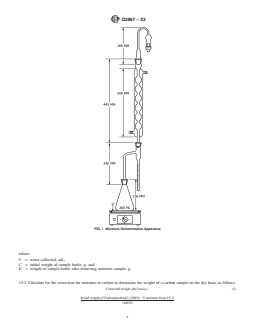
13.1 Clean the condenser, flask, and trap and carefully dry to ensure that it is free of water. Assemble the condenser and water
trap as shown in Fig. 1.
14. Procedure
14.1 Weigh the sample bottle. Dip out with a spoon from the sample bottle 2525 g to 50 g of the sample. Put this into the boiling
flask and reweigh the sample bottle to the nearest 0.1 g. Add 100 mL of xylene and connect the boiling flask to the water trap.
For carbons having density less than 0.30 g/cm , 200 mL of xylene should be used for a 25-g25 g sample.
14.2 Place the hot plate under the boiling flask and heat to boiling. Adjust the temperature control so as to reflux the xylene at
the rate of about 1 drop/s from the tip of the condenser. Continue to reflux until there is no further increase in the water layer in
the trap over a 30-min period (from 22 h to 8 h may be required).
15. Calculation
15.1 Calculate the moisture content as follows:
Moisture, weight %5 V/ C 2 E ×100
@ ~ !#
Reagent Chemicals, American Chemical Society Specifications, ACS Reagent Chemicals, Specifications and Procedures for Reagents and Standard-Grade Reference
Materials, American Chemical Society, Washington, DC. For suggestions on the testing of reagents not listed by the American Chemical Society, see Analar Standards for
Laboratory Chemicals, BDH Ltd., Poole, Dorset, U.K., and the United States Pharmacopeia and National Formulary, U.S. PharmaceuticalPharmacopeial Convention, Inc.
(USPC), Rockville, MD.
D2867 − 23
FIG. 1 Moisture Determination Apparatus
where:
V = water collected, mL,
C = initial weight of sample bottle, g, and
E = weight of sample bottle after removing moisture sample, g.
15.2 Calculate for the correction for moisture in carbon to determine the weight of a carbon sample on the dry basis as follows:
Corrected weight dry basis 5 (1)
~ !
Initial weight of Carbon~undried! ×~100%2% moisture from 15.1!
100%
~ !
D2867 − 23
MOISTURE BALANCE METHOD
16. Apparatus
16.1 Moisture balance, having a sensitivity of 0.1 mg and preferably an indirect heat source.
NOTE 2—An indirect heating sou
...