

ASTM D3803-91(2022)
(Test Method)Standard Test Method for Nuclear-Grade Activated Carbon
General Information
- Abstract
SIGNIFICANCE AND USE
5.1 The results of this test method give a conservative estimate of the performance of nuclear-grade activated carbon used in all nuclear power plant HVAC systems for the removal of radioiodine.
SCOPE
1.1 This test method is a very stringent procedure for establishing the capability of new and used activated carbon to remove radio-labeled methyl iodide from air and gas streams. The single test method described is for application to both new and used carbons, and should give test results comparable to those obtained from similar tests required and performed throughout the world. The conditions employed were selected to approximate operating or accident conditions of a nuclear reactor which would severely reduce the performance of activated carbons. Increasing the temperature at which this test is performed generally increases the removal efficiency of the carbon by increasing the rate of chemical and physical absorption and isotopic exchange, that is, increasing the kinetics of the radioiodine removal mechanisms. Decreasing the relative humidity of the test generally increases the efficiency of methyl iodide removal by activated carbon. The water vapor competes with the methyl iodide for adsorption sites on the carbon, and as the amount of water vapor decreases with lower specified relative humidities, the easier it is for the methyl iodide to be adsorbed. Therefore, this test method is a very stringent test of nuclear-grade activated carbon because of the low temperature and high relative humidity specified. This test method is recommended for the qualification of new carbons and the quantification of the degradation of used carbons.
1.1.1 Guidance for testing new and used carbons using conditions different from this test method is offered in Annex A1.
1.2 The values stated in SI units are to be regarded as standard. No other units of measurement are included in this standard.
1.3 This standard does not purport to address all of the safety concerns, if any, associated with its use. It is the responsibility of the user of this standard to establish appropriate safety, health, and environmental practices and determine the applicability of regulatory limitations prior to use.
1.4 This international standard was developed in accordance with internationally recognized principles on standardization established in the Decision on Principles for the Development of International Standards, Guides and Recommendations issued by the World Trade Organization Technical Barriers to Trade (TBT) Committee.
- Status
- Published
- Publication Date
- 31-Aug-2022
- Technical Committee
- D28 - Activated Carbon
- Drafting Committee
- D28.04 - Gas Phase Evaluation Tests
Overview
ASTM D3803-91(2022), Standard Test Method for Nuclear-Grade Activated Carbon, is an important international standard developed by ASTM specifically for testing the capability of activated carbon used in nuclear power plant HVAC systems. This method assesses both new and used carbon's ability to remove radio-labeled methyl iodide, offering a stringent and globally recognized approach to ensuring nuclear safety and air quality.
The test simulates challenging operating or accident conditions encountered in nuclear reactors, emphasizing high humidity and controlled temperature. Results provide a conservative estimate of performance relevant to the removal of radioactive iodines, forming a crucial basis for qualification and ongoing evaluation of carbon materials in nuclear environments.
Key Topics
- Radioiodine Removal Efficiency: The core objective is to quantify how effectively nuclear-grade activated carbon can remove radio-labeled methyl iodide from air and gas streams.
- Stringent Test Conditions: The method uses low temperatures and high relative humidity, closely approximating severe nuclear reactor scenarios where activated carbon performance is notably diminished.
- Global Comparability: Results from ASTM D3803 tests are designed to be consistent with similar methods used internationally, supporting standardization across different jurisdictions.
- Qualification and Degradation Assessment: The method can be applied to both new and used activated carbon to qualify materials for use and quantify the degradation over time.
- Safety and Compliance: Users are reminded to comply with safety, health, and environmental regulations, and to observe best practices in laboratory setup and operation.
Applications
- Nuclear Power Plant HVAC Air Filtration: Nuclear facilities use large-scale HVAC systems to control airborne contaminants, and compliance with ASTM D3803 assures that activated carbon filters perform reliably in removing radioiodine during both routine operation and accident events.
- Material Qualification: Both manufacturers and nuclear facility operators use this standard to qualify new batches of nuclear-grade activated carbon before installation.
- Performance Monitoring: The test method provides a systematic approach for evaluating the ongoing efficiency of used activated carbon, helping to determine replacement intervals and ensure regulatory compliance.
- International Procurement: As a globally harmonized test, ASTM D3803 results are accepted in supply contracts across various countries, facilitating the global trade of carbon filtration products for nuclear applications.
- Research and Development: Material scientists and engineers employ this method to develop improved nuclear-grade activated carbons with enhanced radioiodine adsorption properties.
Related Standards
A variety of related standards and referenced documents exist to support the implementation and precise execution of ASTM D3803-91(2022):
- ASTM D1193 - Specification for Reagent Water
- ASTM D2652 - Terminology Relating to Activated Carbon
- ASTM D2854 - Test Method for Apparent Density of Activated Carbon
- ASTM E300 - Practice for Sampling Industrial Chemicals
- ASTM E691 - Practice for Conducting an Interlaboratory Study to Determine the Precision of a Test Method
- ANSI/ASME N45.2.6 - Qualifications of Inspection, Examination, and Testing Personnel for Nuclear Power Plants
- MIL-STD-45662 - Calibration Systems Requirements
- MIL-F-51068D, MIL-F-51079A - Filter standards for high-efficiency, fire-resistant filters
Ensuring thorough understanding and adherence to these supporting documents is key for laboratories and nuclear facilities utilizing ASTM D3803. This approach supports enhanced nuclear safety, regulatory alignment, and consistent product quality across the global nuclear energy industry.
Keywords: ASTM D3803-91(2022), nuclear-grade activated carbon, radioiodine removal, nuclear power plant HVAC, activated carbon test method, methyl iodide removal, international standards, air filtration, nuclear safety.
Relations
- Effective Date
- 01-Jul-2014
- Effective Date
- 01-May-2013
- Effective Date
- 01-Nov-2011
- Effective Date
- 15-Jun-2011
- Effective Date
- 01-Apr-2009
- Effective Date
- 01-Oct-2008
- Effective Date
- 01-Mar-2006
- Effective Date
- 01-Nov-2005
- Effective Date
- 01-Jul-2005
- Effective Date
- 01-Jun-2005
- Effective Date
- 01-Oct-2004
- Effective Date
- 01-Jan-2000
- Effective Date
- 10-May-1999
- Effective Date
- 10-Feb-1999
- Effective Date
- 10-Feb-1999
Get Certified
Connect with accredited certification bodies for this standard

ECOCERT
Organic and sustainability certification.

Eurofins Food Testing Global
Global leader in food, environment, and pharmaceutical product testing.

Intertek Bangladesh
Intertek certification and testing services in Bangladesh.
Sponsored listings
Frequently Asked Questions
ASTM D3803-91(2022) is a standard published by ASTM International. Its full title is "Standard Test Method for Nuclear-Grade Activated Carbon". This standard covers: SIGNIFICANCE AND USE 5.1 The results of this test method give a conservative estimate of the performance of nuclear-grade activated carbon used in all nuclear power plant HVAC systems for the removal of radioiodine. SCOPE 1.1 This test method is a very stringent procedure for establishing the capability of new and used activated carbon to remove radio-labeled methyl iodide from air and gas streams. The single test method described is for application to both new and used carbons, and should give test results comparable to those obtained from similar tests required and performed throughout the world. The conditions employed were selected to approximate operating or accident conditions of a nuclear reactor which would severely reduce the performance of activated carbons. Increasing the temperature at which this test is performed generally increases the removal efficiency of the carbon by increasing the rate of chemical and physical absorption and isotopic exchange, that is, increasing the kinetics of the radioiodine removal mechanisms. Decreasing the relative humidity of the test generally increases the efficiency of methyl iodide removal by activated carbon. The water vapor competes with the methyl iodide for adsorption sites on the carbon, and as the amount of water vapor decreases with lower specified relative humidities, the easier it is for the methyl iodide to be adsorbed. Therefore, this test method is a very stringent test of nuclear-grade activated carbon because of the low temperature and high relative humidity specified. This test method is recommended for the qualification of new carbons and the quantification of the degradation of used carbons. 1.1.1 Guidance for testing new and used carbons using conditions different from this test method is offered in Annex A1. 1.2 The values stated in SI units are to be regarded as standard. No other units of measurement are included in this standard. 1.3 This standard does not purport to address all of the safety concerns, if any, associated with its use. It is the responsibility of the user of this standard to establish appropriate safety, health, and environmental practices and determine the applicability of regulatory limitations prior to use. 1.4 This international standard was developed in accordance with internationally recognized principles on standardization established in the Decision on Principles for the Development of International Standards, Guides and Recommendations issued by the World Trade Organization Technical Barriers to Trade (TBT) Committee.
SIGNIFICANCE AND USE 5.1 The results of this test method give a conservative estimate of the performance of nuclear-grade activated carbon used in all nuclear power plant HVAC systems for the removal of radioiodine. SCOPE 1.1 This test method is a very stringent procedure for establishing the capability of new and used activated carbon to remove radio-labeled methyl iodide from air and gas streams. The single test method described is for application to both new and used carbons, and should give test results comparable to those obtained from similar tests required and performed throughout the world. The conditions employed were selected to approximate operating or accident conditions of a nuclear reactor which would severely reduce the performance of activated carbons. Increasing the temperature at which this test is performed generally increases the removal efficiency of the carbon by increasing the rate of chemical and physical absorption and isotopic exchange, that is, increasing the kinetics of the radioiodine removal mechanisms. Decreasing the relative humidity of the test generally increases the efficiency of methyl iodide removal by activated carbon. The water vapor competes with the methyl iodide for adsorption sites on the carbon, and as the amount of water vapor decreases with lower specified relative humidities, the easier it is for the methyl iodide to be adsorbed. Therefore, this test method is a very stringent test of nuclear-grade activated carbon because of the low temperature and high relative humidity specified. This test method is recommended for the qualification of new carbons and the quantification of the degradation of used carbons. 1.1.1 Guidance for testing new and used carbons using conditions different from this test method is offered in Annex A1. 1.2 The values stated in SI units are to be regarded as standard. No other units of measurement are included in this standard. 1.3 This standard does not purport to address all of the safety concerns, if any, associated with its use. It is the responsibility of the user of this standard to establish appropriate safety, health, and environmental practices and determine the applicability of regulatory limitations prior to use. 1.4 This international standard was developed in accordance with internationally recognized principles on standardization established in the Decision on Principles for the Development of International Standards, Guides and Recommendations issued by the World Trade Organization Technical Barriers to Trade (TBT) Committee.
ASTM D3803-91(2022) is classified under the following ICS (International Classification for Standards) categories: 71.040.30 - Chemical reagents. The ICS classification helps identify the subject area and facilitates finding related standards.
ASTM D3803-91(2022) has the following relationships with other standards: It is inter standard links to ASTM D2854-09(2014), ASTM E691-13, ASTM E691-11, ASTM D2652-11, ASTM D2854-09, ASTM E691-08, ASTM D1193-06, ASTM E691-05, ASTM D2652-05a, ASTM D2652-05, ASTM D2854-96(2004), ASTM D2854-96(2000), ASTM E691-99, ASTM D1193-99e1, ASTM D2652-94(1999). Understanding these relationships helps ensure you are using the most current and applicable version of the standard.
ASTM D3803-91(2022) is available in PDF format for immediate download after purchase. The document can be added to your cart and obtained through the secure checkout process. Digital delivery ensures instant access to the complete standard document.
Standards Content (Sample)
This international standard was developed in accordance with internationally recognized principles on standardization established in the Decision on Principles for the
Development of International Standards, Guides and Recommendations issued by the World Trade Organization Technical Barriers to Trade (TBT) Committee.
Designation: D3803 − 91 (Reapproved 2022)
Standard Test Method for
Nuclear-Grade Activated Carbon
This standard is issued under the fixed designation D3803; the number immediately following the designation indicates the year of
original adoption or, in the case of revision, the year of last revision.Anumber in parentheses indicates the year of last reapproval.A
superscript epsilon (´) indicates an editorial change since the last revision or reapproval.
1. Scope 1.4 This international standard was developed in accor-
dance with internationally recognized principles on standard-
1.1 This test method is a very stringent procedure for
ization established in the Decision on Principles for the
establishing the capability of new and used activated carbon to
Development of International Standards, Guides and Recom-
remove radio-labeled methyl iodide from air and gas streams.
mendations issued by the World Trade Organization Technical
Thesingletestmethoddescribedisforapplicationtobothnew
Barriers to Trade (TBT) Committee.
and used carbons, and should give test results comparable to
those obtained from similar tests required and performed
2. Referenced Documents
throughout the world. The conditions employed were selected
2.1 ASTM Standards:
to approximate operating or accident conditions of a nuclear
D1193Specification for Reagent Water
reactor which would severely reduce the performance of
D2652Terminology Relating to Activated Carbon
activatedcarbons.Increasingthetemperatureatwhichthistest
D2854Test Method for Apparent Density of Activated
is performed generally increases the removal efficiency of the
Carbon
carbon by increasing the rate of chemical and physical absorp-
E300Practice for Sampling Industrial Chemicals
tion and isotopic exchange, that is, increasing the kinetics of
E691Practice for Conducting an Interlaboratory Study to
the radioiodine removal mechanisms. Decreasing the relative
Determine the Precision of a Test Method
humidityofthetestgenerallyincreasestheefficiencyofmethyl
2.2 Code of Federal Regulations:
iodideremovalbyactivatedcarbon.Thewatervaporcompetes
CFR Title 49,Section 173.34, “Qualification, Maintenance,
with the methyl iodide for adsorption sites on the carbon, and
and Use of Cylinders’’
as the amount of water vapor decreases with lower specified
CFR Title 49,Part 178, Subpart C, “Specifications for
relative humidities, the easier it is for the methyl iodide to be
Cylinders’’
adsorbed.Therefore, this test method is a very stringent test of
2.3 Military Standards:
nuclear-grade activated carbon because of the low temperature
MIL-F-51068D Filter, Particulate High Efficiency, Fire
and high relative humidity specified. This test method is
Resistant
recommended for the qualification of new carbons and the
MIL-F-51079A Filter, Medium Fire Resistant, High Effi-
quantification of the degradation of used carbons.
ciency
1.1.1 Guidance for testing new and used carbons using
MIL-STD-45662 Calibration Systems Requirements
conditions different from this test method is offered in Annex
2.4 Other Standards:
A1.
ANSI/ASME N45.2.6 Qualifications of Inspection,
1.2 The values stated in SI units are to be regarded as
Examination, and Testing Personnel for Nuclear Power
standard. No other units of measurement are included in this 5
Plants
standard.
3. Terminology
1.3 This standard does not purport to address all of the
safety concerns, if any, associated with its use. It is the
3.1 Definitions of Terms Specific to This Standard:
responsibility of the user of this standard to establish appro-
priate safety, health, and environmental practices and deter-
For referenced ASTM standards, visit the ASTM website, www.astm.org, or
mine the applicability of regulatory limitations prior to use.
contact ASTM Customer Service at service@astm.org. For Annual Book of ASTM
Standards volume information, refer to the standard’s Document Summary page on
the ASTM website.
Published by the General Service Administration, 18th and “F”’ St., N. W.,
This test method is under the jurisdiction of ASTM Committee D28 on Washington, DC 20405.
Activated Carbon and is the direct responsibility of Subcommittee D28.04 on Gas Available from Standardization Documents Order Desk, DODSSP, Bldg. 4,
Phase Evaluation Tests. Section D, 700 Robbins Ave., Philadelphia, PA 19111-5098, http://
Current edition approved Sept. 1, 2022. Published October 2022. Originally dodssp.daps.dla.mil.
approved in 1979. Last previous edition approved in 2014 as D3803–91 (2014). Available fromAmerican National Standards Institute (ANSI), 25 W. 43rd St.,
DOI: 10.1520/D3803-91R22. 4th Floor, New York, NY 10036, http://www.ansi.org.
Copyright © ASTM International, 100 Barr Harbor Drive, PO Box C700, West Conshohocken, PA 19428-2959. United States
D3803 − 91 (2022)
3.1.1 counter effıciency (CE)—the fraction of the actual 6.1.1 Riffle Sampler, in accordance with 32.5.2 of Practice
number of disintegrations of a radioactive sample that is E300.
recorded by a nuclear counter. 6.1.2 Feed Funnel and Vibrator, in accordance with the
Procedure Section of Test Method D2854.
3.1.2 effıciency (E)—the percentage of the contaminant
removed from a gas stream by an adsorption bed; expressed
6.2 Sample and Backup Bed Assemblies:
mathematically as E = 100 − P, where E and P are given in
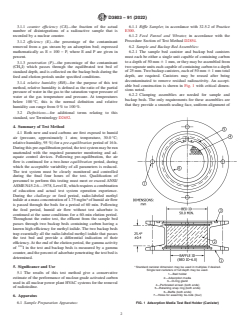
6.2.1 The sample bed canister and backup bed canisters
percent.
must each be either a single unit capable of containing carbon
to a depth of 50mm 6 1 mm, or they may be assembled from
3.1.3 penetration (P)—the percentage of the contaminant
twoseparateunitseachcapableofcontainingcarbontoadepth
(CH I) which passes through the equilibrated test bed of
of25mm.Twobackupcanisters,eachof50mm 61mmtotal
standard depth, and is collected on the backup beds during the
depth, are required. Canisters may be reused after being
feed and elution periods under specified conditions.
decontaminated to remove residual radioactivity. An accept-
3.1.4 relative humidity (RH)—for the purpose of this test
able bed construction is shown in Fig. 1 with critical dimen-
method, relative humidity is defined as the ratio of the partial
sions noted.
pressure of water in the gas to the saturation vapor pressure of
6.2.2 Clamping assemblies are needed for sample and
water at the gas temperature and pressure. At temperatures
backup beds. The only requirements for these assemblies are
below 100°C, this is the normal definition and relative
that they provide a smooth sealing face, uniform alignment of
humidity can range from 0% to 100%.
3.2 Definitions—for additional terms relating to this
standard, see Terminology D2652.
4. Summary of Test Method
4.1 Both new and used carbons are first exposed to humid
air (pressure, approximately 1 atm; temperature, 30.0°C;
relative humidity, 95%) for a pre-equilibration period of 16 h.
Duringthispre-equilibrationperiod,thetestsystemmayberun
unattended with the required parameter monitoring and ad-
equate control devices. Following pre-equilibration, the air
flow is continued for a two-hour equilibration period, during
which the acceptable variability of all parameters is reduced.
The test system must be closely monitored and controlled
during the final four hours of the test. Qualification of
personnel to perform this testing must meet or exceed ANSI/
ASMEN45.2.6—1978,LevelII,whichrequiresacombination
of education and actual test system operation experience.
During the challenge or feed period, radio-labeled methyl
iodideatamassconcentrationof1.75mg/m ofhumidairflow
is passed through the beds for a period of 60 min. Following
the feed period, humid air flow without test adsorbate is
continued at the same conditions for a 60-min elution period.
Throughout the entire test, the effluent from the sample bed
passes through two backup beds containing carbon having a
known high efficiency for methyl iodide.The two backup beds
trap essentially all the radio-labeled methyl iodide that passes
the test bed and provide a differential indication of their
efficiency.At the end of the elution period, the gamma activity
of I in the test and backup beds is measured by a gamma
counter,andthepercentofadsorbatepenetratingthetestbedis
determined.
5. Significance and Use
* Standard canister dimension may be used in multiples if desired.
Single test canisters of full depth may be used.
5.1 The results of this test method give a conservative
1—Bed holder
2—Adsorption media
estimate of the performance of nuclear-grade activated carbon
3—O-ring gland
used in all nuclear power plant HVAC systems for the removal
4—Perforated screen (both ends)
of radioiodine.
5—Retaining snap ring (both ends)
6—Baffle (both ends)
7—Holes for assembly tie-rods (four)
6. Apparatus
6.1 Sample Preparation Apparatus: FIG. 1 Adsorption Media Test Bed Holder (Canister)
D3803 − 91 (2022)
TABLE 1 Parameter Specifications
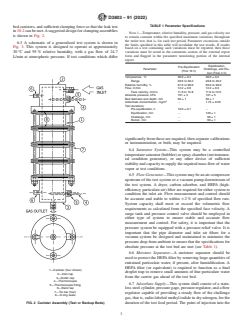
bedcanisters,andsufficientclampingforcesothattheleaktest
in10.2canbemet.Asuggesteddesignforclampingassemblies
NOTE 1—Temperature, relative humidity, pressure, and gas velocity are
is shown in Fig. 2.
to remain constant within the specified maximum variations throughout
the entire test, that is, for each test period. Parameter excursions outside
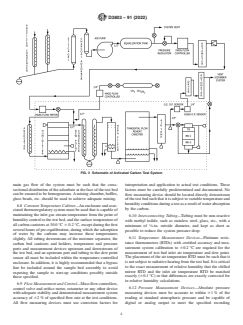
6.3 A schematic of a generalized test system is shown in
the limits specified in this table will invalidate the test results. If results
Fig. 3. This system is designed to operate at approximately
based on a test containing such variations must be reported, then these
30°C and 95% relative humidity, with a gas flow of 24.7 variations must be noted in the comments section of the external report
form and flagged in the parameter monitoring portion of the internal
L/min at atmospheric pressure. If test conditions which differ
report.
Equilibration,
Pre-Equilibration
Parameter Challenge, and Elu-
(First 16 h)
tion (Final 4 h)
Temperature, °C 30.0 ± 0.4 30.0 ± 0.2
Range 29.6 to 30.4 29.8 to 30.2
Relative humidity, % 91.0 to 96.0 93.0 to 96.0
Flow, m/min 12.2 ± 0.6 12.2 ± 0.3
Face velocity, m/min 11.6 to 12.8 11.9 to 12.5
Absolute pressure, kPa 101 ± 5 101 ± 5
Bed diameter and depth, mm 50 ± 1 50 ± 1
Adsorbate concentration, mg/m . 1.75 ± 0.25
Test durations:
Pre-equilibration, h 16.0 ± 0.1 .
Equilibration, min . 120 ± 1
Challenge, min . 60 ± 1
Elution, min . 60 ± 1
significantlyfromthesearerequired,thenseparatecalibrations
or instrumentation, or both, may be required.
6.4 Saturator System—This system may be a controlled
temperaturesaturator(bubbler)orspraychamber(environmen-
tal condition generator), or any other device of sufficient
stabilityandcapacitytosupplytherequiredmassflowofwater
vapor at test conditions.
6.5 FlowGenerator—Thissystemmaybeanaircompressor
upstream of the test system or a vacuum pump downstream of
the test system. A dryer, carbon adsorber, and HEPA (high-
efficiencyparticulateair)filterarerequiredforeithersystemto
condition the inlet air. Flow measurement and control should
be accurate and stable to within 62% of specified flow rate.
System capacity shall meet or exceed the volumetric flow
requirements as calculated from the specified face velocity. A
surge tank and pressure control valve should be employed in
either type of system to ensure stable and accurate flow
measurement and control. For safety, it is important that the
pressure system be equipped with a pressure relief valve. It is
important that the pipe diameter and inlet air filters for a
vacuum system be designed and maintained to minimize the
pressuredropfromambienttoensurethatthespecificationsfor
absolute pressure at the test bed are met (see Table 1).
6.6 Moisture Separator—A moisture separator should be
used to protect the HEPAfilter by removing large quantities of
entrained particulate water, if present, after humidification. A
HEPA filter (or equivalent) is required to function as a final
1—Canister (four shown)
droplet trap to remove small amounts of fine particulate water
2—Inlet cap
3—Outlet cap from the carrier gas ahead of the test bed.
4—Thermocouple
6.7 Adsorbate Supply—This system shall consist of a stain-
5—Thermocouple fitting
6—Static tap
lesssteelcylinder,pressuregage,pressureregulator,andaflow
7—Tie bar (four)
regulator capable of providing a steady flow of the challenge
8—O-ring seals
gas,thatis,radio-labeledmethyliodideindrynitrogen,forthe
FIG. 2 Canister Assembly (Test or Backup Beds) duration of the test feed period. The point of injection into the
D3803 − 91 (2022)
FIG. 3 Schematic of Activated Carbon Test System
main gas flow of the system must be such that the cross- interpretation and application to actual test conditions. These
sectionaldistributionoftheadsorbateatthefaceofthetestbed factors must be carefully predetermined and documented. No
canbeensuredtobehomogeneous.Amixingchamber,baffles, flow measuring device should be located directly downstream
glass beads, etc. should be used to achieve adequate mixing. ofthetestbedsuchthatitissubjecttovariabletemperatureand
humidityconditionsduringatestasaresultofwaterabsorption
6.8 ConstantTemperatureCabinet—Anenclosureandasso-
by the carbon.
ciatedthermoregulatorysystemmustbeusedthatiscapableof
maintaining the inlet gas stream temperature from the point of
6.10 Interconnecting Tubing—Tubing must be non-reactive
humiditycontroltothetestbed,andthesurfacetemperatureof
with methyl iodide, such as stainless steel, glass, etc., with a
allcarboncanistersat30.0°C 60.2°C,exceptduringthefirst 3
minimum of ⁄8-in. outside diameter, and kept as short as
several hours of pre-equilibration, during which the adsorption
possible to reduce the system pressure drop.
of water by the carbons may increase these temperatures
6.11 Temperature Measurement Devices—Platinum resis-
slightly. All tubing downstream of the moisture separator, the
tance thermometers (RTDs) with certified accuracy and mea-
carbon bed canisters and holders, temperature and pressure
surement system calibration to 60.2°C are required for the
ports and measurement devices upstream and downstream of
measurement of test bed inlet air temperature and dew point.
the test bed, and an upstream port and tubing to the dew point
The placement of the air temperature RTD must be such that it
sensor all must be included within the temperature controlled
isnotsubjecttoradiativeheatingfromthetestbed.Itiscritical
enclosure. In addition, it is highly recommended that a bypass
to the exact measurement of relative humidity that the chilled
line be included around the sample bed assembly to avoid
mirror RTD and the inlet air temperature RTD be matched
exposing the sample to start-up conditions possibly outside
exactly (60.1°C) or that differences are exactly corrected for
those specified.
in relative humidity calculations.
6.9 FlowMeasurementandControl—Massflowcontrollers,
control valve and orifice meter, rotameter or any other device 6.12 Pressure Measurement Devices—Absolute pressure
with adequate stability and demonstrated measurement system measuring devices must be accurate to within 61% of the
accuracy of 62% of specified flow rate at the test conditions. reading at standard atmospheric pressure and be capable of
All flow measuring devices must use correction factors for digital or analog output to meet the specified recording
D3803 − 91 (2022)
requirements. The sensors and output devices must be cali- the system. Line filters shall consist of a dryer, activated
brated as a unit to ensure system accuracy. The differential carbon, and HEPA filters and shall be adequately sized and
pressure device required for measurements across the test bed maintained.
mustbecapableofdetectinga0.25kPapressuredifferenceand
7.2 Water—Specification D1193 Type III reagent water,
be accurate to within 62% of the reading at the normal
deionized or distilled, or both, must be used for water-vapor
operating differential pressure.
generation.
6.13 HumidityMeasurement—Ahumiditymeasuringdevice
7.3 Radio-Labeled Methyl Iodide—Methyl iodide solution
with demonstrated accuracy and calibration to 60.2°C at
should be stored in the dark below 0°C to slow its decompo-
30°C and 95% relative humidity is required for measurement 131
sition to I . The activity of I should be such that the total
ofrelativehumidityofthegasstreamimmediatelyupstreamof
activity incident upon the detector in the entire spectrum from
the test bed. Note that for these test conditions only an optical 3 5
the test bed is between 10 and5×10 counts/min.
dew point hygrometer currently meets these specifications. A
7.4 Backup Bed Carbon,withapenetrationofnomorethan
secondary check on this measurement device is required to
3% when tested by this test method. The calculation of the
ensure that calibration offset has not occurred. This secondary
efficiency of the first backup bed is required for each test.
device may be another optical dew point hygrometer, wet
bulb/dry bulb, or any other device with a demonstrated
7.5 HEPA Filter Media—In accordance with MIL-F-
accuracy of 63% relative humidity. For this application, 51079A.Ifapleatedfilterisusedinplaceofaflatsheet,itshall
absolute accuracy is less important than reliability and repro-
be constructed in accordance with MIL-F-51068D.
ducibility.
8. Hazards
6.14 Data Recording—To meet the reporting requirements
8.1 Warning—Overpressure —The contaminant feed sys-
for internal reports (see 14.3), the use of potentiometric
temmakesuseofdrynitrogenfromstandardhigh-pressuregas
recorders or a data logger capable of recording temperatures,
cylinders, a contaminant feed cylinder which is pressurized,
pressures, flow, and relative humidity data a minimum of once
and associated regulators and tubing for transport of the
every five minutes is required
contaminant gas. This system must be designed with adequate
6.15 Gamma Detection System—Any reliable and efficient
safety factors. Standards for the fabrication of such pressure
detection system for gamma rays of 365 keV energy is
vesselsandassociatedfittingsarecontainedin49CFR173.34.
permissible, provided it produces actual counts of gamma
Elastomeric seals must be replaced on a regular basis or if
photons and not an analog rate output, and provides adequate
damaged to ensure system integrity.
eliminationofanyinterferencesthatmightbepresent.Systems
8.2 Warning—Radioactivity —The radiotoxicity of Iis
equipped with internal computers that make calculations or
well documented. The species used in this test is very volatile
corrections for such things as dead time, counting efficiency,
andeasilyinhaled.Rigoroushealthphysicsproceduresmustbe
decay rates, etc. are also permissible, provided they give
followed whenever handling the radioisotope and routine
accuracyequaltothatrequiredinthisstandard.Inmanycases,
thyroid counting must be provided for laboratory personnel.
eitherthallium-activatedsodiumiodidewellcountersorsingle-
The system must be adequately vented through a filter system
or multi-channel gamma spectrometers that use thallium-
capable of handling the maximum possible contaminant re-
activated sodium iodide, lithium-drifted germanium, or intrin-
lease. Radiation shielding and dosimetry must be provided to
sic germanium detectors can be used with appropriate profes-
limitandmonitorworkerexposuresincompliancewithfederal
sional guidance, proper shielding, and preferably graded
and state nuclear regulations. Personnel access to the system
absorbers of cadmium and copper to reduce the production of
should be strictly limited and workers should be trained in
X-rays in the shielding. When significant gamma-emitting
health physics procedures.
interferences are absent and penetration of iodine-131 ( I)
throughthetestbedisgreaterthanafewtenthsofonepercent,
9. Sampling
either the principal I photopeak at 364.46 keV or the entire
9.1 Guidanceinsamplinggranularactivatedcarbonisgiven
spectrum including the Compton continuum can be used.
in Practice E300.
However, when the penetration is low, a multi-channel spec-
trometer with a germanium detector will be required for the
9.2 Occasionally, samples received for laboratory analysis
most accurate measurements. This is necessary to identify the are not of sufficient quantity to fill the test canister to the
I in the presence of the lead-214 daughter of radium-226
standard depth of 5.08 cm (2 in.). If possible, another sample
generally present in carbon, and to permit Compton correction should be obtained. However, this is not always possible
for gamma-emitters such as potassium-40 and daughters of
becauseofcriticaltimeconstraints.Ifasubstandardquantityof
radium-226. The test bed, backup beds, and carbon back- carbon must be tested, the resulting actual penetration value
grounds must all be counted under identical geometrical
must be converted to the predicted penetration at the standard
conditions.Thisrequirestheuseofajigonthedetectortohold
depthandnotedassuchonboththeinternalandexternalreport
eachcountingbottleinidentically(61mm)thesameposition. forms. This conversion is based on the log-linear function of
penetration with depth and is expressed as in Eq 1.
7. Materials
P 5100exp ln P /100 5.08/d (1)
$@ ~ !#~ !%
s a
7.1 Air—Compressor, used for pressure systems, should be
of the oil-free type to minimize injection of hydrocarbons into where:
D3803 − 91 (2022)
10.4.1 No flow measuring device should be located directly
P = predicted penetration at the standard depth, %,
s
downstream of the test bed such that it is subject to variable
P = actual penetration at the substandard depth, %, and
a
temperatureandhumidityconditionsduringatestasaresultof
d = substandard depth, cm.
water adsorption by the carbon.
10. Preparation of Apparatus
11. Calibration
10.1 Fillasetofback-upcanistersandtestcanister(s)using
11.1 The RTDs used to measure the test bed inlet gas
the procedure in Test Method D2854, with the delivery funnel
temperature and the chilled mirror temperature of the dew
modified to accommodate the canister diameter. Count the
point hygrometer must be calibrated together every six months
background radioactivity in each canister (both test and back-
by the National Institute of Standards and Technology (NIST)
up) according to 12.7 and 12.8, then refill the canisters using
or a third party capable of certification to NIST standards.
the procedure in Test Method D2854.
Check the hygrometer accuracy at the same time. In addition,
10.2 Leak testing of the system designed to test carbon at the primary flow measuring device should also be calibrated
standard atmospheric pressure should be performed on a every six months by NIST or a third party capable of
routine basis, and is recommended prior to each test. This test certification to NIST standards. Other temperature, flow and
should be a pressure decay test for pressure induced flow pressure measuring devices, balances, radiation survey meters,
systems or a vacuum decay test for vacuum induced flow and gamma detection systems shall be part of an established
systems. The system should be pressurized to approximately laboratory calibration program as specified in MIL-STD-
125 kPa or depressurized to approximately 75 kPa with filled 45662, with initial calibration intervals of one month and
test and backup canisters in place. The system should then be periodic calibration intervals determined on the basis of
isolated, that is, sealed at all atmospheric connections, and the instrument stability, purpose, and degree of usage. It is impor-
pressure change with time recorded. The system should be tant to note that the measurement systems, that is, sensors,
made as leak tight as possible. However, a maximum leak rate associated electronics, displays, etc., must be calibrated indi-
should not exceed 5 kPa pressure change in 30 min to ensure vidually and together to ensure that the particular parameter
the accuracy of flow measurement. A more stringent leak rate monitoring system meets the accuracy and precision require-
requirement may be necessary because of health physics ments.
considerations. These calculations should be performed by
12. Procedure
each laboratory for each unique situation.
12.1 Stabilization Period—Install the filled test and backup
10.3 To ensure the accuracy of relative humidity
canisters in the system. Perform the leak test described in 10.2
measurement, a check of the differential pressure between the
to ensure system integrity. Bring the system up to operating
test bed and the sensor of the optical dew point hygrometer
conditions (see Table 1) prior to the start of pre-equilibration.
should be performed initially and whenever the system is
The duration of this stabilization period is recommended to be
modified, or semi-annually. This check should be performed
a minimum of 2 h, during which the canisters and carbon must
with the test and backup canisters filled with carbon and with
come to thermal equilibrium at the specified test temperature.
the system operating at the standard conditions specified, that
12.2 Pre-Equilibration Period (for new and used
is, temperature, flow, relative humidity, pressure, etc. This
carbons)—Passairwith95%relativehumidity(range,91.0%
differential pressure should not exceed 1 kPa or must be
to 96.0%) at a temperature of 30.0°C 6 0.4°C through the
corrected for either in the calculation of relative humidity, or
beds for 16.0h 6 0.1 h. There will be a sudden change in
preferably, by modification of the test system to reduce the
relative humidity at the start of pre-equilibration that will
pressure difference.
produce a rapid temperature rise in the carbon caused by the
10.4 Correction factors for flow measurement devices, es-
heat of adsorption of water.The extent of this temperature rise
pecially rotameters, must be predetermined by the comparison
cannot be controlled and depends upon the condition of the
of accurate pressure (61.0 kPa) and temperature (60.2°C)
carbon. The conditions at the test bed inlet must be held at the
measurements made at the device and at the test bed under
specified conditions (see Table 1).
normal operating conditions. Correction of the measured flow
12.3 Equilibration Period (for new and used carbons)—
to the actual flow at test bed for temperature, pressure, and
Continue to pass air with 95% relative humidity (range,
water vapor can be made using Eq 2:
93.0% to 96.0%) at a temperature of 30.0°C 6 0.2°C
~Q ! T ~P ! P
~ !
M A M H2O
through the beds for 120min 6 1 min.This is the critical time
Q 5 11 (2)
S D
A
T P P
~ !~ !
M A A
prior to challenge during which all conditions must be within
their most stringent control limits.
where:
Q = actual gas flow at the test bed, L/min, 12.4 ChallengePeriod(Feed)—Humidairflowisalreadyat
A
Q = flow of gas at the flow measurement device, L/min,
the prescribed conditions (see Table 1) at the start of the feed
M
T = actual gas temperature at the test bed, °K,
A period. Maintain flow at 30.0°C 6 0.2°C at 95% relative
T = gas temperature at flow measurement device, °K,
M
humidity (range, 93.0% to 96.0%) for 60min 6 1 min with
3 3
P = actual gas pressure at the test bed, kPa,
A
1.75mg⁄m 6 0.25 mg/m of radio-labeled CH I in the total
P = gas pressure at flow measurement device, kPa, and
M
system gas flow provided by the addition of a small and
P = partial pressure of water vapor at test bed, kPa.
H2O
continuous flow of the challenge gas during the feed period.
D3803 − 91 (2022)
12.5 Elution Period—To evaluate the ability of the carbon counted with dispatch, even the decay correction can be made
to hold the adsorbate once it is captured, continue flow at the negligible, although this is an unnecessary limitation on the
end of the feed period without change of the flow rate, relative procedure.
humidity, or temperature for a period of 60min 6 1 min (see
12.10 Counting Effıciency—Determination of the counting
Table 1).
efficiencyisunnecessaryasfarasthemeasurementofpenetra-
tion is concerned, and is undesirable because of the extra time
12.6 Monitor and record gas stream temperatures upstream
and downstream of the test bed.Adecrease in the downstream and the standard I solution that are required. However, if a
separate determination of the quantity of I used is desired,
temperature is indicative of bed flooding, where free water
condenses in the sample bed; in this case, the test should be the counting efficiency can be determined rather simply. Fill a
standard counting bottle with carbon to the standard height
aborted. Monitor temperatures, pressures, humidity, and air
flow at least every 5 min or continuously by means of a data used in the test procedure. Determine the volume of water
requiredtofilltheinterstitialvoidsjusttothetopofthecarbon.
logger or other recording device. Also monitor the pressure
dropacrossthebed.Erraticreadingsorasubstantialincreasein Count this sample under the standard counting conditions to
determine the blank. Measure an exact volume of a standard
this differential pressure is an additional indication of test bed
flooding. solution of I of such activity that dead time effects are kept
below about 1%. Dilute with water in a non-wetting plastic
12.7 At the end of the elution period, switch the system to
beaker to the volume determined previously to fill the carbon
bypass mode and shut down the system. Remove and disas-
voids. Repac
...