

ASTM D6646-03(2022)
(Test Method)Standard Test Method for Determination of the Accelerated Hydrogen Sulfide Breakthrough Capacity of Granular and Pelletized Activated Carbon
General Information
- Abstract
SIGNIFICANCE AND USE
5.1 This method compares the performance of granular or pelletized activated carbons used in odor control applications, such as sewage treatment plants, pump stations, etc. The method determines the relative breakthrough performance of activated carbon for removing hydrogen sulfide from a humidified gas stream. Other organic contaminants present in field operations may affect the H2S breakthrough capacity of the carbon; these are not addressed by this test. This test does not simulate actual conditions encountered in an odor control application, and is therefore meant only to compare the hydrogen sulfide breakthrough capacities of different carbons under the conditions of the laboratory test.
5.2 This test does not duplicate conditions that an adsorber would encounter in practical service. The mass transfer zone in the 23 cm column used in this test is proportionally much larger than that in the typical bed used in industrial applications. This difference favors a carbon that functions more rapidly for removal of H2S over a carbon with slower kinetics. Also, the 1 % H2S challenge gas concentration used here engenders a significant temperature rise in the carbon bed. This effect may also differentiate between carbons in a way that is not reflected in the conditions of practical service.
5.3 This standard as written is applicable only to granular and pelletized activated carbons with mean particle diameters less than 2.5 mm. Application of this standard to activated carbons with mean particle diameters (MPD) greater than 2.5 mm will require a larger diameter adsorption column. The ratio of column inside diameter to MPD should be greater than 10 in order to avoid wall effects. In these cases it is suggested that bed superficial velocity and contact time be held invariant at the conditions specified in this standard (4.77 cm/s and 4.8 s). Although not covered by this standard, data obtained from these tests may be reported as in paragraph 12 along with additional ...
SCOPE
1.1 This test method is intended to evaluate the performance of virgin, newly impregnated or in-service, granular or pelletized activated carbon for the removal of hydrogen sulfide from an air stream, under the laboratory test conditions described herein. A humidified air stream containing 1 % (by volume) hydrogen sulfide is passed through a carbon bed until 50 ppm breakthrough of H2S is observed. The H2S adsorption capacity of the carbon per unit volume at 99.5 % removal efficiency (g H2S/cm3 carbon) is then calculated. This test is not necessarily applicable to non-carbon adsorptive materials.
1.2 This standard as written is applicable only to granular and pelletized activated carbons with mean particle diameters (MPD) less than 2.5 mm. See paragraph 5.3 if activated carbons with larger MPDs are to be tested.
1.3 This standard does not purport to address all of the safety concerns, if any, associated with its use. It is the responsibility of the user of this standard to establish appropriate safety, health, and environmental practices and determine the applicability of regulatory limitations prior to use.
1.4 This international standard was developed in accordance with internationally recognized principles on standardization established in the Decision on Principles for the Development of International Standards, Guides and Recommendations issued by the World Trade Organization Technical Barriers to Trade (TBT) Committee.
- Status
- Published
- Publication Date
- 31-Aug-2022
- Technical Committee
- D28 - Activated Carbon
- Drafting Committee
- D28.04 - Gas Phase Evaluation Tests
Overview
ASTM D6646-03(2022) is the internationally recognized Standard Test Method for Determination of the Accelerated Hydrogen Sulfide Breakthrough Capacity of Granular and Pelletized Activated Carbon. Issued by ASTM International, this standard establishes a laboratory testing procedure to evaluate and compare the performance of granular or pelletized activated carbon in removing hydrogen sulfide (H₂S) from humidified gas streams.
While primarily designed for laboratory comparison, not real-world simulation, the method provides critical data for manufacturers and users of activated carbon in odor control applications. It measures the breakthrough capacity-the point at which H₂S is no longer sufficiently retained by the carbon-enabling procurement decisions and quality assurance for materials used in challenging environments like wastewater treatment and various industrial air purification systems.
Key Topics
- Hydrogen Sulfide Removal: Focuses on the efficiency of activated carbon in capturing H₂S from gas streams, a key need in odor control for municipal and industrial operations.
- Performance Comparison: Provides a uniform, reproducible test to compare different carbon types under accelerated but controlled conditions.
- Material Applicability: Applicable to virgin, newly impregnated, or in-service granular and pelletized activated carbon with mean particle diameters less than 2.5 mm. Adjustments are required for testing larger particle sizes.
- Laboratory Test Conditions: Utilizes a humidified air stream with 1% H₂S by volume passed through a carbon bed until a 50 ppm breakthrough is detected. Calculates the H₂S adsorption capacity at 99.5% removal efficiency.
- Limitations: The test does not account for other organic contaminants or simulate practical adsorber conditions, and results should be interpreted accordingly.
Applications
The ASTM D6646-03(2022) test method is widely applied in industries where hydrogen sulfide emissions pose operational or regulatory challenges. Key application areas include:
- Sewage Treatment Plants: Assessing activated carbon for controlling H₂S odors.
- Pump Stations: Ensuring effective air purification and workspace safety.
- Municipal Odor Control Facilities: Selecting optimal activated carbon media for air filtration systems.
- Industrial Air Handling Units: Comparing products for H₂S scrubbing capability in process gases.
- Carbon Supplier Quality Assurance: Providing a reliable benchmark for product performance, supporting material specification and procurement processes.
By standardizing hydrogen sulfide breakthrough testing, facilities can better identify the most efficient carbon products, leading to cost savings, improved air quality, and compliance with environmental standards.
Related Standards
ASTM D6646-03(2022) references and aligns with several other key standards and guides within the activated carbon and gas testing domains:
- ASTM D2652: Terminology Relating to Activated Carbon
- ASTM D2854: Test Method for Apparent Density of Activated Carbon
- ASTM D2867: Test Methods for Moisture in Activated Carbon
- ASTM E300: Practice for Sampling Industrial Chemicals
Facilities and professionals referencing ASTM D6646-03(2022) often utilize these related standards to ensure comprehensive sampling, measurement, and terminology consistency in the testing and application of activated carbon for hydrogen sulfide removal.
Keywords: ASTM D6646, hydrogen sulfide breakthrough, activated carbon, odor control, H₂S removal, granular activated carbon, pelletized activated carbon, laboratory test method, breakthrough capacity, air purification standard.
Relations
- Effective Date
- 01-Jul-2014
- Effective Date
- 15-Jun-2011
- Effective Date
- 01-Nov-2009
- Effective Date
- 01-Apr-2009
- Effective Date
- 01-Jul-2005
- Effective Date
- 01-Jun-2005
- Effective Date
- 01-Oct-2004
- Effective Date
- 01-Apr-2004
- Effective Date
- 01-Jan-2000
- Effective Date
- 10-Feb-1999
- Effective Date
- 10-Feb-1999
Get Certified
Connect with accredited certification bodies for this standard

ECOCERT
Organic and sustainability certification.

Eurofins Food Testing Global
Global leader in food, environment, and pharmaceutical product testing.

IMP NDT d.o.o.
Non-destructive testing services. Radiography, ultrasonic, magnetic particle, penetrant, visual inspection.
Sponsored listings
Frequently Asked Questions
ASTM D6646-03(2022) is a standard published by ASTM International. Its full title is "Standard Test Method for Determination of the Accelerated Hydrogen Sulfide Breakthrough Capacity of Granular and Pelletized Activated Carbon". This standard covers: SIGNIFICANCE AND USE 5.1 This method compares the performance of granular or pelletized activated carbons used in odor control applications, such as sewage treatment plants, pump stations, etc. The method determines the relative breakthrough performance of activated carbon for removing hydrogen sulfide from a humidified gas stream. Other organic contaminants present in field operations may affect the H2S breakthrough capacity of the carbon; these are not addressed by this test. This test does not simulate actual conditions encountered in an odor control application, and is therefore meant only to compare the hydrogen sulfide breakthrough capacities of different carbons under the conditions of the laboratory test. 5.2 This test does not duplicate conditions that an adsorber would encounter in practical service. The mass transfer zone in the 23 cm column used in this test is proportionally much larger than that in the typical bed used in industrial applications. This difference favors a carbon that functions more rapidly for removal of H2S over a carbon with slower kinetics. Also, the 1 % H2S challenge gas concentration used here engenders a significant temperature rise in the carbon bed. This effect may also differentiate between carbons in a way that is not reflected in the conditions of practical service. 5.3 This standard as written is applicable only to granular and pelletized activated carbons with mean particle diameters less than 2.5 mm. Application of this standard to activated carbons with mean particle diameters (MPD) greater than 2.5 mm will require a larger diameter adsorption column. The ratio of column inside diameter to MPD should be greater than 10 in order to avoid wall effects. In these cases it is suggested that bed superficial velocity and contact time be held invariant at the conditions specified in this standard (4.77 cm/s and 4.8 s). Although not covered by this standard, data obtained from these tests may be reported as in paragraph 12 along with additional ... SCOPE 1.1 This test method is intended to evaluate the performance of virgin, newly impregnated or in-service, granular or pelletized activated carbon for the removal of hydrogen sulfide from an air stream, under the laboratory test conditions described herein. A humidified air stream containing 1 % (by volume) hydrogen sulfide is passed through a carbon bed until 50 ppm breakthrough of H2S is observed. The H2S adsorption capacity of the carbon per unit volume at 99.5 % removal efficiency (g H2S/cm3 carbon) is then calculated. This test is not necessarily applicable to non-carbon adsorptive materials. 1.2 This standard as written is applicable only to granular and pelletized activated carbons with mean particle diameters (MPD) less than 2.5 mm. See paragraph 5.3 if activated carbons with larger MPDs are to be tested. 1.3 This standard does not purport to address all of the safety concerns, if any, associated with its use. It is the responsibility of the user of this standard to establish appropriate safety, health, and environmental practices and determine the applicability of regulatory limitations prior to use. 1.4 This international standard was developed in accordance with internationally recognized principles on standardization established in the Decision on Principles for the Development of International Standards, Guides and Recommendations issued by the World Trade Organization Technical Barriers to Trade (TBT) Committee.
SIGNIFICANCE AND USE 5.1 This method compares the performance of granular or pelletized activated carbons used in odor control applications, such as sewage treatment plants, pump stations, etc. The method determines the relative breakthrough performance of activated carbon for removing hydrogen sulfide from a humidified gas stream. Other organic contaminants present in field operations may affect the H2S breakthrough capacity of the carbon; these are not addressed by this test. This test does not simulate actual conditions encountered in an odor control application, and is therefore meant only to compare the hydrogen sulfide breakthrough capacities of different carbons under the conditions of the laboratory test. 5.2 This test does not duplicate conditions that an adsorber would encounter in practical service. The mass transfer zone in the 23 cm column used in this test is proportionally much larger than that in the typical bed used in industrial applications. This difference favors a carbon that functions more rapidly for removal of H2S over a carbon with slower kinetics. Also, the 1 % H2S challenge gas concentration used here engenders a significant temperature rise in the carbon bed. This effect may also differentiate between carbons in a way that is not reflected in the conditions of practical service. 5.3 This standard as written is applicable only to granular and pelletized activated carbons with mean particle diameters less than 2.5 mm. Application of this standard to activated carbons with mean particle diameters (MPD) greater than 2.5 mm will require a larger diameter adsorption column. The ratio of column inside diameter to MPD should be greater than 10 in order to avoid wall effects. In these cases it is suggested that bed superficial velocity and contact time be held invariant at the conditions specified in this standard (4.77 cm/s and 4.8 s). Although not covered by this standard, data obtained from these tests may be reported as in paragraph 12 along with additional ... SCOPE 1.1 This test method is intended to evaluate the performance of virgin, newly impregnated or in-service, granular or pelletized activated carbon for the removal of hydrogen sulfide from an air stream, under the laboratory test conditions described herein. A humidified air stream containing 1 % (by volume) hydrogen sulfide is passed through a carbon bed until 50 ppm breakthrough of H2S is observed. The H2S adsorption capacity of the carbon per unit volume at 99.5 % removal efficiency (g H2S/cm3 carbon) is then calculated. This test is not necessarily applicable to non-carbon adsorptive materials. 1.2 This standard as written is applicable only to granular and pelletized activated carbons with mean particle diameters (MPD) less than 2.5 mm. See paragraph 5.3 if activated carbons with larger MPDs are to be tested. 1.3 This standard does not purport to address all of the safety concerns, if any, associated with its use. It is the responsibility of the user of this standard to establish appropriate safety, health, and environmental practices and determine the applicability of regulatory limitations prior to use. 1.4 This international standard was developed in accordance with internationally recognized principles on standardization established in the Decision on Principles for the Development of International Standards, Guides and Recommendations issued by the World Trade Organization Technical Barriers to Trade (TBT) Committee.
ASTM D6646-03(2022) is classified under the following ICS (International Classification for Standards) categories: 19.020 - Test conditions and procedures in general; 71.040.30 - Chemical reagents. The ICS classification helps identify the subject area and facilitates finding related standards.
ASTM D6646-03(2022) has the following relationships with other standards: It is inter standard links to ASTM D2854-09(2014), ASTM D2652-11, ASTM D2867-09, ASTM D2854-09, ASTM D2652-05a, ASTM D2652-05, ASTM D2854-96(2004), ASTM D2867-04, ASTM D2854-96(2000), ASTM D2652-94(1999), ASTM D2867-99. Understanding these relationships helps ensure you are using the most current and applicable version of the standard.
ASTM D6646-03(2022) is available in PDF format for immediate download after purchase. The document can be added to your cart and obtained through the secure checkout process. Digital delivery ensures instant access to the complete standard document.
Standards Content (Sample)
This international standard was developed in accordance with internationally recognized principles on standardization established in the Decision on Principles for the
Development of International Standards, Guides and Recommendations issued by the World Trade Organization Technical Barriers to Trade (TBT) Committee.
Designation:D6646 −03 (Reapproved 2022)
Standard Test Method for
Determination of the Accelerated Hydrogen Sulfide
Breakthrough Capacity of Granular and Pelletized Activated
Carbon
This standard is issued under the fixed designation D6646; the number immediately following the designation indicates the year of
original adoption or, in the case of revision, the year of last revision.Anumber in parentheses indicates the year of last reapproval.A
superscript epsilon (´) indicates an editorial change since the last revision or reapproval.
1. Scope D2854Test Method for Apparent Density of Activated
Carbon
1.1 Thistestmethodisintendedtoevaluatetheperformance
D2867Test Methods for Moisture in Activated Carbon
of virgin, newly impregnated or in-service, granular or pellet-
E300Practice for Sampling Industrial Chemicals
ized activated carbon for the removal of hydrogen sulfide from
an air stream, under the laboratory test conditions described
3. Terminology
herein. A humidified air stream containing 1% (by volume)
3.1 Terms relating to this standard are defined in D2652.
hydrogen sulfide is passed through a carbon bed until 50 ppm
breakthrough of H S is observed.The H S adsorption capacity
2 2 4. Summary of Test Method
of the carbon per unit volume at 99.5% removal efficiency (g
4.1 Breakthrough capacity is determined by passing a
H S/cm carbon) is then calculated.This test is not necessarily
stream of humidified air containing 1 volume% hydrogen
applicable to non-carbon adsorptive materials.
sulfide through a sample of granular or pelletized activated
1.2 This standard as written is applicable only to granular
carbon of known volume under specified conditions until the
and pelletized activated carbons with mean particle diameters
concentrationofhydrogensulfideintheeffluentgasreaches50
(MPD) less than 2.5 mm. See paragraph 5.3 if activated
ppmv.
carbons with larger MPDs are to be tested.
5. Significance and Use
1.3 This standard does not purport to address all of the
5.1 This method compares the performance of granular or
safety concerns, if any, associated with its use. It is the
pelletized activated carbons used in odor control applications,
responsibility of the user of this standard to establish appro-
such as sewage treatment plants, pump stations, etc. The
priate safety, health, and environmental practices and deter-
method determines the relative breakthrough performance of
mine the applicability of regulatory limitations prior to use.
activatedcarbonforremovinghydrogensulfidefromahumidi-
1.4 This international standard was developed in accor-
fied gas stream. Other organic contaminants present in field
dance with internationally recognized principles on standard-
operations may affect the H S breakthrough capacity of the
ization established in the Decision on Principles for the
carbon; these are not addressed by this test. This test does not
Development of International Standards, Guides and Recom-
simulate actual conditions encountered in an odor control
mendations issued by the World Trade Organization Technical
application, and is therefore meant only to compare the
Barriers to Trade (TBT) Committee.
hydrogen sulfide breakthrough capacities of different carbons
under the conditions of the laboratory test.
2. Referenced Documents
5.2 This test does not duplicate conditions that an adsorber
2.1 ASTM Standards:
D2652Terminology Relating to Activated Carbon wouldencounterinpracticalservice.Themasstransferzonein
the 23 cm column used in this test is proportionally much
larger than that in the typical bed used in industrial applica-
tions. This difference favors a carbon that functions more
This test method is under the jurisdiction of ASTM Committee D28 on
rapidly for removal of H S over a carbon with slower kinetics.
Activated Carbon and is the direct responsibility of Subcommittee D28.04 on Gas
Phase Evaluation Tests.
Also, the 1% H S challenge gas concentration used here
Current edition approved Sept. 1, 2022. Published October 2022. Originally
engendersasignificanttemperatureriseinthecarbonbed.This
approved in 2001. Last previous edition approved in 2014 as D6646– 03 (2014).
effect may also differentiate between carbons in a way that is
DOI: 10.1520/D6646-03R22.
For referenced ASTM standards, visit the ASTM website, www.astm.org, or not reflected in the conditions of practical service.
contact ASTM Customer Service at service@astm.org. For Annual Book of ASTM
5.3 This standard as written is applicable only to granular
Standards volume information, refer to the standard’s Document Summary page on
the ASTM website. and pelletized activated carbons with mean particle diameters
Copyright ©ASTM International, 100 Barr Harbor Drive, PO Box C700, West Conshohocken, PA19428-2959. United States
D6646−03 (2022)
less than 2.5 mm. Application of this standard to activated
carbons with mean particle diameters (MPD) greater than 2.5
mmwillrequirealargerdiameteradsorptioncolumn.Theratio
ofcolumninsidediametertoMPDshouldbegreaterthan10in
order to avoid wall effects. In these cases it is suggested that
bed superficial velocity and contact time be held invariant at
the conditions specified in this standard (4.77 cm/s and 4.8 s).
Although not covered by this standard, data obtained from
these tests may be reported as in paragraph 12 along with
additional information about column diameter, volume of
carbon, and volumetric flow rate used.
5.4 For pelletized carbons, it is felt that the equivalent
spherical diameter of the pellet is the most suitable parameter
for determining the appropriate adsorption column inside
diameter. The equivalent spherical diameter is calculated
according to the following equation.
3XdXh
D 5 (1)
eqv
d12Xh
where:
d = the diameter, and
h = the length of the pellet in mm.
An average of 50 to 100 measurements is recommended to
determinetheaveragelengthofapellet.AnnexA3isatableto
guide the user in selecting bed diameter and flow rates from
typical equivalent diameters (or MPD) of pelletized carbon.
6. Apparatus and Materials
6.1 (561) % Hydrogen Sulfide in Nitrogen Mixture—The
concentration of hydrogen sulfide in the gas test mixture must
be known. It is recommended that gas cylinders specifically
manufactured for holding hydrogen sulfide gas be used. Ana-
lyzed and certified hydrogen sulfide in nitrogen gas mixtures
can be purchased from specialty gas suppliers. Annex A1 and
Annex A2 present methods that may be used to check the
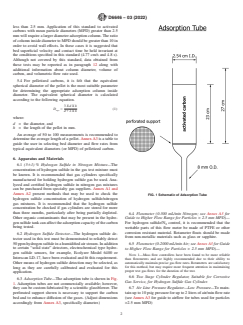
FIG. 1Schematic of Adsorption Tube
hydrogen sulfide concentration of hydrogen sulfide/nitrogen
gas mixtures. It is recommended that the hydrogen sulfide
concentration be checked if gas cylinders are stored for more
than three months, particularly after being partially depleted.
6.4 Flowmeter (0-500 mL/min Nitrogen; see Annex A3 for
Other organic contaminants that may be present in the hydro-
Guide to Higher Flow Range for Particles > 2.5 mm MPD)—
gensulfidetankcanaffecttheadsorptioncapacityofthecarbon
For hydrogen sulfide/N control, it is recommended that the
being tested.
wettable parts of this flow meter be made of PTFE or other
corrosion resistant material. Rotameter floats should be made
6.2 Hydrogen Sulfide Detector—The hydrogen sulfide de-
from non-metallic materials such as glass or sapphire.
tector used in this test must be demonstrated to reliably detect
50ppmhydrogensulfideinahumidifiedairstream.Inaddition 6.5 Flowmeter (0-2000 mL/minAir; see AnnexA3 for Guide
to certain “solid state” detectors, electrochemical type hydro-
to Higher Flow Range for Particles > 2.5 mm MPD)—
gen sulfide sensors, for example, Ecolyzer Model 6400 or
NOTE 1—Mass flow controllers have been found to be more reliable
Interscan LD-17, have been evaluated and fit this requirement.
than flowmeters and are highly recommended due to their ability to
Other means of hydrogen sulfide detection may be selected, as
automatically maintain precise gas flow rates. Rotameters are satisfactory
long as they are carefully calibrated and evaluated for this for this method, but may require more frequent attention in maintaining
proper test gas flows for the duration of the test.
application.
6.6 Two Stage Cylinder Regulator, Suitable for Corrosive
6.3 Adsorption Tube—The adsorption tube is shown in Fig.
Gas Service, for Hydrogen Sulfide Gas Cylinder.
1. Adsorption tubes are not commercially available; however,
they can be custom fabricated by a scientific glassblower. The 6.7 Air Line Pressure Regulator—Low Pressure—To main-
perforated support shown is necessary to support the carbon tainupto10psigpressureforupto2litersofair/minflowrate
bed and to enhance diffusion of the gases. (Adjust dimensions (see AnnexA3 for guide to airflow for tubes used for particles
accordingly from Annex A3, specifically diameter.) >2.5 mm MPD)
D6646−03 (2022)
6.8 Two Metering Valves—Suitable valves are the Whitey 6.14 Powder Funnel.
SS-21-RS4 (H S/N ) and B-21-RS4 (air). Other similar valves
2 2
6.15 Temperature Controlled Water Bath, to maintain the
maybeused.Iftherotametersin6.4and6.5areequippedwith
water bubbler at 25°C 6 2°C.
their own high quality metering valves, these valves are not
6.16 Other miscellaneous hardware needed to set up the
needed.
apparatusinFig.2.Polyethylenetubingissuitableforcarrying
6.9 Source of Dry, Contaminant-Free Air Capable of Deliv-
theH S/N flow.Clampedballandsocketjointsareconvenient
2 2
ering up to 2 liters/min Through the Test System, (higher flow
forquickconnectanddisconnectoftheabsorptioncolumnand
for larger particles, >2.5 mm MPD, see Table A3.2.)
calibration bubbler (see Annex A2) from the system.
6.10 Gas Bubbler—(Ace Glass cat .#5516 gas washing
bottle equipped with gas dispersion fritted tube, cat. #7202, 7. Safety Precautions
porosity code “C,” or equivalent to this.) The glass bubbler
7.1 Severalpotentialhazardsareassociatedwithconducting
shouldbeimmersedinaconstanttemperaturebathregulatedat
this test procedure. It is not the purpose of this standard to
25°C to ensure the generation of a 80% RH air stream for the
address all potential health and safety hazards encountered
final gas mixture (after mixing with dry H S/N ). The porous
2 2
with its use. The user is responsible for establishing appropri-
bubbler should be immersed under at least 3 in. of water to
atehealthandsafetypracticesbeforeuseofthistestprocedure.
consistently saturate the air stream with water during the
Determine the applicability of Federal and State regulations
course of the test. (Alarger gas washing bottle should be used
before attempting to use this standard test method.
if larger particles than 2.5 mm (Equivalent Diameter) and a
7.2 Personnel conducting the hydrogen sulfide adsorption
larger bed are used. Increase size proportionately with air
capacity procedure should be aware of potential safety and
flow).
health hazards associated with the chemicals used in this
6.11 Hydrogen Sulfide Calibration Gas Mixture, 20 to 50
procedure.The “Material Safety Data Sheet” (MSDS) for each
ppmv,innitrogen,tobeusedasaspanorcalibrationgasforthe
reagent listed in Section 6 should be read and understood.
hydrogensulfidedetector.(Availablefromspecialtygassupply
Special precautions to be taken during use of each reagent are
companies.)
included on the MSDS. First aid procedures for contact with a
6.12 Timer—A count up timer that can be tripped at the 50 chemical are also listed on its MSDS. The MSDS for each
ppmv set point of the H S monitor and is capable of retaining reagent may be obtained from the manufacturer.
the tripped time.
7.3 Safety and health hazard information on reagents used
6.13 Vibratory Feeder, (see Test Method D2854). in this procedure may also be obtained from:
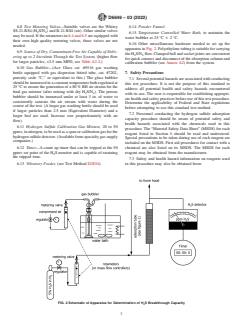
FIG. 2Schematic of Apparatus for Determination of H S Breakthrough Capacity
D6646−03 (2022)
7.3.1 Sax’s Dangerous Properties of Industrial Materials / determine the volume of water required to fill the adsorption
Richard J. Lewis, Sr., New York : J. Wiley, 2000. tube from the top of the carbon support to approximately the
7.3.2 NIOSH/OSHA Pocket Guide to Chemical Hazards, 22.9 cm mark.)
1997, U.S. Department of Labor, Occupational Safety and
10.8 Tare a clean, dry adsorption tube to the nearest 0.1 g.
Health Administration, Washington, D.C. Available from U.S.
Note and record.
Government Printing Office, Washington, D.C. or at http://
10.9 Fill the adsorption tube with 116 mL of carbon [bed
www.cdc.gov/niosh/npg/npg.html.
depthofapproximately22.9cm]usingavibratoryfeeder.(The
apparatus described in Test Method D2854, or equivalent is
8. Sampling
suitable for filling the adsorption tube.)The vibratory feeder is
8.1 Guidanceinsamplinggranularactivatedcarbonisgiven
to be adjusted so the adsorption tube is filled at a rate not less
in recommended Practice E300.
than 0.75mL⁄s or exceeding 1.0 mL/s. (See Annex A3 for
guide to larger volume if larger than 2.5 mm (Equivalent
9. Calibration
Diameter) particles are tested.)
9.1 Calibration of flowmeters, mass flow controllers, and
10.10 Weighthefilledadsorptiontubetothenearest0.1gm.
hydrogen sulfide detectors shall be performed by standard
Note and record.
laboratory methods.
10.11 Carefully transfer the filled adsorption tube to the test
NOTE 2—The test apparatus (Fig. 1) has metering valves at the
system and connect it to the test apparatus.
rotameter outlets. This is done to minimize changes in gas flow rates
caused by small backpressure changes during this long duration test.
NOTE 3—If a sample of non-impregnated, low moisture, virgin carbon
However, placement of metering valves in this position invalidates the
is being evaluated for adsorption capacity, it is advised that it be
atmospheric pressure calibration usually supplied by the rotameter manu-
conditioned for several hours with only humidified air passing through it
facturer. The apparatus in A2.4.2 may be used to calibrate the rotameters.
to equilibrate the moisture content of the carbon with the moisture in the
During this calibration, the gas delivery pressure must be the same as that
airstream.Themoisturecontentofthecarbonwillaffectthebreakthrough
used during the actual test.
capacity
9.2 Determine the percent H S in the H S/nitrogen tank
2 2
Start the H S/air flow and simultaneously start the timer.
using the methods outlined in Annex A1 or Annex A2 if the
10.12 Continue the H S/air flow until a breakthrough of 50
H S/nitrogen tank was not certified by the manufacturer.
ppmv is indicated. Record the time elapsed from the start of
H S/air flow to 50 ppm breakthrough.
10. Procedure 2
10.1 Assemble the test apparatus as shown in the schematic 10.13 Repeat 10.2 – 10.12 on replicate portions of the
carbon sample. A minimum of one replicate analyses must be
diagram of Fig. 2.
performed.
10.2 Adjust the H S/N and air flow rates to generate a
2 2
1.0% H S stream at a total flow rate of 1450 cm /min at the
11. Calculation
one-inch diameter adsorption tube (see Annex A3 for higher
flowrates with larger than 2.5 mm (Equivalent Diameter)
11.1 Calculate the hydrogen sulfide breakthrough capacity
particles).This adjustment will depend on the concentration of
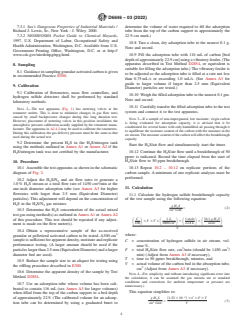
of the test sample using the following equation:
H S in the H S/N gas mixture.
2 2 2
gH S
5 (2)
10.3 Determine the H S concentration of the actual mixed
cm GAC
test gas using method(s) as outlined in AnnexA1 or AnnexA2
C 1 L 1 mole 34.1gH S
of this procedure. This test should be repeated if any adjust- 2
3F 3T 3 3 3
S D S D S D S D
100 1000 c
...