

ASTM E3017-19
(Practice)Standard Practice for Examining Magnetic Card Readers
General Information
- Abstract
SIGNIFICANCE AND USE
4.1 As a skimming device is not typically deemed contraband in of itself, it is the responsibility of the examiner to determine if the device contains unauthorized account information. The purpose of this practice is to describe best practices for seizing, acquiring, and analyzing the data contained within magnetic card readers.
4.2 Limitations—Skimmers present unique examination challenges due to:
4.2.1 Rapid changes in technology;
4.2.2 Difficulty of device disassembly;
4.2.3 Use of alternate/repurposed components;
4.2.4 Use of encryption or examination countermeasures, or both;
4.2.5 Multiple data encoding/modulation formats;
4.2.6 Prevention of chip identification by obfuscation of the device;
4.2.7 Availability of training and documentation;
4.2.8 Lack of chip information/documentation;
4.2.9 Lack of adapters available for chip reading;
4.2.10 Expense of available equipment used in chip removal and reading;
4.2.11 Lack of software’s ability to support reading chip data; and
4.2.12 Lack of commercial software available to analyze encrypted data extracted from skimmers.
SCOPE
1.1 Magnetic card readers, when used for illegal purposes, are commonly referred to as skimmers. This practice provides information on seizing, acquiring, and analyzing skimming devices capable of acquiring and storing personally identifiable information (PII) in an unauthorized manner.
1.2 This standard cannot replace knowledge, skills, or abilities acquired through education, training, and experience and is to be used in conjunction with professional judgment by individuals with such discipline-specific knowledge, skills, and abilities.
1.3 This standard does not purport to address all of the safety concerns, if any, associated with its use. It is the responsibility of the user of this standard to establish appropriate safety, health, and environmental practices and determine the applicability of regulatory limitations prior to use.
1.4 This international standard was developed in accordance with internationally recognized principles on standardization established in the Decision on Principles for the Development of International Standards, Guides and Recommendations issued by the World Trade Organization Technical Barriers to Trade (TBT) Committee.
- Status
- Published
- Publication Date
- 31-May-2019
- Technical Committee
- E30 - Forensic Sciences
- Drafting Committee
- E30.12 - Digital and Multimedia Evidence
Overview
ASTM E3017-19: Standard Practice for Examining Magnetic Card Readers provides comprehensive guidelines for the seizure, acquisition, and analysis of magnetic card readers, particularly those used as skimming devices for unauthorized collection of personally identifiable information (PII). The standard, developed by ASTM International, recognizes that the use and examination of skimming devices requires specialized skills and is intended as a complement to professional training and established forensic procedures.
This standard addresses the rapid evolution of skimming technology, the diverse configurations of skimming devices, and the challenges presented by encryption and proprietary encoding methods. ASTM E3017-19 is an essential tool for forensic examiners, law enforcement, and security professionals managing digital evidence involving magnetic card skimmers.
Key Topics
- Types of Skimming Devices: Categorizes skimmers into hand-held, altered hand-held, and custom devices, each with unique forensic challenges.
- Seizure and Handling: Offers best practices for collecting skimming devices and associated evidence, emphasizing preservation of integrity and chain of custody.
- Data Extraction: Outlines methods and technologies for retrieving stored card data, whether stored in analog or digital form, and notes the frequent challenges of component obfuscation and encryption.
- Data Analysis: Provides guidance on analyzing extracted data-understanding track layouts in accordance with ISO/IEC standards, and handling encoded or encrypted files.
- Limitations and Challenges: Discusses obstacles such as rapidly changing technology, diverse and repurposed hardware, lack of documentation, and limited commercial analysis tools.
Applications
ASTM E3017-19 is applied in various scenarios where identification and investigation of skimming devices is required, including:
- Forensic Investigations: Used by digital forensic examiners and law enforcement to lawfully collect and analyze evidence from skimming devices found at ATMs, point-of-sale terminals, gas pumps, and access control systems.
- Security Assessments: Enables IT and physical security professionals to understand and detect unauthorized devices intended to collect magnetic stripe card data.
- Fraud Prevention: Assists financial institutions and payment processors in identifying attack vectors used by criminals to illegally collect customer data.
- Prosecution Support: Provides standardized procedures and terminology that can support the admissibility of forensic evidence in legal proceedings.
The standard emphasizes that forensic examiners should adapt their examination processes based on the unique design of each device and should consult relevant international standards to interpret card data formats.
Related Standards
ASTM E3017-19 references several established standards and best practices to support effective examination of magnetic card readers:
- ASTM E2763: Practice for Computer Forensics (withdrawn 2019; relevant for foundational forensics practices)
- ASTM E2916: Terminology for Digital and Multimedia Evidence Examination
- ISO/IEC 7811, 7812-1:2017, 7813:2006: Standards on identification cards and financial transaction cards, establishing key card data formats
- SWGDE Best Practices: Recommendations for chip-off techniques, computer forensics, and validation testing
- ANSI X4.16: Standard for magnetic stripe encoding used in financial transaction cards
Complying with ASTM E3017-19 ensures a standardized, reliable approach to the forensic examination of skimming devices and supports international harmonization efforts concerning digital evidence and card data security.
Keywords: ASTM E3017-19, magnetic card reader, skimming device, forensic examination, digital evidence, PII security, card skimmer forensics, data extraction, card fraud prevention, international standards
Relations
- Effective Date
- 01-Mar-2019
- Effective Date
- 01-Nov-2018
- Effective Date
- 01-Jun-2013
- Effective Date
- 15-Aug-2010
Get Certified
Connect with accredited certification bodies for this standard

BSI Group
BSI (British Standards Institution) is the business standards company that helps organizations make excellence a habit.

NYCE
Mexican standards and certification body.
Sponsored listings
Frequently Asked Questions
ASTM E3017-19 is a standard published by ASTM International. Its full title is "Standard Practice for Examining Magnetic Card Readers". This standard covers: SIGNIFICANCE AND USE 4.1 As a skimming device is not typically deemed contraband in of itself, it is the responsibility of the examiner to determine if the device contains unauthorized account information. The purpose of this practice is to describe best practices for seizing, acquiring, and analyzing the data contained within magnetic card readers. 4.2 Limitations—Skimmers present unique examination challenges due to: 4.2.1 Rapid changes in technology; 4.2.2 Difficulty of device disassembly; 4.2.3 Use of alternate/repurposed components; 4.2.4 Use of encryption or examination countermeasures, or both; 4.2.5 Multiple data encoding/modulation formats; 4.2.6 Prevention of chip identification by obfuscation of the device; 4.2.7 Availability of training and documentation; 4.2.8 Lack of chip information/documentation; 4.2.9 Lack of adapters available for chip reading; 4.2.10 Expense of available equipment used in chip removal and reading; 4.2.11 Lack of software’s ability to support reading chip data; and 4.2.12 Lack of commercial software available to analyze encrypted data extracted from skimmers. SCOPE 1.1 Magnetic card readers, when used for illegal purposes, are commonly referred to as skimmers. This practice provides information on seizing, acquiring, and analyzing skimming devices capable of acquiring and storing personally identifiable information (PII) in an unauthorized manner. 1.2 This standard cannot replace knowledge, skills, or abilities acquired through education, training, and experience and is to be used in conjunction with professional judgment by individuals with such discipline-specific knowledge, skills, and abilities. 1.3 This standard does not purport to address all of the safety concerns, if any, associated with its use. It is the responsibility of the user of this standard to establish appropriate safety, health, and environmental practices and determine the applicability of regulatory limitations prior to use. 1.4 This international standard was developed in accordance with internationally recognized principles on standardization established in the Decision on Principles for the Development of International Standards, Guides and Recommendations issued by the World Trade Organization Technical Barriers to Trade (TBT) Committee.
SIGNIFICANCE AND USE 4.1 As a skimming device is not typically deemed contraband in of itself, it is the responsibility of the examiner to determine if the device contains unauthorized account information. The purpose of this practice is to describe best practices for seizing, acquiring, and analyzing the data contained within magnetic card readers. 4.2 Limitations—Skimmers present unique examination challenges due to: 4.2.1 Rapid changes in technology; 4.2.2 Difficulty of device disassembly; 4.2.3 Use of alternate/repurposed components; 4.2.4 Use of encryption or examination countermeasures, or both; 4.2.5 Multiple data encoding/modulation formats; 4.2.6 Prevention of chip identification by obfuscation of the device; 4.2.7 Availability of training and documentation; 4.2.8 Lack of chip information/documentation; 4.2.9 Lack of adapters available for chip reading; 4.2.10 Expense of available equipment used in chip removal and reading; 4.2.11 Lack of software’s ability to support reading chip data; and 4.2.12 Lack of commercial software available to analyze encrypted data extracted from skimmers. SCOPE 1.1 Magnetic card readers, when used for illegal purposes, are commonly referred to as skimmers. This practice provides information on seizing, acquiring, and analyzing skimming devices capable of acquiring and storing personally identifiable information (PII) in an unauthorized manner. 1.2 This standard cannot replace knowledge, skills, or abilities acquired through education, training, and experience and is to be used in conjunction with professional judgment by individuals with such discipline-specific knowledge, skills, and abilities. 1.3 This standard does not purport to address all of the safety concerns, if any, associated with its use. It is the responsibility of the user of this standard to establish appropriate safety, health, and environmental practices and determine the applicability of regulatory limitations prior to use. 1.4 This international standard was developed in accordance with internationally recognized principles on standardization established in the Decision on Principles for the Development of International Standards, Guides and Recommendations issued by the World Trade Organization Technical Barriers to Trade (TBT) Committee.
ASTM E3017-19 is classified under the following ICS (International Classification for Standards) categories: 35.240.15 - Identification cards. Chip cards. Biometrics. The ICS classification helps identify the subject area and facilitates finding related standards.
ASTM E3017-19 has the following relationships with other standards: It is inter standard links to ASTM E2916-19, ASTM E2916-18, ASTM E2916-13, ASTM E2763-10. Understanding these relationships helps ensure you are using the most current and applicable version of the standard.
ASTM E3017-19 is available in PDF format for immediate download after purchase. The document can be added to your cart and obtained through the secure checkout process. Digital delivery ensures instant access to the complete standard document.
Standards Content (Sample)
This international standard was developed in accordance with internationally recognized principles on standardization established in the Decision on Principles for the
Development of International Standards, Guides and Recommendations issued by the World Trade Organization Technical Barriers to Trade (TBT) Committee.
Designation: E3017 − 19 An American National Standard
Standard Practice for
Examining Magnetic Card Readers
This standard is issued under the fixed designation E3017; the number immediately following the designation indicates the year of
original adoption or, in the case of revision, the year of last revision.Anumber in parentheses indicates the year of last reapproval.A
superscript epsilon (´) indicates an editorial change since the last revision or reapproval.
1. Scope ISO/IEC 7812-1:2017Identification Cards—Identification
of Issuers—Part 1: Numbering SSystem
1.1 Magnetic card readers, when used for illegal purposes,
ISO/IEC 7813:2006 Information Technology—
are commonly referred to as skimmers. This practice provides
Identification Cards—Financial Transaction Cards
information on seizing, acquiring, and analyzing skimming
2.3 SWGDE Standards:
devicescapableofacquiringandstoringpersonallyidentifiable
information (PII) in an unauthorized manner. SWGDE Best Practices for Chip-Off
SWGDE Best Practices for Computer Forensics
1.2 This standard cannot replace knowledge, skills, or
SWGDE Recommendations for Validation Testing
abilities acquired through education, training, and experience
SWGDE Tech Notes Regarding Chip-Off via Material Re-
and is to be used in conjunction with professional judgment by
moval Using a Lap and Polish Process
individuals with such discipline-specific knowledge, skills, and
2.4 ANSI Standards:
abilities.
ANSI X4.16 Financial Services—Financial Transaction
1.3 This standard does not purport to address all of the
Cards—Magnetic Stripe Encoding
safety concerns, if any, associated with its use. It is the
responsibility of the user of this standard to establish appro-
3. Terminology
priate safety, health, and environmental practices and deter-
3.1 Definitions:
mine the applicability of regulatory limitations prior to use.
3.1.1 For definitions of terms used in this practice, refer to
1.4 This international standard was developed in accor-
Terminology E2916.
dance with internationally recognized principles on standard-
ization established in the Decision on Principles for the
3.2 Definitions of Terms Specific to This Standard:
Development of International Standards, Guides and Recom-
3.2.1 parasitic skimmer, n—a type of device manufactured
mendations issued by the World Trade Organization Technical
for the capture of account data from magnetically encoded
Barriers to Trade (TBT) Committee.
cardsthatoperatesin-linewiththeoriginalATM,gaspump,or
other card reading device.
2. Referenced Documents
3.2.2 start sentinel, n—a 5-bit binary sequence, or equiva-
2.1 ASTM Standards:
lent ASCII character, used to signify the beginning of track
E2763Practice for Computer Forensics (Withdrawn 2019)
data. (See ISO/IEC 7813:2006.)
E2916Terminology for Digital and Multimedia Evidence
3.2.3 skimmer, n—a magnetic card reader, specifically when
Examination
used for an illegal purpose.
2.2 ISO Standards:
3.2.4 skimming, n—using a skimmer to acquire PII in an
ISO/IEC 7811Identification Cards—Recording Technique
unauthorized manner.
3.2.5 swipe, v—to manually pass a magnetically encoded
This practice is under the jurisdiction of ASTM Committee E30 on Forensic
card through a card reader device to transfer information from
Sciences and is the direct responsibility of Subcommittee E30.12 on Digital and
the card.
Multimedia Evidence.
Current edition approved June 1, 2019. Published June 2019. Originally
3.3 Acronyms:
approved in 2015. Last previous edition approved as E3017 – 15. DOI: 10.1520/
3.3.1 ADPCM, n—adaptive pulse code modulation
E3017-19.
For referenced ASTM standards, visit the ASTM website, www.astm.org, or 3.3.2 AES, n—advanced encryption standard
contact ASTM Customer Service at service@astm.org. For Annual Book of ASTM
Standards volume information, refer to the standard’s Document Summary page on
the ASTM website.
3 5
The last approved version of this historical standard is referenced on Available from the Scientific Working Group on Digital Evidence (SWDGE),
www.astm.org. https://www.swgde.org.
4 6
Available from National Institute of Standards and Technology (NIST), 100 Available fromAmerican National Standards Institute (ANSI), 25 W. 43rd St.,
Bureau Dr., Stop 1070, Gaithersburg, MD 20899-1070, http://www.nist.gov. 4th Floor, New York, NY 10036, http://www.ansi.org.
Copyright © ASTM International, 100 Barr Harbor Drive, PO Box C700, West Conshohocken, PA 19428-2959. United States
E3017 − 19
4. Significance and Use
4.1 As a skimming device is not typically deemed contra-
band in of itself, it is the responsibility of the examiner to
determine if the device contains unauthorized account infor-
mation. The purpose of this practice is to describe best
practices for seizing, acquiring, and analyzing the data con-
tained within magnetic card readers.
4.2 Limitations—Skimmers present unique examination
challenges due to:
4.2.1 Rapid changes in technology;
4.2.2 Difficulty of device disassembly;
4.2.3 Use of alternate/repurposed components;
FIG. 1 Example of a Hand-Held Skimmer
4.2.4 Useofencryptionorexaminationcountermeasures,or
both;
4.2.5 Multiple data encoding/modulation formats;
4.2.6 Prevention of chip identification by obfuscation of the
device;
4.2.7 Availability of training and documentation;
4.2.8 Lack of chip information/documentation;
4.2.9 Lack of adapters available for chip reading;
4.2.10 Expenseofavailableequipmentusedinchipremoval
and reading;
4.2.11 Lack of software’s ability to support reading chip
data; and
FIG. 2 Example of an Altered Hand-Held Skimmer
4.2.12 Lack of commercial software available to analyze
encrypted data extracted from skimmers.
5. Technical Background
5.1 As skimmers are often unique in design and
implementation, examination processes vary depending upon
the category or type of device, or both.
5.2 In general, skimmers may be broken down into the
following three categories:
5.2.1 Hand-held,
5.2.2 Altered hand-held, and
FIG. 3 Example of an Altered Hand-Held Skimmer with Bluetooth 5.2.3 Custom.
5.3 The processes used in examinations vary greatly de-
pendingonthedeviceitselfandthemannerinwhichthestored
information is encoded.
3.3.3 ASCII, n—American standard code for information
interchange
5.4 Skimmer Examples:
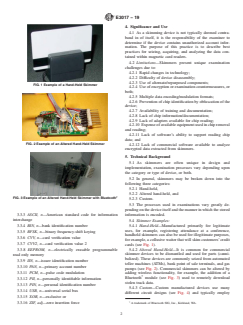
3.3.4 BIN, n—bank identification number 5.4.1 Hand-Held—Manufactured primarily for legitimate
uses, for example, registering attendance at a conference,
3.3.5 BFSK, n—binary frequency-shift keying
handheld skimmers can also be used for illegitimate purposes,
3.3.6 CVV, n—card verification value
forexample,acollusivewaiterthatwillskimcustomers’credit
3.3.7 CVV2, n—card verification value 2
cards (see Fig. 1).
5.4.2 Altered Hand-Held—It is common for commercial
3.3.8 EEPROM, n—electrically erasable programmable
read only memory skimmer devices to be dismantled and used for parts (canni-
balized). These devices are commonly seized from automated
3.3.9 IIN, n—issuer identification number
teller machines (ATMs), bank point of sale terminals, and gas
3.3.10 PAN, n—primary account number
pumps (see Fig. 2). Commercial skimmers can be altered by
3.3.11 PCM, n—pulse code modulation
adding wireless functionality, for example, the addition of a
Bluetooth module (see Fig. 3) used to remotely download
3.3.12 PII, n—personally identifiable information
stolen track data.
3.3.13 PIN, n—personal identification number
5.4.3 Custom—Custom manufactured devices use many
3.3.14 USB, n—universal serial bus
different circuit designs (see Fig. 4) and typically employ
3.3.15 XOR, n—exclusive or
3.3.16 ZIF, adj—zero insertion force A trademark of Bluetooth SIG, Inc., Kirkland, WA.
E3017 − 19
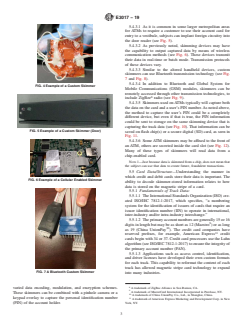
5.4.3.1 As it is common in some larger metropolitan areas
for ATMs to require a customer to use their account card for
entry to a vestibule, subjects can implant foreign circuitry into
the door reader (see Fig. 5).
5.4.3.2 As previously noted, skimming devices may have
the capability to output captured data by means of wireless
communication methods (see Fig. 6). These devices transmit
their data in real-time or batch mode. Transmission protocols
of these devices vary.
5.4.3.3 Similar to the altered handheld devices, custom
skimmers can use Bluetooth transmission technology (see Fig.
7 and Fig. 8).
5.4.3.4 In addition to Bluetooth and Global System for
FIG. 4 Example of a Custom Skimmer
Mobile Communications (GSM) modules, skimmers can be
remotely accessed through other transmission technologies, to
include ZigBee radio (see Fig. 9).
5.4.3.5 Skimmers used onATMs typically will capture both
the data on the card and a user’s PIN number.As noted above,
the method to capture the user’s PIN could be a completely
different device, but even if that is true, the PIN information
could be sent to storage on the same skimming device that is
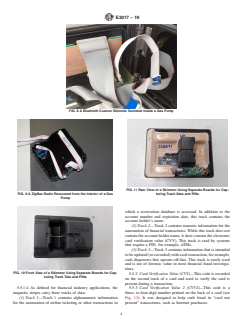
capturing the track data (see Fig. 10). That information can be
FIG. 5 Example of a Custom Skimmer (Door)
saved on flash chip(s) or a secure digital (SD) card, as seen in
Fig. 11.
5.4.3.6 SomeATM skimmers may be affixed to the front of
anATM, others are secreted inside the card slot (see Fig. 12).
Many of these types of skimmers will read data from a
chip-enabled card.
NOTE 1—Just because data is skimmed from a chip, does not mean that
the subject can use that data to create future, fraudulent transactions.
5.5 Card Data/Structure—Understanding the manner in
which credit and debit cards store their data is important. The
FIG. 6 Example of a Cellular Enabled Skimmer
ability to decode skimmer-stored information relates to how
data is stored on the magnetic stripe of a card.
5.5.1 Fundamentals of Track Data:
5.5.1.1 The International Standards Organization (ISO) cre-
ated ISO/IEC 7812-1:2017, which specifies, “a numbering
system for the identification of issuers of cards that require an
issuer identification number (IIN) to operate in international,
inter-industry and/or intra-industry interchange.”
5.5.1.2 Theprimaryaccountnumbersaregenerally15or16
digitsinlengthbutmaybeasshortas12(Maestro )oraslong
as 19 (China UnionPay ). The credit card companies have
reserved prefixes, for example, American Express credit
cards begin with 34 or 37. Credit card processors use the Luhn
algorithm(seeISO/IEC7812-1:2017)toensuretheintegrityof
the primary account number (PAN).
5.5.1.3 Applications such as access control, identification,
and driver licenses have developed their own custom formats
for each track. This capability to reformat the content of each
track has allowed magnetic stripe card technology to expand
FIG. 7 A Bluetooth Custom Skimmer
into many industries.
A trademark of ZigBee Alliance in San Ramon, CA.
varied data encoding, modulation, and encryption schemes.
A trademark of MasterCard International Incorporated in Purchase, NY.
These skimmers can be combined with a pinhole camera or a
A trademark of China UnionPay Co., Ltd., in Shanghai, China.
keypad overlay to capture the personal identification number
Atrademark ofAmerican Express Marketing and Development Corp. in New
(PIN) of the account holder. York, NY.
E3017 − 19
FIG. 8 A Bluetooth Custom Skimmer Secreted Inside a Gas Pump
FIG. 11 Rear View of a Skimmer Using Separate Boards for Cap-
FIG. 9 A ZigBee Radio Recovered from the Interior of a Gas turing Track Data and PINs
Pump
which a reservation database is accessed. In addition to the
account number and expiration date, this track contains the
account holder’s name.
(2) Track 2—Track 2 contains numeric information for the
automation of financial transactions. While this track does not
contain the account holder name, it does contain the electronic
card verification value (CVV). This track is read by systems
that require a PIN, for example, ATMs.
(3) Track 3—Track 3 contains information that is intended
tobeupdated(re-recorded)witheachtransaction,forexample,
cash dispensers that operate off-line. This track is rarely used
and is not of forensic value in most financial fraud investiga-
tions.
FIG. 10 Front View of a Skimmer Using Separate Boards for Cap-
5.5.2 Card Verification Value (CVV)—This code is recorded
turing Track Tata and PINs
on the second track of a card and used to verify the card is
present during a transaction.
5.5.1.4 As defined for financial industry applications, the 5.5.3 Card Verification Value 2 (CVV2)—This code is a
magnetic stripes carry three tracks of data: three- to four-digit number printed on the back of a card (see
(1) Track 1—Track 1 contains alphanumeric information Fig. 13). It was designed to help curb fraud in “card not
for the automation of airline ticketing or other transactions in present” transactions, such as Internet purchases.
E3017 − 19
FIG. 14 Example of Keypad Overlay
FIG. 12 A Skimmer That is Inserted Into an ATM Card Slot
6.1.2.4 Ifadeviceusesvideooraudiorecording,orboth,to
capture information, that recording may continue after the
device is seized.
6.1.2.5 Identifyingparasiticaldevicescanbechallenging,as
they are, by their nature, designed to be hidden. These include
recording devices hidden under keypads and those placed
in-line with a legitimate card reader (see Fig. 14 and Fig. 15).
Removal of these devices can be destructive in nature and
should be done cautiously.
6.2 Handling Evidence:
FIG. 13 Example of CVV2
6.2.1 Evidence should be handled according to laboratory
policy while maintaining a chain of custody and by using best
practices (refer to Practice E2763 and SWGDE Best Practices
5.5.4 Debit Cards:
for Computer Forensics).
5.5.4.1 When skimmed, debit cards and credit cards convey
similar data. However, debit cards are different from credit
7. 7. Acquisition – Account Data
cards as the account is directly linked to fund availability in a
bank (or otherwise stored) account. Debit cards present an
7.1 Background:
attractive target for skimming, as compromised accounts can 7.1.1 As skimmers are often unique in design and
be converted directly into cash as opposed to goods and
implementation, examination processes vary depending upon
services. the category or type of device, or both.
7.1.2 When considering retrieving stored account
6. Collection
information, due to differences in acquisition and analysis,
skimmers can be broken down into two general categories,
6.1 Seizure:
6.1.1 Devices should be collected and protected in the same analog or digital.
manner as flash memory devices (refer to Practice E2763 and 7.1.3 The processes used in examinations vary depending
SWGDE Best Practices for Computer Forensics). Associated on the device itself and the manner in which the stored
cables, documentation, and software should also be collected. information is encoded. While many skimmers will be manu-
6.1.2 Specific Skimmer Considerations Related to Seizure: facturedwiththecapabilityofremotelydownloadingskimmed
6.1.2.1 There is a possibility of two devices being used to account data by the subject, that functionality does not typi-
makeuptheskimmer,onedevicecapturingcardtrackdataand cally change the way skimmed account information is stored
a separate device capturing PINs, for example, video and on the skimmer or acquired by the examiner. Acquiring and
keypad overlay. analyzing Bluetooth module artifacts is completed separately
6.1.2.2 If a device is wired into something like a gas pump, from processing the skimmer for stolen account data (see
it is most likely using power from the pump. Removing the Section 10, Bluetooth Modules).
device from that type of power connection will not affect the 7.1.4 All skimming devices read magnetically-stored data
examination. If a battery is observed on a skimmer, leave the on a card. This process is accomplished by means of an
battery in place, unless there will be a significant delay before electromagnetic head, similar to that found in an audiocassette
examination, that is, more than a month. tapeplayer.Asthecardismanuallyswipedthroughthedevice,
6.1.2.3 If the skimmer is using a universal integrated circuit the head converts the magnetic information on the card into an
card (UICC) or SD card, it should be removed at the time of electrical signal of time-varying voltage, which may be passed
seizure. to other signal processing components. Devices that store that
E3017 − 19
FIG. 16 Example of an Analog-Based Skimming Device
FIG. 15 Example of an In-Line Skimmer
7.3.2 Chip Identification:
7.3.2.1 Custom skimming devices can be complicated in
waveform without further processing are referred to as “ana-
nature. Their design can be developed using new or cannibal-
log” devices. “Digital” devices further process the waveform. ized circuits/chips, or both. The main components of chip
identification are the manufacturer and chip model numbers of
7.2 Analog Skimming Devices:
both the microcontroller and flash chips. It is important to
7.2.1 Analog skimming devices capture the magnetic signal
document/photograph them before removal, as extreme tem-
on the card stripe to a digital waveform in flash memory. This
peratures can remove identification markings. In cases where
signal is encoded according to the ISO/IEC 7811 suite of
the identification number is worn or difficult to read, a
standards, but is otherwise similar to an audio waveform. The
microscope might be required. Additionally, applying a non-
resulting file extracted from a device is similar to an audio file
reactive and easily removed solution, such as isopropyl
and significantly larger than a decoded bit-string of account
alcohol, can make identification numbers easier to read.
data.Recoveryoftheencodeddatarequiresfurtherprocessing.
7.3.3 Chip Removal:
7.2.2 Identification:
7.3.3.1 As skimming devices typically do not have a uni-
7.2.2.1 Recognizing an analog skimmer is important, as the
versal and dependable method to connect to and download
method of extraction differs from that of a custom, digital
skimmed account information (other than USB used by analog
skimmer. Identification of an analog skimmer can be made by
devices), an examiner should remove the data storage chip and
either recognizing the cannibalization of an MPEG-2 Audio
then read the information stored therein. The microcontroller
Layer III (MP3) device or by recognizing the unusually large
might also need to be removed and read to understand the
storagecapacityofthedevice’sflashmemorychip,orboth(see
encoding or encryption methods used by the device.
Fig. 16).As an example, a typical digital skimmer uses a flash
Unfortunately, code protection may prevent the extraction of
chip in the area of two megabytes of storage, an analog
data from a device’s microcontroller.
skimmer typically contains a flash storage chip in the two
7.3.3.2 The chips should be properly removed from the
gigabytes or more range.
circuit board in a manner that ensures they are not damaged.
7.2.3 Extraction:
Removal should only be performed by properly trained and
7.2.3.1 Many analog skimmers originated as other devices,
experienced personnel. Methods of extraction include hot air,
for example, MP3 sunglasses. Therefore, an examiner may
infrared, and chip polishing/lapping/milling. Methods that
extract data from the device using its built-in universal serial
require the entire chip being removed at once are preferred, as
bus (USB) mass storage mode. As it is common for a person
they reduce the chance of physical damage induced by prying
constructing the skimmer to remove the USB header, the
and bending pins or destroying connection pads, or both (refer
examiner must recognize this architecture and solder a header
to SWGDE Best Practices for Chip-Off and SWGDE Tech
or leads on the device to facilitate communication. Once the
Notes regarding Chip-Off via Material Removal Using a Lap
header is attached, the examiner creates an image using
and Polish Process).
traditional computer forensics imaging techniques and soft-
7.3.4 Chip Connectivity and Reading:
ware (refer to Practice E2763 and SWGDE Best Practices for
7.3.4.1 There are several chip readers commercially
Computer Forensics).
available, with each reader possibly supporting a wide array of
7.3 Digital Skimming Devices:
chips. Most of the time, the examiner will need to use a chip
7.3.1 Digitalskimmingdevicespasstheanalogswipewave-
socket adapter that matches the chip package. However, on
formtoanADCtoproduceadigitalwaveform,whichisstored
certain smaller chips, for example, 8-pin flash, connectivity
and coded in flash memory. Digital skimmer devices accept
between the chip and the socket adapter can be established
input by means of a magnetic stripe reader like analog
through a series of wires soldered to the chip pins and inserted
skimmers;however,oncetheskimmer’sprocessorreceivesthe
into the reader, typically by means of a Zero Insertion Force
waveform,thesignalisdecodedwithlogicbeforebeingstored
(ZIF) socket (see Fig. 17 and Fig. 18).
in flash memory. Data can be stored in a variety of formats,
7.3.4.2 Once properly connected, a chip can be read using
which might or might not be ciphered or encrypted.
vendor provided software.The extracted data should be saved,
write protected, and hashed prior to analysis. Analysis should
E3017 − 19
8.1.2 Analog Skimmer Data:
8.1.2.1 Duetotheencodingmentionedabove,file(s)present
on an analog skimming device will not be recovered by means
of automated credit card finder scripts, for exa
...
This document is not an ASTM standard and is intended only to provide the user of an ASTM standard an indication of what changes have been made to the previous version. Because
it may not be technically possible to adequately depict all changes accurately, ASTM recommends that users consult prior editions as appropriate. In all cases only the current version
of the standard as published by ASTM is to be considered the official document.
Designation: E3017 − 15 E3017 − 19
Standard Practice for
Examining Magnetic Card Readers
This standard is issued under the fixed designation E3017; the number immediately following the designation indicates the year of
original adoption or, in the case of revision, the year of last revision. A number in parentheses indicates the year of last reapproval. A
superscript epsilon (´) indicates an editorial change since the last revision or reapproval.
1. Scope
1.1 Magnetic card readers, when used for illegal purposes, are commonly referred to as skimmers. This practice provides
information on seizing, acquiring, and analyzing skimming devices capable of acquiring and storing personally identifiable
information (PII) in an unauthorized manner.
1.2 This standard cannot replace knowledge, skills, or abilities acquired through education, training, and experience and is to
be used in conjunction with professional judgment by individuals with such discipline-specific knowledge, skills, and abilities.
1.3 This standard does not purport to address all of the safety concerns, if any, associated with its use. It is the responsibility
of the user of this standard to establish appropriate safety, health, and environmental practices and determine the applicability of
regulatory limitations prior to use.
1.4 This international standard was developed in accordance with internationally recognized principles on standardization
established in the Decision on Principles for the Development of International Standards, Guides and Recommendations issued
by the World Trade Organization Technical Barriers to Trade (TBT) Committee.
2. Referenced Documents
2.1 ASTM Standards:
E2763 Practice for Computer Forensics (Withdrawn 2019)
E2916 Terminology for Digital and Multimedia Evidence Examination
2.2 ISO Standards:
ISO/IEC 7811 Identification Cards—Recording Technique
ISO/IEC 78127812-1:2017 Identification Cards—Identification of IssuersIssuers—Part 1: Numbering SSystem
ISO/IEC 78137813:2006 Information Technology—Identification Cards—Financial Transaction Cards
2.3 SWGDE Standards:
SWGDE Best Practices for Chip-Off
SWGDE Best Practices for Computer Forensics for Computer Forensics
SWGDE Recommendations for Validation Testing for Validation Testing
SWGDE Tech Notes Regarding Chip-Off via Material Removal Using a Lap and Polish Process
2.4 ANSI Standards:
ANSI X4.16 Financial Services—Financial Transaction Cards—Magnetic Stripe Encoding
3. Terminology
3.1 Definitions:
3.1.1 For definitions of terms used in this practice, refer to Terminology E2916.
3.2 Definitions of Terms Specific to This Standard:
This practice is under the jurisdiction of ASTM Committee E30 on Forensic Sciences and is the direct responsibility of Subcommittee E30.12 on Digital and Multimedia
Evidence.
Current edition approved May 1, 2015June 1, 2019. Published June 2015June 2019. Originally approved in 2015. Last previous edition approved as E3017 – 15. DOI:
10.1520/E3017-15.10.1520/E3017-19.
For referenced ASTM standards, visit the ASTM website, www.astm.org, or contact ASTM Customer Service at service@astm.org. For Annual Book of ASTM Standards
volume information, refer to the standard’s Document Summary page on the ASTM website.
The last approved version of this historical standard is referenced on www.astm.org.
Available from National Institute of Standards and Technology (NIST), 100 Bureau Dr., Stop 1070, Gaithersburg, MD 20899-1070, http://www.nist.gov.
Available from the Scientific Working Group on Digital Evidence (SWDGE), https://www.swgde.org.
Available from American National Standards Institute (ANSI), 25 W. 43rd St., 4th Floor, New York, NY 10036, http://www.ansi.org.
Copyright © ASTM International, 100 Barr Harbor Drive, PO Box C700, West Conshohocken, PA 19428-2959. United States
E3017 − 19
FIG. 1 Example of a Hand-Held Skimmer
3.2.1 parasitic skimmer, n—a type of device manufactured for the capture of account data from magnetically encoded cards that
operates in-line with the original ATM, gas pump, or other card reading device.
3.2.2 start sentinel, n—a 5-bit binary sequence, or equivalent ASCII character, used to signify the beginning of track data. (See
ISO/IEC 7813).7813:2006.)
3.2.3 skimmer, n—a magnetic card reader, specifically when used for an illegal purpose.
3.2.4 skimming, n—using a skimmer to acquire PII in an unauthorized manner.
3.2.5 swipe, v—to manually pass a magnetically encoded card through a card reader device to transfer information from the
card.
3.3 Acronyms:
3.3.1 ADPCM, n—adaptive pulse code modulation
3.3.2 AES, n—advanced encryption standard
3.3.3 ASCII, n—American standard code for information interchange
3.3.4 BIN, n—bank identification number
3.3.5 BFSK, n—binary frequency-shift keying
3.3.6 CVV, n—card verification value
3.3.7 CVV2, n—card verification value 2
3.3.8 EEPROM, n—electrically erasable programmable read only memory
3.3.9 IIN, n—issuer identification number
3.3.10 PAN, n—primary account number
3.3.11 PCM, n—pulse code modulation
3.3.12 PII, n—personally identifiable information
3.3.13 PIN, n—personal identification number
3.3.14 USB, n—universal serial bus
3.3.15 XOR, n—exclusive or
3.3.16 ZIF, adj—zero insertion force
3.2.16 BIN, n—bank identification number
4. Significance and Use
4.1 As a skimming device is not typically deemed contraband in of itself, it is the responsibility of the examiner to determine
if the device contains unauthorized account information. The purpose of this practice is to describe best practices for seizing,
acquiring, and analyzing the data contained within magnetic card readers.
4.2 Limitations—Skimmers present unique examination challenges due to:
4.2.1 Rapid changes in technology,technology;
4.2.2 Difficulty of device disassembly,disassembly;
4.2.3 Lack of standards in use of the technology,Use of alternate/repurposed components;
4.2.4 Use of alternate/repurposed components, encryption or examination countermeasures, or both;
4.2.5 Use of encryption,
4.2.5 Multiple data encoding/modulation formats,formats;
E3017 − 19
FIG. 2 Example of an Altered Hand-Held Skimmer
FIG. 3 Example of an Altered Hand-Held Skimmer with Bluetooth
FIG. 4 Example of a Custom Skimmer
4.2.6 Prevention of chip identification by obfuscation of the device,device;
4.2.7 Availability of training and documentation,documentation;
4.2.8 Lack of chip information/documentation, information/documentation;
4.2.9 Lack of adapters available for chip reading, reading;
4.2.10 Expense of available equipment used in chip removal and reading;
4.2.11 Lack of software’s ability to support reading chip data,data; and
4.2.12 Lack of commercial software available to analyze encrypted data extracted from skimmers.
5. Technical Background
5.1 As skimmers are often unique in design and implementation, examination processes vary depending upon the category or
type of device, or both.
5.2 In general, skimmers may be broken down into the following three categories:
5.2.1 Hand-held,
5.2.2 Altered hand-held, and
5.2.3 Custom.
5.3 The processes used in examinations vary greatly depending on the device itself and the manner in which the stored
information is encoded.
5.4 Hand-Held—Data extraction of hand-held skimmers (Fig. 1) is accomplished by connecting the skimmer to the examiner’s
computer by means of a data cable. Once connected, a program is executed that extracts all of the stored track data from the device.
E3017 − 19
FIG. 5 Example of a Custom Skimmer (Door)
5.5 Altered Hand-Held—It is common for commercial skimmer devices to be dismantled and used for parts (cannibalized).
These devices are commonly seized from automated teller machines (ATMs), bank point-of-sale terminals, and gas pumps.
Examination of these devices is frequently performed in a manner similar to hand-held devices. Wireless-enabled skimmers are
often seen as an alteration of commercial skimmers (Figs. 2 and 3 ).
5.4 Custom: Skimmer Examples:
5.4.1 Hand-Held—Manufactured primarily for legitimate uses, for example, registering attendance at a conference, handheld
skimmers can also be used for illegitimate purposes, for example, a collusive waiter that will skim customers’ credit cards (see Fig.
1).
5.4.2 Altered Hand-Held—By far, the most complicated and difficult-to-examine skimmers are custom-manufactured devices (It
is common for commercial skimmer devices to be dismantled and used for parts (cannibalized). These devices are commonly
seized fromFig. 4). These devices use many different circuit designs and proprietary data encoding, modulation, and automated
teller machines (ATMs), bank point of sale terminals, and gas pumps (see Fig. 2encryption schemes. These ). Commercial
skimmers can be combined with a pinholealtered by adding wireless functionality, for example, the addition of a Bluetooth camera
ormodule (see Fig. 3a keypad overlay to capture the personal identification number (PIN) of the account holder.) used to remotely
download stolen track data.
5.6.2 As it is common in some larger metropolitan area ATMs to require a customer to use their account card for entry to a
vestibule, subjects can implant foreign circuitry into the door reader (Fig. 5).
5.4.3 Custom—Some skimming devices may have the capability to output captured data by means of wireless communication
methods (Custom manufactured devices use many different circuit designs (see Fig. 64). These devices may transmit their data in
real-time or batch mode. The transmitting ability of these devices and the choice of transmission protocols used make detection
of receivers difficult. ) and typically employ varied data encoding, modulation, and encryption schemes. These skimmers can be
combined with a pinhole camera or a keypad overlay to capture the personal identification number (PIN) of the account holder.
5.4.3.1 As it is common in some larger metropolitan areas for ATMs to require a customer to use their account card for entry
to a vestibule, subjects can implant foreign circuitry into the door reader (see Fig. 5).
5.4.3.2 As previously noted, skimming devices may have the capability to output captured data by means of wireless
communication methods (see Fig. 6). These devices transmit their data in real-time or batch mode. Transmission protocols of these
devices vary.
5.4.3.3 Similar to the altered handheld devices, custom skimmers can use Bluetooth transmission technology (see Fig. 7 and Fig.
8).
5.4.3.4 In addition to Bluetooth and Global System for Mobile Communications (GSM) modules, skimmers can be remotely
accessed through other transmission technologies, to include ZigBee radio (see Fig. 9).
5.4.3.5 Skimmers used on ATMs typically will capture both the data on the card and a user’s PIN number. As noted above, the
method to capture the user’s PIN could be a completely different device, but even if that is true, the PIN information could be sent
to storage on the same skimming device that is capturing the track data (see Fig. 10). That information can be saved on flash chip(s)
or a secure digital (SD) card, as seen in Fig. 11.
5.4.3.6 Some ATM skimmers may be affixed to the front of an ATM, others are secreted inside the card slot (see Fig. 12). Many
of these types of skimmers will read data from a chip-enabled card.
NOTE 1—Just because data is skimmed from a chip, does not mean that the subject can use that data to create future, fraudulent transactions.
5.5 Card Data/Structure: Data/Structure—Understanding the manner in which credit and debit cards store their data is
important. The ability to decode skimmer-stored information relates to how data is stored on the magnetic stripe of a card.
5.5.1 Fundamentals of Track Data:
5.5.1.1 The International Standards Organization (ISO) created ISO/IEC 7812,7812-1:2017, which specifies, “a numbering
system for the identification of issuers of cards that require an issuer identification number (IIN) to operate in international,
inter-industry and/or intra-industry interchange.”
A trademark of Bluetooth SIG, Inc., Kirkland, WA.
The validation process is discussed in SWGDE Recommendations for Validation Testing.A trademark of ZigBee Alliance in San Ramon, CA.
E3017 − 19
FIG. 6 Example of a Cellular Enabled Skimmer
FIG. 7 A Bluetooth Custom Skimmer
5.5.1.2 The primary account numbers are generally 15 or 16 digits in length but may be as short as 12 (Maestro)(Maestro ) or
10 11
as long as 19 (China UnionPay).UnionPay ). The credit card companies have reserved prefixes, for example, American Express
credit cards begin with 34 or 37. Credit card processors use the Luhn algorithm (see ISO/IEC 7812)7812-1:2017) to ensure the
integrity of the primary account number (PAN).
5.5.1.3 Applications such as access control, identification, and driver licenses have developed their own custom formats for each
track. This capability to reformat the content of each track has allowed magnetic stripe card technology to expand into many
industries.
5.5.1.4 Applications such as access control, identification, and driver licenses have developed their own custom formats for each
track. This capability to reformat the content of each track has allowed magnetic stripe card technology to expand into many
industries. As defined for financial industry applications, the magnetic stripes carry three tracks of data.data:
(1) Track 1—Track 1 contains alphanumeric information for the automation of airline ticketing or other transactions in which
a reservation database is accessed. In addition to the account number and expiration date, this track will contain contains the
account holder’s name. Typically, Track 1 is only read by hand-held and altered hand-held skimmers.
(2) Track 2—Track 2 contains numeric information for the automation of financial transactions. While this track does not
contain the account holder name, it does contain the electronic card verification value (CVV). This track is read by systems that
require a PIN (for example, ATMs). Typically, custom skimmers will capture only Track 2 information. Track 2 is encoded using
5-bit ASCII (4-bit odd parity). The account information follows a start sentinel of 11010.PIN, for example, ATMs.
(3) Track 3—Track 3 contains information that is intended to be updated (re-recorded) with each transaction (fortransaction,
for example, cash dispensers that operate off-line).off-line. This track is rarely used and is not of forensic value in most financial
fraud investigations.
5.5.2 Card Verification Value (CVV)—This code is recorded on the second track of a card and used to verify the card is present
during a transaction.
5.5.3 Card Verification Value 2 (CVV2)—This code is a three- to four-digit number printed on the back of a card (hard to steal
electronically) ((see Fig. 713). It was designed to help curb fraud in “card not present” transactions, such as Internet purchases.
A trademark of ZigBee Alliance, San Ramon, CA.MasterCard International Incorporated in Purchase, NY.
A trademark of China UnionPay Co., Ltd., in Shanghai, China.
A trademark of American Express Marketing and Development Corp. in New York, NY.
E3017 − 19
FIG. 8 A Bluetooth Custom Skimmer Secreted Inside a Gas Pump
FIG. 9 A ZigBee Radio Recovered from the Interior of a Gas Pump
FIG. 10 Front View of a Skimmer Using Separate Boards for Capturing Track Tata and PINs
5.5.4 Debit Cards—Cards: When skimmed, debit cards and credit cards contain similar data. However, debit cards are different
from credit cards as the account is directly linked to fund availability in a bank (or otherwise stored) account. Debit cards present
a much more attractive target for skimming as compromised accounts can be converted directly into cash as opposed to goods and
services.
E3017 − 19
FIG. 11 Rear View of a Skimmer Using Separate Boards for Capturing Track Data and PINs
FIG. 12 A Skimmer That is Inserted Into an ATM Card Slot
FIG. 713 Example of CVV2
5.5.4.1 When skimmed, debit cards and credit cards convey similar data. However, debit cards are different from credit cards
as the account is directly linked to fund availability in a bank (or otherwise stored) account. Debit cards present an attractive target
for skimming, as compromised accounts can be converted directly into cash as opposed to goods and services.
6. Evidence Collection
6.1 Seizing Evidence: Seizure:
6.1.1 Devices should be collected and protected in the same manner as flash memory devices (refer to Practice E2763). and
SWGDE Best Practices for Computer Forensics). Associated cables, documentation, and software should also be collected.
6.1.2 Identifying parasitical devices can be challenging, as they are, by their nature, designed to be hidden. These include
recording devices hidden under keypads and those placed in-line with a legitimate card reader (Figs. 8 and 9). Removal of these
devices may be destructive in nature and should be done cautiously.Specific Skimmer Considerations Related to Seizure:
E3017 − 19
FIG. 1016 Example of an Analog-Based Skimming Device
6.1.2.1 There is a possibility of two devices being used to make up the skimmer, one device capturing card track data and a
separate device capturing PINs, for example, video and keypad overlay.
6.1.2.2 If a device is wired into something like a gas pump, it is most likely using power from the pump. Removing the device
from that type of power connection will not affect the examination. If a battery is observed on a skimmer, leave the battery in place,
unless there will be a significant delay before examination, that is, more than a month.
6.1.2.3 If the skimmer is using a universal integrated circuit card (UICC) or SD card, it should be removed at the time of seizure.
6.1.2.4 If a device uses video or audio recording, or both, to capture information, that recording may continue after the device
is seized.
6.1.2.5 Identifying parasitical devices can be challenging, as they are, by their nature, designed to be hidden. These include
recording devices hidden under keypads and those placed in-line with a legitimate card reader (see Fig. 14 and Fig. 15). Removal
of these devices can be destructive in nature and should be done cautiously.
6.2 Handling Evidence—Evidence: Evidence should be handled according to laboratory policy while maintaining a chain of
custody and by using best practices (refer to Practice E2763).
6.2.1 Evidence should be handled according to laboratory policy while maintaining a chain of custody and by using best
practices (refer to Practice E2763 and SWGDE Best Practices for Computer Forensics).
6.3 Equipment—Equipment in this section refers to the non-evidentiary hardware and software the examiner uses to conduct
data extraction and analysis of the evidence. Equipment and software applications should be verified to ensure proper
performance.
7. Data Extraction7. Acquisition – Account Data
7.1 Hand-Held/Altered Hand-Held Skimming Devices—Background: As skimmers are not useful unless one can extract the
swiped card information, the manufacturers of these devices provide software to facilitate the exportation of the stored data. The
software typically has the added functionality to decode stored user passwords from the device. The software only provides for
logical extraction (that is, no deleted information) into a text format. The examiner will need the device, appropriate software, and
the appropriate data cable to conduct a successful data extraction. Of particular note, the cable used performs the extraction by
means of serial over Universal Serial Bus (USB) connectivity. The proper driver loaded on the examination computer and a low
COM port setting should be selected so the device has sufficient priority on the system.
7.1.1 As skimmers are often unique in design and implementation, examination processes vary depending upon the category or
type of device, or both.
7.1.2 When considering retrieving stored account information, due to differences in acquisition and analysis, skimmers can be
broken down into two general categories, analog or digital.
7.1.3 The processes used in examinations vary depending on the device itself and the manner in which the stored information
is encoded. While many skimmers will be manufactured with the capability of remotely downloading skimmed account data by
the subject, that functionality does not typically change the way skimmed account information is stored on the skimmer or acquired
by the examiner. Acquiring and analyzing Bluetooth module artifacts is completed separately from processing the skimmer for
stolen account data (see Section 10, Bluetooth Modules).
7.1.4 All skimming devices read magnetically-stored data on a card. This process is accomplished by means of an
electromagnetic head, similar to that found in an audiocassette tape player. As the card is manually swiped through the device, the
head converts the magnetic information on the card into an electrical signal of time-varying voltage, which may be passed to other
signal processing components. Devices that store that waveform without further processing are referred to as “analog” devices.
“Digital” devices further process the waveform.
7.2 Analog Skimming Devices:
7.2.1 Analog skimming devices capture the magnetic signal on the card stripe to a digital waveform in flash memory. This signal
is encoded according to the ISO/IEC 7811 suite of standards, but is otherwise similar to an audio waveform. The resulting file
extracted from a device is similar to an audio file and significantly larger than a decoded bit-string of account data. Recovery of
the encoded data requires further processing.
E3017 − 19
FIG. 814 Example of Keypad Overlay
FIG. 915 Example of an In-Line Skimmer
7.2.2 Identification:
7.2.2.1 Recognizing an analog skimmer is important, as the method of extraction differs from that of a custom, digital skimmer.
Identification of an analog skimmer can be made by either recognizing the cannibalization of an MPEG-2 Audio Layer III (MP3)
device or by recognizing the unusually large storage capacity of the device’s flash memory chip, or both (see Fig. 16). As an
example, a typical digital skimmer uses a flash chip in the area of two megabytes of storage, an analog skimmer typically contains
a flash storage chip in the two gigabytes or more range.
7.2.3 Extraction:
7.2.3.1 Many analog skimmers originated as other devices, for example, MP3 sunglasses. Therefore, an examiner may extract
data from the device using its built-in universal serial bus (USB) mass storage mode. As it is common for a person constructing
the skimmer to remove the USB header, the examiner must recognize this architecture and solder a header or leads on the device
to facilitate communication. Once the header is attached, the examiner creates an image using traditional computer forensics
imaging techniques and software (refer to Practice E2763 and SWGDE Best Practices for Computer Forensics).
7.3 CustomDigital Skimming Devices—Devices: All skimming devices must first read the magnetic signal stored on a card. This
process is accomplished by means of an electromagnetic head, similar to that found in an audio cassette tape player. As the card
is manually swiped through the device, the head converts the magnetic signals on the card into an electrical signal of time-varying
voltage, which is passed to other signal processing components for digital conversion. Devices that store that waveform without
further processing are referred to as “analog” devices. “Digital” devices further process the waveform to recover the encoded
digital data and only store the decoded information.
7.3.1 Analog Skimming Devices—“Analog”Digital skimming devices pass the analog swipe waveform to an analog-to-digital
converter (ADC), ADC to produce a digital waveform, which is stored, undecoded, stored and coded in flash memory. The
resulting data file extracted from a device is similar to an audio file and will be significantly larger than a decoded bit string of
account data.Digital skimmer devices accept input by means of a magnetic stripe reader like analog skimmers; however, once the
skimmer’s processor receives the waveform, the signal is decoded with logic before being stored in flash memory. Data can be
stored in a variety of formats, which might or might not be ciphered or encrypted.
7.2.1.1 Identification—Recognizing an analog skimmer is important as the method of extraction is different than that of a
custom, digital skimmer. While the examiner may notice the lack of an analog to digital encoder chip (although a digital skimmer
may lack this chip as well with the processing being completed by the microcontroller), the identification of an analogue skimmer
E3017 − 19
is typically made by recognizing the unusually large storage capacity of the device’s flash memory chip and are typically indicative
of an audio-based skimming device (Fig. 10). While a typical custom skimmer may use a flash chip with two megabytes of storage,
an analogue skimmer will typically contain a flash storage chip in the two gigabyte range.
7.2.1.2 Extraction—As analog skimmers likely originated as other devices, that is, MP3 sunglasses, an examiner may extract
the information from the device over USB mass storage device mode. As it is common for a person constructing the skimmer to
remove the USB header, the examiner must recognize the architecture and solder a new header on the device to facilitate
communication. Once the header is attached, a write blocker shall be used between the device and an examiner’s computer, and
an image (Terminology E2916) of the device can be extracted using traditional computer forensics imaging software.
E3017 − 19
7.3.2 Chip Identification:
7.3.2.1 Custom skimming devices can be complicated in nature. Their design can be developed using new or cannibalized
circuits/chips, or both. The main components of chip identification are the manufacturer and chip model numbers of both the
microcontroller and flash chips. It is important to document/photograph them before removal, as extreme temperatures can remove
identification markings. In cases where the identification number is worn or difficult to read, a microscope might be required.
Additionally, applying a non-reactive and easily removed solution, such as isopropyl alcohol, can make identification numbers
easier to read.
7.3.3 Digital Skimmer Devices—Chip Removal: Digital skimmer devices accept input via a magnetic stripe reader just like
analog skimmers. However, once the skimmer’s processor receives the waveform, the signal is decoded with logic before being
stored in flash memory. Data is stored in a digital format, which may or may not be encoded or encrypted or both. Extraction of
information from a digital skimmer is most commonly done by removing the flash chip and reading the information through the
use of a chip programmer.
7.3.3.1 Extraction—As custom (and some altered) skimming devices typically do not have a universal and dependable method
to connect to and download the skimmed account information (other than USB used by analog devices), an examiner should
consider removing remove the data storage chip and then read the information stored therein. The microcontroller maymight also
need to be removed and read to understand the encoding or encryption methods used by the device. Code Unfortunately, code
protection may prevent the extraction of codedata from thea device’s microcontroller.
7.2.2.2 Chip Identification—As previously referenced, custom skimming devices can be quite complicated in nature. Their
design can be developed using both new and cannibalized circuits/chips. One of the first steps in examining such a device is to
identify how the skimmer is extracting and storing account information. The identification of the components that make up a
skimmer is crucial to understanding how to extract stored data successfully. The main components of chip identification are their
manufacturer and chip number. The primary chips the examiner should be able to successfully identify are the microcontroller and
the flash storage chips. It is important to document/photograph them before removal as extreme temperatures may remove the
markings on the chip. In cases where the chip identification number is worn or difficult to read, a microscope may be required.
Additionally, applying a non-reactive and easily removed solution such as isopropyl alcohol can make chip numbers easier to read.
7.3.3.2 Chip Removal—Once the chips of forensic significance are identified, they The chips should be properly removed from
the circuit board in a manner that ensures the chips they are not damaged. Chip removal Removal should only be performed by
properly trained and experienced personnel. The two most prominently used methods Methods of extraction include hot air and
infrared. air, infrared, and chip polishing/lapping/milling. Methods that heatrequire the entire chip being removed at once are
preferred, as they reduce the chance of physical damage to the chip induced by prying and bending the pins.pins or destroying
connection pads, or both (refer to SWGDE Best Practices for Chip-Off and SWGDE Tech Notes regarding Chip-Off via Material
Removal Using a Lap and Polish Process).
7.2.2.4 Chip Connectivity and Reading—There are several chip readers commercially available with each reader possibly
supporting a different subset of chips. Most readers require a socket adapter, which is dependent on the chip package. However,
on certain smaller chips (that is, 8-pin flash chips) connectivity between the chip and the socket adapter may be established through
a series of wires soldered to the chip pins and inserted into the reader, typically by means of a ZIF (zero insertion force) socket.
Once properly connected, the chip can then be read using the vendor-provided software, which should be saved and handled as
original evidence.
7.2.2.5 As was mentioned in 5.6.3, some skimming devices use a wireless technology to broadcast the stolen card information,
6 8
that is, Bluetooth, ZigBee, etc. It may be possible, and preferred, to extract data from these through a wireless connection (as
the creator intended) if certain pairing data is known to the examiner, for example, the correct channel on which a ZigBee radio
skimmer is broadcasting, the pairing code for a Bluetooth enabled skimmer.
7.3.4 Chip Connectivity and Reading:
7.3.4.1 There are several chip readers commercially available, with each reader possibly supporting a wide array of chips. Most
of the time, the examiner will need to use a chip socket a
...