


ASTM F2299/F2299M-24
(Test Method)Standard Test Method for Determining the Initial Efficiency of Materials to Penetration by Particulates Using Latex Spheres
Standard Test Method for Determining the Initial Efficiency of Materials to Penetration by Particulates Using Latex Spheres
SIGNIFICANCE AND USE
5.1 This test method measures the initial filtration efficiency of materials by sampling representative volumes of the upstream and downstream latex aerosol concentrations in a controlled airflow chamber.
5.2 This test method provides specific test techniques for both manufacturers and users to evaluate materials when exposed to aerosol particle sizes between 0.1 and 5.0 μm.
5.2.1 This test method establishes a basis of efficiency comparison between materials.
SCOPE
1.1 This test method establishes procedures for measuring the initial particle filtration efficiency of materials using monodispersed aerosols.
1.1.1 This test method utilizes light-scattering particle counting in the size range of 0.1 to 5.0 μm and airflow test velocities of 0.5 to 25 cm/s.
1.2 The test procedure measures filtration efficiency by comparing the particle count in the feed stream (upstream) to that in the filtrate (downstream).
1.3 The values stated in SI units or in other units shall be regarded separately as standard. The values stated in each system must be used independently of the other, without combining values in any way.
1.4 The following precautionary caveat pertains only to the test methods portion, Section 10, of this specification. This standard does not purport to address all of the safety concerns, if any, associated with its use. It is the responsibility of the user of this standard to establish appropriate safety, health, and environmental practices and determine the applicability of regulatory limitations prior to use.
1.5 This international standard was developed in accordance with internationally recognized principles on standardization established in the Decision on Principles for the Development of International Standards, Guides and Recommendations issued by the World Trade Organization Technical Barriers to Trade (TBT) Committee.
General Information
- Status
- Published
- Publication Date
- 31-Jan-2024
- Technical Committee
- F23 - Personal Protective Clothing and Equipment
- Drafting Committee
- F23.40 - Biological
Relations
- Effective Date
- 01-Feb-2024
- Effective Date
- 01-Feb-2024
Overview
ASTM F2299/F2299M-24: Standard Test Method for Determining the Initial Efficiency of Materials to Penetration by Particulates Using Latex Spheres provides a recognized method for measuring the initial filtration efficiency of materials-especially those used in medical face masks-against aerosol penetration by particulates in the size range of 0.1 to 5.0 micrometers (μm). This standard is essential for both manufacturers and users who want to evaluate and compare particle filtration performance of materials in controlled laboratory conditions. The procedure utilizes monodispersed aerosols and light-scattering particle counting, and establishes a practical means for efficiency comparison between different materials, ensuring reliable data for quality control and product development.
Keywords: particle filtration efficiency, medical face mask materials, particulate penetration, latex spheres, ASTM F2299/F2299M, respiratory protective equipment, initial efficiency measurement.
Key Topics
Particle Filtration Efficiency
Focus on initial filtration efficiency when materials are first exposed to latex spheres within a specific particle size range (0.1 to 5.0 μm).Controlled Test Method
The method involves sampling upstream and downstream aerosol concentrations in a controlled airflow chamber, enabling accurate assessment of the material’s barrier effectiveness.Aerosol Generation and Measurement
Utilizes a charge-neutralized, monodispersed latex sphere aerosol and light-scattering particle counters to measure particle concentration before and after the test material.Efficiency Calculation
Efficiency is determined by comparing the number of particles detected upstream (before the material) and downstream (after the material).Practical Relevance
Offers manufacturers and regulatory bodies a standardized way to evaluate, verify, and compare the initial efficacy of filtration materials prior to use in end products such as medical face masks.
Applications
Medical Face Masks and Respirators
This standard is widely used by medical device manufacturers to assess and document the initial particle filtration efficiency of face mask materials, supporting regulatory compliance and product claims.Quality Control in Production
Provides a critical benchmark during the development and mass production of filtration materials, ensuring consistent barrier performance against hazardous particles.Product Comparison for End-Users
Enables healthcare providers, procurement teams, and researchers to make informed, data-driven choices by comparing standardized efficiency results across materials and products.Research and Development
Supports innovation in protective equipment by setting clear, reproducible criteria for evaluating adjustments in design, materials, or manufacturing methods.
Related Standards
- ASTM F2100 - Standard Specification for Performance of Materials Used in Medical Face Masks.
- ASTM F2101 - Standard Test Method for Evaluating the Bacterial Filtration Efficiency (BFE) of Medical Face Mask Materials.
- ASTM F1862 - Standard Test Method for Resistance of Medical Face Masks to Penetration by Synthetic Blood.
- ASTM F50 - Practice for Continuous Sizing and Counting of Airborne Particles in Clean Rooms.
- ASTM D1777 - Test Method for Thickness of Textile Materials.
- ASTM D3776/D3776M - Test Methods for Mass Per Unit Area of Fabric.
- ASTM F2053 - Guide for Documenting Results of Airborne Particle Penetration Testing.
Practical Value
Implementing ASTM F2299/F2299M-24 ensures that particulate filtration materials-especially in critical medical settings-meet reliable and internationally recognized performance standards. The methodology provides both consistency and comparability, vital for regulatory submissions, product labeling, and consumer trust. By employing this standard, stakeholders in the healthcare and personal protective equipment industries can certify the initial effectiveness of barrier materials, supporting both safety and product quality in environments where filtration matters most.
Buy Documents
ASTM F2299/F2299M-24 - Standard Test Method for Determining the Initial Efficiency of Materials to Penetration by Particulates Using Latex Spheres
REDLINE ASTM F2299/F2299M-24 - Standard Test Method for Determining the Initial Efficiency of Materials to Penetration by Particulates Using Latex Spheres
Get Certified
Connect with accredited certification bodies for this standard

BSI Group
BSI (British Standards Institution) is the business standards company that helps organizations make excellence a habit.

TÜV Rheinland
TÜV Rheinland is a leading international provider of technical services.

TÜV SÜD
TÜV SÜD is a trusted partner of choice for safety, security and sustainability solutions.
Sponsored listings
Frequently Asked Questions
ASTM F2299/F2299M-24 is a standard published by ASTM International. Its full title is "Standard Test Method for Determining the Initial Efficiency of Materials to Penetration by Particulates Using Latex Spheres". This standard covers: SIGNIFICANCE AND USE 5.1 This test method measures the initial filtration efficiency of materials by sampling representative volumes of the upstream and downstream latex aerosol concentrations in a controlled airflow chamber. 5.2 This test method provides specific test techniques for both manufacturers and users to evaluate materials when exposed to aerosol particle sizes between 0.1 and 5.0 μm. 5.2.1 This test method establishes a basis of efficiency comparison between materials. SCOPE 1.1 This test method establishes procedures for measuring the initial particle filtration efficiency of materials using monodispersed aerosols. 1.1.1 This test method utilizes light-scattering particle counting in the size range of 0.1 to 5.0 μm and airflow test velocities of 0.5 to 25 cm/s. 1.2 The test procedure measures filtration efficiency by comparing the particle count in the feed stream (upstream) to that in the filtrate (downstream). 1.3 The values stated in SI units or in other units shall be regarded separately as standard. The values stated in each system must be used independently of the other, without combining values in any way. 1.4 The following precautionary caveat pertains only to the test methods portion, Section 10, of this specification. This standard does not purport to address all of the safety concerns, if any, associated with its use. It is the responsibility of the user of this standard to establish appropriate safety, health, and environmental practices and determine the applicability of regulatory limitations prior to use. 1.5 This international standard was developed in accordance with internationally recognized principles on standardization established in the Decision on Principles for the Development of International Standards, Guides and Recommendations issued by the World Trade Organization Technical Barriers to Trade (TBT) Committee.
SIGNIFICANCE AND USE 5.1 This test method measures the initial filtration efficiency of materials by sampling representative volumes of the upstream and downstream latex aerosol concentrations in a controlled airflow chamber. 5.2 This test method provides specific test techniques for both manufacturers and users to evaluate materials when exposed to aerosol particle sizes between 0.1 and 5.0 μm. 5.2.1 This test method establishes a basis of efficiency comparison between materials. SCOPE 1.1 This test method establishes procedures for measuring the initial particle filtration efficiency of materials using monodispersed aerosols. 1.1.1 This test method utilizes light-scattering particle counting in the size range of 0.1 to 5.0 μm and airflow test velocities of 0.5 to 25 cm/s. 1.2 The test procedure measures filtration efficiency by comparing the particle count in the feed stream (upstream) to that in the filtrate (downstream). 1.3 The values stated in SI units or in other units shall be regarded separately as standard. The values stated in each system must be used independently of the other, without combining values in any way. 1.4 The following precautionary caveat pertains only to the test methods portion, Section 10, of this specification. This standard does not purport to address all of the safety concerns, if any, associated with its use. It is the responsibility of the user of this standard to establish appropriate safety, health, and environmental practices and determine the applicability of regulatory limitations prior to use. 1.5 This international standard was developed in accordance with internationally recognized principles on standardization established in the Decision on Principles for the Development of International Standards, Guides and Recommendations issued by the World Trade Organization Technical Barriers to Trade (TBT) Committee.
ASTM F2299/F2299M-24 is classified under the following ICS (International Classification for Standards) categories: 11.120.20 - Wound dressings and compresses. The ICS classification helps identify the subject area and facilitates finding related standards.
ASTM F2299/F2299M-24 has the following relationships with other standards: It is inter standard links to ASTM F2299/F2299M-03(2017), ASTM F2302-22. Understanding these relationships helps ensure you are using the most current and applicable version of the standard.
ASTM F2299/F2299M-24 is available in PDF format for immediate download after purchase. The document can be added to your cart and obtained through the secure checkout process. Digital delivery ensures instant access to the complete standard document.
Standards Content (Sample)
This international standard was developed in accordance with internationally recognized principles on standardization established in the Decision on Principles for the
Development of International Standards, Guides and Recommendations issued by the World Trade Organization Technical Barriers to Trade (TBT) Committee.
Designation: F2299/F2299M − 24
Standard Test Method for
Determining the Initial Efficiency of Materials to Penetration
by Particulates Using Latex Spheres
This standard is issued under the fixed designation F2299/F2299M; the number immediately following the designation indicates the year
of original adoption or, in the case of revision, the year of last revision. A number in parentheses indicates the year of last reapproval.
A superscript epsilon (´) indicates an editorial change since the last revision or reapproval.
1. Scope D2905 Practice for Statements on Number of Specimens for
Textiles (Withdrawn 2008)
1.1 This test method establishes procedures for measuring
D3776/D3776M Test Methods for Mass Per Unit Area
the initial particle filtration efficiency of materials using
(Weight) of Fabric
monodispersed aerosols.
F50 Practice for Continuous Sizing and Counting of Air-
1.1.1 This test method utilizes light-scattering particle
borne Particles in Dust-Controlled Areas and Clean
counting in the size range of 0.1 to 5.0 μm and airflow test
Rooms Using Instruments Capable of Detecting Single
velocities of 0.5 to 25 cm/s.
Sub-Micrometre and Larger Particles
1.2 The test procedure measures filtration efficiency by
F328 Practice for Calibration of an Airborne Particle Coun-
comparing the particle count in the feed stream (upstream) to
ter Using Monodisperse Spherical Particles (Withdrawn
that in the filtrate (downstream). 3
2007)
F778 Methods for Gas Flow Resistance Testing of Filtration
1.3 The values stated in SI units or in other units shall be
regarded separately as standard. The values stated in each Media
F1494 Terminology Relating to Protective Clothing
system must be used independently of the other, without
combining values in any way. F2053 Guide for Documenting the Results of Airborne
Particle Penetration Testing of Protective Clothing Mate-
1.4 The following precautionary caveat pertains only to the
rials
test methods portion, Section 10, of this specification. This
standard does not purport to address all of the safety concerns,
3. Terminology
if any, associated with its use. It is the responsibility of the user
3.1 Definitions:
of this standard to establish appropriate safety, health, and
3.1.1 aerosol, n—a suspension of a liquid or solid particles
environmental practices and determine the applicability of
in a gas with the particles being in the colloidal size range.
regulatory limitations prior to use.
3.1.1.1 Discussion—In this test method, aerosols include
1.5 This international standard was developed in accor-
solid particles having a diameter of 0.1 to 5 μm suspended or
dance with internationally recognized principles on standard-
dispersed in an airflow at concentrations of less than 102 par-
ization established in the Decision on Principles for the
ticles ⁄cm .
Development of International Standards, Guides and Recom-
3.1.2 isokinetic sampling, n—a condition where the velocity
mendations issued by the World Trade Organization Technical
Barriers to Trade (TBT) Committee. of the airflow entering the sampling nozzle is the same as the
velocity of the airflow passing around the sampling nozzle.
2. Referenced Documents
3.1.3 monodispersion, n—scattering of discrete particles in
an airflow where the size is centralized about a specific particle
2.1 ASTM Standards:
size.
D1777 Test Method for Thickness of Textile Materials
3.1.3.1 Discussion—In this test method, the monodispersed
particle distribution has a mean diameter size of the aerosol in
the 0.1 to 5 μm range, with a coefficient of variation of the
This test method is under the jurisdiction of ASTM Committee F23 on Personal
mean diameter of 610 % or less, as certified by the manufac-
Protective Clothing and Equipment and is the direct responsibility of Subcommittee
F23.40 on Biological.
turer.
Current edition approved Feb. 1, 2024. Published February 2024. Originally
3.2 For definitions of other protective clothing-related terms
approved in 2003. Last previous edition approved in 2017 as F2299/F2299M – 03
(2017). DOI: 10.1520/F2299_F2299M-24.
used in this test method, refer to Terminology F1494.
For referenced ASTM standards, visit the ASTM website, www.astm.org, or
contact ASTM Customer Service at service@astm.org. For Annual Book of ASTM
Standards volume information, refer to the standard’s Document Summary page on The last approved version of this historical standard is referenced on
the ASTM website. www.astm.org.
Copyright © ASTM International, 100 Barr Harbor Drive, PO Box C700, West Conshohocken, PA 19428-2959. United States
F2299/F2299M − 24
4. Summary of Test Method take the humidity measurement from the outlet side of the
HEPA filter (see 7.6.2) with an in-line probe.
4.1 Filtered and dried air is passed through an atomizer to
7.1.1 To provide a stable, reproducible aerosol through the
produce an aerosol containing suspended latex spheres.
test material that remains constant over the sampling time of
4.1.1 This aerosol is then passed through a charge neutral-
the efficiency test, maintain the main test duct and filter
izer.
medium specimen holder in a vertical orientation to minimize
4.1.2 The aerosol is then mixed and diluted with additional
aerosol sedimentation losses.
preconditioned air to produce a stable, neutralized, and dried
aerosol of latex spheres to be used in the efficiency test. 7.2 Aerosol Generation:
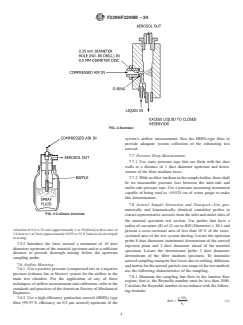
7.2.1 The aerosol generator must be capable of a latex
7 8 3
5. Significance and Use
sphere count concentration output of 10 to 10 particles/m .
The suspension reservoir must be large enough to sustain a
5.1 This test method measures the initial filtration efficiency
stabilized output greater than 1 h. Two commercially available
of materials by sampling representative volumes of the up-
atomizing techniques that provide these concentrations of the
stream and downstream latex aerosol concentrations in a
latex spheres are presented in Figs. 2 and 3.
controlled airflow chamber.
7.2.2 As viewed in Figs. 2 and 3, these techniques utilize the
5.2 This test method provides specific test techniques for
atomizing of suspended uniform latex spheres from dilute
both manufacturers and users to evaluate materials when
water suspensions. One-liter quantities of these suspensions
exposed to aerosol particle sizes between 0.1 and 5.0 μm.
can be made by diluting the 10 %-by-volume solids of the
5.2.1 This test method establishes a basis of efficiency
uniform latex spheres at 1000:1 or greater dilution ratios in
comparison between materials.
deionized, filtered distilled water.
NOTE 1—The suspensions have a three- to six-month usable life. Ideal
6. Apparatus
suspension dilutions are a function of the latex particle size to the aerosol
6.1 The aerosol test system incorporates the components as
generator droplet size. In order to minimize the atomization of doublets or
higher aerosol multiples in the drying process, a recommended latex
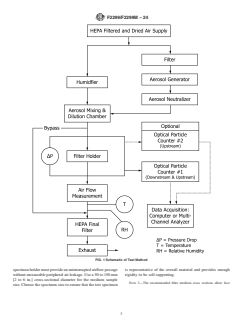
shown in Fig. 1. A more detailed diagram of test system
suspension dilution ratio has been established so that dilution ratios are on
components and equipment is found in STP 975.
the order of 1000:1 to 10 000:1. Other aerosols produced from these
6.2 Equipment:
atomizers can be classified into monodispersed systems, but for an
industrially recognized standard of particle size and composition, the
6.2.1 Clean, dry compressed air supply,
uniform latex spheres are the most reproducible and readily available
6.2.2 HEPA filters (2),
particles.
6.2.3 Aerosol generator,
7.3 Aerosol Neutralizer—This procedure recommends the
6.2.4 Charge neutralizer,
use of an aerosol charge neutralizer at the inlet of the test
6.2.5 Humidifier,
system. This technique generally will ensure aerosol surface
6.2.6 Test filter holder and duct assembly,
charge stability. The aerosol neutralizer can be in the form of a
6.2.7 Pressure drop measuring device,
radioactive decay ionizer. The desired Boltzmann’s charge
6.2.8 Airflow rate measuring device,
equilibrium for the aerosol has been described. Typically, an
6.2.9 Temperature and relative humidity detectors,
3 3
ionizing flux of 10 mCi/m /s provides the required aerosol
6.2.10 Air blower (optional for negative pressure system),
neutralization.
and
NOTE 2—A Krypton 85 source, a Polonium 210 source, or a Corona
6.2.11 Optical particle counters.
electrical discharge A-C source have been found satisfactory for this
purpose.
7. System Preparation and Control
7.4 Aerosol Dilution and Humidity Control—Prior to injec-
7.1 To test in the aerosol particle size range of 0.1 to 5.0 μm,
tion or dispersion of the initial aerosol concentration into the
it is necessary to maintain a very clean inlet air supply. Achieve
main test chamber, dry or dilute the aerosol with make-up
acceptable levels of background aerosol by passing the atom-
airflow for the final test aerosol concentration as needed.
izing air supply sequentially through a silica gel dryer (for
Conduct material testing in a relative humidity range of 30 to
reduction of moisture), a molecular sieve material (for removal
50 % and hold the relative humidity 65 % during a given test.
of oil vapor), and an ultra-low penetrating aerosol (better than
Complete the aerosol mixing a minimum of 8 duct diameters
99.9999 % efficient at 0.6 μm) filter. Then, supply the air to the
distance before the inlet sampling probe and the material
test chamber of aerosol generator through pressure regulators
specimen.
of 67 kPa [61 psi] accuracy. For throttling of the main airflow
7.5 Material Specimen Holder:
as well as other flow splitting requirements, use needle valves
7.5.1 The material specimen holder and test section shall be
to maintain adequate flow stability and back pressure. For
a continuous straight-walled vessel, interrupted only by the
recommended flow control measurement, see 7.6. Monitor and
filter medium sample throughout its length. The material
record the temperature and relative humidity at the exhaust port
of the test chamber. To avoid interference from the test aerosol,
Raabe, O., “The Dilution of Monodispersed Suspensions for Aerosolization,”
American Industrial Hygiene Association Journal, Vol 29, 1968, pp. 439–443.
4 6
Symposium on Gas and Liquid Filtration, Vol II, ASTM STP 975, ASTM Liu, B. Y. H. and Piu, D. Y. H., “Electrical Neutralization of Aerosols,” Aerosol
International, 1986, pp. 141–164. Science, Vol 5, 1974, pp. 465–472.
F2299/F2299M − 24
FIG. 1 Schematic of Test Method
specimen holder must provide an uninterrupted airflow passage is representative of the overall material and provides enough
without measurable peripheral air leakage. Use a 50 to 150 mm rigidity to be self-supporting.
[2 to 6 in.] cross-sectional diameter for the medium sample
NOTE 3—The recommended filter medium cross sections allow face
size. Choose the specimen size to ensure that the test specimen
F2299/F2299M − 24
FIG. 2 Atomizer
system’s airflow measurement. Size the HEPA-type filter to
provide adequate system collection of the exhausting test
aerosol.
7.7 Pressure Drop Measurement:
7.7.1 Use static pressure taps that are flush with the duct
walls at a distance of 1 duct diameter upstream and down-
stream of the filter medium faces.
7.7.2 With no filter medium in the sample holder, there shall
be no measurable pressure loss between the inlet-side and
outlet-side pressure taps. Use a pressure measuring instrument
capable of being read to 60.025 cm of water gauge to make
this determination.
7.8 Aerosol Sample Extraction and Transport—Use geo-
metrically and kinematically identical centerline probes to
FIG. 3 Collision Atomizer
extract representative aerosols from the inlet and outlet sides of
the material specimen test section. Use probes that have a
radius of curvature (R) of 12 cm or R/D (Diameter) > 20:1 and
velocities of 0.5 to 25 cm/s [approximately 1 to 50 ft/min] at flow rates of
present a cross-sectional area of less than 10 % of the cross-
3 3
1 L/min to 1 m /min [approximately 0.035 to 35 ft /min] to be developed
sectional area of the test system ducting. Locate the upstream
in testing.
probe 8 duct diameters (minimum) downstream of the aerosol
7.5.2 Introduce the latex aerosol a minimum of 10 duct
injection point and 2 duct diameters ahead of the material
diameters upstream of the material specimen and at a sufficient
specimen. Locate the downstream probe 3 duct diameters
distance to provide thorough mixing before the upstream
downstream of the filter medium specimen. To minimize
sampling probe.
aerosol sampling transport line losses due to settling, diffusion,
7.6 Airflow Metering:
and inertia for the aerosol particle size range of the test method,
7.6.1 Use a positive pressure (compressed air) or a negative
use the following characteristics of the sampling.
pressure (exhaust fan or blower) system for the airflow to the
7.8.1 Maintain the sampling line flow in the laminar flow
main test chamber. For the application of any of these
regime; that is, the Reynolds number must be less than 1000.
techniques of airflow measurement and calibration, refer to the
Calculate the Reynolds number in accordance with the follow-
standards and practices of the American Society of Mechanical
ing formula:
Engineers.
ρ VD
7.6.2 Use a high efficiency particulate aerosol (HEPA) type
g 1
Re# 5 (1)
filter (99.97 % efficiency on 0.3 μm aerosol) upstream of the μ
g
F2299/F2299M − 24
NOTE 6—The flow rate of the respective optical particle counter must be
where:
measured and recorded.
ρ = gas density (kg/m ),
g
NOTE 7—For test system changes in sampling configuration, that is,
V = gas velocity (m/s),
alternate upstream and downstream sampling or opening and closing the
D = inside diameter of sampling lines (m), and
aerosol flow system, allow a purge time so that 25 sampling line volume
μ = gas viscosity (kg/m-s).
changes can occur before counting resumes. (For flow rates of 7 L/min in
g
6 mm ID samplings, the purge time will be between 10 to 15 s.)
7.8.2 Limit horizontal sampling line length to less than
100 cm and the total sample transport line to less than 2 m.
8. Number of Downstream/Upstream Sampling Intervals
7.8.3 Maintain all radius of curvatures to greater than
8.1 The statistical selection of the number of downstream/
12 cm.
upstream sampling intervals is based on no specimen present in
the filter holder. The test apparatus must meet a 100 6 1 %
NOTE 4—Isokinetic aerosol sampling is recommended to minimize
penetration average with a coefficient of variation of 3 %. Use
probe inlet losses. However, in those cases where isokinetic conditions
the procedure in 8.2 to obtain this selection. Run this procedure
cannot be met, it is recommended that the operation of these probes be
610 % of isokinetic or that the particle Stokes number at the probe inlet
twice and use the number of the two results.
be held to less than 1.0 in order to minimize inertial losses at the probe
8.2 Procedure:
inlet. It is also recommended that the Reynolds number of the sample flow
8.2.1 Obtain two consecutive downstream/upstream
lines be held to less than 2000. The Stokes number is calculated using the
following formula:
(100 %) penetration sample observations. Calculate their aver-
age.
D ρ VC
p p
St# 5 (2)
8.2.2 If the average is between 99 and 101 %, proceed to
9μ D
g n
8.2.4. If the average is not between 99 and 101 %, run another
where:
sample and average it with the previous two samples.
8.2.3 If the new average is between 99 and 101 %, proceed
D = particle diameter (m),
p
ρ = particle density (kg/m),
to 8.2.4. If not, continue this process until 100 6 1 %
p
V = velocity of approach (m/s),
penetration is achieved. If 100 % penetration is not achieved,
μ = gas viscosity (kg/m-s),
g the test apparatus is biased and must be corrected.
D = diameter of sampling nozzle (m), and
n 8.2.4 Subtract the highest test sample observation from the
C = Cunningham correction factor, which for particles
lowest sample to give the sample range at that certain number
–6
larger than 1.0 × 10 m (1 μm) is assumed to be 1.0.
of sample observations. Go to Table 1 for that number of
NOTE 5—Recommended sampling flow rates for extraction of the
observations and read the adjustment number.
mounting volume are to be less than 10 % of the total test system flow
8.2.5 The adjustment number is the greatest range for a
rate.
coefficient of variation of 3 % at a penetration of 100 6 1 % for
7.9 Aerosol Concentration Counting:
the specified number of observations.
8.2.6 If the sample range is equal to or less than the
7.9.1 This practice is structured for utilizing automatic,
a
...
This document is not an ASTM standard and is intended only to provide the user of an ASTM standard an indication of what changes have been made to the previous version. Because
it may not be technically possible to adequately depict all changes accurately, ASTM recommends that users consult prior editions as appropriate. In all cases only the current version
of the standard as published by ASTM is to be considered the official document.
Designation: F2299/F2299M − 03 (Reapproved 2017) F2299/F2299M − 24
Standard Test Method for
Determining the Initial Efficiency of Materials Used in
Medical Face Masks to Penetration by Particulates Using
Latex Spheres
This standard is issued under the fixed designation F2299/F2299M; the number immediately following the designation indicates the year
of original adoption or, in the case of revision, the year of last revision. A number in parentheses indicates the year of last reapproval.
A superscript epsilon (´) indicates an editorial change since the last revision or reapproval.
1. Scope
1.1 This test method establishes procedures for measuring the initial particle filtration efficiency of materials used in medical
facemasks using monodispersed aerosols.
1.1.1 This test method utilizes light scattering light-scattering particle counting in the size range of 0.1 to 5.0 μm and airflow test
velocities of 0.5 to 25 cm/s.
1.2 The test procedure measures filtration efficiency by comparing the particle count in the feed stream (upstream) to that in the
filtrate (downstream).
1.3 The values stated in SI units or in other units shall be regarded separately as standard. The values stated in each system must
be used independently of the other, without combining values in any way.
1.4 The following precautionary caveat pertains only to the test methods portion, Section 10, of this specification. This standard
does not purport to address all of the safety concerns, if any, associated with its use. It is the responsibility of the user of this
standard to establish appropriate safety and healthsafety, health, and environmental practices and determine the applicability of
regulatory limitations prior to use.
1.5 This international standard was developed in accordance with internationally recognized principles on standardization
established in the Decision on Principles for the Development of International Standards, Guides and Recommendations issued
by the World Trade Organization Technical Barriers to Trade (TBT) Committee.
2. Referenced Documents
2.1 ASTM Standards:
D1356 Terminology Relating to Sampling and Analysis of Atmospheres
D1777 Test Method for Thickness of Textile Materials
D2905 Practice for Statements on Number of Specimens for Textiles (Withdrawn 2008)
D3776/D3776M Test Methods for Mass Per Unit Area (Weight) of Fabric
E691 Practice for Conducting an Interlaboratory Study to Determine the Precision of a Test Method
This test method is under the jurisdiction of ASTM Committee F23 on Personal Protective Clothing and Equipment and is the direct responsibility of Subcommittee
F23.40 on Biological.
Current edition approved June 1, 2017Feb. 1, 2024. Published June 2017February 2024. Originally approved in 2003. Last previous edition approved in 20102017 as
F2299/F2299M – 03 (2010).(2017). DOI: 10.1520/F2299_F2299M-03R17.10.1520/F2299_F2299M-24.
For referenced ASTM standards, visit the ASTM website, www.astm.org, or contact ASTM Customer Service at service@astm.org. For Annual Book of ASTM Standards
volume information, refer to the standard’s Document Summary page on the ASTM website.
The last approved version of this historical standard is referenced on www.astm.org.
Copyright © ASTM International, 100 Barr Harbor Drive, PO Box C700, West Conshohocken, PA 19428-2959. United States
F2299/F2299M − 24
F50 Practice for Continuous Sizing and Counting of Airborne Particles in Dust-Controlled Areas and Clean Rooms Using
Instruments Capable of Detecting Single Sub-Micrometre and Larger Particles
F328 Practice for Calibration of an Airborne Particle Counter Using Monodisperse Spherical Particles (Withdrawn 2007)
F778 Methods for Gas Flow Resistance Testing of Filtration Media
F1471 Test Method for Air Cleaning Performance of a High-Efficiency Particulate Air Filter System (Withdrawn 2018)
F1494 Terminology Relating to Protective Clothing
F2053 Guide for Documenting the Results of Airborne Particle Penetration Testing of Protective Clothing Materials
3. Terminology
3.1 Definitions:
3.1.1 aerosol, n—a suspension of a liquid or solid particles in a gas with the particles being in the colloidal size range.
3.1.1.1 Discussion—
In this test method, aerosols include solid particles having a diameter of 0.1 to 5 μm suspended or dispersed in an airflow at
concentrations of less than 102 particles ⁄cm .
3.1.2 isokinetic sampling, n—a condition where the velocity of the airflow entering the sampling nozzle is the same as the velocity
of the airflow passing around the sampling nozzle.
3.1.3 monodispersion, n—scattering of discrete particles in an airflow where the size is centralized about a specific particle size.
3.1.3.1 Discussion—
In this test method, the monodispersed particle distribution has a mean diameter size of the aerosol in the 0.1 to 5 μm range, with
a coefficient of variation of the mean diameter of 610 % or less, as certified by the manufacturer.
3.2 For definitions of other protective clothing-related terms used in this test method, refer to Terminology F1494.
4. Summary of Test Method
4.1 Filtered and dried air is passed through an atomizer to produce an aerosol containing suspended latex spheres.
4.1.1 This aerosol is then passed through a charge neutralizer.
4.1.2 The aerosol is then mixed and diluted with additional preconditioned air to produce a stable, neutralized, and dried aerosol
of latex spheres to be used in the efficiency test.
5. Significance and Use
5.1 This test method measures the initial filtration efficiency of materials used in medical face masks by sampling representative
volumes of the upstream and downstream latex aerosol concentrations in a controlled airflow chamber.
5.2 This test method provides specific test techniques for both manufacturers and users to evaluate materials when exposed to
aerosol particle sizes between 0.1 and 5.0 μm.
5.2.1 This test method establishes a basis of efficiency comparison between medical face mask materials.
5.2.2 This test method does not establish a comprehensive characterization of the medical face mask material for a specific
protective application.
5.3 This test method does not assess the overall effectiveness of medical face masks in preventing the inward leakage of harmful
particles.
5.3.1 The design of the medical face mask and the integrity of the seal of the medical face mask to the wearer’s face are not
evaluated in this test.
5.4 This test method is not suitable for evaluating materials used in protective clothing for determining their effectiveness against
particulate hazards.
F2299/F2299M − 24
5.4.1 In general, clothing design is a significant factor which must be considered in addition to the penetration of particulates.
6. Apparatus
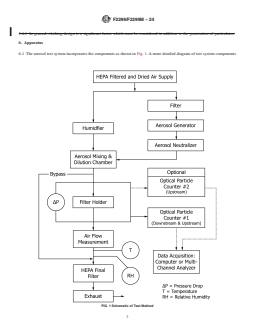
6.1 The aerosol test system incorporates the components as shown in Fig. 1. A more detailed diagram of test system components
FIG. 1 Schematic of Test Method
F2299/F2299M − 24
and equipment is found in STP 975.
6.2 Equipment:
6.2.1 Clean, dry compressed air supply,
6.2.2 HEPA filters (2),
6.2.3 Aerosol generator,
6.2.4 Charge neutralizer,
6.2.5 Humidifier,
6.2.6 Test filter holder and duct assembly,
6.2.7 Pressure drop measuring device,
6.2.8 Air flow Airflow rate measuring device,
6.2.9 Temperature and relative humidity detectors,
6.2.10 Air blower (optional for negative pressure system), and
6.2.11 Optical particle counters.
7. System Preparation and Control
7.1 To test in the aerosol particle size range of 0.1 to 5.0 μm, it is necessary to maintain a very clean inlet air supply. Achieve
acceptable levels of background aerosol by passing the atomizing air supply sequentially through a silica gel dryer (for reduction
of moisture), a molecular sieve material (for removal of oil vapor), and an ultra-low penetrating aerosol (better than 99.9999 %
efficient at 0.6 μm) filter. Then, supply the air to the test chamber of aerosol generator through pressure regulators of 67 kPa [61
psi] accuracy. For throttling of the main airflow as well as other flow splitting requirements, use needle valves to maintain adequate
flow stability and back pressure. For recommended flow control measurement, see 7.6. Monitor and record the temperature and
relative humidity at the exhaust port of the test chamber. To avoid interference from the test aerosol, take the humidity
measurement from the outlet side of the HEPA filter (see 7.6.2) with an in-line probe.
7.1.1 To provide a stable, reproducible aerosol through the test material that remains constant over the sampling time of the
efficiency test, maintain the main test duct and filter medium specimen holder in a vertical orientation to minimize aerosol
sedimentation losses.
7.2 Aerosol Generation:
7 8 3
7.2.1 The aerosol generator must be capable of a latex sphere count concentrationsconcentration output of 10 to 10 particles/m .
The suspension reservoir must be large enough to sustain a stabilized output greater than 1 h. Two commercially available
atomizing techniques that provide these concentrations of the latex spheres are presented in Figs. 2 and 3.
7.2.2 As viewed in Figs. 2 and 3, these techniques utilize the atomizing of suspended uniform latex spheres from dilute water
suspensions. One-liter quantities of these suspensions can be made by diluting the 10 %-by-volume solids of the uniform latex
spheres at 1000:1 or greater dilution ratios in deionized, filtered distilled water.
NOTE 1—The suspensions have a three- to six-month usable life. Ideal suspension dilutions are a function of the latex particle size to the aerosol generator
droplet size. In order to minimize the atomization of doublets or higher aerosol multiples in the drying process, a recommended latex suspension dilution
ratio has been established so that dilution ratios are on the order of 1000:1 to 10 000:1. Other aerosols produced from these atomizers can be classified
Symposium on Gas and Liquid Filtration, Vol II, ASTM STP 975, ASTM, Vol 11, ASTM International, 1986, pp. 141-164.141–164.
Raabe, O., “The Dilution of Monodispersed Suspensions for Aerosolization,” American Industrial Hygiene Association Journal, Vol 29, 1968, pp. 439–443.
F2299/F2299M − 24
FIG. 2 Atomizer
FIG. 3 Collision Atomizer
into monodispersed systems, but for an industrially recognized standard of particle size and composition, the uniform latex spheres are the most
reproducible and readily available particles.
7.3 Aerosol Neutralizer—This procedure recommends the use of an aerosol charge neutralizer at the inlet of the test system. This
technique generally will ensure aerosol surface charge stability. The aerosol neutralizer can be in the form of a radioactive decay
6 3
ionizer. The desired Boltzmann’s charge equilibrium for the aerosol has been described. Typically, an ionizing flux of 10
mCi/m /s provides the required aerosol neutralization.
NOTE 2—A Krypton 85 source, a Polonium 210 source, or a Corona electrical discharge,discharge A-C source have been found satisfactory for this
purpose.
7.4 Aerosol Dilution and Humidity Control—Prior to injection or dispersion of the initial aerosol concentration into the main test
chamber, dry or dilute the aerosol with make-up airflow for the final test aerosol concentration as needed. Conduct material testing
in a relative humidity range of 30 to 50 % and hold the relative humidity 65 % during a given test. Complete the aerosol mixing
a minimum of 8 duct diameters distance before the inlet sampling probe and the material specimen.
Liu, B. Y. H. and Piu, D. Y. H., “Electrical Neutralization of Aerosols,” Aerosol Science, Vol 5, 1974, pp. 465–472.
F2299/F2299M − 24
7.5 Material Specimen Holder:
7.5.1 The material specimen holder and test section shall be a continuous straight-walled vessel, interrupted only by the filter
medium sample throughout its length. The material specimen holder must provide an uninterrupted airflow,airflow passage without
measurable peripheral air leakage. Use a 50- to 150-mm [2- to 6-in.] 50 to 150 mm [2 to 6 in.] cross-sectional diameter for the
medium sample size. Choose the specimen size to ensure that the test specimen is representative of the overall material and
provides enough rigidity to be self-supporting.
NOTE 3—The recommended filter medium cross sections allow face velocities of 0.5 to 25 cm/s [approximately 1 to 50 ft/min] at flow rates of 1 L/min
3 3
to 1 m /min [approximately 0.035 to 35 ft /min] to be developed in testing.
7.5.2 Introduce the latex aerosol a minimum of 10 duct diameters upstream of the material specimen and at a sufficient distance
to provide thorough mixing before the upstream sampling probe.
7.6 Airflow Metering:
7.6.1 Use a positive pressure (compressed air) or a negative pressure (exhaust fan or blower) system for the airflow to the main
test chamber. For the application of any of these techniques of airflow measurement and calibration, refer to the standards and
practices of the American Society of Mechanical Engineers.
7.6.2 Use a high efficiency particulate aerosol (HEPA)-type (HEPA) type filter (99.97 % efficiency on 0.3-μm 0.3 μm aerosol)
upstream of the systemssystem’s airflow measurement. Size the HEPA-type filter to provide adequate system collection of the
exhausting test aerosol.
F2299/F2299M − 24
7.7 Pressure Drop Measurement:
7.7.1 Use static pressure taps that are flush with the duct walls at a distance of 1 duct diameter upstream and downstream of the
filter medium faces.
7.7.2 With no filter medium in the sample holder, there shall be no measurable pressure loss between the inlet-side and outlet-side
pressure taps. Use a pressure-measuring pressure measuring instrument capable of being read to 60.025 cm of water gauge to
make this determination.
7.8 Aerosol Sample Extraction and Transport—Use geometrically and kinematically identical centerline probes to extract
representative aerosols from the inlet and outlet sides of the material specimen test section. Use probes that have a radius of
curvature (R) of 12 cm or R/D (Diameter) > 20:1 and present a cross-sectional area of less than 10 % of the cross-sectional area
of the test system ducting. Locate the upstream probe 8 duct diameters (minimum) downstream of the aerosol injection point and
2 duct diameters ahead of the material specimen. Locate the downstream probe 3 duct diameters downstream of the filter medium
specimen. To minimize aerosol sampling transport line losses due to settling, diffusion, and inertia for the aerosol particle size
range of the test method, use the following characteristics of the sampling.
7.8.1 Maintain the sampling line flow in the laminar flow regime; that is, the Reynolds number must be less than 1000. Calculate
the Reynolds number in accordance with the following formula:
ρ VD
g 1
Re#5 (1)
μ
g
where:
ρ = gas density (kg/m ),
g
V = gas velocity (m/s),
D = inside diameter of sampling lines (m), and
μ = gas viscosity (kg/m-s).
g
7.8.2 Limit horizontal sampling line length to less than 100 cm and the total sample transport line to less than 2 m.
7.8.3 Maintain all radius of curvatures to greater than 12 cm.
NOTE 4—Isokinetic aerosol sampling is recommended to minimize probe inlet losses. However, in those cases where isokinetic conditions cannot be met,
it is recommended that the operation of these probes be 610 % of isokinetic or that the particle Stokes number at the probe inlet be held to less than
1.0 in order to minimize inertial losses at the probe inlet. It is also recommended that the Reynolds number of the sample flow lines be held to less than
2000. The Stokes number is calculated using the following formula:
D ρ VC
p p
St#5 (2)
9μ D
g n
where:
D = particle diameter (m),
p
ρ = particle density (kg/m),
p
V = velocity of approach (m/s),
μ = gas viscosity (kg/m-s),
g
D = diameter of sampling nozzle (m), and
n
–6
C = Cunningham correction factor, which for particles larger than 1.0 × 10 m (1 μm) is assumed to be 1.0.
NOTE 5—Recommended sampling flow rates for extraction of the mounting volume are to be less than 10 % of the total test system flow rate.
7.9 Aerosol Concentration Counting:
7.9.1 This practice is structured for utilizing automatic, single particle single-particle light-scattering counters. For an illustration
of the application, calibration, and analyses by these instruments, refer to Practices F50 and F328.
7.9.2 Generally, single particle single-particle light-scattering counters measure in the range of 0.1 to 15 μm equivalent spherical
F2299/F2299M − 24
diameter, with a single particle single-particle measurement dynamic range of 50 to 1. These instruments shall be calibrated within
the test system, similar to the manufacturer’s standard calibration and with the test aerosol as conditioned for the efficiency testing.
For efficiencies approaching 99.9 % and greater, a higher test inlet aerosol concentration is usually required to maintain reasonable
sampling times at the outlet. If these conditions exceed the suggested coincidence limits for the single particle single-particle
counters, an inlet dilution at the optical particle counter of the aerosol is required. Achieve inlet dilution by passing some portion
of the conditioned inlet aerosol through a HEPA-grade filter and remixing it with the sampled inlet aerosol to the light-scattering
particle counter.
7.9.3 Establish accurate dilution ratios in order to specify the exact aerosol sample volum
...
Questions, Comments and Discussion
Ask us and Technical Secretary will try to provide an answer. You can facilitate discussion about the standard in here.
Loading comments...