

ASTM C231/C231M-24
(Test Method)Standard Test Method for Air Content of Freshly Mixed Concrete by the Pressure Method
General Information
- Abstract
SIGNIFICANCE AND USE
3.1 This test method covers the determination of the air content of freshly mixed concrete. The test determines the air content of freshly mixed concrete exclusive of any air that may exist inside voids within aggregate particles. For this reason, it is applicable to concrete made with relatively dense aggregate particles and requires determination of the aggregate correction factor (see 6.1 and 9.1).
3.2 This test method and Test Method C138/C138M and C173/C173M provide pressure, gravimetric, and volumetric procedures, respectively, for determining the air content of freshly mixed concrete. The pressure procedure of this test method gives substantially the same air contents as the other two test methods for concretes made with dense aggregates.
3.3 The air content of hardened concrete may be either higher or lower than that determined by this test method. This depends upon the methods and amount of consolidation effort applied to the concrete from which the hardened concrete specimen is taken; uniformity and stability of the air bubbles in the fresh and hardened concrete; accuracy of the microscopic examination, if used; time of comparison; environmental exposure; stage in the delivery, placement and consolidation processes at which the air content of the unhardened concrete is determined, that is, before or after the concrete goes through a pump; and other factors.
SCOPE
1.1 This test method covers determination of the air content of freshly mixed concrete from observation of the change in volume of concrete with a change in pressure.
1.2 This test method is intended for use with concretes and mortars made with relatively dense aggregates for which the aggregate correction factor can be satisfactorily determined by the technique described in Section 6. It is not applicable to concretes made with lightweight aggregates, air-cooled blast-furnace slag, or aggregates of high porosity. In these cases, Test Method C173/C173M should be used. This test method is also not applicable to nonplastic concrete such as is commonly used in the manufacture of pipe and concrete masonry units.
1.3 The text of this test method references notes and footnotes that provide explanatory information. These notes and footnotes (excluding those in tables and figures) shall not be considered as requirements of this standard.
1.4 The values stated in either SI units or inch-pound units are to be regarded separately as standard. The values stated in each system may not be exact equivalents; therefore, each system shall be used independently of the other. Combining values from the two systems may result in non-conformance with the standard.
1.5 This standard does not purport to address all of the safety concerns, if any, associated with its use. It is the responsibility of the user of this standard to establish appropriate safety, health, and environmental practices and determine the applicability of regulatory limitations prior to use. (Warning—Fresh hydraulic cementitious mixtures are caustic and may cause chemical burns to skin and tissue upon prolonged exposure.2)
1.6 This international standard was developed in accordance with internationally recognized principles on standardization established in the Decision on Principles for the Development of International Standards, Guides and Recommendations issued by the World Trade Organization Technical Barriers to Trade (TBT) Committee.
- Status
- Published
- Publication Date
- 31-Dec-2023
- Technical Committee
- C09 - Concrete and Concrete Aggregates
- Drafting Committee
- C09.60 - Testing Fresh Concrete
Buy Documents
ASTM C231/C231M-24 - Standard Test Method for Air Content of Freshly Mixed Concrete by the Pressure Method
REDLINE ASTM C231/C231M-24 - Standard Test Method for Air Content of Freshly Mixed Concrete by the Pressure Method
Overview
ASTM C231/C231M-24: Standard Test Method for Air Content of Freshly Mixed Concrete by the Pressure Method establishes a widely recognized procedure for determining the air content of freshly mixed concrete using pressure-based instrumentation. This test method is essential in quality control for concrete production and delivery, especially for concrete designed to be durable under freeze-thaw exposure and other environmental stresses. The standard is applicable primarily to concretes with relatively dense aggregates where the aggregate correction factor can be reliably determined.
Key Topics
- Pressure Method Principle: The test relies on observing the change in concrete volume under pressure to determine the air content. This volume change is directly related to the percentage of entrained and entrapped air in the mix.
- Applicability: The method is intended for concretes and mortars made with dense, non-porous aggregates. It is not suitable for lightweight aggregates, highly porous aggregates, air-cooled blast-furnace slag, or nonplastic concrete. For these materials, alternative test methods like ASTM C173/C173M should be used.
- Aggregate Correction Factor: A critical aspect of this method is the correction for any air that might be present within aggregate particles. Accurate determination requires calculation and periodic verification of this factor.
- Precision and Calibration: The method outlines strict requirements for calibration of the pressure meters and other apparatus to maintain accuracy and reliability of test results.
- Safety Considerations: Users must be aware of the caustic nature of fresh cementitious mixtures and are responsible for appropriate health, safety, and environmental practices.
Applications
- Quality Control for Concrete Production: Regular testing with ASTM C231/C231M is vital in ready-mix plants, precast facilities, and on construction sites to verify that air content meets the specified range for durability and workability.
- Durability Assurance: Adequate air content is essential for concrete exposed to freeze-thaw cycles or aggressive environments. The method ensures that air-entrained concrete has the necessary void system for enhanced durability.
- Comparative Validation: The pressure method provides results comparable to other accepted methods (such as gravimetric and volumetric) for concretes made with dense aggregates, supporting integrated quality programs and conformance to project specifications.
- Field and Laboratory Use: The test can be performed both in the field and laboratory settings, making it versatile for various points during the construction process, from batching to placement.
Related Standards
- ASTM C138/C138M - Standard Test Method for Density (Unit Weight), Yield, and Air Content (Gravimetric) of Concrete
- ASTM C143/C143M - Standard Test Method for Slump of Hydraulic-Cement Concrete
- ASTM C172/C172M - Standard Practice for Sampling Freshly Mixed Concrete
- ASTM C173/C173M - Standard Test Method for Air Content of Freshly Mixed Concrete by the Volumetric Method
- ASTM C31/C31M - Standard Practice for Making and Curing Concrete Test Specimens in the Field
- ASTM C192/C192M - Standard Practice for Making and Curing Concrete Test Specimens in the Laboratory
- ASTM C1758/C1758M - Practice for Fabricating Test Specimens with Self-Consolidating Concrete
Practical Value
Utilizing ASTM C231/C231M-24 ensures consistent, accurate measurement of air content in concrete, a key parameter in achieving optimal durability and service life for concrete structures. The standard supports material producers, contractors, and testing laboratories in maintaining compliance with project requirements and regulatory standards. By following established calibration, operation, and reporting procedures, users can trust test results to inform production decisions and quality assurance activities, ultimately contributing to the reliability and resilience of concrete infrastructure.
Primary keywords: ASTM C231/C231M-24, air content, freshly mixed concrete, pressure method, concrete testing, aggregate correction factor, calibration, concrete durability, quality control
Secondary keywords: dense aggregate, air-entrained concrete, standard test method, pressure meter, concrete standards, field testing
Relations
- Effective Date
- 01-Jan-2024
- Refers
ASTM C31/C31M-24a - Standard Practice for Making and Curing Concrete Test Specimens in the Field - Effective Date
- 01-Apr-2024
- Effective Date
- 01-Feb-2024
- Effective Date
- 01-Jan-2024
- Effective Date
- 01-Jan-2024
- Effective Date
- 01-Sep-2023
- Refers
ASTM C31/C31M-23 - Standard Practice for Making and Curing Concrete Test Specimens in the Field - Effective Date
- 01-Jun-2023
- Effective Date
- 01-Feb-2016
- Effective Date
- 15-Jun-2015
- Effective Date
- 01-Jan-2024
- Effective Date
- 01-Jan-2024
- Effective Date
- 01-Jan-2024
- Effective Date
- 01-Jan-2024
- Effective Date
- 01-Jan-2024
- Referred By
ASTM C858-19 - Standard Specification for Underground Precast Concrete Utility Structures - Effective Date
- 01-Jan-2024
Buy Documents
ASTM C231/C231M-24 - Standard Test Method for Air Content of Freshly Mixed Concrete by the Pressure Method
REDLINE ASTM C231/C231M-24 - Standard Test Method for Air Content of Freshly Mixed Concrete by the Pressure Method
Get Certified
Connect with accredited certification bodies for this standard

DIBt (Deutsches Institut für Bautechnik)
German Institute for Building Technology.
DIN CERTCO
DIN Group product certification.

Aboma Certification B.V.
Specialized in construction, metal, and transport sectors.
Sponsored listings
Frequently Asked Questions
ASTM C231/C231M-24 is a standard published by ASTM International. Its full title is "Standard Test Method for Air Content of Freshly Mixed Concrete by the Pressure Method". This standard covers: SIGNIFICANCE AND USE 3.1 This test method covers the determination of the air content of freshly mixed concrete. The test determines the air content of freshly mixed concrete exclusive of any air that may exist inside voids within aggregate particles. For this reason, it is applicable to concrete made with relatively dense aggregate particles and requires determination of the aggregate correction factor (see 6.1 and 9.1). 3.2 This test method and Test Method C138/C138M and C173/C173M provide pressure, gravimetric, and volumetric procedures, respectively, for determining the air content of freshly mixed concrete. The pressure procedure of this test method gives substantially the same air contents as the other two test methods for concretes made with dense aggregates. 3.3 The air content of hardened concrete may be either higher or lower than that determined by this test method. This depends upon the methods and amount of consolidation effort applied to the concrete from which the hardened concrete specimen is taken; uniformity and stability of the air bubbles in the fresh and hardened concrete; accuracy of the microscopic examination, if used; time of comparison; environmental exposure; stage in the delivery, placement and consolidation processes at which the air content of the unhardened concrete is determined, that is, before or after the concrete goes through a pump; and other factors. SCOPE 1.1 This test method covers determination of the air content of freshly mixed concrete from observation of the change in volume of concrete with a change in pressure. 1.2 This test method is intended for use with concretes and mortars made with relatively dense aggregates for which the aggregate correction factor can be satisfactorily determined by the technique described in Section 6. It is not applicable to concretes made with lightweight aggregates, air-cooled blast-furnace slag, or aggregates of high porosity. In these cases, Test Method C173/C173M should be used. This test method is also not applicable to nonplastic concrete such as is commonly used in the manufacture of pipe and concrete masonry units. 1.3 The text of this test method references notes and footnotes that provide explanatory information. These notes and footnotes (excluding those in tables and figures) shall not be considered as requirements of this standard. 1.4 The values stated in either SI units or inch-pound units are to be regarded separately as standard. The values stated in each system may not be exact equivalents; therefore, each system shall be used independently of the other. Combining values from the two systems may result in non-conformance with the standard. 1.5 This standard does not purport to address all of the safety concerns, if any, associated with its use. It is the responsibility of the user of this standard to establish appropriate safety, health, and environmental practices and determine the applicability of regulatory limitations prior to use. (Warning—Fresh hydraulic cementitious mixtures are caustic and may cause chemical burns to skin and tissue upon prolonged exposure.2) 1.6 This international standard was developed in accordance with internationally recognized principles on standardization established in the Decision on Principles for the Development of International Standards, Guides and Recommendations issued by the World Trade Organization Technical Barriers to Trade (TBT) Committee.
SIGNIFICANCE AND USE 3.1 This test method covers the determination of the air content of freshly mixed concrete. The test determines the air content of freshly mixed concrete exclusive of any air that may exist inside voids within aggregate particles. For this reason, it is applicable to concrete made with relatively dense aggregate particles and requires determination of the aggregate correction factor (see 6.1 and 9.1). 3.2 This test method and Test Method C138/C138M and C173/C173M provide pressure, gravimetric, and volumetric procedures, respectively, for determining the air content of freshly mixed concrete. The pressure procedure of this test method gives substantially the same air contents as the other two test methods for concretes made with dense aggregates. 3.3 The air content of hardened concrete may be either higher or lower than that determined by this test method. This depends upon the methods and amount of consolidation effort applied to the concrete from which the hardened concrete specimen is taken; uniformity and stability of the air bubbles in the fresh and hardened concrete; accuracy of the microscopic examination, if used; time of comparison; environmental exposure; stage in the delivery, placement and consolidation processes at which the air content of the unhardened concrete is determined, that is, before or after the concrete goes through a pump; and other factors. SCOPE 1.1 This test method covers determination of the air content of freshly mixed concrete from observation of the change in volume of concrete with a change in pressure. 1.2 This test method is intended for use with concretes and mortars made with relatively dense aggregates for which the aggregate correction factor can be satisfactorily determined by the technique described in Section 6. It is not applicable to concretes made with lightweight aggregates, air-cooled blast-furnace slag, or aggregates of high porosity. In these cases, Test Method C173/C173M should be used. This test method is also not applicable to nonplastic concrete such as is commonly used in the manufacture of pipe and concrete masonry units. 1.3 The text of this test method references notes and footnotes that provide explanatory information. These notes and footnotes (excluding those in tables and figures) shall not be considered as requirements of this standard. 1.4 The values stated in either SI units or inch-pound units are to be regarded separately as standard. The values stated in each system may not be exact equivalents; therefore, each system shall be used independently of the other. Combining values from the two systems may result in non-conformance with the standard. 1.5 This standard does not purport to address all of the safety concerns, if any, associated with its use. It is the responsibility of the user of this standard to establish appropriate safety, health, and environmental practices and determine the applicability of regulatory limitations prior to use. (Warning—Fresh hydraulic cementitious mixtures are caustic and may cause chemical burns to skin and tissue upon prolonged exposure.2) 1.6 This international standard was developed in accordance with internationally recognized principles on standardization established in the Decision on Principles for the Development of International Standards, Guides and Recommendations issued by the World Trade Organization Technical Barriers to Trade (TBT) Committee.
ASTM C231/C231M-24 is classified under the following ICS (International Classification for Standards) categories: 91.100.30 - Concrete and concrete products. The ICS classification helps identify the subject area and facilitates finding related standards.
ASTM C231/C231M-24 has the following relationships with other standards: It is inter standard links to ASTM C231/C231M-22, ASTM C31/C31M-24a, ASTM C670-24a, ASTM C670-24, ASTM C173/C173M-24, ASTM C173/C173M-23, ASTM C31/C31M-23, ASTM C173/C173M-16, ASTM C670-15, ASTM C1622/C1622M-10(2016)e1, ASTM C192/C192M-19, ASTM C1582/C1582M-11(2017)e1, ASTM C825-19, ASTM C465-23, ASTM C858-19. Understanding these relationships helps ensure you are using the most current and applicable version of the standard.
ASTM C231/C231M-24 is available in PDF format for immediate download after purchase. The document can be added to your cart and obtained through the secure checkout process. Digital delivery ensures instant access to the complete standard document.
Standards Content (Sample)
This international standard was developed in accordance with internationally recognized principles on standardization established in the Decision on Principles for the
Development of International Standards, Guides and Recommendations issued by the World Trade Organization Technical Barriers to Trade (TBT) Committee.
Designation: C231/C231M − 24
Standard Test Method for
Air Content of Freshly Mixed Concrete by the Pressure
Method
This standard is issued under the fixed designation C231/C231M; the number immediately following the designation indicates the year
of original adoption or, in the case of revision, the year of last revision. A number in parentheses indicates the year of last reapproval.
A superscript epsilon (´) indicates an editorial change since the last revision or reapproval.
1. Scope* ization established in the Decision on Principles for the
Development of International Standards, Guides and Recom-
1.1 This test method covers determination of the air content
mendations issued by the World Trade Organization Technical
of freshly mixed concrete from observation of the change in
Barriers to Trade (TBT) Committee.
volume of concrete with a change in pressure.
2. Referenced Documents
1.2 This test method is intended for use with concretes and
mortars made with relatively dense aggregates for which the 3
2.1 ASTM Standards:
aggregate correction factor can be satisfactorily determined by
C31/C31M Practice for Making and Curing Concrete Test
the technique described in Section 6. It is not applicable to
Specimens in the Field
concretes made with lightweight aggregates, air-cooled blast-
C138/C138M Test Method for Density (Unit Weight), Yield,
furnace slag, or aggregates of high porosity. In these cases, Test
and Air Content (Gravimetric) of Concrete
Method C173/C173M should be used. This test method is also
C143/C143M Test Method for Slump of Hydraulic-Cement
not applicable to nonplastic concrete such as is commonly used
Concrete
in the manufacture of pipe and concrete masonry units.
C172/C172M Practice for Sampling Freshly Mixed Con-
1.3 The text of this test method references notes and crete
C173/C173M Test Method for Air Content of Freshly Mixed
footnotes that provide explanatory information. These notes
and footnotes (excluding those in tables and figures) shall not Concrete by the Volumetric Method
C192/C192M Practice for Making and Curing Concrete Test
be considered as requirements of this standard.
Specimens in the Laboratory
1.4 The values stated in either SI units or inch-pound units
C670 Practice for Preparing Precision and Bias Statements
are to be regarded separately as standard. The values stated in
for Test Methods for Construction Materials
each system may not be exact equivalents; therefore, each
C1758/C1758M Practice for Fabricating Test Specimens
system shall be used independently of the other. Combining
with Self-Consolidating Concrete
values from the two systems may result in non-conformance
with the standard.
3. Significance and Use
1.5 This standard does not purport to address all of the
3.1 This test method covers the determination of the air
safety concerns, if any, associated with its use. It is the
content of freshly mixed concrete. The test determines the air
responsibility of the user of this standard to establish appro-
content of freshly mixed concrete exclusive of any air that may
priate safety, health, and environmental practices and deter-
exist inside voids within aggregate particles. For this reason, it
mine the applicability of regulatory limitations prior to use.
is applicable to concrete made with relatively dense aggregate
(Warning—Fresh hydraulic cementitious mixtures are caustic
particles and requires determination of the aggregate correction
and may cause chemical burns to skin and tissue upon
factor (see 6.1 and 9.1).
prolonged exposure. )
3.2 This test method and Test Method C138/C138M and
1.6 This international standard was developed in accor-
C173/C173M provide pressure, gravimetric, and volumetric
dance with internationally recognized principles on standard-
procedures, respectively, for determining the air content of
freshly mixed concrete. The pressure procedure of this test
method gives substantially the same air contents as the other
This test method is under the jurisdiction of ASTM Committee C09 on
Concrete and Concrete Aggregates and is the direct responsibility of Subcommittee
two test methods for concretes made with dense aggregates.
C09.60 on Testing Fresh Concrete.
Current edition approved Jan. 1, 2024. Published March 2024. Originally
approved in 1949. Last previous edition approved in 2022 as C231/C231M – 22. For referenced ASTM standards, visit the ASTM website, www.astm.org, or
DOI: 10.1520/C0231_C0231M-24. contact ASTM Customer Service at service@astm.org. For Annual Book of ASTM
Section on Safety Precautions, Manual of Aggregate and Concrete Testing, Standards volume information, refer to the standard’s Document Summary page on
Annual Book of ASTM Standards, Vol 04.02. the ASTM website.
*A Summary of Changes section appears at the end of this standard
Copyright © ASTM International, 100 Barr Harbor Drive, PO Box C700, West Conshohocken, PA 19428-2959. United States
C231/C231M − 24
3.3 The air content of hardened concrete may be either which equalization takes place. Working pressures of 50 kPa to
higher or lower than that determined by this test method. This 205 kPa [7.5 psi to 30.0 psi] have been used satisfactorily.
depends upon the methods and amount of consolidation effort
4.2 Measuring Bowl—The measuring bowl shall be essen-
applied to the concrete from which the hardened concrete
tially cylindrical in shape, made of steel, hard metal, or other
specimen is taken; uniformity and stability of the air bubbles in
hard material not readily attacked by the cement paste, having
the fresh and hardened concrete; accuracy of the microscopic
a minimum diameter equal to 0.75 to 1.25 times the height, and
examination, if used; time of comparison; environmental
a capacity of at least 6.0 L [0.20 ft ]. It shall be flanged or
exposure; stage in the delivery, placement and consolidation
otherwise constructed to provide for a pressure tight fit
processes at which the air content of the unhardened concrete
between measuring bowl and cover assembly. The interior
is determined, that is, before or after the concrete goes through
surfaces of the measuring bowl and surfaces of rims, flanges,
a pump; and other factors.
and other component fitted parts shall be machined smooth.
The measuring bowl and cover assembly shall be sufficiently
4. Apparatus
rigid to limit the expansion factor, D, of the apparatus assembly
4.1 Air Meters—There are available satisfactory apparatus
(Section A1.5) to not more than 0.1 % of air content on the
of two basic operational designs employing the principle of
indicator scale when under normal operating pressure.
Boyle’s law. For purposes of reference herein these are
4.3 Cover Assembly:
designated Meter Type A and Meter Type B.
4.3.1 The cover assembly shall be made of steel, hard metal,
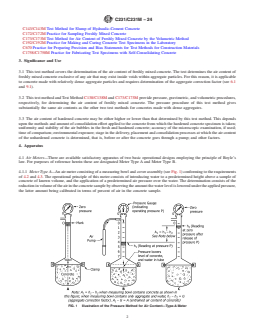
4.1.1 Meter Type A—An air meter consisting of a measuring
or other hard material not readily attacked by the cement paste.
bowl and cover assembly (see Fig. 1) conforming to the
It shall be flanged or otherwise constructed to provide for a
requirements of 4.2 and 4.3. The operational principle of this
pressure-tight fit between measuring bowl and cover assembly
meter consists of introducing water to a predetermined height
and shall have machined smooth interior surfaces contoured to
above a sample of concrete of known volume, and the
provide an air space above the level of the top of the measuring
application of a predetermined air pressure over the water. The
bowl. The cover shall be sufficiently rigid to limit the expan-
determination consists of the reduction in volume of the air in
sion factor of the apparatus assembly as prescribed in 4.2.
the concrete sample by observing the amount the water level is
lowered under the applied pressure, the latter amount being 4.3.2 The cover assembly shall be fitted with a means of
calibrated in terms of percent of air in the concrete sample. direct reading of the air content. The cover for the Type A
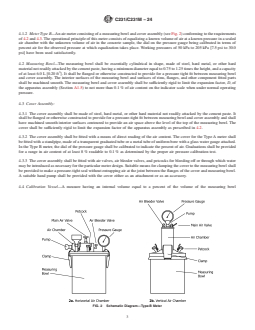
4.1.2 Meter Type B—An air meter consisting of a measuring meter shall be fitted with a standpipe, made of a transparent
bowl and cover assembly (see Fig. 2) conforming to the graduated tube or a metal tube of uniform bore with a glass
requirements of 4.2 and 4.3. The operational principle of this water gauge attached. In the Type B meter, the dial of the
meter consists of equalizing a known volume of air at a known pressure gauge shall be calibrated to indicate the percent of air.
pressure in a sealed air chamber with the unknown volume of Graduations shall be provided for a range in air content of at
air in the concrete sample, the dial on the pressure gauge being least 8 % readable to 0.1 % as determined by the proper air
calibrated in terms of percent air for the observed pressure at pressure calibration test.
FIG. 1 Illustration of the Pressure Method for Air Content—Type-A Meter
C231/C231M − 24
FIG. 2 Schematic Diagram—Type-B Meter
4.3.3 The cover assembly shall be fitted with air valves, air 4.7 Spray Tube—A brass tube of appropriate diameter,
bleeder valves, and petcocks for bleeding off or through which which may be an integral part of the cover assembly, or which
water may be introduced as necessary for the particular meter may be provided separately. It shall be so constructed that
design. Suitable means for clamping the cover to the measuring when water is added to the container, it is sprayed to the walls
bowl shall be provided to make a pressure-tight seal without of the cover in such a manner as to flow down the sides causing
entrapping air at the joint between the flanges of the cover and a minimum of disturbance to the concrete.
measuring bowl. A suitable hand pump shall be provided with
4.8 Trowel—A standard brick mason’s trowel.
the cover either as an attachment or as an accessory.
4.9 Tamping Rod—A round, smooth, straight steel rod, with
4.4 Calibration Vessel—A measure having an internal vol-
5 1
a 16 mm [ ⁄8 in.] 6 2 mm [ ⁄16 in.] diameter. The length of the
ume equal to a percent of the volume of the measuring bowl
tamping rod shall be at least 100 mm [4 in.] greater than the
corresponding to the approximate percent of air in the concrete
depth of the measuring bowl in which rodding is being
to be tested; or, if smaller, it shall be possible to check
performed, but not greater than 600 mm [24 in.] in overall
calibration of the meter indicator at the approximate percent of
length (see Note 2). The rod shall have the tamping end or both
air in the concrete to be tested by repeated filling of the
ends rounded to a hemispherical tip of the same diameter as the
measure. When the design of the meter requires placing the
rod.
calibration vessel within the measuring bowl to check
NOTE 2—A rod length of 400 mm [16 in.] to 600 mm [24 in.] meets the
calibration, the measure shall be cylindrical in shape.
requirements of the following: Practice C31/C31M, Test Method C138/
C138M, Test Method C143/C143M, Test Method C173/C173M, and Test
NOTE 1—A satisfactory calibration vessel to place within the measuring
Method C231/C231M.
bowl may be machined from No. 16 gauge brass tubing, of a diameter to
provide the volume desired, to which a brass disk 13 mm [ ⁄2 in.] in 4.10 Mallet—A mallet (with a rubber or rawhide head)
thickness is soldered to form an end. When design of the meter requires
weighing approximately 0.60 kg 6 0.25 kg [1.25 lb 6 0.50 lb]
withdrawing of water from the water-filled measuring bowl and cover 3
for use with measures of 14 L [0.5 ft ] or smaller, and a mallet
assembly, to check calibration, the measure may be an integral part of the
weighing approximately 1.0 kg 6 0.25 kg [2.25 lb 6 0.50 lb]
cover assembly or may be a separate cylindrical measure similar to the
for use with measures larger than 14 L [0.5 ft ].
above-described cylinder.
4.5 The designs of various available types of air meters are 4.11 Strike-Off Bar—A flat straight bar of steel or other
1 3
suitable metal at least 3 mm [ ⁄8 in.] thick and 20 mm [ ⁄4 in.]
such that they differ in operating techniques; therefore, all of
the items described in 4.6 – 4.16 may not be required. The wide by 300 mm [12 in.] long.
items required shall be those necessary for use with the
4.12 Strike-Off Plate—A flat rectangular metal plate at least
particular design of apparatus used to satisfactorily determine
6 mm [ ⁄4 in.] thick or a glass or acrylic plate at least 13 mm
air content in accordance with the procedures prescribed
[ ⁄2 in.] thick with a length and width at least 50 mm [2 in.]
herein.
greater than the diameter of the measure with which it is to be
4.6 Coil Spring or Other Device for Holding Calibration used. The edges of the plate shall be straight and smooth within
Cylinder in Place. a tolerance of 1.5 mm [ ⁄16 in.].
C231/C231M − 24
4.13 Funnel, with the spout fitting into spray tube. where:
F = mass of fine aggregate in concrete sample under test,
4.14 Measure for Water, having the necessary capacity to fill s
kg [lb],
the indicator with water from the top of the concrete to the zero
S = volume of concrete sample (same as volume of mea-
mark.
3 3
suring bowl), m [ft ],
4.15 Vibrator, as described in Practice C192/C192M.
B = volume of concrete produced per batch (Note 3),
m [ft ],
4.16 Sieves, 37.5 mm (1 ⁄2 in.) with not less than 0.2
2 2
F = total mass of fine aggregate in the moisture condition
m [2 ft ] of sieving area. b
used in batch, kg [lb],
4.17 Scoop—of a size large enough so each amount of
C = mass of coarse aggregate in concrete sample under
s
concrete obtained from the sampling receptacle is representa-
test, kg [lb], and
tive and small enough so it is not spilled during placement in
C = total mass of coarse aggregate in the moisture condi-
b
the measuring bowl.
tion used in batch, kg [lb].
NOTE 3—The volume of concrete produced per batch can be determined
5. Calibration of Apparatus
in accordance with applicable provisions of Test Method C138/C138M.
NOTE 4—The term “weight” is temporarily used in this test method
5.1 Make calibration tests in accordance with procedures
because of established trade usage. The word is used to mean both “force”
prescribed in the annex. Rough handling will affect the
and “mass,” and care must be taken to determine which is meant in each
calibration of both Types A and B meters. Changes in baro-
case (SI unit for force = newton and for mass = kilogram).
metric pressure will affect the calibration of Type A meter but
not Type B meter. The steps described Sections A1.2 – A1.6, as 6.3 Placement of Aggregate in Measuring Bowl—Mix rep-
resentative samples of fine aggregate F and coarse aggregate
applicable to the meter type under consideration, are prerequi-
s
sites for the final calibration test to determine the operating C , and place in the measuring bowl filled one-third full with
s
pressure, P, on the pressure gauge of the Type A meter as water. Place the mixed aggregate, a small amount at a time,
described in Section A1.7, or to determine the accuracy of the
into the measuring bowl; if necessary, add additional water so
graduations indicating air content on the dial face of the as to inundate all of the aggregate. Add each scoopful in a
pressure gauge of the Type B meter as described in Section
manner that will entrap as little air as possible and remove
A1.9. The steps in Sections A1.2 – A1.6 need be made only
accumulations of foam promptly. Tap the sides of the measur-
once (at the time of initial calibration), or only occasionally to
ing bowl and lightly rod the upper 25 mm [1 in.] of the
check volume constancy of the calibration cylinder and mea-
aggregate eight to twelve times. Stir after each addition of
suring bowl. The calibration test described in Sections A1.7
aggregate to eliminate entrapped air.
and A1.9, as applicable to the meter type being checked, must
6.4 Aggregate Correction Factor Determination:
be made as frequently as necessary and at intervals not to
exceed three months to ensure that the proper gauge pressure, 6.4.1 Initial Procedure for Types A and B Meters—When all
P, is being used for the Type A meter or that the correct air of the aggregate has been placed in the measuring bowl,
contents are being indicated on the pressure gauge air content remove excess foam and keep the aggregate inundated for a
scale for the Type B meter. A change in elevation of more than period of time approximately equal to the time between
180 m [600 ft] from the location at which a Type A meter was
introduction of the water into the mixer and the time of
last calibrated will require recalibration in accordance with
performing the test for air content before proceeding with the
Section A1.7.
determination as directed in 6.4.2 or 6.4.3.
6.4.2 Type A Meter—Complete the test as described in 8.2.1
5.2 Calibration Records—Information to be maintained in
– 8.2.3. The aggregate correction factor, G, is equal to h − h
the records shall include determination of expansion factor;
1 2
size of the calibration vessel used; and the reading of the meter (see Fig. 1) (Note 5).
at the calibration test point(s).
6.4.3 Type B Meter—Perform the procedures as described in
8.3.1. Remove a volume of water from the assembled and filled
6. Determination of Aggregate Correction Factor
apparatus approximately equivalent to the volume of air that
would be contained in a typical concrete sample of a size equal
6.1 Procedure—Determine the aggregate correction factor
to the volume of the measuring bowl. Remove the water in the
on a combined sample of fine and coarse aggregate as directed
manner described in Section A1.9 for the calibration tests.
in 6.2 to 6.4. It is determined independently by applying the
Complete the test as described in 8.3.2. The aggregate correc-
calibrated pressure to a sample of inundated fine and coarse
tion factor, G, is equal to the reading on the air-content scale
aggregate in approximately the same moisture condition,
minus the volume of water removed from the measuring bowl
amount, and proportions occurring in the concrete sample
expressed as a percent of the volume of the measuring bowl
under test.
(see Fig. 1).
6.2 Aggregate Sample Size—Calculate the weights of fine
and coarse aggregate present in the sample of fresh concrete
NOTE 5—The aggregate correction factor will vary with different
whose air content is to be determined, as follows:
aggregates. It can be determined only by test, since apparently it is not
directly related to absorption of the particles. The test can be made easily.
F 5 S/B × F (1)
~ !
s b
Ordinarily the factor will remain reasonably constant for given aggregates,
C 5 S/B × C (2) but an occasional check test is recommended.
~ !
s b
C231/C231M − 24
7. Preparation of Concrete Test Sample concrete, vibrator, and measuring bowl involved. The duration
of vibration required will depend upon the workability of the
7.1 Obtain the sample of freshly mixed concrete in accor-
concrete and the effectiveness of the vibrator. Continue vibra-
dance with applicable procedures of Practice C172/C172M. If
tion until the concrete is properly consolidated. Never continue
the concrete contains coarse aggregate particles that would be
vibration long enough to cause escape of froth from the
retained on a 50 mm (2 in.) sieve, wet-sieve a sufficient amount
sample.
of the representative sample over a 37.5 mm (1 ⁄2 in.) sieve, as
described in Practice C172/C172M, to yield sufficient material
NOTE 7—Overvibration may cause segregation and loss of intentionally
entrained air. Usually, sufficient vibration has been applied as soon as the
to completely fill the measuring bowl of the size selected for
surface of the concrete becomes relatively smooth and has a glazed
use. Carry out the wet-sieving operation with the minimum
appearance.
practicable disturbance of the mortar. Make no attempt to wipe
8.1.6 Strike Off—After consolidation of the concrete, strike
adhering mortar from coarse aggregate particles retained on the
off the top surface by sliding the strike-off bar across the top
sieve.
flange or rim of the measuring bowl with a sawing motion until
8. Procedure for Determining Air Content of Concrete
the bowl is just level full. On completion of consolidation, the
measuring bowl must not contain an excess or deficiency of
8.1 Preparation of Measuring Bowl and Consolidation of
concrete. Removal of 3 mm [ ⁄8 in.] during strike off is
Sample:
optimum. When a strike-off plate is used, strike off concrete as
8.1.1 Dampen the interior of the measuring bowl and place
prescribed in Test Method C138/C138M.
it on a flat, level, firm surface.
8.1.2 If self-consolidating concrete is being tested, follow
NOTE 8—A small quantity of representative concrete may be added to
the procedures in Practice C1758/C1758M for filling the
correct a deficiency. If the measure contains a great excess, remove a
representative portion of concrete with a trowel or scoop before the
measure. Upon completion of the filling process, proceed to
measure is struck off.
Strike-Off (8.1.6).
NOTE 9—The use of the strike-off plate on cast aluminum or other
NOTE 6—Practice C1758/C1758M covers the procedure for filling the
relatively soft metal air meter bases may cause rapid wear of the rim and
measure/bowl in one layer and without using any additional consolidation
require frequent maintenance, calibration, and ultimately, replacement.
method.
8.1.7 Application of Test Method—Any portion of the test
8.1.3 Using the scoop described in 4.17, place the concrete
method not specifically designated as pertaining to Type A or
in the measuring bowl in the number of layers required by the
Type B meter shall apply to both types.
consolidation method (8.1.4 or 8.1.5). While placing the
8.2 Procedure—Type A Meter:
concrete in the bowl, move the scoop around the perimeter of
8.2.1 Preparation for Test—Thoroughly clean the flanges or
the bowl opening to ensure an even distribution of the concrete
rims of the measuring bowl and of the cover assembly so that
with minimal segregation. Consolidate each layer by the
when the cover is clamped in place a pressure-tight seal will be
rodding procedure (8.1.4) or by vibration (8.1.5). Strike-off the
obtained. Assemble the apparatus and add water over the
finally consolidated layer (8.1.6). Rod concretes with a slump
concrete by means of the tube until it rises to about the halfway
greater than 75 mm [3 in.]. Rod or vibrate concrete with a
mark in the standpipe. Incline the apparatus assembly about 0.5
slump of 25 mm to 75 mm [1 in. to 3 in.]. Consolidate
rad [30°] from vertical and, using the bottom of the measuring
concretes with a slump less than 25 mm [1 in.] by vibration.
bowl as a pivot, describe several complete circles with the
8.1.4 Rodding—Place the concrete in the measuring bowl in
upper end of the column, simultaneously tapping the cover
three layers of approximately equal volume. Rod each layer 25
lightly to remove any entrapped air bubbles above the concrete
times uniformly over the cross section with the rounded end of
sample. Return the apparatus assembly to a vertical position
the rod. Rod the bottom layer throughout its depth. In rodding
and fill the water column slightly above the zero mark, while
this layer, use care not to damage the bottom of the measuring
lightly tapping the sides of the measuring bowl. Bring the
bowl. For each upper layer, allow the rod to penetrate through
water level to the zero mark of the graduated tube before
the layer being rodded and into the layer below approximately
closing the vent at the top of the water column (see Fig. 1 A).
25 mm [1 in.]. After each layer is rodded, tap the sides of the
measuring bowl smartly 10 to 15 times with the mallet to close
NOTE 10—Some Type A meters have a calibrated starting fill mark
any voids left by the tamping rod and to release any large
above the zero mark. Generally, this starting mark should not be used
since, as noted in 8.2.3, the apparent air content is the difference between
bubbles of air that may have been trapped. Add the final layer
the water level reading H, at pressure P and the water level h at zero
of concrete in a manner to avoid excessive overfilling (8.1.6). 2
pressure after release of pressure P.
8.1.5 Vibration—Place the concrete in the measuring bowl
8.2.2 The internal surface of the cover assembly shall be
in two layers of approximately equal volume. Place all of the
kept clean and free from oil or grease; the surface shall be wet
concrete for each layer before starting vibration of that layer.
to prevent adherence of air bubbles that might be difficult to
Consolidate each layer by three insertions of the vibrator
dislodge after assembly of the apparatus.
evenly distributed over the cross section. Add the final layer in
a manner to avoid excessive overfilling (8.1.6). In consolidat- 8.2.3 Test Procedure—Apply more than the desired test
ing each layer, do not allow the vibrator to rest on or touch the pressure, P, (about 1.4 kPa [0.2 psi] more) to the concrete by
measuring bowl. Take care in withdrawing the vibrator to means of the small hand pump. To relieve local restraints, tap
ensure that no air pockets are left in the specimen. Observe a the sides of the measuring bowl sharply and, when the pressure
standard duration of vibration for the particular kind of gauge indicates the exact test pressure, P, as determined in
C231/C231M − 24
accordance with
...
This document is not an ASTM standard and is intended only to provide the user of an ASTM standard an indication of what changes have been made to the previous version. Because
it may not be technically possible to adequately depict all changes accurately, ASTM recommends that users consult prior editions as appropriate. In all cases only the current version
of the standard as published by ASTM is to be considered the official document.
Designation: C231/C231M − 22 C231/C231M − 24
Standard Test Method for
Air Content of Freshly Mixed Concrete by the Pressure
Method
This standard is issued under the fixed designation C231/C231M; the number immediately following the designation indicates the year
of original adoption or, in the case of revision, the year of last revision. A number in parentheses indicates the year of last reapproval.
A superscript epsilon (´) indicates an editorial change since the last revision or reapproval.
1. Scope*
1.1 This test method covers determination of the air content of freshly mixed concrete from observation of the change in volume
of concrete with a change in pressure.
1.2 This test method is intended for use with concretes and mortars made with relatively dense aggregates for which the aggregate
correction factor can be satisfactorily determined by the technique described in Section 6. It is not applicable to concretes made
with lightweight aggregates, air-cooled blast-furnace slag, or aggregates of high porosity. In these cases, Test Method C173/C173M
should be used. This test method is also not applicable to nonplastic concrete such as is commonly used in the manufacture of pipe
and concrete masonry units.
1.3 The text of this test method references notes and footnotes that provide explanatory information. These notes and footnotes
(excluding those in tables and figures) shall not be considered as requirements of this standard.
1.4 The values stated in either SI units or inch-pound units are to be regarded separately as standard. The values stated in each
system may not be exact equivalents; therefore, each system shall be used independently of the other. Combining values from the
two systems may result in non-conformance with the standard.
1.5 This standard does not purport to address all of the safety concerns, if any, associated with its use. It is the responsibility
of the user of this standard to establish appropriate safety, health, and environmental practices and determine the applicability of
regulatory limitations prior to use. (Warning—Fresh hydraulic cementitious mixtures are caustic and may cause chemical burns
to skin and tissue upon prolonged exposure. )
1.6 This international standard was developed in accordance with internationally recognized principles on standardization
established in the Decision on Principles for the Development of International Standards, Guides and Recommendations issued
by the World Trade Organization Technical Barriers to Trade (TBT) Committee.
2. Referenced Documents
2.1 ASTM Standards:
C31/C31M Practice for Making and Curing Concrete Test Specimens in the Field
C138/C138M Test Method for Density (Unit Weight), Yield, and Air Content (Gravimetric) of Concrete
This test method is under the jurisdiction of ASTM Committee C09 on Concrete and Concrete Aggregates and is the direct responsibility of Subcommittee C09.60 on
Testing Fresh Concrete.
Current edition approved June 1, 2022Jan. 1, 2024. Published June 2022March 2024. Originally approved in 1949. Last previous edition approved in 20172022 as
C231/C231M – 17a. DOI: 10.1520/C0231_C0231M-22.22. DOI: 10.1520/C0231_C0231M-24.
Section on Safety Precautions, Manual of Aggregate and Concrete Testing, Annual Book of ASTM Standards, Vol 04.02.
For referenced ASTM standards, visit the ASTM website, www.astm.org, or contact ASTM Customer Service at service@astm.org. For Annual Book of ASTM Standards
volume information, refer to the standard’s Document Summary page on the ASTM website.
*A Summary of Changes section appears at the end of this standard
Copyright © ASTM International, 100 Barr Harbor Drive, PO Box C700, West Conshohocken, PA 19428-2959. United States
C231/C231M − 24
C143/C143M Test Method for Slump of Hydraulic-Cement Concrete
C172/C172M Practice for Sampling Freshly Mixed Concrete
C173/C173M Test Method for Air Content of Freshly Mixed Concrete by the Volumetric Method
C192/C192M Practice for Making and Curing Concrete Test Specimens in the Laboratory
C670 Practice for Preparing Precision and Bias Statements for Test Methods for Construction Materials
C1758/C1758M Practice for Fabricating Test Specimens with Self-Consolidating Concrete
3. Significance and Use
3.1 This test method covers the determination of the air content of freshly mixed concrete. The test determines the air content of
freshly mixed concrete exclusive of any air that may exist inside voids within aggregate particles. For this reason, it is applicable
to concrete made with relatively dense aggregate particles and requires determination of the aggregate correction factor (see 6.1
and 9.1).
3.2 This test method and Test Method C138/C138M and C173/C173M provide pressure, gravimetric, and volumetric procedures,
respectively, for determining the air content of freshly mixed concrete. The pressure procedure of this test method gives
substantially the same air contents as the other two test methods for concretes made with dense aggregates.
3.3 The air content of hardened concrete may be either higher or lower than that determined by this test method. This depends
upon the methods and amount of consolidation effort applied to the concrete from which the hardened concrete specimen is taken;
uniformity and stability of the air bubbles in the fresh and hardened concrete; accuracy of the microscopic examination, if used;
time of comparison; environmental exposure; stage in the delivery, placement and consolidation processes at which the air content
of the unhardened concrete is determined, that is, before or after the concrete goes through a pump; and other factors.
4. Apparatus
4.1 Air Meters—There are available satisfactory apparatus of two basic operational designs employing the principle of Boyle’s
law. For purposes of reference herein these are designated Meter Type A and Meter Type B.
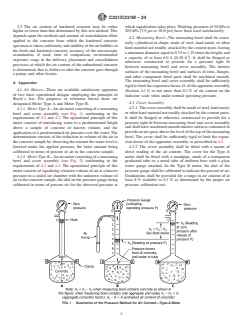
4.1.1 Meter Type A—An air meter consisting of a measuring bowl and cover assembly (see Fig. 1) conforming to the requirements
of 4.2 and 4.3. The operational principle of this meter consists of introducing water to a predetermined height above a sample of
concrete of known volume, and the application of a predetermined air pressure over the water. The determination consists of the
reduction in volume of the air in the concrete sample by observing the amount the water level is lowered under the applied pressure,
the latter amount being calibrated in terms of percent of air in the concrete sample.
FIG. 1 Illustration of the Pressure Method for Air Content—Type-A Meter
C231/C231M − 24
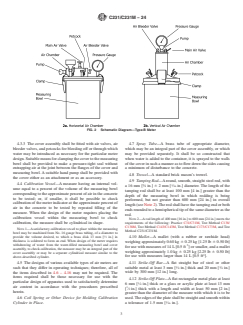
4.1.2 Meter Type B—An air meter consisting of a measuring bowl and cover assembly (see Fig. 2) conforming to the requirements
of 4.2 and 4.3. The operational principle of this meter consists of equalizing a known volume of air at a known pressure in a sealed
air chamber with the unknown volume of air in the concrete sample, the dial on the pressure gauge being calibrated in terms of
percent air for the observed pressure at which equalization takes place. Working pressures of 50 kPa to 205 kPa [7.5 psi to 30.0
psi] have been used satisfactorily.
4.2 Measuring Bowl—The measuring bowl shall be essentially cylindrical in shape, made of steel, hard metal, or other hard
material not readily attacked by the cement paste, having a minimum diameter equal to 0.75 to 1.25 times the height, and a capacity
of at least 6.0 L [0.20 ft ]. It shall be flanged or otherwise constructed to provide for a pressure tight fit between measuring bowl
and cover assembly. The interior surfaces of the measuring bowl and surfaces of rims, flanges, and other component fitted parts
shall be machined smooth. The measuring bowl and cover assembly shall be sufficiently rigid to limit the expansion factor, D, of
the apparatus assembly (Section A1.5) to not more than 0.1 % of air content on the indicator scale when under normal operating
pressure.
4.3 Cover Assembly:
4.3.1 The cover assembly shall be made of steel, hard metal, or other hard material not readily attacked by the cement paste. It
shall be flanged or otherwise constructed to provide for a pressure-tight fit between measuring bowl and cover assembly and shall
have machined smooth interior surfaces contoured to provide an air space above the level of the top of the measuring bowl. The
cover shall be sufficiently rigid to limit the expansion factor of the apparatus assembly as prescribed in 4.2.
4.3.2 The cover assembly shall be fitted with a means of direct reading of the air content. The cover for the Type A meter shall
be fitted with a standpipe, made of a transparent graduated tube or a metal tube of uniform bore with a glass water gauge attached.
In the Type B meter, the dial of the pressure gauge shall be calibrated to indicate the percent of air. Graduations shall be provided
for a range in air content of at least 8 % readable to 0.1 % as determined by the proper air pressure calibration test.
4.3.3 The cover assembly shall be fitted with air valves, air bleeder valves, and petcocks for bleeding off or through which water
may be introduced as necessary for the particular meter design. Suitable means for clamping the cover to the measuring bowl shall
be provided to make a pressure-tight seal without entrapping air at the joint between the flanges of the cover and measuring bowl.
A suitable hand pump shall be provided with the cover either as an attachment or as an accessory.
4.4 Calibration Vessel—A measure having an internal volume equal to a percent of the volume of the measuring bowl
FIG. 2 Schematic Diagram—Type-B Meter
C231/C231M − 24
corresponding to the approximate percent of air in the concrete to be tested; or, if smaller, it shall be possible to check calibration
of the meter indicator at the approximate percent of air in the concrete to be tested by repeated filling of the measure. When the
design of the meter requires placing the calibration vessel within the measuring bowl to check calibration, the measure shall be
cylindrical in shape.
NOTE 1—A satisfactory calibration vessel to place within the measuring bowl may be machined from No. 16 gauge brass tubing, of a diameter to provide
the volume desired, to which a brass disk 13 mm [ ⁄2 in.] in thickness is soldered to form an end. When design of the meter requires withdrawing of water
from the water-filled measuring bowl and cover assembly, to check calibration, the measure may be an integral part of the cover assembly or may be a
separate cylindrical measure similar to the above-described cylinder.
4.5 The designs of various available types of air meters are such that they differ in operating techniques; therefore, all of the items
described in 4.6 – 4.16 may not be required. The items required shall be those necessary for use with the particular design of
apparatus used to satisfactorily determine air content in accordance with the procedures prescribed herein.
4.6 Coil Spring or Other Device for Holding Calibration Cylinder in Place.
4.7 Spray Tube—A brass tube of appropriate diameter, which may be an integral part of the cover assembly, or which may be
provided separately. It shall be so constructed that when water is added to the container, it is sprayed to the walls of the cover in
such a manner as to flow down the sides causing a minimum of disturbance to the concrete.
4.8 Trowel—A standard brick mason’s trowel.
5 1
4.9 Tamping Rod—A round, smooth, straight steel rod, with a 16 mm [ ⁄8 in.] 6 2 mm [ ⁄16 in.] diameter. The length of the tamping
rod shall be at least 100 mm [4 in.] greater than the depth of the measuring bowl in which rodding is being performed, but not
greater than 600 mm [24 in.] in overall length (see Note 2). The rod shall have the tamping end or both ends rounded to a
hemispherical tip of the same diameter as the rod.
NOTE 2—A rod length of 400 mm [16 in.] to 600 mm [24 in.] meets the requirements of the following: Practice C31/C31M, Test Method C138/C138M,
Test Method C143/C143M, Test Method C173/C173M, and Test Method C231/C231M.
4.10 Mallet—A mallet (with a rubber or rawhide head) weighing approximately 0.60 kg 6 0.25 kg [1.25 lb 6 0.50 lb] for use with
measures of 14 L [0.5 ft ] or smaller, and a mallet weighing approximately 1.0 kg 6 0.25 kg [2.25 lb 6 0.50 lb] for use with
measures larger than 14 L [0.5 ft ].
1 3
4.11 Strike-Off Bar—A flat straight bar of steel or other suitable metal at least 3 mm [ ⁄8 in.] thick and 20 mm [ ⁄4 in.] wide by
300 mm [12 in.] long.
1 1
4.12 Strike-Off Plate—A flat rectangular metal plate at least 6 mm [ ⁄4 in.] thick or a glass or acrylic plate at least 13 mm [ ⁄2 in.]
thick with a length and width at least 50 mm [2 in.] greater than the diameter of the measure with which it is to be used. The edges
of the plate shall be straight and smooth within a tolerance of 1.5 mm [ ⁄16 in.].
4.13 Funnel, with the spout fitting into spray tube.
4.14 Measure for Water, having the necessary capacity to fill the indicator with water from the top of the concrete to the zero mark.
4.15 Vibrator, as described in Practice C192/C192M.
2 2
4.16 Sieves, 37.5 mm (1 ⁄2 in.) with not less than 0.2 m [2 ft ] of sieving area.
4.17 Scoop—of a size large enough so each amount of concrete obtained from the sampling receptacle is representative and small
enough so it is not spilled during placement in the measuring bowl.
5. Calibration of Apparatus
5.1 Make calibration tests in accordance with procedures prescribed in the annex. Rough handling will affect the calibration of
C231/C231M − 24
both Types A and B meters. Changes in barometric pressure will affect the calibration of Type A meter but not Type B meter. The
steps described Sections A1.2 – A1.6, as applicable to the meter type under consideration, are prerequisites for the final calibration
test to determine the operating pressure, P, on the pressure gauge of the Type A meter as described in Section A1.7, or to determine
the accuracy of the graduations indicating air content on the dial face of the pressure gauge of the Type B meter as described in
Section A1.9. The steps in Sections A1.2 – A1.6 need be made only once (at the time of initial calibration), or only occasionally
to check volume constancy of the calibration cylinder and measuring bowl. The calibration test described in Sections A1.7 and
A1.9, as applicable to the meter type being checked, must be made as frequently as necessary and at intervals not to exceed three
months to ensure that the proper gauge pressure, P, is being used for the Type A meter or that the correct air contents are being
indicated on the pressure gauge air content scale for the Type B meter. A change in elevation of more than 180 m [600 ft] from
the location at which a Type A meter was last calibrated will require recalibration in accordance with Section A1.7.
5.2 Calibration Records—Information to be maintained in the records shall include determination of expansion factor; size of the
calibration vessel used; and the reading of the meter at the calibration test point(s).
6. Determination of Aggregate Correction Factor
6.1 Procedure—Determine the aggregate correction factor on a combined sample of fine and coarse aggregate as directed in 6.2
to 6.4. It is determined independently by applying the calibrated pressure to a sample of inundated fine and coarse aggregate in
approximately the same moisture condition, amount, and proportions occurring in the concrete sample under test.
6.2 Aggregate Sample Size—Calculate the weights of fine and coarse aggregate present in the sample of fresh concrete whose air
content is to be determined, as follows:
F 5 ~S/B! ×F (1)
s b
C 5 ~S/B! ×C (2)
s b
where:
F = mass of fine aggregate in concrete sample under test, kg [lb],
s
3 3
S = volume of concrete sample (same as volume of measuring bowl), m [ft ],
3 3
B = volume of concrete produced per batch (Note 3), m [ft ],
F = total mass of fine aggregate in the moisture condition used in batch, kg [lb],
b
C = mass of coarse aggregate in concrete sample under test, kg [lb], and
s
C = total mass of coarse aggregate in the moisture condition used in batch, kg [lb].
b
NOTE 3—The volume of concrete produced per batch can be determined in accordance with applicable provisions of Test Method C138/C138M.
NOTE 4—The term “weight” is temporarily used in this test method because of established trade usage. The word is used to mean both “force” and “mass,”
and care must be taken to determine which is meant in each case (SI unit for force = newton and for mass = kilogram).
6.3 Placement of Aggregate in Measuring Bowl—Mix representative samples of fine aggregate F and coarse aggregate C , and
s s
place in the measuring bowl filled one-third full with water. Place the mixed aggregate, a small amount at a time, into the measuring
bowl; if necessary, add additional water so as to inundate all of the aggregate. Add each scoopful in a manner that will entrap as
little air as possible and remove accumulations of foam promptly. Tap the sides of the measuring bowl and lightly rod the upper
25 mm [1 in.] of the aggregate eight to twelve times. Stir after each addition of aggregate to eliminate entrapped air.
6.4 Aggregate Correction Factor Determination:
6.4.1 Initial Procedure for Types A and B Meters—When all of the aggregate has been placed in the measuring bowl, remove
excess foam and keep the aggregate inundated for a period of time approximately equal to the time between introduction of the
water into the mixer and the time of performing the test for air content before proceeding with the determination as directed in
6.4.2 or 6.4.3.
6.4.2 Type A Meter—Complete the test as described in 8.2.1 – 8.2.3. The aggregate correction factor, G, is equal to h − h (see
1 2
Fig. 1) (Note 5).
6.4.3 Type B Meter—Perform the procedures as described in 8.3.1. Remove a volume of water from the assembled and filled
apparatus approximately equivalent to the volume of air that would be contained in a typical concrete sample of a size equal to
the volume of the measuring bowl. Remove the water in the manner described in Section A1.9 for the calibration tests. Complete
C231/C231M − 24
the test as described in 8.3.2. The aggregate correction factor, G, is equal to the reading on the air-content scale minus the volume
of water removed from the measuring bowl expressed as a percent of the volume of the measuring bowl (see Fig. 1).
NOTE 5—The aggregate correction factor will vary with different aggregates. It can be determined only by test, since apparently it is not directly related
to absorption of the particles. The test can be made easily. Ordinarily the factor will remain reasonably constant for given aggregates, but an occasional
check test is recommended.
7. Preparation of Concrete Test Sample
7.1 Obtain the sample of freshly mixed concrete in accordance with applicable procedures of Practice C172/C172M. If the
concrete contains coarse aggregate particles that would be retained on a 50 mm (2 in.) sieve, wet-sieve a sufficient amount of the
representative sample over a 37.5 mm (1 ⁄2 in.) sieve, as described in Practice C172/C172M, to yield sufficient material to
completely fill the measuring bowl of the size selected for use. Carry out the wet-sieving operation with the minimum practicable
disturbance of the mortar. Make no attempt to wipe adhering mortar from coarse aggregate particles retained on the sieve.
8. Procedure for Determining Air Content of Concrete
8.1 Placement Preparation of Measuring Bowl and Consolidation of Sample:
8.1.1 Dampen the interior of the measuring bowl and place it on a flat, level, firm surface.
8.1.2 If self-consolidating concrete is being tested, follow the procedures in Practice C1758/C1758M for filling the measure. Upon
completion of the filling process, proceed to Strike-Off (8.1.6).
NOTE 6—Practice C1758/C1758M covers the procedure for filling the measure/bowl in one layer and without using any additional consolidation method.
8.1.3 Prepare the concrete as described in 7.1. Dampen the interior of the measuring bowl and place it on a flat, level, firm surface.
Using the scoop described in 4.17, place the concrete in the measuring bowl in the number of layers required by the consolidation
method (8.1.38.1.4 or 8.1.48.1.5). While placing the concrete in the bowl, move the scoop around the perimeter of the bowl
opening to ensure an even distribution of the concrete with minimal segregation. Consolidate each layer by the rodding procedure
(8.1.38.1.4) or by vibration (8.1.48.1.5). Strike-off the finally consolidated layer (8.1.58.1.6). Rod concretes with a slump greater
than 75 mm [3 in.]. Rod or vibrate concrete with a slump of 25 mm to 75 mm [1 in. to 3 in.]. Consolidate concretes with a slump
less than 25 mm [1 in.] by vibration.
8.1.2 Self-Consolidating Concrete—If self-consolidating concrete is being tested, follow the procedures in Practice C1758/
C1758M for filling the measuring bowl instead of the procedure in 8.1.1. Upon completion of the filling process, proceed to 8.1.5.
8.1.4 Rodding—Place the concrete in the measuring bowl in three layers of approximately equal volume. Rod each layer 25 times
uniformly over the cross section with the rounded end of the rod. Rod the bottom layer throughout its depth. In rodding this layer,
use care not to damage the bottom of the measuring bowl. For each upper layer, allow the rod to penetrate through the layer being
rodded and into the layer below approximately 25 mm [1 in.]. After each layer is rodded, tap the sides of the measuring bowl
smartly 10 to 15 times with the mallet to close any voids left by the tamping rod and to release any large bubbles of air that may
have been trapped. Add the final layer of concrete in a manner to avoid excessive overfilling (8.1.58.1.6).
8.1.5 Vibration—Place the concrete in the measuring bowl in two layers of approximately equal volume. Place all of the concrete
for each layer before starting vibration of that layer. Consolidate each layer by three insertions of the vibrator evenly distributed
over the cross section. Add the final layer in a manner to avoid excessive overfilling (8.1.58.1.6). In consolidating each layer, do
not allow the vibrator to rest on or touch the measuring bowl. Take care in withdrawing the vibrator to ensure that no air pockets
are left in the specimen. Observe a standard duration of vibration for the particular kind of concrete, vibrator, and measuring bowl
involved. The duration of vibration required will depend upon the workability of the concrete and the effectiveness of the vibrator.
Continue vibration until the concrete is properly consolidated. Never continue vibration long enough to cause escape of froth from
the sample.
NOTE 7—Overvibration may cause segregation and loss of intentionally entrained air. Usually, sufficient vibration has been applied as soon as the surface
of the concrete becomes relatively smooth and has a glazed appearance.
8.1.6 Strike Off—After consolidation of the concrete, strike off the top surface by sliding the strike-off bar across the top flange
or rim of the measuring bowl with a sawing motion until the bowl is just level full. On completion of consolidation, the measuring
C231/C231M − 24
bowl must not contain an excess or deficiency of concrete. Removal of 3 mm [ ⁄8 in.] during strike off is optimum. When a strike-off
plate is used, strike off concrete as prescribed in Test Method C138/C138M.
NOTE 8—A small quantity of representative concrete may be added to correct a deficiency. If the measure contains a great excess, remove a representative
portion of concrete with a trowel or scoop before the measure is struck off.
NOTE 9—The use of the strike-off plate on cast aluminum or other relatively soft metal air meter bases may cause rapid wear of the rim and require
frequent maintenance, calibration, and ultimately, replacement.
8.1.7 Application of Test Method—Any portion of the test method not specifically designated as pertaining to Type A or Type B
meter shall apply to both types.
8.2 Procedure—Type A Meter:
8.2.1 Preparation for Test—Thoroughly clean the flanges or rims of the measuring bowl and of the cover assembly so that when
the cover is clamped in place a pressure-tight seal will be obtained. Assemble the apparatus and add water over the concrete by
means of the tube until it rises to about the halfway mark in the standpipe. Incline the apparatus assembly about 0.5 rad [30°] from
vertical and, using the bottom of the measuring bowl as a pivot, describe several complete circles with the upper end of the column,
simultaneously tapping the cover lightly to remove any entrapped air bubbles above the concrete sample. Return the apparatus
assembly to a vertical position and fill the water column slightly above the zero mark, while lightly tapping the sides of the
measuring bowl. Bring the water level to the zero mark of the graduated tube before closing the vent at the top of the water column
(see Fig. 1 A).
NOTE 10—Some Type A meters have a calibrated starting fill mark above the zero mark. Generally, this starting mark should not be used since, as noted
in 8.2.3, the apparent air content is the difference between the water level reading H, at pressure P and the water level h at zero pressure after release
of pressure P.
8.2.2 The internal surface of the cover assembly shall be kept clean and free from oil or grease; the surface shall be wet to prevent
adherence of air bubbles that might be difficult to dislodge after assembly of the apparatus.
8.2.3 Test Procedure—Apply more than the desired test pressure, P, (about 1.4 kPa [0.2 psi] more) to the concrete by means of
the small hand pump. To relieve local restraints, tap the sides
...