

ASTM C991-23
(Specification)Standard Specification for Flexible Fibrous Glass Insulation for Metal Buildings
General Information
- Abstract
ABSTRACT
This specification covers the classification, composition, and physical properties of flexible fibrous glass insulation for use as interior surface of walls and roofs of metal buildings. The basic insulation blanket is designed to be postprocessed by a laminating process that applies an adhesive bonded facing to provide the interior finish and vapor retarder requirements for the building envelope The flexible insulation is furnished into Types I and II. Type I which is a glass processed from the molten state into fibrous form, bonded with a thermosetting resin, and formed into a resilient flexible blanket or batt. Type II is a Type I material supplied with a suitable facing adhered to one surface. The following physical properties of Types I and II materials shall be determined: thermal resistance, surface burning characteristics, combustion characteristics, water vapor sorption, fungi resistance, corrosiveness, odor emission, dimensional tolerances, and humid aging.
SCOPE
1.1 This specification covers the classification, composition, and physical properties of flexible fibrous glass insulation for use in metal building roofs and walls.
1.2 The basic insulation blanket is designed to be post-processed by a laminating process that applies an adhesive bonded facing.
1.3 The thermal values measured in accordance with this specification for both pre-processed and post-processed insulation are for the insulation only and do not include the effects of air-film surface resistance, changes in mean temperature, or compression of insulation at the framing members of the building, through metal conductance of fasteners and other parallel heat-transfer paths due to design or installation techniques.
1.4 The values stated in inch-pound units are to be regarded as standard. The values given in parentheses are mathematical conversions to SI units that are provided for information only and are not considered standard.
1.5 This standard does not purport to address all of the safety concerns, if any, associated with its use. It is the responsibility of the user of this standard to establish appropriate safety, health, and environmental practices and determine the applicability of regulatory limitations prior to use.
1.6 This international standard was developed in accordance with internationally recognized principles on standardization established in the Decision on Principles for the Development of International Standards, Guides and Recommendations issued by the World Trade Organization Technical Barriers to Trade (TBT) Committee.
- Status
- Published
- Publication Date
- 30-Apr-2023
- Technical Committee
- C16 - Thermal Insulation
- Drafting Committee
- C16.23 - Blanket and Loose Fill Insulation
Buy Documents
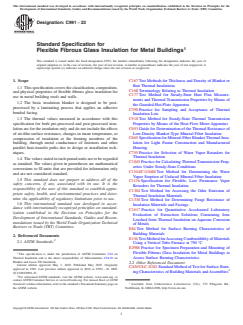
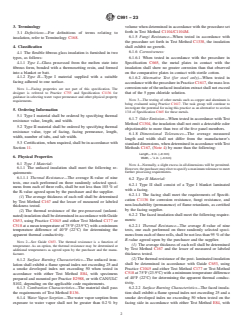


ASTM C991-23 - Standard Specification for Flexible Fibrous Glass Insulation for Metal Buildings
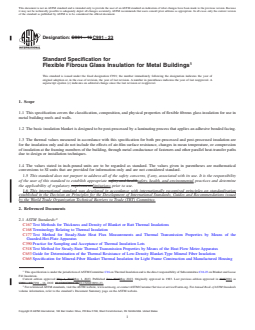
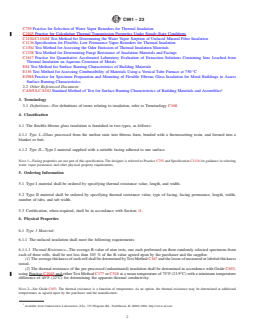
REDLINE ASTM C991-23 - Standard Specification for Flexible Fibrous Glass Insulation for Metal Buildings
Overview
ASTM C991-23: Standard Specification for Flexible Fibrous Glass Insulation for Metal Buildings establishes the classification, composition, and physical properties of flexible fibrous glass insulation specifically designed for use in the walls and roofs of metal buildings. Developed by ASTM International, this standard guides manufacturers, designers, and installers to ensure thermal efficiency, durability, and compliance with building codes when selecting insulation products.
The standard covers two main types of insulation:
- Type I: Unfaced, resilient, flexible glass blankets or batts, bonded with thermosetting resin.
- Type II: Type I material with an adhesive-bonded facing applied to one surface, commonly serving as the building’s interior finish and vapor retarder.
Key Topics
ASTM C991-23 specifies requirements and test methods relating to:
- Thermal Resistance: Ensures insulation achieves specified R-values for energy efficiency.
- Surface Burning Characteristics: Limits for flame spread and smoke development, referencing major fire test methods such as ASTM E84.
- Combustion and Fungi Resistance: Materials must pass combustibility and fungal growth tests for safety and hygiene.
- Water Vapor Sorption: Limits on moisture absorption to prevent degradation and maintain performance.
- Corrosiveness: Evaluates the effect on metals to prevent structural issues in metal buildings.
- Odor Emission: Ensures that installed insulation does not create objectionable odors.
- Dimensional Tolerances: Defines allowable variations in insulation length and width for installation consistency.
- Postprocessing and Facing: Guidance on the application and performance expectations of vapor-retarding facings (Type II).
Applications
ASTM C991-23 is primarily utilized in the design, specification, and installation of flexible fibrous glass blanket insulation in metal building construction. Key applications include:
- Metal Building Roof and Wall Insulation: Provides guidelines for selecting and installing blankets that improve energy-efficiency and interior comfort.
- Specifier and Supplier Guidance: Defines minimum performance requirements, dimensions, and inspection criteria to ensure product suitability.
- Quality Control: Supports field inspection, sampling, and acceptance of insulation products according to standardized criteria.
- Product Certification and Marking: Facilitates product traceability and regulatory compliance with labeling requirements such as R-value and surface burning characteristics.
The standard helps stakeholders-architects, engineers, contractors, and manufacturers-ensure that insulation solutions for metal buildings meet essential safety, performance, and regulatory demands.
Related Standards
ASTM C991-23 references and aligns with several other standards for testing and performance assessment, including:
- ASTM C167: Test Methods for Thickness and Density of Blanket or Batt Thermal Insulations
- ASTM C168: Terminology Relating to Thermal Insulation
- ASTM C177 / C518: Test Methods for Thermal Transmission Properties
- ASTM C653: Guide for Determination of Thermal Resistance of Low-Density Blanket-Type Mineral Fiber Insulation
- ASTM C665: Specification for Mineral-Fiber Blanket Thermal Insulation for Light Frame Construction
- ASTM C1136: Specification for Flexible, Low Permeance Vapor Retarders for Thermal Insulation
- ASTM E84: Standard Test Method for Surface Burning Characteristics of Building Materials
- CAN/ULC-S102: Surface Burning Characteristics of Building Materials and Assemblies
Consulting these documents ensures full compliance with ASTM C991-23 and a comprehensive understanding of insulation product performance for metal buildings.
Keywords: flexible fibrous glass insulation, ASTM C991-23, metal building insulation, thermal insulation, vapor retarder, blanket insulation, faced insulation, building envelope standards
Relations
- Effective Date
- 15-Apr-2024
- Effective Date
- 01-Mar-2024
- Effective Date
- 01-Mar-2024
- Effective Date
- 01-Feb-2024
- Effective Date
- 01-Dec-2023
- Effective Date
- 01-Sep-2023
- Refers
ASTM C755-20 - Standard Practice for Selection of Water Vapor Retarders for Thermal Insulation - Effective Date
- 01-Mar-2020
- Refers
ASTM C755-19b - Standard Practice for Selection of Water Vapor Retarders for Thermal Insulation - Effective Date
- 15-Oct-2019
- Effective Date
- 01-Sep-2019
- Refers
ASTM C755-19a - Standard Practice for Selection of Water Vapor Retarders for Thermal Insulation - Effective Date
- 01-Sep-2019
- Effective Date
- 01-Sep-2019
- Effective Date
- 01-Jul-2019
- Effective Date
- 01-May-2019
- Effective Date
- 15-Apr-2019
- Refers
ASTM C755-19 - Standard Practice for Selection of Water Vapor Retarders for Thermal Insulation - Effective Date
- 15-Apr-2019
Buy Documents
ASTM C991-23 - Standard Specification for Flexible Fibrous Glass Insulation for Metal Buildings
REDLINE ASTM C991-23 - Standard Specification for Flexible Fibrous Glass Insulation for Metal Buildings
Get Certified
Connect with accredited certification bodies for this standard

DIBt (Deutsches Institut für Bautechnik)
German Institute for Building Technology.
DIN CERTCO
DIN Group product certification.

Aboma Certification B.V.
Specialized in construction, metal, and transport sectors.
Sponsored listings
Frequently Asked Questions
ASTM C991-23 is a technical specification published by ASTM International. Its full title is "Standard Specification for Flexible Fibrous Glass Insulation for Metal Buildings". This standard covers: ABSTRACT This specification covers the classification, composition, and physical properties of flexible fibrous glass insulation for use as interior surface of walls and roofs of metal buildings. The basic insulation blanket is designed to be postprocessed by a laminating process that applies an adhesive bonded facing to provide the interior finish and vapor retarder requirements for the building envelope The flexible insulation is furnished into Types I and II. Type I which is a glass processed from the molten state into fibrous form, bonded with a thermosetting resin, and formed into a resilient flexible blanket or batt. Type II is a Type I material supplied with a suitable facing adhered to one surface. The following physical properties of Types I and II materials shall be determined: thermal resistance, surface burning characteristics, combustion characteristics, water vapor sorption, fungi resistance, corrosiveness, odor emission, dimensional tolerances, and humid aging. SCOPE 1.1 This specification covers the classification, composition, and physical properties of flexible fibrous glass insulation for use in metal building roofs and walls. 1.2 The basic insulation blanket is designed to be post-processed by a laminating process that applies an adhesive bonded facing. 1.3 The thermal values measured in accordance with this specification for both pre-processed and post-processed insulation are for the insulation only and do not include the effects of air-film surface resistance, changes in mean temperature, or compression of insulation at the framing members of the building, through metal conductance of fasteners and other parallel heat-transfer paths due to design or installation techniques. 1.4 The values stated in inch-pound units are to be regarded as standard. The values given in parentheses are mathematical conversions to SI units that are provided for information only and are not considered standard. 1.5 This standard does not purport to address all of the safety concerns, if any, associated with its use. It is the responsibility of the user of this standard to establish appropriate safety, health, and environmental practices and determine the applicability of regulatory limitations prior to use. 1.6 This international standard was developed in accordance with internationally recognized principles on standardization established in the Decision on Principles for the Development of International Standards, Guides and Recommendations issued by the World Trade Organization Technical Barriers to Trade (TBT) Committee.
ABSTRACT This specification covers the classification, composition, and physical properties of flexible fibrous glass insulation for use as interior surface of walls and roofs of metal buildings. The basic insulation blanket is designed to be postprocessed by a laminating process that applies an adhesive bonded facing to provide the interior finish and vapor retarder requirements for the building envelope The flexible insulation is furnished into Types I and II. Type I which is a glass processed from the molten state into fibrous form, bonded with a thermosetting resin, and formed into a resilient flexible blanket or batt. Type II is a Type I material supplied with a suitable facing adhered to one surface. The following physical properties of Types I and II materials shall be determined: thermal resistance, surface burning characteristics, combustion characteristics, water vapor sorption, fungi resistance, corrosiveness, odor emission, dimensional tolerances, and humid aging. SCOPE 1.1 This specification covers the classification, composition, and physical properties of flexible fibrous glass insulation for use in metal building roofs and walls. 1.2 The basic insulation blanket is designed to be post-processed by a laminating process that applies an adhesive bonded facing. 1.3 The thermal values measured in accordance with this specification for both pre-processed and post-processed insulation are for the insulation only and do not include the effects of air-film surface resistance, changes in mean temperature, or compression of insulation at the framing members of the building, through metal conductance of fasteners and other parallel heat-transfer paths due to design or installation techniques. 1.4 The values stated in inch-pound units are to be regarded as standard. The values given in parentheses are mathematical conversions to SI units that are provided for information only and are not considered standard. 1.5 This standard does not purport to address all of the safety concerns, if any, associated with its use. It is the responsibility of the user of this standard to establish appropriate safety, health, and environmental practices and determine the applicability of regulatory limitations prior to use. 1.6 This international standard was developed in accordance with internationally recognized principles on standardization established in the Decision on Principles for the Development of International Standards, Guides and Recommendations issued by the World Trade Organization Technical Barriers to Trade (TBT) Committee.
ASTM C991-23 is classified under the following ICS (International Classification for Standards) categories: 91.100.60 - Thermal and sound insulating materials. The ICS classification helps identify the subject area and facilitates finding related standards.
ASTM C991-23 has the following relationships with other standards: It is inter standard links to ASTM C168-24, ASTM C390-08(2024), ASTM E136-24a, ASTM E136-24, ASTM E84-23d, ASTM E84-23c, ASTM C755-20, ASTM C755-19b, ASTM C390-08(2019), ASTM C755-19a, ASTM C1104/C1104M-19, ASTM E84-19b, ASTM C1617-19, ASTM E84-19a, ASTM C755-19. Understanding these relationships helps ensure you are using the most current and applicable version of the standard.
ASTM C991-23 is available in PDF format for immediate download after purchase. The document can be added to your cart and obtained through the secure checkout process. Digital delivery ensures instant access to the complete standard document.
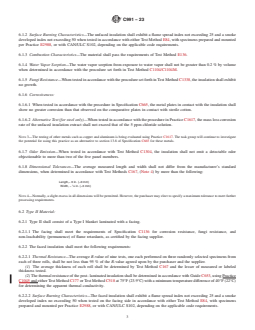
Standards Content (Sample)
This international standard was developed in accordance with internationally recognized principles on standardization established in the Decision on Principles for the
Development of International Standards, Guides and Recommendations issued by the World Trade Organization Technical Barriers to Trade (TBT) Committee.
Designation: C991 − 23
Standard Specification for
Flexible Fibrous Glass Insulation for Metal Buildings
This standard is issued under the fixed designation C991; the number immediately following the designation indicates the year of
original adoption or, in the case of revision, the year of last revision. A number in parentheses indicates the year of last reapproval. A
superscript epsilon (´) indicates an editorial change since the last revision or reapproval.
1. Scope C167 Test Methods for Thickness and Density of Blanket or
Batt Thermal Insulations
1.1 This specification covers the classification, composition,
C168 Terminology Relating to Thermal Insulation
and physical properties of flexible fibrous glass insulation for
C177 Test Method for Steady-State Heat Flux Measure-
use in metal building roofs and walls.
ments and Thermal Transmission Properties by Means of
1.2 The basic insulation blanket is designed to be post-
the Guarded-Hot-Plate Apparatus
processed by a laminating process that applies an adhesive
C390 Practice for Sampling and Acceptance of Thermal
bonded facing.
Insulation Lots
1.3 The thermal values measured in accordance with this C518 Test Method for Steady-State Thermal Transmission
Properties by Means of the Heat Flow Meter Apparatus
specification for both pre-processed and post-processed insu-
lation are for the insulation only and do not include the effects C653 Guide for Determination of the Thermal Resistance of
Low-Density Blanket-Type Mineral Fiber Insulation
of air-film surface resistance, changes in mean temperature, or
compression of insulation at the framing members of the C665 Specification for Mineral-Fiber Blanket Thermal Insu-
lation for Light Frame Construction and Manufactured
building, through metal conductance of fasteners and other
parallel heat-transfer paths due to design or installation tech- Housing
C755 Practice for Selection of Water Vapor Retarders for
niques.
Thermal Insulation
1.4 The values stated in inch-pound units are to be regarded
C1045 Practice for Calculating Thermal Transmission Prop-
as standard. The values given in parentheses are mathematical
erties Under Steady-State Conditions
conversions to SI units that are provided for information only
C1104/C1104M Test Method for Determining the Water
and are not considered standard.
Vapor Sorption of Unfaced Mineral Fiber Insulation
1.5 This standard does not purport to address all of the
C1136 Specification for Flexible, Low Permeance Vapor
safety concerns, if any, associated with its use. It is the
Retarders for Thermal Insulation
responsibility of the user of this standard to establish appro-
C1304 Test Method for Assessing the Odor Emission of
priate safety, health, and environmental practices and deter-
Thermal Insulation Materials
mine the applicability of regulatory limitations prior to use.
C1338 Test Method for Determining Fungi Resistance of
1.6 This international standard was developed in accor-
Insulation Materials and Facings
dance with internationally recognized principles on standard-
C1617 Practice for Quantitative Accelerated Laboratory
ization established in the Decision on Principles for the
Evaluation of Extraction Solutions Containing Ions
Development of International Standards, Guides and Recom-
Leached from Thermal Insulation on Aqueous Corrosion
mendations issued by the World Trade Organization Technical
of Metals
Barriers to Trade (TBT) Committee.
E84 Test Method for Surface Burning Characteristics of
Building Materials
2. Referenced Documents
E136 Test Method for Assessing Combustibility of Materials
2.1 ASTM Standards:
Using a Vertical Tube Furnace at 750 °C
E2988 Practice for Specimen Preparation and Mounting of
Flexible Fibrous Glass Insulation for Metal Buildings to
This specification is under the jurisdiction of ASTM Committee C16 on
Thermal Insulation and is the direct responsibility of Subcommittee C16.23 on Assess Surface Burning Characteristics
Blanket and Loose Fill Insulation.
2.2 Other Referenced Document:
Current edition approved May 1, 2023. Published May 2023. Originally
CAN/ULC-S102 Standard Method of Test for Surface Burn-
approved in 1983. Last previous edition approved in 2016 as C991 – 16. DOI:
ing Characteristics of Building Materials and Assemblies
10.1520/C0991-23.
For referenced ASTM standards, visit the ASTM website, www.astm.org, or
contact ASTM Customer Service at service@astm.org. For Annual Book of ASTM
Standards volume information, refer to the standard’s Document Summary page on Available from Underwriters Laboratories (UL), 333 Pfingsten Rd.,
the ASTM website. Northbrook, IL 60062-2096, http://www.ul.com.
Copyright © ASTM International, 100 Barr Harbor Drive, PO Box C700, West Conshohocken, PA 19428-2959. United States
C991 − 23
3. Terminology volume when determined in accordance with the procedure set
forth in Test Method C1104/C1104M.
3.1 Definitions—For definitions of terms relating to
6.1.5 Fungi Resistance—When tested in accordance with
insulation, refer to Terminology C168.
the procedure set forth in Test Method C1338, the insulation
4. Classification shall exhibit no growth.
6.1.6 Corrosiveness:
4.1 The flexible fibrous glass insulation is furnished in two
types, as follows: 6.1.6.1 When tested in accordance with the procedure in
Specification C665, the metal plates in contact with the
4.1.1 Type I—Glass processed from the molten state into
fibrous form, bonded with a thermosetting resin, and formed insulation shall show no greater corrosion than that observed
on the comparative plates in contact with sterile cotton.
into a blanket or batt.
4.1.2 Type II—Type I material supplied with a suitable
6.1.6.2 Alternative Test (for steel only)—When tested in
facing adhered to one surface.
accordance with the procedure in Practice C1617, the mass loss
corrosion rate of the unfaced insulation extract shall not exceed
NOTE 1—Facing properties are not part of this specification. The
designer is referred to Practice C755 and Specification C1136 for that of the 5 ppm chloride solution.
guidance in selecting water vapor permeance and other physical property
NOTE 3—The testing of other metals such as copper and aluminum is
requirements.
being evaluated using Practice C1617. The task group will continue to
investigate the potential for using this practice as an alternative to section
5. Ordering Information
13.8 of Specification C665 for these metals.
5.1 Type I material shall be ordered by specifying thermal
6.1.7 Odor Emission—When tested in accordance with Test
resistance value, length, and width.
Method C1304, the insulation shall not emit a detectable odor
5.2 Type II material shall be ordered by specifying thermal
objectionable to more than two of the five panel members.
resistance value, type of facing, facing permeance, length,
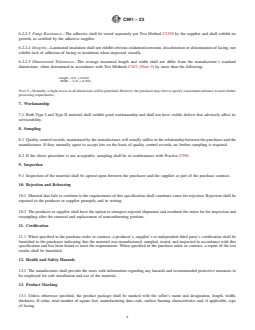
6.1.8 Dimensional Tolerances—The average measured
width, number of tabs, and tab width.
length and width shall not differ from the manufacturer’s
5.3 Certification, when required, shall be in accordance with
standard dimensions, when determined in accordance with Test
Section 11.
Methods C167, (Note 4) by more than the following:
Length,− 0 in. (−0 mm)
6. Physical Properties
Width, − ⁄8 in. (−3 mm)
6.1 Type 1 Material:
NOTE 4—Normally, a slight excess in all dimensions will be permitted.
6.1.1 The unfaced insulation shall meet the following re- However, the purchaser may elect to specify a maximum tolerance to meet
further processing requirements.
quirements:
6.1.1.1 Thermal Resistance—The average R-value of nine
6.2 Type II Material:
tests, one each performed on three randomly selected speci-
6.2.1 Type II sh
...
This document is not an ASTM standard and is intended only to provide the user of an ASTM standard an indication of what changes have been made to the previous version. Because
it may not be technically possible to adequately depict all changes accurately, ASTM recommends that users consult prior editions as appropriate. In all cases only the current version
of the standard as published by ASTM is to be considered the official document.
Designation: C991 − 16 C991 − 23
Standard Specification for
Flexible Fibrous Glass Insulation for Metal Buildings
This standard is issued under the fixed designation C991; the number immediately following the designation indicates the year of
original adoption or, in the case of revision, the year of last revision. A number in parentheses indicates the year of last reapproval. A
superscript epsilon (´) indicates an editorial change since the last revision or reapproval.
1. Scope
1.1 This specification covers the classification, composition, and physical properties of flexible fibrous glass insulation for use in
metal building roofs and walls.
1.2 The basic insulation blanket is designed to be post-processed by a laminating process that applies an adhesive bonded facing.
1.3 The thermal values measured in accordance with this specification for both pre-processed and post-processed insulation are
for the insulation only and do not include the effects of air-film surface resistance, changes in mean temperature, or compression
of insulation at the framing members of the building, through metal conductance of fasteners and other parallel heat-transfer paths
due to design or installation techniques.
1.4 The values stated in inch-pound units are to be regarded as standard. The values given in parentheses are mathematical
conversions to SI units that are provided for information only and are not considered standard.
1.5 This standard does not purport to address all of the safety concerns, if any, associated with its use. It is the responsibility
of the user of this standard to establish appropriate safety and healthsafety, health, and environmental practices and determine
the applicability of regulatory requirementslimitations prior to use.
1.6 This international standard was developed in accordance with internationally recognized principles on standardization
established in the Decision on Principles for the Development of International Standards, Guides and Recommendations issued
by the World Trade Organization Technical Barriers to Trade (TBT) Committee.
2. Referenced Documents
2.1 ASTM Standards:
C167 Test Methods for Thickness and Density of Blanket or Batt Thermal Insulations
C168 Terminology Relating to Thermal Insulation
C177 Test Method for Steady-State Heat Flux Measurements and Thermal Transmission Properties by Means of the
Guarded-Hot-Plate Apparatus
C390 Practice for Sampling and Acceptance of Thermal Insulation Lots
C518 Test Method for Steady-State Thermal Transmission Properties by Means of the Heat Flow Meter Apparatus
C653 Guide for Determination of the Thermal Resistance of Low-Density Blanket-Type Mineral Fiber Insulation
C665 Specification for Mineral-Fiber Blanket Thermal Insulation for Light Frame Construction and Manufactured Housing
This specification is under the jurisdiction of ASTM Committee C16 on Thermal Insulation and is the direct responsibility of Subcommittee C16.23 on Blanket and Loose
Fill Insulation.
Current edition approved May 1, 2016May 1, 2023. Published June 2016May 2023. Originally approved in 1983. Last previous edition approved in 20152016 as
C991 – 15.C991 – 16. DOI: 10.1520/C0991-16.10.1520/C0991-23.
For referenced ASTM standards, visit the ASTM website, www.astm.org, or contact ASTM Customer Service at service@astm.org. For Annual Book of ASTM Standards
volume information, refer to the standard’s Document Summary page on the ASTM website.
Copyright © ASTM International, 100 Barr Harbor Drive, PO Box C700, West Conshohocken, PA 19428-2959. United States
C991 − 23
C755 Practice for Selection of Water Vapor Retarders for Thermal Insulation
C1045 Practice for Calculating Thermal Transmission Properties Under Steady-State Conditions
C1104/C1104M Test Method for Determining the Water Vapor Sorption of Unfaced Mineral Fiber Insulation
C1136 Specification for Flexible, Low Permeance Vapor Retarders for Thermal Insulation
C1304 Test Method for Assessing the Odor Emission of Thermal Insulation Materials
C1338 Test Method for Determining Fungi Resistance of Insulation Materials and Facings
C1617 Practice for Quantitative Accelerated Laboratory Evaluation of Extraction Solutions Containing Ions Leached from
Thermal Insulation on Aqueous Corrosion of Metals
E84 Test Method for Surface Burning Characteristics of Building Materials
E136 Test Method for Assessing Combustibility of Materials Using a Vertical Tube Furnace at 750 °C
E2988 Practice for Specimen Preparation and Mounting of Flexible Fibrous Glass Insulation for Metal Buildings to Assess
Surface Burning Characteristics
2.2 Other Referenced Document:
CAN/ULC-S102 Standard Method of Test for Surface Burning Characteristics of Building Materials and Assemblies
3. Terminology
3.1 Definitions—For definitions of terms relating to insulation, refer to Terminology C168.
4. Classification
4.1 The flexible fibrous glass insulation is furnished in two types, as follows:
4.1.1 Type I—Glass processed from the molten state into fibrous form, bonded with a thermosetting resin, and formed into a
blanket or batt.
4.1.2 Type II—Type I material supplied with a suitable facing adhered to one surface.
NOTE 1—Facing properties are not part of this specification. The designer is referred to Practice C755 and Specification C1136 for guidance in selecting
water vapor permeance and other physical property requirements.
5. Ordering Information
5.1 Type I material shall be ordered by specifying thermal resistance value, length, and width.
5.2 Type II material shall be ordered by specifying thermal resistance value, type of facing, facing permeance, length, width,
number of tabs, and tab width.
5.3 Certification, when required, shall be in accordance with Section 11.
6. Physical Properties
6.1 Type 1 Material:
6.1.1 The unfaced insulation shall meet the following requirements:
6.1.1.1 Thermal Resistance—The average R-value of nine tests, one each performed on three randomly selected specimens from
each of three rolls, shall be not less than 103 % of the R-value agreed upon by the purchaser and the supplier.
(1) The average thickness of each roll shall be determined by Test Method C167 and the lesser of measured or labeled thickness
tested.
(2) The thermal resistance of the pre-processed (unlaminated) insulation shall be determined in accordance with Guide C653,
using Practice C1045 and either Test Method C177 or C518 at a mean temperature of 75°F (23.9°C) with a minimum temperature
difference of 40°F (22°C) for determining the apparent thermal conductivity.
NOTE 2—See Guide C653. The thermal resistance is a function of temperature. As an option, the thermal resistance may be determined at additional
temperatures as agreed upon by the purchaser and the manufacturer.
Available from Underwriters Laboratories (UL), 333 Pfingsten Rd., Northbrook, IL 60062-2096, http://www.ul.com.
C991 − 23
6.1.2 Surface Burning Characteristics—The unfaced insulation shall exhibit a flame spread index not exceeding 25 and a smoke
developed index not exceeding 50 when tested in accordance with either Test Method E84, with specimens prepared and mounted
per Practice E2988, or with CAN/ULC S102, depending on the applicable code requirements.
6.1.3 Combustion Characteristics—The material shall pass the requirements of Test Method E136.
6.1.4 Water Vapor Sorption—The water vapor sorption from exposure to water vapor shall not be greater than 0.2 % by volume
when determined in accordance with the procedure set forth in Test Method C1104/C1104M.
6.1.5 Fungi Resistance—When tested in accordance with the procedure set forth in Test
...