


ASTM E1527-13
(Practice)Standard Practice for Environmental Site Assessments: Phase I Environmental Site Assessment Process
Standard Practice for Environmental Site Assessments: Phase I Environmental Site Assessment Process
SIGNIFICANCE AND USE
4.1 Uses—This practice is intended for use on a voluntary basis by parties who wish to assess the environmental condition of commercial real estate taking into account commonly known and reasonably ascertainable information. While use of this practice is intended to constitute all appropriate inquiries for purposes of the LLPs, it is not intended that its use be limited to that purpose. This practice is intended primarily as an approach to conducting an inquiry designed to identify recognized environmental conditions in connection with a property. No implication is intended that a person must use this practice in order to be deemed to have conducted inquiry in a commercially prudent or reasonable manner in any particular transaction. Nevertheless, this practice is intended to reflect a commercially prudent and reasonable inquiry. (See Section 1.6.)
4.2 Clarifications on Use:
4.2.1 Use Not Limited to CERCLA—This practice is designed to assist the user in developing information about the environmental condition of a property and as such has utility for a wide range of persons, including those who may have no actual or potential CERCLA liability and/or may not be seeking the LLPs.
4.2.2 Residential Tenants/Purchasers and Others—No implication is intended that it is currently customary practice for residential tenants of multifamily residential buildings, tenants of single-family homes or other residential real estate, or purchasers of dwellings for one’s own residential use, to conduct an environmental site assessment in connection with these transactions. Thus, these transactions are not included in the term commercial real estate transactions, and it is not intended to imply that such persons are obligated to conduct an environmental site assessment in connection with these transactions for purposes of all appropriate inquiries or for any other purpose. In addition, no implication is intended that it is currently customary practice for environmental site as...
SCOPE
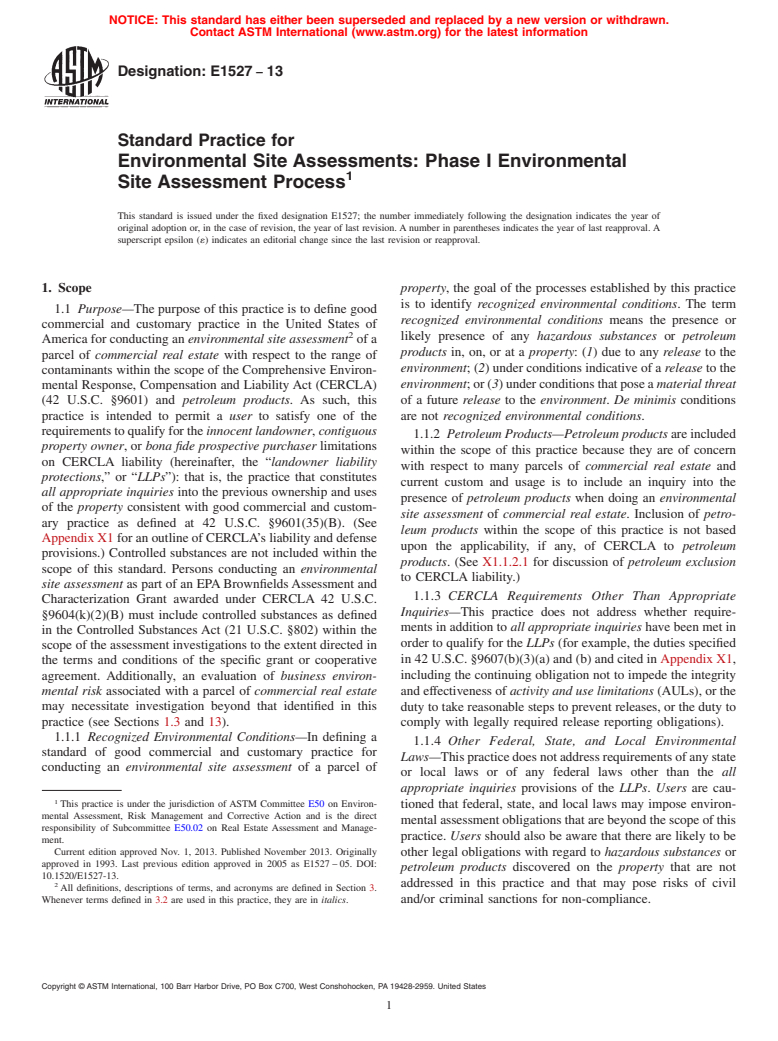
1.1 Purpose—The purpose of this practice is to define good commercial and customary practice in the United States of America for conducting an environmental site assessment2 of a parcel of commercial real estate with respect to the range of contaminants within the scope of the Comprehensive Environmental Response, Compensation and Liability Act (CERCLA) (42 U.S.C. §9601) and petroleum products. As such, this practice is intended to permit a user to satisfy one of the requirements to qualify for the innocent landowner, contiguous property owner, or bona fide prospective purchaser limitations on CERCLA liability (hereinafter, the “landowner liability protections,” or “LLPs”): that is, the practice that constitutes all appropriate inquiries into the previous ownership and uses of the property consistent with good commercial and customary practice as defined at 42 U.S.C. §9601(35)(B). (See Appendix X1 for an outline of CERCLA’s liability and defense provisions.) Controlled substances are not included within the scope of this standard. Persons conducting an environmental site assessment as part of an EPA Brownfields Assessment and Characterization Grant awarded under CERCLA 42 U.S.C. §9604(k)(2)(B) must include controlled substances as defined in the Controlled Substances Act (21 U.S.C. §802) within the scope of the assessment investigations to the extent directed in the terms and conditions of the specific grant or cooperative agreement. Additionally, an evaluation of business environmental risk associated with a parcel of commercial real estate may necessitate investigation beyond that identified in this practice (see Sections 1.3 and 13).
1.1.1 Recognized Environmental Conditions—In defining a standard of good commercial and customary practice for conducting an environmental site assessment of a parcel of property, the goal of the processes established by this practice is to identify recognized environmental condition...
General Information
Buy Standard


Standards Content (Sample)
NOTICE: This standard has either been superseded and replaced by a new version or withdrawn.
Contact ASTM International (www.astm.org) for the latest information
Designation: E1527 − 13
Standard Practice for
Environmental Site Assessments: Phase I Environmental
1
Site Assessment Process
This standard is issued under the fixed designation E1527; the number immediately following the designation indicates the year of
original adoption or, in the case of revision, the year of last revision. A number in parentheses indicates the year of last reapproval. A
superscript epsilon (´) indicates an editorial change since the last revision or reapproval.
1. Scope property, the goal of the processes established by this practice
is to identify recognized environmental conditions. The term
1.1 Purpose—The purpose of this practice is to define good
recognized environmental conditions means the presence or
commercial and customary practice in the United States of
2
likely presence of any hazardous substances or petroleum
America for conducting an environmental site assessment of a
products in, on, or at a property:(1) due to any release to the
parcel of commercial real estate with respect to the range of
environment;(2) under conditions indicative of a release to the
contaminants within the scope of the Comprehensive Environ-
environment;or(3) under conditions that pose a material threat
mental Response, Compensation and Liability Act (CERCLA)
(42 U.S.C. §9601) and petroleum products. As such, this of a future release to the environment. De minimis conditions
practice is intended to permit a user to satisfy one of the are not recognized environmental conditions.
requirements to qualify for the innocent landowner, contiguous
1.1.2 Petroleum Products—Petroleum products are included
property owner,or bona fide prospective purchaser limitations
within the scope of this practice because they are of concern
on CERCLA liability (hereinafter, the “landowner liability
with respect to many parcels of commercial real estate and
protections,” or “LLPs”): that is, the practice that constitutes
current custom and usage is to include an inquiry into the
all appropriate inquiries into the previous ownership and uses
presence of petroleum products when doing an environmental
of the property consistent with good commercial and custom-
site assessment of commercial real estate. Inclusion of petro-
ary practice as defined at 42 U.S.C. §9601(35)(B). (See
leum products within the scope of this practice is not based
Appendix X1 for an outline of CERCLA’s liability and defense
upon the applicability, if any, of CERCLA to petroleum
provisions.) Controlled substances are not included within the
products. (See X1.1.2.1 for discussion of petroleum exclusion
scope of this standard. Persons conducting an environmental
to CERCLA liability.)
site assessment as part of an EPA Brownfields Assessment and
1.1.3 CERCLA Requirements Other Than Appropriate
Characterization Grant awarded under CERCLA 42 U.S.C.
Inquiries—This practice does not address whether require-
§9604(k)(2)(B) must include controlled substances as defined
ments in addition to all appropriate inquiries have been met in
in the Controlled Substances Act (21 U.S.C. §802) within the
order to qualify for the LLPs (for example, the duties specified
scope of the assessment investigations to the extent directed in
in 42 U.S.C. §9607(b)(3)(a) and (b) and cited in Appendix X1,
the terms and conditions of the specific grant or cooperative
including the continuing obligation not to impede the integrity
agreement. Additionally, an evaluation of business environ-
mental risk associated with a parcel of commercial real estate and effectiveness of activity and use limitations (AULs), or the
may necessitate investigation beyond that identified in this duty to take reasonable steps to prevent releases, or the duty to
practice (see Sections 1.3 and 13).
comply with legally required release reporting obligations).
1.1.1 Recognized Environmental Conditions—In defining a
1.1.4 Other Federal, State, and Local Environmental
standard of good commercial and customary practice for
Laws—This practice does not address requirements of any state
conducting an environmental site assessment of a parcel of
or local laws or of any federal laws other than the all
appropriate inquiries provisions of the LLPs. Users are cau-
1
This practice is under the jurisdiction of ASTM Committee E50 on Environ- tioned that federal, state, and local laws may impose environ-
mental Assessment, Risk Management and Corrective Action and is the direct
mental assessment obligations that are beyond the scope of this
responsibility of Subcommittee E50.02 on Real Estate Assessment and Manage-
practice. Users should also be aware that there are likely to be
ment.
Current edition approved Nov. 1, 2013. Published November 2013. Originally other legal obligations with regard to hazardous substances or
approved in 1993. Last previous edition approved in 2005 as E15
...
This document is not an ASTM standard and is intended only to provide the user of an ASTM standard an indication of what changes have been made to the previous version. Because
it may not be technically possible to adequately depict all changes accurately, ASTM recommends that users consult prior editions as appropriate. In all cases only the current version
of the standard as published by ASTM is to be considered the official document.
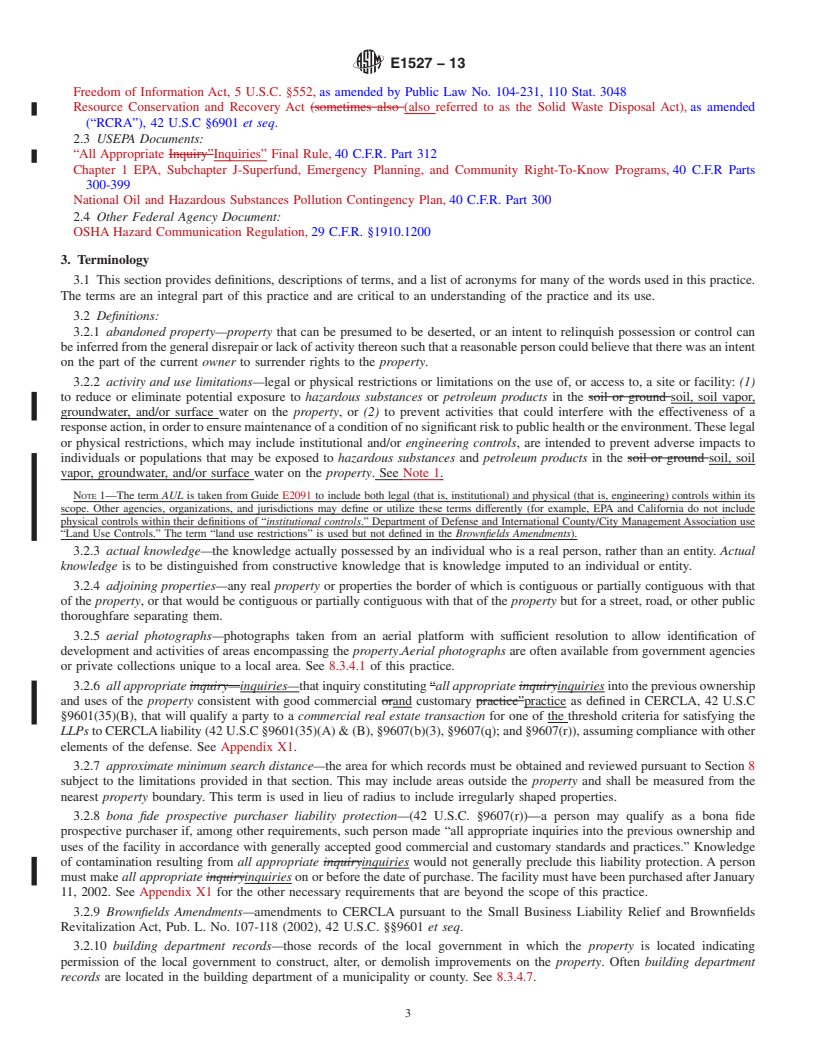
Designation: E1527 − 05 E1527 − 13
Standard Practice for
Environmental Site Assessments: Phase I Environmental
1
Site Assessment Process
This standard is issued under the fixed designation E1527; the number immediately following the designation indicates the year of
original adoption or, in the case of revision, the year of last revision. A number in parentheses indicates the year of last reapproval. A
superscript epsilon (´) indicates an editorial change since the last revision or reapproval.
1. Scope
1.1 Purpose—The purpose of this practice is to define good commercial and customary practice in the United States of America
2
for conducting an environmental site assessment of a parcel of commercial real estate with respect to the range of contaminants
within the scope of the Comprehensive Environmental Response, Compensation and Liability Act (CERCLA) (42 U.S.C. §9601)
and petroleum products. As such, this practice is intended to permit a user to satisfy one of the requirements to qualify for the
innocent landowner, contiguous property owner, or bona fide prospective purchaser limitations on CERCLA liability (hereinafter,
the “landowner liability protections,” or “LLPs”): that is, the practice that constitutes “all appropriate inquiryinquiries into the
previous ownership and uses of the property consistent with good commercial orand customary practice”practice as defined at 42
U.S.C. §9601(35)(B). (See Appendix X1 for an outline of CERCLA’sCERCLA’s liability and defense provisions.) Controlled
substances are not included within the scope of this standard. Persons conducting an environmental site assessment as part of an
EPA Brownfields Assessment and Characterization Grant awarded under CERCLA 42 U.S.C. §9604(k)(2)(B) must include
controlled substances as defined in the Controlled Substances Act (21 U.S.C. §802) within the scope of the assessment
investigations to the extent directed in the terms and conditions of the specific grant or cooperative agreement. Additionally, an
evaluation of business environmental risk associated with a parcel of commercial real estate may necessitate investigation beyond
that identified in this practice (see Sections 1.3 and 13).
1.1.1 Recognized Environmental Conditions—In defining a standard of good commercial and customary practice for conducting
an environmental site assessment of a parcel of property, the goal of the processes established by this practice is to identify
recognized environmental conditions. The term recognized environmental conditions means the presence or likely presence of any
hazardous substances or petroleum products on in, on, or at a property under conditions that indicate an existing release, a past
release, or a : (material threat1 of a release of ) due to any hazardous substancesrelease orto petroleum products into structures
on the propertyenvironment or; (2 into the ground, ground water,) under conditions indicative of a orrelease surface water of to
the property.environment The term includes ; hazardous substancesor (petroleum products3 even under conditions in compliance
with laws. The term is not intended to include ) under conditions that pose a de minimismaterial threat conditions that generally
do not present a threat to human health or the environment and that generally would not be the subject of an enforcementof a future
actionrelease if brought to the attention of appropriate governmental agencies. Conditions determined to be to the deenviron-
ment.De minimis conditions are not recognized environmental conditions.
1.1.2 Petroleum Products—Petroleum products are included within the scope of this practice because they are of concern with
respect to many parcels of commercial real estate and current custom and usage is to include an inquiry into the presence of
petroleum products when doing an environmental site assessment of commercial real estate. Inclusion of petroleum products
within the scope of this practice is not based upon the applicability, if any, of CERCLA to petroleum products. (See X1.7X1.1.2.1
for discussion of petroleum exclusion to CERCLA liability.)
1.1.3 CERCLA Requirements Other Than Appropriate Inquiry—Inquiries—This practice does not address whether requirements
in addition to all appropriate inquiryinquiries have been met in order to qualify for the LLPs (for example, the duties specified
in 42 U.S.C. §9607(b)(3)(a) and (b) and cited in Appendix X1, including the continuing obligation not to impede the integrity and
effectiveness of activity and use limitations (AULs), or the duty to take r
...
Questions, Comments and Discussion
Ask us and Technical Secretary will try to provide an answer. You can facilitate discussion about the standard in here.