


ASTM B761-17(2021)
(Test Method)Standard Test Method for Particle Size Distribution of Metal Powders and Related Compounds by X-Ray Monitoring of Gravity Sedimentation
Standard Test Method for Particle Size Distribution of Metal Powders and Related Compounds by X-Ray Monitoring of Gravity Sedimentation
SIGNIFICANCE AND USE
4.1 This test method is useful to both producers and purchasers of powders, as outlined in 1.1 and 1.2, in determining particle size distribution for product specifications, manufacturing control, development, and research.
4.2 Users should be aware that sample concentrations used in this test method may not be what is considered ideal by some authorities, and that the range of this test method extends into the region where Brownian movement could be a factor in conventional sedimentation. Within the range of this test method, neither the sample concentration nor Brownian movement are believed to be significant.
4.3 Reported particle size measurement is a function of both the actual particle dimension and shape factor as well as the particular physical or chemical properties being measured. Caution is required when comparing data from instruments operating on different physical or chemical parameters or with different particle size measurement ranges. Sample acquisition, handling, and preparation can also affect reported particle size results.
SCOPE
1.1 This test method covers the determination of particle size distributions of metal powders. Experience has shown that this test method is satisfactory for the analysis of elemental tungsten, tungsten carbide, molybdenum, and tantalum powders, all with an as-supplied estimated average particle size of 6 μm or less, as determined by Test Method B330. Other metal powders (for example, elemental metals, carbides, and nitrides) may be analyzed using this test method with caution as to significance until actual satisfactory experience is developed (see 7.2). The procedure covers the determination of particle size distribution of the powder in the following two conditions:
1.1.1 As the powder is supplied (as-supplied), and
1.1.2 After the powder has been deagglomerated by rod milling as described in Practice B859.
1.2 This test method is applicable to particles of uniform density and composition having a particle size distribution range of 0.1 up to 100 μm.
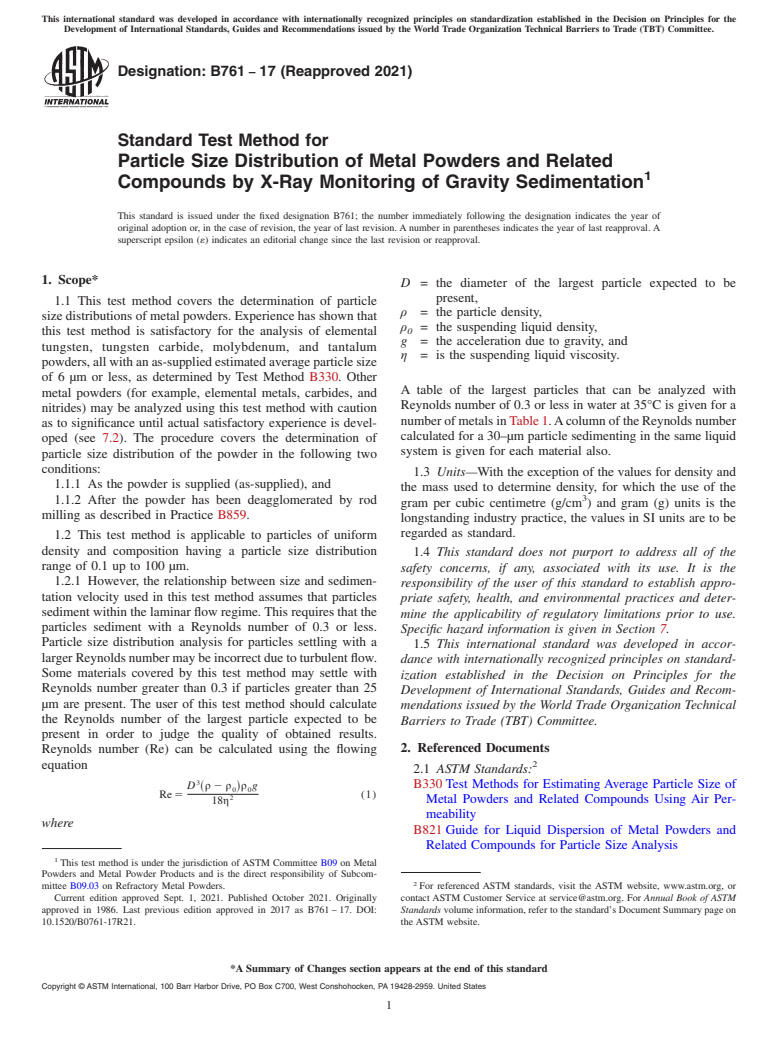
1.2.1 However, the relationship between size and sedimentation velocity used in this test method assumes that particles sediment within the laminar flow regime. This requires that the particles sediment with a Reynolds number of 0.3 or less. Particle size distribution analysis for particles settling with a larger Reynolds number may be incorrect due to turbulent flow. Some materials covered by this test method may settle with Reynolds number greater than 0.3 if particles greater than 25 μm are present. The user of this test method should calculate the Reynolds number of the largest particle expected to be present in order to judge the quality of obtained results. Reynolds number (Re) can be calculated using the flowing equation
where
D = the diameter of the largest particle expected to be present, ρ = the particle density, ρ0 = the suspending liquid density, g = the acceleration due to gravity, and η = is the suspending liquid viscosity.
A table of the largest particles that can be analyzed with Reynolds number of 0.3 or less in water at 35°C is given for a number of metals in Table 1. A column of the Reynolds number calculated for a 30–μm particle sedimenting in the same liquid system is given for each material also.
1.3 Units—With the exception of the values for density and the mass used to determine density, for which the use of the gram per cubic centimetre (g/cm3) and gram (g) units is the longstanding industry practice, the values in SI units are to be regarded as standard.
1.4 This standard does not purport to address all of the safety concerns, if any, associated with its use. It is the responsibility of the user of this standard to establish appropriate safety, health, and environmental practices and determine the applicability of regulatory limitations prior to use. Specific hazard information is given in Section 7.
1.5 ...
General Information
Standards Content (Sample)
This international standard was developed in accordance with internationally recognized principles on standardization established in the Decision on Principles for the
Development of International Standards, Guides and Recommendations issued by the World Trade Organization Technical Barriers to Trade (TBT) Committee.
Designation: B761 − 17 (Reapproved 2021)
Standard Test Method for
Particle Size Distribution of Metal Powders and Related
1
Compounds by X-Ray Monitoring of Gravity Sedimentation
This standard is issued under the fixed designation B761; the number immediately following the designation indicates the year of
original adoption or, in the case of revision, the year of last revision. A number in parentheses indicates the year of last reapproval. A
superscript epsilon (´) indicates an editorial change since the last revision or reapproval.
1. Scope*
D = the diameter of the largest particle expected to be
present,
1.1 This test method covers the determination of particle
ρ = the particle density,
size distributions of metal powders. Experience has shown that
ρ = the suspending liquid density,
0
this test method is satisfactory for the analysis of elemental
g = the acceleration due to gravity, and
tungsten, tungsten carbide, molybdenum, and tantalum
η = is the suspending liquid viscosity.
powders,allwithanas-suppliedestimatedaverageparticlesize
of 6 µm or less, as determined by Test Method B330. Other
A table of the largest particles that can be analyzed with
metal powders (for example, elemental metals, carbides, and
Reynolds number of 0.3 or less in water at 35°C is given for a
nitrides) may be analyzed using this test method with caution
numberofmetalsinTable1.AcolumnoftheReynoldsnumber
as to significance until actual satisfactory experience is devel-
calculated for a 30–µm particle sedimenting in the same liquid
oped (see 7.2). The procedure covers the determination of
system is given for each material also.
particle size distribution of the powder in the following two
conditions:
1.3 Units—With the exception of the values for density and
1.1.1 As the powder is supplied (as-supplied), and
the mass used to determine density, for which the use of the
3
1.1.2 After the powder has been deagglomerated by rod
gram per cubic centimetre (g/cm ) and gram (g) units is the
milling as described in Practice B859.
longstanding industry practice, the values in SI units are to be
regarded as standard.
1.2 This test method is applicable to particles of uniform
density and composition having a particle size distribution
1.4 This standard does not purport to address all of the
range of 0.1 up to 100 µm.
safety concerns, if any, associated with its use. It is the
1.2.1 However, the relationship between size and sedimen-
responsibility of the user of this standard to establish appro-
tation velocity used in this test method assumes that particles
priate safety, health, and environmental practices and deter-
sediment within the laminar flow regime.This requires that the
mine the applicability of regulatory limitations prior to use.
particles sediment with a Reynolds number of 0.3 or less.
Specific hazard information is given in Section 7.
Particle size distribution analysis for particles settling with a
1.5 This international standard was developed in accor-
largerReynoldsnumbermaybeincorrectduetoturbulentflow.
dance with internationally recognized principles on standard-
Some materials covered by this test method may settle with
ization established in the Decision on Principles for the
Reynolds number greater than 0.3 if particles greater than 25
Development of International Standards, Guides and Recom-
µm are present. The user of this test method should calculate
mendations issued by the World Trade Organization Technical
the Reynolds number of the largest particle expected to be
Barriers to Trade (TBT) Committee.
present in order to judge the quality of obtained results.
2. Referenced Documents
Reynolds number (Re) can be calculated using the flowing
2
equation
2.1 ASTM Standards:
3
B330 Test Methods for Estimating Average Particle Size of
D ~ρ 2 ρ !ρ g
0 0
Re 5 (1)
2
Metal Powders and Related Compounds Using Air Per-
18η
meability
where
B821 Guide for Liquid Dispersion of Metal Powders and
Related Compounds for Particle Size Analysis
1
This test method is under the jurisdiction of ASTM Committee B09 on Metal
Powders and Metal Powder Products and is the direct responsibility of Subcom-
2
mittee B09.03 on Refractory Metal Powders. For referenced ASTM standards, visit the ASTM website, www.astm.org, or
Current edition approved Sept. 1, 2021. Published October 2021. Originally contact ASTM Customer Service at service@astm.org. For Annual Book of ASTM
approved in 1986. Last previous edition approved in 2017 as B761 – 17. DOI: Standards volume information, refer to the standard’s Document Summary page on
10.1520/B0761-17R21. the ASTM website.
*A Summary of Changes section appears at the end of this standard
Copyright © ASTM In
...
Questions, Comments and Discussion
Ask us and Technical Secretary will try to provide an answer. You can facilitate discussion about the standard in here.