

ASTM C617/C617M-23
(Practice)Standard Practice for Capping Cylindrical Concrete Specimens
General Information
- Abstract
SIGNIFICANCE AND USE
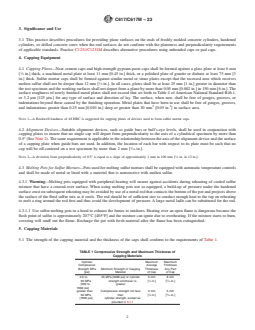
3.1 This practice describes procedures for providing plane surfaces on the ends of freshly molded concrete cylinders, hardened cylinders, or drilled concrete cores when the end surfaces do not conform with the planeness and perpendicularity requirements of applicable standards. Practice C1231/C1231M describes alternative procedures using unbonded caps or pad caps.
SCOPE
1.1 This practice covers apparatus, materials, and procedures for capping freshly molded concrete cylinders with neat cement and hardened cylinders and drilled concrete cores with high-strength gypsum paste or sulfur mortar.
1.2 The text of this standard refers to notes and footnotes that provide explanatory material. These notes and footnotes (excluding those in tables and figures) shall not be considered as requirements of the standard.
1.3 Units—The values stated in either SI units or inch-pound units are to be regarded separately as standard. The values stated in each system are not necessarily exact equivalents; therefore, to ensure conformance with the standard, each system shall be used independently of the other, and values from the two systems shall not be combined. Combining values from the two systems may result in non-conformance with the standard.
1.4 This standard does not purport to address all of the safety concerns, if any, associated with its use. It is the responsibility of the user of this standard to establish appropriate safety, health, and environmental practices and determine the applicability of regulatory limitations prior to use. For specific precaution statements see 4.3.1 and 6.2.4.1.
1.5 This international standard was developed in accordance with internationally recognized principles on standardization established in the Decision on Principles for the Development of International Standards, Guides and Recommendations issued by the World Trade Organization Technical Barriers to Trade (TBT) Committee.
- Status
- Published
- Publication Date
- 30-Sep-2023
- Technical Committee
- C09 - Concrete and Concrete Aggregates
- Drafting Committee
- C09.61 - Testing for Strength
Overview
ASTM C617/C617M-23: Standard Practice for Capping Cylindrical Concrete Specimens provides recognized procedures for preparing plane surfaces on the ends of cylindrical concrete specimens, including freshly molded cylinders, hardened concrete cylinders, or drilled concrete cores. This standard is critical for ensuring reliable compressive strength testing by addressing the planeness and perpendicularity of specimen ends, which may otherwise not meet requirements specified in applicable standards. ASTM C617/C617M sets out equipment specifications, materials, and step-by-step methods for capping, utilizing neat cement paste, high-strength gypsum paste, or sulfur mortar, and aligns with international standardization principles.
Key Topics
- Capping Materials and Methods:
Defines acceptable materials and their application, including:- Neat hydraulic cement paste for freshly molded cylinders
- High-strength gypsum paste and sulfur mortar for hardened cylinders and cores
- Equipment and Alignment:
Details the requirements for capping plates, alignment devices, and melting pots for sulfur mortar, ensuring proper geometry and safe handling. - Qualification and Quality Control:
Outlines qualification requirements for capping materials, including test procedures to demonstrate compliance with compressive strength, cap thickness, and consistency. - Safety and Environmental Considerations:
Highlights potential hazards, especially when working with molten sulfur mortar, and underscores the need for proper ventilation, protective equipment, and adherence to safety protocols. - Precision in Planeness and Perpendicularity:
Specifies acceptable tolerances for cap flatness and alignment, essential for reproducible and accurate compressive strength testing.
Applications
- Testing Laboratory Procedures:
Laboratories conducting compressive strength tests on concrete specimens use this standard to achieve reliable, standardized end conditions, enabling accurate measurement of material properties. - Construction Quality Control:
Construction companies and quality control agencies reference this standard when preparing test specimens to ensure results meet project specifications and regulatory requirements. - Research and Development:
Academic and industrial research that involves material testing or development of new capping compounds applies ASTM C617/C617M to validate experimental consistency. - Evaluation of Field Cores:
Engineers and inspectors rely on these procedures for preparing drilled concrete cores to assess in-situ concrete quality in existing structures.
Compliance with ASTM C617/C617M-23 improves the repeatability and comparability of strength results, minimizes the risk of testing errors due to improper capping, and supports global recognition of concrete testing practices.
Related Standards
For comprehensive quality control in concrete testing, ASTM C617/C617M-23 is often used alongside other widely referenced standards, including:
- ASTM C1231/C1231M - Practice for Use of Unbonded Caps in Determination of Compressive Strength of Hardened Cylindrical Concrete Specimens (provides alternative capping procedures)
- ASTM C109/C109M - Test Method for Compressive Strength of Hydraulic Cement Mortars
- ASTM C150/C150M - Specification for Portland Cement
- ASTM C472 - Test Methods for Physical Testing of Gypsum, Gypsum Plasters, and Gypsum Concrete
- ASTM C595/C595M - Specification for Blended Hydraulic Cements
- ANSI B46.1 - Standard for Surface Texture (Surface Roughness, Waviness, and Lay)
Practical Value
Adhering to ASTM C617/C617M-23 ensures concrete cylinder and core specimen ends are consistently prepared to the highest standards, optimizing accuracy in compressive strength testing. This promotes confidence in concrete quality assessments across construction, infrastructure, and research applications. Proper implementation of this practice reduces variability, supports compliance with international and local regulations, and enables reliable data for critical decision-making in the concrete industry.
Keywords: capping cylindrical concrete specimens, ASTM C617, concrete compressive strength, cement paste capping, gypsum paste capping, sulfur mortar capping, concrete testing standards, concrete laboratory procedures.
Relations
- Effective Date
- 01-Oct-2023
- Effective Date
- 15-Dec-2023
- Effective Date
- 15-Jul-2021
- Effective Date
- 01-Dec-2015
- Effective Date
- 01-Oct-2023
- Effective Date
- 01-Oct-2023
- Effective Date
- 01-Oct-2023
- Effective Date
- 01-Oct-2023
- Referred By
ASTM C31/C31M-23 - Standard Practice for Making and Curing Concrete Test Specimens in the Field - Effective Date
- 01-Oct-2023
- Effective Date
- 01-Oct-2023
- Effective Date
- 01-Oct-2023
- Effective Date
- 01-Oct-2023
- Effective Date
- 01-Oct-2023
- Effective Date
- 01-Oct-2023
- Effective Date
- 01-Oct-2023
Get Certified
Connect with accredited certification bodies for this standard

DIBt (Deutsches Institut für Bautechnik)
German Institute for Building Technology.
DIN CERTCO
DIN Group product certification.

Aboma Certification B.V.
Specialized in construction, metal, and transport sectors.
Sponsored listings
Frequently Asked Questions
ASTM C617/C617M-23 is a standard published by ASTM International. Its full title is "Standard Practice for Capping Cylindrical Concrete Specimens". This standard covers: SIGNIFICANCE AND USE 3.1 This practice describes procedures for providing plane surfaces on the ends of freshly molded concrete cylinders, hardened cylinders, or drilled concrete cores when the end surfaces do not conform with the planeness and perpendicularity requirements of applicable standards. Practice C1231/C1231M describes alternative procedures using unbonded caps or pad caps. SCOPE 1.1 This practice covers apparatus, materials, and procedures for capping freshly molded concrete cylinders with neat cement and hardened cylinders and drilled concrete cores with high-strength gypsum paste or sulfur mortar. 1.2 The text of this standard refers to notes and footnotes that provide explanatory material. These notes and footnotes (excluding those in tables and figures) shall not be considered as requirements of the standard. 1.3 Units—The values stated in either SI units or inch-pound units are to be regarded separately as standard. The values stated in each system are not necessarily exact equivalents; therefore, to ensure conformance with the standard, each system shall be used independently of the other, and values from the two systems shall not be combined. Combining values from the two systems may result in non-conformance with the standard. 1.4 This standard does not purport to address all of the safety concerns, if any, associated with its use. It is the responsibility of the user of this standard to establish appropriate safety, health, and environmental practices and determine the applicability of regulatory limitations prior to use. For specific precaution statements see 4.3.1 and 6.2.4.1. 1.5 This international standard was developed in accordance with internationally recognized principles on standardization established in the Decision on Principles for the Development of International Standards, Guides and Recommendations issued by the World Trade Organization Technical Barriers to Trade (TBT) Committee.
SIGNIFICANCE AND USE 3.1 This practice describes procedures for providing plane surfaces on the ends of freshly molded concrete cylinders, hardened cylinders, or drilled concrete cores when the end surfaces do not conform with the planeness and perpendicularity requirements of applicable standards. Practice C1231/C1231M describes alternative procedures using unbonded caps or pad caps. SCOPE 1.1 This practice covers apparatus, materials, and procedures for capping freshly molded concrete cylinders with neat cement and hardened cylinders and drilled concrete cores with high-strength gypsum paste or sulfur mortar. 1.2 The text of this standard refers to notes and footnotes that provide explanatory material. These notes and footnotes (excluding those in tables and figures) shall not be considered as requirements of the standard. 1.3 Units—The values stated in either SI units or inch-pound units are to be regarded separately as standard. The values stated in each system are not necessarily exact equivalents; therefore, to ensure conformance with the standard, each system shall be used independently of the other, and values from the two systems shall not be combined. Combining values from the two systems may result in non-conformance with the standard. 1.4 This standard does not purport to address all of the safety concerns, if any, associated with its use. It is the responsibility of the user of this standard to establish appropriate safety, health, and environmental practices and determine the applicability of regulatory limitations prior to use. For specific precaution statements see 4.3.1 and 6.2.4.1. 1.5 This international standard was developed in accordance with internationally recognized principles on standardization established in the Decision on Principles for the Development of International Standards, Guides and Recommendations issued by the World Trade Organization Technical Barriers to Trade (TBT) Committee.
ASTM C617/C617M-23 is classified under the following ICS (International Classification for Standards) categories: 91.100.30 - Concrete and concrete products. The ICS classification helps identify the subject area and facilitates finding related standards.
ASTM C617/C617M-23 has the following relationships with other standards: It is inter standard links to ASTM C617/C617M-15, ASTM C109/C109M-23, ASTM C109/C109M-21, ASTM C1231/C1231M-15, ASTM C78/C78M-22, ASTM C293/C293M-16, ASTM D7913/D7913M-14(2020), ASTM C1552-23, ASTM C31/C31M-23, ASTM C192/C192M-19, ASTM D4832/D4832M-23, ASTM C873/C873M-23, ASTM C1231/C1231M-23, ASTM C882/C882M-20, ASTM C497-20e1. Understanding these relationships helps ensure you are using the most current and applicable version of the standard.
ASTM C617/C617M-23 is available in PDF format for immediate download after purchase. The document can be added to your cart and obtained through the secure checkout process. Digital delivery ensures instant access to the complete standard document.
Standards Content (Sample)
This international standard was developed in accordance with internationally recognized principles on standardization established in the Decision on Principles for the
Development of International Standards, Guides and Recommendations issued by the World Trade Organization Technical Barriers to Trade (TBT) Committee.
Designation: C617/C617M − 23
Standard Practice for
Capping Cylindrical Concrete Specimens
This standard is issued under the fixed designation C617/C617M; the number immediately following the designation indicates the year
of original adoption or, in the case of revision, the year of last revision. A number in parentheses indicates the year of last reapproval.
A superscript epsilon (´) indicates an editorial change since the last revision or reapproval.
This standard has been approved for use by agencies of the U.S. Department of Defense.
1. Scope* C109/C109M Test Method for Compressive Strength of
Hydraulic Cement Mortars (Using 2-in. or [50 mm] Cube
1.1 This practice covers apparatus, materials, and proce-
Specimens)
dures for capping freshly molded concrete cylinders with neat
C150/C150M Specification for Portland Cement
cement and hardened cylinders and drilled concrete cores with
C472 Test Methods for Physical Testing of Gypsum, Gyp-
high-strength gypsum paste or sulfur mortar.
sum Plasters, and Gypsum Concrete
1.2 The text of this standard refers to notes and footnotes
C595/C595M Specification for Blended Hydraulic Cements
that provide explanatory material. These notes and footnotes
C1231/C1231M Practice for Use of Unbonded Caps in
(excluding those in tables and figures) shall not be considered
Determination of Compressive Strength of Hardened Cy-
as requirements of the standard.
lindrical Concrete Specimens
1.3 Units—The values stated in either SI units or inch-
2.2 ANSI Standard:
pound units are to be regarded separately as standard. The
B46.1 Standard for Surface Texture (Surface, Roughness,
values stated in each system are not necessarily exact equiva-
Waviness and Lay)
lents; therefore, to ensure conformance with the standard, each
3. Significance and Use
system shall be used independently of the other, and values
from the two systems shall not be combined. Combining values
3.1 This practice describes procedures for providing plane
from the two systems may result in non-conformance with the
surfaces on the ends of freshly molded concrete cylinders,
standard.
hardened cylinders, or drilled concrete cores when the end
1.4 This standard does not purport to address all of the surfaces do not conform with the planeness and perpendicu-
safety concerns, if any, associated with its use. It is the larity requirements of applicable standards. Practice C1231/
responsibility of the user of this standard to establish appro- C1231M describes alternative procedures using unbonded caps
priate safety, health, and environmental practices and deter- or pad caps.
mine the applicability of regulatory limitations prior to use.
4. Capping Equipment
For specific precaution statements see 4.3.1 and 6.2.4.1.
1.5 This international standard was developed in accor-
4.1 Capping Plates—Neat cement caps and high-strength
dance with internationally recognized principles on standard-
gypsum-paste caps shall be formed against a glass plate at least
ization established in the Decision on Principles for the
6 mm [ ⁄4 in.] thick, a machined metal plate at least 11 mm
Development of International Standards, Guides and Recom-
[0.45 in.] thick, or a polished plate of granite or diabase at least
mendations issued by the World Trade Organization Technical
75 mm [3 in.] thick. Sulfur mortar caps shall be formed against
Barriers to Trade (TBT) Committee.
similar metal or stone plates except that the recessed area
which receives molten sulfur shall not be deeper than 12 mm
2. Referenced Documents
[ ⁄2 in.]. In all cases, plates shall be at least 25 mm [1 in.]
2.1 ASTM Standards:
greater in diameter than the test specimen and the working
surfaces shall not depart from a plane by more than 0.05 mm
[0.002 in.] in 150 mm [6 in.]. The surface roughness of newly
This practice is under the jurisdiction of ASTM Committee C09 on Concrete
finished metal plates shall not exceed that set forth in Table 4
and Concrete Aggregates and is the direct responsibility of Subcommittee C09.61 on
Testing for Strength. of American National Standard B46.1, or 3.2 μm [125 μin.] for
Current edition approved Oct. 1, 2023. Published October 2023. Originally
any type of surface and direction of lay. The surface, when
approved in 1968. Last previous edition approved in 2015 as C617/C617M – 15.
new, shall be free of gouges, grooves, or indentations beyond
DOI: 10.1520/C0617_C0617M-23.
For referenced ASTM standards, visit the ASTM website, www.astm.org, or
contact ASTM Customer Service at service@astm.org. For Annual Book of ASTM
Standards volume information, refer to the standard’s Document Summary page on Available from American National Standards Institute (ANSI), 25 W. 43rd St.,
the ASTM website. 4th Floor, New York, NY 10036, http://www.ansi.org.
*A Summary of Changes section appears at the end of this standard
Copyright © ASTM International, 100 Barr Harbor Drive, PO Box C700, West Conshohocken, PA 19428-2959. United States
C617/C617M − 23
those caused by the finishing operation. Metal plates that have 5.1.1 If sulfur mortar, high strength gypsum paste and other
been in use shall be free of gouges, grooves, and indentations materials except neat cement paste are to be used to test
greater than 0.25 mm [0.010 in.] deep or greater than 30 mm concrete with a strength greater than 50 MPa [7000 psi] and
[0.05 in. ] in surface area. their compressive strength is less than the cylinder compressive
strength, the manufacturer or the user of the material must
NOTE 1—A Rockwell hardness of 48 HRC is suggested for capping
provide documentation:
plates of devices used to form sulfur mortar caps.
5.1.1.1 That the average strength of 15 cylinders capped
4.2 Alignment Devices—Suitable alignment devices, such as
with the material is not less than 98 % of the average strength
guide bars or bull’s-eye levels, shall be used in conjunction
of 15 companion cylinders capped with neat cement paste or 15
with capping plates to ensure that no single cap will depart
cylinders ground plane to within 0.05 mm [0.002 in.].
from perpendicularity to the axis of a cylindrical specimen by
5.1.1.2 That the standard deviation of the strengths of the
more than 0.5° (See Note 2). The same requirement is
capped cylinders is not greater than 1.57 times that of the
applicable to the relationship between the axis of the alignment
standard deviation of the reference cylinders.
device and the surface of a capping plate when guide bars are
5.1.1.3 That the cap thickness requirements were met in the
used. In addition, the location of each bar with respect to its
qualification tests, and
plate must be such that no cap will be off-centered on a test
5.1.1.4 Of the hardening time of the caps used in the
specimen by more than 2 mm [ ⁄16 in.].
qualification tests.
NOTE 2—A deviation from perpendicularity of 0.5° is equal to a slope
of approximately 1 mm in 100 mm [ ⁄8 in. in 12 in.].
5.1.2 Additionally, the qualification test report must include
the compressive strength of 50 mm [2 in.] cubes of the material
4.3 Melting Pots for Sulfur Mortars—Pots used for melting
qualified and of neat cement paste cubes, if used. Capping
sulfur mortars shall be equipped with automatic temperature
materials conforming to these requirements is permitted to be
controls and shall be made of metal or lined with a material that
used for cylinders with strengths up to 20 % greater than the
is nonreactive with molten sulfur.
concrete tested in these qualification tests. The manufacturer
4.3.1 Warning—Melting pots equipped with peripheral
must requalify lots of material manufactured on an annual basis
heating will ensure against accidents during reheating of
or whenever there is a change in the formulation or the raw
cooled sulfur mixture that have a crusted-over surface. When
materials. The user of the material must retain a copy of the
using melting pots not so equipped, a build-up of pressure
qualification results, and the dates of manufacture of material
under the hardened surface crust on subsequent reheating may
qualified and of the material currently being used.
be avoided by use of a metal rod that contacts the bottom of the
pot and projects above the surface of the fluid sulfur mix as it
NOTE 3—Table 2 is an example of a report of test results to qualify a
cools. The rod should be of sufficient size to conduct enough
capping material.
heat to the top on reheating to melt a ring around the rod first
5.1.3 The compressive strength of capping materials shall
and thus avoid the development of pressure. A large metal ladle
be determined by testing 50 mm [2 in.] cubes following the
can be substituted for the rod.
procedure described in Test Method C109/C109M. Except for
4.3.1.1 Use sulfur melting pots in a hood to exhaust the
sulfur mortars, molding procedures shall be as in Test Method
fumes to outdoors. Heating over an open flame is dangerous
C109/C109M unless other procedures are required to eliminate
because the flash point of sulfur is approximately 207°C
large entrapped air voids. See Test Methods C472 for alterna-
[405°F] and the mixture can ignite due to overheating. If the
tive compaction procedures. Cure cubes in the same environ-
mixture starts to burn, covering will snuff out the flame.
ment for the same length of time as the material used to cap
Recharge the pot with fresh material after the flame has been
specimens.
extinguished.
5.1.4 The strength of the capping material shall be deter-
mined on receipt of a new lot and at intervals not exceeding
5. Capping Materials
three months. If a given lot of the capping material fails to
5.1 The strength of the capping material and the thickness of
conform to the strength requirements, it shall not be used, and
the caps shall conform to the requirements of Table 1.
strength tests of the replacement material shall be made weekly
until four consecutive determinations conform to specification
requirements.
TABLE 1 Compressive Strength and Maximum Thickness of
5.2 Neat Hydraulic Cement Paste:
Capping Materials
5.2.1 Make qualification tests of the neat hydraulic cement
Cylinder Maximum Maximum
Compressive Average Thickness
paste prior to use for capping to establish the effects of
Strength MPa Minimum Strength of Capping Thickness Any Part
water-cement ratio and age on compressive strength of 50 mm
[psi] Material of Cap of Cap
[2 in.] cubes.
3.5 to 35 MPa [5000 psi] or cylinder 6 mm 8 mm
1 5
50 MPa strength whichever is [ ⁄4 in.] [ ⁄16 in.]
NOTE 4—The cements used generally conform to Specification C150/
[500 to greater
C150M Types I, II or III; however, Specification C595/C595M blended
7000 psi]
cements, calcium aluminate or other hydraulic cements producing accept-
greater than Compressive strength not less 3 mm 5 mm
1 3 able strength may be used.
50 MPa than [ ⁄8 in.] [ ⁄16 in.]
[7000 psi] cylinder strength, except as
5.2.2 Mix the neat cement paste to the desired consistency at
provided in 5.1.1
a water-cement ratio equal to or less than that required to
C617/C617M − 23
TABLE 2 Example of Report of Qualification of a Capping Material
NOTE 1—Manufacturer: Testing Supplies Co.
Capping Material: Super Strong AAA-Sulfur mortar
Lot: 12a45 Date Tested: 11/3/XX
Signed by:______________________________ (testing agency and responsible official)
Capping Ratio Pass/Fail
Item Material Control Cylinders Cap/Control Criteria
Concrete Cylinder Test Data
Type of capping material Sulfur Ground
Average Concrete Strength, psi 11 061 11 008 1.005 >0.98 Pass
Standard Deviation, psi 376 250 1.504 #1.57 Pass
Number of cylinders tested 15 15
Cap age when cylinders tested 7 days na
Capping Material Test Data
Average cap thickness, in. 0.11 na
Compressive strength of 2 in. cubes, psi 12 195
Cube age when tested. 7 days
A
Maximum concrete strength qualified, psi 1.2 Av. Str = 13 273
A
Nominally a specified strength of 11 000 psi and perhaps somewhat higher.
produce the required strength, generally 2 to 4 h before the requirements of Test Method C109/C109M and a metal cover
paste is to be used (Note 5). Remix as necessary to maintain plate conforming in principle to the design shown in Fig. 1
acceptable consistency (Note 6). Some retempering of the (Note 9). Bring the various parts of the apparatus to a
paste is acceptable if the required water-cement ratio is not temperature of 20 °C to 30 °C [68 °F to 86 °F], lightly coat the
exceeded. Optimum consistency is generally produced at surfaces that will be in contact with the sulfur mortar with
water-cement ratios of 0.32 to 0.36 by mass for Type I and mineral oil, and assemble near the melting pot. Bring the
Type II cements and 0.35 to 0.39 by mass for Type III cements. temperature of the molten-sulfur mortar in the pot within a
range of 130 °C to 145 °C [265 °F to 290 °F], stir thoroughly,
NOTE 5—Freshly mixed pastes tend to bleed, shrink, and make
and begin casting cubes. Using a ladle, or other suitable
unacceptable caps. The 2 h to 4 h period is generally appropriate for
pouring device, quickly fill each of the three compartments
portland cements.
NOTE 6—The required consistency of the paste is determined by the
until the molten material reaches the top of the filling hole.
appearance of the cap when it is stripped. Fluid paste results in streaks in
Allow sufficient time for maximum shrinkage, due to cooling,
the cap. Stiff paste results in thick caps.
and solidification to occur (approximately 15 min) and refill
5.3 High-Strength Gypsum Cement Paste:
each hole with molten material (Note 10). After solidification is
5.3.1 No fillers or extenders may be added to neat high-
complete, remove the cubes from the mold without breaking
strength gypsum cement paste subsequent to the manufacture
off the knob formed by the filling hole in the cover plate.
of the cement. (Note 7) Qualification tests shall be made to
Remove oil, sharp edges, and fins from the cubes a
...
This document is not an ASTM standard and is intended only to provide the user of an ASTM standard an indication of what changes have been made to the previous version. Because
it may not be technically possible to adequately depict all changes accurately, ASTM recommends that users consult prior editions as appropriate. In all cases only the current version
of the standard as published by ASTM is to be considered the official document.
Designation: C617/C617M − 15 C617/C617M − 23
Standard Practice for
Capping Cylindrical Concrete Specimens
This standard is issued under the fixed designation C617/C617M; the number immediately following the designation indicates the year
of original adoption or, in the case of revision, the year of last revision. A number in parentheses indicates the year of last reapproval.
A superscript epsilon (´) indicates an editorial change since the last revision or reapproval.
This standard has been approved for use by agencies of the U.S. Department of Defense.
1. Scope*
1.1 This practice covers apparatus, materials, and procedures for capping freshly molded concrete cylinders with neat cement and
hardened cylinders and drilled concrete cores with high-strength gypsum paste or sulfur mortar.
1.2 The text of this standard refers to notes and footnotes that provide explanatory material. These notes and footnotes (excluding
those in tables and figures) shall not be considered as requirements of the standard.
1.3 Units—The values stated in either SI units or inch-pound units are to be regarded separately as standard. The values stated in
each system may not beare not necessarily exact equivalents; therefore, to ensure conformance with the standard, each system shall
be used independently of the other. other, and values from the two systems shall not be combined. Combining values from the two
systems may result in non-conformance with the standard.
1.4 This standard does not purport to address all of the safety concerns, if any, associated with its use. It is the responsibility
of the user of this standard to establish appropriate safety and healthsafety, health, and environmental practices and determine
the applicability of regulatory limitations prior to use. For specific precaution statements see 4.3.1 and 6.2.4.1.
1.5 This international standard was developed in accordance with internationally recognized principles on standardization
established in the Decision on Principles for the Development of International Standards, Guides and Recommendations issued
by the World Trade Organization Technical Barriers to Trade (TBT) Committee.
2. Referenced Documents
2.1 ASTM Standards:
C109/C109M Test Method for Compressive Strength of Hydraulic Cement Mortars (Using 2-in. or [50 mm] Cube Specimens)
C150C150/C150M Specification for Portland Cement
C472 Test Methods for Physical Testing of Gypsum, Gypsum Plasters, and Gypsum Concrete
C595C595/C595M Specification for Blended Hydraulic Cements
C1231/C1231M Practice for Use of Unbonded Caps in Determination of Compressive Strength of Hardened Cylindrical
Concrete Specimens
2.2 ANSI Standard:
B46.1 Standard for Surface Texture (Surface, Roughness, Waviness and Lay)
This practice is under the jurisdiction of ASTM Committee C09 on Concrete and Concrete Aggregates and is the direct responsibility of Subcommittee C09.61 on Testing
for Strength.
Current edition approved April 1, 2015Oct. 1, 2023. Published May 2015October 2023. Originally approved in 1968. Last previous edition approved in 20122015 as
C617/C617M – 12. DOI: 10.1520/C0617_C0617M-15.15. DOI: 10.1520/C0617_C0617M-23.
For referenced ASTM standards, visit the ASTM website, www.astm.org, or contact ASTM Customer Service at service@astm.org. For Annual Book of ASTM Standards
volume information, refer to the standard’s Document Summary page on the ASTM website.
Available from American National Standards Institute (ANSI), 25 W. 43rd St., 4th Floor, New York, NY 10036, http://www.ansi.org.
*A Summary of Changes section appears at the end of this standard
Copyright © ASTM International, 100 Barr Harbor Drive, PO Box C700, West Conshohocken, PA 19428-2959. United States
C617/C617M − 23
3. Significance and Use
3.1 This practice describes procedures for providing plane surfaces on the ends of freshly molded concrete cylinders, hardened
cylinders, or drilled concrete cores when the end surfaces do not conform with the planeness and perpendicularity requirements
of applicable standards. Practice C1231/C1231M describes alternative procedures using unbonded caps or pad caps.
4. Capping Equipment
4.1 Capping Plates—Neat cement caps and high-strength gypsum-paste caps shall be formed against a glass plate at least 6 mm
[ ⁄4 in.] thick, a machined metal plate at least 11 mm [0.45 in.] thick, or a polished plate of granite or diabase at least 75 mm [3
in.] thick. Sulfur mortar caps shall be formed against similar metal or stone plates except that the recessed area which receives
molten sulfur shall not be deeper than 12 mm [ ⁄2 in.]. In all cases, plates shall be at least 25 mm [1 in.] greater in diameter than
the test specimen and the working surfaces shall not depart from a plane by more than 0.05 mm [0.002 in.] in 150 mm [6 in.]. The
surface roughness of newly finished metal plates shall not exceed that set forth in Table 4 of American National Standard B46.1,
or 3.2 μm [125 μin.] for any type of surface and direction of lay. The surface, when new, shall be free of gouges, grooves, or
indentations beyond those caused by the finishing operation. Metal plates that have been in use shall be free of gouges, grooves,
2 2
and indentations greater than 0.25 mm [0.010 in.] deep or greater than 30 mm [0.05 in. ] in surface area.
NOTE 1—A Rockwell hardness of 48 HRC is suggested for capping plates of devices used to form sulfur mortar caps.
4.2 Alignment Devices—Suitable alignment devices, such as guide bars or bull’s-eye levels, shall be used in conjunction with
capping plates to ensure that no single cap will depart from perpendicularity to the axis of a cylindrical specimen by more than
0.5° (See Note 2). The same requirement is applicable to the relationship between the axis of the alignment device and the surface
of a capping plate when guide bars are used. In addition, the location of each bar with respect to its plate must be such that no
cap will be off-centered on a test specimen by more than 2 mm [ ⁄16 in.].
NOTE 2—A deviation from perpendicularity of 0.5° is equal to a slope of approximately 1 mm in 100 mm [ ⁄8 in. in 12 in.].
4.3 Melting Pots for Sulfur Mortars—Pots used for melting sulfur mortars shall be equipped with automatic temperature controls
and shall be made of metal or lined with a material that is nonreactive with molten sulfur.
4.3.1 Warning—Melting pots equipped with peripheral heating will ensure against accidents during reheating of cooled sulfur
mixture that have a crusted-over surface. When using melting pots not so equipped, a build-up of pressure under the hardened
surface crust on subsequent reheating may be avoided by use of a metal rod that contacts the bottom of the pot and projects above
the surface of the fluid sulfur mix as it cools. The rod should be of sufficient size to conduct enough heat to the top on reheating
to melt a ring around the rod first and thus avoid the development of pressure. A large metal ladle can be substituted for the rod.
4.3.1.1 Use sulfur melting pots in a hood to exhaust the fumes to outdoors. Heating over an open flame is dangerous because the
flash point of sulfur is approximately 207°C [405°F] and the mixture can ignite due to overheating. If the mixture starts to burn,
covering will snuff out the flame. Recharge the pot with fresh material after the flame has been extinguished.
5. Capping Materials
5.1 The strength of the capping material and the thickness of the caps shall conform to the requirements of Table 1.
TABLE 1 Compressive Strength and Maximum Thickness of
Capping Materials
Cylinder Maximum Maximum
Compressive Average Thickness
Strength MPa Minimum Strength of Capping Thickness Any Part
[psi] Material of Cap of Cap
3.5 to 35 MPa [5000 psi] or cylinder 6 mm 8 mm
1 5
50 MPa strength whichever is [ ⁄4 in.] [ ⁄16 in.]
[500 to greater
7000 psi]
greater than Compressive strength not less 3 mm 5 mm
1 3
50 MPa than [ ⁄8 in.] [ ⁄16 in.]
[7000 psi] cylinder strength, except as
provided in 5.1.1
C617/C617M − 23
5.1.1 If sulfur mortar, high strength gypsum paste and other materials except neat cement paste are to be used to test concrete with
a strength greater than 50 MPa [7000 psi] and their compressive strength is less than the cylinder compressive strength, the
manufacturer or the user of the material must provide documentation:
5.1.1.1 That the average strength of 15 cylinders capped with the material is not less than 98 % of the average strength of 15
companion cylinders capped with neat cement paste or 15 cylinders ground plane to within 0.05 mm [0.002 in.].
5.1.1.2 That the standard deviation of the strengths of the capped cylinders is not greater than 1.57 times that of the standard
deviation of the reference cylinders.
5.1.1.3 That the cap thickness requirements were met in the qualification tests, and
5.1.1.4 Of the hardening time of the caps used in the qualification tests.
5.1.2 Additionally, the qualification test report must include the compressive strength of 50 mm [2 in.] cubes of the material
qualified and of neat cement paste cubes, if used. Capping materials conforming to these requirements is permitted to be used for
cylinders with strengths up to 20 % greater than the concrete tested in these qualification tests. The manufacturer must requalify
lots of material manufactured on an annual basis or whenever there is a change in the formulation or the raw materials. The user
of the material must retain a copy of the qualification results, and the dates of manufacture of material qualified and of the material
currently being used.
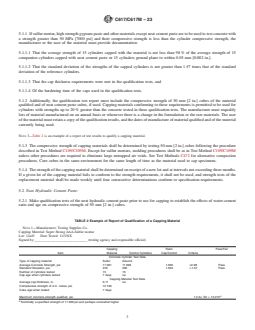
NOTE 3—Table 2 is an example of a report of test results to qualify a capping material.
5.1.3 The compressive strength of capping materials shall be determined by testing 50 mm [2 in.] cubes following the procedure
described in Test Method C109/C109M. Except for sulfur mortars, molding procedures shall be as in Test Method C109/C109M
unless other procedures are required to eliminate large entrapped air voids. See Test Methods C472 for alternative compaction
procedures. Cure cubes in the same environment for the same length of time as the material used to cap specimens.
5.1.4 The strength of the capping material shall be determined on receipt of a new lot and at intervals not exceeding three months.
If a given lot of the capping material fails to conform to the strength requirements, it shall not be used, and strength tests of the
replacement material shall be made weekly until four consecutive determinations conform to specification requirements.
5.2 Neat Hydraulic Cement Paste:
5.2.1 Make qualification tests of the neat hydraulic cement paste prior to use for capping to establish the effects of water-cement
ratio and age on compressive strength of 50 mm [2 in.] cubes.
TABLE 2 Example of Report of Qualification of a Capping Material
NOTE 1—Manufacturer: Testing Supplies Co.
Capping Material: Super Strong AAA-Sulfur mortar
Lot: 12a45 Date Tested: 11/3/XX
Signed by:______________________________ (testing agency and responsible official)
Capping Ratio Pass/Fail
Item Material Control Cylinders Cap/Control Criteria
Concrete Cylinder Test Data
Type of capping material Sulfur Ground
Average Concrete Strength, psi 11 061 11 008 1.005 >0.98 Pass
Standard Deviation, psi 376 250 1.504 #1.57 Pass
Number of cylinders tested 15 15
Cap age when cylinders tested 7 days na
Capping Material Test Data
Average cap thickness, in. 0.11 na
Compressive strength of 2 in. cubes, psi 12 195
Cube age when tested. 7 days
A
Maximum concrete strength qualified, psi 1.2 Av. Str = 13 273
A
Nominally a specified strength of 11 000 psi and perhaps somewhat higher.
C617/C617M − 23
NOTE 4—The cements used generally conform to Specification C150C150/C150M Types I, II or III; however, Specification C595C595/C595M blended
cements, calcium aluminate or other hydraulic cements producing acceptable strength may be used.
5.2.2 Mix the neat cement paste to the desired consistency at a water-cement ratio equal to or less than that required to produce
the required strength, generally 2 to 4 h before the paste is to be used (Note 5). Remix as necessary to maintain acceptable
consistency (Note 6). Some retempering of the paste is acceptable if the required water-cement ratio is not exceeded. Optimum
consistency is generally produced at water-cement ratios of 0.32 to 0.36 by mass for Type I and Type II cements and 0.35 to 0.39
by mass for Type III cements.
NOTE 5—Freshly mixed pastes tend to bleed, shrink, and make unacceptable caps. The 22 h to 4 h period is generally appropriate for portland cements.
NOTE 6—The required consistency of the paste is determined by the appearance of the cap when it is stripped. Fluid paste results in streaks in the cap.
Stiff paste results in thick caps.
5.3 High-Strength Gypsum Cement Paste:
5.3.1 No fillers or extenders may be added to neat high-strength gypsum cement paste subsequent to the manufacture of the
cement. (Note 7) Qualification tests shall be made to determine the effects of water-cement ratio and age on compressive strength
of 50 mm [2 in.] cubes. Retarders may be used to extend working time, but their effects on required water-cement ratio and strength
must be determined. (Note 8)
NOTE 7—Low-strength molding plaster, plaster of paris, or mixtures of plaster of paris and portland cement are unsuitable for capping.
NOTE 8—The water-gypsum cement ratio should be between 0.26 and 0.30. Use of low water-cement ratios and vigorous mixing will usually permit
development of 35 MPa [5000 psi] at ages of 11 h or 2 h. Higher water-gypsum cement ratios extend working time, but reduce strength.
5.3.2 Mix the neat gypsum cement paste at the desired water-cement ratio and use it promptly since it sets rapidly.
5.4 Sulfur Mortar:
5.4.1 Proprietary or laboratory prepared sulfur mortars are permitted if allowed to harden a minimum of 2 h before testing concrete
with strength less than 35
...