

ASTM E647-23b
(Test Method)Standard Test Method for Measurement of Fatigue Crack Growth Rates
General Information
- Abstract
SIGNIFICANCE AND USE
5.1 Fatigue crack growth rate expressed as a function of crack-tip stress-intensity factor range, da/dN versus ΔK, characterizes a material's resistance to stable crack extension under cyclic loading. Background information on the ration-ale for employing linear elastic fracture mechanics to analyze fatigue crack growth rate data is given in Refs (3) and (4).
5.1.1 In innocuous (inert) environments fatigue crack growth rates are primarily a function of ΔK and force ratio, R, or Kmax and R (Note 1). Temperature and aggressive environments can significantly affect da/dN versus ΔK, and in many cases accentuate R-effects and introduce effects of other loading variables such as cycle frequency and waveform. Attention needs to be given to the proper selection and control of these variables in research studies and in the generation of design data.
Note 1: ΔK, Kmax, and R are not independent of each other. Specification of any two of these variables is sufficient to define the loading condition. It is customary to specify one of the stress-intensity parameters (ΔK or Kmax) along with the force ratio, R.
5.1.2 Expressing da/dN as a function of ΔK provides results that are independent of planar geometry, thus enabling exchange and comparison of data obtained from a variety of specimen configurations and loading conditions. Moreover, this feature enables da/dN versus ΔK data to be utilized in the design and evaluation of engineering structures. The concept of similitude is assumed, which implies that cracks of differing lengths subjected to the same nominal ΔK will advance by equal increments of crack extension per cycle.
5.1.3 Fatigue crack growth rate data are not always geometry-independent in the strict sense since thickness effects sometimes occur. However, data on the influence of thickness on fatigue crack growth rate are mixed. Fatigue crack growth rates over a wide range of ΔK have been reported to either increase, decrease, or remain unaffected as specimen...
SCOPE
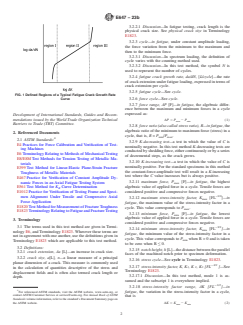
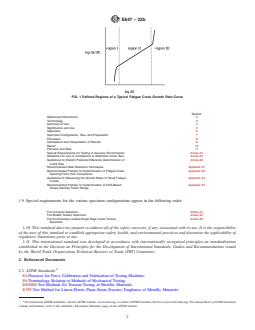
1.1 This test method2 covers the determination of fatigue crack growth rates from near-threshold (see region I in Fig. 1) to Kmax controlled instability (see region III in Fig. 1.) Results are expressed in terms of the crack-tip stress-intensity factor range (ΔK), defined by the theory of linear elasticity.
1.9 Special requirements for the various specimen configurations appear in the following order:
The Compact Specimen
Annex A1
The Middle Tension Specimen
Annex A2
The Eccentrically-Loaded Single Edge Crack Tension Specimen
Annex A3
1.10 This standard does not purport to address all of the safety concerns, if any, associated with its use. It is the responsibility of the user of this standard to establish appropriate safety, health, and environmental practices and determine the applicability of regulatory limitations prior to use.
1.11 This international standard was developed in accordance with internationally recognized principles on standardization established in the Decision on Principles for the Development of International Standards, Guides and Recommendations issued by the World Trade Organization Technical Barriers to Trade (TBT) Committee.
- Status
- Published
- Publication Date
- 14-Nov-2023
- Technical Committee
- E08 - Fatigue and Fracture
- Drafting Committee
- E08.06 - Crack Growth Behavior
Overview
ASTM E647-23b is the internationally recognized standard test method for the measurement of fatigue crack growth rates in materials. Established by ASTM International, this standard defines procedures for determining the rate at which a crack advances under cyclic loading-a critical parameter for characterizing a material’s resistance to fatigue failure. Results are expressed as the relationship between the fatigue crack growth rate (da/dN) and the crack-tip stress-intensity factor range (ΔK), which is fundamental for assessing structural component performance, predicting service life, and ensuring safety in engineering applications.
Key Topics
- Fatigue Crack Growth Rate (da/dN): Measures the rate at which a crack extends per loading cycle under repeated stress conditions.
- Crack-Tip Stress-Intensity Factor (ΔK): The key parameter, based on linear elastic fracture mechanics, representing the severity of the local stress field at the crack tip.
- Test Methods: Includes specific procedures and equipment for various specimen configurations, such as compact, middle-tension, and eccentrically-loaded single edge crack tension specimens.
- Influence of Environment and Loading Variables: Variables like temperature, environment (air, inert, or aggressive media), load ratio (R), frequency, and waveform can significantly impact fatigue crack growth rates.
- Geometry Independence: When properly applied, this standard allows comparison of results across different geometric configurations, making the data broadly transferable and valuable for material selection and design.
- Residual Stress and Crack Closure Effects: Addresses the implications of pre-existing stresses and crack tip shielding phenomena that can influence test results and their interpretation.
Applications
The ASTM E647-23b standard is widely utilized across industries where understanding fatigue behavior is essential:
- Aerospace: Ensures the structural integrity of airframes, engines, and critical components by evaluating growth rates of cracks under cyclic loading.
- Automotive: Supports development and validation of vehicles and components subject to dynamic stresses, contributing to improved durability and safety.
- Energy and Infrastructure: Assists in the assessment and maintenance planning of structures such as pipelines, bridges, and pressure vessels exposed to fluctuating loads.
- Materials Research and Development: Essential for comparing fatigue resistance among candidate alloys and optimizing material processes and heat treatments.
- Quality Assurance and Compliance: Provides a reliable basis for meeting strict industry requirements related to damage tolerance and lifecycle prediction.
Related Standards
Standard test methods and practices referenced or commonly used alongside ASTM E647 include:
- ASTM E399: Linear-Elastic Plane-Strain Fracture Toughness of Metallic Materials
- ASTM E1820: Measurement of Fracture Toughness
- ASTM E561: K₍R₎ Curve Determination
- ASTM E1012: Testing Frame and Specimen Alignment
- ASTM E8/E8M: Tension Testing of Metallic Materials
- ASTM E1823: Terminology Relating to Fatigue and Fracture Testing
The comprehensiveness and robustness of ASTM E647 make it foundational for fatigue crack growth testing. By standardizing the measurement methodology, this document ensures consistent, comparable, and accurate fatigue crack growth rate data, directly supporting safer and more durable engineering systems worldwide. When used in conjunction with related fracture mechanics standards, ASTM E647 enables engineers and researchers to predict structural integrity, inform maintenance schedules, and drive advancements in material science and technology.
Relations
- Effective Date
- 15-Nov-2023
- Effective Date
- 01-Feb-2024
- Effective Date
- 01-Feb-2023
- Effective Date
- 15-Nov-2023
- Effective Date
- 15-Nov-2023
- Effective Date
- 15-Nov-2023
- Effective Date
- 15-Nov-2023
- Effective Date
- 15-Nov-2023
- Effective Date
- 15-Nov-2023
- Effective Date
- 15-Nov-2023
- Effective Date
- 15-Nov-2023
- Effective Date
- 15-Nov-2023
- Effective Date
- 15-Nov-2023
- Effective Date
- 15-Nov-2023
- Effective Date
- 15-Nov-2023
Get Certified
Connect with accredited certification bodies for this standard

Element Materials Technology
Materials testing and product certification.

Inštitut za kovinske materiale in tehnologije
Institute of Metals and Technology. Materials testing, metallurgical analysis, NDT.
Sponsored listings
Frequently Asked Questions
ASTM E647-23b is a standard published by ASTM International. Its full title is "Standard Test Method for Measurement of Fatigue Crack Growth Rates". This standard covers: SIGNIFICANCE AND USE 5.1 Fatigue crack growth rate expressed as a function of crack-tip stress-intensity factor range, da/dN versus ΔK, characterizes a material's resistance to stable crack extension under cyclic loading. Background information on the ration-ale for employing linear elastic fracture mechanics to analyze fatigue crack growth rate data is given in Refs (3) and (4). 5.1.1 In innocuous (inert) environments fatigue crack growth rates are primarily a function of ΔK and force ratio, R, or Kmax and R (Note 1). Temperature and aggressive environments can significantly affect da/dN versus ΔK, and in many cases accentuate R-effects and introduce effects of other loading variables such as cycle frequency and waveform. Attention needs to be given to the proper selection and control of these variables in research studies and in the generation of design data. Note 1: ΔK, Kmax, and R are not independent of each other. Specification of any two of these variables is sufficient to define the loading condition. It is customary to specify one of the stress-intensity parameters (ΔK or Kmax) along with the force ratio, R. 5.1.2 Expressing da/dN as a function of ΔK provides results that are independent of planar geometry, thus enabling exchange and comparison of data obtained from a variety of specimen configurations and loading conditions. Moreover, this feature enables da/dN versus ΔK data to be utilized in the design and evaluation of engineering structures. The concept of similitude is assumed, which implies that cracks of differing lengths subjected to the same nominal ΔK will advance by equal increments of crack extension per cycle. 5.1.3 Fatigue crack growth rate data are not always geometry-independent in the strict sense since thickness effects sometimes occur. However, data on the influence of thickness on fatigue crack growth rate are mixed. Fatigue crack growth rates over a wide range of ΔK have been reported to either increase, decrease, or remain unaffected as specimen... SCOPE 1.1 This test method2 covers the determination of fatigue crack growth rates from near-threshold (see region I in Fig. 1) to Kmax controlled instability (see region III in Fig. 1.) Results are expressed in terms of the crack-tip stress-intensity factor range (ΔK), defined by the theory of linear elasticity. 1.9 Special requirements for the various specimen configurations appear in the following order: The Compact Specimen Annex A1 The Middle Tension Specimen Annex A2 The Eccentrically-Loaded Single Edge Crack Tension Specimen Annex A3 1.10 This standard does not purport to address all of the safety concerns, if any, associated with its use. It is the responsibility of the user of this standard to establish appropriate safety, health, and environmental practices and determine the applicability of regulatory limitations prior to use. 1.11 This international standard was developed in accordance with internationally recognized principles on standardization established in the Decision on Principles for the Development of International Standards, Guides and Recommendations issued by the World Trade Organization Technical Barriers to Trade (TBT) Committee.
SIGNIFICANCE AND USE 5.1 Fatigue crack growth rate expressed as a function of crack-tip stress-intensity factor range, da/dN versus ΔK, characterizes a material's resistance to stable crack extension under cyclic loading. Background information on the ration-ale for employing linear elastic fracture mechanics to analyze fatigue crack growth rate data is given in Refs (3) and (4). 5.1.1 In innocuous (inert) environments fatigue crack growth rates are primarily a function of ΔK and force ratio, R, or Kmax and R (Note 1). Temperature and aggressive environments can significantly affect da/dN versus ΔK, and in many cases accentuate R-effects and introduce effects of other loading variables such as cycle frequency and waveform. Attention needs to be given to the proper selection and control of these variables in research studies and in the generation of design data. Note 1: ΔK, Kmax, and R are not independent of each other. Specification of any two of these variables is sufficient to define the loading condition. It is customary to specify one of the stress-intensity parameters (ΔK or Kmax) along with the force ratio, R. 5.1.2 Expressing da/dN as a function of ΔK provides results that are independent of planar geometry, thus enabling exchange and comparison of data obtained from a variety of specimen configurations and loading conditions. Moreover, this feature enables da/dN versus ΔK data to be utilized in the design and evaluation of engineering structures. The concept of similitude is assumed, which implies that cracks of differing lengths subjected to the same nominal ΔK will advance by equal increments of crack extension per cycle. 5.1.3 Fatigue crack growth rate data are not always geometry-independent in the strict sense since thickness effects sometimes occur. However, data on the influence of thickness on fatigue crack growth rate are mixed. Fatigue crack growth rates over a wide range of ΔK have been reported to either increase, decrease, or remain unaffected as specimen... SCOPE 1.1 This test method2 covers the determination of fatigue crack growth rates from near-threshold (see region I in Fig. 1) to Kmax controlled instability (see region III in Fig. 1.) Results are expressed in terms of the crack-tip stress-intensity factor range (ΔK), defined by the theory of linear elasticity. 1.9 Special requirements for the various specimen configurations appear in the following order: The Compact Specimen Annex A1 The Middle Tension Specimen Annex A2 The Eccentrically-Loaded Single Edge Crack Tension Specimen Annex A3 1.10 This standard does not purport to address all of the safety concerns, if any, associated with its use. It is the responsibility of the user of this standard to establish appropriate safety, health, and environmental practices and determine the applicability of regulatory limitations prior to use. 1.11 This international standard was developed in accordance with internationally recognized principles on standardization established in the Decision on Principles for the Development of International Standards, Guides and Recommendations issued by the World Trade Organization Technical Barriers to Trade (TBT) Committee.
ASTM E647-23b is classified under the following ICS (International Classification for Standards) categories: 77.040.10 - Mechanical testing of metals. The ICS classification helps identify the subject area and facilitates finding related standards.
ASTM E647-23b has the following relationships with other standards: It is inter standard links to ASTM E647-23a, ASTM E1823-24, ASTM E1823-23, ASTM E1823-24a, ASTM F3122-14(2022), ASTM E1681-23, ASTM F2924-14(2021), ASTM E2472-12(2018)e2, ASTM E2714-13(2020), ASTM F3184-16(2023), ASTM E399-23, ASTM F2565-21, ASTM F2759-19, ASTM G107-95(2020)e1, ASTM F3607-22. Understanding these relationships helps ensure you are using the most current and applicable version of the standard.
ASTM E647-23b is available in PDF format for immediate download after purchase. The document can be added to your cart and obtained through the secure checkout process. Digital delivery ensures instant access to the complete standard document.
Standards Content (Sample)
This international standard was developed in accordance with internationally recognized principles on standardization established in the Decision on Principles for the
Development of International Standards, Guides and Recommendations issued by the World Trade Organization Technical Barriers to Trade (TBT) Committee.
Designation: E647 − 23b
Standard Test Method for
Measurement of Fatigue Crack Growth Rates
This standard is issued under the fixed designation E647; the number immediately following the designation indicates the year of
original adoption or, in the case of revision, the year of last revision. A number in parentheses indicates the year of last reapproval. A
superscript epsilon (´) indicates an editorial change since the last revision or reapproval.
1. Scope 1.8 This test method is divided into two main parts. The first
2 part gives general information concerning the recommenda-
1.1 This test method covers the determination of fatigue
tions and requirements for fatigue crack growth rate testing.
crack growth rates from near-threshold (see region I in Fig. 1)
The second part is composed of annexes that describe the
to K controlled instability (see region III in Fig. 1.) Results
max
special requirements for various specimen configurations, spe-
are expressed in terms of the crack-tip stress-intensity factor
cial requirements for testing in aqueous environments, and
range (ΔK), defined by the theory of linear elasticity.
procedures for non-visual crack size determination. In addition,
1.2 Several different test procedures are provided, the opti-
there are appendices that cover techniques for calculating
mum test procedure being primarily dependent on the magni-
da/dN, determining fatigue crack opening force, and guidelines
tude of the fatigue crack growth rate to be measured.
for measuring the growth of small fatigue cracks. General
1.3 Materials that can be tested by this test method are not information and requirements common to all specimen types
are listed as follows:
limited by thickness or by strength so long as specimens are of
sufficient thickness to preclude buckling and of sufficient
Section
Referenced Documents 2
planar size to remain predominantly elastic during testing.
Terminology 3
1.4 A range of specimen sizes with proportional planar Summary of Use 4
Significance and Use 5
dimensions is provided, but size is variable to be adjusted for
Apparatus 6
yield strength and applied force. Specimen thickness may be
Specimen Configuration, Size, and Preparation 7
varied independent of planar size. Procedure 8
Calculations and Interpretation of Results 9
1.5 The details of the various specimens and test configu-
Report 10
Precision and Bias 11
rations are shown in Annex A1 – Annex A3. Specimen
Special Requirements for Testing in Aqueous Environments Annex A4
configurations other than those contained in this method may
Guidelines for Use of Compliance to Determine Crack Size Annex A5
be used provided that well-established stress-intensity factor
Guidelines for Electric Potential Difference Determination of Annex A6
Crack Size
calibrations are available and that specimens are of sufficient
Recommended Data Reduction Techniques Appendix X1
planar size to remain predominantly elastic during testing.
Recommended Practice for Determination of Fatigue Crack Appendix X2
Opening Force from Compliance
1.6 Residual stress as well as a variety of shielding effects
Guidelines for Measuring the Growth Rates of Small Fatigue Appendix X3
such as crack closure may significantly influence the interpre-
Cracks
tation of fatigue crack growth rate data, particularly at low Recommended Practice for Determination of ACR-Based Appendix X4
Stress-Intensity Factor Range
stress-intensity factors and low force ratios (1, 2). None of
1.9 Special requirements for the various specimen configu-
these variables are incorporated into the classical computation
of applied ΔK. rations appear in the following order:
The Compact Specimen Annex A1
1.7 Values stated in SI units are to be regarded as the
The Middle Tension Specimen Annex A2
standard. Values given in parentheses are for information only.
The Eccentrically-Loaded Single Edge Crack Tension Annex A3
Specimen
This test method is under the jurisdiction of ASTM Committee E08 on Fatigue 1.10 This standard does not purport to address all of the
and Fracture and is the direct responsibility of Subcommittee E08.06 on Crack
safety concerns, if any, associated with its use. It is the
Growth Behavior.
responsibility of the user of this standard to establish appro-
Current edition approved Nov. 15, 2023. Published April 2024. Originally
priate safety, health, and environmental practices and deter-
approved in 1978. Last previous approved in 2023 as E647 – 23a. DOI: 10.1520/
E0647-23B.
mine the applicability of regulatory limitations prior to use.
For additional information on this test method see RR: E24 – 1001. Available
1.11 This international standard was developed in accor-
from ASTM Headquarters, 100 Barr Harbor Drive, West Conshohocken, PA 19428.
3 dance with internationally recognized principles on standard-
The boldface numbers in parentheses refer to the list of references at the end of
this standard. ization established in the Decision on Principles for the
Copyright © ASTM International, 100 Barr Harbor Drive, PO Box C700, West Conshohocken, PA 19428-2959. United States
E647 − 23b
3.2.2.1 Discussion—In fatigue testing, crack length is the
physical crack size. See physical crack size in Terminology
E1823.
3.2.3 cycle—in fatigue, under constant amplitude loading,
the force variation from the minimum to the maximum and
then to the minimum force.
3.2.3.1 Discussion—In spectrum loading, the definition of
cycle varies with the counting method used.
3.2.3.2 Discussion—In this test method, the symbol N is
used to represent the number of cycles.
3.2.4 fatigue crack growth rate, da/dN, [L/cycle]—the rate
of crack extension under fatigue loading, expressed in terms of
crack extension per cycle.
3.2.5 fatigue cycle—See cycle.
FIG. 1 Defined Regions of a Typical Fatigue Crack Growth Rate
Curve 3.2.6 force cycle—See cycle.
3.2.7 force range, ΔP [F]—in fatigue, the algebraic differ-
ence between the maximum and minimum forces in a cycle
expressed as:
Development of International Standards, Guides and Recom-
mendations issued by the World Trade Organization Technical
ΔP 5 P 2 P (1)
max min
Barriers to Trade (TBT) Committee.
3.2.8 force ratio (also called stress ratio), R—in fatigue, the
algebraic ratio of the minimum to maximum force (stress) in a
2. Referenced Documents
cycle, that is, R = P /P .
min max
2.1 ASTM Standards:
3.2.9 K-decreasing test—a test in which the value of C is
E4 Practices for Force Calibration and Verification of Test-
nominally negative. In this test method K-decreasing tests are
ing Machines
conducted by shedding force, either continuously or by a series
E6 Terminology Relating to Methods of Mechanical Testing
of decremental steps, as the crack grows.
E8/E8M Test Methods for Tension Testing of Metallic Ma-
3.2.10 K-increasing test—a test in which the value of C is
terials
nominally positive. For the standard specimens in this method
E399 Test Method for Linear-Elastic Plane-Strain Fracture
the constant-force-amplitude test will result in a K-increasing
Toughness of Metallic Materials
test where the C value increases but is always positive.
E467 Practice for Verification of Constant Amplitude Dy-
namic Forces in an Axial Fatigue Testing System 3.2.11 maximum force, P [F]—in fatigue, the highest
max
algebraic value of applied force in a cycle. Tensile forces are
E561 Test Method for K Curve Determination
R
E1012 Practice for Verification of Testing Frame and Speci- considered positive and compressive forces negative.
−3/2
men Alignment Under Tensile and Compressive Axial
3.2.12 maximum stress-intensity factor, K [FL ]—in
max
Force Application
fatigue, the maximum value of the stress-intensity factor in a
E1820 Test Method for Measurement of Fracture Toughness
cycle. This value corresponds to P .
max
E1823 Terminology Relating to Fatigue and Fracture Testing
3.2.13 minimum force, P [F]—in fatigue, the lowest
min
algebraic value of applied force in a cycle. Tensile forces are
3. Terminology
considered positive and compressive forces negative.
3.1 The terms used in this test method are given in Termi-
−3/2
3.2.14 minimum stress-intensity factor, K [FL ]—in
min
nology E6, and Terminology E1823. Wherever these terms are
fatigue, the minimum value of the stress-intensity factor in a
not in agreement with one another, use the definitions given in
cycle. This value corresponds to P when R > 0 and is taken
min
Terminology E1823 which are applicable to this test method.
to be zero when R ≤ 0.
3.2 Definitions:
3.2.15 notch height, h [L]—the distance between the parallel
3.2.1 crack extension, Δa [L]—an increase in crack size.
faces of the machined notch prior to specimen deformation.
3.2.2 crack size, a[L], n—a linear measure of a principal
3.2.16 stress cycle—See cycle in Terminology E1823.
planar dimension of a crack. This measure is commonly used
−3/2
3.2.17 stress-intensity factor, K, K , K , K [FL ]—See
1 2 3
in the calculation of quantities descriptive of the stress and
Terminology E1823.
displacement fields and is often also termed crack length or
3.2.17.1 Discussion—In this test method, mode 1 is as-
depth.
sumed and the subscript 1 is everywhere implied.
−3/2
3.2.18 stress-intensity factor range, ΔK [FL ]—in
For referenced ASTM standards, visit the ASTM website, www.astm.org, or fatigue, the variation in the stress-intensity factor in a cycle,
contact ASTM Customer Service at service@astm.org. For Annual Book of ASTM
that is
Standards volume information, refer to the standard’s Document Summary page on
the ASTM website. ΔK 5 K 2 K (2)
max min
E647 − 23b
3.2.18.1 Discussion—The loading variables R, ΔK, and method, as a function of elapsed fatigue cycles and these data
K are related such that specifying any two uniquely defines are subjected to numerical analysis to establish the rate of crack
max
the third in accordance with the following relationships: growth. Crack growth rates are expressed as a function of the
stress-intensity factor range, ΔK, which is calculated from
ΔK 5 1 2 R K for R $ 0, and (3)
~ !
max
expressions based on linear elastic stress analysis.
ΔK 5 K for R,0.
max
5. Significance and Use
3.2.18.2 Discussion—These preceding stress-intensity fac-
tor definitions do not include local crack-tip effects; for
5.1 Fatigue crack growth rate expressed as a function of
example, crack closure, residual stress, and blunting.
crack-tip stress-intensity factor range, da/dN versus ΔK, char-
3.2.18.3 Discussion—While the operational definition of
acterizes a material’s resistance to stable crack extension under
ΔK states that ΔK does not change for a constant value of K
cyclic loading. Background information on the ration-ale for
max
when R < 0, increases in fatigue crack growth rates can be
employing linear elastic fracture mechanics to analyze fatigue
observed when R becomes more negative. Excluding the
crack growth rate data is given in Refs (3) and (4).
compressive forces in the calculation of ΔK does not influence
5.1.1 In innocuous (inert) environments fatigue crack
the material’s response (da/dN) which is independent of the
growth rates are primarily a function of ΔK and force ratio, R,
operational definition of ΔK. For predicting crack-growth lives
or K and R (Note 1). Temperature and aggressive environ-
max
generated under various R conditions, the life prediction
ments can significantly affect da/dN versus ΔK, and in many
methodology must be consistent with the data reporting meth-
cases accentuate R-effects and introduce effects of other
odology.
loading variables such as cycle frequency and waveform.
3.2.18.4 Discussion—An alternative definition for the
Attention needs to be given to the proper selection and control
stress-intensity factor range, which utilizes the full range of R,
of these variables in research studies and in the generation of
is ΔK = K – K . (In this case, K is the minimum value
design data.
fr max min min
of stress-intensity factor in a cycle, regardless of R.) If using
NOTE 1—ΔK, K , and R are not independent of each other. Specifi-
max
this definition, in addition to the requirements of 10.1.13, the
cation of any two of these variables is sufficient to define the loading
value of R for the test should also be tabulated. If comparing
condition. It is customary to specify one of the stress-intensity parameters
data developed under R < 0 conditions with data developed (ΔK or K ) along with the force ratio, R.
max
under R ≥ 0 conditions, it may be beneficial to plot the da/dN
5.1.2 Expressing da/dN as a function of ΔK provides results
data versus K .
max
that are independent of planar geometry, thus enabling ex-
change and comparison of data obtained from a variety of
3.3 Definitions of Terms Specific to This Standard:
−3/2
specimen configurations and loading conditions. Moreover,
3.3.1 fatigue crack growth threshold, ΔK [FL ]—that
th
this feature enables da/dN versus ΔK data to be utilized in the
asymptotic value of ΔK at which da/dN approaches zero.
design and evaluation of engineering structures. The concept of
3.3.1.1 Discussion—For most materials an operational,
similitude is assumed, which implies that cracks of differing
though arbitrary, definition of ΔK is given as that ΔK which
th
−10
lengths subjected to the same nominal ΔK will advance by
corresponds to a fatigue crack growth rate of 10 m/cycle.
equal increments of crack extension per cycle.
3.3.1.2 Discussion—The procedure for determining this op-
5.1.3 Fatigue crack growth rate data are not always
erational ΔK is given in 9.4.
th
geometry-independent in the strict sense since thickness effects
3.3.1.3 Discussion—The intent of this definition is not to
sometimes occur. However, data on the influence of thickness
define a true threshold, but rather to provide a practical means
on fatigue crack growth rate are mixed. Fatigue crack growth
of characterizing a material’s fatigue crack growth resistance in
rates over a wide range of ΔK have been reported to either
the near-threshold regime. Caution is required in extending this
increase, decrease, or remain unaffected as specimen thickness
concept to design (see 5.1.5).
is increased. Thickness effects can also interact with other
3.3.2 fatigue crack growth rate, da/dN or Δa/ΔN, [L]—in
variables such as environment and heat treatment. For
fatigue, the rate of crack extension caused by fatigue loading
example, materials may exhibit thickness effects over the
and expressed in terms of average crack extension per cycle.
terminal range of da/dN versus ΔK, which are associated with
–1
3.3.3 normalized K-gradient, C = (1/K). dK/da [L ]—the
either nominal yielding (Note 2) or as K approaches the
max
fractional rate of change of K with increasing crack size.
material fracture toughness. The potential influence of speci-
3.3.3.1 Discussion—When C is held constant the percentage
men thickness should be considered when generating data for
change in K is constant for equal increments of crack size. The
research or design.
following identity is true for the normalized K-gradient in a
NOTE 2—This condition should be avoided in tests that conform to the
constant force ratio test:
specimen size requirements listed in the appropriate specimen annex.
1 dK 1 dK 1 dK 1 dΔK
max min
5.1.4 Residual stresses can influence fatigue crack growth
· 5 · 5 · 5 · (4)
K da K da K da ΔK da
max min
rates, the measurement of such growth rates and the predict-
ability of fatigue crack growth performance. The effect can be
4. Summary of Test Method
significant when test specimens are removed from materials
4.1 This test method involves cyclic loading of notched that embody residual stress fields; for example weldments or
specimens which have been acceptably precracked in fatigue. complex shape forged, extruded, cast or machined thick
Crack size is measured, either visually or by an equivalent sections, where full stress relief is not possible, or worked parts
E647 − 23b
having complex shape forged, extruded, cast or machined thick rate data since it implies a non-unique growth rate dependence
sections where full stress relief is not possible or worked parts in terms of ΔK, and R (1).
having intentionally-induced residual stresses. Specimens
NOTE 3—The characterization of small crack behavior may be more
taken from such products that contain residual stresses will
closely approximated in the near-threshold regime by testing at a high
stress ratio where the anomalies due to crack closure are minimized.
likewise themselves contain residual stress. While extraction of
the specimen and introduction of the crack starting slot in itself
5.1.7 Along with crack closure, other forms of crack tip
partially relieves and redistributes the pattern of residual stress,
shielding such as branching, wedging, bridging and sliding
the remaining magnitude can still cause significant error in the
(among other extrinsic effects) can also reduce the crack tip
ensuing test result. Residual stress is superimposed on the
driving force in comparison to the applied ΔK, with some of
applied cyclic stress and results in actual crack-tip maximum
these sensitive to crack orientation relative to the material grain
and minimum stress-intensities that are different from those structure (E1823, Annex A2). The shielding concept is of
based solely on externally applied cyclic forces or displace-
importance to the fracture mechanics interpretation of fatigue
ments. For example, crack-clamping resulting from far-field crack growth rate data since it also implies a non-unique
3D residual stresses may lead to partly compressive stress growth-rate dependence in terms of applied ΔK and R and may
invalidate typical assumptions about LEFM similitude, be-
cycles, and exacerbate the crack closure effect, even when the
cause the shielding dissipates energy not accounted for in the
specimen nominal applied stress range is wholly tensile.
standard stress-intensity factor calculation. Material grain
Machining distortion during specimen preparation, specimen
structure can have a substantial influence on rate behavior,
location and configuration dependence, irregular crack growth
especially for materials with significant deformation during
during fatigue precracking (for example, unexpected slow or
rolling or other forming processes such as those that occur in
fast crack growth rate, excessive crack-front curvature or crack
the manufacture of aluminum alloy sheet, plate, forged, and
path deviation), and dramatic relaxation in crack closing forces
extruded product forms. For some materials, the common L-T
(associated with specimen stress relief as the crack extends)
and T-L orientations can lead to interactions between crack-tip
will often indicate influential residual stress impact on the
stress-strain fields and the surrounding grain structure, leading
measured da/dN versus ΔK result. (5, 6) Noticeable crack-
to such effects as delamination toughening. Applications of
mouth-opening displacement at zero applied force is indicative
some aluminum thick plate and forging products to unitized
of residual stresses that can affect the subsequent fatigue crack
structure introduce possibilities of growth in less common
growth property measurement.
orientations such as L-S and T-S, leading to out-of-plane crack
5.1.5 The growth rate of small fatigue cracks can differ
branching and unexpected crack turning to the weakest micro-
noticeably from that of long cracks at given ΔK values. Use of
structural plane during through-thickness crack growth. Such
long crack data to analyze small crack growth often results in
complex shielding mechanisms may prevent successful trans-
non-conservative life estimates. The small crack effect may be
fer of data from coupons to structural application, where grain
accentuated by environmental factors. Cracks are defined as
structure and crack tip stress state may not be similar to those
being small when 1) their length is small compared to relevant
of the test coupon (2).
microstructural dimension (a continuum mechanics limitation),
5.1.8 Care should be taken to: identify and understand
2) their length is small compared to the scale of local plasticity
unexpected shielding mechanisms during characterization; as-
(a linear elastic fracture mechanics limitation), and 3) they are
sess similitude and transferability of the FCGR data for other
merely physically small (<1 mm). Near-threshold data estab-
uses such as material ranking or structural analysis; and
lished according to this method should be considered as
prevent unconservative data and applications.
representing the materials’ steady-state fatigue crack growth
5.2 This test method can serve the following purposes:
rate response emanating from a long crack, one that is of
5.2.1 To establish the influence of fatigue crack growth on
sufficient length such that transition from the initiation to
the life of components subjected to cyclic loading, provided
propagation stage of fatigue is complete. Steady-state near-
data are generated under representative conditions and com-
threshold data, when applied to service loading histories, may
bined with appropriate fracture toughness data (for example,
result in non-conservative lifetime estimates, particularly for
see Test Method E399), defect characterization data, and stress
small cracks (7-9).
analysis information (10, 11).
5.1.6 Crack closure can have a dominant influence on
NOTE 4—Fatigue crack growth can be significantly influenced by load
fatigue crack growth rate behavior, particularly in the near-
history. During variable amplitude loading, crack growth rates can be
threshold regime at low stress ratios. This implies that the
either enhanced or retarded (relative to steady-state, constant-amplitude
conditions in the wake of the crack and prior loading history growth rates at a given ΔK) depending on the specific loading sequence.
This complicating factor needs to be considered in using constant-
can have a bearing on the current propagation rates. The
amplitude growth rate data to analyze variable amplitude fatigue problems
understanding of the role of the closure process is essential to
(12).
such phenomena as the behavior of small cracks and the
5.2.2 To establish material selection criteria and inspection
transient crack growth rate behavior during variable amplitude
requirements for damage tolerant applications.
loading. Closure provides a mechanism whereby the cyclic
stress intensity near the crack tip, ΔK , differs from the
eff
nominally applied values, ΔK. This concept is of importance to 5
Subcommittee E08.06 has initiated a study group activity on crack closure
the fracture mechanics interpretation of fatigue crack growth measurement and analysis. Reference (1) provides basic information on this subject.
E647 − 23b
5.2.3 To establish, in quantitative terms, the individual and
combined effects of metallurgical, fabrication, environmental,
and loading variables on fatigue crack growth.
6. Apparatus
6.1 Grips and Fixtures—Grips and fixturing required for the
specimens outlined in this method are described in the appro-
priate specimen annex.
6.2 Alignment of Grips—It is important that attention be
given to achieving good alignment in the force train through
careful machining of all gripping fixtures. Misalignment can
cause non-symmetric cracking, particularly for critical appli-
cations such as near-threshold testing, which in turn may lead
to invalid data (see Sec. 8.3.4, 8.8.3). If non-symmetric
cracking occurs, the use of a strain-gaged specimen to identify
and minimize misalignment might prove useful. One method to
identify bending under tensile loading conditions is described
in Practice E1012. Another method which specifically ad-
dresses measurement of bending in pin-loaded specimen con-
figurations is described in Ref (13). For tension-compression
loading the length of the force train (including the hydraulic
actuator) should be minimized, and rigid, non-rotating joints
should be employed to reduce lateral motion in the force train.
NOTE 5—If compliance methods are used employing displacement
gages similar to those described in Test Methods E399, E1820, or E561,
knife edges can be integrally machined or rigidly affixed to the test sample
(either fastened, bonded, or welded) and must be geometrically compat-
ible with the displacement device such that line contact is maintained
FIG. 2 Notch Details and Minimum Fatigue Precracking Require-
throughout the test.
ments
7. Specimen Configuration, Size, and Preparation
7.1 Standard Specimens—Details of the test specimens
constrained to result in measurable post-machining movement
outlined in this method are furnished as separate annexes
after sharp-notch introduction. If this is so, and the crack is
(Annex A1 – Annex A3) to this method. Notch and precracking
small enough to be wholly embedded in a field of tension or
details for the specimens are given in Fig. 2.
compression, then the cyclic stress ratio operating at the
7.1.1 For specimens removed from material for which
crack-tip will be different from that calculated from the applied
complete stress relief is impractical (see 5.1.4), the effect of
cyclic loads. At this time the only recourse is to test an alternate
residual stresses on the crack propagation behavior can be
specimen configuration or sample location to check for unique-
minimized through the careful selection of specimen shape and
ness of the da/dN-ΔK relationship as a means to determine if
size. By selecting a small ratio of specimen dimensions, B/W
residual stress is significantly biasing the measured result.
the effect of a through-the-thickness distribution of residual
7.2 Specimen Size—In order for results to be valid according
stresses acting perpendicular to the direction of crack growth
to this test method it is required that the specimen be
can be reduced. This choice of specimen shape minimizes
predominantly elastic at all values of applied force. The
crack curvature or other crack front irregularities which con-
minimum in-plane specimen sizes to meet this requirement are
fuse the calculation of both da/dN and ΔK. In addition, residual
based primarily on empirical results and are specific to the
stresses acting parallel to the direction of crack growth can
specimen configuration as furnished in the appropriate speci-
often produce clamping or opening moments about the crack-
men annex (11).
tip, which can also confound test results. This is particularly
true for deep edge-notched specimens such as the C(T), which
NOTE 6—The size requirements described in the various specimen
annexes are appropriate for low-strain hardening materials (σ /σ ≤
can display significant crack-mouth movement during machin-
ULT YS
1.3) (15) and for high-strain hardening materials (σ /σ ≥ 1.3) under
ing of the crack starter notch. In these instances it is useful to ULT YS
certain conditions of force ratio and temperature (16, 17) (where σ is
ULT
augment both specimen preparation and subsequent testing
the ultimate tensile strength of the material). However, under other
with displacement measurements as has been recommended for
conditions of force ratio and temperature, the requirements listed in the
fracture toughness determination in non-stress-relieved prod-
annexes appear to be overly restrictive-that is, they require specimen sizes
which are larger than necessary (18, 19). Currently, the conditions giving
ucts. (14) In most, but not all, of these cases, the impact of
rise to each of these two regimes of behavior are not clearly defined.
residual-stress-induced clamping on crack growth property
measurement can be minimized by selecting a symmetrical 7.2.1 An alternative size requirement may be employed for
specimen configuration, that is, the M(T) specimen. high-strain hardening materials as follows. The uncracked
Alternately, there can be situations where the specimen is too ligament requirement listed for the specific specimen geometry
E647 − 23b
may be relaxed by replacing σ with a higher, effective yield scatter may be increased further by variables such as micro-
YS
strength which accounts for the material strain hardening structural differences, residual stresses, changes in crack tip
capacity. For purposes of this test method, this effective yield geometry (crack branching) or near tip stresses as influenced
strength, termed flow strength, is defined as follows: for example by crack roughness or product wedging, force
precision, environmental control, and data processing tech-
σ 5 σ 1σ /2 (5)
~ !
FS YS ULT
niques. These variables can take on added significance in the
−8
However, it should be noted that the use of this alternative
low crack growth rate regime (da/dN < 10 m/cycle). In view
size requirement allows mean plastic deflections to occur in the
of the operational definition of the threshold stress intensity
specimen. These mean deflections under certain conditions, as
(see 3.3.1 and 9.4), at or near threshold it is more meaningful
noted previously, can accelerate growth rates by as much as a
to express variability in terms of ΔK rather than da/dN. It is
factor of two. Although these data will generally add conser-
good practice to conduct replicate tests; when this is
vatism to design or structural reliability computations, they can
impractical, multiple tests should be planned such that regions
also confound the effects of primary variables such as speci-
of overlapping da/dN versus ΔK data are obtained, particularly
men thickness (if B/W is maintained constant), force ratio, and
under both K-increasing and K-decreasing conditions. Since
possibly environmental effects. Thus, when the alternative size
confidence in inferences drawn from the data increases with
requirement is utilized, it is important to clearly distinguish
number of tests, the desired number of tests will depend on the
between data that meet the yield strength or flow strength
end use of the data.
criteria. In this way, data will be generated that can be used to
8.2 Specimen Measurements—The specimen dimensions
formulate a specimen size requirement of general utility.
shall be within the tolerances given in the appropriate specimen
7.3 Notch Preparation—The machined notch for standard
annex.
specimens may be made by electrical-discharge machining
(EDM), milling, broaching, or sawcutting. The following notch 8.3 Fatigue Precracking—The importance of precracking is
preparation procedures are suggested to facilitate fatigue pre- to provide a sharpened fatigue crack of adequate size and
cracking in various materials: straightness (also symmetry for the M(T) specimen) which
7.3.1 Electric Discharge Machining—ρ < 0.25 mm (0.010 ensures that 1) the effect of the machined starter notch is
in.) (ρ = notch root radius), high-strength steels (σ ≥ 1175 removed from the specimen K-calibration, and 2) the effects on
YS
MPa/170 ksi), titanium and aluminum alloys.
subsequent crack growth rate data caused by changing crack
7.3.2 Mill or Broach—ρ ≤ 0.075 mm (0.003 in.), low or front shape or precrack load history are eliminated.
medium-strength steels (σ ≤ 1175 MPa/170 ksi), aluminum
YS 8.3.1 Conduct fatigue precracking with the specimen fully
alloys.
heat treated to the condition in which it is to be tested. The
7.3.3 Grind—ρ ≤ 0.25 mm (0.010 in.), low or medium-
precracking equipment shall be such that the force distribution
strength steels.
is symmetrical with respect to the machined notch and K -
max
7.3.4 Mill or Broach—ρ ≤ 0.25 mm (0.010 in.), aluminum
during precracking is controlled to within 65 %. Any conve-
alloys.
nient loading frequency that enables the required force accu-
7.3.5 Sawcut—Recommended only for aluminum alloys.
racy to be achieved can be used for precracking. The machined
7.3.6 Examples of various machined-notch geometries and
notch plus the precrack must lie within the envelope, shown in
associated precracking requirements are given in Fig. 2 (see
Fig. 2, that has as its apex the end of the fatigue precrack. In
8.3).
addition the fatigue precrack shall not be less than 0.10B, h, or
7.3.7 When residual stresses are suspected of being present
1.0 mm (0.040 in.), whichever is greater Fig. 2
(see 5.1.4), local displacement measurements made before and
8.3.2 The final K during precracking shall not exceed the
max
after machining the crack starter notch are useful for detecting
initial K for which test data are to be obtained. If necessary,
max
the potential magnitude of the effect. A simple mechanical
forces corresponding to higher K values may be used to
max
displacement gage can be used to measure distance between
initiate cracking at the machined notch. In this event, the force
two hardness indentations at the mouth of the notch (5, 14).
range shall be stepped-down to meet the above requirement.
Limited data obtained during preparation of aluminum alloy
Furthermore, it is suggested that reduction in P for any of
max
C(T) specimens with the specimen width, W, ranging from
these steps be no greater than 20 % and that measurable crack
50-100 mm (2-4 in.) has shown that fatigue crack growth rates
extension occur before proceeding to the next step. To avert
can be impacted significantly when these mechanical displace-
transient effects in the test data, apply the force range in each
ment measurements change by more than 0.05 mm (0.002
step over a crack size increment of at least (3/π) (K' /σ ) ,
max YS
in.).(6)
where K' is the terminal value of K from the previous
max max
forcestep. If P /P during precracking differs from that
min max
8. Procedure
used during testing, see the precautions described in 8.5.1.
8.1 Number of Tests—At crack growth rates greater than 8.3.3 For the K-decreasing test procedure, prior loading
−8
10 m/cycle, the within-lot variability (neighboring speci- history may influence near-threshold growth rates despite the
mens) of da/dN at a given ΔK typically can cover about a factor precautions of 8.3.2. It is good practice to initiate fatigue
−8
of two (20). At rates below 10 m/cycle, the variability in cracks at the lowest stress intensity possible. Precracking
−8
da/dN may increase to about a factor of five or more due to growth rates less than 10 m/cycle are suggested. A compres-
increased sensitivity of da/dN to small variations in ΔK. This sive force, less than or equal to the precracking force, may
E647 − 23b
facilitate fatigue precracking and may diminish the influence of establish a steady-state value. The amount of crack growth that
the K-decreasing test procedure on subsequent fatigue crack is required depends on the magnitude of force change and on
growth rate behavior. the material. An incremental increase of 10 % or less will
8.3.4 Measure the crack sizes on the front and back surfaces minimize these transient growth rates.
of the specimen to within 0.10 mm (0.004 in.) or 0.002W,
8.5.2 When environmental effects are present, changes in
whichever is greater. For specimens where W > 127 mm (5 in.),
force level, test frequency, or waveform can result in transient
measure crack size to within 0.25 mm (0.01 in.). If crack sizes
growth rates. Sufficient crack extension should be allowed
measured on front and back surfaces differ by more than 0.25B,
between changes in these loading variables to enable the
the pre-cracking operation is not suitable and subsequent
growth rate to achieve a steady-state value.
testing would be invalid under this test method. In addition for
8.5.3 Transient growth rates can also occur, in the absence
the M(T) specimen, measurements referenced from the speci-
of loading variable changes, due to long-duration test
men centerline to the two cracks (for each crack use the
interruptions, for example, during work stoppages. In this case,
average of measurements on front and back surfaces) shall not
data should be discarded if the growth rates following an
differ by more than 0.025W. If the fatigue crack departs more
interruption are less than those before the interruption.
than the allowable limit from the plane of symmetry (see 8.8.3)
−8
8.6 K-Decreasing Procedure for da/dN < 10 m/cycle—
the specimen is not suitable for subsequent testing. If the above
This procedure is started by cycling at a ΔK and K level
requirements cannot be satisfied, check for potential problems
max
equal to or greater than the terminal precracking values.
in alignment of the loading system and details of the machined
Subsequently, forces are decreased (shed) as the crack grows,
notch, or material-related problems such as residual stresses.
and test data are recorded until the lowest ΔK or crack growth
8.4 Test Equipment—The equipment for fatigue testing shall
rate of interest is achieved. The test may then be continued at
be such that the force distribution is symmetrical to the
constant force limits to obtain comparison data under
specimen notch.
K-increasing conditions. The K-decreasing procedure is not
8.4.1 Verify the force cell in the test machine in accordance
−8
recommended at fatigue crack growth rates above 10 m/cycle
with Practices E4 and E467. Conduct testing such that both ΔP
since prior loading history at such associated ΔK levels may
and P are controlled to within 62 % of the targeted values
max
influence the near-threshold fatigue crack growth rate behavior.
throughout the test.
8.4.2 An accurate digital device is required for counting
NOTE 7—ASTM Subcommittee E08.06 has initiated a task group
(E08.06.06) that is investigating the procedures for the determination of
elapsed cycles. A timer is a desirable supplement to the counter
fatigue crack growth rates at or near threshold. The outcome of this task
and provides a check on the counter. Multiplication factors (for
group may influence the procedure outlined in this section. Recent
example, ×10 or ×100) should not be used on counting devices
research has indicated that the use of the force-reduction procedure, in
−5
when obtaining data at growth rates above 10 m/cycle since
some circumstances, may result in non-steady-state conditions, specimen-
they can introduce significant errors in the growth rate deter-
width effects (22), specimen-type effects (23), and non-conservative
growth rates.
mination.
8.5 Constant-Force-Amplitude Test Procedure for da/dN > 8.6.1 Force shedding during the K-decreasing test may be
−8
conducted as decreasing force steps at selected crack size
10 m/cycle—This test procedure is well suited for fatigue
−8
crack growth rates above 10 m/cycle. However, it becomes intervals, as shown in Fig. 3. Alternatively, the force may be
shed in a continuous manner by an automated technique (for
increasingly difficult to use as growth rates decrease below
−8
10 m/cycle because of precracking considerations (see 8.3.3). example, by use of an analog computer or digital computer, or
both) (24).
(A K-decreasing test procedure which is better suited for rates
−8
below 10 m/cycle is provided in 8.6.) When using the
8.6.2 The rate of force shedding with increasing crack size
constant-force-amplitude procedure it is preferred that each
shall be gradual enough to 1) preclude anomalous data result-
specimen be tested at a constant force range (ΔP) and a fixed
ing from reductions in the stress-intensity factor and concomi-
set of loading variables (stress ratio and frequency). However,
tant transient growth rates, and 2) allow the establishment of
this may not be feasible when it is necessary to generate a wide
about five da/dN, ΔK data points of approximately equal
range of information with a limited number of specimens.
spacing per decade of crack growth rate. The above require-
When loading variables are changed during a test, potential
ments can be met by limiting the normalized K-gradient,
problems arise from several types of transient phenomenon
C = 1 ⁄K·dK/da, to a value algebraically equal to or greater
−1 −1
(21). The following test procedures should be followed to
than −0.08 mm (−2 in. ). That is:
minimize or eliminate transient effects while using this
1 dK
21 21
K-increasing test procedure. C 5 · .20.08 mm 22 in. (6)
S D S D ~ !
K da
8.5.1 If force range is to be incrementally varied it should be
done such that P is increased rather than decreased to
When forces are incrementally shed, the requirements on C
max
preclude retardation of growth rates caused by overload effects;
correspond to the nominal K-gradient depicted in Fig. 3.
retardation being a more pronounced effect than accelerated
NOTE 8—Acceptable values of C may depend on load ratio, test
crack growth associated with incremental increase in P .
max
material, and environment. Values of C algebraically greater than that
Transient growth rates are also known to result from changes in
indicated above have been demonstrated as acceptable for use in decreas-
P or R. Sufficient crack extension should be allowed
min ing K tests of several steel alloys and aluminum alloys tested in laboratory
following changes in force to enable the growth rate to air over a wide range of force ratios (15, 24).
E647 − 23b
FIG. 3 Typical K Decreasing Test by Stepped Force Shedding
8.6.3 If the normalized K-gradient C is algebraically less 8.6.7 When employing continuous shedding of force, the
than that prescribed in 8.6.2, the procedure shall consist of requirement of 8.6.6 is waived. Continuous force shedding is
decreasing K to the lowest growth rate of interest followed by defined as (P − P )/P ≤ 0.02.
max1 max2 max1
a K-increasing test at a constant ΔP (conducted in accordance
8.7 Alternative K-control test procedures—Ideally, it is
with 8.5). Upon demonstrating that data obtained using
desirable to generate da/dN, ΔK data at K-gradients indepen-
K-increasing and K-decreasing procedures are equivalent for a
dent of the specimen geometry (25). Exercising control over
given set of test conditions, the K-increasing testing may be
this K-gradient allows much steeper gradients for small values
eliminated from all replicate testing under these same test
of a/W without the undesirable feature of having too steep a
conditions.
K-gradient at the larger values of a/W associated with constant
amplitude loading. Generating data at an appropriate
NOTE 9—It is good practice to have K-decreasing followed by
K-increasing data for the first test of any single material regardless of the K-gradient, using a constant and positive value of the
C value used.
K-gradient parameter, C, (see 8.6.2) provides numerous advan-
tages: the test time is reduced; the da/dN-ΔK data can be
8.6.4 It is recommended that the force ratio, R, and C be
evenly distributed without using variable Δa increments; a
maintained constant during K-decreasing testing (see 8.7.1 for
wider range of data may be generated without incremental
exceptions to this recommendation).
force increases; the K-gradient is independent of the specimen
8.6.5 The relationships between K and crack size and
geometry.
between force and crack size for a constant-C test are given as
8.7.1 Situations may arise where changing ΔK under con-
follows:
ditions of constant K or constant K may be more
8.6.5.1 ΔK = ΔK exp[C(a − a )], where ΔK is the initial max mean
o o o
representative than under conditions of constant R. The appli-
ΔK at the start of the test, and a is the corresponding crack
o
cation of the test data should be considered in choosing an
size. Because of the identities given in 5.1.1 (Note 1) and in the
appropriate mode of K-control. For example, a more conser-
Definitions 3.2.18, the above relationship is also true for K
max
vative estimate of near-threshold behavior may be obtained by
and K .
min
using this test method. This process effectively measures
8.6.5.2 The force histories for the standard specimens of this
near-threshold data at a high stress ratio.
test method are obtained by substituting the appropriate
K-calibrations given in the respective specimen annex into the 8.8 Measurement of Crack Size—Make fatigue crack size
above expression.
measurements as a function of elapsed cycles by means of a
8.6.6 When employing step shedding of force, as in Fig. 3, visual, or equivalent, technique capable of resolving crack
the reduction in P of adjacent force steps shall not exceed extensions of 0.10 mm (0.004 in.), or 0.002W, whichever is
max
10 % of the previous P . Upon adjustment of maximum greater. For visual measurements, polishing the test area of th
...
This document is not an ASTM standard and is intended only to provide the user of an ASTM standard an indication of what changes have been made to the previous version. Because
it may not be technically possible to adequately depict all changes accurately, ASTM recommends that users consult prior editions as appropriate. In all cases only the current version
of the standard as published by ASTM is to be considered the official document.
Designation: E647 − 23a E647 − 23b
Standard Test Method for
Measurement of Fatigue Crack Growth Rates
This standard is issued under the fixed designation E647; the number immediately following the designation indicates the year of
original adoption or, in the case of revision, the year of last revision. A number in parentheses indicates the year of last reapproval. A
superscript epsilon (´) indicates an editorial change since the last revision or reapproval.
1. Scope
1.1 This test method covers the determination of fatigue crack growth rates from near-threshold (see region I in Fig. 1) to K
max
controlled instability (see region III in Fig. 1.) Results are expressed in terms of the crack-tip stress-intensity factor range (ΔK),
defined by the theory of linear elasticity.
1.2 Several different test procedures are provided, the optimum test procedure being primarily dependent on the magnitude of the
fatigue crack growth rate to be measured.
1.3 Materials that can be tested by this test method are not limited by thickness or by strength so long as specimens are of sufficient
thickness to preclude buckling and of sufficient planar size to remain predominantly elastic during testing.
1.4 A range of specimen sizes with proportional planar dimensions is provided, but size is variable to be adjusted for yield strength
and applied force. Specimen thickness may be varied independent of planar size.
1.5 The details of the various specimens and test configurations are shown in Annex A1 – Annex A3. Specimen configurations
other than those contained in this method may be used provided that well-established stress-intensity factor calibrations are
available and that specimens are of sufficient planar size to remain predominantly elastic during testing.
1.6 Residual stress as well as a variety of shielding effects such as crack closure may significantly influence the interpretation of
fatigue crack growth rate data, particularly at low stress-intensity factors and low force ratios (1, 2). None of these variables are
incorporated into the classical computation of applied ΔK.
1.7 Values stated in SI units are to be regarded as the standard. Values given in parentheses are for information only.
1.8 This test method is divided into two main parts. The first part gives general information concerning the recommendations and
requirements for fatigue crack growth rate testing. The second part is composed of annexes that describe the special requirements
for various specimen configurations, special requirements for testing in aqueous environments, and procedures for non-visual crack
size determination. In addition, there are appendices that cover techniques for calculating da/dN, determining fatigue crack opening
force, and guidelines for measuring the growth of small fatigue cracks. General information and requirements common to all
specimen types are listed as follows:
This test method is under the jurisdiction of ASTM Committee E08 on Fatigue and Fracture and is the direct responsibility of Subcommittee E08.06 on Crack Growth
Behavior.
Current edition approved June 1, 2023Nov. 15, 2023. Published June 2023April 2024. Originally approved in 1978. Last previous approved in 2023 as
E647 – 23.E647 – 23a. DOI: 10.1520/E0647-23A.10.1520/E0647-23B.
2 For additional information on this test method see RR: E24 – 1001. Available from ASTM Headquarters, 100 Barr Harbor Drive, West Conshohocken, PA 19428.
The boldface numbers in parentheses refer to the list of references at the end of this standard.
Copyright © ASTM International, 100 Barr Harbor Drive, PO Box C700, West Conshohocken, PA 19428-2959. United States
E647 − 23b
FIG. 1 Defined Regions of a Typical Fatigue Crack Growth Rate Curve
Section
Referenced Documents 2
Terminology 3
Summary of Use 4
Significance and Use 5
Apparatus 6
Specimen Configuration, Size, and Preparation 7
Procedure 8
Calculations and Interpretation of Results 9
Report 10
Precision and Bias 11
Special Requirements for Testing in Aqueous Environments Annex A4
Guidelines for Use of Compliance to Determine Crack Size Annex A5
Guidelines for Electric Potential Difference Determination of Annex A6
Crack Size
Recommended Data Reduction Techniques Appendix X1
Recommended Practice for Determination of Fatigue Crack Appendix X2
Opening Force from Compliance
Guidelines for Measuring the Growth Rates of Small Fatigue Appendix X3
Cracks
Recommended Practice for Determination of ACR-Based Appendix X4
Stress-Intensity Factor Range
1.9 Special requirements for the various specimen configurations appear in the following order:
The Compact Specimen Annex A1
The Middle Tension Specimen Annex A2
The Eccentrically-Loaded Single Edge Crack Tension Annex A3
Specimen
1.10 This standard does not purport to address all of the safety concerns, if any, associated with its use. It is the responsibility
of the user of this standard to establish appropriate safety, health, and environmental practices and determine the applicability of
regulatory limitations prior to use.
1.11 This international standard was developed in accordance with internationally recognized principles on standardization
established in the Decision on Principles for the Development of International Standards, Guides and Recommendations issued
by the World Trade Organization Technical Barriers to Trade (TBT) Committee.
2. Referenced Documents
2.1 ASTM Standards:
E4 Practices for Force Calibration and Verification of Testing Machines
E6 Terminology Relating to Methods of Mechanical Testing
E8/E8M Test Methods for Tension Testing of Metallic Materials
E399 Test Method for Linear-Elastic Plane-Strain Fracture Toughness of Metallic Materials
For referenced ASTM standards, visit the ASTM website, www.astm.org, or contact ASTM Customer Service at service@astm.org. For Annual Book of ASTM Standards
volume information, refer to the standard’s Document Summary page on the ASTM website.
E647 − 23b
E467 Practice for Verification of Constant Amplitude Dynamic Forces in an Axial Fatigue Testing System
E561 Test Method for K Curve Determination
R
E1012 Practice for Verification of Testing Frame and Specimen Alignment Under Tensile and Compressive Axial Force
Application
E1820 Test Method for Measurement of Fracture Toughness
E1823 Terminology Relating to Fatigue and Fracture Testing
3. Terminology
3.1 The terms used in this test method are given in Terminology E6, and Terminology E1823. Wherever these terms are not in
agreement with one another, use the definitions given in Terminology E1823 which are applicable to this test method.
3.2 Definitions:
3.2.1 crack extension, Δa [L]—an increase in crack size.
3.2.2 crack size, a[L],n—a linear measure of a principal planar dimension of a crack. This measure is commonly used in the
calculation of quantities descriptive of the stress and displacement fields and is often also termed crack length or depth.
3.2.2.1 Discussion—
In fatigue testing, crack length is the physical crack size. See physical crack size in Terminology E1823.
3.2.3 cycle—in fatigue, under constant amplitude loading, the force variation from the minimum to the maximum and then to the
minimum force.
3.2.3.1 Discussion—
In spectrum loading, the definition of cycle varies with the counting method used.
3.2.3.2 Discussion—
In this test method, the symbol N is used to represent the number of cycles.
3.2.4 fatigue-crack-growth fatigue crack growth rate, da/dN, [L/cycle]—the rate of crack extension under fatigue loading,
expressed in terms of crack extension per cycle.
3.2.5 fatigue cycle—See cycle.
3.2.6 force cycle—See cycle.
3.2.7 force range, ΔP [F]—in fatigue, the algebraic difference between the maximum and minimum forces in a cycle expressed
as:
ΔP 5 P 2 P (1)
max min
3.2.8 force ratio (also called stress ratio), R—in fatigue, the algebraic ratio of the minimum to maximum force (stress) in a cycle,
that is, R = P /P .
min max
3.2.9 K-decreasing test—a test in which the value of C is nominally negative. In this test method K-decreasing tests are conducted
by shedding force, either continuously or by a series of decremental steps, as the crack grows.
3.2.10 K-increasing test—a test in which the value of C is nominally positive. For the standard specimens in this method the
constant-force-amplitude test will result in a K-increasing test where the C value increases but is always positive.
3.2.11 maximum force, P [F]—in fatigue, the highest algebraic value of applied force in a cycle. Tensile forces are considered
max
positive and compressive forces negative.
−3/2
3.2.12 maximum stress-intensity factor, K [FL ]—in fatigue, the maximum value of the stress-intensity factor in a cycle. This
max
value corresponds to P .
max
3.2.13 minimum force, P [F]—in fatigue, the lowest algebraic value of applied force in a cycle. Tensile forces are considered
min
positive and compressive forces negative.
E647 − 23b
−3/2
3.2.14 minimum stress-intensity factor, K [FL ]—in fatigue, the minimum value of the stress-intensity factor in a cycle. This
min
value corresponds to P when R > 0 and is taken to be zero when R ≤ 0.
min
3.2.15 notch height, h [L]—the distance between the parallel faces of the machined notch prior to specimen deformation.
3.2.16 stress cycle—See cycle in Terminology E1823.
−3/2
3.2.17 stress-intensity factor, K, K , K , K [FL ]—See Terminology E1823.
1 2 3
3.2.17.1 Discussion—
In this test method, mode 1 is assumed and the subscript 1 is everywhere implied.
−3/2
3.2.18 stress-intensity factor range, ΔK [FL ]—in fatigue, the variation in the stress-intensity factor in a cycle, that is
ΔK 5 K 2 K (2)
max min
3.2.18.1 Discussion—
The loading variables R, ΔK, and K are related such that specifying any two uniquely defines the third in accordance with the
max
following relationships:
ΔK 5 ~12 R!K for R $ 0, and (3)
max
ΔK 5 K for R # 0.
max
ΔK 5 12 R K for R $ 0, and (3)
~ !
max
ΔK 5 K for R,0.
max
3.2.18.2 Discussion—
These operationalpreceding stress-intensity factor definitions do not include local crack-tip effects; for example, crack closure,
residual stress, and blunting.
3.2.18.3 Discussion—
While the operational definition of ΔK states that ΔK does not change for a constant value of K when R ≤< 0, increases in fatigue
max
crack growth rates can be observed when R becomes more negative. Excluding the compressive forces in the calculation of ΔK
does not influence the material’s response since this response (da/dN) which is independent of the operational definition of ΔK.
For predicting crack-growth lives generated under various R conditions, the life prediction methodology must be consistent with
the data reporting methodology.
3.2.18.4 Discussion—
An alternative definition for the stress-intensity factor range, which utilizes the full range of R, is ΔK = K – K . (In this case,
fr max min
K is the minimum value of stress-intensity factor in a cycle, regardless of R.) If using this definition, in addition to the
min
requirements of 10.1.13, the value of R for the test should also be tabulated. If comparing data developed under R ≤< 0 conditions
with data developed under R >≥ 0 conditions, it may be beneficial to plot the da/dN data versus K .
max
3.3 Definitions of Terms Specific to This Standard:
−3/2
3.3.1 fatigue crack growth threshold, ΔK [FL ]—that asymptotic value of ΔK at which da/dN approaches zero.
th
3.3.1.1 Discussion—
For most materials an operational, though arbitrary, definition of ΔK is given as that ΔK which corresponds to a fatigue crack
th
−10
growth rate of 10 m/cycle.
3.3.1.2 Discussion—
The procedure for determining this operationalΔK is given in 9.4.
th
3.3.1.3 Discussion—
The intent of this definition is not to define a true threshold, but rather to provide a practical means of characterizing a material’s
fatigue crack growth resistance in the near-threshold regime. Caution is required in extending this concept to design (see 5.1.5).
3.3.2 fatigue crack growth rate, da/dN or Δa/ΔN, [L]—in fatigue, the rate of crack extension caused by fatigue loading and
expressed in terms of average crack extension per cycle.
–1
3.3.3 normalized K-gradient, C = (1/K). dK/da[L ]—the fractional rate of change of K with increasing crack size.
3.3.3.1 Discussion—
When C is held constant the percentage change in K is constant for equal increments of crack size. The following identity is true
for the normalized K-gradient in a constant force ratio test:
E647 − 23b
1 dK 1 dK 1 dK 1 dΔK
max min
· 5 · 5 · 5 · (4)
K da K da K da ΔK da
max min
3.3.4 K-decreasing test—a test in which the value of C is nominally negative. In this test method K-decreasing tests are conducted
by shedding force, either continuously or by a series of decremental steps, as the crack grows.
3.3.5 K-increasing test—a test in which the value of C is nominally positive. For the standard specimens in this method the
constant-force-amplitude test will result in a K-increasing test where the C value increases but is always positive.
4. Summary of Test Method
4.1 This test method involves cyclic loading of notched specimens which have been acceptably precracked in fatigue. Crack size
is measured, either visually or by an equivalent method, as a function of elapsed fatigue cycles and these data are subjected to
numerical analysis to establish the rate of crack growth. Crack growth rates are expressed as a function of the stress-intensity factor
range, ΔK, which is calculated from expressions based on linear elastic stress analysis.
5. Significance and Use
5.1 Fatigue crack growth rate expressed as a function of crack-tip stress-intensity factor range, da/dN versus ΔK, characterizes a
material’s resistance to stable crack extension under cyclic loading. Background information on the ration-ale for employing linear
elastic fracture mechanics to analyze fatigue crack growth rate data is given in Refs (3) and (4).
5.1.1 In innocuous (inert) environments fatigue crack growth rates are primarily a function of ΔK and force ratio, R, or K and
max
R (Note 1). Temperature and aggressive environments can significantly affect da/dN versus ΔK, and in many cases accentuate
R-effects and introduce effects of other loading variables such as cycle frequency and waveform. Attention needs to be given to
the proper selection and control of these variables in research studies and in the generation of design data.
NOTE 1—ΔK,K , and R are not independent of each other. Specification of any two of these variables is sufficient to define the loading condition. It
max
is customary to specify one of the stress-intensity parameters (ΔK or K ) along with the force ratio, R.
max
5.1.2 Expressing da/dN as a function of ΔK provides results that are independent of planar geometry, thus enabling exchange and
comparison of data obtained from a variety of specimen configurations and loading conditions. Moreover, this feature enables
da/dN versus ΔK data to be utilized in the design and evaluation of engineering structures. The concept of similitude is assumed,
which implies that cracks of differing lengths subjected to the same nominal ΔK will advance by equal increments of crack
extension per cycle.
5.1.3 Fatigue crack growth rate data are not always geometry-independent in the strict sense since thickness effects sometimes
occur. However, data on the influence of thickness on fatigue crack growth rate are mixed. Fatigue crack growth rates over a wide
range of ΔK have been reported to either increase, decrease, or remain unaffected as specimen thickness is increased. Thickness
effects can also interact with other variables such as environment and heat treatment. For example, materials may exhibit thickness
effects over the terminal range of da/dN versus ΔK, which are associated with either nominal yielding (Note 2) or as K
max
approaches the material fracture toughness. The potential influence of specimen thickness should be considered when generating
data for research or design.
NOTE 2—This condition should be avoided in tests that conform to the specimen size requirements listed in the appropriate specimen annex.
5.1.4 Residual stresses can influence fatigue crack growth rates, the measurement of such growth rates and the predictability of
fatigue crack growth performance. The effect can be significant when test specimens are removed from materials that embody
residual stress fields; for example weldments or complex shape forged, extruded, cast or machined thick sections, where full stress
relief is not possible, or worked parts having complex shape forged, extruded, cast or machined thick sections where full stress
relief is not possible or worked parts having intentionally-induced residual stresses. Specimens taken from such products that
contain residual stresses will likewise themselves contain residual stress. While extraction of the specimen and introduction of the
crack starting slot in itself partially relieves and redistributes the pattern of residual stress, the remaining magnitude can still cause
significant error in the ensuing test result. Residual stress is superimposed on the applied cyclic stress and results in actual crack-tip
maximum and minimum stress-intensities that are different from those based solely on externally applied cyclic forces or
displacements. For example, crack-clamping resulting from far-field 3D residual stresses may lead to partly compressive stress
cycles, and exacerbate the crack closure effect, even when the specimen nominal applied stress range is wholly tensile. Machining
E647 − 23b
distortion during specimen preparation, specimen location and configuration dependence, irregular crack growth during fatigue
precracking (for example, unexpected slow or fast crack growth rate, excessive crack-front curvature or crack path deviation), and
dramatic relaxation in crack closing forces (associated with specimen stress relief as the crack extends) will often indicate
influential residual stress impact on the measured da/dN versus ΔK result. (5, 6) Noticeable crack-mouth-opening displacement at
zero applied force is indicative of residual stresses that can affect the subsequent fatigue crack growth property measurement.
5.1.5 The growth rate of small fatigue cracks can differ noticeably from that of long cracks at given ΔK values. Use of long crack
data to analyze small crack growth often results in non-conservative life estimates. The small crack effect may be accentuated by
environmental factors. Cracks are defined as being small when 1) their length is small compared to relevant microstructural
dimension (a continuum mechanics limitation), 2) their length is small compared to the scale of local plasticity (a linear elastic
fracture mechanics limitation), and 3) they are merely physically small (<1 mm). Near-threshold data established according to this
method should be considered as representing the materials’ steady-state fatigue crack growth rate response emanating from a long
crack, one that is of sufficient length such that transition from the initiation to propagation stage of fatigue is complete. Steady-state
near-threshold data, when applied to service loading histories, may result in non-conservative lifetime estimates, particularly for
small cracks (7-9).
5.1.6 Crack closure can have a dominant influence on fatigue crack growth rate behavior, particularly in the near-threshold regime
at low stress ratios. This implies that the conditions in the wake of the crack and prior loading history can have a bearing on the
current propagation rates. The understanding of the role of the closure process is essential to such phenomena as the behavior of
small cracks and the transient crack growth rate behavior during variable amplitude loading. Closure provides a mechanism
whereby the cyclic stress intensity near the crack tip, ΔK , differs from the nominally applied values, ΔK. This concept is of
eff
importance to the fracture mechanics interpretation of fatigue crack growth rate data since it implies a non-unique growth rate
dependence in terms of ΔK, and R(1).
NOTE 3—The characterization of small crack behavior may be more closely approximated in the near-threshold regime by testing at a high stress ratio
where the anomalies due to crack closure are minimized.
5.1.7 Along with crack closure, other forms of crack tip shielding such as branching, wedging, bridging and sliding (among other
extrinsic effects) can also reduce the crack tip driving force in comparison to the applied ΔK, with some of these sensitive to crack
orientation relative to the material grain structure (E1823, Annex A2). The shielding concept is of importance to the fracture
mechanics interpretation of fatigue crack growth rate data since it also implies a non-unique growth-rate dependence in terms of
applied ΔK and R and may invalidate typical assumptions about LEFM similitude, because the shielding dissipates energy not
accounted for in the standard stress-intensity factor calculation. Material grain structure can have a substantial influence on rate
behavior, especially for materials with significant deformation during rolling or other forming processes such as those that occur
in the manufacture of aluminum alloy sheet, plate, forged, and extruded product forms. For some materials, the common L-T and
T-L orientations can lead to interactions between crack-tip stress-strain fields and the surrounding grain structure, leading to such
effects as delamination toughening. Applications of some aluminum thick plate and forging products to unitized structure introduce
possibilities of growth in less common orientations such as L-S and T-S, leading to out-of-plane crack branching and unexpected
crack turning to the weakest microstructural plane during through-thickness crack growth. Such complex shielding mechanisms
may prevent successful transfer of data from coupons to structural application, where grain structure and crack tip stress state may
not be similar to those of the test coupon (2).
5.1.8 Care should be taken to: identify and understand unexpected shielding mechanisms during characterization; assess similitude
and transferability of the FCGR data for other uses such as material ranking or structural analysis; and prevent unconservative data
and applications.
5.2 This test method can serve the following purposes:
5.2.1 To establish the influence of fatigue crack growth on the life of components subjected to cyclic loading, provided data are
generated under representative conditions and combined with appropriate fracture toughness data (for example, see Test Method
E399), defect characterization data, and stress analysis information (10, 11).
NOTE 4—Fatigue crack growth can be significantly influenced by load history. During variable amplitude loading, crack growth rates can be either
enhanced or retarded (relative to steady-state, constant-amplitude growth rates at a given ΔK) depending on the specific loading sequence. This
complicating factor needs to be considered in using constant-amplitude growth rate data to analyze variable amplitude fatigue problems (12).
Subcommittee E08.06 has initiated a study group activity on crack closure measurement and analysis. Reference (1) provides basic information on this subject.
E647 − 23b
5.2.2 To establish material selection criteria and inspection requirements for damage tolerant applications.
5.2.3 To establish, in quantitative terms, the individual and combined effects of metallurgical, fabrication, environmental, and
loading variables on fatigue crack growth.
6. Apparatus
6.1 Grips and Fixtures—Grips and fixturing required for the specimens outlined in this method are described in the appropriate
specimen annex.
6.2 Alignment of Grips—It is important that attention be given to achieving good alignment in the force train through careful
machining of all gripping fixtures. Misalignment can cause non-symmetric cracking, particularly for critical applications such as
near-threshold testing, which in turn may lead to invalid data (see Sec. 8.3.4, 8.8.3). If non-symmetric cracking occurs, the use of
a strain-gaged specimen to identify and minimize misalignment might prove useful. One method to identify bending under tensile
loading conditions is described in Practice E1012. Another method which specifically addresses measurement of bending in
pin-loaded specimen configurations is described in Ref (13). For tension-compression loading the length of the force train
(including the hydraulic actuator) should be minimized, and rigid, non-rotating joints should be employed to reduce lateral motion
in the force train.
NOTE 5—If compliance methods are used employing displacement gages similar to those described in Test Methods E399, E1820, or E561, knife edges
can be integrally machined or rigidly affixed to the test sample (either fastened, bonded, or welded) and must be geometrically compatible with the
displacement device such that line contact is maintained throughout the test.
7. Specimen Configuration, Size, and Preparation
7.1 Standard Specimens—Details of the test specimens outlined in this method are furnished as separate annexes (Annex A1 –
Annex A3) to this method. Notch and precracking details for the specimens are given in Fig. 2.
FIG. 2 Notch Details and Minimum Fatigue Precracking Requirements
E647 − 23b
7.1.1 For specimens removed from material for which complete stress relief is impractical (see 5.1.4), the effect of residual stresses
on the crack propagation behavior can be minimized through the careful selection of specimen shape and size. By selecting a small
ratio of specimen dimensions, B/W the effect of a through-the-thickness distribution of residual stresses acting perpendicular to the
direction of crack growth can be reduced. This choice of specimen shape minimizes crack curvature or other crack front
irregularities which confuse the calculation of both da/dN and ΔK. In addition, residual stresses acting parallel to the direction of
crack growth can often produce clamping or opening moments about the crack-tip, which can also confound test results. This is
particularly true for deep edge-notched specimens such as the C(T), which can display significant crack-mouth movement during
machining of the crack starter notch. In these instances it is useful to augment both specimen preparation and subsequent testing
with displacement measurements as has been recommended for fracture toughness determination in non-stress-relieved products.
(14) In most, but not all, of these cases, the impact of residual-stress-induced clamping on crack growth property measurement can
be minimized by selecting a symmetrical specimen configuration, that is, the M(T) specimen. Alternately, there can be situations
where the specimen is too constrained to result in measurable post-machining movement after sharp-notch introduction. If this is
so, and the crack is small enough to be wholly embedded in a field of tension or compression, then the cyclic stress ratio operating
at the crack-tip will be different from that calculated from the applied cyclic loads. At this time the only recourse is to test an
alternate specimen configuration or sample location to check for uniqueness of the da/dN-ΔK relationship as a means to determine
if residual stress is significantly biasing the measured result.
7.2 Specimen Size—In order for results to be valid according to this test method it is required that the specimen be predominantly
elastic at all values of applied force. The minimum in-plane specimen sizes to meet this requirement are based primarily on
empirical results and are specific to the specimen configuration as furnished in the appropriate specimen annex (11).
NOTE 6—The size requirements described in the various specimen annexes are appropriate for low-strain hardening materials (σ /σ ≤ 1.3) (15) and
ULT YS
for high-strain hardening materials (σ /σ ≥ 1.3) under certain conditions of force ratio and temperature (16, 17) (where σ is the ultimate tensile
ULT YS ULT
strength of the material). However, under other conditions of force ratio and temperature, the requirements listed in the annexes appear to be overly
restrictive-that is, they require specimen sizes which are larger than necessary (18, 19). Currently, the conditions giving rise to each of these two regimes
of behavior are not clearly defined.
7.2.1 An alternative size requirement may be employed for high-strain hardening materials as follows. The uncracked ligament
requirement listed for the specific specimen geometry may be relaxed by replacing σ with a higher, effective yield strength which
YS
accounts for the material strain hardening capacity. For purposes of this test method, this effective yield strength, termed flow
strength, is defined as follows:
σ 5 σ 1σ /2 (5)
~ !
FS YS ULT
However, it should be noted that the use of this alternative size requirement allows mean plastic deflections to occur in the
specimen. These mean deflections under certain conditions, as noted previously, can accelerate growth rates by as much as a factor
of two. Although these data will generally add conservatism to design or structural reliability computations, they can also confound
the effects of primary variables such as specimen thickness (if B/W is maintained constant), force ratio, and possibly environmental
effects. Thus, when the alternative size requirement is utilized, it is important to clearly distinguish between data that meet the yield
strength or flow strength criteria. In this way, data will be generated that can be used to formulate a specimen size requirement
of general utility.
7.3 Notch Preparation—The machined notch for standard specimens may be made by electrical-discharge machining (EDM),
milling, broaching, or sawcutting. The following notch preparation procedures are suggested to facilitate fatigue precracking in
various materials:
7.3.1 Electric Discharge Machining—ρ < 0.25 mm (0.010 in.) (ρ = notch root radius), high-strength steels (σ ≥ 1175 MPa/170
YS
ksi), titanium and aluminum alloys.
7.3.2 Mill or Broach—ρ ≤ 0.075 mm (0.003 in.), low or medium-strength steels (σ ≤ 1175 MPa/170 ksi), aluminum alloys.
YS
7.3.3 Grind—ρ ≤ 0.25 mm (0.010 in.), low or medium-strength steels.
7.3.4 Mill or Broach—ρ ≤ 0.25 mm (0.010 in.), aluminum alloys.
7.3.5 Sawcut—Recommended only for aluminum alloys.
7.3.6 Examples of various machined-notch geometries and associated precracking requirements are given in Fig. 2 (see 8.3).
E647 − 23b
7.3.7 When residual stresses are suspected of being present (see 5.1.4), local displacement measurements made before and after
machining the crack starter notch are useful for detecting the potential magnitude of the effect. A simple mechanical displacement
gage can be used to measure distance between two hardness indentations at the mouth of the notch (5, 14). Limited data obtained
during preparation of aluminum alloy C(T) specimens with the specimen width, W, ranging from 50-100 mm (2-4 in.) has shown
that fatigue crack growth rates can be impacted significantly when these mechanical displacement measurements change by more
than 0.05 mm (0.002 in.).(6)
8. Procedure
−8
8.1 Number of Tests—At crack growth rates greater than 10 m/cycle, the within-lot variability (neighboring specimens) of da/dN
−8
at a given ΔK typically can cover about a factor of two (20). At rates below 10 m/cycle, the variability in da/dN may increase
to about a factor of five or more due to increased sensitivity of da/dN to small variations in ΔK. This scatter may be increased
further by variables such as microstructural differences, residual stresses, changes in crack tip geometry (crack branching) or near
tip stresses as influenced for example by crack roughness or product wedging, force precision, environmental control, and data
−8
processing techniques. These variables can take on added significance in the low crack growth rate regime (da/dN < 10 m/cycle).
In view of the operational definition of the threshold stress-intensity stress intensity (see 3.3.1 and 9.4), at or near threshold it is
more meaningful to express variability in terms of ΔK rather than da/dN. It is good practice to conduct replicate tests; when this
is impractical, multiple tests should be planned such that regions of overlapping da/dN versus ΔK data are obtained, particularly
under both K-increasing and K-decreasing conditions. Since confidence in inferences drawn from the data increases with number
of tests, the desired number of tests will depend on the end use of the data.
8.2 Specimen Measurements—The specimen dimensions shall be within the tolerances given in the appropriate specimen annex.
8.3 Fatigue Precracking—The importance of precracking is to provide a sharpened fatigue crack of adequate size and straightness
(also symmetry for the M(T) specimen) which ensures that 1) the effect of the machined starter notch is removed from the specimen
K-calibration, and 2) the effects on subsequent crack growth rate data caused by changing crack front shape or precrack load history
are eliminated.
8.3.1 Conduct fatigue precracking with the specimen fully heat treated to the condition in which it is to be tested. The precracking
equipment shall be such that the force distribution is symmetrical with respect to the machined notch and K during precracking
max
is controlled to within 65 %. Any convenient loading frequency that enables the required force accuracy to be achieved can be
used for precracking. The machined notch plus the precrack must lie within the envelope, shown in Fig. 2, that has as its apex the
end of the fatigue precrack. In addition the fatigue precrack shall not be less than 0.10B,h, or 1.0 mm (0.040 in.), whichever is
greater Fig. 2
8.3.2 The final K during precracking shall not exceed the initial K for which test data are to be obtained. If necessary, forces
max max
corresponding to higher K values may be used to initiate cracking at the machined notch. In this event, the force range shall
max
be stepped-down to meet the above requirement. Furthermore, it is suggested that reduction in P for any of these steps be no
max
greater than 20 % and that measurable crack extension occur before proceeding to the next step. To avert transient effects in the
test data, apply the force range in each step over a crack size increment of at least (3/π) (K' /σ ) , where K' is the terminal
max YS max
value of K from the previous forcestep. If P /P during precracking differs from that used during testing, see the precautions
max min max
described in 8.5.1.
8.3.3 For the K-decreasing test procedure, prior loading history may influence near-threshold growth rates despite the precautions
−8
of 8.3.2. It is good practice to initiate fatigue cracks at the lowest stress intensity possible. Precracking growth rates less than 10
m/cycle are suggested. A compressive force, less than or equal to the precracking force, may facilitate fatigue precracking and may
diminish the influence of the K-decreasing test procedure on subsequent fatigue crack growth rate behavior.
8.3.4 Measure the crack sizes on the front and back surfaces of the specimen to within 0.10 mm (0.004 in.) or 0.002W, whichever
is greater. For specimens where W > 127 mm (5 in.), measure crack size to within 0.25 mm (0.01 in.). If crack sizes measured
on front and back surfaces differ by more than 0.25B, the pre-cracking operation is not suitable and subsequent testing would be
invalid under this test method. In addition for the M(T) specimen, measurements referenced from the specimen centerline to the
two cracks (for each crack use the average of measurements on front and back surfaces) shall not differ by more than 0.025W. If
the fatigue crack departs more than the allowable limit from the plane of symmetry (see 8.8.3) the specimen is not suitable for
subsequent testing. If the above requirements cannot be satisfied, check for potential problems in alignment of the loading system
and details of the machined notch, or material-related problems such as residual stresses.
E647 − 23b
8.4 Test Equipment—The equipment for fatigue testing shall be such that the force distribution is symmetrical to the specimen
notch.
8.4.1 Verify the force cell in the test machine in accordance with Practices E4 and E467. Conduct testing such that both ΔP and
P are controlled to within 62 % of the targeted values throughout the test.
max
8.4.2 An accurate digital device is required for counting elapsed cycles. A timer is a desirable supplement to the counter and
provides a check on the counter. Multiplication factors (for example, ×10 or ×100) should not be used on counting devices when
−5
obtaining data at growth rates above 10 m/cycle since they can introduce significant errors in the growth rate determination.
−8
8.5 Constant-Force-Amplitude Test Procedure for da/dN > 10 m/cycle—This test procedure is well suited for fatigue crack
−8 −8
growth rates above 10 m/cycle. However, it becomes increasingly difficult to use as growth rates decrease below 10 m/cycle
−8
because of precracking considerations (see 8.3.3). (A K-decreasing test procedure which is better suited for rates below 10
m/cycle is provided in 8.6.) When using the constant-force-amplitude procedure it is preferred that each specimen be tested at a
constant force range (ΔP) and a fixed set of loading variables (stress ratio and frequency). However, this may not be feasible when
it is necessary to generate a wide range of information with a limited number of specimens. When loading variables are changed
during a test, potential problems arise from several types of transient phenomenon (21). The following test procedures should be
followed to minimize or eliminate transient effects while using this K-increasing test procedure.
8.5.1 If force range is to be incrementally varied it should be done such that P is increased rather than decreased to preclude
max
retardation of growth rates caused by overload effects; retardation being a more pronounced effect than accelerated crack growth
associated with incremental increase in P . Transient growth rates are also known to result from changes in P or R. Sufficient
max min
crack extension should be allowed following changes in force to enable the growth rate to establish a steady-state value. The
amount of crack growth that is required depends on the magnitude of force change and on the material. An incremental increase
of 10 % or less will minimize these transient growth rates.
8.5.2 When environmental effects are present, changes in force level, test frequency, or waveform can result in transient growth
rates. Sufficient crack extension should be allowed between changes in these loading variables to enable the growth rate to achieve
a steady-state value.
8.5.3 Transient growth rates can also occur, in the absence of loading variable changes, due to long-duration test interruptions, for
example, during work stoppages. In this case, data should be discarded if the growth rates following an interruption are less than
those before the interruption.
−8
8.6 K-Decreasing Procedure for da/dN < 10 m/cycle—This procedure is started by cycling at a ΔK and K level equal to or
max
greater than the terminal precracking values. Subsequently, forces are decreased (shed) as the crack grows, and test data are
recorded until the lowest ΔK or crack growth rate of interest is achieved. The test may then be continued at constant force limits
to obtain comparison data under K-increasing conditions. The K-decreasing procedure is not recommended at fatigue crack growth
−8
rates above 10 m/cycle since prior loading history at such associated ΔK levels may influence the near-threshold fatigue crack
growth rate behavior.
NOTE 7—ASTM Subcommittee E08.06 has initiated a task group (E08.06.06) that is investigating the procedures for the determination of fatigue crack
growth rates at or near threshold. The outcome of this task group may influence the procedure outlined in this section. Recent research has indicated that
the use of the force-reduction procedure, in some circumstances, may result in non-steady-state conditions, specimen-width effects (22), specimen-type
effects (23), and non-conservative growth rates.
8.6.1 Force shedding during the K-decreasing test may be conducted as decreasing force steps at selected crack size intervals, as
shown in Fig. 3. Alternatively, the force may be shed in a continuous manner by an automated technique (for example, by use of
an analog computer or digital computer, or both) (24).
8.6.2 The rate of force shedding with increasing crack size shall be gradual enough to 1) preclude anomalous data resulting from
reductions in the stress-intensity factor and concomitant transient growth rates, and 2) allow the establishment of about five da/dN,
ΔK data points of approximately equal spacing per decade of crack growth rate. The above requirements can be met by limiting
−1 −1
the normalized K-gradient, C = 1 ⁄K·dK/da, to a value algebraically equal to or greater than −0.08 mm (−2 in. ). That is:
1 dK
21 21
C 5 · .20.08 mm 22 in. (6)
S D S D ~ !
K da
E647 − 23b
FIG. 3 Typical K Decreasing Test by Stepped Force Shedding
When forces are incrementally shed, the requirements on C correspond to the nominal K-gradient depicted in Fig. 3.
NOTE 8—Acceptable values of C may depend on load ratio, test material, and environment. Values of C algebraically greater than that indicated above
have been demonstrated as acceptable for use in decreasing K tests of several steel alloys and aluminum alloys tested in laboratory air over a wide range
of force ratios (15, 24).
8.6.3 If the normalized K-gradient C is algebraically less than that prescribed in 8.6.2, the procedure shall consist of decreasing
K to the lowest growth rate of interest followed by a K-increasing test at a constant ΔP (conducted in accordance with 8.5). Upon
demonstrating that data obtained using K-increasing and K-decreasing procedures are equivalent for a given set of test conditions,
the K-increasing testing may be eliminated from all replicate testing under these same test conditions.
NOTE 9—It is good practice to have K-decreasing followed by K-increasing data for the first test of any single material regardless of the C value used.
8.6.4 It is recommended that the force ratio, R, and C be maintained constant during K-decreasing testing (see 8.7.1 for exceptions
to this recommendation).
8.6.5 The relationships between K and crack size and between force and crack size for a constant-C test are given as follows:
8.6.5.1 ΔK = ΔK exp[C(a − a )], where ΔK is the initial ΔK at the start of the test, and a is the corresponding crack size. Because
o o o o
of the identities given in 5.1.1 (Note 1) and in the Definitions 3.2.163.2.18, the above relationship is also true for K and K .
max min
8.6.5.2 The force histories for the standard specimens of this test method are obtained by substituting the appropriate
K-calibrations given in the respective specimen annex into the above expression.
8.6.6 When employing step shedding of force, as in Fig. 3, the reduction in P of adjacent force steps shall not exceed 10 %
max
of the previous P . Upon adjustment of maximum force from P to a lower value, P , a minimum crack extension of 0.50
max max1 max2
mm (0.02 in.) is recommended.
8.6.7 When employing continuous shedding of force, the requirement of 8.6.6 is waived. Continuous force shedding is defined
as (P − P )/P ≤ 0.02.
max1 max2 max1
8.7 Alternative K-control test procedures—Ideally, it is desirable to generate da/dN, ΔK data at K-gradients independent of the
specimen geometry (25). Exercising control over this K-gradient allows much steeper gradients for small values of a/W without
E647 − 23b
the undesirable feature of having too steep a K-gradient at the larger values of a/W associated with constant amplitude loading.
Generating data at an appropriate K-gradient, using a constant and positive value of the K-gradie
...