

ASTM E1823-24a
(Terminology)Standard Terminology Relating to Fatigue and Fracture Testing
General Information
- Abstract
SCOPE
1.1 This terminology contains definitions, definitions of terms specific to certain standards, symbols, and abbreviations approved for use in standards on fatigue and fracture testing. The definitions are preceded by two lists. The first is an alphabetical listing of symbols used. (Greek symbols are listed in accordance with their spelling in English.) The second is an alphabetical listing of relevant abbreviations.
1.2 This terminology includes Annex A1 on Units and Annex A2 on Designation Codes for Specimen Configuration, Applied Loading, and Crack or Notch Orientation.
1.3 This international standard was developed in accordance with internationally recognized principles on standardization established in the Decision on Principles for the Development of International Standards, Guides and Recommendations issued by the World Trade Organization Technical Barriers to Trade (TBT) Committee.
- Status
- Published
- Publication Date
- 14-Feb-2024
- Technical Committee
- E08 - Fatigue and Fracture
- Drafting Committee
- E08.02 - Terminology
Overview
ASTM E1823-24a: Standard Terminology Relating to Fatigue and Fracture Testing is an international standard developed by ASTM International. This standard provides a comprehensive set of definitions, symbols, and abbreviations specifically for fatigue and fracture testing. It ensures clear communication and consistency across testing documentation, research, and industry practices. The standard includes key terminology used in fatigue and fracture mechanics, with supporting annexes on test units and specimen configuration codes, and is harmonized with international standardization principles as outlined by the World Trade Organization Technical Barriers to Trade (TBT) Committee.
Key Topics
- Definitions and Terminology: Clear, concise definitions for terms commonly used in fatigue and fracture testing, such as "crack growth rate," "fatigue limit," "compliance," and "fracture toughness."
- Symbols and Abbreviations: Alphabetized listings of symbols (including Greek symbols) and abbreviations to promote uniform usage in technical documents and standards.
- Annexes:
- Annex A1: Dedicated to measurement units commonly used in fatigue and fracture testing.
- Annex A2: Provides designation codes for specimen configuration, types of applied loading, and crack or notch orientation.
- Referenced Standards: The terminology references foundational ASTM and ISO documents, ensuring compatibility with common test methods such as linear-elastic fracture toughness, fatigue crack growth, and dynamic tear testing.
Applications
The practical value of ASTM E1823-24a lies in its ability to harmonize technical language and data reporting within the fields of materials engineering, mechanical testing, and structural analysis. Typical applications include:
- Test Reporting and Documentation: Laboratories and researchers use the standard's terminology to create clear, comparable test reports for clients, regulatory bodies, and accreditation organizations.
- Engineering Design and Analysis: Engineers reference standardized terms when designing components for fatigue resistance and fracture toughness, ensuring product reliability and safety.
- Data Analysis and Software Development: Uniform terminology supports consistent input and output formats for analysis software used in fatigue and fracture mechanics.
- Cross-referencing with International Standards: By aligning with internationally recognized terminology, users can more easily interpret results and methodologies across different standards organizations and global markets.
- Training and Education: The standard serves as a foundational resource for onboarding new personnel or students in the fields of fatigue testing and fracture mechanics.
Related Standards
ASTM E1823-24a references and complements several key standards in fatigue and fracture testing, including:
- ASTM E399: Test Method for Linear-Elastic Plane-Strain Fracture Toughness of Metallic Materials
- ASTM E647: Test Method for Measurement of Fatigue Crack Growth Rates
- ASTM E606: Test Method for Strain-Controlled Fatigue Testing
- ASTM E1049: Practices for Cycle Counting in Fatigue Analysis
- ASTM E1921: Test Method for Determination of Reference Temperature, T0, for Ferritic Steels
- ISO 12135: Metallic materials - Unified method of test for the determination of quasi-static fracture toughness
By providing a unified terminology resource, ASTM E1823-24a facilitates clearer communication, effective test result interpretation, and strengthened compliance across industries engaged in fatigue and fracture testing.
Relations
- Effective Date
- 15-Feb-2024
- Effective Date
- 01-Apr-2024
- Effective Date
- 15-Feb-2024
- Effective Date
- 15-Nov-2023
- Effective Date
- 15-Nov-2023
- Effective Date
- 01-Jun-2023
- Effective Date
- 01-May-2023
- Effective Date
- 01-Nov-2019
- Effective Date
- 01-Nov-2018
- Referred By
ASTM F1264-16e1 - Standard Specification and Test Methods for Intramedullary Fixation Devices - Effective Date
- 15-Feb-2024
- Effective Date
- 15-Feb-2024
- Effective Date
- 15-Feb-2024
- Effective Date
- 15-Feb-2024
- Effective Date
- 15-Feb-2024
- Effective Date
- 15-Feb-2024
Get Certified
Connect with accredited certification bodies for this standard

IMP NDT d.o.o.
Non-destructive testing services. Radiography, ultrasonic, magnetic particle, penetrant, visual inspection.
Inštitut za kovinske materiale in tehnologije
Institute of Metals and Technology. Materials testing, metallurgical analysis, NDT.
Q Techna d.o.o.
NDT and quality assurance specialist. 30+ years experience. NDT personnel certification per ISO 9712, nuclear and thermal power plant inspections, QA/
Sponsored listings
Frequently Asked Questions
ASTM E1823-24a is a standard published by ASTM International. Its full title is "Standard Terminology Relating to Fatigue and Fracture Testing". This standard covers: SCOPE 1.1 This terminology contains definitions, definitions of terms specific to certain standards, symbols, and abbreviations approved for use in standards on fatigue and fracture testing. The definitions are preceded by two lists. The first is an alphabetical listing of symbols used. (Greek symbols are listed in accordance with their spelling in English.) The second is an alphabetical listing of relevant abbreviations. 1.2 This terminology includes Annex A1 on Units and Annex A2 on Designation Codes for Specimen Configuration, Applied Loading, and Crack or Notch Orientation. 1.3 This international standard was developed in accordance with internationally recognized principles on standardization established in the Decision on Principles for the Development of International Standards, Guides and Recommendations issued by the World Trade Organization Technical Barriers to Trade (TBT) Committee.
SCOPE 1.1 This terminology contains definitions, definitions of terms specific to certain standards, symbols, and abbreviations approved for use in standards on fatigue and fracture testing. The definitions are preceded by two lists. The first is an alphabetical listing of symbols used. (Greek symbols are listed in accordance with their spelling in English.) The second is an alphabetical listing of relevant abbreviations. 1.2 This terminology includes Annex A1 on Units and Annex A2 on Designation Codes for Specimen Configuration, Applied Loading, and Crack or Notch Orientation. 1.3 This international standard was developed in accordance with internationally recognized principles on standardization established in the Decision on Principles for the Development of International Standards, Guides and Recommendations issued by the World Trade Organization Technical Barriers to Trade (TBT) Committee.
ASTM E1823-24a is classified under the following ICS (International Classification for Standards) categories: 01.040.19 - Testing (Vocabularies); 19.060 - Mechanical testing. The ICS classification helps identify the subject area and facilitates finding related standards.
ASTM E1823-24a has the following relationships with other standards: It is inter standard links to ASTM E1823-24, ASTM E23-24, ASTM E2899-24, ASTM E1457-23e1, ASTM E647-23b, ASTM E647-23a, ASTM E1681-23e1, ASTM E2760-19e2, ASTM E2472-12(2018)e3, ASTM F1264-16e1, ASTM E1922/E1922M-22, ASTM E2208-02(2018)e1, ASTM E2789-10(2021), ASTM D7615/D7615M-23, ASTM F2193-20. Understanding these relationships helps ensure you are using the most current and applicable version of the standard.
ASTM E1823-24a is available in PDF format for immediate download after purchase. The document can be added to your cart and obtained through the secure checkout process. Digital delivery ensures instant access to the complete standard document.
Standards Content (Sample)
This international standard was developed in accordance with internationally recognized principles on standardization established in the Decision on Principles for the
Development of International Standards, Guides and Recommendations issued by the World Trade Organization Technical Barriers to Trade (TBT) Committee.
Designation: E1823 − 24a
Standard Terminology
Relating to Fatigue and Fracture Testing
This standard is issued under the fixed designation E1823; the number immediately following the designation indicates the year of
original adoption or, in the case of revision, the year of last revision. A number in parentheses indicates the year of last reapproval. A
superscript epsilon (´) indicates an editorial change since the last revision or reapproval.
1. Scope E399 Test Method for Linear-Elastic Plane-Strain Fracture
Toughness of Metallic Materials
1.1 This terminology contains definitions, definitions of
E436 Test Method for Drop-Weight Tear Tests of Ferritic
terms specific to certain standards, symbols, and abbreviations
Steels
approved for use in standards on fatigue and fracture testing.
E467 Practice for Verification of Constant Amplitude Dy-
The definitions are preceded by two lists. The first is an
namic Forces in an Axial Fatigue Testing System
alphabetical listing of symbols used. (Greek symbols are listed
E468 Practice for Presentation of Constant Amplitude Fa-
in accordance with their spelling in English.) The second is an
tigue Test Results for Metallic Materials
alphabetical listing of relevant abbreviations.
E561 Test Method for K Curve Determination
R
1.2 This terminology includes Annex A1 on Units and
E602 Test Method for Sharp-Notch Tension Testing with
Annex A2 on Designation Codes for Specimen Configuration,
Cylindrical Specimens (Withdrawn 2010)
Applied Loading, and Crack or Notch Orientation.
E604 Test Method for Dynamic Tear Testing of Metallic
1.3 This international standard was developed in accor-
Materials
dance with internationally recognized principles on standard-
E606 Test Method for Strain-Controlled Fatigue Testing
ization established in the Decision on Principles for the
E647 Test Method for Measurement of Fatigue Crack
Development of International Standards, Guides and Recom-
Growth Rates
mendations issued by the World Trade Organization Technical
E739 Guide for Statistical Analysis of Linear or Linearized
Barriers to Trade (TBT) Committee.
Stress-Life (S-N) and Strain-Life (ε-N) Fatigue Data
(Withdrawn 2024)
2. Referenced Documents
E740 Practice for Fracture Testing with Surface-Crack Ten-
2.1 ASTM Standards:
sion Specimens
E6 Terminology Relating to Methods of Mechanical Testing
E813 Test Method for JIc, A Measure of Fracture Toughness
E23 Test Methods for Notched Bar Impact Testing of Me-
E992 Practice for Determination of Fracture Toughness of
tallic Materials
Steels Using Equivalent Energy Methodology
E28 Test Methods for Softening Point of Resins Derived
E1049 Practices for Cycle Counting in Fatigue Analysis
from Pine Chemicals and Hydrocarbons, by Ring-and-
E1152 Test Method for Determining-J-R-Curves
Ball Apparatus
E1221 Test Method for Determining Plane-Strain Crack-
E208 Test Method for Conducting Drop-Weight Test to
Arrest Fracture Toughness, K , of Ferritic Steels
Ia
Determine Nil-Ductility Transition Temperature of Fer-
E1290 Test Method for Crack-Tip Opening Displacement
ritic Steels
(CTOD) Fracture Toughness Measurement (Withdrawn
E338 Test Method of Sharp-Notch Tension Testing of High-
2013)
Strength Sheet Materials (Withdrawn 2010)
E1304 Test Method for Plane-Strain (Chevron-Notch) Frac-
ture Toughness of Metallic Materials
E1450 Test Method for Tension Testing of Structural Alloys
This terminology is under the jurisdiction of ASTM Committee E08 on Fatigue
in Liquid Helium
and Fracture and is the direct responsibility of Subcommittee E08.02 on Terminol-
E1457 Test Method for Measurement of Creep Crack
ogy.
Current edition approved Feb. 15, 2024. Published April 2024. Originally
Growth Times in Metals
approved in 1996. Last previous edition approved in 2024 as E1823 – 24. DOI:
E1681 Test Method for Determining Threshold Stress Inten-
10.1520/E1823-24A.
2 sity Factor for Environment-Assisted Cracking of Metallic
For referenced ASTM standards, visit the ASTM website, www.astm.org, or
contact ASTM Customer Service at service@astm.org. For Annual Book of ASTM
Materials
Standards volume information, refer to the standard’s Document Summary page on
E1737 Test Method forJ-Integral Characterization of Frac-
the ASTM website.
3 ture Toughness (Withdrawn 1998)
The last approved version of this historical standard is referenced on
www.astm.org. E1820 Test Method for Measurement of Fracture Toughness
Copyright © ASTM International, 100 Barr Harbor Drive, PO Box C700, West Conshohocken, PA 19428-2959. United States
E1823 − 24a
E1921 Test Method for Determination of Reference
Symbol Term
Temperature, T , for Ferritic Steels in the Transition
k theoretical stress concentration factor (sometimes
t
Range
abbreviated stress concentration factor)
E1942 Guide for Evaluating Data Acquisition Systems Used K, K , K , K , stress-intensity factor (see mode)
1 2 3
K , K , K
I II III
in Cyclic Fatigue and Fracture Mechanics Testing
K crack-arrest fracture toughness
a
E2207 Practice for Strain-Controlled Axial-Torsional Fa-
K stress intensity factor threshold for environment-
EAC
tigue Testing with Thin-Walled Tubular Specimens
assisted cracking
K plane-strain crack-arrest fracture toughness
Ia
E2208 Guide for Evaluating Non-Contacting Optical Strain
K stress intensity factor threshold for plane strain
IEAC
Measurement Systems
environment-assisted cracking
E2298 Test Method for Instrumented Impact Testing of K plane-strain fracture toughness
Ic
K , K , K plane-strain (chevron-notch) fracture toughness
IvM Iv Ivj
Metallic Materials
K maximum stress-intensity factor
max
E2443 Guide for Verifying Computer-Generated Test Re-
K minimum stress-intensity factor
min
sults Through The Use Of Standard Data Sets K stress-intensity factor at crack initiation
o
K crack-extension resistance
R
E2472 Test Method for Determination of Resistance to
n cycles endured
Stable Crack Extension under Low-Constraint Conditions
N fatigue life
f
E2714 Test Method for Creep-Fatigue Testing P force
P force amplitude
a
E2760 Test Method for Creep-Fatigue Crack Growth Testing
P mean force
m
E2899 Test Method for Measurement of Initiation Tough-
P precrack force
M
P maximum force
ness in Surface Cracks Under Tension and Bending
max
P minimum force
min
G15 Terminology Relating to Corrosion and Corrosion Test-
q fatigue notch sensitivity
ing (Withdrawn 2010)
r effective unloading slope ratio
r critical slope ratio
c
2.2 ISO Standard:
r plastic-zone adjustment
y
ISO 12135 Metallic materials
R force ratio, stress ratio
s sample standard deviation
s sample variance
3. Terminology
S specimen span
S stress amplitude
3.1 Alphabetical Listing of Principal Symbols Used in This
a
S fatigue limit
f
Terminology:
S mean stress
m
S fatigue strength at N cycles
N
Symbol Term σ crack strength
c
a crack depth, crack length, crack size, estimated crack σ nominal (net-section) stress
N
size σ residual strength
r
a effective crack size σ sharp-notch strength
e
s
a notch length
σ tensile strength
n TS
a original crack size σ , σ , σ normal stresses (refer to Fig. 1)
o
x y z
a physical crack size
σ effective yield strength
p Y
a/W normalized crack size σ yield strength
YS
A net-section area T specimen temperature
N
b remaining ligament t transition time
T
b original uncracked ligament τ total cycle period
o t
B specimen thickness τ ,τ , τ shear stresses (refer to Fig. 1)
xy yz zx
B net thickness u displacement in x direction
N
2c surface-crack length
v displacement in y direction
C normalized K-gradient 2v crack-mouth opening displacement
m
C*(t) C*(t) − Integral V force-line displacement due to creep
c
D cycle ratio (n/N ) w displacement in z direction
f
da/dN fatigue crack growth rate W specimen width
δ crack-tip opening displacement (CTOD) Y* stress-intensity factor coefficient
δd specimen gage length Y* minimum stress-intensity factor coefficient
m
Δa crack extension, estimated crack extension
ΔK stress-intensity-factor range
ΔP force range
3.2 Alphabetical Listing of Abbreviations Used:
ε strain amplitude
a
ε inelastic strain
in
CMOD crack-mouth opening displacement
G crack-extension force
COD see CTOD
G crack-extension resistance
R
CTOD crack-tip opening displacement
h notch height
DT dynamic tear
H* specimen center of pin hole distance
EAC environment-assisted cracking
Γ the path of the J-integral
K-EE equivalent-energy fracture toughness
J J-integral
NTS notch tensile strength
J plane-strain fracture toughness
Ic
PS part-through surface
J crack-extension resistance
R
SCC stress corrosion cracking
k fatigue notch factor
f
SZW stretch zone width
3.3 Definitions—Each definition is followed by the desig-
nation(s) of the standard(s) of origin. The listing of definitions
Available from International Organization for Standardization (ISO), ISO
is alphabetical.
Central Secretariat, Chemin de Blandonnet 8, CP 401, 1214 Vernier, Geneva,
Switzerland, https://www.iso.org. alternating force—See loading amplitude.
E1823 − 24a
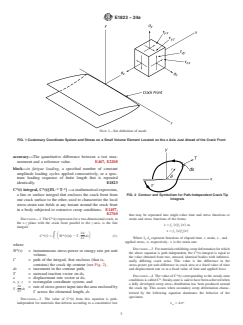
NOTE 1—See definition of mode.
FIG. 1 Customary Coordinate System and Stress on a Small Volume Element Located on the x Axis Just Ahead of the Crack Front
accuracy—The quantitative difference between a test mea-
surement and a reference value. E467, E2208
block—in fatigue loading, a specified number of constant
amplitude loading cycles applied consecutively, or a spec-
trum loading sequence of finite length that is repeated
identically. E1823
−1 −1
C*(t) integral, C*(t)[FL T ] —a mathematical expression,
a line or surface integral that encloses the crack front from FIG. 2 Contour and Symbolism for Path-Independent Crack Tip
Integrals
one crack surface to the other, used to characterize the local
stress-strain rate fields at any instant around the crack front
in a body subjected to extensive creep conditions. E1457,
E2760
that may be separated into single-value time and stress functions or
DISCUSSION—1 The C*(t) expression for a two-dimensional crack, in strain and stress functions of the forms:
the x-z plane with the crack front parallel to the z-axis, is the line
ε˙ 5 f ~t!f ~σ! or,
1 2
integral:
ε˙ 5 f ~ε!f ~σ!
3 4
] u˙
*
C* t 5 W* t dy 2 T · ds (1)
~ ! S ~ ! D
] x Where f –f represent functions of elapsed time, t, strain, ε , and
Γ
1 4
applied stress, σ, respectively; ε˙ is the strain rate.
where:
DISCUSSION—3 For materials exhibiting creep deformation for which
W*(t) = instantaneous stress-power or energy rate per unit
the above equation is path independent, the C*(t)-integral is equal to
volume,
the value obtained from two, stressed, identical bodies with infinitesi-
Γ = path of the integral, that encloses (that is,
mally differing crack areas. This value is the difference in the
contains) the crack tip contour (see Fig. 2),
stress-power per unit difference in crack area at a fixed value of time
ds = increment in the contour path,
and displacement rate or at a fixed value of time and applied force.
T = outward traction vector on ds,
DISCUSSION—4 The value of C*(t) corresponding to the steady-state
u˙ = displacement rate vector at ds,
conditions is called C*. Steady-state is said to have been achieved when
x, y, z = rectangular coordinate system, and
a fully developed creep stress distribution has been produced around
]u˙
= rate of stress-power input into the area enclosed by
the crack tip. This occurs when secondary creep deformation charac-
T · ds
]x
Γ across the elemental length, ds.
terized by the following equation dominates the behavior of the
specimen.
DISCUSSION—2 The value of C*(t) from this equation is path-
n
independent for materials that deform according to a constitutive law ε˙ 5 Aσ
ss
E1823 − 24a
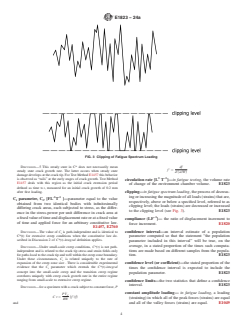
FIG. 3 Clipping of Fatigue Spectrum Loading
DISCUSSION—5 This steady state in C* does not necessarily mean
df
f ' 5
steady state crack growth rate. The latter occurs when steady state
d ~a/W!
damage develops at the crack tip. For Test Method E1457 this behavior
3 −1
is observed as “tails” at the early stages of crack growth. Test Method
circulation rate [L T ]—in fatigue testing, the volume rate
E1457 deals with this region as the initial crack extension period
of change of the environment chamber volume. E1823
defined as time t , measured for an initial crack growth of 0.2 mm
0.2
after first loading.
clipping—in fatigue spectrum loading, the process of decreas-
-1 -1 ing or increasing the magnitude of all loads (strains) that are,
C parameter, C , [FL T ]—parameter equal to the value
t t
respectively, above or below a specified level, referred to as
obtained from two identical bodies with infinitesimally
clipping level; the loads (strains) are decreased or increased
differing crack areas, each subjected to stress, as the differ-
to the clipping level (see Fig. 3). E1823
ence in the stress-power per unit difference in crack area at
−1
a fixed value of time and displacement rate or at a fixed value
compliance (LF ]— the ratio of displacement increment to
of time and applied force for an arbitrary constitutive law.
force increment. E1820
E1457, E2760
DISCUSSION—The value of C is path-independent and is identical to confidence interval—an interval estimate of a population
t
C*(t) for extensive creep conditions when the constitutive law de-
parameter computed so that the statement “the population
scribed in Discussion 2 of C*(t)-integral definition applies.
parameter included in this interval” will be true, on the
average, in a stated proportion of the times such computa-
DISCUSSION—Under small-scale creep conditions, C*(t) is not path-
independent and is related to the crack tip stress and strain fields only tions are made based on different samples from the popula-
for paths local to the crack tip and well within the creep zone boundary.
tion. E1823
Under these circumstances, C is related uniquely to the rate of
t
expansion of the creep zone size . There is considerable experimental confidence level (or coefficient)—the stated proportion of the
evidence that the C parameter which extends the C*(t)-integral
t times the confidence interval is expected to include the
concept into the small-scale creep and the transition creep regime
population parameter. E1823
correlates uniquely with creep crack growth rate in the entire regime
ranging from small-scale to extensive creep regime.
confidence limits—the two statistics that define a confidence
interval. E1823
DISCUSSION—for a specimen with a crack subject to constant force, P
˙
constant amplitude loading— in fatigue loading, a loading
PV
C
C t 5 f '/f
~ !
(straining) in which all of the peak forces (strains) are equal
BW
and and all of the valley forces (strains) are equal. E1049
E1823 − 24a
constant life diagram— in fatigue, a plot (usually on rectan- crack-mouth opening displacement (CMOD), Vm, 2v
m
gular coordinates) of a family of curves each of which is for [L]—crack opening displacement resulting from the total
a single fatigue life, N, relating stress amplitude, S , to mean deformation (elastic plus plastic), measured under force at
a
stress, S , or maximum stress, S , or both, to minimum the location on a crack surface that has the largest displace-
m max
stress, S . The constant life fatigue diagram is usually ment per unit force.
min
DISCUSSION—In part-through surface-crack (PS) specimens, CMOD
derived from a family of S-N curves each of which repre-
is measured on the specimen surface at the midpoint of the crack
sents a different stress ratio (A or R) for a 50 % probability
length. E399, E647, E740, E1221, E1457, E1681, E1820
of survival. E1820
crack opening displacement (COD)[L]—force-induced sepa-
control force, Pm [F]—a calculated value of maximum force
ration vector between two points at a specified gage length.
to stipulate allowable precracking limits. E1820, E1921
The direction of the vector is normal to the crack plane.
corrosion fatigue—the process by which fracture occurs
E399, E1221, E1290, E1820, E2472
prematurely under conditions of simultaneous corrosion and
crack-plane orientation—an identification of the plane and
repeated cyclic loading at lower stress levels or fewer cycles
direction of fracture or crack extension in relation to product
than would be required in the absence of the corrosive
configuration. This identification is designated by a hyphen-
environment. G15
ated code with the first letter(s) representing the direction
counting method—in fatigue spectrum loading, a method of
normal to the crack plane and the second letter(s) designat-
counting the occurrences and defining the magnitude of
ing the expected direction of crack propagation.
various loading parameters from a load-time history; (some
DISCUSSION—See also E1823 Annex A2, (A2.4 on crack or notch
of the counting methods are: level crossing count, peak
orientation). E399, E1457
count, mean crossing peak count, range count, range-pair
crack size, a [L]—principal lineal dimension used in the
count, rain-flow count, racetrack count). E1049
calculation of fracture mechanics parameters for through-
crack extension, Δa [L]—an increase in crack size.
thickness cracks as defined in the applicable standard. See
DISCUSSION—For example, Δa or Δa is the difference between the
p e
Fig. A2.2 for schematic representations.
crack size, either a (physical crack size) or a (effective crack size),
p e
DISCUSSION—For example, in the C(T) specimen a is the average
and a (original crack size).
o
measurement from the line connecting the bearing points of force
application; in the M(T) specimen, a is the average measurement from
DISCUSSION—In Test Method E2472, it should be noted that in
the perpendicular bisector of the central crack.
thin-sheet and thick-plate materials under low constraint conditions, the
crack extension observed on the surface of the specimen may be
DISCUSSION—In practice, the value of a is obtained from procedures
significantly less than that in the interior of the specimen due to the
for measurement of physical crack size, a , original crack size, a , and
p o
effects of crack tunneling. This must be considered if direct optical
effective crack size, a , as appropriate to the situation being considered.
e
techniques are used to monitor and measure free-surface crack exten-
sion. Indirect crack extension measurement techniques such as unload-
DISCUSSION—For part-through cracks see crack depth (a) and surface
ing compliance and electric potential drop method may be used in place
crack length (2c) in Definitions of Terms (Specific to the indicated
of (or to complement) the direct optical techniques to provide a
standards.)
measure of average crack extension. (See Test Method E647 for
DISCUSSION—In Test Method E1457, the physical crack size is
compliance methods for C(T) and M(T) specimens; and ISO 12135 and
represented as a . The subscript p is everywhere implied. E1457
Test Method E647 for electric potential drop methods for C(T) p
specimens.) E647, E1820, E2472
−2
crack strength, σ [FL ]—the maximum value of the nomi-
c
−1 −2
nal stress that a cracked structure is capable of sustaining.
crack-extension force, G [FL or FLL ]—the elastic en-
DISCUSSION—1 Crack strength is calculated on the basis of the
ergy per unit of new separation area that is made available at
maximum force and the original minimum cross-sectional area (net
the front of an ideal crack in an elastic solid during a virtual
cross section or ligament). Thus, it takes into account the original size
increment of forward crack extension.
of the crack but ignores any crack extension that may occur during the
DISCUSSION—This force concept implies an analytical model for
test.
which the stress-strain relations are regarded as elastic. The preceding
definition of G applies to either static cracks or running cracks. From
DISCUSSION—2 Crack strength is analogous to the ultimate tensile
past usage, G is commonly associated with linear-elastic methods of
strength, as it is based on the ratio of the maximum force to the
analysis, although the J (see J-integral) also may be used for such
minimum cross-sectional area at the start of the test. E338, E602
analyses. E1823
crack-tip opening displacement (CTOD),δ, [L]—the crack
−3/2 −1
crack-extension resistance, K [FL ], G [FL ] or J
R R R displacement resulting from the total deformation (elastic
−1
[FL ]—a measure of the resistance of a material to crack
plus plastic) at variously defined locations near the original
extension expressed in terms of the stress-intensity factor, K;
(prior to force application) crack tip.
crack-extension force, G; or values of J derived using the
DISCUSSION—In common practice, δ is estimated for Mode 1 by
J-integral concept. inference from observations of crack displacement nearby or away, or
DISCUSSION—See definition of R-curve. E561 both, from the crack tip. E1290
crack initiation—the onset of crack propagation from a crack-tip plane strain—a stress-strain field (near the crack
preexisting macroscopic crack created in the specimen by a tip) that approaches plane strain to the degree required by an
stipulated procedure. E1921 empirical criterion.
E1823 − 24a
DISCUSSION—For example, in Mode 1, the criterion for crack-tip
dynamometer—an elastic calibration device used to verify the
plane strain given by Test Method E399 requires that plate thickness, B,
indicated forces applied by a fatigue testing system. It shall
must be equal to or greater than 2.5 (K/σ ) . E399
YS
consist of an instrumented member having mass, stiffness,
and end displacements such that the inertial effects of the
crack-tip plane stress—a stress-strain field (near the crack tip)
specimen and its attachments to the testing machine for
that is not in plane strain.
which the verification of forces is desired are duplicated
DISCUSSION—In such situations, a significant degree of plane strain
within 5 %. The instrumentation shall permit an accurate
may be present. E1823
determination of the magnitude of the average strain in a
creep crack growth (CCG) rate, da/dt or Δa/Δt [L/t]—the region of the uniform transverse cross section when the
rate of crack extension caused by creep damage and ex-
dynamometer is subjected to a tensile or compressive force
pressed in terms of average crack extension per unit time. along its longitudinal axis, within 1 % of the true strains. A
E1457
strain gaged specimen is often used as a dynamometer. E467
creep zone boundary—the locus of points ahead of the crack dynamometer dynamic forces [F]—the maximum and mini-
front where the equivalent strain caused by the creep mum forces (or the mean force and the force amplitude) that
deformation equals 0.002 (0.2%). correspond to the readings obtained from the dynamometer
DISCUSSION—Under small-scale creep conditions, the creep zone output according to an existing static calibration. Such forces
expansion with time occurs in a self-similar manner for planar bodies,
are considered true specimen dynamic forces for the purpose
thus, the creep zone size, r , can be defined as the distance to the creep
c
of this terminology. E467
zone boundary from the crack tip at a fixed angle, θ, with respect to the
crack plane. The rate of expansion of the creep zone size is designated
dynamometer range [F]—the range of forces for which the
as r˙ (θ). E1457, E2760
c dynamometer may be used for verification purposes. A
dynamometer for use in tension and in compression will
criterion of failure—complete separation, or the presence of a
have two dynamometer ranges, one in tension and one in
crack of specified length visible at a specified magnification.
compression. E467
Other criteria may be used but should be clearly defined.
E468
effective crack size, a [L]—the physical crack size aug-
e
mented to account for crack-tip plastic deformation.
crystallographic cleavage—the separation of a crystal along a
DISCUSSION—Sometimes the effective crack size, a , is calculated
e
plane of fixed orientation relative to the three-dimensional
from a measured value of a physical crack size, a , plus a calculated
p
crystal structure within which the separation process occurs,
value of a plastic-zone adjustment, r . Another method for calculation
Y
with the separation process causing the newly formed
of a involves comparing the compliance from the secant of a
e
surfaces to move away from one another in directions force-deflection trace with the elastic compliance from a calibration for
containing major components of motion perpendicular to the the given specimen design. E561
fixed plane. E1823
-2
effective modulus, E [FL ]—an elastic modulus that allows
eff
cumulative frequency spectrum—See exceedances spectrum.
a theoretical (modulus normalized) compliance to match an
experimentally measured compliance for an actual initial
cumulative occurrences spectrum—See exceedances spec-
crack size, a . E561, E1450, E1921
trum.
o
cycle—in fatigue, one complete sequence of values of force
−2
effective yield strength, σ [FL ]—an assumed value of
Y
(strain) that is repeated under constant amplitude loading
uniaxial yield strength, that represents the influences of
(straining). (See Fig. 4.) The symbol N (see definition of
plastic yielding upon fracture test parameters. E1820, E1921
fatigue life) is used to indicate the number of cycles.
DISCUSSION—1 It is calculated as the average of the 0.2 % offset
DISCUSSION—In spectrum loading, definition of cycle varies with the
yield strength, σ , and the ultimate tensile strength, σ , as follows:
YS TS
counting method. E1823
σ 5 σ 1σ /2 (2)
~ !
Y YS TS
cycle ratio, D— the ratio of cycles endured, n, to the estimated
DISCUSSION—2 In calculating σ , influences of testing conditions,
Y
fatigue life, N , obtained from the stress versus fatigue life
f
such as loading rate and temperature, should be considered.
(S-N) or the strain versus fatigue life (ε-N) diagram for
cycles of the same character, that is, D = n ⁄N . E1823
elastic constraint modulus, E’ [FL-2]—a linear-elastic factor
f
relating stress to strain, the value of which is dependent on
cycles endured, n—in fatigue, the number of cycles of
the degree of constraint. For plane stress, E’ = E is used, and
specified character (that produce fluctuating force) which a
for plane strain, E/(1 – ν ) is used, with ν being Poisson’s
specimen has endured at any time in its force history. E1823
ratio. E399, E647, E1457, E1681, E1921
cyclic loading—See fatigue loading.
elastic modulus—see modulus of elasticity.
deaeration—in environmentally affected fatigue testing, the
process of removal of air from the liquid environment before environment—in fatigue testing, the aggregate of chemical
and during a test. E1823 species and energy that surrounds a test specimen. E1823
derived data—data obtained through processing of the raw environment chamber— in fatigue testing, the container of
data. E1942, E2208, E2443 the bulk volume surrounding a test specimen. E1823
E1823 − 24a
FIG. 4 Fatigue Loading Basic Terms
3 −3
environment chamber volume [L ]—in fatigue testing, that environment oxygen content [ML ]—in corrosion fatigue
bulk volume surrounding a test specimen. E1823 testing, the oxygen concentration of the fluid environment
surrounding a test specimen. E1823
−3
environment composition [ML ]—in corrosion fatigue
−2
testing, the concentration of the chemical components in the
environment pressure [FL ]—in fatigue testing, the pressure
fluid environment surrounding a test specimen. E1823
of the bulk volume surrounding a test specimen. E1823
−3
environment hydrogen content [ML ]—in corrosion fa-
environment temperature— in fatigue testing, the tempera-
tigue testing, the hydrogen gas concentration of the fluid
ture of the bulk volume surrounding a test specimen. E1823
environment surrounding a test specimen. E1823
environment volume [L ]—in fatigue testing, the total vol-
environment monitoring— in fatigue testing, the periodic or
ume immediately surrounding a test specimen plus that
continuous measurement of fluid concentrations of the
contained in a circulating reservoir if applicable. E1823
environment. E1823
E1823 − 24a
estimate—in statistical analysis, the particular value or values fatigue life for p %survival —an estimate of the fatigue life
of a parameter computed by an estimation procedure for a that p % of the population would attain or exceed under a
given sample. E1823 given loading. The observed value of the median fatigue life
estimates the fatigue life for 50 % survival. Fatigue life for
estimated crack extension, Δa[L]—an increase in estimated
p % survival values, where p is any number, such as, 95, 90,
crack size (Δa = a − a ). E1737
oq
and so forth, also may be estimated from the individual
fatigue life values. E1823
estimated crack size a[L]—the distance from a reference
plane to the observed crack front developed from measure-
−2
fatigue limit, S [FL ]—the limiting value of the median
f
ments of elastic compliance or other methods. The reference
fatigue strength as the fatigue life, N , becomes very large.
f
plane depends on the specimen form, and it is normally
DISCUSSION—Certain materials and environments preclude the attain-
taken to be either the boundary, or a plane containing either
ment of a fatigue limit. Values tabulated as “fatigue limits” in the
the force line or the centerline of a specimen or plate. The
literature are frequently (but not always) values of S for which 50 %
N
reference plane is defined prior to specimen deformation. of the specimens survive a predetermined number of cycles. These
E1737 specimens are frequently tested at a mean stress of zero. E1823
−2
fatigue limit for p %survival [FL ]—the limiting value of
estimation—in statistical analysis, a procedure for making a
fatigue strength for p % survival as N becomes very large; p
statistical inference about the numerical values of one or
may be any number, such as 95, 90, and so forth. E1823
more unknown population parameters from the observed
values in a sample. E1823
fatigue loading—periodic, or not periodic, fluctuating loading
applied to a test specimen or experienced by a structure in
exceedances spectrum— in fatigue loading, representation of
service. (Also known as cyclic loading.) E1823
spectrum loading contents by the number of times specified
values of a particular loading parameter (peak, range, and so
fatigue notch factor, k —the ratio of the fatigue strength of a
f
forth) are equaled or exceeded (also known as cumulative
specimen with no stress concentration to a specimen with a
occurrences or cumulative frequency spectrum). E1823
stress concentration for the same percent survival at N cycles
and for the same conditions.
fatigue—the process of progressive localized permanent struc-
DISCUSSION—1 In specifying k , it is necessary to specify the
tural change occurring in a material subjected to conditions
f
geometry and the values of S , S , and N for which it is computed.
a m
that produce fluctuating stresses and strains at some point or
points and that may culminate in cracks or complete fracture
DISCUSSION—2 k was originally termed the fatigue limit (endurance
f
after a sufficient number of fluctuations. limit) reduction factor. Early data pertained almost exclusively to mild
steels, namely, to S − N curves with knees. Later the term was
DISCUSSION—1 In ceramic technology, static tests of considerable
a
generalized to fatigue strength reduction factor; but, nevertheless, the k
duration are called “static fatigue” tests, a type of test referred to as
f
values tabulated in the literature still pertain almost exclusively to very
stress-rupture in metal testing.
long (“infinite”) fatigue lives where the notched and unnotched S − N
a
DISCUSSION—2 Fluctuations may occur both in force and with time
curves were almost parallel and almost horizontal. Otherwise, the k
f
(frequency) as in the case of “random vibration.” E1823
data are not consistent and are markedly dependent on the type of
notch, the fatigue life of interest, and the value of the mean stress.
fatigue crack growth rate, da/dN, [L/cycle]—the rate of
DISCUSSION—3 Virtually no k data exist for percentiles other than
crack extension under fatigue loading, expressed in terms of f
(approximately) 50 %. Nevertheless, k is highly dependent on the
f
crack extension per cycle. E399, E647
percentile of interest. E1823
fatigue cycle—See cycle.
fatigue notch sensitivity, q—a measure of the degree of
fatigue ductility coefficient, ε'f —the ability of a material to
agreement between fatigue notch factor, k , and theoretical
f
deform plastically before fracturing, determined from con-
stress concentration factor, k .
t
stant strain-amplitude, low-cycle fatigue tests. Intercept of
DISCUSSION—1 The definition of fatigue notch sensitivity is q = (k
f
the log-log plot of plastic strain amplitude and the fatigue
− 1) ⁄(k − 1).
t
life in reversals (1 cycle = 2 reversals). E1823, E606, E2207
DISCUSSION—2 q was originally termed the fatigue notch sensitivity
DISCUSSION—The fatigue ductility coefficient corresponds to the
index.
fracture ductility, the true tensile strain at fracture. Elongation and
reduction in area represent the engineering tensile strain after fracture.
DISCUSSION—3 Virtually all q data and q curves found in the
literature pertain to very long (“infinite”) fatigue lives where the
fatigue ductility exponent, c—the slope of the log-log plot of
notched and unnotched S − N curves are almost parallel and almost
a
plastic strain amplitude and the fatigue life in reversals (1
horizontal, as well as to tests in which S = 0. Thus, these values
m
cycle = 2 reversals). Determined from constant strain
should not be extrapolated to S ≠ 0 or “finite” life situations.
m
amplitude, low-cycle fatigue tests. E1823, E606, E2207
DISCUSSION—4 Fatigue notch sensitivity is not considered to be a
DISCUSSION—The fatigue ductility exponent varies between -0.5 and
-0.7 for many metallic alloys. material property. E1823
−2
fatigue life, N —the number of cycles of a specified character fatigue strength at N cycles, S [FL ]—a value of stress for
f N
that a given specimen sustains before failure of a specified failure at exactly N cycles as determined from an S − N
nature occurs. Fatigue life, or the logarithm of fatigue life, is diagram. The value of S thus determined is subject to the
N
a dependent variable. E1823 same conditions as those which apply to the S − N diagram.
E1823 − 24a
DISCUSSION—The value of S that is commonly found in the literature
tive range or increasing force range) or between successive
N
is the value of S or S at which 50 % of the specimens of a given
max a
peak and valley forces (negative range or decreasing force
sample could survive N stress cycles in which S = 0. This is also
m
range). (See Fig. 4.) In constant amplitude loading, the range
known as the median fatigue strength for N cycles. E1823
is given as follows:
−2
fatigue strength for p % survival at N cycles [FL ]—an
ΔP 5 P 2 P (3)
max min
estimate of the stress level at which p % of the population
DISCUSSION—In cycle counting by various methods, it is common to
would survive N cycles; p may be any percent, such as 95, employ ranges between valley and peak forces, or between peak and
valley forces, which are not necessarily successive events. The word
90, and so forth.
5 6
“range” is used in this broader sense when dealing with cycle counting.
DISCUSSION—ASTM STP 588 and STP 744 include estimation
E1823
methods for these values. E1823
fatigue testing system—a device for applying repeated force
force ratio (also stress ratio), R, A—in fatigue, the algebraic
cycles to a specimen or component. E467 ratio of the two loading parameters of a cycle. The most
widely used ratios are as follows
ferritic steels—typically carbon, low-alloy, and higher alloy
minimum load P S
grades. Typical microstructures are bainite, tempered bainite,
min min
R 5 5 5 , and (4)
maximum load P S
tempered martensite, and ferrite and pearlite. All ferritic max max
steels have body centered cubic crystal structures that
loading amplitude P S
a a
A 5 5 5 (5)
display ductile-to-cleavage transition temperature fracture
mean load P S
m m
toughness characteristics. See also test methods E23, E208,
E647
and E436. E1921
−2
force (strain) amplitude, P (S or ε ) [F or FL ] —in
DISCUSSION—This definition is not intended to imply that all of the a a a
fatigue loading, one half of the range of a cycle (see Fig. 4)
many possible types of ferritic steels have been verified as being
amenable to analysis by Test Method E1921.
(also known as alternating force). E1823
force, P [F]—the force applied to a test specimen or to a
force transducer—a measuring device that can provide an
component.
output signal proportional to the force being applied. E467
DISCUSSION—used in Practices E1049 to denote force, stress, strain,
fracture toughness—a generic term for measures of resistance
torque, acceleration, or other parameters of interest. E1823
to extension of a crack.
force cycle—See cycle.
DISCUSSION—The term is sometimes restricted to results of fracture
force-line displacement due to creep, elastic and plastic
mechanics tests, which are directly applicable in fracture control.
strain V [L]— the total displacement measured at the
However, the term commonly includes results from tests of notched or
FLD
loading pins (V ) due to the force placed on the specimen precracked specimens which do not involve fracture mechanics analy-
sis. Results from tests of the latter type are often useful for fracture
at any instant and due to subsequent crack extension that is
control, based upon either service experience or empirical correlations
associated with the accumulation of creep, elastic, and
with tests analyzed using fracture mechanics. E740
plastic strains in the specimen. E1457, E2760
DISCUSSION—1 in creeping bodies, the total displacement at the
frequency distribution—the way in which the frequencies of
FLD
force-line V can be partitioned into an instantaneous elastic part V ,
e
occurrence of members of a population, or a sample, are
a plastic part, V , and a time-dependent creep part V where V ~ V +
p c e
distributed in accordance with the values of the variable
V + V The corresponding symbols for the rates of force-line
p c
under consideration. E1823
displacement components shown in the equation above are given
˙ ˙ ˙ ˙
respectively as: V, V ,V ,V This information is used to derive the
e p c
group—in fatigue, specimens of the same type tested at a
parameter C* and C .
t
specific time, or consecutively, at one stress level. A group
DISCUSSION—2 for the set of specimens in Test Method E1457 for
may comprise one or more specimens. E1823
creep ductile material where creep strains dominate and in which test
times are longer (usually >1000 hours), the elastic and plastic displace- high point, High—the point on a force-displacement plot, at
ment rate components are small compared to the creep and therefore it
the start of an unloading-reloading cycle, at which the
˙
is recommended to use the total displacement rate,V assuming that,
displacement reverses direction, that is, the point at which
˙ ˙
V 'V to derive the steady state C*. See Test Method E1457, Section 11
the specimen mouth begins closing due to unloading (see
c
for detailed discussion.
points labeled High in Fig. 5 and Fig. 6). E1304
DISCUSSION—3 the force-line displacement associated with just the
hold time, t [T]—in fatigue testing, the amount of time in the
h
creep strains is expressed as V .
c
cycle where the controlled test variable (for example, force,
-1
force line displacement rate dΔ /dt [LT ]—rate of increase strain, displacement) remains constant with time. (See Fig.
LL
of specimen force-line displacement. E1921
7.) E606
force range, Δ P [F]—in fatigue loading, the algebraic
hysteresis diagram—in fatigue, the stress-strain path during a
difference between successive valley and peak forces (posi-
cycle. E1823
ideal crack—a simplified model of a crack. In a stress-free
body, the crack has two smooth surfaces that are coincident
Manual on Statistical Planning and Analysis, ASTM STP 588, ASTM, 1975.
Statistical Analysis of Fatigue Data, ASTM STP744, ASTM, 1979. and join within the body along a smooth curve called the
E1823 − 24a
FIG. 5 Schematic of a Force-Displacement Test Record for Crack Jump Behavior, with Unloading/Reloading Cycles, Data Reduction
Constructions, and Definitions of Terms
FIG. 6 Schematic of a Force-Displacement Test Record for Smooth Crack Growth Behavior, with Unloading/Reloading Cycles, Data Re-
duction Constructions, and Definitions of Terms
DISCUSSION—In a linear-elastic body, the crack-tip stress field can be
crack front; in two-dimensional representations the crack
regarded as the superposition of three component stress fields called
front is called the crack tip. E1823
modes. E1823
ideal-crack-tip stress field—the singular stress field, infini-
tesimally close to the crack front, that results from loading
independent variable—the selected and controlled variable
an ideal crack. In a linear-elastic homogeneous body, the (namely, stress or strain). It is denoted X when plotted on
significant stress components vary inversely as the square
appropriate coordinates. E739
root of the distance from the crack tip.
E1823 − 24a
FIG. 7 Definitions of Terms for Force-Histories with Hold Times
indicated dynamic forces [F]—the maximum and minimum
Γ = path of the integral, that encloses (that is, contains)
forces (or the mean force and the force amplitude) that
the crack tip (see Fig. 2),
correspond to the readings obtained from the force trans-
ds = increment of the contour path,
ducer associated with the fatigue testing system, according T = outward traction vector on ds,
to an existing static calibration. The force transducer cali- u = displacement vector at ds,
x, y, z = rectangular coordinates (see Fig. 1), and
bration may have been furnished by the machine manufac-
]u
= rate of work input from the stress field into the area
turer or may have been developed by the user. E467
T ds
]x
enclosed by Γ.
inelastic strain, ε — the strain that is not elastic.
in
DISCUSSION—2 The value of J obtained from the preceding equation
DISCUSSION—For isothermal conditions, ε is calculated by subtract-
in
is taken to be path independent for commonly used specimen designs.
ing the elastic strain from the total strain. E606
However, in service components (and perhaps in test specimens),
interval estimate—the estimate of a parameter given by two caution is needed to adequately consider loading interior to Γ such as
from motion of the crack and from residual and thermal stress.
statistics, defining the end points of an interval. E1823
DISCUSSION—3 In elastic (linear or nonlinear) solids, the J-integral
irregularity factor— in fatigue loading, the ratio of the
equals the crack-extension force, G. (See crack extension force.)
number of zero crossings with positive slope (or mean
crossings) to the number of peaks or valleys in a given, DISCUSSION—4 In Test Method E1820, in elastic (linear and nonlin-
ear) solids for which the mathematical expression is path independent,
force-time history. E1823
the J-integral is equal to the value obtained from two identical bodies
irregular loading— See spectrum loading.
with infinitesimally differing crack areas each subject to stress. The
−1
parameter J is the difference in work per unit difference in crack area
J-integral, J [FL ]—a mathematical expression, a line or
at a fixed value of displacement or, where appropriate, at a fixed value
surface integral that encloses the crack front from one crack
of force.
surface to the other, used to characterize the local stress-
strain field around the crack front. E1457, E1820
J-R curve—a plot of far-field J-integral versus the physical
DISCUSSION—1 The J-integral expression for a two-dimensional
crack extension, Δa . It is recognized that the far-field value
p
crack, in the x-z plane with the crack front parallel to the z axis, is the
of J may not represent the stress-strain field local to a
line integral,
growing crack. E1820
] u
DISCUSSION—In Test Method E1820, the J-R curve is a plot of the
J 5 Wdy 2 T ds (6)
*S D
Γ ] x J-integral against physical crack extension Δa .
p
where:
W = loading work p
...
This document is not an ASTM standard and is intended only to provide the user of an ASTM standard an indication of what changes have been made to the previous version. Because
it may not be technically possible to adequately depict all changes accurately, ASTM recommends that users consult prior editions as appropriate. In all cases only the current version
of the standard as published by ASTM is to be considered the official document.
Designation: E1823 − 24 E1823 − 24a
Standard Terminology
Relating to Fatigue and Fracture Testing
This standard is issued under the fixed designation E1823; the number immediately following the designation indicates the year of
original adoption or, in the case of revision, the year of last revision. A number in parentheses indicates the year of last reapproval. A
superscript epsilon (´) indicates an editorial change since the last revision or reapproval.
1. Scope
1.1 This terminology contains definitions, definitions of terms specific to certain standards, symbols, and abbreviations approved
for use in standards on fatigue and fracture testing. The definitions are preceded by two lists. The first is an alphabetical listing
of symbols used. (Greek symbols are listed in accordance with their spelling in English.) The second is an alphabetical listing of
relevant abbreviations.
1.2 This terminology includes Annex A1 on Units and Annex A2 on Designation Codes for Specimen Configuration, Applied
Loading, and Crack or Notch Orientation.
1.3 This international standard was developed in accordance with internationally recognized principles on standardization
established in the Decision on Principles for the Development of International Standards, Guides and Recommendations issued
by the World Trade Organization Technical Barriers to Trade (TBT) Committee.
2. Referenced Documents
2.1 ASTM Standards:
E6 Terminology Relating to Methods of Mechanical Testing
E23 Test Methods for Notched Bar Impact Testing of Metallic Materials
E28 Test Methods for Softening Point of Resins Derived from Pine Chemicals and Hydrocarbons, by Ring-and-Ball Apparatus
E208 Test Method for Conducting Drop-Weight Test to Determine Nil-Ductility Transition Temperature of Ferritic Steels
E338 Test Method of Sharp-Notch Tension Testing of High-Strength Sheet Materials (Withdrawn 2010)
E399 Test Method for Linear-Elastic Plane-Strain Fracture Toughness of Metallic Materials
E436 Test Method for Drop-Weight Tear Tests of Ferritic Steels
E467 Practice for Verification of Constant Amplitude Dynamic Forces in an Axial Fatigue Testing System
E468 Practice for Presentation of Constant Amplitude Fatigue Test Results for Metallic Materials
E561 Test Method for K Curve Determination
R
E602 Test Method for Sharp-Notch Tension Testing with Cylindrical Specimens (Withdrawn 2010)
E604 Test Method for Dynamic Tear Testing of Metallic Materials
E606 Test Method for Strain-Controlled Fatigue Testing
E647 Test Method for Measurement of Fatigue Crack Growth Rates
E739 Guide for Statistical Analysis of Linear or Linearized Stress-Life (S-N) and Strain-Life (ε-N) Fatigue Data (Withdrawn
2024)
E740 Practice for Fracture Testing with Surface-Crack Tension Specimens
This terminology is under the jurisdiction of ASTM Committee E08 on Fatigue and Fracture and is the direct responsibility of Subcommittee E08.02 on Terminology.
Current edition approved Feb. 1, 2024Feb. 15, 2024. Published April 2024. Originally approved in 1996. Last previous edition approved in 20232024 as
E1823 – 23.E1823 – 24. DOI: 10.1520/E1823-24.10.1520/E1823-24A.
For referenced ASTM standards, visit the ASTM website, www.astm.org, or contact ASTM Customer Service at service@astm.org. For Annual Book of ASTM Standards
volume information, refer to the standard’s Document Summary page on the ASTM website.
The last approved version of this historical standard is referenced on www.astm.org.
Copyright © ASTM International, 100 Barr Harbor Drive, PO Box C700, West Conshohocken, PA 19428-2959. United States
E1823 − 24a
E813 Test Method for JIc, A Measure of Fracture Toughness
E992 Practice for Determination of Fracture Toughness of Steels Using Equivalent Energy Methodology
E1049 Practices for Cycle Counting in Fatigue Analysis
E1152 Test Method for Determining-J-R-Curves
E1221 Test Method for Determining Plane-Strain Crack-Arrest Fracture Toughness, K , of Ferritic Steels
Ia
E1290 Test Method for Crack-Tip Opening Displacement (CTOD) Fracture Toughness Measurement (Withdrawn 2013)
E1304 Test Method for Plane-Strain (Chevron-Notch) Fracture Toughness of Metallic Materials
E1450 Test Method for Tension Testing of Structural Alloys in Liquid Helium
E1457 Test Method for Measurement of Creep Crack Growth Times in Metals
E1681 Test Method for Determining Threshold Stress Intensity Factor for Environment-Assisted Cracking of Metallic Materials
E1737 Test Method forJ-Integral Characterization of Fracture Toughness (Withdrawn 1998)
E1820 Test Method for Measurement of Fracture Toughness
E1921 Test Method for Determination of Reference Temperature, T , for Ferritic Steels in the Transition Range
E1942 Guide for Evaluating Data Acquisition Systems Used in Cyclic Fatigue and Fracture Mechanics Testing
E2207 Practice for Strain-Controlled Axial-Torsional Fatigue Testing with Thin-Walled Tubular Specimens
E2208 Guide for Evaluating Non-Contacting Optical Strain Measurement Systems
E2298 Test Method for Instrumented Impact Testing of Metallic Materials
E2443 Guide for Verifying Computer-Generated Test Results Through The Use Of Standard Data Sets
E2472 Test Method for Determination of Resistance to Stable Crack Extension under Low-Constraint Conditions
E2714 Test Method for Creep-Fatigue Testing
E2760 Test Method for Creep-Fatigue Crack Growth Testing
E2899 Test Method for Measurement of Initiation Toughness in Surface Cracks Under Tension and Bending
G15 Terminology Relating to Corrosion and Corrosion Testing (Withdrawn 2010)
2.2 ISO Standard:
ISO 12135 Metallic materials
3. Terminology
3.1 Alphabetical Listing of Principal Symbols Used in This Terminology:
Symbol Term
a crack depth, crack length, crack size, estimated crack
size
a effective crack size
e
a notch length
n
a original crack size
o
a physical crack size
p
a/W normalized crack size
A net-section area
N
b remaining ligament
b original uncracked ligament
o
B specimen thickness
B net thickness
N
2c surface-crack length
C normalized K-gradient
C*(t) C*(t) − Integral
D cycle ratio (n/N )
f
da/dN fatigue crack growth rate
δ crack-tip opening displacement (CTOD)
δd specimen gage length
Δa crack extension, estimated crack extension
ΔK stress-intensity-factor range
ΔP force range
ε strain amplitude
a
ε inelastic strain
in
G crack-extension force
G crack-extension resistance
R
h notch height
H* specimen center of pin hole distance
Γ the path of the J-integral
J J-integral
J plane-strain fracture toughness
Ic
J crack-extension resistance
R
Available from International Organization for Standardization (ISO), ISO Central Secretariat, Chemin de Blandonnet 8, CP 401, 1214 Vernier, Geneva, Switzerland,
https://www.iso.org.
E1823 − 24a
Symbol Term
k fatigue notch factor
f
k theoretical stress concentration factor (sometimes
t
abbreviated stress concentration factor)
K, K , K , K , stress-intensity factor (see mode)
1 2 3
K , K , K
I II III
K crack-arrest fracture toughness
a
K stress intensity factor threshold for environment-
EAC
assisted cracking
K plane-strain crack-arrest fracture toughness
Ia
K stress intensity factor threshold for plane strain
IEAC
environment-assisted cracking
K plane-strain fracture toughness
Ic
K , K , K plane-strain (chevron-notch) fracture toughness
IvM Iv Ivj
K maximum stress-intensity factor
max
K minimum stress-intensity factor
min
K stress-intensity factor at crack initiation
o
K crack-extension resistance
R
n cycles endured
N fatigue life
f
P force
P force amplitude
a
P mean force
m
P precrack force
M
P maximum force
max
P minimum force
min
q fatigue notch sensitivity
r effective unloading slope ratio
r critical slope ratio
c
r plastic-zone adjustment
y
R force ratio, stress ratio
s sample standard deviation
s sample variance
S specimen span
S stress amplitude
a
S fatigue limit
f
S mean stress
m
S fatigue strength at N cycles
N
σ crack strength
c
σ nominal (net-section) stress
N
σ residual strength
r
σ sharp-notch strength
s
σ tensile strength
TS
σ , σ , σ normal stresses (refer to Fig. 1)
x y z
σ effective yield strength
Y
σ yield strength
YS
T specimen temperature
t transition time
T
τ total cycle period
t
τ ,τ , τ shear stresses (refer to Fig. 1)
xy yz zx
u displacement in x direction
v displacement in y direction
2v crack-mouth opening displacement
m
V force-line displacement due to creep
c
w displacement in z direction
W specimen width
Y* stress-intensity factor coefficient
Y* minimum stress-intensity factor coefficient
m
3.2 Alphabetical Listing of Abbreviations Used:
CMOD crack-mouth opening displacement
COD see CTOD
CTOD crack-tip opening displacement
DT dynamic tear
EAC environment-assisted cracking
K-EE equivalent-energy fracture toughness
NTS notch tensile strength
PS part-through surface
SCC stress corrosion cracking
SZW stretch zone width
3.3 Definitions—Each definition is followed by the designation(s) of the standard(s) of origin. The listing of definitions is
alphabetical.
E1823 − 24a
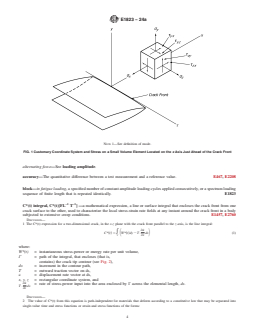
NOTE 1—See definition of mode.
FIG. 1 Customary Coordinate System and Stress on a Small Volume Element Located on the x Axis Just Ahead of the Crack Front
alternating force—See loading amplitude.
accuracy—The quantitative difference between a test measurement and a reference value. E467, E2208
block—in fatigue loading, a specified number of constant amplitude loading cycles applied consecutively, or a spectrum loading
sequence of finite length that is repeated identically. E1823
−1 −1
C*(t) integral, C*(t)[FL T ] —a mathematical expression, a line or surface integral that encloses the crack front from one
crack surface to the other, used to characterize the local stress-strain rate fields at any instant around the crack front in a body
subjected to extensive creep conditions. E1457, E2760
DISCUSSION—
1 The C*(t) expression for a two-dimensional crack, in the x-z plane with the crack front parallel to the z-axis, is the line integral:
]u˙
*
C*~t! 5 W*~t!dy 2 T · ds (1)
S D
Γ ]x
where:
W*(t) = instantaneous stress-power or energy rate per unit volume,
Γ = path of the integral, that encloses (that is,
contains) the crack tip contour (see Fig. 2),
ds = increment in the contour path,
T = outward traction vector on ds,
u˙ = displacement rate vector at ds,
x, y, z = rectangular coordinate system, and
]u˙
= rate of stress-power input into the area enclosed by Γ across the elemental length, ds.
T · ds
]x
DISCUSSION—
2 The value of C*(t) from this equation is path-independent for materials that deform according to a constitutive law that may be separated into
single-value time and stress functions or strain and stress functions of the forms:
E1823 − 24a
FIG. 2 Contour and Symbolism for Path-Independent Crack Tip Integrals
˙ε5 f ~t!f ~σ! or,
1 2
˙ε5 f ε f σ
~ ! ~ !
3 4
Where f –f represent functions of elapsed time, t, strain, ε , and applied stress, σ, respectively; ˙ε is the strain rate.
1 4
DISCUSSION—
3 For materials exhibiting creep deformation for which the above equation is path independent, the C*(t)-integral is equal to the value obtained from
two, stressed, identical bodies with infinitesimally differing crack areas. This value is the difference in the stress-power per unit difference in crack area
at a fixed value of time and displacement rate or at a fixed value of time and applied force.
DISCUSSION—
4 The value of C*(t) corresponding to the steady-state conditions is called C*. Steady-state is said to have been achieved when a fully developed creep
stress distribution has been produced around the crack tip. This occurs when secondary creep deformation characterized by the following equation
dominates the behavior of the specimen.
n
˙ε 5 Aσ
ss
DISCUSSION—
5 This steady state in C* does not necessarily mean steady state crack growth rate. The latter occurs when steady state damage develops at the crack
tip. For Test Method E1457 this behavior is observed as “tails” at the early stages of crack growth. Test Method E1457 deals with this region as the
initial crack extension period defined as time t , measured for an initial crack growth of 0.2 mm after first loading.
0.2
-1 -1
C parameter, C , [FL T ]—parameter equal to the value obtained from two identical bodies with infinitesimally differing
t t
crack areas, each subjected to stress, as the difference in the stress-power per unit difference in crack area at a fixed value of
time and displacement rate or at a fixed value of time and applied force for an arbitrary constitutive law. E1457, E2760
DISCUSSION—
The value of C is path-independent and is identical to C*(t) for extensive creep conditions when the constitutive law described in Discussion 2 of
t
C*(t)-integral definition applies.
DISCUSSION—
Under small-scale creep conditions, C*(t) is not path-independent and is related to the crack tip stress and strain fields only for paths local to the crack
tip and well within the creep zone boundary. Under these circumstances, C is related uniquely to the rate of expansion of the creep zone size . There
t
is considerable experimental evidence that the C parameter which extends the C*(t)-integral concept into the small-scale creep and the transition creep
t
regime correlates uniquely with creep crack growth rate in the entire regime ranging from small-scale to extensive creep regime.
DISCUSSION—
for a specimen with a crack subject to constant force, P
˙
PV
C
C t 5 ~f '/f!
BW
and
df
f '5
d a/W
~ !
3 −1
circulation rate [L T ]—in fatigue testing, the volume rate of change of the environment chamber volume. E1823
clipping—in fatigue spectrum loading, the process of decreasing or increasing the magnitude of all loads (strains) that are,
respectively, above or below a specified level, referred to as clipping level; the loads (strains) are decreased or increased to the
clipping level (see Fig. 3). E1823
−1
compliance (LF ]— the ratio of displacement increment to force increment. E1820
E1823 − 24a
FIG. 3 Clipping of Fatigue Spectrum Loading
confidence interval—an interval estimate of a population parameter computed so that the statement “the population parameter
included in this interval” will be true, on the average, in a stated proportion of the times such computations are made based on
different samples from the population. E1823
confidence level (or coefficient)—the stated proportion of the times the confidence interval is expected to include the population
parameter. E1823
confidence limits—the two statistics that define a confidence interval. E1823
constant amplitude loading— in fatigue loading, a loading (straining) in which all of the peak forces (strains) are equal and
all of the valley forces (strains) are equal. E1049
constant life diagram— in fatigue, a plot (usually on rectangular coordinates) of a family of curves each of which is for a single
fatigue life, N, relating stress amplitude, S , to mean stress, S , or maximum stress, S , or both, to minimum stress, S . The
a m max min
constant life fatigue diagram is usually derived from a family of S-N curves each of which represents a different stress ratio (A
or R) for a 50 % probability of survival. E1820
control force, Pm [F]—a calculated value of maximum force to stipulate allowable precracking limits. E1820, E1921
corrosion fatigue—the process by which fracture occurs prematurely under conditions of simultaneous corrosion and repeated
cyclic loading at lower stress levels or fewer cycles than would be required in the absence of the corrosive environment. G15
counting method—in fatigue spectrum loading, a method of counting the occurrences and defining the magnitude of various
E1823 − 24a
loading parameters from a load-time history; (some of the counting methods are: level crossing count, peak count, mean crossing
peak count, range count, range-pair count, rain-flow count, racetrack count). E1049
crack extension, Δa [L]—an increase in crack size.
DISCUSSION—
For example, Δa or Δa is the difference between the crack size, either a (physical crack size) or a (effective crack size), and a (original crack size).
p e p e o
DISCUSSION—
In Test Method E2472, it should be noted that in thin-sheet and thick-plate materials under low constraint conditions, the crack extension observed
on the surface of the specimen may be significantly less than that in the interior of the specimen due to the effects of crack tunneling. This must be
considered if direct optical techniques are used to monitor and measure free-surface crack extension. Indirect crack extension measurement techniques
such as unloading compliance and electric potential drop method may be used in place of (or to complement) the direct optical techniques to provide
a measure of average crack extension. (See Test Method E647 for compliance methods for C(T) and M(T) specimens; and ISO 12135 and Test Method
E647 for electric potential drop methods for C(T) specimens.) E647, E1820, E2472
−1 −2
crack-extension force, G [FL or FLL ]—the elastic energy per unit of new separation area that is made available at the front
of an ideal crack in an elastic solid during a virtual increment of forward crack extension.
DISCUSSION—
This force concept implies an analytical model for which the stress-strain relations are regarded as elastic. The preceding definition of G applies to
either static cracks or running cracks. From past usage, G is commonly associated with linear-elastic methods of analysis, although the J (see
J-integral) also may be used for such analyses. E1823
−3/2 −1 −1
crack-extension resistance, K [FL ],G [FL ] or J [FL ]—a measure of the resistance of a material to crack extension
R R R
expressed in terms of the stress-intensity factor, K; crack-extension force, G; or values of J derived using the J-integral concept.
DISCUSSION—
See definition of R-curve. E561
crack initiation—the onset of crack propagation from a preexisting macroscopic crack created in the specimen by a stipulated
procedure. E1921
crack-mouth opening displacement (CMOD), Vm, 2v [L]—crack opening displacement resulting from the total deformation
m
(elastic plus plastic), measured under force at the location on a crack surface that has the largest displacement per unit force.
DISCUSSION—
In part-through surface-crack (PS) specimens, CMOD is measured on the specimen surface at the midpoint of the crack length. E399, E647, E740,
E1221, E1457, E1681, E1820
crack opening displacement (COD)[L]—force-induced separation vector between two points at a specified gage length. The
direction of the vector is normal to the crack plane. E399, E1221, E1290, E1820, E2472
crack-plane orientation—an identification of the plane and direction of fracture or crack extension in relation to product
configuration. This identification is designated by a hyphenated code with the first letter(s) representing the direction normal to
the crack plane and the second letter(s) designating the expected direction of crack propagation.
DISCUSSION—
See also E1823 Annex A2, (A2.4 on crack or notch orientation). E399, E1457
crack size, a [L]—principal lineal dimension used in the calculation of fracture mechanics parameters for through-thickness
cracks as defined in the applicable standard. See Fig. A2.2 for schematic representations.
DISCUSSION—
For example, in the C(T) specimen a is the average measurement from the line connecting the bearing points of force application; in the M(T)
specimen, a is the average measurement from the perpendicular bisector of the central crack.
DISCUSSION—
In practice, the value of a is obtained from procedures for measurement of physical crack size, a , original crack size, a , and effective crack size, a ,
p o e
as appropriate to the situation being considered.
DISCUSSION—
For part-through cracks see crack depth (a) and surface crack length (2c) in Definitions of Terms (Specific to the indicated standards.)
E1823 − 24a
DISCUSSION—
In Test Method E1457, the physical crack size is represented as a . The subscript p is everywhere implied. E1457
p
−2
crack strength, σ [FL ]—the maximum value of the nominal stress that a cracked structure is capable of sustaining.
c
DISCUSSION—
1 Crack strength is calculated on the basis of the maximum force and the original minimum cross-sectional area (net cross section or ligament). Thus,
it takes into account the original size of the crack but ignores any crack extension that may occur during the test.
DISCUSSION—
2 Crack strength is analogous to the ultimate tensile strength, as it is based on the ratio of the maximum force to the minimum cross-sectional area
at the start of the test. E338, E602
crack-tip opening displacement (CTOD),δ, [L]—the crack displacement resulting from the total deformation (elastic plus
plastic) at variously defined locations near the original (prior to force application) crack tip.
DISCUSSION—
In common practice, δ is estimated for Mode 1 by inference from observations of crack displacement nearby or away, or both, from the crack tip.
E1290
crack-tip plane strain—a stress-strain field (near the crack tip) that approaches plane strain to the degree required by an
empirical criterion.
DISCUSSION—
For example, in Mode 1, the criterion for crack-tip plane strain given by Test Method E399 requires that plate thickness, B, must be equal to or greater
than 2.5 (K/σ ) . E399
YS
crack-tip plane stress—a stress-strain field (near the crack tip) that is not in plane strain.
DISCUSSION—
In such situations, a significant degree of plane strain may be present. E1823
creep crack growth (CCG) rate, da/dt or Δa/Δt [L/t]—the rate of crack extension caused by creep damage and expressed in
terms of average crack extension per unit time. E1457
creep zone boundary—the locus of points ahead of the crack front where the equivalent strain caused by the creep deformation
equals 0.002 (0.2%).
DISCUSSION—
Under small-scale creep conditions, the creep zone expansion with time occurs in a self-similar manner for planar bodies, thus, the creep zone size,
r , can be defined as the distance to the creep zone boundary from the crack tip at a fixed angle, θ, with respect to the crack plane. The rate of expansion
c
of the creep zone size is designated as r˙ (θ). E1457, E2760
c
criterion of failure—complete separation, or the presence of a crack of specified length visible at a specified magnification.
Other criteria may be used but should be clearly defined. E468
crystallographic cleavage—the separation of a crystal along a plane of fixed orientation relative to the three-dimensional crystal
structure within which the separation process occurs, with the separation process causing the newly formed surfaces to move
away from one another in directions containing major components of motion perpendicular to the fixed plane. E1823
cumulative frequency spectrum—See exceedances spectrum.
cumulative occurrences spectrum—See exceedances spectrum.
cycle—in fatigue, one complete sequence of values of force (strain) that is repeated under constant amplitude loading (straining).
(See Fig. 4.) The symbol N (see definition of fatigue life) is used to indicate the number of cycles.
DISCUSSION—
In spectrum loading, definition of cycle varies with the counting method. E1823
cycle ratio, D— the ratio of cycles endured, n, to the estimated fatigue life, N , obtained from the stress versus fatigue life (S-N)
f
or the strain versus fatigue life (ε-N) diagram for cycles of the same character, that is, D = n ⁄N . E1823
f
E1823 − 24a
FIG. 4 Fatigue Loading Basic Terms
cycles endured, n—in fatigue, the number of cycles of specified character (that produce fluctuating force) which a specimen
has endured at any time in its force history. E1823
cyclic loading—See fatigue loading.
deaeration—in environmentally affected fatigue testing, the process of removal of air from the liquid environment before and
during a test. E1823
derived data—data obtained through processing of the raw data. E1942, E2208, E2443
dynamometer—an elastic calibration device used to verify the indicated forces applied by a fatigue testing system. It shall
consist of an instrumented member having mass, stiffness, and end displacements such that the inertial effects of the specimen
and its attachments to the testing machine for which the verification of forces is desired are duplicated within 5 %. The
instrumentation shall permit an accurate determination of the magnitude of the average strain in a region of the uniform
E1823 − 24a
transverse cross section when the dynamometer is subjected to a tensile or compressive force along its longitudinal axis, within
1 % of the true strains. A strain gaged specimen is often used as a dynamometer. E467
dynamometer dynamic forces [F]—the maximum and minimum forces (or the mean force and the force amplitude) that
correspond to the readings obtained from the dynamometer output according to an existing static calibration. Such forces are
considered true specimen dynamic forces for the purpose of this terminology. E467
dynamometer range [F]—the range of forces for which the dynamometer may be used for verification purposes. A
dynamometer for use in tension and in compression will have two dynamometer ranges, one in tension and one in compression.
E467
effective crack size, a [L]—the physical crack size augmented to account for crack-tip plastic deformation.
e
DISCUSSION—
Sometimes the effective crack size, a , is calculated from a measured value of a physical crack size, a , plus a calculated value of a plastic-zone
e p
adjustment, r . Another method for calculation of a involves comparing the compliance from the secant of a force-deflection trace with the elastic
Y e
compliance from a calibration for the given specimen design. E561
-2
effective modulus, E [FL ]—an elastic modulus that allows a theoretical (modulus normalized) compliance to match an
eff
experimentally measured compliance for an actual initial crack size, a . E561, E1450, E1921
o
−2
effective yield strength, σ [FL ]—an assumed value of uniaxial yield strength, that represents the influences of plastic
Y
yielding upon fracture test parameters. E1820, E1921
DISCUSSION—
1 It is calculated as the average of the 0.2 % offset yield strength, σ , and the ultimate tensile strength, σ , as follows:
YS TS
σ 5 σ 1σ /2 (2)
~ !
Y YS TS
DISCUSSION—
2 In calculating σ , influences of testing conditions, such as loading rate and temperature, should be considered.
Y
elastic constraint modulus, E’ [FL-2]—a linear-elastic factor relating stress to strain, the value of which is dependent on the
degree of constraint. For plane stress, E’ = E is used, and for plane strain, E/(1 – ν ) is used, with ν being Poisson’s ratio. E399,
E647, E1457, E1681, E1921
elastic modulus—see modulus of elasticity.
environment—in fatigue testing, the aggregate of chemical species and energy that surrounds a test specimen. E1823
environment chamber— in fatigue testing, the container of the bulk volume surrounding a test specimen. E1823
environment chamber volume [L ]—in fatigue testing, that bulk volume surrounding a test specimen. E1823
−3
environment composition [ML ]—in corrosion fatigue testing, the concentration of the chemical components in the fluid
environment surrounding a test specimen. E1823
−3
environment hydrogen content [ML ]—in corrosion fatigue testing, the hydrogen gas concentration of the fluid environment
surrounding a test specimen. E1823
environment monitoring— in fatigue testing, the periodic or continuous measurement of fluid concentrations of the
environment. E1823
−3
environment oxygen content [ML ]—in corrosion fatigue testing, the oxygen concentration of the fluid environment
surrounding a test specimen. E1823
E1823 − 24a
−2
environment pressure [FL ]—in fatigue testing, the pressure of the bulk volume surrounding a test specimen. E1823
environment temperature— in fatigue testing, the temperature of the bulk volume surrounding a test specimen. E1823
environment volume [L ]—in fatigue testing, the total volume immediately surrounding a test specimen plus that contained in
a circulating reservoir if applicable. E1823
estimate—in statistical analysis, the particular value or values of a parameter computed by an estimation procedure for a given
sample. E1823
estimated crack extension, Δa[L]—an increase in estimated crack size (Δa = a − a ). E1737
oq
estimated crack size a[L]—the distance from a reference plane to the observed crack front developed from measurements of
elastic compliance or other methods. The reference plane depends on the specimen form, and it is normally taken to be either
the boundary, or a plane containing either the force line or the centerline of a specimen or plate. The reference plane is defined
prior to specimen deformation. E1737
estimation—in statistical analysis, a procedure for making a statistical inference about the numerical values of one or more
unknown population parameters from the observed values in a sample. E1823
exceedances spectrum— in fatigue loading, representation of spectrum loading contents by the number of times specified
values of a particular loading parameter (peak, range, and so forth) are equaled or exceeded (also known as cumulative
occurrences or cumulative frequency spectrum). E1823
fatigue—the process of progressive localized permanent structural change occurring in a material subjected to conditions that
produce fluctuating stresses and strains at some point or points and that may culminate in cracks or complete fracture after a
sufficient number of fluctuations.
DISCUSSION—
1 In ceramic technology, static tests of considerable duration are called “static fatigue” tests, a type of test referred to as stress-rupture in metal testing.
DISCUSSION—
2 Fluctuations may occur both in force and with time (frequency) as in the case of “random vibration.” E1823
fatigue crack growth rate, da/dN, [L/cycle]—the rate of crack extension under fatigue loading, expressed in terms of crack
extension per cycle. E399, E647
fatigue cycle—See cycle.
fatigue ductility coefficient, ε'f —the ability of a material to deform plastically before fracturing, determined from constant
strain-amplitude, low-cycle fatigue tests. Intercept of the log-log plot of plastic strain amplitude and the fatigue life in reversals
(1 cycle = 2 reversals). E1823, E606, E2207
DISCUSSION—
The fatigue ductility coefficient corresponds to the fracture ductility, the true tensile strain at fracture. Elongation and reduction in area represent the
engineering tensile strain after fracture.
fatigue ductility exponent, c—the slope of the log-log plot of plastic strain amplitude and the fatigue life in reversals (1 cycle
= 2 reversals). Determined from constant strain amplitude, low-cycle fatigue tests. E1823, E606, E2207
DISCUSSION—
The fatigue ductility exponent varies between -0.5 and -0.7 for many metallic alloys.
fatigue life, N —the number of cycles of a specified character that a given specimen sustains before failure of a specified nature
f
occurs. Fatigue life, or the logarithm of fatigue life, is a dependent variable. E1823
E1823 − 24a
fatigue life for p %survival —an estimate of the fatigue life that p % of the population would attain or exceed under a given
loading. The observed value of the median fatigue life estimates the fatigue life for 50 % survival. Fatigue life for p % survival
values, where p is any number, such as, 95, 90, and so forth, also may be estimated from the individual fatigue life values. E1823
−2
fatigue limit, S [FL ]—the limiting value of the median fatigue strength as the fatigue life, N , becomes very large.
f f
DISCUSSION—
Certain materials and environments preclude the attainment of a fatigue limit. Values tabulated as “fatigue limits” in the literature are frequently (but
not always) values of S for which 50 % of the specimens survive a predetermined number of cycles. These specimens are frequently tested at a mean
N
stress of zero. E1823
−2
fatigue limit for p %survival [FL ]—the limiting value of fatigue strength for p % survival as N becomes very large; p may
be any number, such as 95, 90, and so forth. E1823
fatigue loading—periodic, or not periodic, fluctuating loading applied to a test specimen or experienced by a structure in
service. (Also known as cyclic loading.) E1823
fatigue notch factor, k —the ratio of the fatigue strength of a specimen with no stress concentration to a specimen with a stress
f
concentration for the same percent survival at N cycles and for the same conditions.
DISCUSSION—
1 In specifying k , it is necessary to specify the geometry and the values of S , S , and N for which it is computed.
f a m
DISCUSSION—
2 k was originally termed the fatigue limit (endurance limit) reduction factor. Early data pertained almost exclusively to mild steels, namely, to S − N
f a
curves with knees. Later the term was generalized to fatigue strength reduction factor; but, nevertheless, the k values tabulated in the literature still
f
pertain almost exclusively to very long (“infinite”) fatigue lives where the notched and unnotched S − N curves were almost parallel and almost
a
horizontal. Otherwise, the k data are not consistent and are markedly dependent on the type of notch, the fatigue life of interest, and the value of the
f
mean stress.
DISCUSSION—
3 Virtually no k data exist for percentiles other than (approximately) 50 %. Nevertheless, k is highly dependent on the percentile of interest. E1823
f f
fatigue notch sensitivity, q—a measure of the degree of agreement between fatigue notch factor, k , and theoretical stress
f
concentration factor, k .
t
DISCUSSION—
1 The definition of fatigue notch sensitivity is q = (k − 1) ⁄(k − 1).
f t
DISCUSSION—
2 q was originally termed the fatigue notch sensitivity index.
DISCUSSION—
3 Virtually all q data and q curves found in the literature pertain to very long (“infinite”) fatigue lives where the notched and unnotched S − N curves
a
are almost parallel and almost horizontal, as well as to tests in which S = 0. Thus, these values should not be extrapolated to S ≠ 0 or “finite” life
m m
situations.
DISCUSSION—
4 Fatigue notch sensitivity is not considered to be a material property. E1823
−2
fatigue strength at N cycles,S [FL ]—a value of stress for failure at exactly N cycles as determined from an S − N diagram.
N
The value of S thus determined is subject to the same conditions as those which apply to the S − N diagram.
N
DISCUSSION—
The value of S that is commonly found in the literature is the value of S or S at which 50 % of the specimens of a given sample could survive
N max a
N stress cycles in which S = 0. This is also known as the median fatigue strength for N cycles. E1823
m
−2
fatigue strength for p % survival atN cycles [FL ]—an estimate of the stress level at which p % of the population would
survive N cycles; p may be any percent, such as 95, 90, and so forth.
E1823 − 24a
DISCUSSION—
5 6
ASTM STP 588 and STP 744 include estimation methods for these values. E1823
fatigue testing system—a device for applying repeated force cycles to a specimen or component. E467
ferritic steels—typically carbon, low-alloy, and higher alloy grades. Typical microstructures are bainite, tempered bainite,
tempered martensite, and ferrite and pearlite. All ferritic steels have body centered cubic crystal structures that display
ductile-to-cleavage transition temperature fracture toughness characteristics. See also test methods E23, E208, and E436. E1921
DISCUSSION—
This definition is not intended to imply that all of the many possible types of ferritic steels have been verified as being amenable to analysis by Test
Method E1921.
force, P [F]—the force applied to a test specimen or to a component.
DISCUSSION—
used in Practices E1049 to denote force, stress, strain, torque, acceleration, or other parameters of interest. E1823
force cycle—See cycle.
force-line displacement due to creep, elastic and plastic strain V [L]— the total displacement measured at the loading pins
FLD
(V ) due to the force placed on the specimen at any instant and due to subsequent crack extension that is associated with the
accumulation of creep, elastic, and plastic strains in the specimen. E1457, E2760
DISCUSSION—
FLD
1 in creeping bodies, the total displacement at the force-line V can be partitioned into an instantaneous elastic part V , a plastic part, V , and a
e p
time-dependent creep part V where V ~ V + V + V The corresponding symbols for the rates of force-line displacement components shown in the
c e p c
˙ ˙ ˙ ˙
equation above are given respectively as: V, V ,V ,V This information is used to derive the parameter C* and C .
e p c t
DISCUSSION—
2 for the set of specimens in Test Method E1457 for creep ductile material where creep strains dominate and in which test times are longer (usually
>1000 hours), the elastic and plastic displacement rate components are small compared to the creep and therefore it is recommended to use the total
˙ ˙ ˙
displacement rate,V assuming that,V 'V to derive the steady state C*. See Test Method E1457, Section 11 for detailed discussion.
c
DISCUSSION—
3 the force-line displacement associated with just the creep strains is expressed as V .
c
-1
force line displacement rate dΔ /dt [LT ]—rate of increase of specimen force-line displacement. E1921
LL
force range, Δ P [F]—in fatigue loading, the algebraic difference between successive valley and peak forces (positive range or
increasing force range) or between successive peak and valley forces (negative range or decreasing force range). (See Fig. 4.)
In constant amplitude loading, the range is given as follows:
ΔP 5 P 2 P (3)
max min
DISCUSSION—
In cycle counting by various methods, it is common to employ ranges between valley and peak forces, or between peak and valley forces, which are
not necessarily successive events. The word “range” is used in this broader sense when dealing with cycle counting. E1823
force ratio (also stress ratio), R, A—in fatigue, the algebraic ratio of the two loading parameters of a cycle. The most widely
used ratios are as follows
minimum load P S
min min
R 5 5 5 , and (4)
maximum load P S
max max
loading amplitude P S
a a
A 5 5 5 (5)
mean load P S
m m
E647
Manual on Statistical Planning and Analysis, ASTM STP 588, ASTM, 1975.
Statistical Analysis of Fatigue Data, ASTM STP744, ASTM, 1979.
E1823 − 24a
FIG. 5 Schematic of a Force-Displacement Test Record for Crack Jump Behavior, with Unloading/Reloading Cycles, Data Reduction
Constructions, and Definitions of Terms
−2
force (strain) amplitude, P (S or ε ) [F or FL ] —in fatigue loading, one half of the range of a cycle (see Fig. 4) (also known
a a a
as alternating force). E1823
force transducer—a measuring device that can provide an output signal proportional to the force being applied. E467
fracture toughness—a generic term for measures of resistance to extension of a crack.
DISCUSSION—
The term is sometimes restricted to results of fracture mechanics tests, which are directly applicable in fracture control. However, the term commonly
includes results from tests of notched or precracked specimens which do not involve fracture mechanics analysis. Results from tests of the latter type
are often useful for fracture control, based upon either service experience or empirical correlations with tests analyzed using fracture mechanics. E740
frequency distribution—the way in which the frequencies of occurrence of members of a population, or a sample, are
distributed in accordance with the values of the variable under consideration. E1823
group—in fatigue, specimens of the same type tested at a specific time, or consecutively, at one stress level. A group may
comprise one or more specimens. E1823
high point, High—the point on a force-displacement plot, at the start of an unloading-reloading cycle, at which the displacement
reverses direction, that is, the point at which the specimen mouth begins closing due to unloading (see points labeled High in
Fig. 5 and Fig. 6). E1304
hold time, t [T]—in fatigue testing, the amount of time in the cycle where the controlled test variable (for example, force,
h
strain, displacement) remains constant with time. (See Fig. 7.) E606
hysteresis diagram—in fatigue, the stress-strain path during a cycle. E1823
ideal crack—a simplified model of a crack. In a stress-free body, the crack has two smooth surfaces that are coincident and join
E1823 − 24a
FIG. 6 Schematic of a Force-Displacement Test Record for Smooth Crack Growth Behavior, with Unloading/Reloading Cycles, Data Re-
duction Constructions, and Definitions of Terms
FIG. 7 Definitions of Terms for Force-Histories with Hold Times
within the body along a smooth curve called the crack front; in two-dimensional representations the crack front is called the
crack tip. E1823
ideal-crack-tip stress field—the singular stress field, infinitesimally close to the crack front, that results from loading an ideal
crack. In a linear-elastic homogeneous body, the significant stress components vary inversely as the square root of the distance
from the crack tip.
E1823 − 24a
DISCUSSION—
In a linear-elastic body, the crack-tip stress field can be regarded as the superposition of three component stress fields called modes. E1823
independent variable—the selected and controlled variable (namely, stress or strain). It is denoted X when plotted on
appropriate coordinates. E739
indicated dynamic forces [F]—the maximum and minimum forces (or the mean force and the force amplitude) that correspond
to the readings obtained from the force transducer associated with the fatigue testing system, according to an existing static
calibration. The force transducer calibration may have been furnished by the machine manufacturer or may have been developed
by the user. E467
inelastic strain, ε — the strain that is not elastic.
in
DISCUSSION—
For isothermal conditions, ε is calculated by subtracting the elastic strain from the total strain. E606
in
interval estimate—the estimate of a parameter given by two statistics, defining the end points of an interval. E1823
irregularity factor— in fatigue loading, the ratio of the number of zero crossings with positive slope (or mean crossings) to
the number of peaks or valleys in a given, force-time history. E1823
irregular loading— See spectrum loading.
−1
J-integral,J [FL ]—a mathematical expression, a line or surface integral that encloses the crack front from one crack surface
to the other, used to characterize the local stress-strain field around the crack front. E1457, E1820
DISCUSSION—
1 The J-integral expression for a two-dimensional crack, in the x-z plane with the crack front parallel to the z axis, is the line integral,
]u
J 5 Wdy 2 T ds (6)
*S D
Γ ]x
where:
W = loading work per unit volume or, for elastic bodies, strain energy density,
Γ = path of the integral, that encloses (that is, contains) the crack tip (see Fig. 2),
ds = increment of the contour path,
T = outward traction vector on ds,
u = displacement vector at ds,
x, y, z = rectangular coordinates (see Fig. 1), and
]u
= rate of work input from the stress field into the area enclosed by Γ.
T ds
]x
DISCUSSION—
2 The value of J obtained from the preceding equation is taken to be path independent for commonly used specimen designs. However, in service
components (and perhaps in test specimens), caution is needed to adequately consider loading interior to Γ such as from motion of the crack and from
residual and thermal stress.
DISCUSSION—
3 In elastic (linear or nonlinear) solids, the J-integral equals the crack-extension force, G. (See crack extension force.)
DISCUSSION—
4 In Test Method E1820, in elastic (linear and nonlinear) solids for which the mathematical expression is path independent, the J-integral is equal to
the value obtained from two identical bodies with infinite
...