

ASTM E3072-22a
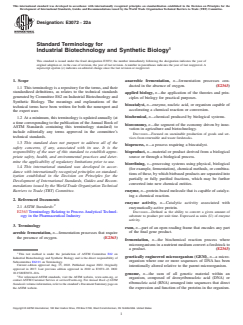
(Terminology)Standard Terminology for Industrial Biotechnology and Synthetic Biology
General Information
- Abstract
SCOPE
1.1 This terminology is a repository for the terms, and their standardized definitions, as relates to the technical standards generated by Committee E62 on Industrial Biotechnology and Synthetic Biology. The meanings and explanations of the technical terms have been written for both the nonexpert and the expert user.
1.2 At a minimum, this terminology is updated annually (at a time corresponding to the publication of the Annual Book of ASTM Standards containing this terminology standard) to include editorially any terms approved in the committee’s technical standards.
1.3 This standard does not purport to address all of the safety concerns, if any, associated with its use. It is the responsibility of the user of this standard to establish appropriate safety, health, and environmental practices and determine the applicability of regulatory limitations prior to use.
1.4 This international standard was developed in accordance with internationally recognized principles on standardization established in the Decision on Principles for the Development of International Standards, Guides and Recommendations issued by the World Trade Organization Technical Barriers to Trade (TBT) Committee.
- Status
- Published
- Publication Date
- 14-Aug-2022
- Technical Committee
- E62 - Industrial Biotechnology and Synthetic Biology
- Drafting Committee
- E62.91 - Terminology


Overview
ASTM E3072-22a - Standard Terminology for Industrial Biotechnology and Synthetic Biology provides a comprehensive, authoritative repository of terms and definitions crucial for professionals and stakeholders engaged in industrial biotechnology and synthetic biology. Developed by ASTM Committee E62, this international standard ensures clarity and consistency in the language used across the sector, supporting both novice and expert users. Terms are updated annually to remain relevant with evolving technologies and regulatory requirements, promoting seamless communication and harmonization within the bioeconomy.
Key Topics
- Standardized Definitions: This standard covers essential vocabulary such as biocatalyst, bioeconomy, bioprocess, bioproduct, genome editing, proteomics, and systems biology, enabling precise understanding and application across research, manufacturing, and policy discussions.
- Industrial Biotechnology: Encompasses terms describing processes like fermentation, biorefining, and metabolic engineering, which are central to the production of biobased products.
- Synthetic Biology: Includes terminology for advanced genetic manipulation, such as genome editing, transgenic organisms, and related regulatory elements, reflecting the cutting edge of the field.
- Quality and Safety: Emphasizes that while terminology is standardized, users must independently address safety, health, and environmental concerns associated with terminology use and its applications.
- Continuous Updates: The terminology is reviewed and updated annually to incorporate new advances and emerging terms within the field, ensuring ongoing relevance and accuracy.
Applications
ASTM E3072-22a is widely applicable across the industrial biotechnology and synthetic biology landscape, serving the following practical purposes:
- Regulatory Compliance: Enables clearer interpretation and implementation of standards in policy, permitting, and quality management systems involving bioprocesses and genome-engineered products.
- Research and Development: Facilitates mutual understanding and communication among multidisciplinary teams, including biologists, chemists, engineers, and informatics experts working on bio-based innovations.
- Product Innovation: Provides a common language for companies developing enzymes, bioproducts, or processes such as fermentation, metabolic engineering, and biorefining, supporting process optimization and product labeling.
- Environmental and Public Health Applications: Assists in defining terms related to remediation, microbiomes, and biological analytics, underpinning sustainable solutions in waste management and ecosystem monitoring.
- Education and Training: Serves as a foundational resource for developing teaching materials, training programs, and industry guidelines, fostering knowledge transfer and workforce development.
Related Standards
The terminology in ASTM E3072-22a is intended to be compatible and cross-referenced with other key industry standards, including:
- ASTM E2363 - Terminology Relating to Process Analytical Technology in the Pharmaceutical Industry: Provides complementary definitions for process analytics relevant to biotechnology.
- Other ASTM E62 committee standards, which address technical requirements for processes and products in industrial biotechnology and synthetic biology.
- International guidance documents from organizations adhering to principles such as those outlined by the World Trade Organization Technical Barriers to Trade (TBT) Committee.
Keywords: industrial biotechnology, synthetic biology, standardized terminology, biocatalyst, genome editing, bioproducts, bioprocesses, biobased industry, ASTM standard, bioeconomy, enzyme activity, metabolic engineering, proteomics, systems biology.
Relations
- Effective Date
- 15-Jul-2006
- Effective Date
- 15-Jan-2006
- Effective Date
- 15-Oct-2005
- Effective Date
- 15-Aug-2005
- Effective Date
- 01-Mar-2005
- Effective Date
- 01-Dec-2004
- Effective Date
- 01-Jul-2004
Frequently Asked Questions
ASTM E3072-22a is a standard published by ASTM International. Its full title is "Standard Terminology for Industrial Biotechnology and Synthetic Biology". This standard covers: SCOPE 1.1 This terminology is a repository for the terms, and their standardized definitions, as relates to the technical standards generated by Committee E62 on Industrial Biotechnology and Synthetic Biology. The meanings and explanations of the technical terms have been written for both the nonexpert and the expert user. 1.2 At a minimum, this terminology is updated annually (at a time corresponding to the publication of the Annual Book of ASTM Standards containing this terminology standard) to include editorially any terms approved in the committee’s technical standards. 1.3 This standard does not purport to address all of the safety concerns, if any, associated with its use. It is the responsibility of the user of this standard to establish appropriate safety, health, and environmental practices and determine the applicability of regulatory limitations prior to use. 1.4 This international standard was developed in accordance with internationally recognized principles on standardization established in the Decision on Principles for the Development of International Standards, Guides and Recommendations issued by the World Trade Organization Technical Barriers to Trade (TBT) Committee.
SCOPE 1.1 This terminology is a repository for the terms, and their standardized definitions, as relates to the technical standards generated by Committee E62 on Industrial Biotechnology and Synthetic Biology. The meanings and explanations of the technical terms have been written for both the nonexpert and the expert user. 1.2 At a minimum, this terminology is updated annually (at a time corresponding to the publication of the Annual Book of ASTM Standards containing this terminology standard) to include editorially any terms approved in the committee’s technical standards. 1.3 This standard does not purport to address all of the safety concerns, if any, associated with its use. It is the responsibility of the user of this standard to establish appropriate safety, health, and environmental practices and determine the applicability of regulatory limitations prior to use. 1.4 This international standard was developed in accordance with internationally recognized principles on standardization established in the Decision on Principles for the Development of International Standards, Guides and Recommendations issued by the World Trade Organization Technical Barriers to Trade (TBT) Committee.
ASTM E3072-22a is classified under the following ICS (International Classification for Standards) categories: 01.040.07 - Natural and applied sciences (Vocabularies); 07.080 - Biology. Botany. Zoology. The ICS classification helps identify the subject area and facilitates finding related standards.
ASTM E3072-22a has the following relationships with other standards: It is inter standard links to ASTM E2363-06a, ASTM E2363-06, ASTM E2363-05b, ASTM E2363-05a, ASTM E2363-05, ASTM E2363-04a, ASTM E2363-04. Understanding these relationships helps ensure you are using the most current and applicable version of the standard.
ASTM E3072-22a is available in PDF format for immediate download after purchase. The document can be added to your cart and obtained through the secure checkout process. Digital delivery ensures instant access to the complete standard document.
Standards Content (Sample)
This international standard was developed in accordance with internationally recognized principles on standardization established in the Decision on Principles for the
Development of International Standards, Guides and Recommendations issued by the World Trade Organization Technical Barriers to Trade (TBT) Committee.
Designation: E3072 − 22a
Standard Terminology for
Industrial Biotechnology and Synthetic Biology
This standard is issued under the fixed designation E3072; the number immediately following the designation indicates the year of
original adoption or, in the case of revision, the year of last revision. A number in parentheses indicates the year of last reapproval. A
superscript epsilon (´) indicates an editorial change since the last revision or reapproval.
1. Scope anaerobic fermentation, n—fermentation processes con-
ducted in the absence of oxygen. (E2363)
1.1 This terminology is a repository for the terms, and their
standardized definitions, as relates to the technical standards
applied biology, n—the application of the theories and prin-
generated by Committee E62 on Industrial Biotechnology and
ciples of biology for practical purposes.
Synthetic Biology. The meanings and explanations of the
biocatalyst, n—enzyme, nucleic acid, or organism capable of
technical terms have been written for both the nonexpert and
accelerating a chemical reaction or conversion.
the expert user.
biochemical, n—chemical produced by biological systems.
1.2 At a minimum, this terminology is updated annually (at
a time corresponding to the publication of theAnnual Book of
bioeconomy, n—the segment of the economy driven by inno-
ASTM Standards containing this terminology standard) to
vation in agriculture and biotechnology.
include editorially any terms approved in the committee’s
DISCUSSION—Focused on sustainable production of goods and ser-
technical standards.
vices from renewable and waste feedstocks.
1.3 This standard does not purport to address all of the
bioprocess, n—a process requiring a biocatalyst.
safety concerns, if any, associated with its use. It is the
bioproduct, n—material or product derived from a biological
responsibility of the user of this standard to establish appro-
priate safety, health, and environmental practices and deter- source or through a biological process.
mine the applicability of regulatory limitations prior to use.
biorefining, v—processing systems using physical, biological
1.4 This international standard was developed in accor-
(for example, fermentation), chemical methods, or combina-
dance with internationally recognized principles on standard-
tions of these, by which biobased products are separated into
ization established in the Decision on Principles for the
partially or fully purified fractions, which may be further
Development of International Standards, Guides and Recom-
converted into new chemical entities.
mendations issued by the World Trade Organization Technical
Barriers to Trade (TBT) Committee.
enzyme, n—protein-based molecule that is capable of catalyz-
ing a chemical reaction.
2. Referenced Documents
enzyme activity, n—Catalytic activity associated with
2.1 ASTM Standards:
enzymatically-active protein.
E2363 Terminology Relating to ProcessAnalytical Technol-
DISCUSSION—Defined as the ability to convert a given amount of
ogy in the Pharmaceutical Industry substrate to product per unit time. Expressed as units (U) of enzyme
activity.
3. Terminology
exon, n—part of an open reading frame that encodes any part
of the final gene product.
aerobic fermentation, n—fermentation processes that require
the presence of oxygen. (E2363)
fermentation, n—the biochemical reaction process where
microorganisms in a nutrient medium convert a feedstock to
a product. (E2363)
This test method is under the jurisdiction of ASTM Committee E62 on
genetically engineered microorganism (GEM), n—a micro-
Industrial Biotechnology and Synthetic Biology and is the direct responsibility of
Subcommittee E62.91 on Terminology. organism where one or more sequences of DNA has been
Current edition approved Aug. 15, 2022. Published August 2022. Originally
intentionally altered relative to the parent microorganism.
approved in 2017. Last previous edition approved in 2022 as E3072–22. DOI:
10.1520/E3072–22A.
genome, n—the sum of all genetic material within an
For referenced ASTM standards, visit the ASTM website, www.astm.org, or
organism, composed of deoxyribonucleic acid (DNA) or
contact ASTM Customer Service at service@astm.org. For Annual Book of ASTM
ribonucleic acid (RNA) arranged into sequences that direct
Standards volume information, refer to the standard’s Document Summary page on
the ASTM website. the expression and function of the proteins in the organism.
Copyright © ASTM International, 100 Barr Harbor Drive, PO Box C700, West Conshohocken, PA 19428-2959. United States
E3072 − 22a
genome-edited organism, n—an organism containing a ge- given as a percentage of the theoretical yield from the
nome altered through the process of genome-editing. defined input material.
DISCUSSION—Gene-edited organisms can be either cisgenic or
process yield, n—amount of product output of interest from a
transgenic, depending on the nature of the genomic alterations.
single-ormulti-stepprocessexpressedasapercentageofthe
genome editing, v—The introduction of precise changes to the
amount of input material either as moles or mass.
DNA sequence of an organism at defined locations within a
promoter, n—a non-coding region of DNA that controls
genome.
transcription of a particular gene, or set of genes.
DISCUSSION—Gene edits can involve alteration of a single base pair,
or the deletion or addition of
...
This document is not an ASTM standard and is intended only to provide the user of an ASTM standard an indication of what changes have been made to the previous version. Because
it may not be technically possible to adequately depict all changes accurately, ASTM recommends that users consult prior editions as appropriate. In all cases only the current version
of the standard as published by ASTM is to be considered the official document.
Designation: E3072 − 22 E3072 − 22a
Standard Terminology for
Industrial Biotechnology and Synthetic Biology
This standard is issued under the fixed designation E3072; the number immediately following the designation indicates the year of
original adoption or, in the case of revision, the year of last revision. A number in parentheses indicates the year of last reapproval. A
superscript epsilon (´) indicates an editorial change since the last revision or reapproval.
1. Scope
1.1 This terminology is a repository for the terms, and their standardized definitions, as relates to the technical standards generated
by Committee E62 on Industrial Biotechnology. Biotechnology and Synthetic Biology. The meanings and explanations of the
technical terms have been written for both the nonexpert and the expert user.
1.2 At a minimum, this terminology is updated annually (at a time corresponding to the publication of the Annual Book of ASTM
Standards containing this terminology standard) to include editorially any terms approved in the committee’s technical standards.
1.3 This standard does not purport to address all of the safety concerns, if any, associated with its use. It is the responsibility
of the user of this standard to establish appropriate safety, health, and environmental practices and determine the applicability of
regulatory limitations prior to use.
1.4 This international standard was developed in accordance with internationally recognized principles on standardization
established in the Decision on Principles for the Development of International Standards, Guides and Recommendations issued
by the World Trade Organization Technical Barriers to Trade (TBT) Committee.
2. Referenced Documents
2.1 ASTM Standards:
E2363 Terminology Relating to Process Analytical Technology in the Pharmaceutical Industry
3. Terminology
aerobic fermentation, n—fermentation processes that require the presence of oxygen. (E2363)
anaerobic fermentation, n—fermentation processes conducted in the absence of oxygen. (E2363)
applied biology, n—the application of the theories and principles of biology for practical purposes.
biocatalyst, n—enzyme, nucleic acid, or organism capable of accelerating a chemical reaction or conversion.
biochemical, n—chemical produced by biological systems.
This test method is under the jurisdiction of ASTM Committee E62 on Industrial Biotechnology and Synthetic Biology and is the direct responsibility of Subcommittee
E62.91 on Terminology.
Current edition approved Aug. 1, 2022Aug. 15, 2022. Published August 2022. Originally approved in 2017. Last previous edition approved in 20192022 as E3072–19.–22.
DOI: 10.1520/E3072–22.10.1520/E3072–22A.
For referenced ASTM standards, visit the ASTM website, www.astm.org, or contact ASTM Customer Service at service@astm.org. For Annual Book of ASTM Standards
volume information, refer to the standard’s Document Summary page on the ASTM website.
Copyright © ASTM International, 100 Barr Harbor Drive, PO Box C700, West Conshohocken, PA 19428-2959. United States
E3072 − 22a
bioeconomy, n—the segment of the economy driven by innovation in agriculture and biotechnology.
DISCUSSION—
Focused on sustainable production of goods and services from renewable and waste feedstocks.
bioprocess, n—a process requiring a biocatalyst.
bioproduct, n—material or product derived from a biological source or through a biological process.
biorefining, v—processing systems using physical, biological (for example, fermentation), chemical methods, or combinations
of these, by which biobased products are separated into partially or fully purified fractions, which may be further converted into
new chemical entities.
enzyme, n—protein-based molecule that is capable of catalyzing a chemical reaction.
enzyme activity, n—Catalytic activity associated with enzymatically-active protein.
DISCUSSION—
Defined as the ability to convert a given amount of substrate to product per unit time. Expressed as units (U) of enzyme activity.
exon, n—part of an open reading frame that encodes any part of the final gene product.
fermentation, n—the biochemical reaction process where microorganisms in a nutrient medium convert a feedstock to a
product. (E2363)
genetically engineered microorganism (GEM), n—a microorganism where one or more sequences of DNA has been
intentionally altered relative to the parent microorganism.
genome, n—the sum of all genetic material within an organism, composed of deoxyribonucleic acid (DNA) or ribonucleic acid
(RNA) arranged into sequences that direct the expression and function of the proteins in the organism.
genome-edited organism, n—an organism containing a genome altered through the process of genome-editing.
DISCUSSION—
Gene-edited organisms can be either cisgenic or transgenic, depending on the nature of the genomic alterations.
genome editing, v—The introduction of precise changes to the DNA sequence of an organism at defined locations within a
genome.
DISCUSSION—
Gene edits can involve alteration of a single base pair, or the deletion or addition of longer DNA sequences, including entire genes.
genotype, n—The portion of genetic material within an organism which determines the expression of a specific characteristic
(phenotype).
glycoform, n—A specific glycoprotein variant, where both polypeptide and associated glycan structure(s) are defined.
interactome, n—The set of all interactions between molecules within
...