

ASTM E135-23a
(Terminology)Standard Terminology Relating to Analytical Chemistry for Metals, Ores, and Related Materials
General Information
- Abstract
SIGNIFICANCE AND USE
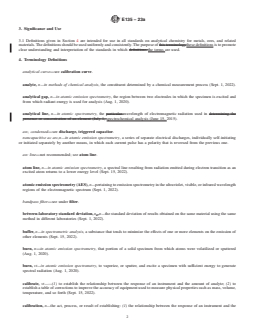
3.1 Definitions given in Section 4 are intended for use in all standards on analytical chemistry for metals, ores, and related materials. The definitions should be used uniformly and consistently. The purpose of these definitions is to promote clear understanding and interpretation of the standards in which the terms are used.
SCOPE
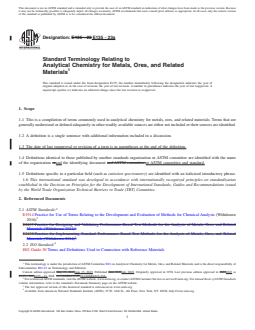
1.1 This is a compilation of terms commonly used in analytical chemistry for metals, ores, and related materials. Terms that are generally understood or defined adequately in other readily available sources are either not included or their sources are identified.
1.2 A definition is a single sentence with additional information included in a discussion.
1.3 The date of last reapproval or revision of a term is in parentheses at the end of the definition.
1.4 Definitions identical to those published by another standards organization or ASTM committee are identified with the name of the organization and the identifying document or ASTM committee and standard.
1.5 Definitions specific to a particular field (such as emission spectrometry) are identified with an italicized introductory phrase.
1.6 This international standard was developed in accordance with internationally recognized principles on standardization established in the Decision on Principles for the Development of International Standards, Guides and Recommendations issued by the World Trade Organization Technical Barriers to Trade (TBT) Committee.
- Status
- Published
- Publication Date
- 14-Jun-2023
- Technical Committee
- E01 - Analytical Chemistry for Metals, Ores, and Related Materials
- Drafting Committee
- E01.23 - Terminology and Editorial
Buy Documents
ASTM E135-23a - Standard Terminology Relating to Analytical Chemistry for Metals, Ores, and Related Materials
REDLINE ASTM E135-23a - Standard Terminology Relating to Analytical Chemistry for Metals, Ores, and Related Materials
Overview
ASTM E135-23a: Standard Terminology Relating to Analytical Chemistry for Metals, Ores, and Related Materials is a foundational terminology standard developed by ASTM to support the field of analytical chemistry, particularly as it pertains to metals and ores. This document compiles and defines terms commonly encountered in analytical chemistry, ensuring clear communication and consistent interpretation across related ASTM standards. By promoting the uniform use of terminology, ASTM E135-23a serves as a critical reference for professionals involved in laboratory analysis, quality control, and method validation in industrial and research settings.
Key Topics
- Comprehensive Collection of Terms: The standard gathers terms relevant to analytical chemistry for metals, ores, and related materials, adopting well-recognized and essential vocabulary.
- Uniform and Consistent Definitions: It ensures that definitions are applied consistently across all related ASTM analytical chemistry standards, minimizing ambiguity.
- Guidance on Usage and Sources: Terms that are either universally understood or defined in authoritative sources are referenced accordingly. Definitions from other standard organizations are clearly identified.
- Field-Specific Terminology: Terms unique to certain analytical disciplines (e.g., emission spectrometry) are distinctly marked to preserve context.
- Historical Context: Withdrawn or superseded terms are identified, providing a record of changes and the rationale for removal or replacement.
- International Compliance: ASTM E135-23a aligns with internationally recognized standardization principles set by the World Trade Organization’s TBT Committee.
Applications
ASTM E135-23a has broad value across industries and organizations working with metals analysis, including:
- Laboratory Operations: Provides a consistent reference for laboratory staff, ensuring that reports, procedures, and communications use standardized terminology.
- Quality Assurance: Supports QA/QC activities by institutionalizing definitions critical to testing accuracy, calibration, and measurement traceability.
- Method Development and Validation: Facilitates method design, validation, and comparison by establishing clear and consistent language around analytical processes, detection limits, calibration, and performance-based methods.
- Industry Sectors: Applies to mining, metallurgy, environmental monitoring, manufacturing, and regulatory compliance where metals and ores are analyzed.
- Training and Documentation: Serves as an authoritative glossary for technical staff training, educational programs, and development of operating procedures.
Related Standards
Professionals utilizing ASTM E135-23a may also reference several related standards to ensure comprehensive understanding and application:
- ASTM E1914: Practice for Use of Terms Relating to the Development and Evaluation of Methods for Chemical Analysis (Withdrawn 2016).
- ASTM E2437: Practice for Designing and Validating Performance-Based Test Methods for the Analysis of Metals, Ores, and Related Materials (Withdrawn 2014).
- ASTM E2438: Practice for Implementing Standard Performance Based Test Methods for the Analysis of Metals, Ores, and Related Materials (Withdrawn 2014).
- ISO Guide 30: Terms and Definitions Used in Connection with Reference Materials.
- IUPAC Gold Book: Recognized glossary for chemical terminology, referenced for certain specialized terms.
Conclusion
ASTM E135-23a is an essential international standard that ensures clarity, precision, and uniformity in the terminology used throughout analytical chemistry for metals, ores, and related materials. Its consistent application advances communication across laboratories, industries, and regulatory bodies, enhancing the reliability of analytical results and supporting global harmonization of technical practices.
Keywords: analytical chemistry, metals analysis, ore analysis, ASTM terminology, laboratory standards, calibration, quality assurance, performance-based methods, spectrometry, certification, reference material.
Relations
- Effective Date
- 01-Jun-2007
- Effective Date
- 01-Oct-2003
- Effective Date
- 10-May-1998
Buy Documents
ASTM E135-23a - Standard Terminology Relating to Analytical Chemistry for Metals, Ores, and Related Materials
REDLINE ASTM E135-23a - Standard Terminology Relating to Analytical Chemistry for Metals, Ores, and Related Materials
Get Certified
Connect with accredited certification bodies for this standard

ECOCERT
Organic and sustainability certification.

Eurofins Food Testing Global
Global leader in food, environment, and pharmaceutical product testing.

Intertek Bangladesh
Intertek certification and testing services in Bangladesh.
Sponsored listings
Frequently Asked Questions
ASTM E135-23a is a standard published by ASTM International. Its full title is "Standard Terminology Relating to Analytical Chemistry for Metals, Ores, and Related Materials". This standard covers: SIGNIFICANCE AND USE 3.1 Definitions given in Section 4 are intended for use in all standards on analytical chemistry for metals, ores, and related materials. The definitions should be used uniformly and consistently. The purpose of these definitions is to promote clear understanding and interpretation of the standards in which the terms are used. SCOPE 1.1 This is a compilation of terms commonly used in analytical chemistry for metals, ores, and related materials. Terms that are generally understood or defined adequately in other readily available sources are either not included or their sources are identified. 1.2 A definition is a single sentence with additional information included in a discussion. 1.3 The date of last reapproval or revision of a term is in parentheses at the end of the definition. 1.4 Definitions identical to those published by another standards organization or ASTM committee are identified with the name of the organization and the identifying document or ASTM committee and standard. 1.5 Definitions specific to a particular field (such as emission spectrometry) are identified with an italicized introductory phrase. 1.6 This international standard was developed in accordance with internationally recognized principles on standardization established in the Decision on Principles for the Development of International Standards, Guides and Recommendations issued by the World Trade Organization Technical Barriers to Trade (TBT) Committee.
SIGNIFICANCE AND USE 3.1 Definitions given in Section 4 are intended for use in all standards on analytical chemistry for metals, ores, and related materials. The definitions should be used uniformly and consistently. The purpose of these definitions is to promote clear understanding and interpretation of the standards in which the terms are used. SCOPE 1.1 This is a compilation of terms commonly used in analytical chemistry for metals, ores, and related materials. Terms that are generally understood or defined adequately in other readily available sources are either not included or their sources are identified. 1.2 A definition is a single sentence with additional information included in a discussion. 1.3 The date of last reapproval or revision of a term is in parentheses at the end of the definition. 1.4 Definitions identical to those published by another standards organization or ASTM committee are identified with the name of the organization and the identifying document or ASTM committee and standard. 1.5 Definitions specific to a particular field (such as emission spectrometry) are identified with an italicized introductory phrase. 1.6 This international standard was developed in accordance with internationally recognized principles on standardization established in the Decision on Principles for the Development of International Standards, Guides and Recommendations issued by the World Trade Organization Technical Barriers to Trade (TBT) Committee.
ASTM E135-23a is classified under the following ICS (International Classification for Standards) categories: 01.040.71 - Chemical technology (Vocabularies); 71.040.50 - Physicochemical methods of analysis. The ICS classification helps identify the subject area and facilitates finding related standards.
ASTM E135-23a has the following relationships with other standards: It is inter standard links to ASTM E1914-07, ASTM E1914-98(2003), ASTM E1914-98. Understanding these relationships helps ensure you are using the most current and applicable version of the standard.
ASTM E135-23a is available in PDF format for immediate download after purchase. The document can be added to your cart and obtained through the secure checkout process. Digital delivery ensures instant access to the complete standard document.
Standards Content (Sample)
This international standard was developed in accordance with internationally recognized principles on standardization established in the Decision on Principles for the
Development of International Standards, Guides and Recommendations issued by the World Trade Organization Technical Barriers to Trade (TBT) Committee.
Designation: E135 − 23a
Standard Terminology Relating to
Analytical Chemistry for Metals, Ores, and Related
Materials
This standard is issued under the fixed designation E135; the number immediately following the designation indicates the year of
original adoption or, in the case of revision, the year of last revision. A number in parentheses indicates the year of last reapproval. A
superscript epsilon (´) indicates an editorial change since the last revision or reapproval.
1. Scope 2.2 ISO Standard:
ISO Guide 30 Terms and Definitions Used in Connection
1.1 This is a compilation of terms commonly used in
with Reference Materials
analytical chemistry for metals, ores, and related materials.
Terms that are generally understood or defined adequately in
3. Significance and Use
other readily available sources are either not included or their
3.1 Definitions given in Section 4 are intended for use in all
sources are identified.
standards on analytical chemistry for metals, ores, and related
1.2 A definition is a single sentence with additional infor-
materials. The definitions should be used uniformly and
mation included in a discussion.
consistently. The purpose of these definitions is to promote
1.3 The date of last reapproval or revision of a term is in
clear understanding and interpretation of the standards in
parentheses at the end of the definition.
which the terms are used.
1.4 Definitions identical to those published by another
4. Terminology Definitions
standards organization or ASTM committee are identified with
the name of the organization and the identifying document or
analytical curve—see calibration curve.
ASTM committee and standard.
analyte, n—in methods of chemical analysis, the constituent
1.5 Definitions specific to a particular field (such as emis-
determined by a chemical measurement process (Sept. 1,
sion spectrometry) are identified with an italicized introductory
2022).
phrase.
analytical gap, n—in atomic emission spectrometry, the region
1.6 This international standard was developed in accor-
between two electrodes in which the specimen is excited and
dance with internationally recognized principles on standard-
from which radiant energy is used for analysis (Aug. 1,
ization established in the Decision on Principles for the
2020).
Development of International Standards, Guides and Recom-
mendations issued by the World Trade Organization Technical
analytical line, n—in atomic spectrometry, the wavelength of
Barriers to Trade (TBT) Committee.
electromagnetic radiation used in spectrochemical analysis
(June 15, 2015).
2. Referenced Documents
arc, condensed—see discharge, triggered capacitor.
2.1 ASTM Standards:
noncapacitive ac arc, n—in atomic emission spectrometry, a
E1914 Practice for Use of Terms Relating to the Develop-
series of separate electrical discharges, individually self-
ment and Evaluation of Methods for Chemical Analysis
initiating or initiated separately by another means, in which
(Withdrawn 2016)
each current pulse has a polarity that is reversed from the
previous one.
This terminology is under the jurisdiction of ASTM Committee E01 on
arc line—not recommended; see atom line.
Analytical Chemistry for Metals, Ores, and Related Materials and is the direct
responsibility of Subcommittee E01.23 on Terminology and Editorial.
atom line, n—in atomic emission spectrometry, a spectral line
Current edition approved June 15, 2023. Published July 2023. Originally
resulting from radiation emitted during electron transition as
approved in 1958. Last previous edition approved in 2023 as E135 – 23. DOI:
an excited atom returns to a lower energy level (Sept. 15,
10.1520/E0135-23A.
For referenced ASTM standards, visit the ASTM website, www.astm.org, or
2022).
contact ASTM Customer Service at service@astm.org. For Annual Book of ASTM
Standards volume information, refer to the standard’s Document Summary page on
the ASTM website.
3 4
The last approved version of this historical standard is referenced on Available from American National Standards Institute (ANSI), 25 W. 43rd St.,
www.astm.org. 4th Floor, New York, NY 10036, http://www.ansi.org.
Copyright © ASTM International, 100 Barr Harbor Drive, PO Box C700, West Conshohocken, PA 19428-2959. United States
E135 − 23a
atomic emission spectrometry (AES), n—pertaining to emis- from the background signal at a specified confidence level
sion spectrometry in the ultraviolet, visible, or infrared (Sept. 1, 2022). E1914
wavelength regions of the electromagnetic spectrum (Sept. DISCUSSION—The detection limit may be designated as L . An
D
equivalent alternative term is Limit of Detection with an acronym of
1, 2022).
LOD.
bandpass filter—see under filter.
discharge, triggered capacitor, n—a series of electrical dis-
between-laboratory standard deviation, s , n—the standard
charges from capacitors initiated by a separate means and
R
deviation of results obtained on the same material using the
extinguished when the voltage across the analytical gap falls
same method in different laboratories (Sept. 1, 2022).
to a value that no longer is sufficient to maintain it (Sept. 15,
2022).
buffer, n—in spectrometric analysis, a substance that tends to
minimize the effects of one or more elements on the
division, n—in sample preparation, a process which divides a
emission of other elements (Sept. 15, 2022).
sample into two or more subsamples without changing the
composition (May 15, 2016).
burn, n—in atomic emission spectrometry, that portion of a
solid specimen from which atoms were volatilized or sput-
doré bead, n—a gold and silver bead that results from
tered (Aug. 1, 2020).
cupellation and may contain platinum group metals (Sept. 1,
2022).
burn, vt—in atomic emission spectrometry, to vaporize, or
sputter, and excite a specimen with sufficient energy to
drift correction, n—in spectrometric analysis, the process of
generate spectral radiation (Aug. 1, 2020).
adjusting for a translational shift or a rotational shift, or both,
of an instrument calibration (May 15, 2016).
calibrate, vt——(1) to establish the relationship between the
response of an instrument and the amount of analyte; (2) to
electrode gap—not recommended; see analytical gap.
establish a table of corrections to improve the accuracy of
error, n—of a result, the difference between a result obtained
equipment used to measure physical properties such as mass,
on a material and its accepted reference value (May 15,
volume, temperature, and so forth (Sept. 15, 2022).
2016). E1914
calibration, n—the act, process, or result of establishing: (1)
fatigue, n—in atomic emission spectrometry, the decrease in
the relationship between the response of an instrument and
response of a photoelectric radiant energy detector caused by
the amount of analyte present; (2) a table of corrections to
the accumulated exposure of the detector to radiant energy
improve the accuracy of equipment used to measure physical
(Sept. 15, 2022).
properties such as mass, volume, temperature, and so forth
(Sept. 15, 2022).
filter, n—in atomic spectrometry, a substance that attenuates
the radiant power in a definite manner with respect to
calibration curve, n—the graphical or mathematical represen-
spectral distribution (Sept. 1, 2022).
tation of the relationship between the response of an instru-
bandpass filter—a filter that passes wavelengths (or frequen-
ment and the concentration or mass of the analyte (May 15,
2016). cies) within a specified range and attenuates all wavelengths
(or frequencies) outside that range.
condensed arc—see under discharge, triggered capacitor.
gross sample—see under sample (May 15, 2016).
certified reference material (CRM), n—a reference material,
accompanied by a certificate, one or more of whose property homologous lines, n—in atomic emission spectrometry, spec-
tral lines that exhibit minimal change in their intensity ratios
values are certified by a procedure which establishes trace-
ability to an accurate realization of the unit in which the with variations in excitation conditions (Sept. 15, 2022).
property values are expressed, and for which each certified
increment, n—in sampling, a portion of material removed
value is accompanied by an uncertainty at a stated level of
from a lot by a single operation (Sept. 15, 2022).
confidence, and a statement of metrological traceability
(June 15, 2023).
inquartation, n—in fire assay, the addition of silver to
DISCUSSION—Before the advent of the term certified reference mate-
facilitate parting (May 15, 2015).
rial (CRM), the term standard reference material was used in many
interlaboratory study (ILS), n—a study initiated among
documents of ASTM International. This results from the use of the term ®
Standard Reference Material (SRM ) as the name for certified refer-
multiple laboratories to demonstrate the precision and bias of
ence materials (CRM) issued by the National Institute of Standards and
a test method (June 15, 2023).
Technology (NIST), an agency of the United States government.
internal standard, n—in spectrometry, a material present in or
counter electrode, n—in atomic emission spectrometry, the
added to test samples that serves as an intensity reference for
electrode in an analytical pair that does not contain the
spectral measurements (May 15, 2019).
specimen being analyzed (Aug. 1, 2020).
detection limit, n—the smallest net signal (or the derived
property value, constituent mass fraction, etc.) obtained by a
For a complete discussion, refer to L. A. Currie (ed.), Pure and Applied
given measurement procedure, that can be distinguished Chemistry, Vol 67, No. 10, 1995, pp. 1699–1723.
E135 − 23a
internal standard line, n—in atomic spectrometry, a spectral mixed with the oxidizing gas before reaching the combus-
line of an internal standard, to which the radiant energy of an tion zone (April 15, 2021).
analytical line is compared (Sept. 15, 2022).
prepared sample—see under sample.
ion line, n—in atomic emission spectrometry, a spectral line
primary X-rays, n—in spectrometry, the emergent beam from
resulting from radiation emitted during electron transition as
the X-ray source (July 1, 2015).
an ionized atom decays to a lower, but still ionized, energy
level; see atom line (Sept. 15, 2022). profile, vt—in atomic emission spectrometry, to scan and set
the deflection of the grating, or actual or apparent position of
laboratory sample—see under sample.
the entrance slit, or actual or apparent location of the exit
slits, to produce optimum measurement of intensity (Sept.
linear dispersion, n—the derivative dx/dλ, where x is the
15, 2022).
distance along the spectrum and λ is the wavelength (May
15, 2016).
proof, n—in fire assay, a synthetic verifier having a precious
metal content similar to that expect
...
This document is not an ASTM standard and is intended only to provide the user of an ASTM standard an indication of what changes have been made to the previous version. Because
it may not be technically possible to adequately depict all changes accurately, ASTM recommends that users consult prior editions as appropriate. In all cases only the current version
of the standard as published by ASTM is to be considered the official document.
Designation: E135 − 23 E135 − 23a
Standard Terminology Relating to
Analytical Chemistry for Metals, Ores, and Related
Materials
This standard is issued under the fixed designation E135; the number immediately following the designation indicates the year of
original adoption or, in the case of revision, the year of last revision. A number in parentheses indicates the year of last reapproval. A
superscript epsilon (´) indicates an editorial change since the last revision or reapproval.
1. Scope
1.1 This is a compilation of terms commonly used in analytical chemistry for metals, ores, and related materials. Terms that are
generally understood or defined adequately in other readily available sources are either not included or their sources are identified.
1.2 A definition is a single sentence with additional information included in a discussion.
1.3 The date of last reapproval or revision of a term is in parentheses at the end of the definition.
1.4 Definitions identical to those published by another standards organization or ASTM committee are identified with the name
of the organization orand the identifying document and ASTM committee.or ASTM committee and standard.
1.5 Definitions specific to a particular field (such as emission spectrometry) are identified with an italicized introductory phrase.
1.6 This international standard was developed in accordance with internationally recognized principles on standardization
established in the Decision on Principles for the Development of International Standards, Guides and Recommendations issued
by the World Trade Organization Technical Barriers to Trade (TBT) Committee.
2. Referenced Documents
2.1 ASTM Standards:
E1914 Practice for Use of Terms Relating to the Development and Evaluation of Methods for Chemical Analysis (Withdrawn
2016)
E2437 Practice for Designing and Validating Performance-Based Test Methods for the Analysis of Metals, Ores, and Related
Materials (Withdrawn 2014)
E2438 Practice for Implementing Standard Performance Based Test Methods for the Analysis of Metals, Ores, and Related
Materials (Withdrawn 2014)
2.2 ISO Standard:
ISO Guide 30 Terms and Definitions Used in Connection with Reference Materials
This terminology is under the jurisdiction of ASTM Committee E01 on Analytical Chemistry for Metals, Ores, and Related Materials and is the direct responsibility of
Subcommittee E01.23 on Terminology and Editorial.
Current edition approved May 15, 2023June 15, 2023. Published June 2023July 2023. Originally approved in 1958. Last previous edition approved in 20222023 as
E135 – 22b.E135 – 23. DOI: 10.1520/E0135-23.10.1520/E0135-23A.
For referenced ASTM standards, visit the ASTM website, www.astm.org, or contact ASTM Customer Service at service@astm.org. For Annual Book of ASTM Standards
volume information, refer to the standard’s Document Summary page on the ASTM website.
The last approved version of this historical standard is referenced on www.astm.org.
Available from American National Standards Institute (ANSI), 25 W. 43rd St., 4th Floor, New York, NY 10036, http://www.ansi.org.
Copyright © ASTM International, 100 Barr Harbor Drive, PO Box C700, West Conshohocken, PA 19428-2959. United States
E135 − 23a
3. Significance and Use
3.1 Definitions given in Section 4 are intended for use in all standards on analytical chemistry for metals, ores, and related
materials. The definitions should be used uniformly and consistently. The purpose of this terminologythese definitions is to promote
clear understanding and interpretation of the standards in which definitions the terms are used.
4. Terminology Definitions
analytical curve—see calibration curve.
analyte, n—in methods of chemical analysis, the constituent determined by a chemical measurement process (Sept. 1, 2022).
analytical gap, n—in atomic emission spectrometry, the region between two electrodes in which the specimen is excited and
from which radiant energy is used for analysis (Aug. 1, 2020).
analytical line, n—in atomic spectrometry, the particular wavelength of electromagnetic radiation used in determining the
presence or concentration of an element (July 1, spectrochemical analysis (June 15, 2015).
arc, condensed—see discharge, triggered capacitor.
noncapacitive ac arc,n—in atomic emission spectrometry, a series of separate electrical discharges, individually self-initiating
or initiated separately by another means, in which each current pulse has a polarity that is reversed from the previous one.
arc line—not recommended; see atom line.
atom line, n—in atomic emission spectrometry, a spectral line resulting from radiation emitted during electron transition as an
excited atom returns to a lower energy level (Sept. 15, 2022).
atomic emission spectrometry (AES), n—pertaining to emission spectrometry in the ultraviolet, visible, or infrared wavelength
regions of the electromagnetic spectrum (Sept. 1, 2022).
bandpass filter—see under filter.
between-laboratory standard deviation, s ,n—the standard deviation of results obtained on the same material using the same
R
method in different laboratories (Sept. 1, 2022).
buffer, n—in spectrometric analysis, a substance that tends to minimize the effects of one or more elements on the emission of
other elements (Sept. 15, 2022).
burn, n—in atomic emission spectrometry, that portion of a solid specimen from which atoms were volatilized or sputtered
(Aug. 1, 2020).
burn, vt—in atomic emission spectrometry, to vaporize, or sputter, and excite a specimen with sufficient energy to generate
spectral radiation (Aug. 1, 2020).
calibrate, vt——(1) to establish the relationship between the response of an instrument and the amount of analyte; (2) to
establish a table of corrections to improve the accuracy of equipment used to measure physical properties such as mass, volume,
temperature, and so forth (Sept. 15, 2022).
calibration, n—the act, process, or result of establishing: (1) the relationship between the response of an instrument and the
E135 − 23a
amount of analyte present; (2) a table of corrections to improve the accuracy of equipment used to measure physical properties
such as mass, volume, temperature, and so forth (Sept. 15, 2022).
calibration curve, n—the graphical or mathematical representation of the relationship between the response of an instrument
and the concentration or mass of the analyte (May (May 15, 201615, 2016).).
condensed arc—see under discharge, triggered capacitor.
certified reference material (CRM), n—a reference material, accompanied by a certificate, one or more of whose property
values are certified by a procedure which establishes traceability to an accurate realization of the unit in which the property
values are expressed, and for which each certified value is accompanied by an uncertainty at a stated level of confidence
(confidence, andMay 15, 2015). a statement of metrological traceability (June 15, 2023).
DISCUSSION—
Before the advent of the term certified reference material (CRM), the term standard reference material was used in many documents of ASTM ®
International. This results from the use of the term Standard Reference Material (SRM)(SRM ) as the name for certified reference materials (CRM)
issued by the National Institute of Standards and Technology (NIST), an agency of the United States government.
counter electrode, n—in atomic emission spectrometry, the electrode in an analytical pair that does not contain the specimen
being analyzed (Aug. 1, 2020).
detection limit, n—the smallest net signal (or the derived property value, constituent mass fraction, etc.) obtained by a given
measurement procedure, that can be distinguished from the background signal at a specified confidence level (Sept. 1, 2022).
E1914
DISCUSSION—
The detection limit may be designated as L . An equivalent alternative term is Limit of Detection with an acronym of LOD.
D
discharge, triggered capacitor, n—a series of electrical discharges from capacitors initiated by a separate means and
extinguished when the voltage across the analytical gap falls to a value that no longer is sufficient to maintain it (Sept. 15, 2022).
division, n—in sample preparation, a process which divides a sample into two or more subsamples without changing the
composition (May 15, 2016).
doré bead, n—a gold and silver bead that results from cupellation and may contain platinum group metals (Sept. 1, 2022).
drift correction, n—in spectrometric analysis, the process of adjusting for a translational shift or a rotational shift, or both, of
an instrument calibration (May 15, 2016).
electrode gap—not recommended; see analytical gap.
error, n—of a result, the difference between a result obtained on a material and its accepted reference value (May 15, 2016).
E1914
fatigue, n—in atomic emission spectrometry, the decrease in response of a photoelectric radiant energy detector caused by the
accumulated exposure of the detector to radiant energy (Sept. 15, 2022).
filter, n—in atomic spectrometry, a substance that attenuates the radiant power in a definite manner with respect to spectral
distribution (Sept. 1, 2022).
bandpass filter—a filter that passes wavelengths (or frequencies) within a specified range and attenuates all wavelengths (or
frequencies) outside that range.
For a complete discussion, refer to L. A. Currie (ed.), Pure and Applied Chemistry, Vol 67, No. 10, 1995, pp. 1699–1723.
E135 − 23a
gross sample—see under sample (May 15, 2016).
homologous lines, n—in atomic emission spectrometry, spectral lines that exhibit minimal change in their intensity ratios with
variations in excitation conditions (Sept. 15, 2022).
increment, n—in sampling, a portion of material removed from a lot by a single operation (Sept. 15, 2022).
inquartation, n—in fire assay, the addition of silver to facilitate parting (May 15, 2015).
interlaboratory study (ILS), n—a study initiated among multiple, independent multiple laboratories to demonstrate the
precision and bias of a test method. (method (JuneMay 15, 2023). 15, 2023).
internal standard, n—in spectrometry, a material present in or added to test samples that serves as an intensity reference for
spectral measurements (May 15, 2019).
internal standard line, n—in atomic spectrometry, a spectral line of an internal standard, to which the radiant energy of an
analytical line is compared (Sept. 15, 2022).
ion line, n—in atomic emission spectrometry, a spectral line resulting from radiation emitted during electron transition as an
ionized atom decays to a lower, but still ionized, energy level; see atom line (Sept. 15, 2022).
laboratory sample—see under sample.
linear dispersion, n—the derivative dx/dλ, where x is the distance along the spectrum and λ is the wavelength (May 15, 2016).
line pair, n—in atomic emission spectrometry, an analytical line and the internal standard line with which it is compared (May
15, 2016).
lot, n—in sampling, a collection of material regarded as a unit (Sept. 15, 2022).
matrix, n—withdrawn; see definition in the IUPAC Gold Book (https://goldbook.iupac.org/) (April 15, 2021). E1914
method, n—in chemical analysis, instructions used to
...