

ASTM F2435-22
(Specification)Standard Specification for Steel Reinforced Polyethylene (PE) Corrugated Pipe
General Information
- Abstract
ABSTRACT
This specification covers requirements and test methods for materials, dimensions, workmanship, elongation, impact resistance, pipe stiffness, perforations, and markings for steel reinforced corrugated polyethylene (PE) piping systems. The steel reinforced polyethylene pipes governed by this standard are intended for use in underground applications where soil provides support for their flexible walls. These pipes will be used to collect or convey storm-water runoff for storm sewers and drainage pipes, or both. The following tests shall be performed: pipe dimensions and tolerances; perforations; pipe stiffness; steel to the polyethylene bonding; and joint tightness.
SIGNIFICANCE AND USE
4.1 Steel reinforced corrugated PE pipes are used for underground applications where soil provides support to their flexible walls. Their major use is to collect or convey storm water run-off for sewers and drains, or both.
4.2 Exclusions from recommended use:
4.2.1 Permanent exposure to sunlight and exposure to chemicals whose compatibility with the pipe and fittings is not known.
SCOPE
1.1 This specification covers requirements and test methods for materials, dimensions, workmanship, elongation, impact resistance, pipe stiffness, perforations, and markings for steel reinforced corrugated polyethylene (PE) piping systems of nominal sizes 8 in. (200 mm), through 80 in. (2000 mm). The steel reinforced polyethylene pipes governed by this standard are intended for use in underground applications where soil provides support for their flexible walls. The steel reinforced polyethylene corrugated pipes governed by this standard are intended for use in non-pressure applications for sanitary sewers, storm sewers and drainage pipes.
1.2 The values stated in inch-pound units are to be regarded as standard. The values given in parentheses are mathematical conversions to SI units that are provided for information only and are not considered standard.
1.3 There is no similar or equivalent ISO standard.
1.4 This standard does not purport to address all of the safety concerns, if any, associated with its use. It is the responsibility of the user of this standard to establish appropriate safety, health, and environmental practices and determine the applicability of regulatory limitations prior to use.
1.5 This international standard was developed in accordance with internationally recognized principles on standardization established in the Decision on Principles for the Development of International Standards, Guides and Recommendations issued by the World Trade Organization Technical Barriers to Trade (TBT) Committee.
- Status
- Published
- Publication Date
- 31-Jan-2022
- Technical Committee
- F17 - Plastic Piping Systems
- Drafting Committee
- F17.62 - Sewer
Buy Documents
ASTM F2435-22 - Standard Specification for Steel Reinforced Polyethylene (PE) Corrugated Pipe
REDLINE ASTM F2435-22 - Standard Specification for Steel Reinforced Polyethylene (PE) Corrugated Pipe
Overview
ASTM F2435-22: Standard Specification for Steel Reinforced Polyethylene (PE) Corrugated Pipe provides comprehensive requirements for steel reinforced corrugated polyethylene pipes used in underground applications. This standard covers materials, workmanship, dimensional tolerances, elongation, impact resistance, pipe stiffness, perforations, and product markings. Pipes compliant with ASTM F2435-22 are primarily intended for use in non-pressure underground systems such as storm sewers, sanitary sewers, and drainage pipes, where the surrounding soil provides structural support to their flexible walls.
Key Topics
- Materials: Specifies the use of high-quality PE compounds and steel conforming to defined standards.
- Pipe Structure:
- Single-wall, double-wall, and triple-wall configurations
- Steel reinforcement encapsulated within corrugated PE
- Permitted V-shaped or U-shaped steel profiles for reinforcement
- Performance Requirements:
- Minimum values for pipe stiffness, elongation, and impact resistance
- Strong bond between steel and PE, ensuring composite integrity
- Perforation suitability for drainage, ensuring steel is never exposed by these perforations
- Testing and Quality Assurance:
- Dimensional compliance for inside/outside diameters and wall thickness
- Pipe stiffness tests at 5% deflection
- Joint tightness and fitting requirements (water-tight and soil-tight)
- Markings for traceability and compliance verification
- Installation Guidance: References to accepted underground installation practices such as ASTM D2321 and F449.
Applications
Steel reinforced PE corrugated pipes manufactured in accordance with ASTM F2435-22 offer robust, cost-effective solutions for a variety of non-pressure underground drainage and sewerage systems. Practical applications include:
- Stormwater Collection and Conveyance: Handling runoff in municipal and roadway storm sewers.
- Sanitary Sewer Systems: Underground transport of wastewater in gravity flow applications.
- Subsurface Drainage: Agricultural and infrastructure drainage where soil provides wall support.
- Retention and Detention Systems: Managing water flow in engineered detention basins.
Note: ASTM F2435-22 explicitly excludes applications involving long-term direct sunlight exposure or contact with incompatible chemicals. For best performance, installation should follow established guidelines suitable for thermoplastic pipes in gravity systems.
Related Standards
The following ASTM and industry standards are often referenced or used alongside ASTM F2435-22 for steel reinforced PE pipe systems:
- ASTM D2321: Practice for Underground Installation of Thermoplastic Pipe for Sewers and Other Gravity-Flow Applications
- ASTM F449: Practice for Subsurface Installation of Corrugated Polyethylene Pipe for Agricultural Drainage or Water Table Control
- ASTM F477: Specification for Elastomeric Seals (Gaskets) for Joining Plastic Pipe
- ASTM D3212: Specification for Joints for Drain and Sewer Plastic Pipes Using Flexible Elastomeric Seals
- ASTM D3350: Specification for Polyethylene Plastics Pipe and Fittings Materials
These standards ensure the comprehensive evaluation of materials, joints, installation, and performance for reliable, long-term infrastructure.
Conclusion
ASTM F2435-22 is a critical standard for manufacturers, engineers, and contractors working with steel reinforced polyethylene corrugated pipe in underground sewer and drainage systems. Compliance ensures that installations meet structural, hydraulic, and durability expectations, providing confidence in performance for both public and private infrastructure projects. For the most current technical requirements and application advice, always consult the official ASTM publication and adhere to local regulatory guidance.
Relations
- Effective Date
- 01-Feb-2024
- Refers
ASTM D1238-23a - Standard Test Method for Melt Flow Rates of Thermoplastics by Extrusion Plastometer - Effective Date
- 15-Nov-2023
- Effective Date
- 01-Nov-2023
- Effective Date
- 01-Nov-2023
- Effective Date
- 01-Apr-2020
- Effective Date
- 15-Mar-2020
- Effective Date
- 01-Feb-2020
- Effective Date
- 01-Jan-2019
- Effective Date
- 01-Sep-2018
- Effective Date
- 01-Mar-2018
- Effective Date
- 15-Feb-2018
- Effective Date
- 01-Aug-2017
- Effective Date
- 01-Feb-2017
- Effective Date
- 15-Nov-2016
- Effective Date
- 01-Sep-2016
Buy Documents
ASTM F2435-22 - Standard Specification for Steel Reinforced Polyethylene (PE) Corrugated Pipe
REDLINE ASTM F2435-22 - Standard Specification for Steel Reinforced Polyethylene (PE) Corrugated Pipe
Get Certified
Connect with accredited certification bodies for this standard

Institut za varilstvo d.o.o. (Welding Institute)
Slovenia's leading welding institute since 1952. ISO 3834, EN 1090, pressure equipment certification, NDT personnel, welder qualification. Only IIW Au
Sponsored listings
Frequently Asked Questions
ASTM F2435-22 is a technical specification published by ASTM International. Its full title is "Standard Specification for Steel Reinforced Polyethylene (PE) Corrugated Pipe". This standard covers: ABSTRACT This specification covers requirements and test methods for materials, dimensions, workmanship, elongation, impact resistance, pipe stiffness, perforations, and markings for steel reinforced corrugated polyethylene (PE) piping systems. The steel reinforced polyethylene pipes governed by this standard are intended for use in underground applications where soil provides support for their flexible walls. These pipes will be used to collect or convey storm-water runoff for storm sewers and drainage pipes, or both. The following tests shall be performed: pipe dimensions and tolerances; perforations; pipe stiffness; steel to the polyethylene bonding; and joint tightness. SIGNIFICANCE AND USE 4.1 Steel reinforced corrugated PE pipes are used for underground applications where soil provides support to their flexible walls. Their major use is to collect or convey storm water run-off for sewers and drains, or both. 4.2 Exclusions from recommended use: 4.2.1 Permanent exposure to sunlight and exposure to chemicals whose compatibility with the pipe and fittings is not known. SCOPE 1.1 This specification covers requirements and test methods for materials, dimensions, workmanship, elongation, impact resistance, pipe stiffness, perforations, and markings for steel reinforced corrugated polyethylene (PE) piping systems of nominal sizes 8 in. (200 mm), through 80 in. (2000 mm). The steel reinforced polyethylene pipes governed by this standard are intended for use in underground applications where soil provides support for their flexible walls. The steel reinforced polyethylene corrugated pipes governed by this standard are intended for use in non-pressure applications for sanitary sewers, storm sewers and drainage pipes. 1.2 The values stated in inch-pound units are to be regarded as standard. The values given in parentheses are mathematical conversions to SI units that are provided for information only and are not considered standard. 1.3 There is no similar or equivalent ISO standard. 1.4 This standard does not purport to address all of the safety concerns, if any, associated with its use. It is the responsibility of the user of this standard to establish appropriate safety, health, and environmental practices and determine the applicability of regulatory limitations prior to use. 1.5 This international standard was developed in accordance with internationally recognized principles on standardization established in the Decision on Principles for the Development of International Standards, Guides and Recommendations issued by the World Trade Organization Technical Barriers to Trade (TBT) Committee.
ABSTRACT This specification covers requirements and test methods for materials, dimensions, workmanship, elongation, impact resistance, pipe stiffness, perforations, and markings for steel reinforced corrugated polyethylene (PE) piping systems. The steel reinforced polyethylene pipes governed by this standard are intended for use in underground applications where soil provides support for their flexible walls. These pipes will be used to collect or convey storm-water runoff for storm sewers and drainage pipes, or both. The following tests shall be performed: pipe dimensions and tolerances; perforations; pipe stiffness; steel to the polyethylene bonding; and joint tightness. SIGNIFICANCE AND USE 4.1 Steel reinforced corrugated PE pipes are used for underground applications where soil provides support to their flexible walls. Their major use is to collect or convey storm water run-off for sewers and drains, or both. 4.2 Exclusions from recommended use: 4.2.1 Permanent exposure to sunlight and exposure to chemicals whose compatibility with the pipe and fittings is not known. SCOPE 1.1 This specification covers requirements and test methods for materials, dimensions, workmanship, elongation, impact resistance, pipe stiffness, perforations, and markings for steel reinforced corrugated polyethylene (PE) piping systems of nominal sizes 8 in. (200 mm), through 80 in. (2000 mm). The steel reinforced polyethylene pipes governed by this standard are intended for use in underground applications where soil provides support for their flexible walls. The steel reinforced polyethylene corrugated pipes governed by this standard are intended for use in non-pressure applications for sanitary sewers, storm sewers and drainage pipes. 1.2 The values stated in inch-pound units are to be regarded as standard. The values given in parentheses are mathematical conversions to SI units that are provided for information only and are not considered standard. 1.3 There is no similar or equivalent ISO standard. 1.4 This standard does not purport to address all of the safety concerns, if any, associated with its use. It is the responsibility of the user of this standard to establish appropriate safety, health, and environmental practices and determine the applicability of regulatory limitations prior to use. 1.5 This international standard was developed in accordance with internationally recognized principles on standardization established in the Decision on Principles for the Development of International Standards, Guides and Recommendations issued by the World Trade Organization Technical Barriers to Trade (TBT) Committee.
ASTM F2435-22 is classified under the following ICS (International Classification for Standards) categories: 23.040.20 - Plastics pipes. The ICS classification helps identify the subject area and facilitates finding related standards.
ASTM F2435-22 has the following relationships with other standards: It is inter standard links to ASTM F2136-18(2024), ASTM D1238-23a, ASTM A1008/A1008M-23, ASTM A1008/A1008M-23e1, ASTM F412-20, ASTM D2321-20, ASTM F449-20, ASTM F412-19, ASTM A1008/A1008M-18, ASTM D2321-18, ASTM F2136-18, ASTM F412-17a, ASTM F412-17, ASTM F412-16a, ASTM A1008/A1008M-16. Understanding these relationships helps ensure you are using the most current and applicable version of the standard.
ASTM F2435-22 is available in PDF format for immediate download after purchase. The document can be added to your cart and obtained through the secure checkout process. Digital delivery ensures instant access to the complete standard document.
Standards Content (Sample)
This international standard was developed in accordance with internationally recognized principles on standardization established in the Decision on Principles for the
Development of International Standards, Guides and Recommendations issued by the World Trade Organization Technical Barriers to Trade (TBT) Committee.
Designation:F2435 −22
Standard Specification for
Steel Reinforced Polyethylene (PE) Corrugated Pipe
This standard is issued under the fixed designation F2435; the number immediately following the designation indicates the year of
original adoption or, in the case of revision, the year of last revision. A number in parentheses indicates the year of last reapproval. A
superscript epsilon (´) indicates an editorial change since the last revision or reapproval.
1. Scope* tions (Withdrawn 2005)
A653/A653M Specification for Steel Sheet, Zinc-Coated
1.1 This specification covers requirements and test methods
(Galvanized) or Zinc-Iron Alloy-Coated (Galvannealed)
for materials, dimensions, workmanship, elongation, impact
by the Hot-Dip Process
resistance, pipe stiffness, perforations, and markings for steel
A1008/A1008M Specification for Steel, Sheet, Cold-Rolled,
reinforced corrugated polyethylene (PE) piping systems of
Carbon, Structural, High-Strength Low-Alloy, High-
nominal sizes 8 in. (200 mm), through 80 in. (2000 mm). The
Strength Low-Alloy with Improved Formability, Required
steel reinforced polyethylene pipes governed by this standard
Hardness, Solution Hardened, and Bake Hardenable
are intended for use in underground applications where soil
D638 Test Method for Tensile Properties of Plastics
provides support for their flexible walls. The steel reinforced
D1238 Test Method for Melt Flow Rates of Thermoplastics
polyethylene corrugated pipes governed by this standard are
by Extrusion Plastometer
intended for use in non-pressure applications for sanitary
D1505 Test Method for Density of Plastics by the Density-
sewers, storm sewers and drainage pipes.
Gradient Technique
1.2 The values stated in inch-pound units are to be regarded
D2122 Test Method for Determining Dimensions of Ther-
as standard. The values given in parentheses are mathematical
moplastic Pipe and Fittings
conversions to SI units that are provided for information only
F2136 Test Method for Notched, Constant Ligament-Stress
and are not considered standard.
(NCLS) Test to Determine Slow-Crack-Growth Resis-
1.3 There is no similar or equivalent ISO standard.
tance of HDPE Resins or HDPE Corrugated Pipe
D2240 Test Method for Rubber Property—Durometer Hard-
1.4 This standard does not purport to address all of the
ness
safety concerns, if any, associated with its use. It is the
D2321 PracticeforUndergroundInstallationofThermoplas-
responsibility of the user of this standard to establish appro-
tic Pipe for Sewers and Other Gravity-Flow Applications
priate safety, health, and environmental practices and deter-
D2412 Test Method for Determination of External Loading
mine the applicability of regulatory limitations prior to use.
Characteristics of Plastic Pipe by Parallel-Plate Loading
1.5 This international standard was developed in accor-
D3212 Specification for Joints for Drain and Sewer Plastic
dance with internationally recognized principles on standard-
Pipes Using Flexible Elastomeric Seals
ization established in the Decision on Principles for the
D3350 Specification for Polyethylene Plastics Pipe and Fit-
Development of International Standards, Guides and Recom-
tings Materials
mendations issued by the World Trade Organization Technical
D6869 Test Method for Coulometric and Volumetric Deter-
Barriers to Trade (TBT) Committee.
mination of Moisture in Plastics Using the Karl Fischer
Reaction (the Reaction of Iodine with Water)
2. Referenced Documents
F412 Terminology Relating to Plastic Piping Systems
2.1 ASTM Standards:
F449 Practice for Subsurface Installation of Corrugated
A591/A591M Specification for Steel Sheet, Electrolytic
Polyethylene Pipe for Agricultural Drainage or Water
Zinc-Coated, for Light Coating Weight [Mass] Applica-
Table Control
F477 Specification for Elastomeric Seals (Gaskets) for Join-
ing Plastic Pipe
This specification is under the jurisdiction ofASTM Committee F17 on Plastic
F2136 Test Method for Notched, Constant Ligament-Stress
Piping Systems and is the direct responsibility of Subcommittee F17.62 on Sewer.
(NCLS) Test to Determine Slow-Crack-Growth Resis-
Current edition approved Feb. 1, 2022. Published April 2022. Originally
tance of HDPE Resins or HDPE Corrugated Pipe
approved in 2005. Last previous edition approved in 2015 as F2435–15. DOI:
10.1520/F2435-22.
For referenced ASTM standards, visit the ASTM website, www.astm.org, or
contact ASTM Customer Service at service@astm.org. For Annual Book of ASTM
Standards volume information, refer to the standard’s Document Summary page on The last approved version of this historical standard is referenced on
the ASTM website. www.astm.org.
*A Summary of Changes section appears at the end of this standard
Copyright © ASTM International, 100 Barr Harbor Drive, PO Box C700, West Conshohocken, PA 19428-2959. United States
F2435−22
2.2 AASHO Standard the exterior polyethylene layer and with a closed channel
Standard Specification for Highway Bridges, Division II, (polyethylene layer) on the inside of the pipe (See Fig. 3 and
Section 30, “Metal Culverts.” Fig. 4).
2.3 Federal Standards:
3.2.4 Steel Reinforced Polyethylene Corrugated Pipe
Fed. Std. No. 123 Marking for Shipment (Civil Agencies)
(SRPCP), n—single wall, double wall or triple wall, helical
2.4 Military Standards:
(spiral) corrugated pipe with steel reinforcing ribs, either
MIL-STD-129 Marking for Shipment and Storage
V-shaped or U-shaped, encapsulated within polyethylene.
3. Terminology
4. Significance and Use
3.1 Definitions—Definitions used in this specification are in
4.1 Steel reinforced corrugated PE pipes are used for
accordance with Terminology F412, unless otherwise noted.
underground applications where soil provides support to their
flexible walls. Their major use is to collect or convey storm
3.2 Definitions of Terms Specific to This Standard:
water run-off for sewers and drains, or both.
3.2.1 double-wall steel reinforced polyethylene corrugated
pipe, n—polyethylene corrugated pipe with steel reinforcing
4.2 Exclusions from recommended use:
helical V-shaped profile encapsulated within the corrugations
4.2.1 Permanent exposure to sunlight and exposure to
andwithaclosedchannelontheinsideofthepipe(SeeFig.2).
chemicals whose compatibility with the pipe and fittings is not
known.
3.2.2 single-wall steel reinforced polyethylene corrugated
pipe, n—polyethylene corrugated pipe with steel reinforcing
5. Materials
helical V-shaped profile encapsulated within the corrugations
5.1 Polyethylene Materials:
and with an open channel on the inside of the pipe (See Fig. 1).
5.1.1 Polyethylene compounds used in the manufacture of
3.2.3 triple-wall, adj—polyethylene corrugated pipe with
steel reinforced corrugated PE drainage pipe shall meet or
steel reinforcing profiles either helical V-shaped profiles or
exceedtherequirementsofPE80orhavingacellclassification
U-shaped profiles encapsulated within the corrugations and
of 333474C as defined and described in Specification D3350.
with steel reinforcing helical flat profiles encapsulated within
5.1.2 Slow crack growth resistance of the polyethylene
compound shall be determined by testing in accordance with
Test Method F2136. The applied stress shall be 600 psi (4100
Available from American Association of State Highway and Transportation
Officials (AASHTO), 444 N. Capitol St., NW, Suite 249, Washington, DC 20001. kPa). The test specimens must exceed 41 h with no failures.
http://www.transportation.org
Testing shall be done on polyethylene material taken from the
DLA Document Services Building 4/D 700 Robbins Avenue Philadelphia, PA
finished pipe.
19111-5094 http://quicksearch.dla.mil/
FIG. 1Single-Wall Steel Reinforced Corrugated Polyethylene Pipe – Types I, III and IV
F2435−22
FIG. 2Double-Wall Steel Reinforced Corrugated Polyethylene Pipe – Types I, III and IV
FIG. 3Triple-Wall Steel Reinforced Corrugated Polyethylene Pipe – Type IIA
5.1.2.1 For slow crack growth resistance, the pipe shall be 5.1.3.1 The bonding layer shall ensure bonding between the
evaluated using the notched constant ligament stress (NCLS) PE layer and the steel tape, and shall either be made of a
test according to the procedure described in 5.1.2.2.The NCLS
mixtureofPEmaterialwithadditivesincompliancewithTable
test shall be conducted on molded plaques, and the average 1, or an adhesive in compliance with Table 2.
failuretimeofthefivetestspecimensshallexceed41hwithno
5.1.4 Carbon Black Content—Minimum 2.0 wt. % to a
single test specimen’s failure time less than 29 h.
maximum3.0wt. %ofthetotalofthepolyethylenecompound.
5.1.2.2 Pipe test specimens shall be molded into test speci-
5.2 Steel Materials:
mens from the pipe. Test 5 pipe specimens using the same
protocol for molded bars inTest Method F2136 test, except for 5.2.1 The minimum thickness of the steel sheet shall be as
listed in Tables 3-6. The steel substrate shall conform to
the following modifications:
(a) The applied stress for the NCLS test shall be 600 psi Specification A1008/A1008M or A653/A653M, and the mini-
mum yield strength of the steel sheet shall not be less than
(4.1 MPa).
(b) The test specimen is taken from the extruded pipe and 24.66 ksi (170 MPa). The zinc-galvanized coating shall have a
is chopped and molded into a specimen. minimum zinc coating designation of 20Z (intermediate coat-
5.1.3 Bonding layer on steel tape. ing) as defined in Specification A591/A591M.
F2435−22
FIG. 4Triple-Wall Steel Reinforced Corrugated Polyethylene Pipe – Type IIB
TABLE 1 Requirements for Polyethylene-based Coating
6. Requirements
Compound
6.1 Workmanship—The inside and outside surfaces of the
Characteristic Unit Requirement Test Method
pipe shall be semi-matte or glossy in appearance and free of
Density of base resin g/cm > 0.93 D1505
MFR (190 °C ⁄2.16 kg) g/10 min < 0.6 D1238 chalking, sticky, or tacky materials. The pipe wall shall not
Strain at break at (23 °C ±3 °C) % > 600 D638
have cracks, holes, blisters, voids, foreign inclusions or other
Stress at yield at (23 °C ±3 °C) MPa > 15 D638
defects that are visible to the naked eye and that can affect the
Water content % # 0.05 D6869
Hardness, Shore D . > 55 D2240
wall integrity or the bonding to the steel reinforcement. Holes
Slow crack growth Hours Average$ F2136
deliberately placed in perforated pipe are permitted. The
surface shall be free of bloom.
6.2 Pipe Dimensions and Tolerances:
TABLE 2 Requirements for Adhesive Material
6.2.1 Pipe Dimensions (for both perforated and non-
Characteristic Unit Requirement Test Method
perforated pipe) shall comply with Table 3, Table 5, and Table
Strain at break at (23 °C ± 2 °C) % > 600 D638
2 6 for single-wall and double-wall pipe and Table 4 for
Density g/cm > 0.92 D1505
MFR (190 °C ⁄2.16 kg) g/10 min < 1.2 D1238 triple-wall pipe, when measured in accordance with Test
Stress at yield at (23 °C ± 2 °C) MPa > 8 D1238
Method D2122.
Water content % 0.05 D6869
6.2.2 Inside Diameter—The tolerance on the nominal inside
diameter shall be 62.0 %, when measured in accordance with
section 8.3.
5.2.2 Steel Material Content—Maximum 75 % (62%) of 6.2.3 Outside Diameter—The tolerance on the nominal
the total weight of the pipe. The steel material is fully
outside diameter shall be 62.0 %, when measured in accor-
encapsulated by the polyethylene material with a minimum
dance with section 8.4.
thickness of the polyethylene at its thinnest point of 0.012 in.
6.2.4 Wall Thickness—The tolerance of the minimum wall
(0.3 mm).
thickness of the waterway of the pipe (see Tables 3-6) shall be
+35 % when measured in accordance with 8.5.
5.3 Rework Material—Rework material is not to be used in
the manufacture of this product.
6.2.5 Length—The pipe shall be sold in any length agree-
able to the user. Length shall not be less than 99 % of the
5.4 Gaskets—Elastomeric gaskets shall comply with the
specifiedlengthwhenmeasuredinaccordancewithsection8.6.
requirements specified in Specification F477.
6.3 Perforations:
5.5 Lubricant—The lubricant used for assembly of gasketed
joints shall have no detrimental effect on the gasket or on the
6.3.1 Drainage Pipe—Whenperforationsarenecessarythey
pipe.
shall be cleanly cut and uniformly spaced along the length and
circumference of the pipe in a size, shape, and pattern suited to
NOTE 1—The purpose of the HDPE encapsulation of the steel is to
the needs of the user. Perforations shall be in the valley portion
attain bonding between the steel and PE to form a composite structure.
The PE encapsulation is not for protecting the steel from corrosion
of the pipe. The reinforcing steel material shall not be exposed
damage. The minimum PE thickness of 0.012 in. at the thinnest point still
by these perforations.
maintains the bond between the steel and PE. The pipe is designed to
6.3.2 The inlet area of the perforations shall be a minimum
combine pipe stiffness and buckling performance. The thickness of the
2 2
HDPE encapsulation does not affect buckling resistance. of 1 in. /ft (21 cm /m) of pipe.
F2435−22
TABLE 3 Dimensions and Pipe Stiffness for Single-Wall Pipe and Double-Wall Pipe – Type I (V-shaped profile)
Minimum Minimum
Nominal Inside Outside Waterway Wall
Pitch Steel Pipe
Size Diameter Diameter Thickness (min)
Thickness Stiffness
in. (mm) in. (mm) in. (mm) in. (mm) in. (mm) psi (MPa)
8 8.0 (203) 9.1 (231.1) 2.16 (54.9) 0.13 (3.3) 0.0118 (0.30) 58 (0.40)
10 10.0 (254) 10.95 (278.1) 2.16 (54.9) 0.13 (3.3) 0.0118 (0.30) 58 (0.40)
12 12.0 (305) 13.12 (333.2) 2.16 (54.9) 0.13 (3.3) 0.0118 (0.30) 58 (0.40)
18 18.0 (457) 19.58 (497.3) 2.63 (66.8) 0.165 (4.2) 0.0157 (0.40) 58 (0.40)
24 24.0 (610) 26.56 (674.6) 3.42 (86.9) 0.165 (4.2) 0.0157 (0.40) 58 (0.40)
28 28.0 (711) 30.85 (783.6) 3.85 (97.8) 0.204 (5.2) 0.0157 (0.40) 58 (0.40)
32 32.0 (813) 35.11 (891.8) 4.25 (108.0) 0.212 (5.4) 0.0157 (0.40) 58 (0.40)
36 36.0 (914) 39.4 (1000.8) 4.88 (124.0) 0.272 (6.9) 0.0157 (0.40) 58 (0.40)
40 40.0 (1016) 47.2 (1198.9) 6.69 (169.9) 0.382 (9.7) 0.0157 (0.40) 58 (0.40)
45 44.0 (1118) 51.73 (1313.9) 7.48 (190.0) 0.402 (10.2) 0.0157 (0.40) 58 (0.40)
48 48.0 (1219) 56.42 (1432.1) 8.07 (205.0) 0.425 (10.8) 0.0157 (0.40) 58 (0.40)
54 54.0 (1372) 63.12 (1603.2) 8.85 (224.8) 0.449 (11.4) 0.0157 (0.40) 58 (0.40)
61 61.0 (1524) 70.41 (1788.4) 9.25 (235.0) 0.469 (11.9) 0.0157 (0.40) 58 (0.40)
67 67.0 (1676) 76.4 (1940.6) 9.25 (235.0) 0.492 (12.5) 0.0157 (0.40) 58 (0.40)
73 73.0 (1829) 82.98 (2107.7) 9.25 (235.0) 0.512 (13.0) 0.0157 (0.40) 58 (0.40)
80 80.0 (2032) 91.25 (2317.8) 9.25 (235.0) 0.512 (13.0) 0.0157 (0.40) 58 (0.40)
TABLE 4 Nominal Pipe Sizes, Dimensions, and Pipe Stiffness for Triple-Wall Pipe – Type IIA and IIB
Minimum Minimum
Minimum Minimum
Nominal Inside Outside Pipe Pipe
Pitch Waterway Steel
Size Diameter Diameter Stiffness Stiffness
Wall Thickness
Type IIA Type IIB
in. (mm) in. (mm) in. mm) in. (mm) in. (mm) psi (MPa) psi (MPa)
12 11.89 (302) 13.46 (342) 1.18 (30) 0.039 (1.0) 0.0118 (0.30) . 50.75 (0.35)
14 13.66 (347) 15.55 (395) 1.38 (35) 0.047 (1.2) 0.0118 (0.30) . 50.75 (0.35)
15 14.76 (375) 16.73 (425) 1.50 (38) 0.055 (1.4) 0.0118 (0.30) . 43.50 (0.30)
16 15.75 (400) 17.72 (450) 1.50 (38) 0.055 (1.4) 0.0118 (0.30) . 40.60 (0.28)
18 18.07 (459) 20.31 (518) 1.57 (40) 0.055 (1.4) 0.0118 (0.30) . 40.60 (0.28)
20 19.69 (500) 22.24 (565) 1.77 (45) 0.059 (1.5) 0.0118 (0.30) . 40.60 (0.28)
21 20.67 (525) 23.23 (590) 1.77 (45) 0.059 (1.5) 0.0118 (0.30) . 40.60 (0.28)
24 24.02 (610) 26.85 (682) 2.17 (55) 0.059 (1.5) 0.0118 (0.30) . 39.15 (0.27)
27 26.57 (675) 30.51 (775) 2.60 (66) 0.067 (1.7) 0.0118 (0.30) . 39.15 (0.27)
28 27.72 (704) 31.50 (800) 2.60 (66) 0.083 (2.1) 0.0118 (0.30) . 39.15 (0.27)
30 29.53 (750) 33.31 (846) 2.60 (66) 0.083 (2.1) 0.0118 (0.30) . 39.15 (0.27)
32 31.50 (800) 35.83 (910) 2.91 (74) 0.083 (2.1) 0.0118 (0.30) . 39.15 (0.27)
36 35.43 (900) 40.39 (1026) 3.15 (80) 0.118 (3.0)
...
This document is not an ASTM standard and is intended only to provide the user of an ASTM standard an indication of what changes have been made to the previous version. Because
it may not be technically possible to adequately depict all changes accurately, ASTM recommends that users consult prior editions as appropriate. In all cases only the current version
of the standard as published by ASTM is to be considered the official document.
Designation: F2435 − 15 F2435 − 22
Standard Specification for
Steel Reinforced Polyethylene (PE) Corrugated Pipe
This standard is issued under the fixed designation F2435; the number immediately following the designation indicates the year of
original adoption or, in the case of revision, the year of last revision. A number in parentheses indicates the year of last reapproval. A
superscript epsilon (´) indicates an editorial change since the last revision or reapproval.
1. Scope*
1.1 This specification covers requirements and test methods for materials, dimensions, workmanship, elongation, impact
resistance, pipe stiffness, perforations, and markings for steel reinforced corrugated polyethylene (PE) piping systems of nominal
sizes 8 in. (200 mm), through 80 in. (2000 mm). The steel reinforced polyethylene pipes governed by this standard are intended
for use in underground applications where soil provides support for their flexible walls. The steel reinforced polyethylene
corrugated pipes governed by this standard are intended for use in non-pressure applications for sanitary sewers, storm sewers and
drainage pipes.
1.2 The values stated in inch-pound units are to be regarded as standard. The values given in parentheses are mathematical
conversions to SI units that are provided for information only and are not considered standard.
1.3 There is no similar or equivalent ISO standard.
1.4 This standard does not purport to address all of the safety concerns, if any, associated with its use. It is the responsibility
of the user of this standard to establish appropriate safety, health, and environmental practices and determine the applicability of
regulatory limitations prior to use.
1.5 This international standard was developed in accordance with internationally recognized principles on standardization
established in the Decision on Principles for the Development of International Standards, Guides and Recommendations issued
by the World Trade Organization Technical Barriers to Trade (TBT) Committee.
2. Referenced Documents
2.1 ASTM Standards:
A591/A591M Specification for Steel Sheet, Electrolytic Zinc-Coated, for Light Coating Weight [Mass] Applications (Withdrawn
2005)
A653/A653M Specification for Steel Sheet, Zinc-Coated (Galvanized) or Zinc-Iron Alloy-Coated (Galvannealed) by the
Hot-Dip Process
A1008/A1008M Specification for Steel, Sheet, Cold-Rolled, Carbon, Structural, High-Strength Low-Alloy, High-Strength
Low-Alloy with Improved Formability, Required Hardness, Solution Hardened, and Bake Hardenable
D618D638 Practice for Conditioning Plastics for TestingTest Method for Tensile Properties of Plastics
D1238 Test Method for Melt Flow Rates of Thermoplastics by Extrusion Plastometer
D1505 Test Method for Density of Plastics by the Density-Gradient Technique
D2122 Test Method for Determining Dimensions of Thermoplastic Pipe and Fittings
This specification is under the jurisdiction of ASTM Committee F17 on Plastic Piping Systems and is the direct responsibility of Subcommittee F17.62 on Sewer.
Current edition approved June 1, 2015Feb. 1, 2022. Published September 2015April 2022. Originally approved in 2005. Last previous edition approved in 20122015 as
F2435–12.–15. DOI: 10.1520/F2435-15.10.1520/F2435-22.
For referenced ASTM standards, visit the ASTM website, www.astm.org, or contact ASTM Customer Service at service@astm.org. For Annual Book of ASTM Standards
volume information, refer to the standard’s Document Summary page on the ASTM website.
The last approved version of this historical standard is referenced on www.astm.org.
*A Summary of Changes section appears at the end of this standard
Copyright © ASTM International, 100 Barr Harbor Drive, PO Box C700, West Conshohocken, PA 19428-2959. United States
F2435 − 22
F2136 Test Method for Notched, Constant Ligament-Stress (NCLS) Test to Determine Slow-Crack-Growth Resistance of HDPE
Resins or HDPE Corrugated Pipe
D2240 Test Method for Rubber Property—Durometer Hardness
D2321 Practice for Underground Installation of Thermoplastic Pipe for Sewers and Other Gravity-Flow Applications
D2412 Test Method for Determination of External Loading Characteristics of Plastic Pipe by Parallel-Plate Loading
D3212 Specification for Joints for Drain and Sewer Plastic Pipes Using Flexible Elastomeric Seals
D3350 Specification for Polyethylene Plastics Pipe and Fittings Materials
D6869 Test Method for Coulometric and Volumetric Determination of Moisture in Plastics Using the Karl Fischer Reaction (the
Reaction of Iodine with Water)
F412 Terminology Relating to Plastic Piping Systems
F449 Practice for Subsurface Installation of Corrugated Polyethylene Pipe for Agricultural Drainage or Water Table Control
F477 Specification for Elastomeric Seals (Gaskets) for Joining Plastic Pipe
F2136 Test Method for Notched, Constant Ligament-Stress (NCLS) Test to Determine Slow-Crack-Growth Resistance of HDPE
Resins or HDPE Corrugated Pipe
2.2 AASHO Standard
Standard Specification for Highway Bridges, Division II, Section 30, “Metal Culverts.”
2.3 Federal Standards:
Fed. Std. No. 123 Marking for Shipment (Civil Agencies)
2.4 Military Standards:
MIL-STD-129 Marking for Shipment and Storage
3. Terminology
3.1 Definitions—Definitions used in this specification are in accordance with Terminology F412, unless otherwise noted.
3.2 Definitions of Terms Specific to This Standard:
FIG. 1 Single-Wall Steel Reinforced Corrugated Polyethylene Pipe – Types I, III and IV
Available from American Association of State Highway and Transportation Officials (AASHTO), 444 N. Capitol St., NW, Suite 249, Washington, DC 20001.
http://www.transportation.org
DLA Document Services Building 4/D 700 Robbins Avenue Philadelphia, PA 19111-5094 http://quicksearch.dla.mil/
F2435 − 22
3.2.1 double-wall steel reinforced polyethylene corrugated pipe, n—polyethylene corrugated pipe with steel reinforcing helical
V-shaped profile encapsulated within the corrugations and with a closed channel on the inside of the pipe (See Fig. 2).
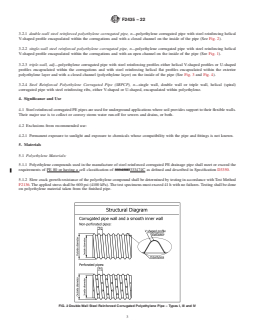
3.2.2 single-wall steel reinforced polyethylene corrugated pipe, n—polyethylene corrugated pipe with steel reinforcing helical
V-shaped profile encapsulated within the corrugations and with an open channel on the inside of the pipe (See Fig. 1).
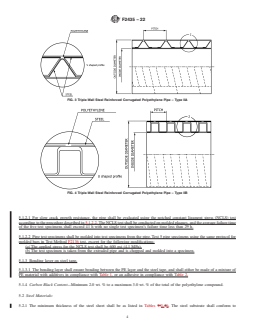
3.2.3 triple-wall, adj—polyethylene corrugated pipe with steel reinforcing profiles either helical V-shaped profiles or U-shaped
profiles encapsulated within the corrugations and with steel reinforcing helical flat profiles encapsulated within the exterior
polyethylene layer and with a closed channel (polyethylene layer) on the inside of the pipe (See Fig. 3 and Fig. 4).
3.2.4 Steel Reinforced Polyethylene Corrugated Pipe (SRPCP), n—single wall, double wall or triple wall, helical (spiral)
corrugated pipe with steel reinforcing ribs, either V-shaped or U-shaped, encapsulated within polyethylene.
4. Significance and Use
4.1 Steel reinforced corrugated PE pipes are used for underground applications where soil provides support to their flexible walls.
Their major use is to collect or convey storm water run-off for sewers and drains, or both.
4.2 Exclusions from recommended use:
4.2.1 Permanent exposure to sunlight and exposure to chemicals whose compatibility with the pipe and fittings is not known.
5. Materials
5.1 Polyethylene Materials:
5.1.1 Polyethylene compounds used in the manufacture of steel reinforced corrugated PE drainage pipe shall meet or exceed the
requirements of PE 80 or having a cell classification of 333430C333474C as defined and described in Specification D3350.
5.1.2 Slow crack growth resistance of the polyethylene compound shall be determined by testing in accordance with Test Method
F2136. The applied stress shall be 600 psi (4100 kPa). The test specimens must exceed 41 h with no failures. Testing shall be done
on polyethylene material taken from the finished pipe.
FIG. 2 Double-Wall Steel Reinforced Corrugated Polyethylene Pipe – Types I, III and IV
F2435 − 22
FIG. 3 Triple-Wall Steel Reinforced Corrugated Polyethylene Pipe – Type IIA
FIG. 4 Triple-Wall Steel Reinforced Corrugated Polyethylene Pipe – Type IIB
5.1.2.1 For slow crack growth resistance, the pipe shall be evaluated using the notched constant ligament stress (NCLS) test
according to the procedure described in 5.1.2.2. The NCLS test shall be conducted on molded plaques, and the average failure time
of the five test specimens shall exceed 41 h with no single test specimen’s failure time less than 29 h.
5.1.2.2 Pipe test specimens shall be molded into test specimens from the pipe. Test 5 pipe specimens using the same protocol for
molded bars in Test Method F2136 test, except for the following modifications:
(a) The applied stress for the NCLS test shall be 600 psi (4.1 MPa).
(b) The test specimen is taken from the extruded pipe and is chopped and molded into a specimen.
5.1.3 Bonding layer on steel tape.
5.1.3.1 The bonding layer shall ensure bonding between the PE layer and the steel tape, and shall either be made of a mixture of
PE material with additives in compliance with Table 1, or an adhesive in compliance with Table 2.
5.1.4 Carbon Black Content—Minimum 2.0 wt. % to a maximum 3.0 wt. % of the total of the polyethylene compound.
5.2 Steel Materials:
5.2.1 The minimum thickness of the steel sheet shall be as listed in Tables 1-3-46. The steel substrate shall conform to
F2435 − 22
TABLE 1 Requirements for Polyethylene-based Coating
Compound
Characteristic Unit Requirement Test Method
Density of base resin g/cm > 0.93 D1505
MFR (190 °C ⁄2.16 kg) g/10 min < 0.6 D1238
Strain at break at (23 °C ±3 °C) % > 600 D638
Stress at yield at (23 °C ±3 °C) MPa > 15 D638
Water content % # 0.05 D6869
Hardness, Shore D . > 55 D2240
Slow crack growth Hours Average $ F2136
TABLE 2 Requirements for Adhesive Material
Characteristic Unit Requirement Test Method
Strain at break at (23 °C ± 2 °C) % > 600 D638
Density g/cm > 0.92 D1505
MFR (190 °C ⁄2.16 kg) g/10 min < 1.2 D1238
Stress at yield at (23 °C ± 2 °C) MPa > 8 D1238
Water content % 0.05 D6869
Specification A1008/A1008M or A653/A653M, and the minimum yield strength of the steel sheet shall not be less than 24.66 ksi
(170 MPa). The zinc-galvanized coating shall have a minimum zinc coating designation of 20Z (intermediate coating) as defined
in Specification A591/A591M.
5.2.2 Steel Material Content—Maximum 75%75 % (62 %) of the total weight of the pipe. The steel material is fully encapsulated
by the polyethylene material with a minimum thickness of the polyethylene at its thinnest point of 0.012 in. (0.3 mm).
5.3 Rework Material—Rework material is not to be used in the manufacture of this product.
5.4 Gaskets—Elastomeric gaskets shall comply with the requirements specified in Specification F477.
5.5 Lubricant—The lubricant used for assembly of gasketed joints shall have no detrimental effect on the gasket or on the pipe.
NOTE 1—The purpose of the HDPE encapsulation of the steel is to attain bonding between the steel and PE to form a composite structure. The PE
encapsulation is not for protecting the steel from corrosion damage. The minimum PE thickness of 0.012 in. at the thinnest point still maintains the bond
between the steel and PE. The pipe is designed to combine pipe stiffness and buckling performance. The thickness of the HDPE encapsulation does not
affect product performance.buckling resistance.
6. Requirements
6.1 Workmanship—The inside and outside surfaces of the pipe shall be semi-matte or glossy in appearance and free of chalking,
sticky, or tacky materials. The pipe wall shall not have cracks, holes, blisters, voids, foreign inclusions or other defects that are
visible to the naked eye and that can affect the wall integrity or the bonding to the steel reinforcement. Holes deliberately placed
in perforated pipe are permitted. The surface shall be free of bloom.
6.2 Pipe Dimensions and Tolerances:
6.2.1 Pipe Dimensions (for both perforated and non-perforated pipe) shall comply with Table 13, Table 35, and Table 46 for
single-wall and double-wall pipe and Table 24 for triple-wall pipe, when measured in accordance with Test Method D2122.
6.2.2 Inside Diameter—The tolerance on the nominal inside diameter shall be 62.0 %, when measured in accordance with section
8.3.
6.2.3 Outside Diameter—The tolerance on the nominal outside diameter shall be 62.0 %, when measured in accordance with
section 8.4.
6.2.4 Wall Thickness—The tolerance of the minimum wall thickness of the waterway of the pipe (see Tables 1-3-46) shall be
+35 % when measured in accordance with 8.5.
F2435 − 22
TABLE 1 Dimensions and Pipe Stiffness for Single-Wall Pipe and Double-Wall Pipe – Type I (V-shaped profile)
Minimum Minimum
Nominal Inside Outside Waterway Wall
Pitch Steel Pipe
Size Diameter Diameter Thickness (min)
Thickness Stiffness
inch mm inch mm inch mm inch psi mm MPainchmminchmm
8 200 203 9.1 231.1 54.9 0.13 3.3 0.30 58 0.40
8.0 2.16 0.0118
10 250 254 10.95 278.1 54.9 0.13 3.3 0.30 58 0.40
10.0 2.16 0.0118
12 300 305 13.12 333.2 54.9 0.13 3.3 0.30 58 0.40
12.0 2.16 0.0118
18 450 457 19.58 497.3 66.8 0.165 4.2 0.40 58 0.40
18.0 2.63 0.0157
24 600 610 26.56 674.6 86.9 0.165 4.2 0.40 58 0.40
24.0 3.42 0.0157
28 700 711 30.85 783.6 97.8 0.204 5.2 0.40 58 0.40
28.0 3.85 0.0157
32 800 813 35.11 891.8 108.0 0.212 5.4 0.40 58 0.40
32.0 4.25 0.0157
36 900 914 39.4 1000.8 124.0 0.272 6.9 0.40 58 0.40
36.0 4.88 0.0157
40 1000 1016 47.2 1198.9 169.9 0.382 9.7 0.40 58 0.40
40.0 6.69 0.0157
45 1125 1118 51.73 1313.9 190.0 0.402 10.2 0.40 58 0.40
44.0 7.48 0.0157
48 1200 1219 56.42 1432.1 205.0 0.425 10.8 0.40 58 0.40
48.0 8.07 0.0157
54 1375 1372 63.12 1603.2 224.8 0.449 11.4 0.40 58 0.40
54.0 8.85 0.0157
61 1525 1524 70.41 1788.4 235.0 0.469 11.9 0.40 58 0.40
61.0 9.25 0.0157
67 1675 1676 76.4 1940.6 235.0 0.492 12.5 0.40 58 0.40
67.0 9.25 0.0157
73 1825 1829 82.98 2107.7 235.0 0.512 13.0 0.40 58 0.40
73.0 9.25 0.0157
80 2000 2032 91.25 2317.8 235.0 0.512 13.0 0.40 58 0.40
80.0 9.25 0.0157
TABLE 3 Dimensions and Pipe Stiffness for Single-Wall Pipe and Double-Wall Pipe – Type I (V-shaped profile)
Minimum Minimum
Nominal Inside Outside Waterway Wall
Pitch Steel Pipe
Size Diameter Diameter Thickness (min)
Thickness Stiffness
in. (mm) in. (mm) in. (mm) in. (mm) in. (mm) psi (MPa)
8 8.0 (203) 9.1 (231.1) 2.16 (54.9) 0.13 (3.3) 0.0118 (0.30) 58 (0.40)
10 10.0 (254) 10.95 (278.1) 2.16 (54.9) 0.13 (3.3) 0.0118 (0.30) 58 (0.40)
12 12.0 (305) 13.12 (333.2) 2.16 (54.9) 0.13 (3.3) 0.0118 (0.30) 58 (0.40)
18 18.0 (457) 19.58 (497.3) 2.63 (66.8) 0.165 (4.2) 0.0157 (0.40) 58 (0.40)
24 24.0 (610) 26.56 (674.6) 3.42 (86.9) 0.165 (4.2) 0.0157 (0.40) 58 (0.40)
28 28.0 (711) 30.85 (783.6) 3.85 (97.8) 0.204 (5.2) 0.0157 (0.40) 58 (0.40)
32 32.0 (813) 35.11 (891.8) 4.25 (108.0) 0.212 (5.4) 0.0157 (0.40) 58 (0.40)
36 36.0 (914) 39.4 (1000.8) 4.88 (124.0) 0.272 (6.9) 0.0157 (0.40) 58 (0.40)
40 40.0 (1016) 47.2 (1198.9) 6.69 (169.9) 0.382 (9.7) 0.0157 (0.40) 58 (0.40)
45 44.0 (1118) 51.73 (1313.9) 7.48 (190.0) 0.402 (10.2) 0.0157 (0.40) 58 (0.40)
48 48.0 (1219) 56.42 (1432.1) 8.07 (205.0) 0.425 (10.8) 0.0157 (0.40) 58 (0.40)
54 54.0 (1372) 63.12 (1603.2) 8.85 (224.8) 0.449 (11.4) 0.0157 (0.40) 58 (0.40)
61 61.0 (1524) 70.41 (1788.4) 9.25 (235.0) 0.469 (11.9) 0.0157 (0.40) 58 (0.40)
67 67.0 (1676) 76.4 (1940.6) 9.25 (235.0) 0.492 (12.5) 0.0157 (0.40) 58 (0.40)
73 73.0 (1829) 82.98 (2107.7) 9.25 (235.0) 0.512 (13.0) 0.0157 (0.40) 58 (0.40)
80 80.0 (2032) 91.25 (2317.8) 9.25 (235.0) 0.512 (13.0) 0.0157 (0.40) 58 (0.40)
6.2.5 Length—The pipe shall be sold in any length agreeable to the user. Length shall not be less than 99 % of the specified length
when measured in accordance with section 8.6.
6.3 Perforations:
6.3.1 Drainage Pipe—When perforations are necessary they shall be cleanly cut and uniformly spaced along the length and
circumference of the pipe in a size, shape, and pattern suited to the needs of the user. Perforations shall be in the valley portion
of the pipe. The reinforcing steel material shall not be exposed by these perforations.
2 2
6.3.2 The inlet area of the perforations shall be a minimum of 1 in. /ft (21 cm /m) of pipe.
F2435 − 22
TABLE 2 Nominal Pipe Sizes, Dimensions, and Pipe Stiffness for Triple-Wall Pipe – Type IIA and IIB
Minimum Minimum
Minimum Minimum
Nominal Inside Outside Pipe Pipe
Pitch Waterway Steel
Size Diameter Diameter Stiffness Stiffness
Wall Thickness
Type IIA Type IIB
MPa
inch mm inch mm Inch mm inch psi mm inch MPamm Inchmm
psi
12 300 302 13.46 342 30 0.039 1.0 0.30 50.75 0.35
11.89 1.18 0.0118
14 350 347 15.55 395 35 0.047 1.2 0.30 50.75 0.35
13.66 1.38 0.0118
15 375 375 16.73 425 38 0.055 1.4 0.30 43.50 0.30
14.76 1.50 0.0118
16 400 400 17.72 450 38 0.055 1.4 0.30 40.60 0.28
15.75 1.50 0.0118
18 450 459 20.31 518 40 0.055 1.4 0.30 40.60 0.28
18.07 1.57 0.0118
20 500 500 22.24 565 45 0.059 1.5 0.30 40.60 0.28
19.69 1.77 0.0118
21 525 525 23.23 590 45 0.059 1.5 0.30 40.60 0.28
20.67 1.77 0.0118
24 600 610 26.85 682 55 0.059 1.5 0.30 39.15 0.27
24.02 2.17 0.0118
27 675 675 30.51 775 66 0.067 1.7 0.30 39.15 0.27
26.57 2.60 0.0118
28 700 704 31.50 800 66 0.083 2.1 0.30 39.15 0.27
27.72 2.60 0.0118
30 750 750 33.31 846 66 0.083 2.1 0.30 39.15 0.27
29.53 2.60 0.0118
32 800 800 35.83 910 74 0.083 2.1 0.30 39.15 0.27
31.50 2.91 0.0118
36 900 900 40.39 1026 80 0.118 3.0 0.30 39.15 0.27
35.43 3.15 0.0118
40 1000 1000 45.28 1150 86 0.122 3.1 0.30 39.15 0.27
39.37 3.39 0.0118
42 1050 1050 47.24 1200 86 0.122 3.1 0.30 39.15 0.27
41.34 3.39 0.0118
44 1100 1100 50.98 1295 190 0.157 4.0 0.30 58 0.40
43.31 7.48 0.0118
48 1200 1200 54.92 1395 190 0.157 4.0 0.30 58 0.40
47.24 7.48 0.0118
54 1375 1350 60.83 1545 190 0.177 4.5 0.30 58 0.40
53.15 7.48 0.0118
60 1524 1500 67.44 1713 205 0.177 4.5 0.30 58 0.40
59.06 8.07 0.0118
66 1650 1650 73.35 1863 205 0.177 4.5 0.30 58 0.40
64.96 8.07 0.0118
71 1800 1800 79.25 2013 205 0.177 4.5 0.30 58 0.40
70.87 8.07 0.0118
80 2000 2000 87.13 2213 205 0.177 4.5 0.30 58 0.40
78.74 8.07 0.0118
TABLE 4 Nominal Pipe Sizes, Dimensions, and Pipe Stiffness for Triple-Wall Pipe – Type IIA and IIB
Minimum Minimum
Minimum Minimum
Nominal Inside Outside Pipe Pipe
Pitch Waterway Steel
Size Diameter Diameter Stiffness Stiffness
Wall Thickness
Type IIA Type IIB
in. (mm) in. (mm) in. mm) in. (mm) in. (mm) psi (MPa) psi (MPa)
12 11.89 (302) 13.46 (342) 1.18 (30) 0.039 (1.0) 0.0118 (0.30) . 50.75 (0.35)
14 13.66 (347) 15.55 (395) 1.38 (35) 0.047 (1.2) 0.0118 (0.30) . 50.75 (0.35)
15 14.76 (375) 16.73 (425) 1.50 (38) 0.055 (1.4) 0.0118 (0.30) . 43.50 (0.30)
16 15.75 (400) 17.72 (450) 1.50 (38) 0.055 (1.4) 0.0118 (0.30) . 40.60 (0.28)
18 18.07 (459) 20.31 (518) 1.57 (40) 0.055 (1.4) 0.0118 (0.30) . 40.60 (0.28)
20 19.69 (500) 22.24 (565) 1.77 (45) 0.059 (1.5) 0.0118 (0.30) . 40.60 (0.28)
21 20.67 (525) 23.23 (590) 1.77 (45) 0.059 (1.5) 0.0118 (0.
...