

ASTM A1008/A1008M-23e1
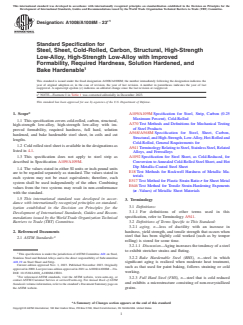
(Specification)Standard Specification for Steel, Sheet, Cold-Rolled, Carbon, Structural, High-Strength Low-Alloy, High-Strength Low-Alloy with Improved Formability, Required Hardness, Solution Hardened, and Bake Hardenable
General Information
- Abstract
ABSTRACT
This specification covers cold-rolled, carbon steel sheets, in coils and cut lengths, in the following designations: commercial steels (CS Types A, B, and C); drawing steel (DS Types A and B); deep drawing steel (DDS); extra deep drawing steel (EDDS); structural steel (SS Grades 25[170], 30[205], 33[230] Types 1 and 2, 40[275] Types 1 and 2, 50[340], 60[410], 70[480], and 80[550]); high-strength low-alloy steel (HSLAS Classes 1 and 2 of Grades 45[310], 50[340]. 55[380], 60[410], 65[450], and 70[480]), high-strength low-alloy steel with improved formability (HSLAS-F Grades 50[340], 60[410], 70[480], and 80[550]); solution hardened steel (SHS); and bake hardenable steel (BHS). Conformance of the steel sheets to chemical composition requirements shall be tested by heat analysis. Specimens shall also undergo tension and bending tests and shall conform to specified values of tensile and yield strength, elongation, and bake hardening index. Unless otherwise indicated, sheet surfaces shall have a matte finish and shall be oiled.
SCOPE
1.1 This specification covers cold-rolled, carbon, structural, high-strength low-alloy, high-strength low-alloy with improved formability, required hardness, full hard, solution hardened, and bake hardenable steel sheet, in coils and cut lengths.
1.2 Cold rolled steel sheet is available in the designations as listed in 4.1.
1.3 This specification does not apply to steel strip as described in Specification A109/A109M.
1.4 The values stated in either SI units or inch-pound units are to be regarded separately as standard. The values stated in each system may not be exact equivalents; therefore, each system shall be used independently of the other. Combining values from the two systems may result in non-conformance with the standard.
1.5 This international standard was developed in accordance with internationally recognized principles on standardization established in the Decision on Principles for the Development of International Standards, Guides and Recommendations issued by the World Trade Organization Technical Barriers to Trade (TBT) Committee.
- Status
- Published
- Publication Date
- 31-Oct-2023
- Technical Committee
- A01 - Steel, Stainless Steel and Related Alloys
- Drafting Committee
- A01.19 - Steel Sheet and Strip
Buy Documents
ASTM A1008/A1008M-23e1 - Standard Specification for Steel, Sheet, Cold-Rolled, Carbon, Structural, High-Strength Low-Alloy, High-Strength Low-Alloy with Improved Formability, Required Hardness, Solution Hardened, and Bake Hardenable
Overview
ASTM A1008/A1008M-23e1 is the internationally recognized standard specification for cold-rolled, carbon steel sheet products. Issued by ASTM International, this standard covers a comprehensive range of cold-rolled steel designations, including commercial steel, drawing steel, deep drawing steel, extra deep drawing steel, structural steel, high-strength low-alloy (HSLA) steel, HSLA with improved formability, solution-hardened steels, bake hardenable steels, required hardness steels, full hard steels, and special forming grades. These products are provided in both coils and cut lengths and are utilized across industries where consistent steel quality, mechanical properties, and surface finish are critical.
Key Topics
Product Classifications
- Commercial Steel (CS Types A, B, C)
- Drawing Steel (DS Types A, B)
- Deep Drawing Steel (DDS)
- Extra Deep Drawing Steel (EDDS)
- Special Forming Steel (SFS)
- Structural Steel (SS, Grades 25–80)
- High-Strength Low-Alloy Steel (HSLAS)
- High-Strength Low-Alloy with Improved Formability (HSLAS-F)
- Solution Hardened Steel (SHS)
- Bake Hardenable Steel (BHS)
- Required Hardness Steel (RHS)
- Full Hard Steel (FHS)
Mechanical Properties and Testing
- Requirements for chemical composition, tensile and yield strength, elongation, and bake hardening index.
- Standardized mechanical tests such as tension and bending tests.
- Hardness and formability requirements based on application.
- Suitability for welding with proper material selection.
Surface and Finish Options
- Standard matte finish unless otherwise specified.
- Option for oiled or dry surface as specified by the purchaser.
- Exposed and unexposed application finishes.
- Customized dimensions and coil specifications as per purchasing requirements.
Ordering and Compliance
- Clear designation of grade, type, class, finish, oiling, size, and application on purchase orders.
- Dual units (SI and inch-pound) outlined for global applicability.
- Product marking for traceability to grade and batch.
Applications
ASTM A1008/A1008M-23e1 cold-rolled steel sheets are used extensively in:
- Automotive manufacturing: Body panels, door components, reinforcements, brackets, and structural elements benefiting from improved surface quality and controlled mechanical properties.
- Appliance fabrication: Chassis, panels, and enclosures requiring consistent finish and precise formability.
- General fabrication: Applications such as shelving, furniture, cabinets, and commercial fixtures leveraging the sheet’s consistent thickness and surface quality.
- Construction and building products: Lightweight framing, roofing, wall panels, and support structures using structural and high-strength types.
- Electronics: Enclosures and mounting parts needing enhanced surface finish and dimensional accuracy.
These steel sheets offer manufacturers improved productivity, high-quality finishes suitable for painting or coating, and adaptability to welding, forming, and stamping processes.
Related Standards
- ASTM A568/A568M - General requirements for steel sheet, hot-rolled and cold-rolled, carbon, structural, and high-strength low-alloy.
- ASTM A370 - Test methods for mechanical testing of steel products.
- ASTM E18 - Test methods for Rockwell hardness of metallic materials.
- ASTM A941 - Terminology relating to steel, stainless steel, related alloys, and ferroalloys.
- ISO 3574 - Cold-reduced carbon steel sheet of commercial and drawing qualities.
- ISO 4997 - Cold-reduced steel sheet of structural quality.
- ISO 13887 - Cold-reduced steel sheet of higher strength with improved formability.
Summary
Adopting ASTM A1008/A1008M-23e1 enables consistent specification, manufacturing, and quality assurance of cold-rolled carbon steel sheets for a wide range of industrial applications. This standard helps ensure reliable performance, compatibility with international trade, and compliance with the latest technical requirements in steel production. For companies seeking high-quality cold-rolled steel, referencing ASTM A1008/A1008M enhances product value, safety, and market competitiveness.
Relations
- Effective Date
- 01-Nov-2023
- Effective Date
- 01-Mar-2024
- Effective Date
- 01-Mar-2024
- Effective Date
- 01-Mar-2024
- Effective Date
- 01-Mar-2024
- Effective Date
- 15-Sep-2023
- Effective Date
- 01-May-2023
- Effective Date
- 01-Oct-2019
- Effective Date
- 01-Nov-2018
- Effective Date
- 01-Nov-2023
- Effective Date
- 01-Nov-2023
- Effective Date
- 01-Nov-2023
- Effective Date
- 01-Nov-2023
- Effective Date
- 01-Nov-2023
- Effective Date
- 01-Nov-2023
Buy Documents
ASTM A1008/A1008M-23e1 - Standard Specification for Steel, Sheet, Cold-Rolled, Carbon, Structural, High-Strength Low-Alloy, High-Strength Low-Alloy with Improved Formability, Required Hardness, Solution Hardened, and Bake Hardenable
Get Certified
Connect with accredited certification bodies for this standard

Element Materials Technology
Materials testing and product certification.

Inštitut za kovinske materiale in tehnologije
Institute of Metals and Technology. Materials testing, metallurgical analysis, NDT.
Sponsored listings
Frequently Asked Questions
ASTM A1008/A1008M-23e1 is a technical specification published by ASTM International. Its full title is "Standard Specification for Steel, Sheet, Cold-Rolled, Carbon, Structural, High-Strength Low-Alloy, High-Strength Low-Alloy with Improved Formability, Required Hardness, Solution Hardened, and Bake Hardenable". This standard covers: ABSTRACT This specification covers cold-rolled, carbon steel sheets, in coils and cut lengths, in the following designations: commercial steels (CS Types A, B, and C); drawing steel (DS Types A and B); deep drawing steel (DDS); extra deep drawing steel (EDDS); structural steel (SS Grades 25[170], 30[205], 33[230] Types 1 and 2, 40[275] Types 1 and 2, 50[340], 60[410], 70[480], and 80[550]); high-strength low-alloy steel (HSLAS Classes 1 and 2 of Grades 45[310], 50[340]. 55[380], 60[410], 65[450], and 70[480]), high-strength low-alloy steel with improved formability (HSLAS-F Grades 50[340], 60[410], 70[480], and 80[550]); solution hardened steel (SHS); and bake hardenable steel (BHS). Conformance of the steel sheets to chemical composition requirements shall be tested by heat analysis. Specimens shall also undergo tension and bending tests and shall conform to specified values of tensile and yield strength, elongation, and bake hardening index. Unless otherwise indicated, sheet surfaces shall have a matte finish and shall be oiled. SCOPE 1.1 This specification covers cold-rolled, carbon, structural, high-strength low-alloy, high-strength low-alloy with improved formability, required hardness, full hard, solution hardened, and bake hardenable steel sheet, in coils and cut lengths. 1.2 Cold rolled steel sheet is available in the designations as listed in 4.1. 1.3 This specification does not apply to steel strip as described in Specification A109/A109M. 1.4 The values stated in either SI units or inch-pound units are to be regarded separately as standard. The values stated in each system may not be exact equivalents; therefore, each system shall be used independently of the other. Combining values from the two systems may result in non-conformance with the standard. 1.5 This international standard was developed in accordance with internationally recognized principles on standardization established in the Decision on Principles for the Development of International Standards, Guides and Recommendations issued by the World Trade Organization Technical Barriers to Trade (TBT) Committee.
ABSTRACT This specification covers cold-rolled, carbon steel sheets, in coils and cut lengths, in the following designations: commercial steels (CS Types A, B, and C); drawing steel (DS Types A and B); deep drawing steel (DDS); extra deep drawing steel (EDDS); structural steel (SS Grades 25[170], 30[205], 33[230] Types 1 and 2, 40[275] Types 1 and 2, 50[340], 60[410], 70[480], and 80[550]); high-strength low-alloy steel (HSLAS Classes 1 and 2 of Grades 45[310], 50[340]. 55[380], 60[410], 65[450], and 70[480]), high-strength low-alloy steel with improved formability (HSLAS-F Grades 50[340], 60[410], 70[480], and 80[550]); solution hardened steel (SHS); and bake hardenable steel (BHS). Conformance of the steel sheets to chemical composition requirements shall be tested by heat analysis. Specimens shall also undergo tension and bending tests and shall conform to specified values of tensile and yield strength, elongation, and bake hardening index. Unless otherwise indicated, sheet surfaces shall have a matte finish and shall be oiled. SCOPE 1.1 This specification covers cold-rolled, carbon, structural, high-strength low-alloy, high-strength low-alloy with improved formability, required hardness, full hard, solution hardened, and bake hardenable steel sheet, in coils and cut lengths. 1.2 Cold rolled steel sheet is available in the designations as listed in 4.1. 1.3 This specification does not apply to steel strip as described in Specification A109/A109M. 1.4 The values stated in either SI units or inch-pound units are to be regarded separately as standard. The values stated in each system may not be exact equivalents; therefore, each system shall be used independently of the other. Combining values from the two systems may result in non-conformance with the standard. 1.5 This international standard was developed in accordance with internationally recognized principles on standardization established in the Decision on Principles for the Development of International Standards, Guides and Recommendations issued by the World Trade Organization Technical Barriers to Trade (TBT) Committee.
ASTM A1008/A1008M-23e1 is classified under the following ICS (International Classification for Standards) categories: 77.140.01 - Iron and steel products in general. The ICS classification helps identify the subject area and facilitates finding related standards.
ASTM A1008/A1008M-23e1 has the following relationships with other standards: It is inter standard links to ASTM A1008/A1008M-23, ASTM A109/A109M-24, ASTM A370-24, ASTM A941-24, ASTM E517-24, ASTM A370-23, ASTM A941-23, ASTM E517-19, ASTM A109/A109M-16(2018), ASTM F782-19, ASTM F2432-12(2018), ASTM F824-22, ASTM F821/F821M-23, ASTM A568/A568M-19a, ASTM A513/A513M-20a. Understanding these relationships helps ensure you are using the most current and applicable version of the standard.
ASTM A1008/A1008M-23e1 is available in PDF format for immediate download after purchase. The document can be added to your cart and obtained through the secure checkout process. Digital delivery ensures instant access to the complete standard document.
Standards Content (Sample)
This international standard was developed in accordance with internationally recognized principles on standardization established in the Decision on Principles for the
Development of International Standards, Guides and Recommendations issued by the World Trade Organization Technical Barriers to Trade (TBT) Committee.
´1
Designation: A1008/A1008M − 23
Standard Specification for
Steel, Sheet, Cold-Rolled, Carbon, Structural, High-Strength
Low-Alloy, High-Strength Low-Alloy with Improved
Formability, Required Hardness, Solution Hardened, and
Bake Hardenable
This standard is issued under the fixed designation A1008/A1008M; the number immediately following the designation indicates the
year of original adoption or, in the case of revision, the year of last revision. A number in parentheses indicates the year of last
reapproval. A superscript epsilon (´) indicates an editorial change since the last revision or reapproval.
ε NOTE—Footnote I in Table 1 was corrected editorially in December 2023.
This standard has been approved for use by agencies of the U.S. Department of Defense.
1. Scope* A109/A109M Specification for Steel, Strip, Carbon (0.25
Maximum Percent), Cold-Rolled
1.1 This specification covers cold-rolled, carbon, structural,
A370 Test Methods and Definitions for Mechanical Testing
high-strength low-alloy, high-strength low-alloy with im-
of Steel Products
proved formability, required hardness, full hard, solution
A568/A568M Specification for Steel, Sheet, Carbon,
hardened, and bake hardenable steel sheet, in coils and cut
Structural, and High-Strength, Low-Alloy, Hot-Rolled and
lengths.
Cold-Rolled, General Requirements for
1.2 Cold rolled steel sheet is available in the designations as
A941 Terminology Relating to Steel, Stainless Steel, Related
listed in 4.1.
Alloys, and Ferroalloys
A1092 Specification for Steel Sheet, as Cold-Reduced, for
1.3 This specification does not apply to steel strip as
described in Specification A109/A109M. Conversion to Annealed Cold-Rolled Steel Sheet, and Hot
Dip Metallic-Coated Steel Sheet
1.4 The values stated in either SI units or inch-pound units
E18 Test Methods for Rockwell Hardness of Metallic Ma-
are to be regarded separately as standard. The values stated in
terials
each system may not be exact equivalents; therefore, each
E517 Test Method for Plastic Strain Ratio r for Sheet Metal
system shall be used independently of the other. Combining
E646 Test Method for Tensile Strain-Hardening Exponents
values from the two systems may result in non-conformance
(n -Values) of Metallic Sheet Materials
with the standard.
1.5 This international standard was developed in accor-
3. Terminology
dance with internationally recognized principles on standard-
3.1 Definitions:
ization established in the Decision on Principles for the
3.1.1 For definitions of other terms used in this
Development of International Standards, Guides and Recom-
specification, refer to Terminology A941.
mendations issued by the World Trade Organization Technical
3.2 Definitions of Terms Specific to This Standard:
Barriers to Trade (TBT) Committee.
3.2.1 aging, n—loss of ductility with an increase in
hardness, yield strength, and tensile strength that occurs when
2. Referenced Documents
steel that has been slightly cold worked (such as by temper
2.1 ASTM Standards:
rolling) is stored for some time.
3.2.1.1 Discussion—Aging increases the tendency of a steel
to exhibit stretcher strains and fluting.
This specification is under the jurisdiction of ASTM Committee A01 on Steel,
3.2.2 Bake Hardenable Steel (BHS), n—steel in which
Stainless Steel and Related Alloys and is the direct responsibility of Subcommittee
A01.19 on Steel Sheet and Strip.
significant aging is realized when moderate heat treatment,
Current edition approved Nov. 1, 2023. Published November 2023. Originally
such as that used for paint baking, follows straining or cold
approved in 2000. Last previous edition approved in 2021 as A1008/A1008M – 21a.
working.
DOI: 10.1520/A1008_A1008M-23E01.
For referenced ASTM standards, visit the ASTM website, www.astm.org, or
3.2.3 Full Hard Steel (FHS), n—steel that is cold reduced
contact ASTM Customer Service at service@astm.org. For Annual Book of ASTM
and exhibits a microstructure consisting of non-recrystallized
Standards volume information, refer to the standard’s Document Summary page on
the ASTM website. grains.
*A Summary of Changes section appears at the end of this standard
Copyright © ASTM International, 100 Barr Harbor Drive, PO Box C700, West Conshohocken, PA 19428-2959. United States
´1
A1008/A1008M − 23
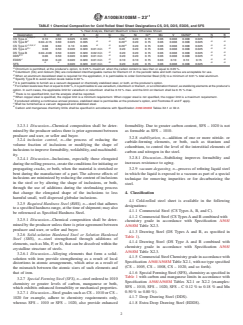
TABLE 1 Chemical Composition for Cold Rolled Steel Sheet Designations CS, DS, DDS, EDDS, and SFS
% Heat Analysis, Element Maximum Unless Otherwise Shown
A B
Designation C Mn P S Al Si Cu Ni Cr Mo V Cb/Nb Ti N B
C,D,E,F G G H G G
CS Type A 0.10 0.60 0.025 0.035 0.20 0.20 0.15 0.06 0.008 0.008 0.025
C G G H G G
CS Type B 0.02–0.15 0.60 0.025 0.035 0.20 0.20 0.15 0.06 0.008 0.008 0.025
C,D,E,F G G H G G
CS Type C 0.08 0.60 0.10 0.035 0.20 0.20 0.15 0.06 0.008 0.008 0.025
D,I G G G
DS Type A 0.08 0.50 0.020 0.020 0.01 min 0.20 0.20 0.15 0.06 0.008 0.008 0.025
G G G
DS Type B 0.02–0.08 0.50 0.020 0.020 0.02 min 0.20 0.20 0.15 0.06 0.008 0.008 0.025
E,F G G G
DDS 0.06 0.50 0.020 0.020 0.01 min 0.20 0.20 0.15 0.06 0.008 0.008 0.025
J G G G
EDDS 0.02 0.40 0.020 0.020 0.01 min 0.10 0.10 0.15 0.03 0.10 0.10 0.15
K K G G G
SFS 0.020 0.020 0.01 min 0.20 0.20 0.15 0.06 0.008 0.008 0.025
A
Chromium is permitted, at the producer’s option, to 0.25 % maximum when the carbon content is less than or equal to 0.05 %.
B
Columbium (Cb) and niobium (Nb) are considered interchangeable names for Element 41 in the periodic table and both names are acceptable for use.
C
When an aluminum deoxidized steel is required for the application, it is permissible to order Commercial Steel (CS) to a minimum of 0.01 % total aluminum.
D
Specify Type B to avoid carbon levels below 0.02 %.
E
It is permissible to furnish as a vacuum degassed or chemically stabilized steel, or both, at the producer’s option.
F
For carbon levels less than or equal to 0.02 %, it is permissible to use vanadium, columbium or titanium, or a combination thereof, as stabilizing elements at the producer’s
option. In such cases, the applicable limit for vanadium or columbium shall be 0.10 % max. and the limit on titanium shall be 0.15 % max.
G
There is no specified limit, but the analysis shall be reported.
H
When copper steel is specified, the copper limit is a minimum requirement. When copper steel is not specified, the copper limit is a maximum requirement.
I
If produced utilizing a continuous anneal process, stabilized steel is permissible at the producer’s option, and Footnotes E and F apply.
J
Shall be furnished as a vacuum degassed and stabilized steel.
K
Carbon and manganese chemistry limits shall be specified in accordance with Specification A568/A568M Tables X2.1 or X2.2.
3.2.3.1 Discussion—Chemical composition shall be deter- formability. Due to greater carbon content, SFS – 1020 is not
mined by the producer unless there is prior agreement between
as formable as SFS – 1010.
producer and user, or seller and buyer.
3.2.8 stabilization, n—addition of one or more nitride- or
3.2.4 inclusion control, n—the process of reducing the
carbide-forming elements, or both, such as titanium and
volume fraction of inclusions or modifying the shape of
columbium, to control the level of the interstitial elements of
inclusions to improve formability, weldability, and machinabil-
carbon and nitrogen in the steel.
ity.
3.2.8.1 Discussion—Stabilizing improves formability and
3.2.4.1 Discussion—Inclusions, especially those elongated
increases resistance to aging.
during the rolling process, create the conditions for initiating or
propagating cracks, or both, when the material is stretched or
3.2.9 vacuum degassing, n—process of refining liquid steel
bent during the manufacture of a part. The adverse effects of
in which the liquid is exposed to a vacuum as part of a special
inclusions are minimized by reducing the content of inclusions
technique for removing impurities or for decarburizing the
in the steel or by altering the shape of inclusions, or both,
steel.
through the use of additions during the steelmaking process
that change the elongated shape of the inclusions to less
4. Classification
harmful small, well dispersed globular inclusions.
4.1 Cold-rolled steel sheet is available in the following
3.2.5 Required Hardness Steel (RHS), n—steel that adheres
designations:
to a specified hardness range, at the time of shipment; may also
4.1.1 Commercial Steel (CS Types A, B, and C).
be referenced as Specified Hardness Steel.
4.1.2 Commercial Steel (CS Types A and B combined with
3.2.5.1 Discussion—Chemical composition shall be deter-
chemistry grade in accordance with Specification A568/
mined by the producer unless there is prior agreement between
A568M Table X2.3.
producer and user, or seller and buyer.
4.1.3 Drawing Steel (DS Types A and B, as specified in
3.2.6 Solid-solution Hardened Steel or Solution Hardened
Table 1).
Steel (SHS), n—steel strengthened through additions of
4.1.4 Drawing Steel (DS Type A and B combined with
elements, such as Mn, P, or Si, that can be dissolved within the
chemistry grade in accordance with Specification A568/
crystalline structure of steels.
A568M Table X2.3.
3.2.6.1 Discussion—Alloying elements that form a solid-
4.1.5 Commercial Steel Chemistry grade in accordance with
solution with iron provide strengthening as a result of local
Specification A568/A568M Table X2.1, with no type specified
distortions in atomic arrangements, which arise as a result of
(CS – 1005, CS – 1008, CS – 1020, and so forth).
the mismatch between the atomic sizes of such elements and
4.1.6 Special Forming Steel (SFS), chemistry as specified in
that of iron.
Table 1 with carbon and manganese limits in accordance with
3.2.7 Special Forming Steel (SFS), n—steel ordered to 1010
Specification A568/A568M Tables X2.1 or X2.2 (examples:
chemistry or greater levels of carbon, manganese or both,
SFS – 1010, SFS – 1020, SFS – C 0.12 % to 0.18 % and Mn
which exhibits enhanced formability or mechanical properties.
0.50 % to 0.80 %).
3.2.7.1 Discussion—Steel grades such as CS – 1010 or CS –
4.1.7 Deep Drawing Steel (DDS).
1020 for example, adhere to chemistry requirements only,
whereas SFS – 1010 or SFS – 1020, also provide enhanced 4.1.8 Extra Deep Drawing Steel (EDDS).
´1
A1008/A1008M − 23
4.1.9 Structural Steel (SS Grades 25 [170], 30 [205], 33 fied by the user or purchaser, on the purchase order. If
[230] Types 1 and 2, 40 [275] Types 1 and 2, 45 [310], 50 requested, the producer or seller shall provide verification of
[340], 60 [410], 70 [480], and 80 [550]). special practices or mechanical properties supporting enhanced
4.1.10 High-strength Low-alloy Steel (HSLAS, in Classes 1 formability.
and 2, in Grades 45 [310], 50 [340], 55 [380], 60 [410], 65 5.1.2.5 When a class is not specified for HSLAS, Class 1
[450], and 70 [480] in Classes 1 and 2). will be furnished (see 4.1).
4.1.11 High-strength Low-alloy Steel with Improved Form- 5.1.2.6 When a type is not specified for SS 33 [230] and SS
ability (HSLAS-F Grades 50 [340], 60 [410], 70 [480], and 80 40 [275], Type 1 will be furnished (see 4.1).
[550]). 5.1.3 Classification (either exposed, unexposed, temper
4.1.11.1 HSLAS-F steel has improved formability when rolled, or annealed last) (see 4.3).
compared to HSLAS. The steel is fully deoxidized, made to 5.1.4 Finish (see 9.1).
fine grain practice and includes microalloying elements such as 5.1.5 Oiled or not oiled, as required (see 9.2).
columbium, vanadium, zirconium, and so forth. The steel shall 5.1.6 Dimensions (thickness, width, and whether cut lengths
be treated to achieve inclusion control. or coils).
4.1.12 Solution Hardened Steel (SHS).
NOTE 1—Not all producers are capable of meeting all the limitations of
4.1.13 Bake Hardenable Steel (BHS).
the thickness tolerance tables in Specification A568/A568M. The pur-
4.1.14 Required Hardness Steel (RHS).
chaser should contact the producer regarding possible limitations prior to
placing an order.
4.1.15 Full Hard Steel (FHS).
5.1.7 Coil size (must include inside diameter, outside
4.2 When required for HSLAS and HSLAS-F steels, limi-
diameter, and maximum weight).
tations on the use of one or more of the microalloy elements
5.1.8 Copper bearing steel (if required).
shall be specified on the order.
5.1.9 Quantity.
4.3 Cold-rolled steel sheet is supplied for either exposed or
5.1.10 Application (part identification and description).
unexposed applications. Within the latter category, cold-rolled
5.1.11 A report of heat analysis will be supplied, if
sheet is specified either “temper rolled” or “annealed last” or
requested, for CS, DS, DDS, EDDS, SFS, RHS, and FHS. For
“full hard.” For details on processing, attributes and
materials with required mechanical properties, SS, HSLAS,
limitations, and inspection standards, refer to Specification
HSLAS-F, SHS, and BHS, a report is required of heat analysis
A568/A568M.
and mechanical properties as determined by the tension test.
5.1.12 Special requirements (if any).
5. Ordering Information
5.1.12.1 When the purchaser requires thickness tolerances
5.1 It is the purchaser’s responsibility to specify in the
for ⁄8 in. [10 mm] minimum edge distance (see Supplementary
purchase order all ordering information necessary to describe
Requirement in Specification A568/A568M), this requirement
the required material. Examples of such information include,
shall be specified in the purchase order or contract.
but are not limited to, the following:
5.1.12.2 Tighter requirements can be specified based on
5.1.1 ASTM specification number and year of issue.
agreement between seller and purchaser.
5.1.2 Name of material and designation (cold-rolled steel
NOTE 2—A typical ordering description is as follows:
sheet) (include grade, type, and class, as appropriate, for CS,
ASTM A1008-XX, cold rolled steel sheet, CS Type A, exposed, matte
DS, DDS, EDDS, SFS, SS, HSLAS, HSLAS-F, RHS, FHS,
finish, oiled, 0.035 in. by 30 in. by coil, ID 24 in., OD 48 in., max weight
SHS, or BHS) (see 4.1).
15 000 lbs, 100 000 lb, for part No. 4560, Door Panel; or
5.1.2.1 When a Chemistry grade is specified in accordance
ASTM A 1008M-XX, cold-rolled steel sheet, SS Grade 275,
unexposed, matte finish, oiled, 0.88 mm by 760 mm by 2440 mm,
with Specification A568/A568M Table X2.3, the grade shall be
10 000 kg, for shelf bracket.
furnished as CS Type B – 1008, DS Type A – 1005, and so
forth.
6. General Requirements for Delivery
5.1.2.2 When a Chemistry grade is specified in accordance
6.1 Material furnished under this specification shall con-
with Specification A568/A568M Table X2.1, with no reference
form to the applicable requirements of the current edition of
to CS Type A, CS Type B, DS Type A, DS Type B, or SFS, the
Specification A568/A568M unless otherwise provided herein.
grade shall be furnished as CS – 1005, CS – 1008, CS – 1020,
and so forth, and meet chemistry specified in accordance with
7. Chemical Composition
Specification A568/A568M Table X2.1.
7.1 The heat analysis of the steel shall conform to the
5.1.2.3 When a type is not specified for CS or DS and there
chemical composition requirements of the appropriate desig-
is no reference to a chemistry grade such as 1005, 1006, and so
nation shown in Table 1 for CS, DS, DDS, EDDS, and SFS,
forth, Type B will be furnished (see 4.1).
and in Table 2 for SS, HSLAS, HSLAS-F, SHS, and BHS.
5.1.2.4 When SFS is specified, a chemistry grade designa-
tion shall also be specified in accordance with Specification 7.2 Each of the elements listed in Tables 1 and 2, and
A568/A568M Table X2.1 (that is, 1010, 1020, and so forth), or Specification A568/A568M Table X2.3 shall be included in the
carbon and manganese in accordance with Specification A568/ report of the heat analysis. When the amount of copper, nickel,
A568M Table X2.2 (that is, C 0.12 % to 0.18 %, Mn 0.50 % to chromium, or molybdenum is less than 0.02 %, report the
0.80 %, and so forth). The characteristics identifying the analysis as <0.02 % or the actual determined value. When the
enhanced formability or mechanical properties shall be speci- amount of vanadium, columbium, or titanium is less than
´1
A1008/A1008M − 23
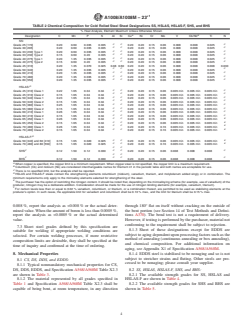
TABLE 2 Chemical Composition for Cold Rolled Steel Sheet Designations SS, HSLAS, HSLAS-F, SHS, and BHS
% Heat Analysis, Element Maximum Unless Otherwise Shown
A B
Designation C Mn P S Al Si Cu Ni Cr Mo V Cb/Nb Ti N
SS:
C C C
Grade 25 [170] 0.20 0.60 0.035 0.035 0.20 0.20 0.15 0.06 0.008 0.008 0.025
C C C
Grade 30 [205] 0.20 0.60 0.035 0.035 0.20 0.20 0.15 0.06 0.008 0.008 0.025
C C C
Grade 33 [230] Type 1 0.20 0.60 0.035 0.035 0.20 0.20 0.15 0.06 0.008 0.008 0.025
C C C
Grade 33 [230] Type 2 0.15 0.60 0.20 0.035 0.20 0.20 0.15 0.06 0.008 0.008 0.025
C C C
Grade 40 [275] Type 1 0.20 1.35 0.035 0.035 0.20 0.20 0.15 0.06 0.008 0.008 0.025
C C C
Grade 40 [275] Type 2 0.15 0.60 0.20 0.035 0.20 0.20 0.15 0.06 0.008 0.008 0.025
Grade 45 [310] 0.20 1.35 0.070 0.025 0.08 0.60 0.20 0.20 0.15 0.06 0.008 0.008 0.008 0.030
C C C
Grade 50 [340] 0.20 1.35 0.035 0.035 0.20 0.20 0.15 0.06 0.008 0.008 0.025
C C C
Grade 60 [410] 0.20 1.35 0.035 0.035 0.20 0.20 0.15 0.06 0.008 0.008 0.025
C C C
Grade 70 [480] 0.20 1.35 0.035 0.035 0.20 0.20 0.15 0.06 0.008 0.008 0.025
C C C
Grade 80 [550] 0.20 1.35 0.035 0.035 0.20 0.20 0.15 0.06 0.008 0.008 0.025
D
HSLAS:
C C C
Grade 45 [310] Class 1 0.22 1.65 0.04 0.04 0.20 0.20 0.15 0.06 0.005 min 0.005 min 0.005 min
C C C
Grade 45 [310] Class 2 0.15 1.65 0.04 0.04 0.20 0.20 0.15 0.06 0.005 min 0.005 min 0.005 min
C C C
Grade 50 [340] Class 1 0.23 1.65 0.04 0.04 0.20 0.20 0.15 0.06 0.005 min 0.005 min 0.005 min
C C C
Grade 50 [340] Class 2 0.15 1.65 0.04 0.04 0.20 0.20 0.15 0.06 0.005 min 0.005 min 0.005 min
C C C
Grade 55 [380] Class 1 0.25 1.65 0.04 0.04 0.20 0.20 0.15 0.06 0.005 min 0.005 min 0.005 min
C C C
Grade 55 [380] Class 2 0.15 1.65 0.04 0.04 0.20 0.20 0.15 0.06 0.005 min 0.005 min 0.005 min
C C C
Grade 60 [410] Class 1 0.26 1.65 0.04 0.04 0.20 0.20 0.15 0.06 0.005 min 0.005 min 0.005 min
C C C
Grade 60 [410] Class 2 0.15 1.65 0.04 0.04 0.20 0.20 0.15 0.06 0.005 min 0.005 min 0.005 min
C C E
Grade 65 [450] Class 1 0.26 1.65 0.04 0.04 0.20 0.20 0.15 0.06 0.005 min 0.005 min 0.005 min
C C E
Grade 65 [450] Class 2 0.15 1.65 0.04 0.04 0.20 0.20 0.15 0.06 0.005 min 0.005 min 0.005 min
C C E
Grade 70 [480] Class 1 0.26 1.65 0.04 0.04 0.20 0.20 0.15 0.16 0.005 min 0.005 min 0.005 min
C C E
Grade 70 [480] Class 2 0.15 1.65 0.04 0.04 0.20 0.20 0.15 0.16 0.005 min 0.005 min 0.005 min
D
HSLAS-F:
C C E
Grade 50 [340] and 60 [410] 0.15 1.65 0.020 0.025 0.20 0.20 0.15 0.06 0.005 min 0.005 min 0.005 min
C C E
Grade 70 [480] and 80 [550] 0.15 1.65 0.020 0.025 0.20 0.20 0.15 0.16 0.005 min 0.005 min 0.005 min
C C
F C C C
SHS 0.12 1.50 0.12 0.030 0.20 0.20 0.15 0.06 0.008 0.008 0.008
C C
F C C C
BHS 0.12 1.50 0.12 0.030 0.20 0.20 0.15 0.06 0.008 0.008 0.008
A
When copper is specified, the copper limit is a minimum requirement. When copper steel is not specified, the copper limit is a maximum requirement.
B
Columbium (Cb) and niobium (Nb) are considered interchangeable names for Element 41 in the periodic table and both names are acceptable for use.
C
There is no specified limit, but the analysis shall be reported.
D
HSLAS and HSLAS-F steels contain the strengthening elements columbium (niobium), vanadium, titanium, and molybdenum added singly or in combination. The
minimum requirements only apply to the microalloy elements selected for strengthening of the steel.
E
The purchaser has the option of restricting the nitrogen content. It should be noted that, depending on the microalloying scheme (for example, use of vanadium) of the
producer, nitrogen may be a deliberate addition. Consideration should be made for the use of nitrogen binding elements (for example, vanadium, titanium).
F
For carbon levels less than or equal to 0.02 % vanadium, columbium, or titanium, or a combination thereof,
...