


ASTM F1297-90(2018)
(Guide)Standard Guide for Location and Instruction Symbols for Evacuation and Lifesaving Equipment
Standard Guide for Location and Instruction Symbols for Evacuation and Lifesaving Equipment
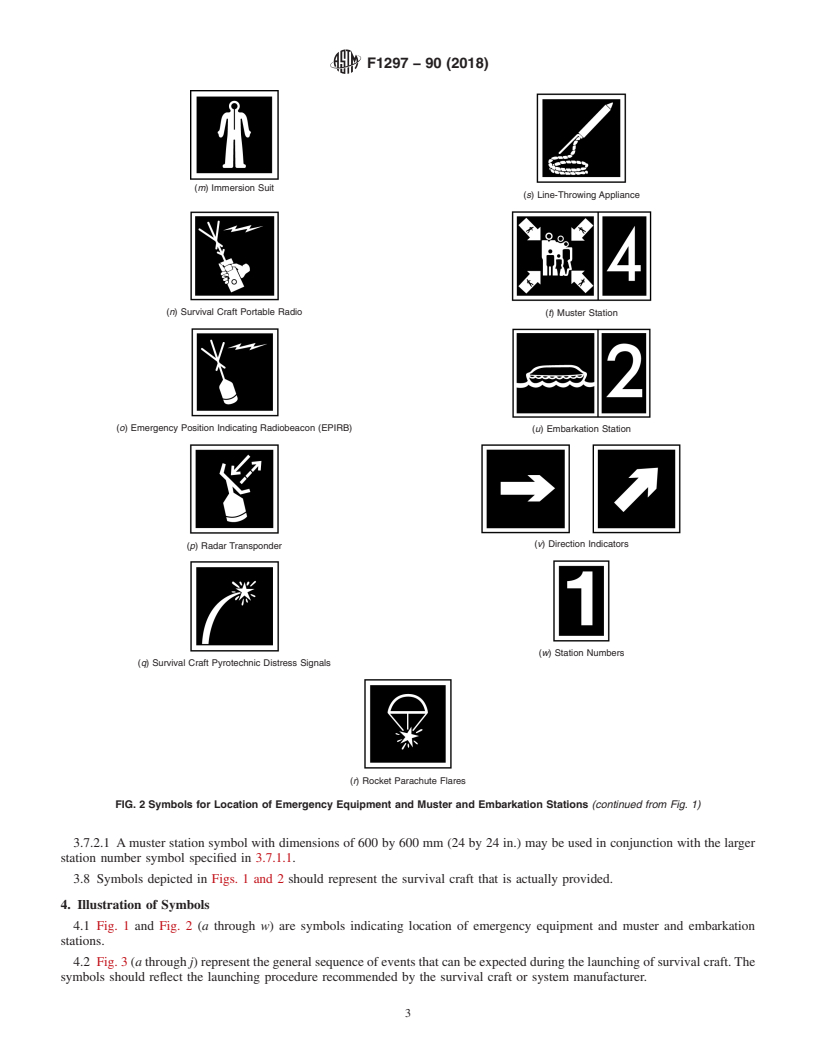
SIGNIFICANCE AND USE
3.1 The symbols depicted represent the following:
3.1.1 Equipment required during evacuation or rescue,
3.1.2 Location of muster stations in preparation for evacuation or rescue, or
3.1.3 The sequence of events for operation of survival craft.
3.2 Where station numbers are used with another symbol, they should be abutted to the right hand side of the other symbol.
3.3 Arrows may be used with any other symbol and, where feasible, should point in the direction of the equipment or station by being abutted to the symbol on the edge toward which the arrow is pointing.
3.4 Symbols that indicate station or equipment location should be in white on a green background (see Figs. 1 and 2).
3.5 Symbols that specify the operating sequence of survival craft should be in white on a blue background (see Fig. 3).
3.6 Symbols used as legends in station bills, lifesaving equipment arrangement plans or drawings, or other posters, need not meet the dimensions specified in 3.7.
3.7 Symbols used as markers to indicate the location of stations or equipment should be sized in accordance with 3.7.1 or 3.7.2.
3.7.1 Station number symbol dimensions should be a minimum of 150 mm in height by 75 mm in width (6 by 3 in.).
3.7.1.1 Station number symbol dimensions of 600 by 300 mm (24 by 12 in.) should be used for greater prominence with the larger muster station symbol specified in 3.7.2.1.
3.7.2 Other symbol dimensions should be a minimum of 150 by 150 mm (6 by 6 in.), except:
3.7.2.1 A muster station symbol with dimensions of 600 by 600 mm (24 by 24 in.) may be used in conjunction with the larger station number symbol specified in 3.7.1.1.
3.8 Symbols depicted in Figs. 1 and 2 should represent the survival craft that is actually provided.
SCOPE
1.1 This guide covers those symbols to be used to identify the location and operation of lifesaving equipment related to evacuation of personnel in the marine environment.
1.2 The symbols depicted should be used whenever graphic representation could assist personnel in locating their emergency stations and equipment and in the operation of such equipment.
1.3 Posters or signs depicting these symbols should be placed in conspicuous locations in the vicinity of survival craft, their launching controls, or other lifesaving equipment.
1.4 The values stated in SI units are to be regarded as standard. The values given in parentheses are mathematical conversions to inch-pound units that are provided for information only and are not considered standard.
1.5 This international standard was developed in accordance with internationally recognized principles on standardization established in the Decision on Principles for the Development of International Standards, Guides and Recommendations issued by the World Trade Organization Technical Barriers to Trade (TBT) Committee.
General Information
Buy Standard

Standards Content (Sample)
NOTICE: This standard has either been superseded and replaced by a new version or withdrawn.
Contact ASTM International (www.astm.org) for the latest information
Designation: F1297 − 90 (Reapproved 2018) An American National Standard
Standard Guide for
Location and Instruction Symbols for Evacuation and
Lifesaving Equipment
This standard is issued under the fixed designation F1297; the number immediately following the designation indicates the year of
original adoption or, in the case of revision, the year of last revision. A number in parentheses indicates the year of last reapproval. A
superscript epsilon (´) indicates an editorial change since the last revision or reapproval.
INTRODUCTION
This guide provides information on symbols for lifesaving appliances and arrangements required by
Chapter III/9.2.3 of the 1983 Amendments to the 1974 Safety of Life at Sea Convention (SOLAS).
Though this requirement applies only to ships that have either a SOLAS Passenger Ship Safety
Certificate or SOLAS Cargo Ship Safety Equipment Certificate, it is recommended that all vessels or
facilities engaged in waterborne operations seriously consider the use of this guide.
1. Scope 3. Significance and Use
1.1 This guide covers those symbols to be used to identify 3.1 The symbols depicted represent the following:
the location and operation of lifesaving equipment related to 3.1.1 Equipment required during evacuation or rescue,
3.1.2 Location of muster stations in preparation for evacu-
evacuation of personnel in the marine environment.
ation or rescue, or
1.2 The symbols depicted should be used whenever graphic
3.1.3 The sequence of events for operation of survival craft.
representation could assist personnel in locating their emer-
3.2 Where station numbers are used with another symbol,
gency stations and equipment and in the operation of such
they should be abutted to the right hand side of the other
equipment.
symbol.
1.3 Posters or signs depicting these symbols should be
3.3 Arrows may be used with any other symbol and, where
placed in conspicuous locations in the vicinity of survival craft,
feasible, should point in the direction of the equipment or
their launching controls, or other lifesaving equipment.
station by being abutted to the symbol on the edge toward
1.4 The values stated in SI units are to be regarded as
which the arrow is pointing.
standard. The values given in parentheses are mathematical
3.4 Symbols that indicate station or equipment location
conversions to inch-pound units that are provided for informa-
should be in white on a green background (see Figs. 1 and 2).
tion only and are not considered standard.
3.5 Symbols that specify the operating sequence of survival
1.5 This international standard was developed in accor-
craft should be in white on a blue background (see Fig. 3).
dance with internationally recognized principles on standard-
ization established in the Decision on Principles for the
3.6 Symbols used as legends in station bills, lifesaving
Development of International Standards, Guides and Recom-
equipment arrangement plans or drawings, or other posters,
mendations issued by the World Trade Organization Technical
need not meet the dimensions specified in 3.7.
Barriers to Trade (TBT) Committee.
3.7 Symbols used as markers to indicate the location of
stations or equipment should be sized in accordance with 3.7.1
2. Referenced Documents
or 3.7.2.
2.1 SOLAS Convention:
3.7.1 Station number symbol dimensions should be a mini-
SOLAS 74 International Convention for the Safety of Life at
mum of 150 mm in height by 75 mm in width (6 by 3 in.).
Sea
3.7.1.1 Station number symbol dimensions of 600 by 300
mm (24 by 12 in.) should be used for greater prominence with
This guide is under the jurisdiction of ASTM Committee F25 on Ships and
the larger muster station symbol specified in 3.7.2.1.
Marine Technology and is the direct responsibility of Subcommittee F25.07 on
3.7.2 Other symbol dimensions should be a minimum of
General Requirements.
Current edition approved Oct. 1, 2018. Published October 2018. Originally
150 by 150 mm (6 by 6 i
...
This document is not an ASTM standard and is intended only to provide the user of an ASTM standard an indication of what changes have been made to the previous version. Because
it may not be technically possible to adequately depict all changes accurately, ASTM recommends that users consult prior editions as appropriate. In all cases only the current version
of the standard as published by ASTM is to be considered the official document.
Designation: F1297 − 90 (Reapproved 2012) F1297 − 90 (Reapproved 2018)An American National Standard
Standard Guide for
Location and Instruction Symbols for Evacuation and
Lifesaving Equipment
This standard is issued under the fixed designation F1297; the number immediately following the designation indicates the year of
original adoption or, in the case of revision, the year of last revision. A number in parentheses indicates the year of last reapproval. A
superscript epsilon (´) indicates an editorial change since the last revision or reapproval.
INTRODUCTION
This guide provides information on symbols for lifesaving appliances and arrangements required by
Chapter III/9.2.3 of the 1983 Amendments to the 1974 Safety of Life at Sea Convention (SOLAS).
Though this requirement applies only to ships that have either a SOLAS Passenger Ship Safety
Certificate or SOLAS Cargo Ship Safety Equipment Certificate, it is recommended that all vessels or
facilities engaged in waterborne operations seriously consider the use of this guide.
1. Scope
1.1 This guide covers those symbols to be used to identify the location and operation of lifesaving equipment related to
evacuation of personnel in the marine environment.
1.2 The symbols depicted should be used whenever graphic representation could assist personnel in locating their emergency
stations and equipment and in the operation of such equipment.
1.3 Posters or signs depicting these symbols should be placed in conspicuous locations in the vicinity of survival craft, their
launching controls, or other lifesaving equipment.
1.4 The values stated in SI units are to be regarded as standard. The values given in parentheses are for information
only.mathematical conversions to inch-pound units that are provided for information only and are not considered standard.
1.5 This international standard was developed in accordance with internationally recognized principles on standardization
established in the Decision on Principles for the Development of International Standards, Guides and Recommendations issued
by the World Trade Organization Technical Barriers to Trade (TBT) Committee.
2. Referenced Documents
2.1 Safety of Life at Sea SOLAS Convention:
SOLAS 74 International Convention for the Safety of Life at Sea
3. Significance and Use
3.1 The symbols depicted represent the following:
3.1.1 Equipment required during evacuation or rescue,
3.1.2 Location of muster stations in preparation for evacuation or rescue, or
3.1.3 The sequence of events for operation of survival craft.
3.2 Where station numbers are used with another symbol, they should be abutted to the right hand side of the other symbol.
3.3 Arrows may be used with any other symbol and, where feasible, should point in the direction of the equipment or station
by being abutted to the symbol on the edge toward which the arrow is pointing.
3.4 Symbols that indicate station or equipment location should be in white on a green background (see Figs. 1 and 2).
3.5 Symbols that specify the operating sequence of survival craft should be in white on a blue background (see Fig. 3).
This guide is under the jurisdiction of ASTM Committee F25 on Ships and Marine Technology and is the direct responsibility of Subcommittee F25.07 on General
Requirements.
Current edition approved May 1, 2012Oct. 1, 2018. Published May 2012October 2018. Originally approved in 1990. Last previous edition approved in 20052012 as
F1297 – 90 (2005).(2012). DOI: 10.1520/F1297-90R12.10.1520/F1297-90R18.
Available from American National Standards Institute (ANSI), 25 W. 43rd St., 4th Floor, New York, NY 10036, http://www.ansi.org.
Copyright © ASTM International, 100 Barr Harbor Drive, PO Box C700, West Conshohocken, PA 19428-2959. United States
F1297 − 90 (2018)
(a) Lifeboat
(g) Lifebuoy
(
...
Questions, Comments and Discussion
Ask us and Technical Secretary will try to provide an answer. You can facilitate discussion about the standard in here.