

ASTM D2187-17
(Test Method)Standard Test Methods and Practices for Evaluating Physical and Chemical Properties of Particulate Ion-Exchange Resins
General Information
- Abstract
SIGNIFICANCE AND USE
7.1 The ionic form of an ion-exchange material affects both its equivalent mass and its equilibrium water content. These in turn influence the numerical values obtained in exchange capacity determinations, in density measurements, and in the size of the particles. To provide a uniform basis for comparison, therefore, the sample should be converted to a known ionic form before analysis. This procedure provides for the conversion of cation-exchange materials to the sodium form and anion-exchange materials to the chloride form prior to analysis. These forms are chosen since they permit samples to be weighed and dried without concern for air contamination or decomposition. If other ionic forms are used this fact should be noted in reporting the results.
SCOPE
1.1 These test methods cover the determination of the physical and chemical properties of ion-exchange resins when used for the treatment of water. They are intended for use in testing both new and used materials. The following thirteen test methods are included:
Sections
Test Practice A—Pretreatment
6 – 10
Test Method B—Water Retention Capacity
11 – 18
Test Method C—Backwashed and Settled Density
19 – 26
Test Method D—Particle Size Distribution
27 – 35
Test Method E—Salt-Splitting Capacity of Cation-Exchange Resins
36 – 45
Test Method F—Total Capacity of Cation-Exchange Resins
46 – 55
Test Method G—Percent Regeneration of Hydrogen-Form Cation-Exchange Resins
56 – 64
Test Method H—Total and Salt-Splitting Capacity of Anion-Exchange Resins
65 – 73
Test Practice I—Percent Regeneration of Anion Exchange Resins
74 – 82
Test Practice J—Ionic Chloride Content of Anion-Exchange Resins
83 – 90
Test Method K—Carbonate Content of Anion-Exchange Resins
91 – 99
Test Method L—Sulfate Content of Anion Exchange Resins
100 – 108
Test Practice M—Total Anion Capacity of Anion-Exchange Resins
109 – 117
1.2 The values stated in SI units are to be regarded as standard. The values given in parentheses are mathematical conversions to inch-pound units that are provided for information only and are not considered standard.
1.3 This standard does not purport to address all of the safety concerns, if any, associated with its use. It is the responsibility of the user of this standard to establish appropriate safety, health and environmental practices and determine the applicability of regulatory limitations prior to use. Specific precautionary statements are given in Section 10.8.
1.4 This international standard was developed in accordance with internationally recognized principles on standardization established in the Decision on Principles for the Development of International Standards, Guides and Recommendations issued by the World Trade Organization Technical Barriers to Trade (TBT) Committee.
- Status
- Published
- Publication Date
- 31-Jul-2017
- Technical Committee
- D19 - Water
- Drafting Committee
- D19.08 - Membranes and Ion Exchange Materials
Buy Documents
ASTM D2187-17 - Standard Test Methods and Practices for Evaluating Physical and Chemical Properties of Particulate Ion-Exchange Resins
REDLINE ASTM D2187-17 - Standard Test Methods and Practices for Evaluating Physical and Chemical Properties of Particulate Ion-Exchange Resins
Overview
ASTM D2187-17: Standard Test Methods and Practices for Evaluating Physical and Chemical Properties of Particulate Ion-Exchange Resins establishes standardized procedures for assessing both the physical and chemical characteristics of ion-exchange resins. Developed by ASTM International, this standard is essential for consistent analysis and quality assurance of ion-exchange materials, especially in water treatment applications. The methods outlined are suitable for both new and used resins and enable reliable comparison through controlled preconditioning processes.
Key Topics
The standard covers a comprehensive range of test methods and practices, including:
- Sample Pretreatment: Procedures to convert cation-exchange resins to sodium form and anion-exchange resins to chloride form prior to analysis, ensuring uniform test results.
- Water Retention Capacity: Determining the amount of water absorbed by ion-exchange resins, providing insights into crosslinking, polymer condition, and fouling or degradation.
- Backwashed and Settled Density: Measurement of the density of resin after backwashing and settling, relevant for practical performance in column operations.
- Particle Size Distribution: Wet sieve analysis to assess the size uniformity and potential physical breakdown of resin beads.
- Exchange Capacity: Quantification of salt-splitting capacity and total ion-exchange sites available per gram of resin.
- Regeneration and Content Analysis: Methods to evaluate the regeneration efficiency, chloride, carbonate, and sulfate content in anion-exchange resins.
These methods utilize rigorous analytical procedures, such as titration and gravimetric analysis, and employ SI units as standard measurements for consistency.
Applications
ASTM D2187-17 is widely used across various industries that rely on water purification and ion-exchange processes, including:
- Water Treatment Plants: Quality control and performance verification of resins used in softening, demineralization, and deionization units.
- Industrial and Power Generation Facilities: Monitoring resin properties to maintain process efficiency and comply with regulatory standards.
- Manufacturers of Ion-Exchange Materials: Batch testing during production to ensure consistency and functionality.
- Environmental Laboratories: Routine testing of both new and used resins for research and compliance assessment.
- Quality Assurance Laboratories: Validating resin performance after cycles of use or regeneration.
By implementing these standardized test methods, organizations can ensure the reliability, durability, and effectiveness of ion-exchange resins in critical applications.
Related Standards
Several related ASTM and international standards provide complementary guidance and terminology for the analysis and use of ion-exchange materials:
- ASTM D1129: Terminology Relating to Water
- ASTM D1193: Specification for Reagent Water
- ASTM D1293: Test Methods for pH of Water
- ASTM D2687: Practices for Sampling Particulate Ion-Exchange Materials
- ASTM D2777: Practice for Determination of Precision and Bias of Applicable Test Methods of Committee D19 on Water
- ASTM E11: Specification for Woven Wire Test Sieve Cloth and Test Sieves
In addition, ASTM D2187-17 aligns with principles established by the World Trade Organization Technical Barriers to Trade (TBT) Committee, supporting international harmonization and trade.
Keywords: ASTM D2187-17, ion-exchange resin testing, water treatment standards, particle size analysis, resin water retention, resin density measurement, exchange capacity, industrial water quality.
Relations
- Effective Date
- 01-Aug-2017
- Effective Date
- 01-Apr-2024
- Effective Date
- 01-May-2020
- Effective Date
- 15-May-2016
- Effective Date
- 01-Oct-2013
- Effective Date
- 15-Jun-2012
- Effective Date
- 01-Jan-2012
- Effective Date
- 01-Mar-2010
- Effective Date
- 01-May-2009
- Effective Date
- 15-Jan-2008
- Effective Date
- 01-Dec-2007
- Effective Date
- 01-Sep-2006
- Effective Date
- 01-Sep-2006
- Effective Date
- 15-Aug-2006
- Effective Date
- 01-Mar-2006
Buy Documents
ASTM D2187-17 - Standard Test Methods and Practices for Evaluating Physical and Chemical Properties of Particulate Ion-Exchange Resins
REDLINE ASTM D2187-17 - Standard Test Methods and Practices for Evaluating Physical and Chemical Properties of Particulate Ion-Exchange Resins
Get Certified
Connect with accredited certification bodies for this standard

ECOCERT
Organic and sustainability certification.

Eurofins Food Testing Global
Global leader in food, environment, and pharmaceutical product testing.

Intertek Bangladesh
Intertek certification and testing services in Bangladesh.
Sponsored listings
Frequently Asked Questions
ASTM D2187-17 is a standard published by ASTM International. Its full title is "Standard Test Methods and Practices for Evaluating Physical and Chemical Properties of Particulate Ion-Exchange Resins". This standard covers: SIGNIFICANCE AND USE 7.1 The ionic form of an ion-exchange material affects both its equivalent mass and its equilibrium water content. These in turn influence the numerical values obtained in exchange capacity determinations, in density measurements, and in the size of the particles. To provide a uniform basis for comparison, therefore, the sample should be converted to a known ionic form before analysis. This procedure provides for the conversion of cation-exchange materials to the sodium form and anion-exchange materials to the chloride form prior to analysis. These forms are chosen since they permit samples to be weighed and dried without concern for air contamination or decomposition. If other ionic forms are used this fact should be noted in reporting the results. SCOPE 1.1 These test methods cover the determination of the physical and chemical properties of ion-exchange resins when used for the treatment of water. They are intended for use in testing both new and used materials. The following thirteen test methods are included: Sections Test Practice A—Pretreatment 6 – 10 Test Method B—Water Retention Capacity 11 – 18 Test Method C—Backwashed and Settled Density 19 – 26 Test Method D—Particle Size Distribution 27 – 35 Test Method E—Salt-Splitting Capacity of Cation-Exchange Resins 36 – 45 Test Method F—Total Capacity of Cation-Exchange Resins 46 – 55 Test Method G—Percent Regeneration of Hydrogen-Form Cation-Exchange Resins 56 – 64 Test Method H—Total and Salt-Splitting Capacity of Anion-Exchange Resins 65 – 73 Test Practice I—Percent Regeneration of Anion Exchange Resins 74 – 82 Test Practice J—Ionic Chloride Content of Anion-Exchange Resins 83 – 90 Test Method K—Carbonate Content of Anion-Exchange Resins 91 – 99 Test Method L—Sulfate Content of Anion Exchange Resins 100 – 108 Test Practice M—Total Anion Capacity of Anion-Exchange Resins 109 – 117 1.2 The values stated in SI units are to be regarded as standard. The values given in parentheses are mathematical conversions to inch-pound units that are provided for information only and are not considered standard. 1.3 This standard does not purport to address all of the safety concerns, if any, associated with its use. It is the responsibility of the user of this standard to establish appropriate safety, health and environmental practices and determine the applicability of regulatory limitations prior to use. Specific precautionary statements are given in Section 10.8. 1.4 This international standard was developed in accordance with internationally recognized principles on standardization established in the Decision on Principles for the Development of International Standards, Guides and Recommendations issued by the World Trade Organization Technical Barriers to Trade (TBT) Committee.
SIGNIFICANCE AND USE 7.1 The ionic form of an ion-exchange material affects both its equivalent mass and its equilibrium water content. These in turn influence the numerical values obtained in exchange capacity determinations, in density measurements, and in the size of the particles. To provide a uniform basis for comparison, therefore, the sample should be converted to a known ionic form before analysis. This procedure provides for the conversion of cation-exchange materials to the sodium form and anion-exchange materials to the chloride form prior to analysis. These forms are chosen since they permit samples to be weighed and dried without concern for air contamination or decomposition. If other ionic forms are used this fact should be noted in reporting the results. SCOPE 1.1 These test methods cover the determination of the physical and chemical properties of ion-exchange resins when used for the treatment of water. They are intended for use in testing both new and used materials. The following thirteen test methods are included: Sections Test Practice A—Pretreatment 6 – 10 Test Method B—Water Retention Capacity 11 – 18 Test Method C—Backwashed and Settled Density 19 – 26 Test Method D—Particle Size Distribution 27 – 35 Test Method E—Salt-Splitting Capacity of Cation-Exchange Resins 36 – 45 Test Method F—Total Capacity of Cation-Exchange Resins 46 – 55 Test Method G—Percent Regeneration of Hydrogen-Form Cation-Exchange Resins 56 – 64 Test Method H—Total and Salt-Splitting Capacity of Anion-Exchange Resins 65 – 73 Test Practice I—Percent Regeneration of Anion Exchange Resins 74 – 82 Test Practice J—Ionic Chloride Content of Anion-Exchange Resins 83 – 90 Test Method K—Carbonate Content of Anion-Exchange Resins 91 – 99 Test Method L—Sulfate Content of Anion Exchange Resins 100 – 108 Test Practice M—Total Anion Capacity of Anion-Exchange Resins 109 – 117 1.2 The values stated in SI units are to be regarded as standard. The values given in parentheses are mathematical conversions to inch-pound units that are provided for information only and are not considered standard. 1.3 This standard does not purport to address all of the safety concerns, if any, associated with its use. It is the responsibility of the user of this standard to establish appropriate safety, health and environmental practices and determine the applicability of regulatory limitations prior to use. Specific precautionary statements are given in Section 10.8. 1.4 This international standard was developed in accordance with internationally recognized principles on standardization established in the Decision on Principles for the Development of International Standards, Guides and Recommendations issued by the World Trade Organization Technical Barriers to Trade (TBT) Committee.
ASTM D2187-17 is classified under the following ICS (International Classification for Standards) categories: 71.100.40 - Surface active agents. The ICS classification helps identify the subject area and facilitates finding related standards.
ASTM D2187-17 has the following relationships with other standards: It is inter standard links to ASTM D2187-94(2009)e1, ASTM D2687-95(2024), ASTM D1129-13(2020)e2, ASTM D2687-95(2016), ASTM E11-13, ASTM D2777-12, ASTM D1293-12, ASTM D1129-10, ASTM E11-09e1, ASTM D2777-08, ASTM D2687-95(2007)e1, ASTM D1129-06ae1, ASTM D1129-06a, ASTM D2777-06, ASTM D1193-06. Understanding these relationships helps ensure you are using the most current and applicable version of the standard.
ASTM D2187-17 is available in PDF format for immediate download after purchase. The document can be added to your cart and obtained through the secure checkout process. Digital delivery ensures instant access to the complete standard document.
Standards Content (Sample)
This international standard was developed in accordance with internationally recognized principles on standardization established in the Decision on Principles for the
Development of International Standards, Guides and Recommendations issued by the World Trade Organization Technical Barriers to Trade (TBT) Committee.
Designation: D2187 − 17
Standard Test Methods and Practices for
Evaluating Physical and Chemical Properties of Particulate
Ion-Exchange Resins
This standard is issued under the fixed designation D2187; the number immediately following the designation indicates the year of
original adoption or, in the case of revision, the year of last revision.Anumber in parentheses indicates the year of last reapproval.A
superscript epsilon (´) indicates an editorial change since the last revision or reapproval.
1. Scope ization established in the Decision on Principles for the
Development of International Standards, Guides and Recom-
1.1 These test methods cover the determination of the
mendations issued by the World Trade Organization Technical
physical and chemical properties of ion-exchange resins when
Barriers to Trade (TBT) Committee.
used for the treatment of water. They are intended for use in
testingbothnewandusedmaterials.Thefollowingthirteentest
2. Referenced Documents
methods are included:
2.1 ASTM Standards:
Sections
Test PracticeA—Pretreatment 6–10 D1129Terminology Relating to Water
Test Method B—Water Retention Capacity 11–18
D1193Specification for Reagent Water
Test Method C—Backwashed and Settled Density 19–26
D1293Test Methods for pH of Water
Test Method D—Particle Size Distribution 27–35
D2687PracticesforSamplingParticulateIon-ExchangeMa-
Test Method E—Salt-Splitting Capacity of Cation- 36–45
Exchange Resins
terials
Test Method F—Total Capacity of Cation-Exchange 46–55
D2777Practice for Determination of Precision and Bias of
Resins
Applicable Test Methods of Committee D19 on Water
Test Method G—Percent Regeneration of Hydrogen- 56–64
Form Cation-Exchange Resins
E11Specification forWovenWireTest Sieve Cloth andTest
Test Method H—Total and Salt-Splitting Capacity of 65–73
Sieves
Anion-Exchange Resins
Test Practice I—Percent Regeneration ofAnion Ex- 74–82
change Resins
3. Terminology
Test Practice J—Ionic Chloride Content ofAnion- 83–90
Exchange Resins 3.1 Definitions:
Test Method K—Carbonate Content ofAnion-Exchange 91–99
3.1.1 For definitions of terms used in these standards, refer
Resins
to Terminology D1129.
Test Method L—Sulfate Content ofAnion Exchange 100 – 108
Resins
3.2 Definitions of Terms Specific to This Standard:
Test Practice M—TotalAnion Capacity ofAnion- 109 – 117
3.2.1 anion-exchange material—an ion-exchange material
Exchange Resins
capable of the reversible exchange of negatively charged ions.
1.2 The values stated in SI units are to be regarded as
3.2.2 cation-exchange material—an ion-exchange material
standard. The values given in parentheses are mathematical
conversions to inch-pound units that are provided for informa- capable of the reversible exchange of positively charged ions.
tion only and are not considered standard.
3.2.3 ion-exchange resin—a synthetic organic ion-exchange
material.
1.3 This standard does not purport to address all of the
safety concerns, if any, associated with its use. It is the
3.2.4 mixed bed—a physical mixture of anion-exchange
responsibility of the user of this standard to establish appro-
material and cation-exchange material.
priate safety, health and environmental practices and deter-
mine the applicability of regulatory limitations prior to use.
4. Reagents
Specific precautionary statements are given in Section 10.8.
4.1 Purity of Reagents—Reagent grade chemicals shall be
1.4 This international standard was developed in accor-
used in all tests. Unless otherwise indicated, it is intended that
dance with internationally recognized principles on standard-
all reagents shall conform to the specifications of the Commit-
tee onAnalytical Reagents of theAmerican Chemical Society,
These test methods and practices are under the jurisdiction ofASTM Commit-
tee D19 on Water and are the direct responsibility of Subcommittee D19.08 on
Membranes and Ion Exchange Materials. For referenced ASTM standards, visit the ASTM website, www.astm.org, or
Current edition approved Aug. 1, 2017. Published August 2017. Originally contact ASTM Customer Service at service@astm.org. For Annual Book of ASTM
ɛ1
approved in 1963. Last previous edition approved in 2009 as D2187–94 (2009) . Standards volume information, refer to the standard’s Document Summary page on
DOI: 10.1520/D2187-17. the ASTM website.
Copyright ©ASTM International, 100 Barr Harbor Drive, PO Box C700, West Conshohocken, PA19428-2959. United States
D2187 − 17
where such specifications are available. Other grades may be
used, provided it is first ascertained that the reagent is of
sufficiently high purity to permit its use without lessening the
accuracy of the determination.
4.2 Purity of Water—Unless otherwise indicated, references
to water shall be understood to mean Type IV reagent water
described in Specification D1193.
5. Sampling
5.1 Obtain a representative sample of the ion-exchange
resin in accordance with Practices D2687.
5.2 A minimum sample size of 1 L is recommended for a
complete testing program.
TEST PRACTICE A—PRETREATMENT
6. Scope
6.1 Thistestpracticecoverstheconversionofion-exchange
resins to a known ionic form and is intended for application to
both new and used material.
7. Significance and Use
7.1 The ionic form of an ion-exchange material affects both
its equivalent mass and its equilibrium water content.These in
turn influence the numerical values obtained in exchange
capacity determinations, in density measurements, and in the
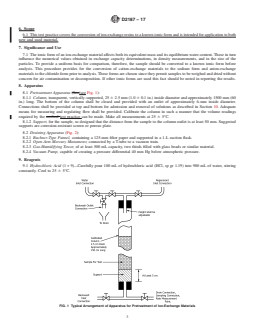
FIG. 1 Typical Arrangement of Apparatus for Pretreatment of Ion-
size of the particles. To provide a uniform basis for
Exchange Materials
comparison, therefore, the sample should be converted to a
known ionic form before analysis.This procedure provides for
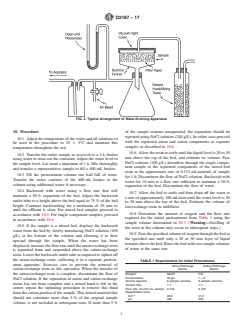
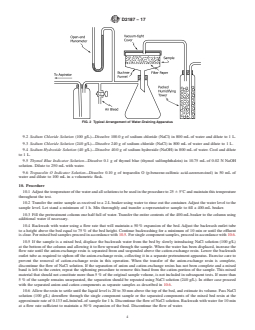
8.2 Draining Apparatus (Fig. 2):
the conversion of cation-exchange materials to the sodium
8.2.1 Buchner-Type Funnel, containing a 125-mm filter
form and anion-exchange materials to the chloride form prior
paper and supported in a 1-L suction flask.
to analysis. These forms are chosen since they permit samples
8.2.2 Open-ArmMercuryManometer,connectedbyaT-tube
to be weighed and dried without concern for air contamination
to a vacuum train.
ordecomposition.Ifotherionicformsareusedthisfactshould
8.2.3 Gas-Humidifying Tower, of at least 500 mL capacity,
be noted in reporting the results.
two thirds filled with glass beads or similar material.
8.2.4 Vacuum Pump, capable of creating a pressure differ-
8. Apparatus
ential 40 mm Hg below atmospheric pressure.
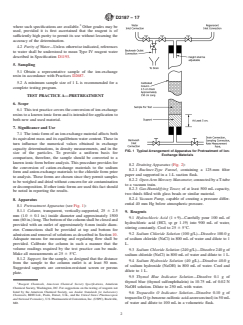
8.1 Pretreatment Apparatus (see Fig. 1):
8.1.1 Column, transparent, vertically-supported, 25 6 2.5
9. Reagents
mm (1.0 6 0.1 in.) inside diameter and approximately 1500
9.1 Hydrochloric Acid (1+9)—Carefully pour 100 mL of
mm(60in.)long.Thebottomofthecolumnshallbeclosedand
hydrochloric acid (HCl, sp gr 1.19) into 900 mL of water,
provided with an outlet of approximately 6-mm inside diam-
stirring constantly. Cool to 25 6 5°C.
eter. Connections shall be provided at top and bottom for
9.2 Sodium Chloride Solution (100 g/L)—Dissolve 100.0 g
admissionandremovalofsolutionsasdescribedinSection10.
of sodium chloride (NaCl) in 800 mL of water and dilute to 1
Adequate means for measuring and regulating flow shall be
L.
provided. Calibrate the column in such a manner that the
volume readings required by the test practice can be made.
9.3 Sodium Chloride Solution (240 g/L)—Dissolve 240 g of
Make all measurements at 25 6 5°C.
sodium chloride (NaCl) in 800 mL of water and dilute to 1 L.
8.1.2 Support, for the sample, so designed that the distance
9.4 Sodium Hydroxide Solution (40 g/L)—Dissolve 40.0 g
from the sample to the column outlet is at least 50 mm.
of sodium hydroxide (NaOH) in 800 mL of water. Cool and
Suggested supports are corrosion-resistant screen or porous
dilute to 1 L.
plate.
9.5 Thymol Blue Indicator Solution—Dissolve 0.1 g of
thymol blue (thymol sulfonphthalein) in 10.75 mL of 0.02 N
Reagent Chemicals, American Chemical Society Specifications, American
NaOH solution. Dilute to 250 mL with water.
Chemical Society, Washington, DC. For suggestions on the testing of reagents not
listed by the American Chemical Society, see Analar Standards for Laboratory
9.6 Tropaeolin O Indicator Solution—Dissolve 0.10 g of
Chemicals, BDH Ltd., Poole, Dorset, U.K., and the United States Pharmacopeia
tropaeolinO(p-benzene-sulfonicacid-azoresorcinol)in50mL
and National Formulary, U.S. Pharmaceutical Convention, Inc. (USPC), Rockville,
MD. of water and dilute to 100 mL in a volumetric flask.
D2187 − 17
FIG. 2 Typical Arrangement of Water-Draining Apparatus
10. Procedure of the sample remains unseparated, the separation should be
repeated using NaCl solution (240 g/L). In either case proceed
10.1 Adjustthetemperatureofthewaterandallsolutionsto
with the separated anion and cation components as separate
be used in the procedure to 25 6 5°C and maintain this
samples as described in 10.6.
temperature throughout the test.
10.6 Allowtheresintosettleuntiltheliquidlevelis20to30
10.2 Transfer the entire sample as received to a 2-L beaker
mm above the top of the bed, and estimate its volume. Pass
using water to rinse out the container.Adjust the water level to
NaCl solution (100 g/L) downflow through the single compo-
the sample level. Let stand a minimum of 1 h. Mix thoroughly
nent sample or the separated components of the mixed bed
and transfer a representative sample to fill a 400-mL beaker.
resin at the approximate rate of 0.133 mL/min/mL of sample
10.3 Fill the pretreatment column one half full of water.
for 1 h. Discontinue the flow of NaCl solution. Backwash with
Transfer the entire contents of the 400-mL beaker to the
water for 10 min at a flow rate sufficient to maintain a 50%
column using additional water if necessary.
expansion of the bed. Discontinue the flow of water.
10.4 Backwash with water using a flow rate that will
10.7 Allow the bed to settle and then drain off the water at
maintain a 50% expansion of the bed. Adjust the backwash
a rate of approximately 100 mL/min until the water level is 20
outlet tube to a height above the bed equal to 75% of the bed
to 30 mm above the top of the bed. Estimate the volume of
height. Continue backwashing for a minimum of 10 min or
ion-exchange resin in millilitres.
until the effluent is clear. For mixed bed samples proceed in
10.8 Determine the amount of reagent and the flow rate
accordance with 10.5. For single component samples, proceed
required for the initial pretreatment from Table 1 using the
in accordance with 10.6.
sample volume determined in 10.7.(Warning—Swelling of
10.5 If the sample is a mixed bed, displace the backwash
the resin in the column may occur in subsequent steps.)
water from the bed by slowly introducing NaCl solution (100
10.9 Passthespecifiedvolumeofreagentthroughthebedat
g/L) at the bottom of the column and allowing it to flow
the specified rate until only a 20 or 30 mm layer of liquid
upward through the sample. When the water has been
remainsabovethebed.Rinsethebedwithtwosamplevolumes
displaced, increasetheflowrateuntiltheanion-exchangeresin
of water at the same rate.
is separated from and suspended above the cation-exchange
resin.Lowerthebackwashoutlettubeasrequiredtosiphonoff
the anion-exchange resin, collecting it in a separate pretreat-
TABLE 1 Requirements for Initial Pretreatment
ment apparatus. Exercise care to prevent the removal of
Anion-Exchange Cation-Exchange
cation-exchange resin in this operation. When the transfer of Resins Resins
the anion-exchange resin is complete, discontinue the flow of
Reagent NaOH HCl
Concentration 40 g/L 1+9
NaCl solution. If the separation of anion and cation-exchange
Volume required 8 sample volumes 8 sample volumes
resins has not been complete and a mixed band is left in the
Contact time 1 h 1 h
center, repeat the siphoning procedure to remove this band Flow rate, mL/min-mL sample 0.133 0.133
Regeneration level:
fromthecation-portionofthesample.Thismixedmaterialthat
lb/ft 20.0 21.2
should not constitute more than 5% of the original sample
g/L 320 340
volume, is not included in subsequent tests. If more than 5%
D2187 − 17
10.10 Determine the amount of reagent and the flow rate lower effective crosslinking. Increases in water retention ca-
required for the second pretreatment from Table 2 using the pacity of used materials as compared with the values for new
sample volume determined in 10.7. Note that this second material serve as an indicator of polymer decrosslinking:
pretreatment is not used for some methods. decreasesmayindicateeitherlossoffunctionalityorfoulingof
the ion-exchange material. Since the numerical value is di-
10.11 Pass the specified volume of reagent through a bed at
rectly dependent on the ionic form of the material, careful
the specified rate until only a 20 to 30-mm layer of liquid
preconditioning of both original and used samples to known
remains above the bed. Rinse the bed with one sample volume
ionic forms as outlined in Section 7 is essential when such
ofwateratthesamerate.Increasetherinserateto100mL/min.
comparisons are made.
Rinse for 15 min. Thereafter test successive 100-mL portions
oftheeffluentfromanion-exchangeresinsbyaddingtwodrops
14. Procedure
of thymol blue indicator solution. Continue rinsing until a 100
14.1 Weigh three approximately 5-g representative samples
mL portion of the effluent remains yellow (pH > 2.5) on the
of material pretreated in accordance with Section 10 to the
addition of the indicator. Test the effluent from the cation-
nearest 1 mg into previously tared weighing vessels.
exchange resins in the same manner with two drops of
tropaeolin-O indicator solution. Continue rinsing until a
14.2 Dry the samples for 18 62hat104 6 2°C.
100-mLportion of the effluent remains yellow (pH < 11.0) on
14.3 Remove the samples from the oven. Cool 30 min in a
the addition of the indicator.
desiccator, and reweigh.
10.12 Removetheion-exchangeresinfromthepretreatment
15. Calculation
column, discarding any extraneous material that may have
accumulated at the bottom of the bed. Transfer the resin to the
15.1 Calculate the water retention capacity, in percent, as
Buchner funnel of the draining apparatus that has been fitted
follows:
with a medium porosity filter paper. Drain the water to the top
waterretained, % 5 @~A 2 B!/A# 3100 (1)
of the sample using suction if required. Cover the funnel with
a suitable vacuum-tight cover, which is fitted with an inlet for where:
air from the water-filled humidifying tower. Apply sufficient
A = amount of wet sample used, g, and
suction to maintain a pressure differential of 40 65mmHg
B = amount of dry sample obtained, g.
below atmospheric pressure. Continue passing humidified air
16. Report
through the sample for 10 min.
16.1 Report the percent water retained as the average of the
10.13 Transfertheentiredrainedsampletoaclean,dry,1-L
three values obtained.
(1-qt.), wide-mouthed bottle with a screw top or other vapor-
tight closure.
17. Precision and Bias
TEST METHOD B—WATER RETENTION CAPACITY
17.1 Precision—The precision of this test method of deter-
mining water retention capacity of ion exchange resins may be
11. Scope
expressed as follows:
11.1 This test method covers the determination of the
S 5 0.017x
T
amount of water retained by ion-exchange resins and is
S 5 0.004x
o
intended for testing both new and used materials.
where:
12. Summary of Test Method
S = overall precision,
T
12.1 This test method consists of the determination of the
S = single-operator precision, and
o
loss of mass on drying at 104 6 2°C.
x = water retention capacity determined in percent.
17.1.1 Information given for the precision statement is
13. Significance and Use
derived from round robin testing in which eight laboratories,
13.1 The water retention capacity of an ion-exchange ma-
including ten operators, participated. Four samples were in-
terial is proportional to its pore volume. For new materials of
cluded in the testing. The range of water retention capacity in
thesamefunctionalityandpolymertype,highervaluesindicate
the samples tested was 40 to 60%.
17.2 Bias—Ion exchange resins are the product of a
TABLE 2 Requirements for Second Pretreatment
complex, multiple step synthesis involving a polymerization
Anion-Exchange Cation-Exchange
reaction followed by one or more additional reactions to place
Resins Resins
functional groups on the polymeric structure. Consequently,
Reagent HCl NaOH
Concentration 1+9 40 g/L
the true value for any property of the finished product is
Volume required 8 sample volumes 4 sample volumes
unknown and a bias statement cannot be given.
Contact time 1 h 0.5 h
Flow rate, mL/min-mL sample 0.133 0.133
Regeneration level:
Supporting data have been filed atASTM International Headquarters and may
lb/ft 21.2 10.0
g/L 340 160 be obtained by requesting Research Reports RR:D19-0139 and RR:D19-1007.
Contact ASTM Customer Service at service@astm.org.
D2187 − 17
3 3
18. Quality Control density, lb/ft g/ft 5 C 362.4 (3)
~ !
18.1 Intheanalysisofionexchangeresins,itisnotpossible
where:
to prepare a known standard resin for comparison with the
C = density, g/mL.
actualsample.Therefore,itisimpossibletotesttheaccuracyof
the results, and this test method does not include a bias
24. Report
statement.
24.1 Report the density of the tested material as the average
18.2 Analysts are expected to use replicate samples to
of that calculated from two volumes that agree within 5 mL.
determineiftheresultsarewithintheexpectedprecisionstated
in Section 17. 25. Precision and Bias
25.1 Precision—The precision of this test method of deter-
TEST METHOD C—BACKWASHED AND SETTLED
mining backwashed and settled density of ion exchange resins
DENSITY
may be expressed as follows:
19. Scope
S 5 0.035x
T
19.1 This test method covers the determination of the
S 5 0.005x
o
backwashed and settled density of ion-exchange resin and is
where:
intended for testing both new and used material.
S = overall precision,
T
20. Summary of Test Method
S = single-operator precision, and
o
x = density determined in g/mL.
20.1 The test method consists of the determination of the
backwashed and settled volume of a known number of grams
25.1.1 Information given for the precision statement is
of chemically pretreated resin.
derived from round robin testing in which eight laboratories,
including ten operators, participated. Four samples were in-
21. Significance and Use
cluded in the testing. Six of the operators ran each sample in
21.1 This test method for the determination of backwashed duplicate. The remainder were single observations.
and settled density of a hydraulically classified and settled bed
25.2 Bias—Ion exchange resins are the product of a
was developed to correlate with the density of ion-exchange
complex, multiple step synthesis involving a polymerization
materials in operating units. Results obtained by this test
reaction followed by one or more additional reactions to place
method in a 25-mm (1-in.) column may be expected to agree
functional groups on the polymeric structure. Consequently,
with those obtained in larger diameter units within the over-all
the true value for any property of the finished product is
precision limits of the test, but the bias of these results, as
unknown and a bias statement cannot be given.
compared with measurements in larger diameters, is toward
lower values.
26. Quality Control
26.1 Intheanalysisofionexchangeresins,itisnotpossible
22. Procedure
to prepare a known standard resin for comparison with the
22.1 Weigh a 200-g sample of resin, pretreated in accor-
actualsample.Therefore,itisimpossibletotesttheaccuracyof
dance with Section 10, to the nearest 0.1 g. Transfer it
the results, and this test method does not include a bias
quantitatively to a column that has been calibrated every 5 mL
statement.
above the 200-mL volume.
26.2 Analysts are expected to use replicate samples to
22.2 Backwash with water for 10 min using a slow rate that
determineiftheresultsarewithintheexpectedprecisionstated
will maintain a 50% expansion of the bed.
in Section 25.
22.3 Allow the bed to settle and then drain at a rate of
TEST METHOD D—PARTICLE SIZE DISTRIBUTION
approximately100mL/minuntilthewaterlevelis20to30mm
above the top of the bed. Do not jar. Record the volume, in
27. Scope
millilitres, of ion-exchange resin. Repeat the 10-min backwash
until two successive readings of volume agree within 5 mL. 27.1 This test method covers the wet sieve analysis of
ion-exchange materials.
23. Calculation
28. Summary of Test Method
23.1 Calculatethebackwashedandsettleddensity,ingrams
per millilitre as follows:
28.1 This test method consists of hand-sieving the chemi-
cally pretreated resin in water through a series of standard
density, g/mL 5 A/B (2)
sievesofprogressivelydecreasingsizeofopening.Thevolume
where:
retained on each of the sieves is measured.
A = amount of sample used, g, and
B = volume of sample from 22.3, mL. 29. Significance and Use
23.2 Calculate the backwashed and settled density in 29.1 Theparticlesizedistributionofion-exchangematerials
pounds (grams) per cubic foot, as follows: is determined in the fully-hydrated state and in known ionic
D2187 − 17
formtoprovideareproduciblebaseforcomparisonofchanges 12, 16, 20, 30, 40, 50, 70, and 100 have been used, the
in size due to particle breakage in use. cumulative percent retained on No. 16 equals:
percentretainedonNo.81percentretainedon No.12
30. Apparatus
1percentretainedonNo. 16
30.1 Sieves, 203 mm (8 in.) in diameter, conforming to
32.3 Using normal probability paper, plot the cumulative
Specification E11. A suitable series of such sieves consists of
percent retained on each sieve on the probability axis as a
U.S.StandardSievesNumbers8(2.36-mm),12(1.70-mm),16
function of the sieve opening in millimetres on the linear axis.
(1.18-mm), 20 (850-µm), 30 (600-µm), 40 (425-µm), 50
Draw the best straight line through the points giving greater
(300-µm), 70 (212-µm), and 100 (150-µm).
weight to the points representing the largest resin fractions.
30.2 Water Bath, minimum diameter 305 mm (12 in.);
32.4 On the line drawn as described in 32.3, determine the
minimum depth, 152 mm (6 in.).
sieve openings that will retain 40 and 90% of the sample.The
sieveopeninginmillimetresthatwillretain90%ofthesample
31. Procedure
is the effective size of that sample.
31.1 Add sufficient water to the water bath to fill it to the
32.5 Calculate the uniformity coefficient of the sample as
level of the top rim of a sieve placed on the bottom of it.
follows:
31.2 Fill a 100-mL beaker with a representative portion of
uniformitycoefficient (5)
the sample pretreated in accordance with Section 10.
mesh size mm retaining 40% of the sample
~ !
31.3 Transfer the entire sample onto the sieve with the
mesh size mm retaining 90% of the sample
~ !
largest mesh opening using water as required.
31.4 Gently raise and lower the sieve through the water 33. Report
interface in the bath so as to alternately lift the particles on the
33.1 Report the numbers of the sieves used, and the cumu-
sieve and float them off again. Exercise care that none of the
lative percent retained on each. Report also the effective size
material on the sieve is floated over the edge. Repeat the
and the uniformity coefficient.
operation until no further material passes through the screen.
34. Precision and Bias
31.5 Remove the sieve from the water bath. Transfer the
34.1 Precision—The precision for this test method of deter-
particles in the bath quantitatively to a suitably-sized beaker.
mining particle size distribution and uniformity coefficient of
31.6 Invert the sieve containing the ion-exchange material
ion exchange resins may be expressed as follows:
inthebathandwashthematerialfromtheopeningswithwater.
34.1.1 Spheroidal Materials:
Remove the sieve and transfer the particles quantitatively to a
suitable-sized graduated cylinder.Tap the material collected in
the graduated cylinder until a constant volume is obtained.
S 5 0.061 ~foruniformitycoefficient!
T
Record this volume in millilitres.
and
31.7 Place the sieve of next smaller mesh opening in the
34.1.2 Granular Materials:
bath. Pour the particles that passed the first sieve onto it and
S 5 0.05 foreffectivesize
~ !
T
adjust the bath level as described in 31.1. Repeat the operation
S 5 0.157 foruniformitycoefficient
~ !
T
described in 31.4 to 31.6 using this smaller mesh sieve.
where:
31.8 Repeat the sieving operation with sieves of progres-
sively smaller mesh size until all the sieves in the series have
S = overall precision in millimetres for effective size, and a
T
been used. After the final sieving, collect and record the
dimensionless unit for uniformity coefficient.
volume of any material remaining in the bath.
34.1.3 Information given for the precision statement is
derived from round robin testing in which eight laboratories,
32. Calculation
including ten operators, participated. Four samples were in-
32.1 Calculate the percentage of ion-exchange material
cluded in the testing, and of these, three were spherically
retained on each sieve as follows:
shaped and one was granular. All tests were single observa-
tions.
volumeretained, % 5 100X/ (4)
(
34.2 Bias—Ion exchange resins are the product of a
where:
complex, multiple step synthesis involving a polymerization
X = amount of material retained on a particular sieve, mL,
reaction followed by one or more additional reactions to place
and
functional groups on the polymeric structure. Consequently,
∑ = summation of all volumes retained by the sieves used,
the true value for any property of the finished product is
plus the volume passing the smallest sieve, mL.
unknown and a bias statement cannot be given.
32.2 Calculate the cumulative percent retained on each
35. Quality Control
sievebyaddingtothepercentageretainedonitthepercentages
retained on all of the sieves used having larger mesh openings. 35.1 Intheanalysisofionexchangeresins,itisnotpossible
For example: in a series where U.S. Standard Sieves Nos. 8, to prepare a known standard resin for comparison with the
D2187 − 17
actualsample.Therefore,itisimpossibletotesttheaccuracyof 40. Reagents
the results, and this test method does not include a bias
40.1 Carbon Dioxide-Free Water—Prepare carbon dioxide-
statement.
free water by heating Type II reagent water (see Specification
35.2 Analysts are expected to use replicate samples to D1193) to boiling in a conical flask. Boil vigorously for 10
determineiftheresultsarewithintheexpectedprecisionstated min. Stopper with a one-hole rubber stopper fitted with a
in Section 34. soda-lime drying tube and cool to 25 6 5°C.
40.2 Hydrochloric Acid(1+9)—Carefully pour 100 mL of
TEST METHOD E—SALT-SPLITTING CAPACITY OF
hydrochloric acid (HCl, sp gr 1.19) into 500 mL of water,
CATION EXCHANGE RESINS
stirring constantly. Cool to 25 6 5°C and dilute to 1 L.
36. Scope 40.3 Methyl Orange Indicator Solution (0.5 g/L)—Dissolve
0.05 g of methyl orange in water and dilute to 100 mL with
36.1 This test method covers the determination of the
water.
number of milliequivalents of exchangeable hydrogen in a
cation-exchange resin sufficiently acidic to split neutral salts. 40.4 Phenolphthalein Indicator Solution (5.0 g/L)—
Dissolve 0.5 g of phenolphthalein in 50 mL of 95% ethanol
(see Note 1). Transfer to a volumetric flask and dilute to 100
37. Summary of Test Method
mL with water.
37.1 This test method consists of conversion of the sample
to the hydrogen form, elution with sodium chloride solution, NOTE 1—Specifically denatured ethyl alcohol conforming to Formula
3A or 30 of the U.S. Bureau of Internal Revenue may be substituted for
followed by titration of the hydrogen ion exchanged in this
95% ethyl alcohol.
process.
40.5 Sodium Chloride Solution (50 g/L)—Dissolve 50 g of
sodium chloride (NaCl) in 800 mL of water and dilute to 1 L.
38. Significance and Use
40.6 SodiumHydroxideSolution,50%—Prepareasaturated
38.1 This test method is generally assumed to measure only
solution by dissolving 162 g of sodium hydroxide (NaOH)
thesulfonicacidgroupsinion-exchangematerials.Itshouldbe
pellets in 150 mL of carbon dioxide-free water. Cool to 25 6
pointed out, however, that some phosphonic acid and carbox-
5°C and decant the free liquid. Store in a plastic bottle.
ylic acid groups will also exhibit salt-splitting when tested by
this procedure.
40.7 Sodium Hydroxide Solution Standard (0.10 N)—
Measure 5.45 mLor 8.0 g of 50% sodium hydroxide (NaOH)
39. Apparatus
solution into a 10 mL graduated cylinder. Rinse it intoa1L
volumetric flask with carbon dioxide-free water at 25 6 5°C,
39.1 Test Apparatus, as shown in Fig. 3 shall consist of a
dilute to 1 L with like water and mix well. Standardize
filter tube of at least 30-mL capacity having a diameter of at
monthly.
least 20 mm containing a sintered glass plate of coarse (A)
40.7.1 To standardize, dry approximately 10 g of primary
porosity, a 1-L-separatory funnel and a 1-L volumetric flask.
standard grade potassium hydrogen phthalate (KHC H O)in
5 4 4
39.2 Electrometric pH Measurement Apparatus, conform-
a glass container at 120°C for 2 h. Cool in a desiccator. Weigh
ing to the requirements given in Section 4 of Test Methods
accurately three 1.00-g samples of the dried potassium hydro-
D1293.
gen phthalate and transfer to separate 250-mL conical flasks.
Add 100 mL of carbon dioxide-free water and stir gently to
dissolve the sample. Titrate with the 0.10 N NaOH solution
electrometrically to a pH of 8.2 or add two drops of phenol-
phthalein indicator solution and titrate to the first pink that
persists for 15 s with swirling.
40.7.2 Calculate the normality of the NaOH solution as
follows:
N 5 B/ 0.20423 3C (6)
~ !
where:
N = normality of the NaOH solution,
B = actual amount of KHC H O used, g, and
5 4 4
C = amount of NaOH solution used, mL.
41. Procedure
41.1 Weigh accurately into separate 100-mL beakers, three
10-g representative samples of material pretreated in accor-
dance with Section 10.
41.2 Rinse the weighed samples with water quantitatively
FIG. 3 Typical Arrangement of Apparatus for Salt-Splitting Ca-
pacity into the filter tubes. Fill the separatory funnel with 1 Lof HCl
D2187 − 17
(1+9). Fill the sample tube with acid and tap to remove air where:
bubbles.Attach the stem of the funnel to the filter tube with a
H = milliequivalents cationic salt-splitting capacity per wet
suitable-size rubber stopper. Pass the acid through the sample
gram, and
at a rate of 20 to 25 mL/min, keeping the sample covered with
C = wet, settled density, in grams per millilitre, as deter-
acidatalltimes.Draintheliquidtotheresinlevel.Discardthe
mined in accordance with Sections19–25.
effluent.
43. Report
41.3 Rinse the separatory funnel thoroughly with water.
43.1 Report the cationic salt-splitting capacity as the aver-
Run water through the acid-treated samples at the rate of 20 to
age of the results of the three samples.
25 mL/min until the effluent is yellow to methyl orange or has
apHabove3.9.Draintotheresinlevelanddiscardtheeffluent
44. Precision and Bias
water.
44.1 Precision—The precision for this test method of deter-
41.4 Position a clean 1-L volumetric flask under the tip of
mining salt-splitting cation exchange capacity of ion exchange
the filter tube. Fill the separatory funnel with 1 L of NaCl
materials may be expressed as follows:
solution(50g/L).PasstheNaClsolutionthroughthesampleat
S 5 0.075
T
a rate of 20 to 25 mL/min keeping the sample covered with
solutionatalltimes.Collecttheeffluentinthevolumetricflask. S 5 0.084
o
Discontinue the flow of the liquid when 1.0 L has been
where:
collected.
S = overall precision in meq/dry g, and
T
41.5 Stopper and mix the NaCl effluent thoroughly. Pipet
S = single operator precision in meq/dry g.
o
out three 100-mL portions of each sample of effluent. Add 2
44.1.1 Information for the precision statement is derived
drops of phenolphthalein indicator solution to each and titrate
from round-robin testing in which five laboratories, including
with 0.1 N NaOH solution to the first pink color that will
ten operators, participated. Six laboratories are required by the
persist on 15-s swirling, or titrate electrometrically to a pH of
1986 edition of Practice D2777; however, this interlaboratory
8.2.RecordthevolumeofNaOHsolutionusedineachtitration
test was performed at a time when five was acceptable. Four
to the nearest 0.01 mL. Use the average of the three titrations
samples were included in the round-robin test, and of these,
for each sample as E.
three were new resin and the other had been used in a
commercial unit for some period of time.Two laboratories ran
42. Calculation
tests in duplicate, two in triplicate and the fifth ran four to six
42.1 Calculate the salt-splitting capacity in milliequivalents
replicates.
per wet gram as follows:
44.2 Bias—Ion exchange resins are the product of a
milliequivalentscationicsalt 2 splittingcapacity
complex, multiple step synthesis involving a polymerization
5 ~E 3N 310!/W
wetgram reaction followed by one or more additional reactions to place
functional groups on the polymeric structure. Consequently,
(7)
the true value for any property of the finished product is
where:
unknown and a bias statement cannot be given.
E = average millilitres of NaOH solution required for the
titration in 41.5, 45. Quality Control
W = wet grams of the sample, and
45.1 Intheanalysisofionexchangeresins,itisnotpossible
N = normality of NaOH solution used.
to prepare a known standard resin for comparison with the
42.2 Calculate the cationic salt-splitting capacity in mil- actualsample.Therefore,itisimpossibletotesttheaccuracyof
liequivalents per dry gram as follows: the results, and this test method does not include a bias
statement.
milliequivalents cationic salt 2 splitting capacity
(8)
drygram
45.2 Analysts are expected to use replicate samples to
determineiftheresultsarewithintheexpectedprecisionstated
5H/ 1 2 M/100
~ ~ !!
in Section 44.
where:
45.3 Analysis of the resin column effluent is subject to the
quality control requirements of the referenced analytical meth-
H = milliequivalents cationic salt-splitting capacity per wet
gram, and ods.
M = percent water retained as determined in accordance
TEST METHOD F—TOTAL CAPACITY OF CATION-
with Sections11–17.
EXCHANGE RESINS
42.3 Calculate the cationic salt-splitting capacity in mil-
liequivalentspermillilitreofback-washedandsettledmaterials 46. Scope
as follows:
46.1 This test method covers the determination of the total
milliequivalentscationic salt 2 splittingcapacity
number of milliequivalents of exchangeable hydrogen in a
5 H 3C (9)
millilitresettled bed cation-exchange resin.
D2187 − 17
47. Summary of Test Method dioxide-free water at 25 6 5°C and mix well. To standardize,
see 40.7.1 and 40.7.2.
47.1 This test method consists of conversion of the sample
to the hydrogen form, equilibration within a known excess of
51. Procedure
standard sodium hydroxide solution in the presence of sodium
chloride, followed by titration of the residual hydroxide ion
51.1 Weigh into separate 100-mL beakers, three 2.00 g
with standard acid.
samples of material pretreated in accordance with Section 10.
51.2 Rinse the weighed samples with water quantitatively
48. Significance and Use
into the filter tubes of the test apparatus. Fill the separatory
48.1 This test method is generally used for ion-exchange
funnel with 1 L of HCl (1+9). Fill the sample tube with acid
materials that contain functional groups other than or in
and tap to remove air bubbles.Attach the stem of the funnel to
addition to sulfonic acid groups.
the filter tube with a suitable size rubber stopper. Pass the acid
through the sample at a rate of 20 to 25 mL/min keeping the
49. Apparatus
sample covered with acid at all times. Drain the liquid to the
49.1 Test Apparatus, as described in 39.1 and shown in Fig.
resin level and discard the effluent.
3.
51.3 Rinse the separatory funnel thoroughly with water and
49.2 Electrometric pH Measurement Apparatus, conform-
thenwithisopropylalcohol.Runisopropylalcoholthroughthe
ing to the requirements in Section 4 of Test Methods D1293.
acid-treated samples at a rate of 20 to 25 mL/min until 10 mL
49.3 Vacuum Pump, capable of creating a pressure differen- of the effluent collected in 10 mLof water is yellow to methyl
tial of 40 mm Hg below atmospheric pressure. orange or has a pH above 3.9.
49.4 Flasks or Bottles, 500-mL, with glass stoppers.
51.4 Transfer the filter tube to the top of a suction flask and
draintheresidualalcoholfromtheresinusingavacuumpump.
50. Reagents
Continue to aspirate until the sample is free-flowing.
50.1 Bromcresol Green Indicator Solution (1 g/L)—
51.5 Transferthesamplesquantitativelyto500-mLflasksor
Dissolve0.1gofbromcresolgreenin2.9mLof0.02 Nsodium
bottles. Pipet in exactly 200 mL of standard NaOH solution
hydroxide (NaOH) solution. Dilute to 100 mL with water.
(0.1 N) in NaCl. Stopper immediately and mix well.
50.2 Carbon Dioxide-Free Water—See 40.1.
51.6 Allow samples to equilibrate for 16 h.
50.3 Hydrochloric Acid(1+9)—See 40.2.
51.7 Remix and allow the samples to settle. Pipet out three
50.4 Hydrochloric Acid, Standard Solution, (0.10 N)—
50 mL portions of each sample taking the necessary precau-
Measure 8.5 mL of hydrochloric acid (HCl, sp gr 1.19) into a
tions to avoid drawing resinous material up into the pipet.
10-mLgraduated cylinder. Rinse it into a 1-Lvolumetric flask
Titrate electrometrically with standard HCl (0.1 N)toapHof
and dilute to 1 L with water at 25 6 5°C. Mix well.
8.2orcolorimetricallyusingphenolphthaleinindicator.Record
50.4.1 Tostandardize,dryprimarystandardsodiumcarbon-
thevolumeofHClusedineachtitrationtothenearest0.01mL.
ate at 250°C for 4 h and cool in a desiccator. Weigh three
Use the average of the three titrations for each sample as F.
0.22-g samples of dried sodium carbonate into separate
250-mL conical flasks. Titrate electrometrically to a pH of 3.9
52. Calculation
or colorimetrically using bromcresol green indicator.
52.1 Calculate the total cation-exchange capacity in mil-
50.4.2 Calculate the normality of the HCl as follows:
liequivalents per wet gram, C , as follows:
w
N 5 D/~0.05299 3E! (10)
A
C 5 200 3N 2 F 3N 34 /W (11)
@~ ! ~ !#
w B A
where:
where:
N = normality of HCl,
A
D = actual amount of Na CO used, g, and F = average millilitres of HCl required for the titration in
2 3
E = amount of HCl used, mL. 51.7,
W = wet grams of the sample,
50.5 Isopropyl Alcohol, neutral.
N = normality of HCl used, and
A
50.6 Methyl Orange Indicator Solution(0.5g/L)—See40.3.
N = normality of NaOH solution used.
B
50.7 Phenolphthalein Indicator Solution (5.0 g/L)—See
52.2 Calculate the total cation exchange capacity in mil-
40.4.
liequivalents per dry gram, C , as follows:
d
50.8 Sodium Hydroxide Solution,50%—See 40.6.
C 5 C /~1 2 ~M/100!! (12)
d w
50.9 Sodium Hydroxide Solution, Standard (0.10 N) in
where:
Sodium Chloride Solution (50 g/L)—Dissolve 50.0 g of so-
C = milliequivalents of total cation-exchange capacity per
w
dium chloride (NaCl) in 500 mL of carbon dioxide-free water
wet gram, and
in a 1-L volumetric flask. Add8gof50% sodium hydroxide
M = percentage water retained as determined in accordance
(NaOH) solution to the NaCl solution and rinse the graduate
with Sections11–17.
with carbon dioxide-free water. Dilute to 1 L with carbon
D2187 − 17
52.3 Calculate the total cation exchange capacity in mil- TEST METHOD G—PERCENT REGENERATION OF
liequivalentspermillilitreofback-washedandsettledmaterial, HYDROGEN-FORM CATION-EXCHANGE RESINS
C , as follows:
b
56. Scope
C 5 C 3C (13)
b w
56.1 This test method covers the determination of the
where:
percentage of ion-exchanging groups in a cation-exchange
resin that is in the hydrogen form.
C = milliequivalents of total cation exchange capacity per
w
wet gram, and
57. Significance and Use
C = wet, settled density as determined in accordance with
Sections19–25, g/mL. 57.1 This test method is intended for the evaluation of new
cation-exchangeresinsoldinthehydrogenformorforsamples
takenfromoperatingunitswhereacidisusedastheregenerant.
53. Report
Inthelattercase,itisusedasameasureoftheefficiencyofthe
53.1 Report the total cation exchange capacities as the
regenerationproceduresincetheresinsampleisnotpretreated.
average of results of the three samples.
58. Apparatus
54. Precision and Bias
58.1 Test apparatus required is described in Section 39 and
Fig. 3.
54.1 Precision—The precision of this test method may be
expressed as follows:
59. Reagents
S 5 0.089
T
59.1 Carbon Dioxide-Free Water—See 40.1.
S 5 0.029
o
59.2 Hydrochloric Acid(1+9)—See 40.2.
where:
59.3 Hydrochloric Acid, Standard Solution (0.10 N)—See
S = overall precision in meq/wet g, and
T
50.4.
S = single operator precision in meq/wet g.
o
59.4 Isopropyl Alcohol, neutral.
54.1.1 Information given for the precision statement is
59.5 mMethyl Orange Indicator Solution (0.5 g/L)—See
derived from round-robin testing in which seven laboratories,
40.3.
including seven operators, participated. Six samples were
59.6 Phenolphthalein Indicator Solution (5.0 g/L)—See
included in the testing, and of these, five were new resins and
40.4.
one had been used in a commercial unit for some period of
time.Allsamplesweretestedintriplicatewiththeexceptionof 59.7 Sodium Chloride Solution (50 g/L)—See 40.5.
oneinoneofthelaboratoriesthatwastestedinduplicate.Data
59.8 Sodium Hydroxide Solution—See 40.6.
for one sample submitted by one laboratory was omitted. Data
59.9 Sodium Hydroxide, Standard Solution (0.10 N)—See
wasnotsubmittedbyonelaboratory(notnecessarilythesame)
40.7.
for three of the samples. Data was not submitted for two of the
samples by one laboratory. 59.10 Sodium Hydroxide, Standard Solution (0.10 N) in
Sodium Chloride Solution (50 g/L)—See 50.9.
54.2 Bias—Ion exchange resins are the product of a
complex, multiple step synthesis involving a polymerization
60. Procedure
reaction followed by one or more additional reactions to place
60.1 For salt-splitting cation capacity only:
functional groups on the polymeric structure. Consequently,
60.1.1 Weigh into separate 100-mL beakers, three 10.0 g
the true value for any property of the finished product is
representative samples of the material as received.
unknown and a bias statement cannot be given.
60.1.2 Rinse the weighed samples with water quantitatively
into the filter tubes of the apparatus described in Section 39.
55. Quality Control
60.1.3 Proceed in accordance with 41.4 and 41.5. Record
average titrations as E .
55.1 Intheanalysisofionexchangeresins,itisnotpossible
R
60.1.4 Using the same sample, begin the procedure de-
to prepare a known standard resin for comparison with the
scribedin41.2atthepoint“Filltheseparatoryfunnel.”,and
actualsample.Therefore,itisimpossibletotesttheaccuracyof
continue through 41.3, 41.4, and 41.5, recording the second
the results, and this test method does not include a bias
titration average as E.
statement.
60.2 For total cation capacity:
55.2 Analysts are expected to use replicate samples to
60.2.1 Weigh into separate 100-mL beakers, three 2.00 g
determineiftheresultsarewithintheexpectedprecisionstated
portions of material as received.
in Section 54.
60.2.2 Proceed in accordance with 51.2 through 51.7.
55.3 Analysis of the resin column effluent is subject to the 60.2.3 Weigh into separate 500-mL bottles of flasks, three
quality control requirements of the referenced analytical meth-
2.00-g portions of material as received. Continue with the
ods. procedure described in 51.5 at the point “Pipet in exactly 200
D2187 − 17
mL.” and continue through 51.7. Record the average of the where:
second titration as F .
R S = overall precision, %,
T
S = single-operator precision, %,
o
61. Calculation C = received cation-exchange capacity in milliequiva-
WR
lents per wet gram calculated in 61.2.2, and
61.1 Percent Regeneration of Cationic Salt-Splitting
C = totalcation-exchangecapacityinmilliequivalentsper
w
Capacity—Calculate the percent regeneration of cationic salt-
wet gram calculated in 61.2.1.
splitting cation-exchange capacity as follows:
63.1.3 Information given for the precision statements is
Percent regeneration of cationic salt
...
This document is not an ASTM standard and is intended only to provide the user of an ASTM standard an indication of what changes have been made to the previous version. Because
it may not be technically possible to adequately depict all changes accurately, ASTM recommends that users consult prior editions as appropriate. In all cases only the current version
of the standard as published by ASTM is to be considered the official document.
´1
Designation: D2187 − 94 (Reapproved 2009) D2187 − 17
Standard Test Methods and Practices for
Evaluating Physical and Chemical Properties of Particulate
Ion-Exchange Resins
This standard is issued under the fixed designation D2187; the number immediately following the designation indicates the year of
original adoption or, in the case of revision, the year of last revision. A number in parentheses indicates the year of last reapproval. A
superscript epsilon (´) indicates an editorial change since the last revision or reapproval.
ε NOTE—A typo was editorially corrected in Section 47.7 in March 2010.
1. Scope
1.1 These test methods cover the determination of the physical and chemical properties of ion-exchange resins when used for
the treatment of water. They are intended for use in testing both new and used materials. The following thirteen test methods are
included:
These test methods cover the determination of the physical and chemical properties of ion-exchange resins when used for the
treatment of water. They are intended for use in testing both new and used materials. The following thirteen test methods are
included:
Sections
Test Method A—Pretreatment 6 – 10
Test Practice A—Pretreatment 6 – 10
Test Method B—Water Retention Capacity 11 – 17
Test Method B—Water Retention Capacity 11 – 18
Test Method C—Backwashed and Settled Density 18 – 24
Test Method C—Backwashed and Settled Density 19 – 26
Test Method D—Particle Size Distribution 25 – 32
Test Method D—Particle Size Distribution 27 – 35
Test Method E—Salt-Splitting Capacity of Cation- 33 – 41
Exchange Resins
Test Method E—Salt-Splitting Capacity of Cation- 36 – 45
Exchange
Resins
Test Method F—Total Capacity of Cation-Exchange 42 – 50
Resins
Test Method F—Total Capacity of Cation-Exchange 46 – 55
Resins
Test Method G—Percent Regeneration of Hydrogen- 51 – 58
Form Cation-Exchange Resins
Test Method G—Percent Regeneration of Hydrogen- 56 – 64
Form
Cation-Exchange Resins
Test Method H—Total and Salt-Splitting Capacity of 59 – 66
Anion-Exchange Resins
Test Method H—Total and Salt-Splitting Capacity of 65 – 73
Anion-Exchange Resins
Test Method I—Percent Regeneration of Anion 67 – 75
Exchange Resins
Test Practice I—Percent Regeneration of Anion 74 – 82
Exchange Resins
Test Method J—Ionic Chloride Content of Anion- 76 – 83
Exchange Resins
Test Practice J—Ionic Chloride Content of Anion- 83 – 90
Exchange
Resins
Test Method K—Carbonate Content of Anion- 84 – 91
Exchange Resins
Test Method K—Carbonate Content of Anion-Exchange 91 – 99
Resins
These test methods and practices are under the jurisdiction of ASTM Committee D19 on Water and are the direct responsibility of Subcommittee D19.08 on Membranes
and Ion Exchange Materials.
Current edition approved May 1, 2009Aug. 1, 2017. Published June 2009August 2017. Originally approved in 1963. Last previous edition approved in 20042009 as
ɛ1
D2187 – 94 (2009) (2004). . DOI: 10.1520/D2187-94R09E01.10.1520/D2187-17.
Copyright © ASTM International, 100 Barr Harbor Drive, PO Box C700, West Conshohocken, PA 19428-2959. United States
D2187 − 17
Test Method L—Sulfate Content of Anion Exchange 92 – 99
Resins
Test Method L—Sulfate Content of Anion Exchange 100 – 108
Resins
Test Method M—Total Anion Capacity of Anion- 100 – 108
Exchange Resins
Test Practice M—Total Anion Capacity of Anion- 109 – 117
Exchange
Resins
1.2 The values stated in SI units are to be regarded as the standard. The inch-pound units values given in parentheses are for
information only.mathematical conversions to inch-pound units that are provided for information only and are not considered
standard.
1.3 This standard does not purport to address all of the safety concerns, if any, associated with its use. It is the responsibility
of the user of this standard to establish appropriate safety safety, health and healthenvironmental practices and determine the
applicability of regulatory limitations prior to use. Specific precautionary statements are given in Section 10.8.
1.4 This international standard was developed in accordance with internationally recognized principles on standardization
established in the Decision on Principles for the Development of International Standards, Guides and Recommendations issued
by the World Trade Organization Technical Barriers to Trade (TBT) Committee.
2. Referenced Documents
2.1 ASTM Standards:
D1129 Terminology Relating to Water
D1193 Specification for Reagent Water
D1293 Test Methods for pH of Water
D2687 Practices for Sampling Particulate Ion-Exchange Materials
D2777 Practice for Determination of Precision and Bias of Applicable Test Methods of Committee D19 on Water
E11 Specification for Woven Wire Test Sieve Cloth and Test Sieves
3. Terminology
3.1 Definitions—Definitions: For definitions of terms used in these test methods refer to Terminology D1129.
3.1.1 For definitions of terms used in these standards, refer to Terminology D1129.
3.2 Definitions of Terms Specific to This Standard:
3.2.1 anion-exchange material—an ion-exchange material capable of the reversible exchange of negatively charged ions.
3.2.2 cation-exchange material—an ion-exchange material capable of the reversible exchange of positively charged ions.
3.2.3 ion-exchange resin—a synthetic organic ion-exchange material.
3.2.4 mixed bed—a physical mixture of anion-exchange material and cation-exchange material.
4. Reagents
4.1 Purity of Reagents—Reagent grade chemicals shall be used in all tests. Unless otherwise indicated, it is intended that all
reagents shall conform to the specifications of the Committee on Analytical Reagents of the American Chemical Society, where
such specifications are available. Other grades may be used, provided it is first ascertained that the reagent is of sufficiently high
purity to permit its use without lessening the accuracy of the determination.
4.2 Purity of Water—Unless otherwise indicated, references to water shall be understood to mean Type IV reagent water
described in Specification D1193.
5. Sampling
5.1 Obtain a representative sample of the ion-exchange resin in accordance with Practices D2687.
5.2 A minimum sample size of 1 L is recommended for a complete testing program.
TEST METHODPRACTICE A—PRETREATMENT
6. Scope
6.1 This test method covers the conversion of ion-exchange resins to a known ionic form and is intended for application to both
new and used material.
For referenced ASTM standards, visit the ASTM website, www.astm.org, or contact ASTM Customer Service at service@astm.org. For Annual Book of ASTM Standards
volume information, refer to the standard’s Document Summary page on the ASTM website.
Reagent Chemicals, American Chemical Society Specifications, American Chemical Society, Washington, DC. For suggestions on the testing of reagents not listed by
the American Chemical Society, see Analar Standards for Laboratory Chemicals, BDH Ltd., Poole, Dorset, U.K., and the United States Pharmacopeia and National
Formulary, U.S. Pharmaceutical Convention, Inc. (USPC), Rockville, MD.
D2187 − 17
6. Scope
6.1 This test practice covers the conversion of ion-exchange resins to a known ionic form and is intended for application to both
new and used material.
7. Significance and Use
7.1 The ionic form of an ion-exchange material affects both its equivalent mass and its equilibrium water content. These in turn
influence the numerical values obtained in exchange capacity determinations, in density measurements, and in the size of the
particles. To provide a uniform basis for comparison, therefore, the sample should be converted to a known ionic form before
analysis. This procedure provides for the conversion of cation-exchange materials to the sodium form and anion-exchange
materials to the chloride form prior to analysis. These forms are chosen since they permit samples to be weighed and dried without
concern for air contamination or decomposition. If other ionic forms are used this fact should be noted in reporting the results.
8. Apparatus
8.1 Pretreatment Apparatus (See(see Fig. 1):
8.1.1 Column, transparent, vertically-supported, 25 6 2.5 mm (1.0 6 0.1 in.) inside diameter and approximately 1500 mm (60
in.) long. The bottom of the column shall be closed and provided with an outlet of approximately 6-mm inside diameter.
Connections shall be provided at top and bottom for admission and removal of solutions as described in Section 10. Adequate
means for measuring and regulating flow shall be provided. Calibrate the column in such a manner that the volume readings
required by the method test practice can be made. Make all measurements at 25 6 5°C.
8.1.2 Support, for the sample, so designed that the distance from the sample to the column outlet is at least 50 mm. Suggested
supports are corrosion-resistant screen or porous plate.
8.2 Draining Apparatus (Fig. 2):
8.2.1 Buchner-Type Funnel, containing a 125-mm filter paper and supported in a 1-L suction flask.
8.2.2 Open-Arm Mercury Manometer, connected by a T-tube to a vacuum train.
8.2.3 Gas-Humidifying Tower, of at least 500 mL capacity, two thirds filled with glass beads or similar material.
8.2.4 Vacuum Pump, capable of creating a pressure differential 40 mm Hg below atmospheric pressure.
9. Reagents
9.1 Hydrochloric Acid (1 + 9)—Carefully pour 100 mL of hydrochloric acid (HCl, sp gr 1.19) into 900 mL of water, stirring
constantly. Cool to 25 6 5°C.
FIG. 1 Typical Arrangement of Apparatus for Pretreatment of Ion-Exchange Materials
D2187 − 17
FIG. 2 Typical Arrangement of Water-Draining Apparatus
9.2 Sodium Chloride Solution (100 g/L)—Dissolve 100.0 g of sodium chloride (NaCl) in 800 mL of water and dilute to 1 L.
9.3 Sodium Chloride Solution (240 g/L)—Dissolve 240 g of sodium chloride (NaCl) in 800 mL of water and dilute to 1 L.
9.4 Sodium Hydroxide Solution (40 g/L)—Dissolve 40.0 g of sodium hydroxide (NaOH) in 800 mL of water. Cool and dilute
to 1 L.
9.5 Thymol Blue Indicator Solution—Dissolve 0.1 g of thymol blue (thymol sulfonphthalein) in 10.75 mL of 0.02 N NaOH
solution. Dilute to 250 mL with water.
9.6 Tropaeolin O Indicator Solution—Dissolve 0.10 g of tropaeolin O (p-benzene-sulfonic acid-azoresorcinol) in 50 mL of
water and dilute to 100 mL in a volumetric flask.
10. Procedure
10.1 Adjust the temperature of the water and all solutions to be used in the procedure to 25 6 5°C and maintain this temperature
throughout the test.
10.2 Transfer the entire sample as received to a 2-L beaker using water to rinse out the container. Adjust the water level to the
sample level. Let stand a minimum of 1 h. Mix thoroughly and transfer a representative sample to fill a 400-mL beaker.
10.3 Fill the pretreatment column one half full of water. Transfer the entire contents of the 400-mL beaker to the column using
additional water if necessary.
10.4 Backwash with water using a flow rate that will maintain a 50 % expansion of the bed. Adjust the backwash outlet tube
to a height above the bed equal to 75 % of the bed height. Continue backwashing for a minimum of 10 min or until the effluent
is clear. For mixed bed samples proceed in accordance with 10.5. For single component samples, proceed in accordance with 10.6.
10.5 If the sample is a mixed bed, displace the backwash water from the bed by slowly introducing NaCl solution (100 g/L)
at the bottom of the column and allowing it to flow upward through the sample. When the water has been displaced, increase the
flow rate until the anion-exchange resin is separated from and suspended above the cation-exchange resin. Lower the backwash
outlet tube as required to siphon off the anion-exchange resin, collecting it in a separate pretreatment apparatus. Exercise care to
prevent the removal of cation-exchange resin in this operation. When the transfer of the anion-exchange resin is complete,
discontinue the flow of NaCl solution. If the separation of anion and cation-exchange resins has not been complete and a mixed
band is left in the center, repeat the siphoning procedure to remove this band from the cation-portion of the sample. This mixed
material that should not constitute more than 5 % of the original sample volume, is not included in subsequent tests. If more than
5 % of the sample remains unseparated, the separation should be repeated using NaCl solution (240 g/L). In either case proceed
with the separated anion and cation components as separate samples as described in 10.6.
10.6 Allow the resin to settle until the liquid level is 20 to 30 mm above the top of the bed, and estimate its volume. Pass NaCl
solution (100 g/L) downflow through the single component sample or the separated components of the mixed bed resin at the
approximate rate of 0.133 mL/min/mL of sample for 1 h. Discontinue the flow of NaCl solution. Backwash with water for 10 min
at a flow rate sufficient to maintain a 50 % expansion of the bed. Discontinue the flow of water.
D2187 − 17
10.7 Allow the bed to settle and then drain off the water at a rate of approximately 100 mL/min until the water level is 20 to
30 mm above the top of the bed. Estimate the volume of ion-exchange resin in millilitres.
10.8 Determine the amount of reagent and the flow rate required for the initial pretreatment from Table 1 using the sample
volume determined in 10.7. (Warning—Swelling of the resin in the column may occur in subsequent steps.)
10.9 Pass the specified volume of reagent through the bed at the specified rate until only a 20 or 30 mm layer of liquid remains
above the bed. Rinse the bed with two sample volumes of water at the same rate.
10.10 Determine the amount of reagent and the flow rate required for the second pretreatment from Table 2 using the sample
volume determined in 10.7. Note that this second pretreatment is not used for some methods.
10.11 Pass the specified volume of reagent through a bed at the specified rate until only a 20 to 30-mm layer of liquid remains
above the bed. Rinse the bed with one sample volume of water at the same rate. Increase the rinse rate to 100 mL/min. Rinse for
15 min. Thereafter test successive 100-mL portions of the effluent from anion-exchange resins by adding two drops of thymol blue
indicator solution. Continue rinsing until a 100 mL portion of the effluent remains yellow (pH > 2.5) on the addition of the
indicator. Test the effluent from the cation-exchange resins in the same manner with two drops of tropaeolin-O indicator solution.
Continue rinsing until a 100-mL portion of the effluent remains yellow (pH < 11.0) on the addition of the indicator.
10.12 Remove the ion-exchange resin from the pretreatment column, discarding any extraneous material that may have
accumulated at the bottom of the bed. Transfer the resin to the Buchner funnel of the draining apparatus that has been fitted with
a medium porosity filter paper. Drain the water to the top of the sample using suction if required. Cover the funnel with a suitable
vacuum-tight cover, which is fitted with an inlet for air from the water-filled humidifying tower. Apply sufficient suction to
maintain a pressure differential of 40 6 5 mm Hg below atmospheric pressure. Continue passing humidified air through the sample
for 10 min.
10.13 Transfer the entire drained sample to a clean, dry, 1-L (1-qt.), wide-mouthed bottle with a screw top or other vapor-tight
closure.
TEST METHOD B—WATER RETENTION CAPACITY
11. Scope
11.1 This test method covers the determination of the amount of water retained by ion-exchange resins and is intended for
testing both new and used materials.
11. Scope
11.1 This test method covers the determination of the amount of water retained by ion-exchange resins and is intended for
testing both new and used materials.
12. Summary of Test Method
12.1 This test method consists of the determination of the loss of mass on drying at 104 6 2°C.
13. Significance and Use
13.1 The water retention capacity of an ion-exchange material is proportional to its pore volume. For new materials of the same
functionality and polymer type, higher values indicate lower effective crosslinking. Increases in water retention capacity of used
materials as compared with the values for new material serve as an indicator of polymer decrosslinking: decreases may indicate
either loss of functionality or fouling of the ion-exchange material. Since the numerical value is directly dependent on the ionic
form of the material, careful preconditioning of both original and used samples to known ionic forms as outlined in Section 7 is
essential when such comparisons are made.
TABLE 1 Requirements for Initial Pretreatment
Anion-Exchange Cation-Exchange
Resins Resins
Reagent NaOH HCl
Concentration 40 g/L 1 + 9
Volume required 8 sample volumes 8 sample volumes
Contact time 1 h 1 h
Flow rate, mL/min-mL sample 0.133 0.133
Regeneration level:
lb/ft 20.0 21.2
g/L 320 340
D2187 − 17
TABLE 2 Requirements for Second Pretreatment
Anion-Exchange Cation-Exchange
Resins Resins
Reagent HCl NaOH
Concentration 1 + 9 40 g/L
Volume required 8 sample volumes 4 sample volumes
Contact time 1 h 0.5 h
Flow rate, mL/min-mL sample 0.133 0.133
Regeneration level:
lb/ft 21.2 10.0
g/L 340 160
14. Procedure
14.1 Weigh three approximately 5-g representative samples of material pretreated in accordance with Section 10 to the nearest
1 mg into previously tared weighing vessels.
14.2 Dry the samples for 18 6 2 h at 104 6 2°C.
14.3 Remove the samples from the oven. Cool 30 min in a desiccator, and reweigh.
15. Calculation
15.1 Calculate the water retention capacity, in percent, as follows:
Calculate the water retention capacity, in percent, as follows:
water retained, %5 @~A 2 B!/A# 3100 (1)
where:
A = amount of wet sample used, g, and
B = amount of dry sample obtained, g.
16. Report
16.1 Report the percent water retained as the average of the three values obtained.
17. Precision and Bias
17.1 Precision—The precision of this test method of determining water retention capacity of ion exchange resins may be
expressed as follows:
The precision of this test method of determining water retention capacity of ion exchange resins may be expressed as follows:
S 5 0.017x
T
S 5 0.004x
o
where:
S = overall precision,
T
S = single-operator precision, and
o
x = water retention capacity determined in percent.
17.1.1 Information given for the precision statement is derived from round robin testing in which eight laboratories, including
ten operators, participated. Four samples were included in the testing. The range of water retention capacity in the samples tested
was 40 to 60 %.
17.2 Bias—Ion exchange resins are the product of a complex, multiple step synthesis involving a polymerization reaction
followed by one or more additional reactions to place functional groups on the polymeric structure. Consequently, the true value
for any property of the finished product is unknown and a bias statement cannot be given.
18. Quality Control
18.1 In the analysis of ion exchange resins, it is not possible to prepare a known standard resin for comparison with the actual
sample. Therefore, it is impossible to test the accuracy of the results, and this test method does not include a bias statement.
18.2 Analysts are expected to use replicate samples to determine if the results are within the expected precision stated in Section
17.
Supporting data have been filed at ASTM International Headquarters and may be obtained by requesting Research Reports RR:D19-139RR:D19-0139 and RR:D19-1007.
Contact ASTM Customer Service at service@astm.org.
D2187 − 17
TEST METHOD C—BACKWASHED AND SETTLED DENSITY
18. Scope
18.1 This test method covers the determination of the backwashed and settled density of ion-exchange resin and is intended for
testing both new and used material.
19. Scope
19.1 This test method covers the determination of the backwashed and settled density of ion-exchange resin and is intended for
testing both new and used material.
20. Summary of Test Method
20.1 The test method consists of the determination of the backwashed and settled volume of a known number of grams of
chemically pretreated resin.
21. Significance and Use
21.1 This test method for the determination of backwashed and settled density of a hydraulically classified and settled bed was
developed to correlate with the density of ion-exchange materials in operating units. Results obtained by this test method in a
25-mm (1-in.) column may be expected to agree with those obtained in larger diameter units within the over-all precision limits
of the test, but the bias of these results, as compared with measurements in larger diameters, is toward lower values.
22. Procedure
22.1 Weigh a 200-g sample of resin, pretreated in accordance with Section 10, to the nearest 0.1 g. Transfer it quantitatively
to a column that has been calibrated every 5 mL above the 200-mL volume.
22.2 Backwash with water for 10 min using a slow rate that will maintain a 50 % expansion of the bed.
22.3 Allow the bed to settle and then drain at a rate of approximately 100 mL/min until the water level is 20 to 30 mm above
the top of the bed. Do not jar. Record the volume, in millilitres, of ion-exchange resin. Repeat the 10-min backwash until two
successive readings of volume agree within 5 mL.
23. Calculation
23.1 Calculate the backwashed and settled density, in grams per millilitre as follows:
Calculate the backwashed and settled density, in grams per millilitre as follows:
density, g/mL 5 A/B (2)
where:
A = amount of sample used, g, and
B = volume of sample from 21.3, mL.
B = volume of sample from 22.3, mL.
23.2 Calculate the backwashed and settled density in pounds (grams) per cubic foot, as follows:
Calculate the backwashed and settled density in pounds (grams) per cubic foot, as follows:
3 3
density, lb/ft g/ft 5 C 362.4 (3)
~ !
where:
C = density, g/mL.
24. Report
24.1 Report the density of the tested material as the average of that calculated from two volumes that agree within 5 mL.
25. Precision and Bias
25.1 Precision—The precision of this test method of determining backwashed and settled density of ion exchange resins may
be expressed as follows:
The precision of this test method of determining backwashed and settled density of ion exchange resins may be expressed as
follows:
S 5 0.035x
T
S 5 0.005x
o
where:
S = overall precision,
T
D2187 − 17
S = single-operator precision, and
o
x = density determined in g/mL.
25.1.1 Information given for the precision statement is derived from round robin testing in which eight laboratories, including
ten operators, participated. Four samples were included in the testing. Six of the operators ran each sample in duplicate. The
remainder were single observations.
25.2 Bias—Ion exchange resins are the product of a complex, multiple step synthesis involving a polymerization reaction
followed by one or more additional reactions to place functional groups on the polymeric structure. Consequently, the true value
for any property of the finished product is unknown and a bias statement cannot be given.
26. Quality Control
26.1 In the analysis of ion exchange resins, it is not possible to prepare a known standard resin for comparison with the actual
sample. Therefore, it is impossible to test the accuracy of the results, and this test method does not include a bias statement.
26.2 Analysts are expected to use replicate samples to determine if the results are within the expected precision stated in Section
25.
TEST METHOD D—PARTICLE SIZE DISTRIBUTION
25. Scope
25.1 This test method covers the wet sieve analysis of ion-exchange materials.
27. Scope
27.1 This test method covers the wet sieve analysis of ion-exchange materials.
28. Summary of Test Method
28.1 This test method consists of hand-sieving the chemically pretreated resin in water through a series of standard sieves of
progressively decreasing size of opening. The volume retained on each of the sieves is measured.
29. Significance and Use
29.1 The particle size distribution of ion-exchange materials is determined in the fully-hydrated state and in known ionic form
to provide a reproducible base for comparison of changes in size due to particle breakage in use.
30. Apparatus
30.1 Sieves, 203 mm (8 in.) in diameter, conforming to Specification E11. A suitable series of such sieves consists of U.S.
Standard Sieves Numbers 8 (2.36-mm), 12 (1.70-mm), 16 (1.18-mm), 20 (850-μm), 30 (600-μm), 40 (425-μm), 50 (300-μm), 70
(212-μm), and 100 (150-μm).
30.2 Water Bath, minimum diameter 305 mm (12 in.); minimum depth, 152 mm (6 in.).
31. Procedure
31.1 Add sufficient water to the water bath to fill it to the level of the top rim of a sieve placed on the bottom of it.
31.2 Fill a 100-mL beaker with a representative portion of the sample pretreated in accordance with Section 10.
31.3 Transfer the entire sample onto the sieve with the largest mesh opening using water as required.
31.4 Gently raise and lower the sieve through the water interface in the bath so as to alternately lift the particles on the sieve
and float them off again. Exercise care that none of the material on the sieve is floated over the edge. Repeat the operation until
no further material passes through the screen.
31.5 Remove the sieve from the water bath. Transfer the particles in the bath quantitatively to a suitably-sized beaker.
31.6 Invert the sieve containing the ion-exchange material in the bath and wash the material from the openings with water.
Remove the sieve and transfer the particles quantitatively to a suitable-sized graduated cylinder. Tap the material collected in the
graduated cylinder until a constant volume is obtained. Record this volume in millilitres.
31.7 Place the sieve of next smaller mesh opening in the bath. Pour the particles that passed the first sieve onto it and adjust
the bath level as described in 29.131.1. Repeat the operation described in 29.431.4 to 29.631.6 using this smaller mesh sieve.
31.8 Repeat the sieving operation with sieves of progressively smaller mesh size until all the sieves in the series have been used.
After the final sieving, collect and record the volume of any material remaining in the bath.
32. Calculation
32.1 Calculate the percentage of ion-exchange material retained on each sieve as follows:
Calculate the percentage of ion-exchange material retained on each sieve as follows:
D2187 − 17
volume retained, %5 100X/ (4)
(
where:
X = amount of material retained on a particular sieve, mL, and
∑ = summation of all volumes retained by the sieves used, plus the volume passing the smallest sieve, mL.
32.2 Calculate the cumulative percent retained on each sieve by adding to the percentage retained on it the percentages retained
on all of the sieves used having larger mesh openings. For example: in a series where U.S. Standard Sieves Nos. 8, 12, 16, 20,
30, 40, 50, 70, and 100 have been used, the cumulative percent retained on No. 16 equals:
percent retained on No. 81percent retained on No. 12
1percent retained on No. 16
percent retained on No. 81percent retained on No. 12
1percent retained on No. 16
32.3 Using normal probability paper, plot the cumulative percent retained on each sieve on the probability axis as a function
of the sieve opening in millimetres on the linear axis. Draw the best straight line through the points giving greater weight to the
points representing the largest resin fractions.
32.4 On the line drawn as described in 30.332.3, determine the sieve openings that will retain 40 and 90 % of the sample. The
sieve opening in millimetres that will retain 90 % of the sample is the effective size of that sample.
32.5 Calculate the uniformity coefficient of the sample as follows:
Calculate the uniformity coefficient of the sample as follows:
uniformity coefficient (5)
mesh size mm retaining 40 % of the sample
~ !
mesh size ~mm! retaining 90 % of the sample
33. Report
33.1 Report the numbers of the sieves used, and the cumulative percent retained on each. Report also the effective size and the
uniformity coefficient.
34. Precision and Bias
34.1 Precision—The precision for this test method of determining particle size distribution and uniformity coefficient of ion
exchange resins may be expressed as follows:
34.1.1 Spheroidal Materials:
S 5 0.032 ~for effective size!
T
S 5 0.061 for uniformity coefficient
~ !
T
and
34.1.2 Granular Materials:
S 5 0.05 ~for effective size!
T
S 5 0.157 ~for uniformity coefficient!
T
where:
S = overall precision in millimetres for effective size, and a dimensionless unit for uniformity coefficient
T
S = overall precision in millimetres for effective size, and a dimensionless unit for uniformity coefficient.
T
34.1.3 Information given for the precision statement is derived from round robin testing in which eight laboratories, including
ten operators, participated. Four samples were included in the testing, and of these, three were spherically shaped and one was
granular. All tests were single observations.
34.2 Bias—Ion exchange resins are the product of a complex, multiple step synthesis involving a polymerization reaction
followed by one or more additional reactions to place functional groups on the polymeric structure. Consequently, the true value
for any property of the finished product is unknown and a bias statement cannot be given.
35. Quality Control
35.1 In the analysis of ion exchange resins, it is not possible to prepare a known standard resin for comparison with the actual
sample. Therefore, it is impossible to test the accuracy of the results, and this test method does not include a bias statement.
35.2 Analysts are expected to use replicate samples to determine if the results are within the expected precision stated in Section
34.
D2187 − 17
TEST METHOD E—SALT-SPLITTING CAPACITY OF CATION EXCHANGE RESINS
33. Scope
33.1 This test method covers the determination of the number of milliequivalents of exchangeable hydrogen in a
cation-exchange resin sufficiently acidic to split neutral salts.
36. Scope
36.1 This test method covers the determination of the number of milliequivalents of exchangeable hydrogen in a
cation-exchange resin sufficiently acidic to split neutral salts.
37. Summary of Test Method
37.1 This test method consists of conversion of the sample to the hydrogen form, elution with sodium chloride solution,
followed by titration of the hydrogen ion exchanged in this process.
38. Significance and Use
38.1 This test method is generally assumed to measure only the sulfonic acid groups in ion-exchange materials. It should be
pointed out, however, that some phosphonic acid and carboxylic acid groups will also exhibit salt-splitting when tested by this
procedure.
39. Apparatus
39.1 Test Apparatus, as shown in Fig. 3 shall consist of a filter tube of at least 30-mL capacity having a diameter of at least 20
mm containing a sintered glass plate of coarse (A) porosity, a 1-L-separatory funnel and a 1-L volumetric flask.
39.2 Electrometric pH Measurement Apparatus, conforming to the requirements given in Section 4 of Test MethodMethods
D1293.
40. Reagents
40.1 Carbon Dioxide-Free Water—Prepare carbon dioxide-free water by heating Type II reagent water (see Specification
D1193) to boiling in a conical flask. Boil vigorously for 10 min. Stopper with a one-hole rubber stopper fitted with a soda-lime
drying tube and cool to 25 6 5°C.
40.2 Hydrochloric Acid (1 + 9)—Carefully pour 100 mL of hydrochloric acid (HCl, sp gr 1.19) into 500 mL of water, stirring
constantly. Cool to 25 6 5°C and dilute to 1 L.
40.3 Methyl Orange Indicator Solution (0.5 g/L)—Dissolve 0.05 g of methyl orange in water and dilute to 100 mL with water.
40.4 Phenolphthalein Indicator Solution (5.0 g/L)—Dissolve 0.5 g of phenolphthalein in 50 mL of 95 % ethanol (see Note 1).
Transfer to a volumetric flask and dilute to 100 mL with water.
NOTE 1—Specifically denatured ethyl alcohol conforming to Formula 3A or 30 of the U.S. Bureau of Internal Revenue may be substituted for 95 %
ethyl alcohol.
40.5 Sodium Chloride Solution (50 g/L)—Dissolve 50 g of sodium chloride (NaCl) in 800 mL of water and dilute to 1 L.
FIG. 3 Typical Arrangement of Apparatus for Salt-Splitting Capacity
D2187 − 17
40.6 Sodium Hydroxide Solution, 50 %—Prepare a saturated solution by dissolving 162 g of sodium hydroxide (NaOH) pellets
in 150 mL of carbon dioxide-free water. Cool to 25 6 5°C and decant the free liquid. Store in a plastic bottle.
40.7 Sodium Hydroxide Solution Standard (0.10 N)—Measure 5.45 mL or 8.0 g of 50 % sodium hydroxide (NaOH) solution
into a 10 mL graduated cylinder. Rinse it into a 1 L volumetric flask with carbon dioxide-free water at 25 6 5°C, dilute to 1 L
with like water and mix well. Standardize monthly.
40.7.1 To standardize, dry approximately 10 g of primary standard grade potassium hydrogen phthalate (KHC H O ) in a glass
5 4 4
container at 120°C for 2 h. Cool in a desiccator. Weigh accurately three 1.00-g samples of the dried potassium hydrogen phthalate
and transfer to separate 250-mL conical flasks. Add 100 mL of carbon dioxide-free water and stir gently to dissolve the sample.
Titrate with the 0.10 N NaOH solution electrometrically to a pH of 8.2 or add two drops of phenolphthalein indicator solution and
titrate to the first pink that persists for 15 s with swirling.
40.7.2 Calculate the normality of the NaOH solution as follows:
Calculate the normality of the NaOH solution as follows:
N 5 B/ 0.20423 3C (6)
~ !
where:
N = normality of the NaOH solution,
B = actual amount of KHC H O used, g, and
5 4 4
C = amount of NaOH solution used, mL.
41. Procedure
41.1 Weigh accurately into separate 100-mL beakers, three 10-g representative samples of material pretreated in accordance
with Section 10.
41.2 Rinse the weighed samples with water quantitatively into the filter tubes. Fill the separatory funnel with 1 L of HCl (1 + 9).
Fill the sample tube with acid and tap to remove air bubbles. Attach the stem of the funnel to the filter tube with a suitable-size
rubber stopper. Pass the acid through the sample at a rate of 20 to 25 mL/min, keeping the sample covered with acid at all times.
Drain the liquid to the resin level. Discard the effluent.
41.3 Rinse the separatory funnel thoroughly with water. Run water through the acid-treated samples at the rate of 20 to 25
mL/min until the effluent is yellow to methyl orange or has a pH above 3.9. Drain to the resin level and discard the effluent water.
41.4 Position a clean 1-L volumetric flask under the tip of the filter tube. Fill the separatory funnel with 1 L of NaCl solution
(50 g/L). Pass the NaCl solution through the sample at a rate of 20 to 25 mL/min keeping the sample covered with solution at all
times. Collect the effluent in the volumetric flask. Discontinue the flow of the liquid when 1.0 L has been collected.
41.5 Stopper and mix the NaCl effluent thoroughly. Pipet out three 100-mL portions of each sample of effluent. Add 2 drops
of phenolphthalein indicator solution to each and titrate with 0.1 N NaOH solution to the first pink color that will persist on 15-s
swirling, or titrate electrometrically to a pH of 8.2. Record the volume of NaOH solution used in each titration to the nearest 0.01
mL. Use the average of the three titrations for each sample as E.
42. Calculation
42.1 Calculate the salt-splitting capacity in milliequivalents per wet gram as follows:
Calculate the salt-splitting capacity in milliequivalents per wet gram as follows:
milliequivalents cationic salt 2 splitting capacity
5 ~E 3N 310!/W (7)
wet gram
milliequivalents cationic salt 2 splitting capacity
5 E 3N 310 /W (7)
~ !
wet gram
where:
E = average millilitres of NaOH solution required for the titration in 38.5,
E = average millilitres of NaOH solution required for the titration in 41.5,
W = wet grams of the sample, and
N = normality of NaOH solution used.
42.2 Calculate the cationic salt-splitting capacity in milliequivalents per dry gram as follows:
Calculate the cationic salt-splitting capacity in milliequivalents per dry gram as follows:
milliequivalents cationic salt 2 splitting capacity
5 H/ 12 M/100 (8)
~ ~ !!
dry gram
milliequivalents cationic salt 2 splitting capacity
(8)
dry gram
5H/ 12 M/100
~ ~ !!
D2187 − 17
where:
H = milliequivalents cationic salt-splitting capacity per wet gram, and
M = percent water retained as determined in accordance with Sections 11 – 17.
42.3 Calculate the cationic salt-splitting capacity in milliequivalents per millilitre of back-washed and settled materials as
follows:
Calculate the cationic salt-splitting capacity in milliequivalents per millilitre of back-washed and settled materials as follows:
milliequivalents cationic salt 2 splitting capacity
5 H 3C (9)
millilitre settled bed
where:
H = milliequivalents cationic salt-splitting capacity per wet gram, and
C = wet, settled density, in grams per millilitre, as determined in accordance with Sections 18 – 24.
C = wet, settled density, in grams per millilitre, as determined in accordance with Sections 19 – 25.
43. Report
43.1 Report the cationic salt-splitting capacity as the average of the results of the three samples.
44. Precision and Bias
44.1 Precision—The precision for this test method of determining salt-splitting cation exchange capacity of ion exchange
materials may be expressed as follows:
The precision for this test method of determining salt-splitting cation exchange capacity of ion exchange materials may be
expressed as follows:
S 5 0.075
T
S 5 0.084
o
where:
S = overall precision in meq/dry g, and
T
S = single operator precision in meq/dry g.
o
44.1.1 Information for the precision statement is derived from round-robin testing in which five laboratories, including ten
operators, participated. Six laboratories are required by the 1986 edition of Practice D2777; however, this interlaboratory test was
performed at a time when five was acceptable. Four samples were included in the round-robin test, and of these, three were new
resin and the other had been used in a commercial unit for some period of time. Two laboratories ran tests in duplicate, two in
triplicate and the fifth ran four to six replicates.
44.2 Bias—Ion exchange resins are the product of a complex, multiple step synthesis involving a polymerization reaction
followed by one or more additional reactions to place functional groups on the polymeric structure. Consequently, the true value
for any property of the finished product is unknown and a bias statement cannot be given.
45. Quality Control
45.1 In the analysis of ion exchange resins, it is not possible to prepare a known standard resin for comparison with the actual
sample. Therefore, it is impossible to test the accuracy of the results, and this test method does not include a bias statement.
45.2 Analysts are expected to use replicate samples to determine if the results are within the expected precision stated in Section
44.
45.3 Analysis of the resin column effluent is subject to the quality control requirements of the referenced analytical methods.
TEST METHOD F—TOTAL CAPACITY OF CATION-EXCHANGE RESINS
42. Scope
42.1 This test method covers the determination of the total number of milliequivalents of exchangeable hydrogen in a
cation-exchange resin.
46. Scope
46.1 This test method covers the determination of the total number of milliequivalents of exchangeable hydrogen in a
cation-exchange resin.
47. Summary of Test Method
47.1 This test method consists of conversion of the sample to the hydrogen form, equilibration within a known excess of
standard sodium hydroxide solution in the presence of sodium chloride, followed by titration of the residual hydroxide ion with
standard acid.
D2187 − 17
48. Significance and Use
48.1 This test method is generally used for ion-exchange materials that contain functional groups other than or in addition to
sulfonic acid groups.
49. Apparatus
49.1 Test Apparatus, as described in 36.139.1 and shown in Fig. 3.
49.2 Electrometric pH Measurement Apparatus, conforming to the requirements in Section 4 of Test Methods D1293.
49.3 Vacuum Pump, capable of creating a pressure differential of 40 mm Hg below atmospheric pressure.
49.4 Flasks or Bottles, 500-mL, with glass stoppers.
50. Reagents
50.1 Bromcresol Green Indicator Solution (1 g/L)—Dissolve 0.1 g of bromcresol green in 2.9 mL of 0.02 N sodium hydroxide
(NaOH) solution. Dilute to 100 mL with water.
50.2 Carbon Dioxide-Free Water—See 37.140.1.
50.3 Hydrochloric Acid (1 + 9)—See 37.240.2.
50.4 Hydrochloric Acid, Standard Solution, (0.10 N)—Measure 8.5 mL of hydrochloric acid (HCl, sp gr 1.19) into a 10-mL
graduated cylinder. Rinse it into a 1-L volumetric flask and dilute to 1 L with water at 25 6 5°C. Mix well.
50.4.1 To standardize, dry primary standard sodium carbonate at 250°C for 4 h and cool in a desiccator. Weigh three 0.22-g
samples of dried sodium carbonate into separate 250-mL conical flasks. Titrate electrometrically to a pH of 3.9 or colorimetrically
using bromcresol green indicator.
50.4.2 Calculate the normality of the HCl as follows:
Calculate the normality of the HCl as follows:
N 5 D/ 0.05299 3E (10)
~ !
A
where:
N = normality of HCl,
A
D = actual amount of Na CO used, g, and
2 3
E = amount of HCl used, mL.
50.5 Isopropyl Alcohol, neutral.
50.6 Methyl Orange Indicator Solution (0.5 g/L)—See 37.340.3.
50.7 Phenolphthalein Indicator Solution (5.0 g/L)—See 37.440.4.
50.8 Sodium Hydroxide Solution, 50 %—See 37.640.6.
50.9 Sodium Hydroxide Solution, Standard (0.10 N) in Sodium Chloride Solution (50 g/L)—Dissolve 50.0 g of sodium chloride
(NaCl) in 500 mL of carbon dioxide-free water in a 1-L volumetric flask. Add 8 g of 50 % sodium hydroxide (NaOH) solution
to the NaCl solution and rinse the graduate with carbon dioxide-free water. Dilute to 1 L with carbon dioxide-free water at 25 6
5°C and mix well. To standardize, see 37.7.140.7.1 and 37.7.240.7.2.
51. Procedure
51.1 Weigh into separate 100-mL beakers, three 2.00 g samples of material pretreated in accordance with Section 10.
51.2 Rinse the weighed samples with water quantitatively into the filter tubes of the test apparatus. Fill the separatory funnel
with 1 L of HCl (1 + 9). Fill the sample tube with acid and tap to remove air bubbles. Attach the stem of the funnel to the filter
tube with a suitable size rubber stopper. Pass the acid through the sample at a rate of 20 to 25 mL/min keeping the sample covered
with acid at all times. Drain the liquid to the resin level and discard the effluent.
51.3 Rinse the separatory funnel thoroughly with water and then with isopropyl alcohol. Run isopropyl alcohol through the
acid-treated samples at a rate of 20 to 25 mL/min until 10 mL of the effluent collected in 10 mL of water is yellow to methyl orange
or has a pH above 3.9.
51.4 Transfer the filter tube to the top of a suction flask and drain the residual alcohol from the resin using a vacuum pump.
Continue to aspirate until the sample is free-flowing.
51.5 Transfer the samples quantitatively to 500-mL flasks or bottles. Pipet in exactly 200 mL of standard NaOH solution (0.1
N) in NaCl. Stopper immediately and mix well.
51.6 Allow samples to equilibrate for 16 h.
51.7 Remix and allow the samples to settle. Pipet out three 50 mL portions of each sample taking the necessary precautions to
avoid drawing resinous material up into the pipet. Titrate electrometrically with standard HCl (0.1 N) to a pH of 8.2 or
D2187 − 17
colorimetrically using phenolphthalein indicator. Record the volume of HCl used in each titration to the nearest 0.01 mL. Use the
average of the three titrations for each sample as F.
52. Calculation
52.1 Calculate the total cation-exchange capacity in milliequivalents per wet gram, C , as follows:
w
Calculate the total cation-exchange capacity in milliequivalents per wet gram, C , as follows:
w
C 5 @~200 3N !2 ~F 3N 34!#/W (11)
w B A
where:
F = average millilitres of HCl required for the titration in 47.7,
F = average mi
...