

ASTM F1668-16(2022)
(Guide)Standard Guide for Construction Procedures for Buried Plastic Pipe
General Information
- Abstract
SIGNIFICANCE AND USE
4.1 This guide may be used as a reference of acceptable open-cut construction practices for the proper installation of buried fiberglass and thermoplastic pipe. This guide may be used as follows:
4.1.1 Installation contractors have an awareness of the level of workmanship required and use this information for bidding purposes and during construction.
4.1.2 Construction inspectors have a reference of acceptable installation practices.
4.1.3 Specification writers may use this guide as a reference in contract documents.
4.1.4 Designers may review this information during planning and design for factors to consider in the preparation of plans and specifications.
4.1.5 The owner of the pipeline may use this guide as a reference for restoration of proper pipe support and embedment when original construction is disturbed due to repairs, modifications, or construction of adjacent or crossing pipelines or cables.
4.2 This guide should not be used to replace project specification requirements, manufacturer's recommendations, plumbing codes, building codes, or ASTM installation standards, but may be used to supplement that information.
SCOPE
1.1 This guide describes installation techniques and considerations for open-cut construction of buried pipe. Although this guide was developed for plastic pipe, the concepts of providing the appropriate soil support, care in handling, correct joining techniques, proper soil compaction methods, and prevention of installation damage may apply to any pipe.
1.1.1 Plastic pipe refers to thermoplastic and fiberglass pipe.
1.1.2 Thermoplastic pipe refers to pipe fabricated from polyvinyl chloride (PVC), polyethylene (PE), acrylonitrile-butadiene styrene (ABS), cross-linked polyethylene (PEX), chlorinated polyvinyl chloride (CPVC), or polypropylene (PP). A list of specifications for these products is given in Appendix X2.
1.1.3 Fiberglass pipe refers to a glass-fiber-reinforced thermosetting-resin pipe. A list of ASTM specifications for these products is given in Appendix X2.
Note 1: Appendix X2 cannot be considered inclusive because there may be unlisted, recently adopted ASTM specifications for new products that may be installed using this guide.
Note 2: Only a few of the ASTM specifications listed in Appendix X2 include the associated fittings. While this guide applies to the installation of pipe, couplings, and fittings, no attempt was made to list all the possible fitting specifications that may be used in conjunction with the pipe specifications. Consult each specification or manufacturer for appropriate fitting standards.
1.1.4 For simplification, the term pipe will be used in this document to mean pipe sections, fittings, and couplings.
1.2 This guide contains general construction information applicable for plastic pipe and supplements the installation standards for the various types of pipe as described in Practices D2321, D2774, D3839, F690, and Guide F645.
Note 3: This guide is not applicable for gas pipe applications as additional requirements may apply.
1.3 Flexible pipe, such as thermoplastic and fiberglass, are typically designed to rely on the stiffness of the soil surrounding the pipe for support. The contract documents should describe the requirements of an appropriate soil support system. The construction practices described in this guide can be instrumental in attaining the required soil stiffness.
1.3.1 A discussion of the interaction between a buried pipe and the surrounding soil and the importance of attaining proper soil support is in Appendix X1.
1.3.2 Following these guidelines will be helpful in preventing local deformations in the pipe.
1.4 This guide does not cover underwater installation, pipe that needs to be supported on piling, perforated pipe used for drainage, or gas pipelines.
1.5 Pipelines through areas described as “expansive soils,” “collapsing soils,” landfills or water-logge...
- Status
- Published
- Publication Date
- 30-Apr-2022
- Technical Committee
- F17 - Plastic Piping Systems
- Drafting Committee
- F17.61 - Water
Overview
ASTM F1668-16(2022): Standard Guide for Construction Procedures for Buried Plastic Pipe is a key ASTM International standard developed for professionals involved in the installation of buried plastic pipe systems. This guide outlines acceptable open-cut construction practices that promote proper installation of both fiberglass and thermoplastic pipes. By following the guidance in ASTM F1668, stakeholders can ensure the integrity, support, and durability of plastic piping systems used in a range of water conveyance, drainage, and utility applications.
Key Topics
- Scope of Application: Provides a comprehensive reference for construction procedures for buried pipes made of materials such as polyvinyl chloride (PVC), polyethylene (PE), acrylonitrile-butadiene styrene (ABS), cross-linked polyethylene (PEX), chlorinated polyvinyl chloride (CPVC), polypropylene (PP), and fiberglass-reinforced thermosetting-resin pipes.
- Soil Support & Embedment: Emphasizes the significance of proper soil support for flexible pipes, which rely on surrounding soil stiffness to prevent deformations and ensure long-term performance.
- Inspection, Handling, and Storage: Recommends procedures for receiving, inspecting, transporting, handling, and safely storing plastic pipes to avoid damage prior to installation.
- Trench Preparation & Excavation: Offers best practices for trench excavation, trench width, the use of trench shields, and control of groundwater. Guides users on foundation and bedding requirements to provide consistent and uniform pipe support.
- Joining Techniques: Covers proper joining methods for thermoplastic and fiberglass pipes, including solvent cementing, heat fusion, and gasketed joints. Highlights the importance of following manufacturer’s instructions for joint integrity.
- Backfilling and Compaction: Addresses backfilling processes and the significance of achieving adequate soil compaction around pipes to avoid local deformations and sustain structural performance.
- Restoration and Repair Reference: Functions as a valuable guide for restoring pipe support when original construction is disturbed by repairs or adjacent projects.
Applications
ASTM F1668 is an essential reference for a variety of stakeholders involved in underground plastic piping projects, including:
- Contractors: Understand the level of workmanship required, enhance bid accuracy, and maintain high construction standards on-site.
- Construction Inspectors: Use as a benchmark for acceptable installation practices, ensuring compliance and quality throughout construction processes.
- Designers and Engineers: Review critical factors during the planning and design stages, including soil interaction, support, and embedment details necessary for robust specifications.
- Specification Writers: Reference this guide in contract documents to supplement project requirements and ASTM installation standards.
- Pipeline Owners: Apply the guidance when restoring pipe support after maintenance, repairs, or modifications, especially when construction may impact or disturb existing installations.
This standard is particularly useful in water and wastewater conveyance, stormwater management, underground utility installations, and other non-gas pipeline applications where the integrity and stability of buried plastic pipes are critical.
Related Standards
Several standards are referenced within ASTM F1668 to provide a broader framework for installation, inspection, soil classification, and joining procedures:
- ASTM D2321: Underground Installation of Thermoplastic Pipe for Sewers and Gravity-Flow Applications
- ASTM D2774: Underground Installation of Thermoplastic Pressure Piping
- ASTM D3839: Underground Installation of Fiberglass (Glass-Fiber Reinforced Thermosetting-Resin) Pipe
- ASTM F645: Selection, Design, and Installation of Thermoplastic Water-Pressure Piping Systems
- ASTM F690: Underground Installation of Thermoplastic Pressure Piping Irrigation Systems
- Soil testing standards: ASTM D698, D1556, D1557, D2216, D2487, and others for trench and bedding preparation
- Joining and Materials: ASTM D2855, D2657, F477, F913, F2164, F2620
Note: This guide is not intended to replace manufacturer instructions, project specifications, plumbing or building codes, or other applicable ASTM installation standards but should be used to inform and supplement these requirements.
By integrating ASTM F1668-16(2022) into the planning, installation, and maintenance of buried plastic pipelines, organizations can achieve high performance, reduced maintenance, and long service life for critical infrastructure projects.
Relations
- Effective Date
- 01-Apr-2024
- Effective Date
- 01-Feb-2024
- Refers
ASTM D4959-24 - Standard Test Method for Determination of Water Content of Soil By Direct Heating - Effective Date
- 01-Feb-2024
- Effective Date
- 01-Jan-2024
- Effective Date
- 01-Nov-2023
- Effective Date
- 01-Aug-2020
- Effective Date
- 01-Apr-2020
- Effective Date
- 01-Apr-2020
- Effective Date
- 15-Mar-2020
- Effective Date
- 01-Jan-2020
- Effective Date
- 01-Aug-2019
- Effective Date
- 01-Aug-2019
- Effective Date
- 01-Aug-2019
- Effective Date
- 01-Aug-2019
- Effective Date
- 01-Aug-2019
Get Certified
Connect with accredited certification bodies for this standard

Institut za varilstvo d.o.o. (Welding Institute)
Slovenia's leading welding institute since 1952. ISO 3834, EN 1090, pressure equipment certification, NDT personnel, welder qualification. Only IIW Au
Sponsored listings
Frequently Asked Questions
ASTM F1668-16(2022) is a guide published by ASTM International. Its full title is "Standard Guide for Construction Procedures for Buried Plastic Pipe". This standard covers: SIGNIFICANCE AND USE 4.1 This guide may be used as a reference of acceptable open-cut construction practices for the proper installation of buried fiberglass and thermoplastic pipe. This guide may be used as follows: 4.1.1 Installation contractors have an awareness of the level of workmanship required and use this information for bidding purposes and during construction. 4.1.2 Construction inspectors have a reference of acceptable installation practices. 4.1.3 Specification writers may use this guide as a reference in contract documents. 4.1.4 Designers may review this information during planning and design for factors to consider in the preparation of plans and specifications. 4.1.5 The owner of the pipeline may use this guide as a reference for restoration of proper pipe support and embedment when original construction is disturbed due to repairs, modifications, or construction of adjacent or crossing pipelines or cables. 4.2 This guide should not be used to replace project specification requirements, manufacturer's recommendations, plumbing codes, building codes, or ASTM installation standards, but may be used to supplement that information. SCOPE 1.1 This guide describes installation techniques and considerations for open-cut construction of buried pipe. Although this guide was developed for plastic pipe, the concepts of providing the appropriate soil support, care in handling, correct joining techniques, proper soil compaction methods, and prevention of installation damage may apply to any pipe. 1.1.1 Plastic pipe refers to thermoplastic and fiberglass pipe. 1.1.2 Thermoplastic pipe refers to pipe fabricated from polyvinyl chloride (PVC), polyethylene (PE), acrylonitrile-butadiene styrene (ABS), cross-linked polyethylene (PEX), chlorinated polyvinyl chloride (CPVC), or polypropylene (PP). A list of specifications for these products is given in Appendix X2. 1.1.3 Fiberglass pipe refers to a glass-fiber-reinforced thermosetting-resin pipe. A list of ASTM specifications for these products is given in Appendix X2. Note 1: Appendix X2 cannot be considered inclusive because there may be unlisted, recently adopted ASTM specifications for new products that may be installed using this guide. Note 2: Only a few of the ASTM specifications listed in Appendix X2 include the associated fittings. While this guide applies to the installation of pipe, couplings, and fittings, no attempt was made to list all the possible fitting specifications that may be used in conjunction with the pipe specifications. Consult each specification or manufacturer for appropriate fitting standards. 1.1.4 For simplification, the term pipe will be used in this document to mean pipe sections, fittings, and couplings. 1.2 This guide contains general construction information applicable for plastic pipe and supplements the installation standards for the various types of pipe as described in Practices D2321, D2774, D3839, F690, and Guide F645. Note 3: This guide is not applicable for gas pipe applications as additional requirements may apply. 1.3 Flexible pipe, such as thermoplastic and fiberglass, are typically designed to rely on the stiffness of the soil surrounding the pipe for support. The contract documents should describe the requirements of an appropriate soil support system. The construction practices described in this guide can be instrumental in attaining the required soil stiffness. 1.3.1 A discussion of the interaction between a buried pipe and the surrounding soil and the importance of attaining proper soil support is in Appendix X1. 1.3.2 Following these guidelines will be helpful in preventing local deformations in the pipe. 1.4 This guide does not cover underwater installation, pipe that needs to be supported on piling, perforated pipe used for drainage, or gas pipelines. 1.5 Pipelines through areas described as “expansive soils,” “collapsing soils,” landfills or water-logge...
SIGNIFICANCE AND USE 4.1 This guide may be used as a reference of acceptable open-cut construction practices for the proper installation of buried fiberglass and thermoplastic pipe. This guide may be used as follows: 4.1.1 Installation contractors have an awareness of the level of workmanship required and use this information for bidding purposes and during construction. 4.1.2 Construction inspectors have a reference of acceptable installation practices. 4.1.3 Specification writers may use this guide as a reference in contract documents. 4.1.4 Designers may review this information during planning and design for factors to consider in the preparation of plans and specifications. 4.1.5 The owner of the pipeline may use this guide as a reference for restoration of proper pipe support and embedment when original construction is disturbed due to repairs, modifications, or construction of adjacent or crossing pipelines or cables. 4.2 This guide should not be used to replace project specification requirements, manufacturer's recommendations, plumbing codes, building codes, or ASTM installation standards, but may be used to supplement that information. SCOPE 1.1 This guide describes installation techniques and considerations for open-cut construction of buried pipe. Although this guide was developed for plastic pipe, the concepts of providing the appropriate soil support, care in handling, correct joining techniques, proper soil compaction methods, and prevention of installation damage may apply to any pipe. 1.1.1 Plastic pipe refers to thermoplastic and fiberglass pipe. 1.1.2 Thermoplastic pipe refers to pipe fabricated from polyvinyl chloride (PVC), polyethylene (PE), acrylonitrile-butadiene styrene (ABS), cross-linked polyethylene (PEX), chlorinated polyvinyl chloride (CPVC), or polypropylene (PP). A list of specifications for these products is given in Appendix X2. 1.1.3 Fiberglass pipe refers to a glass-fiber-reinforced thermosetting-resin pipe. A list of ASTM specifications for these products is given in Appendix X2. Note 1: Appendix X2 cannot be considered inclusive because there may be unlisted, recently adopted ASTM specifications for new products that may be installed using this guide. Note 2: Only a few of the ASTM specifications listed in Appendix X2 include the associated fittings. While this guide applies to the installation of pipe, couplings, and fittings, no attempt was made to list all the possible fitting specifications that may be used in conjunction with the pipe specifications. Consult each specification or manufacturer for appropriate fitting standards. 1.1.4 For simplification, the term pipe will be used in this document to mean pipe sections, fittings, and couplings. 1.2 This guide contains general construction information applicable for plastic pipe and supplements the installation standards for the various types of pipe as described in Practices D2321, D2774, D3839, F690, and Guide F645. Note 3: This guide is not applicable for gas pipe applications as additional requirements may apply. 1.3 Flexible pipe, such as thermoplastic and fiberglass, are typically designed to rely on the stiffness of the soil surrounding the pipe for support. The contract documents should describe the requirements of an appropriate soil support system. The construction practices described in this guide can be instrumental in attaining the required soil stiffness. 1.3.1 A discussion of the interaction between a buried pipe and the surrounding soil and the importance of attaining proper soil support is in Appendix X1. 1.3.2 Following these guidelines will be helpful in preventing local deformations in the pipe. 1.4 This guide does not cover underwater installation, pipe that needs to be supported on piling, perforated pipe used for drainage, or gas pipelines. 1.5 Pipelines through areas described as “expansive soils,” “collapsing soils,” landfills or water-logge...
ASTM F1668-16(2022) is classified under the following ICS (International Classification for Standards) categories: 23.040.20 - Plastics pipes. The ICS classification helps identify the subject area and facilitates finding related standards.
ASTM F1668-16(2022) has the following relationships with other standards: It is inter standard links to ASTM C94/C94M-24a, ASTM D883-24, ASTM D4959-24, ASTM C94/C94M-24, ASTM D883-23, ASTM D2855-20, ASTM F412-20, ASTM D4653-87(2020), ASTM D2321-20, ASTM D883-20, ASTM D3839-14(2019), ASTM D8-19, ASTM D883-19c, ASTM F1417-11a(2019), ASTM F1417-11A(2019)e1. Understanding these relationships helps ensure you are using the most current and applicable version of the standard.
ASTM F1668-16(2022) is available in PDF format for immediate download after purchase. The document can be added to your cart and obtained through the secure checkout process. Digital delivery ensures instant access to the complete standard document.
Standards Content (Sample)
This international standard was developed in accordance with internationally recognized principles on standardization established in the Decision on Principles for the
Development of International Standards, Guides and Recommendations issued by the World Trade Organization Technical Barriers to Trade (TBT) Committee.
Designation: F1668 − 16 (Reapproved 2022) An American National Standard
Standard Guide for
Construction Procedures for Buried Plastic Pipe
This standard is issued under the fixed designation F1668; the number immediately following the designation indicates the year of
original adoption or, in the case of revision, the year of last revision. A number in parentheses indicates the year of last reapproval. A
superscript epsilon (´) indicates an editorial change since the last revision or reapproval.
1. Scope* system. The construction practices described in this guide can
be instrumental in attaining the required soil stiffness.
1.1 This guide describes installation techniques and consid-
1.3.1 A discussion of the interaction between a buried pipe
erationsforopen-cutconstructionofburiedpipe.Althoughthis
andthesurroundingsoilandtheimportanceofattainingproper
guidewasdevelopedforplasticpipe,theconceptsofproviding
soil support is in Appendix X1.
the appropriate soil support, care in handling, correct joining
1.3.2 Following these guidelines will be helpful in prevent-
techniques, proper soil compaction methods, and prevention of
ing local deformations in the pipe.
installation damage may apply to any pipe.
1.1.1 Plasticpipereferstothermoplasticandfiberglasspipe. 1.4 This guide does not cover underwater installation, pipe
1.1.2 Thermoplastic pipe refers to pipe fabricated from that needs to be supported on piling, perforated pipe used for
polyvinyl chloride (PVC), polyethylene (PE), acrylonitrile- drainage, or gas pipelines.
butadiene styrene (ABS), cross-linked polyethylene (PEX),
1.5 Pipelines through areas described as “expansive soils,”
chlorinatedpolyvinylchloride(CPVC),orpolypropylene(PP).
“collapsing soils,” landfills or water-logged land (such as
Alist of specifications for these products is given in Appendix
swamps) should be constructed using site-specific installation
X2.
procedures and are not discussed in this guide.
1.1.3 Fiberglass pipe refers to a glass-fiber-reinforced
1.6 This guide is not intended to cover all situations.
thermosetting-resin pipe. A list of ASTM specifications for
Specific pipe characteristics, fluid transported, local site
these products is given in Appendix X2.
conditions, environmental concerns, or manufacturer’s recom-
NOTE 1—Appendix X2 cannot be considered inclusive because there
mendations may require different guidelines.
may be unlisted, recently adopted ASTM specifications for new products
1.7 The construction practices presented in this guide may
that may be installed using this guide.
NOTE 2—Only a few of theASTM specifications listed in Appendix X2
be affected by the installation requirements of owners, speci-
include the associated fittings. While this guide applies to the installation
fying organizations, or regulatory agencies for pipelines cross-
ofpipe,couplings,andfittings,noattemptwasmadetolistallthepossible
ing roads and highways, other pipelines or cables, or water-
fitting specifications that may be used in conjunction with the pipe
ways such as streams, drainage channels, or floodways.
specifications. Consult each specification or manufacturer for appropriate
fitting standards.
1.8 Culverts or pipe that are used as passages through water
1.1.4 For simplification, the term pipe will be used in this
retaining embankments (for example, earth dams) may be
document to mean pipe sections, fittings, and couplings. constructed using the principles of this guide, if appropriate
provisions are made to prevent water movement along the
1.2 This guide contains general construction information
outside of the pipe (using impervious soils, cutoff collars, head
applicable for plastic pipe and supplements the installation
walls, etc.).
standardsforthevarioustypesofpipeasdescribedinPractices
D2321, D2774, D3839, F690, and Guide F645. 1.9 The values stated in SI units are to be regarded as the
standard. The inch-pound units in parentheses are given for
NOTE 3—This guide is not applicable for gas pipe applications as
information only.
additional requirements may apply.
NOTE 4—There is no similar or equivalent ISO standard covering the
1.3 Flexible pipe, such as thermoplastic and fiberglass, are
primary subject matter of this guide.
typically designed to rely on the stiffness of the soil surround-
1.10 This standard does not purport to address all of the
ing the pipe for support. The contract documents should
safety concerns, if any, associated with its use. It is the
describe the requirements of an appropriate soil support
responsibility of the user of this standard to establish appro-
priate safety, health, and environmental practices and deter-
This guide is under the jurisdiction ofASTM Committee F17 on Plastic Piping
mine the applicability of regulatory limitations prior to use.
Systems and is the direct responsibility of Subcommittee F17.61 on Water.
1.11 This international standard was developed in accor-
Current edition approved May 1, 2022. Published May 2022. Originally
dance with internationally recognized principles on standard-
approved in 1995. Last previous edition approved in 2016 as F1668 – 16. DOI:
10.1520/F1668-16R22. ization established in the Decision on Principles for the
*A Summary of Changes section appears at the end of this standard
Copyright © ASTM International, 100 Barr Harbor Drive, PO Box C700, West Conshohocken, PA 19428-2959. United States
F1668 − 16 (2022)
Development of International Standards, Guides and Recom- Place by the Sleeve Method (Withdrawn 2013)
mendations issued by the World Trade Organization Technical D4653 Test Method for Total Chlorides in Leather
Barriers to Trade (TBT) Committee. D4944 TestMethodforFieldDeterminationofWater(Mois-
ture)ContentofSoilbytheCalciumCarbideGasPressure
2. Referenced Documents
Tester
D4959 Test Method for Determination of Water Content of
2.1 ASTM Standards:
Soil By Direct Heating
D8 Terminology Relating to Materials for Roads and Pave-
D5080 Test Method for Rapid Determination of Percent
ments
Compaction
D653 Terminology Relating to Soil, Rock, and Contained
Joining Practices:
Fluids
D2657 Practice for Heat Fusion Joining of Polyolefin Pipe
D883 Terminology Relating to Plastics
and Fittings
D1600 Terminology forAbbreviatedTerms Relating to Plas-
D2855 Practice for the Two-Step (Primer and Solvent Ce-
tics
ment) Method of Joining Poly (Vinyl Chloride) (PVC) or
D4914/D4914M Test Methods for Density of Soil and Rock
Chlorinated Poly (Vinyl Chloride) (CPVC) Pipe and
in Place by the Sand Replacement Method in a Test Pit
Piping Components with Tapered Sockets
D5030/D5030M Test Methods for Density of In-Place Soil
D6938 TestMethodsforIn-PlaceDensityandWaterContent
and Rock Materials by the Water Replacement Method in
of Soil and Soil-Aggregate by Nuclear Methods (Shallow
a Test Pit
Depth)
F412 Terminology Relating to Plastic Piping Systems
F402 Practice for Safe Handling of Solvent Cements,
Pipe Installation:
Primers, and Cleaners Used for Joining Thermoplastic
D2321 PracticeforUndergroundInstallationofThermoplas-
Pipe and Fittings
tic Pipe for Sewers and Other Gravity-Flow Applications
F477 Specification for Elastomeric Seals (Gaskets) for Join-
D2774 PracticeforUndergroundInstallationofThermoplas-
ing Plastic Pipe
tic Pressure Piping
F913 Specification for Thermoplastic Elastomeric Seals
D3839 Guide for Underground Installation of “Fiberglass”
(Gaskets) for Joining Plastic Pipe
(Glass-Fiber Reinforced Thermosetting-Resin) Pipe
F2164 Practice for Field Leak Testing of Polyethylene (PE)
F645 Guide for Selection, Design, and Installation of Ther-
and Crosslinked Polyethylene (PEX) Pressure Piping
moplastic Water- Pressure Piping Systems
Systems Using Hydrostatic Pressure
F690 PracticeforUndergroundInstallationofThermoplastic
F2620 PracticeforHeatFusionJoiningofPolyethylenePipe
Pressure Piping Irrigation Systems (Withdrawn 2012)
and Fittings
Soil Testing:
Other ASTM Standards:
D698 Test Methods for Laboratory Compaction Character-
C94/C94M Specification for Ready-Mixed Concrete
istics of Soil Using Standard Effort (12,400 ft-lbf/ft (600
F1417 Practice for Installation Acceptance of Plastic Non-
kN-m/m ))
pressure Sewer Lines Using Low-Pressure Air
D1556/D1556M Test Method for Density and Unit Weight
2.2 American Water Works Association (AWWA) Stan-
of Soil in Place by Sand-Cone Method
D1557 Test Methods for Laboratory Compaction Character- dards:
C651 Disinfecting Water Mains
istics of Soil Using Modified Effort (56,000 ft-lbf/ft
(2,700 kN-m/m )) C904 Practice for Field Leak Testing of Polyethylene (PE)
Pressure Piping system Using Hydrostatic Pressure
D2167 Test Method for Density and Unit Weight of Soil in
Place by the Rubber Balloon Method
2.3 American Association of State Highway and Transpor-
D2216 Test Methods for Laboratory Determination of Water tation Offıcials (AASHTO) Standard:
(Moisture) Content of Soil and Rock by Mass
Standard Specification for Highway Bridges
D2487 Practice for Classification of Soils for Engineering
2.4 Uni-Bell PVC Pipe Association Standard:
Purposes (Unified Soil Classification System)
UNI-B-13 Recommended Performance Specification for
D2488 Practice for Description and Identification of Soils
Joint Restraint Devices for Use with Polyvinyl Chloride
(Visual-Manual Procedures)
(PVC) Pipe
D4253 Test Methods for Maximum Index Density and Unit
3. Terminology
Weight of Soils Using a Vibratory Table
D4254 Test Methods for Minimum Index Density and Unit
3.1 Definitions—Definitions are in accordance with Termi-
Weight of Soils and Calculation of Relative Density
nologies D8, D653, D883, D1600, and F412 unless otherwise
D4564 Test Method for Density and Unit Weight of Soil in
Available fromAmerican Water WorksAssociation (AWWA), 6666 W. Quincy
For referenced ASTM standards, visit the ASTM website, www.astm.org, or Ave., Denver, CO 80235, http://www.awwa.org.
contact ASTM Customer Service at service@astm.org. For Annual Book of ASTM Available from American Association of State Highway and Transportation
Standards volume information, refer to the standard’s Document Summary page on Officials (AASHTO), 444 N. Capitol St., NW, Suite 249, Washington, DC 20001,
the ASTM website. http://www.transportation.org.
3 6
The last approved version of this historical standard is referenced on Available from the Uni-Bell PVC PipeAssoc., 2655Villa Creek Dr., Suite 155,
www.astm.org. Dallas, TX 75234.
F1668 − 16 (2022)
indicated. Abbreviations are in accordance with Terminology
D1600, unless otherwise indicated.
3.1.1 The definitions and descriptions of soil are in accor-
dance with the Unified Soil Classification System as presented
in Classification D2487. Soils may be identified and described
in the field using the procedures stated in Practice D2488.
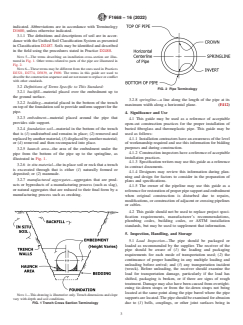
NOTE 5—The terms describing an installation cross-section are illus-
trated in Fig. 1. Other terms related to parts of the pipe are illustrated in
Fig. 2.
NOTE 6—These terms may be different from the ones used in Practices
D2321, D2774, D3839,or F690. The terms in this guide are used to
describetheconstructionsequenceandarenotmeanttoreplaceorconflict
with other standards.
3.2 Definitions of Terms Specific to This Standard:
FIG. 2 Pipe Terminology
3.2.1 backfill—material placed over the embedment up to
the ground surface.
3.2.8 springline—a line along the length of the pipe at its
3.2.2 bedding—material placed in the bottom of the trench
maximum width along a horizontal plane. (F412)
on top of the foundation soil to provide uniform support for the
pipe.
4. Significance and Use
3.2.3 embedment—material placed around the pipe that
4.1 This guide may be used as a reference of acceptable
provides side support.
open-cut construction practices for the proper installation of
3.2.4 foundation soil—material in the bottom of the trench buried fiberglass and thermoplastic pipe. This guide may be
that is (1) undisturbed and remains in place; (2) removed and used as follows:
replacedbyanothermaterial,(3)displacedbyanothermaterial; 4.1.1 Installation contractors have an awareness of the level
or (4) removed and then recompacted into place. of workmanship required and use this information for bidding
purposes and during construction.
3.2.5 haunch area—the area of the embedment under the
4.1.2 Constructioninspectorshaveareferenceofacceptable
pipe from the bottom of the pipe up to the springline, as
installation practices.
illustrated in Fig. 1.
4.1.3 Specification writers may use this guide as a reference
3.2.6 in situ material—the in-place soil or rock that a trench
in contract documents.
is excavated through that is either (1) naturally formed or
4.1.4 Designers may review this information during plan-
deposited; or (2) manmade.
ning and design for factors to consider in the preparation of
3.2.7 manufactured aggregates—aggregates that are prod-
plans and specifications.
ucts or byproducts of a manufacturing process (such as slag),
4.1.5 The owner of the pipeline may use this guide as a
or natural aggregates that are reduced to their final form by a
referenceforrestorationofproperpipesupportandembedment
manufacturing process such as crushing.
when original construction is disturbed due to repairs,
modifications, or construction of adjacent or crossing pipelines
or cables.
4.2 This guide should not be used to replace project speci-
fication requirements, manufacturer’s recommendations,
plumbing codes, building codes, or ASTM installation
standards, but may be used to supplement that information.
5. Inspection, Handling, and Storage
5.1 Load Inspection—The pipe should be packaged or
loaded as recommended by the supplier. The receiver of the
pipe should be aware of (1) the loading and packaging
requirements for each mode of transportation used; (2) the
continuance of proper handling in any multiple loading and
unloading before arrival; and (3) any transportation incident
(wreck). Before unloading, the receiver should examine the
load for transportation damage, particularly if the load has
shifted, packaging is broken, or if there are signs of rough
treatment. Damage may also have been caused from overtight-
ening tie-down straps or from the tie-down straps not being
located at the same point along the pipe barrel where the pipe
NOTE1—Thisdrawingisillustrativeonly.Trenchdimensionsandslope
supportsarelocated.Thepipeshouldbeexaminedforabrasion
vary with depth and soil conditions.
FIG. 1 Trench Cross Section Terminology due to (1) bells, couplings, or other joint surfaces being in
F1668 − 16 (2022)
contact with each other or any hard object or surface; and (2) 5.4.3 Movepackagingunitsonlywithforksorslingsthatgo
unpadded metal tie-down straps. under the packaging units. Packaging is not normally designed
to be lifted by a chain or cable attached only to the top of the
5.2 Pipe Inspection—Each load of pipe should be inspected
unit.
and inventoried for conformance to product specifications and
5.4.4 The flexibility and impact resistance of PVC, PE,
contract documents. Pipe markings vary according to ASTM
ABS, and PB pipe are reduced as the temperature approaches
specification, the type of pipe, and the manufacturer. In
freezing. Use extra care when handling these pipes during cold
general, these markings include: ASTM specification, pipe
weather. (Warning—Unloading pipe may be hazardous and
class or pressure designation, cell classification, pipe diameter,
the unloading steps must always follow the supplier’s instruc-
date of manufacture, name or trademark of the manufacturer,
tions.)
and plant identification. In some circumstances, the plant
5.5 Storage—Store the pipe in accordance with the manu-
inspector’s approval mark may also be required. Pipe intended
facturer’s recommendations. Depending on the material, typi-
for the conveyance of potable water is evaluated, tested, and
cal precautions may be as follows:
certified for use by an acceptable certifying organization when
required by the regulatory authority having jurisdiction. The 5.5.1 Store pipe under appropriate protective cover for
adverse weather conditions or if the unprotected storage time
seal or mark of the laboratory making the evaluation should be
on the pipe. Observe the unloading, uncrating, storage and might exceed the manufacturer’s recommendation.
distribution of the pipe, as applicable, and inspect each pipe 5.5.2 Storepipeunderconditionsthatwillminimizedirtand
section for damage, such as cuts, cracks, or gouges. Depths of
foreign matter accumulating on the sealing surface and in the
cuts and gouges should be compared to allowable limits in the interior of the pipe to reduce future cleaning.
pipe specifications, contract documents, or manufacturer’s
5.5.3 Store pipe in a manner that prevents bulges, flat areas,
recommendations.
ovalization,oranyotherabruptchangeinpipecurvature.Ifthe
5.2.1 Damaged pipe may or may not be repairable depend- pipe or packaging units are stacked, never exceed the stack
height allowed by the manufacturer. If the pipes are not stored
ing on the type of pipe.
in their packaging units, use the original shipping supports. If
5.2.1.1 Repairable pipe should be repaired in accordance
thisisnotpossible,storethepipewithsupportsthatpreventthe
with the manufacturer’s recommendations.
bells, spigots, couplings, or any other joint surface from
5.2.1.2 Pipe that cannot be repaired should be clearly
contact. Space the supports at intervals along the pipe to
marked to prevent usage, in a manner acceptable to the
preventlongitudinalsag.Usechocks,withorwithoutfabric(or
supplier, and then removed from the job.
rope) tiedowns, to prevent the pipe from rolling.
5.2.2 Gaskets should be checked for conformance to con-
5.5.4 Protect the pipe from excessive heat or harmful
tract documents and inspected for transportation damage. If
chemicals. Use cleaning solutions, detergents, solvents, etc.,
two or more types of gaskets are being used, the different
only in accordance with the manufacturer’s recommendations.
gaskets should be clearly identified by appropriate markings.
5.5.5 Protect gaskets from harmful substances such as dust
Specifications F477 and F913 cover the requirements for two
and grit, solvents, and petroleum-based greases and oils. Do
types of gaskets.
not store gaskets close to electrical equipment that produces
5.2.3 All solvent cements, primers, cleaners, adhesives, and
ozone. Some gaskets may need to be protected from sunlight.
lubricants should be marked, or otherwise certified, for con-
5.6 Stringing—When distributing the pipe along the pipe-
formance to applicable standards and regulations.
line alignment, the same precautions mentioned in 5.4 should
5.3 Nested Pipe—The pipe interiors and exteriors should be
be followed. In addition, the pipe should be blocked to prevent
inspected for transportation damage. Follow manufacturer’s
any possibility of rolling, due to a slight slope, wind, wash-out,
recommendations for unloading, or proceed as follows: The
or accidental bumping. Pipe with bells and spigots should be
pipe should be removed starting with the inside pipe (smallest
supportedalongthebarrelofthepipetopreventdeformationof
diameter). The pipe should be removed with a padded forklift
the jointing ends. Supporting the pipe on two or more wooden
boom and without touching other pipe.
blocks, sandbags, or earth mounds, will help prevent dirt
accumulating on the sealing surfaces and inside the pipe and,
5.4 Handling—Handling of the pipe to prevent damage
where appropriate, provide a space to slip any pipe-lifting
should be in agreement with manufacturer’s requirements.
slings under the pipe.
Typically, handling procedures will include the following
precautions:
6. Trench Excavation
5.4.1 Avoid rough handling or dropping of the pipe and
resting the pipe on hard objects that would create a point
6.1 Excavation—Excavate trenches so that sidewalls will be
loading on the pipe. Pipe sections should not be rolled over
stable under all working conditions. Slope trench walls or
rough or rocky ground. Prevent objects from being dropped on
provide supports in conformance with all local and national
or impacting the pipe.
standards for safety. Open only as much trench as can be safely
maintained.
5.4.2 Moveindividualsectionsofpipetooheavytobelifted
manually with a fabric sling, a pair of slings, or with appro- 6.1.1 The amount of open trench and the length of time
priate lifting equipment. Do not use chains, wire ropes, trenches remain open may be restricted for other reasons such
backhoe buckets, or hooks. as pedestrian safety, traffic disruptions, etc.
F1668 − 16 (2022)
6.2 Minimum Trench Width—The trench width, normally the pipe and the trench walls. Typical methods used to attain
specified in the contract documents, is based on design and full compaction between the pipe and the trench walls are as
construction factors such as pipe outside diameter, installation follows:
methods, and inspection requirements. Specific activities in the 6.5.2.1 Provide bottom cutouts in the wall of the trench box
trench that might influence the width would be joining
so that embedment material can be compacted directly against
procedures, checking gaskets, compacting soil into the haunch thetrenchwalls.Acutoutareaatthebottomoftheshieldonthe
area and beside the pipe, and soil density testing.
trailing edge allows the shield to be moved forward laterally.
6.5.2.2 In some conditions, a “subtrench” may be excavated
6.3 Supported Trench Walls—Sheeting, bracing, shoring, or
below the bottom of the trench shield. The depth of the
trench shields should be used in the following conditions:
subtrench is limited by safety regulations.
6.3.1 Whererequiredbynationalorlocalsafetyregulations.
6.5.2.3 Theshieldisraisedverticallyinabout30 cm(12 in.)
6.3.2 Where sloped trench walls are not adequate to protect
increments and the soil compacted below the bottom edge of
personnel in the trench from slides, caving, sloughing, or other
the shield from the pipe to the trench wall. This operation is
unstable soil conditions.
continued until the specified height of compacted soil is
6.3.3 Where necessary to (1) prevent structural damage to
reached.
adjoining buildings, roads, utilities, vegetation, or anything
6.6 Trench Walls—The type of soil and the density of the
else that cannot be moved, or ( 2) prevent disruptions to
trench walls may have a significant effect on the performance
businesses, provide traffic access, or similar concerns.
of the pipe and the soil-pipe system. If the conditions of the
6.3.4 Where necessary to remain within the construction
trench walls encountered are not as assumed in design, the
easement or right-of-way.
pipeline designer shall be notified and alternative provisions
6.4 Sheeting or Shoring—When supports such as trench made. The anticipated conditions should be stated in the
sheeting, shoring, bracing, or trench jacks are used, ensure that
contract documents.
the pipe support and any compacted soil around the pipe is
6.7 Contaminated Areas—If the trench excavation encoun-
maintained throughout installation. Ensure that sheeting is
ters an area contaminated with significant concentrations of
sufficiently tight to prevent washing soil out of the trench wall
pollutants comprised of low-molecular weight petroleum prod-
from behind the sheeting. Provide tight support of trench walls
ucts or organic solvents, there may be restrictions on the type
below viaducts, existing utilities, or other obstructions that
of pipe and gaskets that are used. If a previously unknown
restrict driving of sheeting.
contaminated area is encountered, all appropriate entities shall
6.4.1 Unless otherwise directed, sheeting should be left in
be notified and the contamination identified. (Warning—
place to preclude loss of support of foundation and embedment
Working in excavated trenches may be hazardous. Follow all
materials. When the top of sheeting is to be cut off, make a cut
safety regulations.)
0.5 m or more above the top of the pipe. Leave all vertical and
horizontal braces in place. Top cross bracing may need to be
7. Groundwater Control During Construction
installed after the sheeting is cut off. Sheeting that is to be left
7.1 The pipe should not be installed in standing or running
in the trench shall be constructed of materials that will not
water. Control of both surface and subsurface water (ground-
corrode or rot, resulting in a loss of support for the pipe.
water) may be required.
6.4.2 Ensure that pipe and foundation and embedment
materials are not disturbed by support removal. Avoid use of 7.2 Groundwater—When groundwater is present in the
vibratory extraction equipment. Fill voids left upon removal of trench excavation, dewatering may be necessary to maintain
supports and compact all material to required densities. stability of in situ and imported materials. As appropriate, use
sump pumps, wells or well points, or drainage blankets to
6.5 Trench Shields—A trench shield or box is a rigid
removeandcontrolwaterinthetrench.Whenexcavatingwhile
structure that can be moved along the trench to protect workers
controlling groundwater, ensure that the groundwater is below
from potentially unstable trench walls.
the bottom of the cut to prevent washout from behind sheeting
6.5.1 Application—A shield can be used in two different
or sloughing of exposed trench walls. The water should be
ways, as follows:
controlled in the trench before, during, and after pipe installa-
6.5.1.1 Trench Wall Support—The trench is excavated
tion and control maintained until the embedment is installed
from inside the shield. The trench box is lowered as the
and sufficient backfill has been placed to prevent flotation of
material is excavated.
the pipe. To prevent loss of soil support, dewatering methods
6.5.1.2 Protect Workers—The trench shield is placed into
should be used that minimize removal of fines and the creation
an existing excavation.
of voids in native materials.
6.5.2 Soil Compaction—Improper use of trench boxes 7.2.1 Drainage Blankets—Free-draining materials may be
while compacting the embedment soil can significantly affect used for all or a portion of the foundation or bedding to drain
the deflection of flexible pipe and compromise the structural water along the trench to sumps or other outlets for removal.
integrity of the pipe. Do not compact embedment soil against Perforateddrainagetubingmaybeusedtosupplementtheflow
the walls of a trench shield and then move the shield creating capacity of the drainage blanket. Select a gradation for the
a void between the compacted embedment and the trench wall. drainage materials to minimize migration of fines from sur-
The embedment soil must get completely compacted between rounding materials, or use a geotextile separator.
F1668 − 16 (2022)
7.2.2 Sump Pumps—If direct pumping from sumps is used, the in situ material. (This may not be necessary for extensive
the pumps should be submersible or self-priming, so that lengths of overexcavation, where the pipeline grade is not
intermittent flows may be discharged. Diaphragm pumps are critical.)
generally more suitable when muddy water is to be pumped,
8.2.4 If trench sidewalls slough prior to installation of the
while centrifugal pumps are best for pumping large quantities
pipe, remove all sloughed and loose material from the trench.
of water. Regardless of the specific type of pump used, a
8.2.5 Selection of material for the foundation may be
standby pump should be readily available in case the operating
affected by the recommendations in Sections 7, 17, and 18.
pump stops or becomes clogged.
7.2.3 Wells or Well Points—Lowering of the water table
9. Bedding
with wells or a well-point system is an effective means of
9.1 Requirements:
controlling groundwater in permeable soils and may eliminate
9.1.1 The bedding is material placed on the bottom of the
the need for sheeting or shoring. However, when the water
trench to provide uniform support for the pipe. Since the pipe
table is lowered, subsidence of the ground in the surrounding
is laid directly on the bedding material, place the bedding so
area may occur. Structures close to the dewatered area may
that the pipe will be at the proper elevation and slope. Where
also settle and develop structural damage or cracking.
the trench is excavated in rock, the bedding also serves as a
7.3 Surface Water—Drainage should be controlled in the
cushion for the pipe and is typically thicker than normal.When
vicinity of the excavation by grading and ditching the ground
rock is excavated, the minimum bedding thickness is the
surface to prevent runoff and surface water from running into
distance between any point of rock and the pipe, pipe bell,
the trench.
coupling, or fitting.
9.1.2 The thickness, type of soil, and degree of compaction
7.4 Flotation—If groundwater is encountered, potential flo-
tation of the pipe following construction should be evaluated. for the bedding should be specified in the contract documents.
If required, construct the pipeline to prevent flotation. Anti- If not described, contact the specifying organization for spe-
flotation restraints, such as collars or anchors, may be required cific instructions. Any change during construction shall be
in some circumstances. approved by the specifying organization.
9.1.3 The maximum particle size permitted in the bedding
8. Foundation material is typically related to the type of pipe being installed.
The allowable maximum particle size should be stated in the
8.1 Requirements:
contract documents.
8.1.1 The foundation is the material beneath the pipe that
9.1.4 For some soil conditions, a bedding may not be
prevents excessive settlement or excessive differential settle-
specified and the pipe is laid directly on the trench bottom.
ment of the pipeline. If the native material is unsuitable,
However, a bedding should be constructed if the foundation
remove it (overexcavate) and replace with suitable material.
contains alternating hard and soft areas, rock particles larger
8.1.2 A description of what material is unsuitable for the
than permitted in the embedment material, or if rock is
foundation and what soil is suitable as a replacement material
unexpectedlyencountered.Continuousevaluationofthetrench
should be part of the contract documents.
bottom during excavation may be required. Shaping the trench
8.1.3 Not all foundation problems may be anticipated in the
bottom to fit the curvature of the pipe is not recommended.
designstages.Ifanyunusualconditionsareencounteredduring
9.1.5 Selection of material for the bedding may be affected
trench excavation, site-specific modifications may be required.
by the recommendations in Sections 7, 17, and 18.
Any changes during construction shall be approved by the
specifying organization.
9.2 Construction Considerations—Recommended steps in
the placement of the bedding are as follows:
8.2 Construction Considerations—The following guidelines
9.2.1 Remove any loose rocks, large dirt clods, and debris
are recommended for the foundation:
from the trench.
8.2.1 Afoundation is considered to be stable for laying pipe
9.2.2 Do not use material for bedding that contains organic
when a person can walk on the surface without sinking into the
matter, stumps or limbs, frozen earth, debris, manmade waste,
soil or can walk without feeling the soil move underfoot. If the
or other unsuitable materials.
trench bottom is unstable, gravel, cobbles, crushed rock, slag,
9.2.3 If the soil in the bottom of the trench excavation is
crushed shell, or other durable inert material may be worked
suitable for use as the bedding material, remove the soil and
intothesoiluntilthetrenchbottomisstable.Inmanycases,the
then place it back on the trench bottom. This is useful in
unstable soil will have to be excavated and replaced with one
obtaining an even thickness of bedding and avoids high and
of these materials until the foundation is stable.
low areas or hard and soft spots beneath the pipe.
8.2.1.1 Appropriate geotextiles may be used for stabilizing
quick and unstable trench bottoms. 9.2.4 Place the bedding material so the pipe will be at the
8.2.2 Some contract documents require that when the trench proper grade when laid on the bedding. Anticipate settlement
of the pipe into uncompacted soil. Do not apply pressure to the
bottom is in rock, the minimum bedding thickness be in-
creased. pipe (such as with a backhoe bucket) to push the pipe down to
grade.
8.2.3 If the trench bottom is inadvertently overexcavated
below the intended grade, fill the overexcavation with compat- 9.2.5 Place the bedding material so each section of pipe will
ible foundation material and compact to a density equivalent to have a uniform bearing for the length of the pipe, except at
F1668 − 16 (2022)
bell-and-spigot (or other protruding) joints. Do not use soil 11.4.2 Joints and fittings in gasketed joint pressure systems
mounds or any blocking to bring the pipe to grade. should be restrained by mechanical restraint devices or thrust
blocks to compensate for these pull-out forces. See Section 19.
9.2.6 When the pipe has joints that form an offset on the
outsideofthepipe,suchasbell-and-spigotjoints,excavatebell
11.5 Gasket (Elastomeric Seal) Joints—Pipe with gasketed
holes in the bedding so that the bell does not rest on any part
joints are assembled section by section in the bottom of the
of the bedding or foundation.
trench. The bell end of the pipe should face the direction of
9.2.7 When appropriate, excavate sling holes in the bedding
laying. The sealing surfaces of the bell and spigot should be
to facilitate removal of the slings.
cleanedandinspectedfordamage.Iflubricantisused,applyas
recommended by manufacturer. Align the pipe sections, insert
10. Laying
the spigot into the bell, and push until the insertion position
marked on the pipe is reached or to the position recommended
10.1 Lay the pipe in accordance with the manufacturer’s
by the pipe manufacturer. Mark pipe insertion points if
recommendations. Typical laying practices may include the
necessary. Protect the end of the pipe during assembly, and do
following:
not use excessive force that may result in damage to the pipe
10.1.1 Lower pipe too heavy to be handled manually
or dislodged gaskets. The following practices are recom-
carefullyintoplaceonthebeddingusingapairoffabricslings.
mended when joining the pipe:
Do not use chains, wire ropes, or hooks. The pipe must never
11.5.1 When lubricant is required, use only the lubricant
be thrown, rolled, or dropped into place.
supplied or recommended for use by the manufacturer. Use
10.1.1.1 Nylon slings with a colored wear-indicator are
lubricant liberally and apply to the bell, spigot, or gasket, or
recommended for handling pipe. The slings should be dis-
any combination thereof, as recommended by the manufac-
carded when the outer fabric layer has worn enough to expose
turer. The lubricated surfaces must be protected from dirt or
the brightly colored inner layer. On these slings, the load
grit until the joining is complete. Keep the containers of
capacity is usually indicated by numbers sewn into the fabric.
lubricant covered to prevent contamination with grit or debris.
10.1.2 Avoid excessive bending of the pipe, if the pipe is
11.5.2 Examine any splices in the gasket and discard if any
assembled above ground and lowered into the trench. Bending
separation exists.As recommended by the manufacturer, some
should be within the limits recommended by the pipe manu-
pipe to be assembled with the gasket in the spigot groove
facturer for the kind, type, grade, wall thickness, and diameter
should have the tension in the gasket equalized in an approved
of a specific pipe.
manner.
10.1.3 Whenever pipe laying or joining is interrupted,
11.5.3 Useabarandwoodenblock,paddedcome-alongs,or
protecttheendsofthepipesothatpeople,animals,water,dust,
mechanical equipment with a padded push frame to push the
dirt, mud, or foreign matter is kept out of the pipe.
spigot into the bell. Use caution when using power equipment
10.1.4 Appropriate precautions should be taken on slopes to
that makes it difficult for the operator to judge when the pipe is
prevent separation of gasketed joints or pipe slippage, such as
overinserted. Be careful when using equipment that may apply
laying the pipe uphill or anchoring the pipe in place.
uneven, non-aligned pressure such as the bucket of a backhoe.
Equipment with pneumatic tires that may slip on loose or
11. Joining
cohesionless bedding material shall be used with caution to
11.1 Plastic pipe may be joined to pipe of similar or
preventsudden,uncontrolledthruststhatmaydamagethepipe.
dissimilar material using a number of different techniques. Use
Do not stab or swing one section of pipe into another pipe. Do
a technique suitable for the particular pipes being joined
not overinsert the pipe.
together. Manufacturers should be consulted for specific in-
11.5.4 Following assembly of the joint, check the pipe for
structions not covered by contract documents.
line and grade.
11.5.5 Small changes in direction for horizontal and vertical
11.2 Commonly used procedures, joining materials, and
angle points, long radius curves, or alignment corrections may
fittings are listed in Section 2.
be made by a joint angle change (an unsymmetrical closure of
11.3 Use the manufacturer’s recommended techniques,
the joint with a normal joint opening on one side of pipe and
tools, and equipment to join the pipe. Successfully joining pipe
a wider space on the opposite side of pipe). Limit the amount
requires skill, knowledge, and experience. New personnel
of angle so that the seal between the gasket and the pipe
should be trained under the guidance of skilled installers.
remains intact. The permissible angular movement varies
Detailed written procedures and visual aids for training per-
considerably among pipe manufacturers. The pipe manufactur-
sonnel are usually available from manufacturers of pipe and
er’s literature should state the maximum permissible angle
joining equipment.
change and the recommended procedure. Typically, the pipe is
11.4 Unequal forces due to fluid pressure at changes in joined as if the pipeline alignment were straight and then the
pipeline alignment or reduction in pipe size or at the end of a last pipe section moved (pulled) to the desired angle.
line may create a separation force at joining locations. These
11.5.6 With some types of gasketed joints, the gasket may
forces shall be accounted for as follows:
be checked using a feeler gage to see if the gasket has been
11.4.1 Bonded joints in pressure systems (such as heat dislodged, twisted, or pinched during assembly. The pipe may
fused, adhesive bonded, or solvent cemented), shall be de- leak where a gasket is not in the correct location. Check the
signed and constructed to withstand the separation forces. gasket around the complete circumference of the pipe.
F1668 − 16 (2022)
11.5.7 If joining is not successful, disassemble the joint, 11.8.5 Hold the joint or coupling tightly together for the
inspect for damage, reclean all joint components, and reas- entire cure time.
semble using a new gasket (except when using nonremovable-
11.9 Other Fiberglass Joining Systems—Other types of
type gaskets). If a nonremovable-type gasket is damaged,
joining methods for fiberglass pipe include mechanical
replace the pipe section (or coupling).
couplings, butt joints with laminated overlay, bell-and-spigot
11.5.8 If the pipeline is near another pipeline carrying
with laminated overlay, or flanged joints. These joints should
petroleum products, or traverses an area contaminated with
be made in conformance with the recommendations of the pipe
petroleumproducts,specialpetroleum-resistantgasketmaterial
manufacturer since equipment and procedures may be unique
mayberequired.Whentwodifferenttypesofgasketsarebeing
for each manufacturer’s product.
used, mark the gaskets or packaging to prevent misuse.
11.5.9 Pipe transporting potable water shall be joined with
12. Embedment
gaskets and lubricants that meet all regulations for products
12.1 Requirements:
used in potable water systems.
12.1.1 The embedment is the material placed around the
11.6 Solvent Cemented Joints—When making solvent-
pipe. The embedment and the pipe act together as a pipe-soil
cemented joints, follow the recommendations of both the pipe
structure to support the external loads on the pipe.
and solvent cement manufacturer or the recommendations of
12.1.1.1 Theembedmentmayextendfromthebottomofthe
Practice D2855.All contractor, inspection, and testing person-
pipe, up to a specified level somewhere between the springline
nel shall be aware of the safety precautions for using solvent
of the pipe and about 15 to 30 cm (6 to 12 in.) over the top of
cement as in Practice F402. If full entry is not achieved,
the pipe, depending on the individual requirements of the
disassemble or remove and replace the pipe. Allow freshly
owner or specifying organization.
made joints to set for the recommended time before moving,
12.1.2 The type of material, the degree of compaction, and
burying, or otherwise disturbing the pipe.Axial restraint of the
theallowablemaximumparticlesizefortheembedmentshould
joined sections may be required during curing, to prevent
be specified in the contract documents. If not specified, contact
movement from thermal expansion or contraction which could
the specifying organization for specific instructions. Any
damage the joint.
changeduringconstructionshallbeapprovedbythespecifying
11.6.1 Cold-temperature conditions slow the cure of solvent
organization.
cements. Solvent cements containing tetrahydrofuran (THF)
and other solvents that are immiscible in water are less reliable 12.1.2.1 Describe manufactured aggregates in accordance
in wet conditions. with Appendix X2 of Classification D2487. Materials such as
slag, cinders, and shells should be evaluated for particle
11.7 Heat Fusion Joints—Make heat fusion joints in con-
strength and degradation.
formance with the recommendations of the pipe manufacturer
or the recommendations of Practice D2657 for polyolefin pipe
12.2 Construction Considerations—The following opera-
excluding polyethylene pipe and Practice F2620 for polyeth-
tions are recommended for installation of the embedment:
ylenepipe.Pipemaybejoinedoutsideofthetrenchexcavation
12.2.1 Before placing embedment materials, remove any
and then lowered into position, provided the pipe is supported
rocks larger than the allowable maximum particle size, large
and handled in a manner that precludes damage. Allow
dirt clods, sloughed soil from trench walls, or any debris from
heat-fused joints to cool for the minimum prescribed time
surface of bedding.
before moving the pipe. When moving large-diameter
12.2.2 Do not use material for the embedment that contains
pipelines, avoid excessive stressing of the joints.
organic material, stumps or limbs, frozen earth, debris, man-
11.7.1 Changes in direction for horizontal and vertical angle
made wastes, and other unsuitable materials.
points, long radius curves, or alignment corrections may be
12.2.3 Do not drop the embedment material directly on the
made by slightly bending the pipe.The minimum pipe-bending
pipeifitisdeterminedthatdamagemayresult.Inthiscase,use
radius is usually stated in the manufacturer’s literature. Too
chutes or other means to direct or divert the flow of material to
much curvature of the pipe can create excessive diametral
the sides of the trench.
deformation or excessive bending stresses which can induce
12.2.4 Distribute the embedment material evenly along the
pipe failure. Bracing or blocking the pipe should not be used to
trench and equally on both sides of the pipe to maintain
force curvature.
alignment. Do not dump the material into a large pile in the
11.8 Adhesive Bonded Joints—Make adhesive-bonded
trench prior to spreading into a layer for compaction. A large
joints in conformance with the recommendations of the pipe
mass of material against the pipe may push the pipe out of
manufacturer. Some fiberglass pipe are joined using adhesives
alignment or create a flat or depressed area on the pipe. Small
to bond bell-and-spigot joints on tapered couplings. The
wedges of material in the haunch area may be useful to
following precautions are typically part of the pr
...