

ASTM G205-23
(Guide)Standard Guide for Determining Emulsion Properties, Wetting Behavior, and Corrosion-Inhibitory Properties of Crude Oils
General Information
- Abstract
SIGNIFICANCE AND USE
5.1 In the absence of water, the crude oil is noncorrosive. However, trace amounts of water and sediment have the potential to create corrosive situations during crude oil handling or transport if such materials accumulate and persist on steel surfaces. Test Methods D473 and D4006 provide methods for determination of the water and sediment content of crude oil.
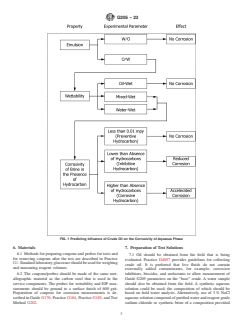
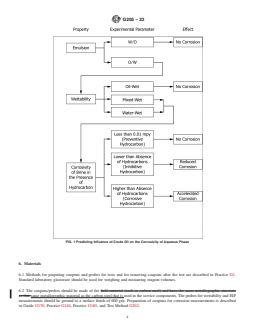
5.2 The potential for a corrosive situation to develop during the handling and transport of crude oil that contains water can be determined by a combination of three properties (Fig. 1) (1)6: the type of emulsion formed between oil and water, the wettability of the steel surface, and the corrosivity of water phase in the presence of oil.
FIG. 1 Predicting Influence of Crude Oil on the Corrosivity of Aqueous Phase
5.3 Water and oil are immiscible but, under certain conditions, they can form emulsion. There are two kinds of emulsion: oil-in-water (O/W) and water-in-oil (W/O). W/O emulsion (in which oil is the continuous phase) has low conductivity and is thus less corrosive; whereas O/W (in which water is the continuous phase) has high conductivity and, hence, is corrosive (2) (see ISO 6614). The percentage of water at which W/O converts to O/W is known as the emulsion inversion point (EIP). EIP can be determined by measuring the conductivity of the emulsion. At and above the EIP, a continuous phase of water or free water is present. Therefore, there is a potential for corrosion.
5.4 Whether water phase can cause corrosion in the presence of oil depends on whether the surface is oil-wet (hydrophobic) or water-wet (hydrophilic) (1, 3-5). Because of higher resistance, an oil-wet surface is not susceptible to corrosion, but a water-wet surface is. Wettability can be characterized by measuring the contact angle or by evaluating the tendency of water to displace oil from a multi-electrode array by measuring the resistance (or conductors) between the electrodes (spreading methodology).
5.4.1 In the con...
SCOPE
1.1 This guide covers some generally accepted laboratory methodologies that are used for determining emulsion forming tendency, wetting behavior, and corrosion-inhibitory properties of crude oil.
1.2 This guide does not cover detailed calculations and methods, but rather covers a range of approaches that have found application in evaluating emulsions, wettability, and the corrosion rate of steel in crude oil/water mixtures.
1.3 Only those methodologies that have found wide acceptance in the industry are considered in this guide.
1.4 This guide is intended to assist in the selection of methodologies that can be used for determining the corrosivity of crude oil under conditions in which water is present in the liquid state (typically up to 100 °C). These conditions normally occur during oil and gas production, storage, and transportation in the pipelines.
1.5 This guide is not applicable at higher temperatures (typically above 300 °C) that occur during refining crude oil in refineries.
1.6 This guide involves the use of electrical currents in the presence of flammable liquids. Awareness of fire safety is critical for the safe use of this guide.
1.7 The values stated in SI units are to be regarded as standard. No other units of measurement are included in this standard.
1.8 This standard does not purport to address all of the safety concerns, if any, associated with its use. It is the responsibility of the user of this standard to establish appropriate safety, health, and environmental practices and determine the applicability of regulatory limitations prior to use.
1.9 This international standard was developed in accordance with internationally recognized principles on standardization established in the Decision on Principles for the Development of International Standards, Guides and Recommendations issued by the World Trade Organization Technical Barriers to Trade (TBT) Committee.
- Status
- Published
- Publication Date
- 30-Nov-2023
- Technical Committee
- G01 - Corrosion of Metals
- Drafting Committee
- G01.05 - Laboratory Corrosion Tests
Buy Documents
ASTM G205-23 - Standard Guide for Determining Emulsion Properties, Wetting Behavior, and Corrosion-Inhibitory Properties of Crude Oils
REDLINE ASTM G205-23 - Standard Guide for Determining Emulsion Properties, Wetting Behavior, and Corrosion-Inhibitory Properties of Crude Oils
Overview
ASTM G205-23 is a comprehensive standard guide developed by ASTM International that outlines laboratory methodologies for determining emulsion properties, wetting behavior, and corrosion-inhibitory properties of crude oils. The standard is particularly significant for industries involved in the production, storage, and transportation of crude oil, where understanding the interactions between oil, water, and steel surfaces can help mitigate the risk of corrosion in pipelines and related facilities. ASTM G205-23 consolidates widely accepted testing approaches and is intended to assist professionals in choosing appropriate methods for evaluating the potential corrosivity of crude oil systems, especially under conditions in which water is present in the liquid state.
Key Topics
Emulsion Properties:
Crude oil and water are typically immiscible but can form emulsions under certain conditions. The guide distinguishes between oil-in-water (O/W) and water-in-oil (W/O) emulsions:- Oil-in-Water (O/W) Emulsion: Water is the continuous phase, which is more conductive and generally more corrosive.
- Water-in-Oil (W/O) Emulsion: Oil is the continuous phase, resulting in lower conductivity and lower corrosivity.
- The Emulsion Inversion Point (EIP) is the critical water percentage at which W/O converts to O/W and is determined by measuring emulsion conductivity.
Wetting Behavior (Wettability):
- The typical methods to evaluate how a steel surface interacts with oil and water include contact angle measurements and spreading methodologies.
- Oil-wet (hydrophobic) surfaces exhibit higher resistance and are less susceptible to corrosion.
- Water-wet (hydrophilic) surfaces are more prone to corrosion.
- The degree of wettability is quantified by measuring the contact angle between the steel surface and the test fluids.
Corrosion-Inhibitory Properties:
- The corrosivity of the aqueous phase in the presence of crude oil is evaluated to classify a crude oil as corrosive, neutral, or inhibitive.
- Laboratory procedures assess the corrosion rate of steel in contact with oil-water emulsions or after exposure to crude oil.
Applications
Pipeline Integrity Management:
The standard is critical for pipeline operators to assess corrosion risks related to water and sediment accumulation and select appropriate monitoring and mitigation strategies.Crude Oil Production and Storage:
By understanding emulsion tendencies and wettability, operators can optimize crude oil handling, storage, and transport conditions to minimize corrosion of tanks and processing infrastructure.Laboratory Testing and Quality Assurance:
Laboratories apply ASTM G205-23 methodologies to simulate field conditions, assess the effects of water cut, and provide data for materials selection or corrosion inhibition strategies.Regulatory and Safety Compliance:
ASTM G205-23 supports industry adherence to best practices regarding fire safety, environmental protection, and overall risk management when handling flammable and corrosive substances.
Related Standards
- ASTM D473 – Sediment in Crude Oils and Fuel Oils
- ASTM D4006 – Water in Crude Oil by Distillation
- ASTM D1125 – Electrical Conductivity and Resistivity of Water
- ASTM G31 – Laboratory Immersion Corrosion Testing of Metals
- ASTM G170/G184/G185/G202 – Guides and practices for evaluating corrosion inhibitors and corrosion rates in oilfield and refinery environments
- ISO 6614 – Determination of Water Separability of Petroleum Oils
- NACE TM0172 – Test Method for Corrosive Properties in Petroleum Product Pipelines
Keywords: crude oil corrosion, emulsion properties, wettability, pipeline corrosion, emulsion inversion point, corrosion-inhibitory oil, oil-in-water emulsion, water-in-oil emulsion, ASTM G205-23, laboratory corrosion testing, crude oil handling standards, oil and gas pipeline integrity.
Relations
- Effective Date
- 01-Dec-2023
- Effective Date
- 01-Dec-2023
- Effective Date
- 01-May-2020
- Effective Date
- 01-May-2020
- Effective Date
- 01-Dec-2019
Buy Documents
ASTM G205-23 - Standard Guide for Determining Emulsion Properties, Wetting Behavior, and Corrosion-Inhibitory Properties of Crude Oils
REDLINE ASTM G205-23 - Standard Guide for Determining Emulsion Properties, Wetting Behavior, and Corrosion-Inhibitory Properties of Crude Oils
Get Certified
Connect with accredited certification bodies for this standard

Element Materials Technology
Materials testing and product certification.

ABS Group Brazil
ABS Group certification services in Brazil.

ABS Quality Evaluations Inc.
American Bureau of Shipping quality certification.
Sponsored listings
Frequently Asked Questions
ASTM G205-23 is a guide published by ASTM International. Its full title is "Standard Guide for Determining Emulsion Properties, Wetting Behavior, and Corrosion-Inhibitory Properties of Crude Oils". This standard covers: SIGNIFICANCE AND USE 5.1 In the absence of water, the crude oil is noncorrosive. However, trace amounts of water and sediment have the potential to create corrosive situations during crude oil handling or transport if such materials accumulate and persist on steel surfaces. Test Methods D473 and D4006 provide methods for determination of the water and sediment content of crude oil. 5.2 The potential for a corrosive situation to develop during the handling and transport of crude oil that contains water can be determined by a combination of three properties (Fig. 1) (1)6: the type of emulsion formed between oil and water, the wettability of the steel surface, and the corrosivity of water phase in the presence of oil. FIG. 1 Predicting Influence of Crude Oil on the Corrosivity of Aqueous Phase 5.3 Water and oil are immiscible but, under certain conditions, they can form emulsion. There are two kinds of emulsion: oil-in-water (O/W) and water-in-oil (W/O). W/O emulsion (in which oil is the continuous phase) has low conductivity and is thus less corrosive; whereas O/W (in which water is the continuous phase) has high conductivity and, hence, is corrosive (2) (see ISO 6614). The percentage of water at which W/O converts to O/W is known as the emulsion inversion point (EIP). EIP can be determined by measuring the conductivity of the emulsion. At and above the EIP, a continuous phase of water or free water is present. Therefore, there is a potential for corrosion. 5.4 Whether water phase can cause corrosion in the presence of oil depends on whether the surface is oil-wet (hydrophobic) or water-wet (hydrophilic) (1, 3-5). Because of higher resistance, an oil-wet surface is not susceptible to corrosion, but a water-wet surface is. Wettability can be characterized by measuring the contact angle or by evaluating the tendency of water to displace oil from a multi-electrode array by measuring the resistance (or conductors) between the electrodes (spreading methodology). 5.4.1 In the con... SCOPE 1.1 This guide covers some generally accepted laboratory methodologies that are used for determining emulsion forming tendency, wetting behavior, and corrosion-inhibitory properties of crude oil. 1.2 This guide does not cover detailed calculations and methods, but rather covers a range of approaches that have found application in evaluating emulsions, wettability, and the corrosion rate of steel in crude oil/water mixtures. 1.3 Only those methodologies that have found wide acceptance in the industry are considered in this guide. 1.4 This guide is intended to assist in the selection of methodologies that can be used for determining the corrosivity of crude oil under conditions in which water is present in the liquid state (typically up to 100 °C). These conditions normally occur during oil and gas production, storage, and transportation in the pipelines. 1.5 This guide is not applicable at higher temperatures (typically above 300 °C) that occur during refining crude oil in refineries. 1.6 This guide involves the use of electrical currents in the presence of flammable liquids. Awareness of fire safety is critical for the safe use of this guide. 1.7 The values stated in SI units are to be regarded as standard. No other units of measurement are included in this standard. 1.8 This standard does not purport to address all of the safety concerns, if any, associated with its use. It is the responsibility of the user of this standard to establish appropriate safety, health, and environmental practices and determine the applicability of regulatory limitations prior to use. 1.9 This international standard was developed in accordance with internationally recognized principles on standardization established in the Decision on Principles for the Development of International Standards, Guides and Recommendations issued by the World Trade Organization Technical Barriers to Trade (TBT) Committee.
SIGNIFICANCE AND USE 5.1 In the absence of water, the crude oil is noncorrosive. However, trace amounts of water and sediment have the potential to create corrosive situations during crude oil handling or transport if such materials accumulate and persist on steel surfaces. Test Methods D473 and D4006 provide methods for determination of the water and sediment content of crude oil. 5.2 The potential for a corrosive situation to develop during the handling and transport of crude oil that contains water can be determined by a combination of three properties (Fig. 1) (1)6: the type of emulsion formed between oil and water, the wettability of the steel surface, and the corrosivity of water phase in the presence of oil. FIG. 1 Predicting Influence of Crude Oil on the Corrosivity of Aqueous Phase 5.3 Water and oil are immiscible but, under certain conditions, they can form emulsion. There are two kinds of emulsion: oil-in-water (O/W) and water-in-oil (W/O). W/O emulsion (in which oil is the continuous phase) has low conductivity and is thus less corrosive; whereas O/W (in which water is the continuous phase) has high conductivity and, hence, is corrosive (2) (see ISO 6614). The percentage of water at which W/O converts to O/W is known as the emulsion inversion point (EIP). EIP can be determined by measuring the conductivity of the emulsion. At and above the EIP, a continuous phase of water or free water is present. Therefore, there is a potential for corrosion. 5.4 Whether water phase can cause corrosion in the presence of oil depends on whether the surface is oil-wet (hydrophobic) or water-wet (hydrophilic) (1, 3-5). Because of higher resistance, an oil-wet surface is not susceptible to corrosion, but a water-wet surface is. Wettability can be characterized by measuring the contact angle or by evaluating the tendency of water to displace oil from a multi-electrode array by measuring the resistance (or conductors) between the electrodes (spreading methodology). 5.4.1 In the con... SCOPE 1.1 This guide covers some generally accepted laboratory methodologies that are used for determining emulsion forming tendency, wetting behavior, and corrosion-inhibitory properties of crude oil. 1.2 This guide does not cover detailed calculations and methods, but rather covers a range of approaches that have found application in evaluating emulsions, wettability, and the corrosion rate of steel in crude oil/water mixtures. 1.3 Only those methodologies that have found wide acceptance in the industry are considered in this guide. 1.4 This guide is intended to assist in the selection of methodologies that can be used for determining the corrosivity of crude oil under conditions in which water is present in the liquid state (typically up to 100 °C). These conditions normally occur during oil and gas production, storage, and transportation in the pipelines. 1.5 This guide is not applicable at higher temperatures (typically above 300 °C) that occur during refining crude oil in refineries. 1.6 This guide involves the use of electrical currents in the presence of flammable liquids. Awareness of fire safety is critical for the safe use of this guide. 1.7 The values stated in SI units are to be regarded as standard. No other units of measurement are included in this standard. 1.8 This standard does not purport to address all of the safety concerns, if any, associated with its use. It is the responsibility of the user of this standard to establish appropriate safety, health, and environmental practices and determine the applicability of regulatory limitations prior to use. 1.9 This international standard was developed in accordance with internationally recognized principles on standardization established in the Decision on Principles for the Development of International Standards, Guides and Recommendations issued by the World Trade Organization Technical Barriers to Trade (TBT) Committee.
ASTM G205-23 is classified under the following ICS (International Classification for Standards) categories: 75.040 - Crude petroleum. The ICS classification helps identify the subject area and facilitates finding related standards.
ASTM G205-23 has the following relationships with other standards: It is inter standard links to ASTM G205-16, ASTM D665-23, ASTM D1129-13(2020)e2, ASTM D1129-13(2020)e1, ASTM D665-19. Understanding these relationships helps ensure you are using the most current and applicable version of the standard.
ASTM G205-23 is available in PDF format for immediate download after purchase. The document can be added to your cart and obtained through the secure checkout process. Digital delivery ensures instant access to the complete standard document.
Standards Content (Sample)
This international standard was developed in accordance with internationally recognized principles on standardization established in the Decision on Principles for the
Development of International Standards, Guides and Recommendations issued by the World Trade Organization Technical Barriers to Trade (TBT) Committee.
Designation: G205 − 23
Standard Guide for
Determining Emulsion Properties, Wetting Behavior, and
Corrosion-Inhibitory Properties of Crude Oils
This standard is issued under the fixed designation G205; the number immediately following the designation indicates the year of
original adoption or, in the case of revision, the year of last revision. A number in parentheses indicates the year of last reapproval. A
superscript epsilon (´) indicates an editorial change since the last revision or reapproval.
1. Scope ization established in the Decision on Principles for the
Development of International Standards, Guides and Recom-
1.1 This guide covers some generally accepted laboratory
mendations issued by the World Trade Organization Technical
methodologies that are used for determining emulsion forming
Barriers to Trade (TBT) Committee.
tendency, wetting behavior, and corrosion-inhibitory properties
of crude oil.
2. Referenced Documents
1.2 This guide does not cover detailed calculations and
2.1 ASTM Standards:
methods, but rather covers a range of approaches that have
D473 Test Method for Sediment in Crude Oils and Fuel Oils
found application in evaluating emulsions, wettability, and the
by the Extraction Method
corrosion rate of steel in crude oil/water mixtures.
D665 Test Method for Rust-Preventing Characteristics of
1.3 Only those methodologies that have found wide accep-
Inhibited Mineral Oil in the Presence of Water
tance in the industry are considered in this guide.
D724 Test Method for Surface Wettability of Paper (Angle-
of-Contact Method) (Withdrawn 2009)
1.4 This guide is intended to assist in the selection of
D1125 Test Methods for Electrical Conductivity and Resis-
methodologies that can be used for determining the corrosivity
tivity of Water
of crude oil under conditions in which water is present in the
D1129 Terminology Relating to Water
liquid state (typically up to 100 °C). These conditions normally
D1141 Practice for Preparation of Substitute Ocean Water
occur during oil and gas production, storage, and transportation
D4006 Test Method for Water in Crude Oil by Distillation
in the pipelines.
D4057 Practice for Manual Sampling of Petroleum and
1.5 This guide is not applicable at higher temperatures
Petroleum Products
(typically above 300 °C) that occur during refining crude oil in
G1 Practice for Preparing, Cleaning, and Evaluating Corro-
refineries.
sion Test Specimens
1.6 This guide involves the use of electrical currents in the
G31 Guide for Laboratory Immersion Corrosion Testing of
presence of flammable liquids. Awareness of fire safety is
Metals
critical for the safe use of this guide.
G111 Guide for Corrosion Tests in High Temperature or
High Pressure Environment, or Both
1.7 The values stated in SI units are to be regarded as
G170 Guide for Evaluating and Qualifying Oilfield and
standard. No other units of measurement are included in this
Refinery Corrosion Inhibitors in the Laboratory
standard.
G184 Practice for Evaluating and Qualifying Oil Field and
1.8 This standard does not purport to address all of the
Refinery Corrosion Inhibitors Using Rotating Cage
safety concerns, if any, associated with its use. It is the
G185 Practice for Evaluating and Qualifying Oil Field and
responsibility of the user of this standard to establish appro-
Refinery Corrosion Inhibitors Using the Rotating Cylinder
priate safety, health, and environmental practices and deter-
Electrode
mine the applicability of regulatory limitations prior to use.
G193 Terminology and Acronyms Relating to Corrosion
1.9 This international standard was developed in accor-
G202 Test Method for Using Atmospheric Pressure Rotating
dance with internationally recognized principles on standard-
Cage
1 2
This guide is under the jurisdiction of ASTM Committee G01 on Corrosion of For referenced ASTM standards, visit the ASTM website, www.astm.org, or
Metals and is the direct responsibility of Subcommittee G01.05 on Laboratory contact ASTM Customer Service at service@astm.org. For Annual Book of ASTM
Corrosion Tests. Standards volume information, refer to the standard’s Document Summary page on
Current edition approved Dec. 1, 2023. Published January 2024. Originally the ASTM website.
approved in 2010. Last previous edition approved in 2016 as G205 – 16. DOI: The last approved version of this historical standard is referenced on
10.1520/G0205-23. www.astm.org.
Copyright © ASTM International, 100 Barr Harbor Drive, PO Box C700, West Conshohocken, PA 19428-2959. United States
G205 − 23
2.2 ISO Standard: dling or transport if such materials accumulate and persist on
ISO 6614 Petroleum products—Determination of Water steel surfaces. Test Methods D473 and D4006 provide methods
Separability of Petroleum Oils and Synthetic Fluids for determination of the water and sediment content of crude
2.3 NACE Standard: oil.
TM0172 Standard Test Method Determining Corrosive
5.2 The potential for a corrosive situation to develop during
Properties of Cargoes in Petroleum Product Pipelines
the handling and transport of crude oil that contains water can
be determined by a combination of three properties (Fig. 1)
3. Terminology
(1) : the type of emulsion formed between oil and water, the
3.1 Definitions—The terminology used herein, if not spe-
wettability of the steel surface, and the corrosivity of water
cifically defined otherwise, shall be in accordance with termi-
phase in the presence of oil.
nologies in Guide G170, Terminology G193, and Terminology
5.3 Water and oil are immiscible but, under certain
D1129. Definitions provided herein and not given in terminolo-
conditions, they can form emulsion. There are two kinds of
gies in Guide G170, Terminology G193, and Terminology
emulsion: oil-in-water (O/W) and water-in-oil (W/O). W/O
D1129 are limited only to this standard.
emulsion (in which oil is the continuous phase) has low
3.2 Definitions of Terms Specific to This Standard:
conductivity and is thus less corrosive; whereas O/W (in which
3.2.1 emulsion, n—a two-phase immiscible liquid system in
water is the continuous phase) has high conductivity and,
which one phase is dispersed as droplets in the other phase.
hence, is corrosive (2) (see ISO 6614). The percentage of water
3.2.2 emulsion-inversion point, n—the volume percentage at which W/O converts to O/W is known as the emulsion
of water at which a water-in-oil (W/O) emulsion converts into inversion point (EIP). EIP can be determined by measuring the
oil-in-water (O/W) emulsion. conductivity of the emulsion. At and above the EIP, a continu-
ous phase of water or free water is present. Therefore, there is
3.2.3 wettability, n—tendency of a liquid to wet or adhere on
a potential for corrosion.
to a solid surface.
5.4 Whether water phase can cause corrosion in the pres-
3.3 Acronyms:
ence of oil depends on whether the surface is oil-wet (hydro-
CO = Carbon dioxide
phobic) or water-wet (hydrophilic) (1, 3-5). Because of higher
EIP = Emulsion inversion point
resistance, an oil-wet surface is not susceptible to corrosion,
H S = Hydrogen sulfide
2 but a water-wet surface is. Wettability can be characterized by
NaCl = Sodium chloride
measuring the contact angle or by evaluating the tendency of
O/W = Oil-in-water
water to displace oil from a multi-electrode array by measuring
W/O = Water-in-oil
the resistance (or conductors) between the electrodes (spread-
ing methodology).
4. Summary of Guide
5.4.1 In the contact angle methodology, the tendency of
4.1 This guide describes methodologies for determining
water to displace hydrocarbon from steel is determined by
three properties of crude oils that are relevant to corrosion
direct observation of the contact angle that results when both
processes caused by the presence of water in hydrocarbon
oil and water are in contact with the steel. Although this contact
transport and handling: (1) the emulsion of the oil and water,
angle is determined by the interfacial free energies of the
(2) the wettability of the steel surface, and (3) the corrosivity of
phases involved, there is no standard method to determine the
water phase in the presence of oil.
steel-oil or steel-water interfacial free energies.
4.2 Conductivity of emulsion can be used to determine the
5.4.2 In the spreading methodology of determining
type of emulsion: oil-in-water (O/W) or water-in-oil (W/O).
wettability, the resistance between isolated steel pins is mea-
The conductivity of O/W emulsion (in which water is the
sured. If a conducting phase (for example, water) covers (wets)
continuous phase) is high. The conductivity of W/O emulsion the distance between the pins, conductivity between them will
(in which oil is the continuous phase) is low.
be high. If a non-conducting phase (for example, oil) covers
(wets) the distance between the pins, the conductivity between
4.3 The wettability of a steel surface is determined by either
them will be low.
contact angle methodology or spreading methodology.
5.5 Dissolution of ingredients from crude oils may alter the
4.4 The corrosiveness of water phase in the presence of
corrosiveness of the aqueous phase. A crude oil can be
crude oil can be determined using several methodologies.
classified as corrosive or inhibitory based on how the corro-
5. Significance and Use sivity of the aqueous phase is altered by the presence of the oil.
Corrosiveness of aqueous phase in the presence of oil can be
5.1 In the absence of water, the crude oil is noncorrosive.
determined by methods described in Test Method D665, Guide
However, trace amounts of water and sediment have the
G170, Practice G184, Practice G185, Test Method G202, and
potential to create corrosive situations during crude oil han-
NACE TM0172.
Available from the American National Standards Institute, 25 W. 43rd St., New
York, NY 10036.
5 6
Available from the National Association of Corrosion Engineers, 1440 S. Creek The boldface numbers in parentheses refer to a list of references at the end of
Dr., Houston, TX 77084-4906. this standard.
G205 − 23
FIG. 1 Predicting Influence of Crude Oil on the Corrosivity of Aqueous Phase
6. Materials 7. Preparation of Test Solutions
6.1 Methods for preparing coupons and probes for tests and
7.1 Oil should be obtained from the field that is being
for removing coupons after the test are described in Practice
evaluated. Practice D4057 provides guidelines for collecting
G1. Standard laboratory glassware should be used for weighing
crude oil. It is preferred that live fluids do not contain
and measuring reagent volumes.
externally added contaminants, for example, corrosion
6.2 The coupons/probes should be made of the same met- inhibitors, biocides, and surfactants to allow measurement of
allographic material as the carbon steel that is used in the Guide G205 parameters on the “base” crude. A water sample
service components. The probes for wettability and EIP mea- should also be obtained from the field. A synthetic aqueous
surements should be ground to a surface finish of 600 grit. solution could be used; the composition of which should be
Preparation of coupons for corrosion measurements is de- based on field water analysis. Alternatively, use of 3 % NaCl
scribed in Guide G170, Practice G184, Practice G185, and Test aqueous solution composed of purified water and reagent grade
Method G202. sodium chloride or synthetic brine of a composition provided
G205 − 23
1—Experimental section (see Fig. 3)
2—Flow controller
3—Circulatory pump
4—Reservoir (volume = 7 L)
5—Impeller
6—Gas inlet
7—Gas outlet
8—Power source to operate the impeller
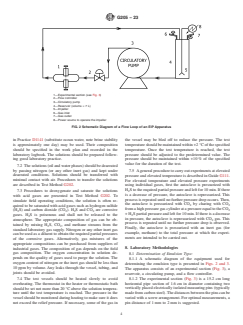
FIG. 2 Schematic Diagram of a Flow Loop of an EIP Apparatus
in Practice D1141 (substitute ocean water, note brine stability the vessel may be bled off to reduce the pressure. The test
is approximately one day) may be used. Their composition temperature should be maintained within +2 °C of the specified
should be specified in the work plan and recorded in the temperature. Once the test temperature is reached, the test
laboratory logbook. The solutions should be prepared follow- pressure should be adjusted to the predetermined value. The
ing good laboratory practice. pressure should be maintained within +10 % of the specified
value for the duration of the test.
7.2 The solutions (oil and water phases) should be deaerated
by passing nitrogen (or any other inert gas) and kept under
7.5 A general procedure to carry out experiments at elevated
deaerated conditions. Solutions should be transferred with
pressure and elevated temperature is described in Guide G111.
minimal contact with air. Procedures to transfer the solutions
For elevated temperature and elevated pressure experiments
are described in Test Method G202.
using individual gases, first the autoclave is pressurized with
H S to the required partial pressure and left for 10 min. If there
7.3 Procedures to deoxygenate and saturate the solutions
is a decrease of pressure, the autoclave is repressurized. This
with acid gases are presented in Test Method G202. To
process is repeated until no further pressure drop occurs. Then,
simulate field operating conditions, the solution is often re-
the autoclave is pressurized with CO by charing with CO
2 2
quired to be saturated with acid gases such as hydrogen sulfide
from a high pressure gas cylinder at a pressure equal to the CO
(H S) and carbon dioxide (CO ). H S and CO are corrosive
2 2 2 2
+ H S partial pressure and left for 10 min. If there is a decrease
gases. H S is poisonous and shall not be released to the
in pressure, the autoclave is repressurized with CO gas. This
atmosphere. The appropriate composition of gas can be ob-
process is repeated until no further pressure drop is observed.
tained by mixing H S, CO , and methane streams from the
2 2
Finally, the autoclave is pressurized with an inert gas (for
standard laboratory gas supply. Nitrogen or any other inert gas
example, methane) to the total pressure at which the experi-
can be used as a diluent to obtain the required partial pressures
ments are intended to be carried out.
of the corrosive gases. Alternatively, gas mixtures of the
appropriate compositions can be purchased from suppliers of
8. Laboratory Methodologies
industrial gases. The composition of gas depends on the field
gas composition. The oxygen concentration in solution de-
8.1 Determination of Emulsion Type:
pends on the quality of gases used to purge the solution. The
8.1.1 A schematic diagram of the equipment used for
oxygen content of nitrogen or the inert gas should be less than
determining the emulsion type is presented in Figs. 2 and 3.
10 ppm by volume. Any leaks through the vessel, tubing, and
The apparatus consists of an experimental section (Fig. 3), a
joints should be avoided.
reservoir, a circulating pump, and a flow controller.
7.4 The test vessels should be heated slowly to avoid 8.1.2 The experimental section (Fig. 3) is a 15.2 cm long
overheating. The thermostat in the heater or thermostatic bath horizontal pipe section of 1.6 cm in diameter containing two
should be set not more than 20 °C above the solution tempera- vertically placed electrically isolated measuring pins (typically
ture until the test temperature is reached. The pressure in the made from carbon steel). The distances between the pins can be
vessel should be monitored during heating to make sure it does varied with a screw arrangement. For optimal measurements, a
not exceed the relief pressure. If necessary, some of the gas in pin distance of 1 mm to 2 mm is suggested.
G205 − 23
FIG. 3 Schematic Diagram of the Experimental Section of the EIP Apparatus
8.1.3 The reservoir (typically 7 L capacity) may be an started to thoroughly mix the fluids. The rotation speed of the
autoclave (for higher pressure measurements) or a glass impeller and the duration of rotation depend on the character-
container (for atmospheric pressure measurements). The top istics of oil. Alternatively the test solution can be mixed within
cover of the reservoir is fitted with an inlet, an outlet, and an the apparatus during fluid circulation by releasing the returning
impeller. For higher pressure experiments, the reservoir is also fluids within the reservoir at an angle to create a vortex. A
fitted with a pressure gauge to monitor the pressure. The homogenous mixture of water and crude oil, is required during
impeller should be capable of rotating at annular rotation the conductivity measurements.
speeds higher than 1000 rpm. A homogenous solution may also
8.1.8 Once a homogenous mixture of brine and crude oil is
be created without an impeller by designing the reservoir inlet
circulating through the experimental section, the electrical
with horizontal flow and adjustable height to the top of the
resistance of the solution is measured using the two probes as
liquid level that provides sufficient turbulence to mix the test
described in Test Method D1125.
fluids.
NOTE 1—The DC method of measuring electrical resistance may be
8.1.4 The circulating pump is used to circulate the emulsion
used with a low voltage (1.5 V to 3 V battery) multi-meter. However, care
between the reservoir and the experimental section. The pump
should be taken to avoid electrolysis of the measuring probes by
should be capable of pumping fluids at a speed of 50 cm/s
restricting the duration of the measurement (typically five seconds) and by
through the experimental section across the measuring pins.
taking several measurements (typically three) at regular intervals (with at
least 1 min between each measurement (during which time the DC power
The flowrate is achieved with a flow controller or variable
source is turned off).
speed pump.
8.1.5 The apparatus should be cleaned before each experi-
8.1.9 After measuring the electrical resistance of 90 % oil,
ment. The measuring pins should be washed as described in
circulation is stopped and an additional 10 % increment of
Practice G1 to remove any corrosion products.
brine is added to the reservoir. Subsection 8.1.7 is repeated
8.1.6 An appropriate volume of oil (typically 1 L) is poured
after each 10 % addition of brine. This process is repeated until
into the reservoir and the entire EIP apparatus is deoxygenated
conductivity measurements indicate the inversion of the emul-
using an inert gas (and presaturated with gases (typically CO ,
sion by a significant increase in the measured conductivity.
H S, and methane) when necessary), as described in Section 7.
8.1.10 The emulsion inversion point is determined from a
Note that proper deoxygen
...
This document is not an ASTM standard and is intended only to provide the user of an ASTM standard an indication of what changes have been made to the previous version. Because
it may not be technically possible to adequately depict all changes accurately, ASTM recommends that users consult prior editions as appropriate. In all cases only the current version
of the standard as published by ASTM is to be considered the official document.
Designation: G205 − 16 G205 − 23
Standard Guide for
Determining Emulsion Properties, Wetting Behavior, and
Corrosion-Inhibitory Properties of Crude Oils
This standard is issued under the fixed designation G205; the number immediately following the designation indicates the year of
original adoption or, in the case of revision, the year of last revision. A number in parentheses indicates the year of last reapproval. A
superscript epsilon (´) indicates an editorial change since the last revision or reapproval.
1. Scope
1.1 This guide presentscovers some generally accepted laboratory methodologies that are used for determining emulsion forming
tendency, wetting behavior, and corrosion-inhibitory properties of crude oil.
1.2 This guide does not cover detailed calculations and methods, but rather covers a range of approaches that have found
application in evaluating emulsions, wettability, and the corrosion rate of steel in crude oil/water mixtures.
1.3 Only those methodologies that have found wide acceptance in the industry are considered in this guide.
1.4 This guide is intended to assist in the selection of methodologies that can be used for determining the corrosivity of crude oil
under conditions in which water is present in the liquid state (typically up to 100°C).100 °C). These conditions normally occur
during oil and gas production, storage, and transportation in the pipelines.
1.5 This guide is not applicable at higher temperatures (typically above 300°C)300 °C) that occur during refining crude oil in
refineries.
1.6 This guide involves the use of electrical currents in the presence of flammable liquids. Awareness of fire safety is critical for
the safe use of this guide.
1.7 The values stated in SI units are to be regarded as standard. No other units of measurement are included in this standard.
1.8 This standard does not purport to address all of the safety concerns, if any, associated with its use. It is the responsibility
of the user of this standard to establish appropriate safety and healthsafety, health, and environmental practices and determine
the applicability of regulatory limitations prior to use.
1.9 This international standard was developed in accordance with internationally recognized principles on standardization
established in the Decision on Principles for the Development of International Standards, Guides and Recommendations issued
by the World Trade Organization Technical Barriers to Trade (TBT) Committee.
This guide is under the jurisdiction of ASTM Committee G01 on Corrosion of Metals and is the direct responsibility of Subcommittee G01.05 on Laboratory Corrosion
Tests.
Current edition approved Nov. 1, 2016Dec. 1, 2023. Published December 2016January 2024. Originally approved in 2010. Last previous edition approved in 20102016
as G205 – 10.G205 – 16. DOI: 10.1520/G0205-16.10.1520/G0205-23.
Copyright © ASTM International, 100 Barr Harbor Drive, PO Box C700, West Conshohocken, PA 19428-2959. United States
G205 − 23
2. Referenced Documents
2.1 ASTM Standards:
D96 Test Method for Water and Sediment in Crude Oil by Centrifuge Method (Field Procedure) (Withdrawn 2000)
D473 Test Method for Sediment in Crude Oils and Fuel Oils by the Extraction Method
D665 Test Method for Rust-Preventing Characteristics of Inhibited Mineral Oil in the Presence of Water
D724 Test Method for Surface Wettability of Paper (Angle-of-Contact Method) (Withdrawn 2009)
D1125 Test Methods for Electrical Conductivity and Resistivity of Water
D1129 Terminology Relating to Water
D1141 Practice for Preparation of Substitute Ocean Water
D1193 Specification for Reagent Water
D4006 Test Method for Water in Crude Oil by Distillation
D4057 Practice for Manual Sampling of Petroleum and Petroleum Products
D4377 Test Method for Water in Crude Oils by Potentiometric Karl Fischer Titration (Withdrawn 2020)
G1 Practice for Preparing, Cleaning, and Evaluating Corrosion Test Specimens
G31 Guide for Laboratory Immersion Corrosion Testing of Metals
G111 Guide for Corrosion Tests in High Temperature or High Pressure Environment, or Both
G170 Guide for Evaluating and Qualifying Oilfield and Refinery Corrosion Inhibitors in the Laboratory
G184 Practice for Evaluating and Qualifying Oil Field and Refinery Corrosion Inhibitors Using Rotating Cage
G185 Practice for Evaluating and Qualifying Oil Field and Refinery Corrosion Inhibitors Using the Rotating Cylinder Electrode
G193 Terminology and Acronyms Relating to Corrosion
G202 Test Method for Using Atmospheric Pressure Rotating Cage
2.2 ISO Standard:
ISO 6614 Petroleum products—Determination of Water Separability of Petroleum Oils and Synthetic Fluids
2.3 NACE Standard:
TM0172 Standard Test Method Determining Corrosive Properties of Cargoes in Petroleum Product Pipelines
3. Terminology
3.1 Definitions—The terminology used herein, if not specifically defined otherwise, shall be in accordance with terminologies in
Guide G170, Terminology G193, and Terminology D1129. Definitions provided herein and not given in terminologies in Guide
G170, Terminology G193, and Terminology D1129 are limited only to this standard.
3.2 Definitions of Terms Specific to This Standard:
3.2.1 emulsion, n—a two-phase immiscible liquid system in which one phase is dispersed as droplets in the other phase.
3.2.2 emulsion-inversion point, n—the volume percentage of water at which a water-in-oil (W/O) emulsion converts into
oil-in-water (O/W) emulsion.
3.2.3 wettability, n—tendency of a liquid to wet or adhere on to a solid surface.
3.3 Acronyms:
CO = Carbon dioxide
EIP = Emulsion inversion point
H S = Hydrogen sulfide
KOH = Potassium hydroxide
NaCl = Sodium chloride
Na CO = Sodium carbonate
2 3
NaHCO = Sodium bicarbonate
NaOH = Sodium hydroxide
Na S = Sodium sulfide
For referenced ASTM standards, visit the ASTM website, www.astm.org, or contact ASTM Customer Service at service@astm.org. For Annual Book of ASTM Standards
volume information, refer to the standard’s Document Summary page on the ASTM website.
The last approved version of this historical standard is referenced on www.astm.org.
Available from the American National Standards Institute, 25 W. 43rd St., New York, NY 10036.
Available from the National Association of Corrosion Engineers, 1440 S. Creek Dr., Houston, TX 77084-4906.
G205 − 23
O/W = Oil-in-water
W/O = Water-in-oil
4. Summary of Guide
4.1 This guide describes methodologies for determining three properties of crude oils that are relevant to corrosion processes
caused by the presence of water in hydrocarbon transport and handling: (1) the emulsion of the oil and water, (2) the wettability
of the steel surface, and (3) the corrosivity of water phase in the presence of oil.
4.2 Conductivity of emulsion can be used to determine the type of emulsion: oil-in-water (O/W) or water-in-oil (W/O). The
conductivity of O/W emulsion (in which water is the continuous phase) is high. The conductivity of W/O emulsion (in which oil
is the continuous phase) is low.
4.3 The wettability of a steel surface is determined by either contact angle methodology or spreading methodology.
4.4 The corrosiveness of water phase in the presence of crude oil can be determined using several methodologies.
5. Significance and Use
5.1 In the absence of water, the crude oil is noncorrosive. However, trace amounts of water and sediment have the potential to
create corrosive situations during crude oil handling or transport if such materials accumulate and persist on steel surfaces. Test
Methods D96, D473, D4006, andand D4006 D4377provide methods for determination of the water and sediment content of crude
oil.
5.2 The potential for a corrosive situation to develop during the handling and transport of crude oil that contains water can be
determined by a combination of three properties (Fig. 1) (1) : the type of emulsion formed between oil and water, the wettability
of the steel surface, and the corrosivity of water phase in the presence of oil.
5.3 Water and oil are immiscible but, under certain conditions, they can form emulsion. There are two kinds of emulsion:
oil-in-water (O/W) and water-in-oil (W/O). W/O emulsion (in which oil is the continuous phase) has low conductivity and is thus
less corrosive; whereas O/W (in which water is the continuous phase) has high conductivity and, hence, is corrosive (2) (see ISO
6614). The percentage of water at which W/O converts to O/W is known as the emulsion inversion point (EIP). EIP can be
determined by measuring the conductivity of the emulsion. At and above the EIP, a continuous phase of water or free water is
present. Therefore, there is a potential for corrosion.
5.4 Whether water phase can cause corrosion in the presence of oil depends on whether the surface is oil-wet (hydrophobic) or
water-wet (hydrophilic) (1, 3-5). Because of higher resistance, an oil-wet surface is not susceptible to corrosion, but a water-wet
surface is. Wettability can be characterized by measuring the contact angle or by evaluating the tendency of water to displace oil
from a multi-electrode array by measuring the resistance (or conductors) between the electrodes (spreading methodology).
5.4.1 In the contact angle methodology, the tendency of water to displace hydrocarbon from steel is determined by direct
observation of the contact angle that results when both oil and water are in contact with the steel. Although this contact angle is
determined by the interfacial free energies of the phases involved, there is no standard method to determine the steel-oil or
steel-water interfacial free energies.
5.4.2 In the spreading methodology of determining wettability, the resistance between isolated steel pins is measured. If a
conducting phase (for example, water) covers (wets) the distance between the pins, conductivity between them will be high. If a
non-conducting phase (for example, oil) covers (wets) the distance between the pins, the conductivity between them will be low.
5.5 Dissolution of ingredients from crude oils may alter the corrosiveness of the aqueous phase. A crude oil can be classified as
corrosive, neutral, corrosive or inhibitory based on how the corrosivity of the aqueous phase is altered by the presence of the oil.
Corrosiveness of aqueous phase in the presence of oil can be determined by methods described in Test Method D665, Guide G170,
Practice G184, Practice G185, Test Method G202, and NACE TM0172.
The boldface numbers in parentheses refer to a list of references at the end of this standard.
G205 − 23
FIG. 1 Predicting Influence of Crude Oil on the Corrosivity of Aqueous Phase
6. Materials
6.1 Methods for preparing coupons and probes for tests and for removing coupons after the test are described in Practice G1.
Standard laboratory glassware should be used for weighing and measuring reagent volumes.
6.2 The coupons/probes should be made of the field material (such as carbon steel) and have the same metallographic structure
as that same metallographic material as the carbon steel that is used in the service components. The probes for wettability and EIP
measurements should be ground to a surface finish of 600 grit. Preparation of coupons for corrosion measurements is described
in Guide G170, Practice G184, Practice G185, and Test Method G202.
G205 − 23
7. Preparation of Test Solutions
7.1 Oil should be obtained from the field that is being evaluated. Practice D4057 provides guidelines for collecting crude oil. It
is importantpreferred that live fluids do not contain externally added contaminants, for example, corrosion inhibitors, biocides, and
surfactants to allow measurement of Guide G205 parameters on the “base” crude. A water sample should also be obtained from
the field. A synthetic aqueous solution could be used; the composition of which should be based on field water analysis.
Alternatively, use of 3 % NaCl aqueous solution composed of purified water and reagent grade sodium chloride or synthetic brine
of a composition provided in Practice D1141 (substitute ocean water, note brine stability is approximately one day) may be used.
Their composition should be specified in the work plan and recorded in the laboratory logbook. The solutions should be prepared
following good laboratory practice.
7.2 The solutions (oil and water phases) should be deaerated by passing nitrogen (or any other inert gas) and kept under deaerated
conditions. Solutions should be transferred with minimal contact with air. Procedures to transfer the solutions are described in Test
Method G202.
7.3 Procedures to deoxygenate and saturate the solutions with acid gases are presented in Test Method G202. To simulate field
operating conditions, the solution is often required to be saturated with acid gases such as hydrogen sulfide (H S) and carbon
dioxide (CO ). H S and CO are corrosive gases. H S is poisonous and shall not be released to the atmosphere. The appropriate
2 2 2 2
composition of gas can be obtained by mixing H S, CO , and methane streams from the standard laboratory gas supply. Nitrogen
2 2
or any other inert gas can be used as a diluent to obtain the required partial pressures of the corrosive gases. Alternatively, gas
mixtures of the appropriate compositions can be purchased from suppliers of industrial gases. The composition of gas depends on
the field gas composition. The oxygen concentration in solution depends on the quality of gases used to purge the solution. The
oxygen content of nitrogen or the inert gas should be less than 10 ppm by volume. Any leaks through the vessel, tubing, and joints
should be avoided.
7.4 The test vessels should be heated slowly to avoid overheating. The thermostat in the heater or thermostatic bath should be set
not more than 20°C20 °C above the solution temperature until the test temperature is reached. The pressure in the vessel should
be monitored during heating to make sure it does not exceed the relief pressure. If necessary, some of the gas in the vessel may
be bled off to reduce the pressure. The test temperature should be maintained within +2°C+2 °C of the specified temperature. Once
the test temperature is reached, the test pressure should be adjusted to the predetermined value. The pressure should be maintained
within +10 % +10 % of the specified value for the duration of the test.
7.5 A general procedure to carry out experiments at elevated pressure and elevated temperature is described in Guide G111. For
elevated temperature and elevated pressure experiments using individual gases, first the autoclave is pressurized with H S to the
required partial pressure and left for 10 minutes. 10 min. If there is a decrease of pressure, the autoclave is repressurized. This
process is repeated until no further pressure drop occurs. Then, the autoclave is pressurized with CO by opening thecharing with
CO from a high pressure gas cylinder at a pressure equal to the CO + H S partial pressure and left for 10 minutes. 10 min. If
2 2 2
there is a decrease in pressure, the autoclave is repressurized with CO gas. This process is repeated until no further pressure drop
is observed. Finally, the autoclave is pressurized with an inert gas (for example, methane) by opening the appropriate cylinder at
the total gas to the total pressure at which the experiments are intended to be carried out.
8. Laboratory Methodologies
8.1 Determination of Emulsion Type:
8.1.1 A schematic diagram of the equipment used for determining the emulsion type is presented in Figs. 2 and 3. The apparatus
consists of an experimental section (Fig. 3), a reservoir, a circulating pump, and a flow controller.
8.1.2 The experimental section (Fig. 3) is a 15.2 cm long horizontal pipe section of 2.5 cm 1.6 cm in diameter containing two
vertically placed electrically isolated measuring pins (typically made from carbon steel). The distances between the pins can be
varied with a screw arrangement. For optimal measurements, a pin distance of 0.25 cm 1 mm to 2 mm is suggested.
8.1.3 The reservoir (typically 7 L 7 L capacity) may be an autoclave (for higher pressure measurements) or a glass container (for
atmospheric pressure measurements). The top cover of the reservoir is fitted with an inlet, an outlet, and an impeller. For higher
pressure experiments, the reservoir is also fitted with a pressure gauge to monitor the pressure. The impeller should be capable of
G205 − 23
1—Experimental section (see Fig. 3)
2—Flow controller
3—Circulatory pump
4—Reservoir (volume = 7 L)
5—Impeller
6—Gas inlet
7—Gas outlet
8—Power source to operate the impeller
FIG. 2 Schematic Diagram of a Flow Loop of an EIP Apparatus
FIG. 3 Schematic Diagram of the Experimental Section of the EIP Apparatus
rotating at annular rotation speeds higher than 1000 rpm. A homogenous solution may also be created without an impeller by
designing the reservoir inlet with horizontal flow and adjustable height to the top of the liquid level that provides sufficient
turbulence to mix the test fluids.
8.1.4 The circulating pump is used to circulate the emulsion between the reservoir and the experimental section. The pump should
be capable of pumping fluids up to at a speed of 50 cm/s.cm/s through the experimental section across the measuring pins. The
flowrate is achieved with a flow controller or variable speed pump.
G205 − 23
8.1.5 The flow controller controls the velocity of the fluids through the experimental section. The flow controller should be capable
of controlling fluids up to a linear velocity of 50 cm/s.
8.1.5 The apparatus should be cleaned before each experiment. The measuring pins should be washed as described in Practice G1
to remove any corrosion products.
8.1.6 An appropriate volume of oil (typically 4 L) 1 L) is poured into the reservoir and the entire EIP apparatus is deoxygenated
using an inert gas (and presaturated with gases (typically CO , H S, and methane) when necessary), as described in Section 7. Note
2 2
that proper deoxygenation of the apparatus may be critical for fire safety.
8.1.7 The initial 1 L of crude is circulated through the apparatus to remove residual cleaning fluids and then discarded. A second
reservoir charge of 900 mL crude and 100 mL brine (10 %) is added to the reservoir. The impeller is started to thoroughly mix the
fluids. The rotation speed of the impeller and the duration of rotation depend on the characteristics of oil. To create a Alternatively
the test solution can be mixed within the apparatus during fluid circulation by releasing the returning fluids within the reservoir
at an angle to create a vortex. A homogenous mixture of water and crude oil, a minimum impeller speed of 1000 rpm and rotation
for up to 30 minutes is sufficient.is required during the conductivity measurements.
8.1.9 Once a homogenous mixture of brine and crude oil is created in the reservoir, the circulating pump is started and the flow
controller is adjusted. For most crude oil-water systems, a flow velocity of about 20 cm/s at the experimental section provides
reproducible results.
8.1.8 The Once a homogenous mixture of brine and crude oil is circulating through the experimental section, the electrical
resistance of the solution passing through the experimental section is measured using the two probes as described in Test Method
D1125.
NOTE 1—The DC method of measuring electrical resistance may be used with a low voltage (1.5 to 3 V battery) multi-meter. However, care should be
taken to avoid electrolysis of the measuring probes by restricting the duration of the measurement (typically 5 seconds) and by taking several
measurements (typically three) at regular intervals (with at least 1 min between each measurement (during which time the DC power source is turned
off).
NOTE 1—The DC method of measuring electrical resistance may be used with a low voltage (1.5 V to 3 V battery) multi-meter. However, care should
be taken to avoid electrolysis of the measuring probes by restricting the duration of the measurement (typically five seconds) and by taking several
measurements (typically three) at regular intervals (with at least 1 min between each measurement (during which time the DC power source is turned
off).
8.1.9 After measuring the electrical resistance of 100 % oil, the circulating pump and impeller are stopped. 400 mL oil (10 % of
the original volume) is pumped out and replaced with 400 mL of 3 % NaCl brine and90 % oil, circulation is stopped and an
additional 10 % increment of brine is 8.1.8added to 8.1.10 are repeated. Afterthe reservoir. Subsection 8.1.7 measuring with 90 %
oil the water and oil are allowed to separate and 400 mL of the oil is removed (10 % of the volu
...