


ASTM E1447-09(2016)
(Test Method)Standard Test Method for Determination of Hydrogen in Titanium and Titanium Alloys by Inert Gas Fusion Thermal Conductivity/Infrared Detection Method
Standard Test Method for Determination of Hydrogen in Titanium and Titanium Alloys by Inert Gas Fusion Thermal Conductivity/Infrared Detection Method
SIGNIFICANCE AND USE
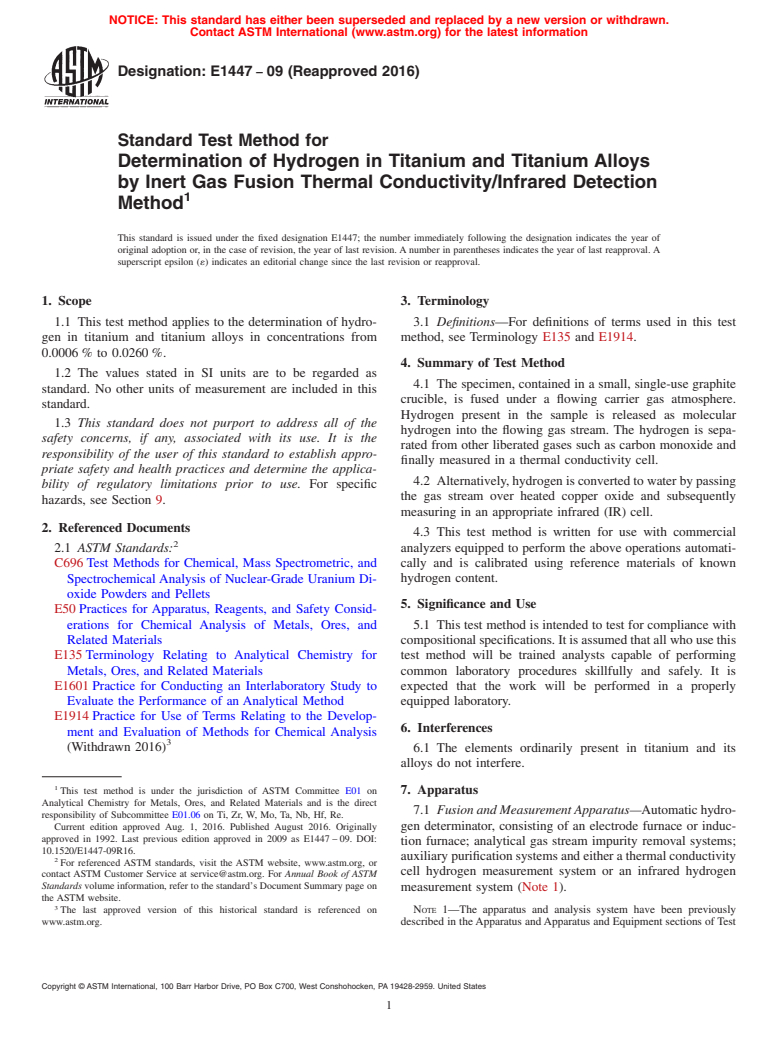
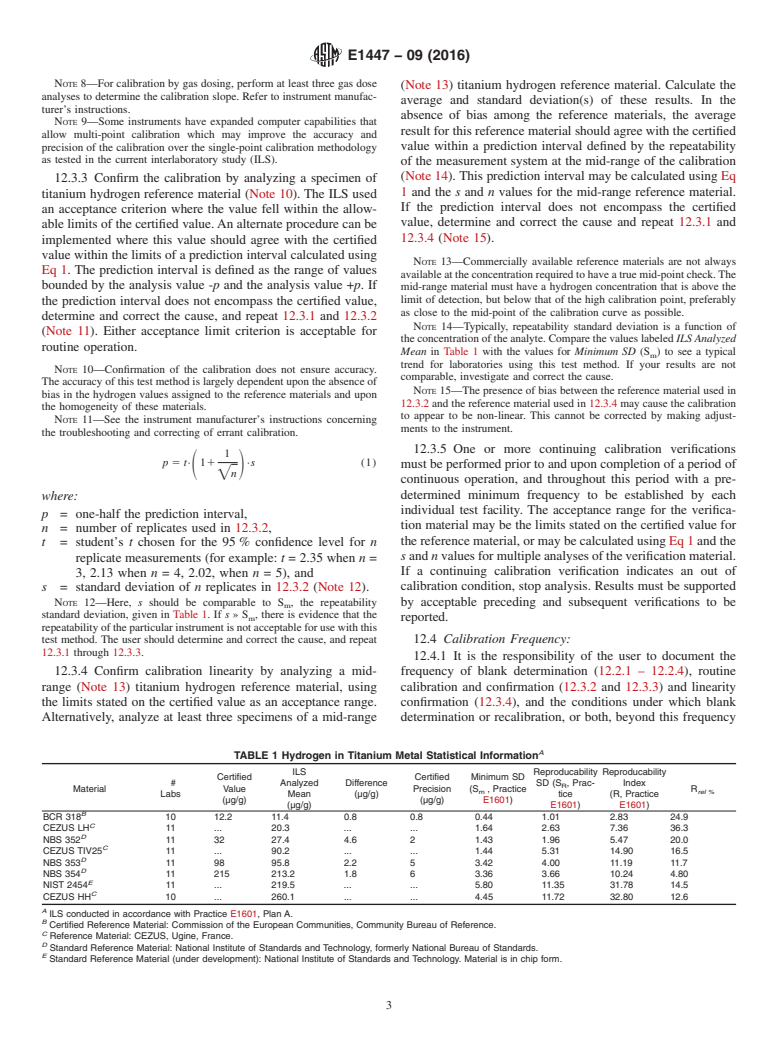
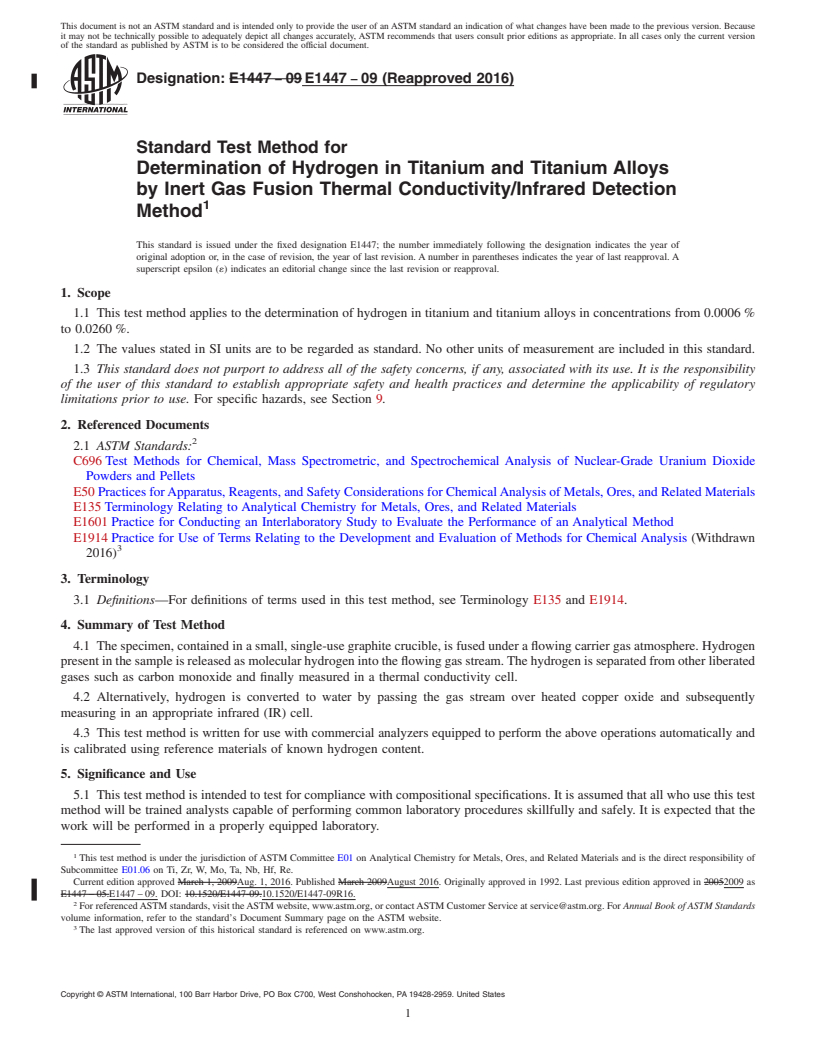
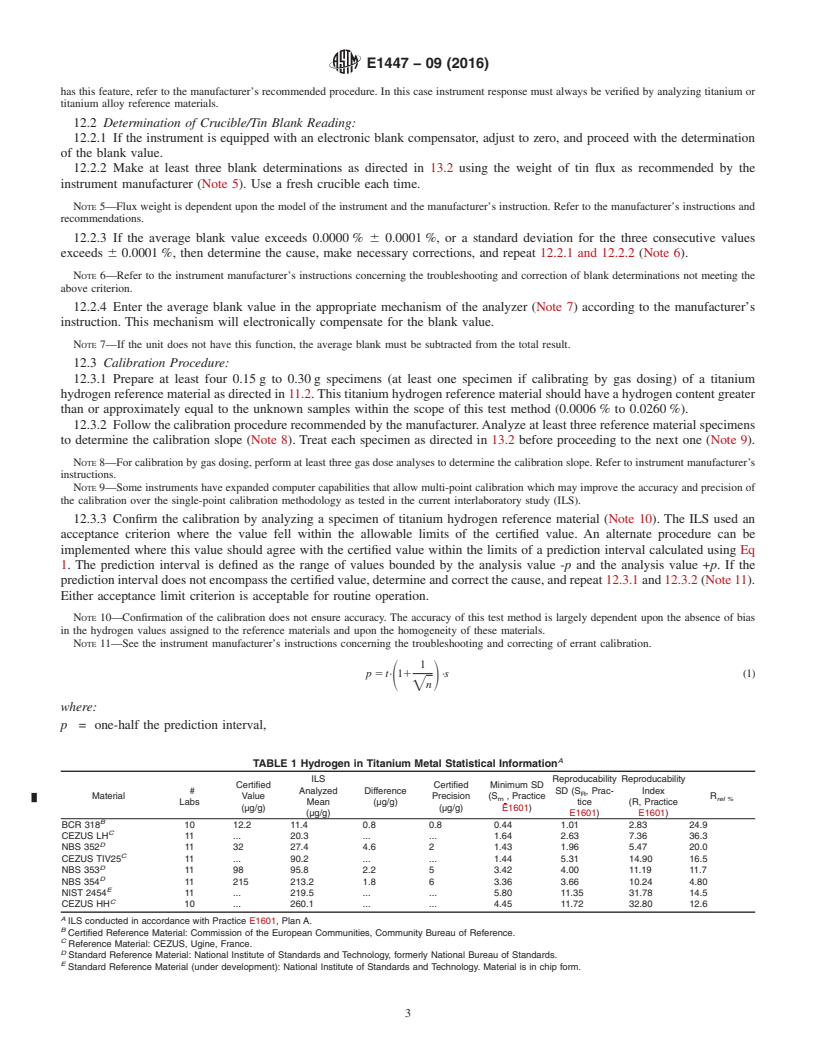
5.1 This test method is intended to test for compliance with compositional specifications. It is assumed that all who use this test method will be trained analysts capable of performing common laboratory procedures skillfully and safely. It is expected that the work will be performed in a properly equipped laboratory.
SCOPE
1.1 This test method applies to the determination of hydrogen in titanium and titanium alloys in concentrations from 0.0006 % to 0.0260 %.
1.2 The values stated in SI units are to be regarded as standard. No other units of measurement are included in this standard.
1.3 This standard does not purport to address all of the safety concerns, if any, associated with its use. It is the responsibility of the user of this standard to establish appropriate safety and health practices and determine the applicability of regulatory limitations prior to use. For specific hazards, see Section 9.
General Information
Buy Standard
Standards Content (Sample)
NOTICE: This standard has either been superseded and replaced by a new version or withdrawn.
Contact ASTM International (www.astm.org) for the latest information
Designation: E1447 − 09 (Reapproved 2016)
Standard Test Method for
Determination of Hydrogen in Titanium and Titanium Alloys
by Inert Gas Fusion Thermal Conductivity/Infrared Detection
Method
This standard is issued under the fixed designation E1447; the number immediately following the designation indicates the year of
original adoption or, in the case of revision, the year of last revision. A number in parentheses indicates the year of last reapproval. A
superscript epsilon (´) indicates an editorial change since the last revision or reapproval.
1. Scope 3. Terminology
1.1 This test method applies to the determination of hydro- 3.1 Definitions—For definitions of terms used in this test
gen in titanium and titanium alloys in concentrations from method, see Terminology E135 and E1914.
0.0006 % to 0.0260 %.
4. Summary of Test Method
1.2 The values stated in SI units are to be regarded as
4.1 The specimen, contained in a small, single-use graphite
standard. No other units of measurement are included in this
crucible, is fused under a flowing carrier gas atmosphere.
standard.
Hydrogen present in the sample is released as molecular
1.3 This standard does not purport to address all of the
hydrogen into the flowing gas stream. The hydrogen is sepa-
safety concerns, if any, associated with its use. It is the
rated from other liberated gases such as carbon monoxide and
responsibility of the user of this standard to establish appro-
finally measured in a thermal conductivity cell.
priate safety and health practices and determine the applica-
4.2 Alternatively,hydrogenisconvertedtowaterbypassing
bility of regulatory limitations prior to use. For specific
the gas stream over heated copper oxide and subsequently
hazards, see Section 9.
measuring in an appropriate infrared (IR) cell.
2. Referenced Documents
4.3 This test method is written for use with commercial
2.1 ASTM Standards: analyzers equipped to perform the above operations automati-
cally and is calibrated using reference materials of known
C696 Test Methods for Chemical, Mass Spectrometric, and
Spectrochemical Analysis of Nuclear-Grade Uranium Di- hydrogen content.
oxide Powders and Pellets
5. Significance and Use
E50 Practices for Apparatus, Reagents, and Safety Consid-
erations for Chemical Analysis of Metals, Ores, and 5.1 This test method is intended to test for compliance with
Related Materials compositionalspecifications.Itisassumedthatallwhousethis
E135 Terminology Relating to Analytical Chemistry for
test method will be trained analysts capable of performing
Metals, Ores, and Related Materials common laboratory procedures skillfully and safely. It is
E1601 Practice for Conducting an Interlaboratory Study to
expected that the work will be performed in a properly
Evaluate the Performance of an Analytical Method equipped laboratory.
E1914 Practice for Use of Terms Relating to the Develop-
6. Interferences
ment and Evaluation of Methods for Chemical Analysis
(Withdrawn 2016)
6.1 The elements ordinarily present in titanium and its
alloys do not interfere.
This test method is under the jurisdiction of ASTM Committee E01 on 7. Apparatus
Analytical Chemistry for Metals, Ores, and Related Materials and is the direct
7.1 Fusion and MeasurementApparatus—Automatichydro-
responsibility of Subcommittee E01.06 on Ti, Zr, W, Mo, Ta, Nb, Hf, Re.
Current edition approved Aug. 1, 2016. Published August 2016. Originally gen determinator, consisting of an electrode furnace or induc-
approved in 1992. Last previous edition approved in 2009 as E1447 – 09. DOI:
tion furnace; analytical gas stream impurity removal systems;
10.1520/E1447-09R16.
auxiliarypurificationsystemsandeitherathermalconductivity
For referenced ASTM standards, visit the ASTM website, www.astm.org, or
cell hydrogen measurement system or an infrared hydrogen
contact ASTM Customer Service at service@astm.org. For Annual Book of ASTM
Standards volume information, refer to the standard’s Document Summary page on
measurement system (Note 1).
the ASTM website.
The last approved version of this historical standard is referenced on NOTE 1—The apparatus and analysis system have been previously
www.astm.org. described in theApparatus andApparatus and Equipment sections of Test
Copyright © ASTM International, 100 Barr Harbor Drive, PO Box C700, West Conshohocken, PA 19428-2959. United States
E1447 − 09 (2016)
Methods C696. Several models of commercial analyzers are available and
history or suspected surface contamination, abrade specimen
presentlyinuseinindustry.Eachhasitsownuniquedesigncharacteristics
surfaces with a clean file to remove contamination. Other
and operational requirements. Consult the instrument manufacturer’s
methods, such as turning down on a lathe, may be employed
instructions for operational details.
for reducing sample size and removing the surface of the
7.2 Graphite Crucibles—The crucibles are machined from
sample (Note 3). Rinse the sample in acetone, and air dry.
high-purity graphite. Use the size crucibles recommended by
Weigh to 6 0.001 g. Samples shall be handled only with
the manufacturer of the instrument.
tweezers or forceps after cleaning and weighing to prevent
7.3 Crucible Tongs—Capable of handling recommended contamination.
crucibles.
NOTE 3—Regardless of the method used, the sample must not be
allowedtooverheat,asthiswilladverselyaffecttheresultsoftheanalysis.
7.4 Tweezers or Forceps—For contamination-free sample
Indications that the sample has overheated while being worked may
handling.
include discoloration of the metal or the sample becoming too hot to
handle without tools.
8. Reagents and Materials
12. Calibration
8.1 Acetone, low-residue reagent grade or higher purity.
12.1 Calibration Reference Materials—Select only titanium
8.2 Sodium Hydroxide on Clay Base, commonly known as
or titanium alloy reference materials (Note 4).
Ascarite II.
NOTE 4—Gas dosing: it is satisfactory to calibrate the unit by dosing
8.3 High-Purity Carrier Gas (99.99 %)—Argon, nitrogen,
known volume(s) of hydrogen gas into the detection system. If the
or helium (Note 2).
instrument has this feature, refer to the manufacturer’s recommended
procedure. In this case instrument response must always be verified by
NOTE 2—Carrier gases vary by instrument model and include high-
analyzing titanium or titanium alloy reference materials.
purity argon, nitrogen, and helium. Consult instrument manufacturer’s
instructions for proper gas recommendation.
12.2 Determination of Crucible/Tin Blank Reading:
8.4 High-Purity Tin Metal (Low Hydrogen)—Use the purity 12.2.1 Iftheinstrumentisequippedwithanelectronicblank
specified by the instrument manufacturer. compensator, adjust to zero, and proceed with the determina-
tion of the blank value.
8.5 Magnesium Perchlorate, Anhydrone.
12.2.2 Make at least three blank determinations as directed
8.6 Molecular Sieve—Characteristics specified by the in-
in 13.2 using the weight of tin flux as recommended by the
strument manufacturer.
instrument manufacturer (Note 5). Use a fresh crucible each
8.7 Schutze Reagent—Iodine pentoxide over silica gel. time.
8.8 Copper Oxide Wire—To convert hydrogen to water in NOTE 5—Flux weight is dependent upon the model of the instrument
and the manufacturer’s instruction. Refer to the manufacturer’s instruc-
IR-detection instruments. Characteristics specified by the in-
tions and recommendations.
strument manufacturer.
12.2.3 If the average blank value exceeds 0.0000 % 6
9. Hazards 0.0001 %, or a standard deviation for the three consecutive
values exceeds 6 0.0001 %, then determine the cause, make
9.1 Forhazardstobeobservedintheuseofthistestmethod,
necessary corrections, and repeat 12.2.1 and 12.2.2 (Note 6).
refer to Practices E50.
NOTE 6—Refer to the instrument manufacturer’s instructions concern-
9.2 Use care when handling hot crucibles and operating
ing the troubleshooting and correction of blank determinations not
electrical equipment to avoid personal injury by either burn or
meeting the above criterion.
electrical shock.
12.2.4 Enter the average blank value in the appropriate
mechanism of the analyzer (Note 7) according to the manu-
10. Preparation of Apparatus
facturer’s instruction.This mechanism will electronically com-
10.1 Assemble the apparatus as recommended by the manu-
pensate for the blank value.
facturer.
NOTE 7—If the unit does not have this function, the average blank must
10.2 Test the furnace and analyzer to ensure the absence of
be subtracted from the total result.
gas leaks and make the required electrical power and water
12.3 Calibration Procedure:
connections. Prepare the apparatus for operation in accordance
12.3.1 Prepare at least four 0.15 g to 0.30 g specimens (at
with the manufacturer’s instructions. Make a minimum of two
least one specimen if calibrating by gas dosing) of a titanium
determinations using a specimen as directed in 13.2 before
hydrogen reference material as directed in 11.2. This titanium
attempting to calibrate the system or to determine the blank.
hydrogen reference material should have a hydrogen content
greater than or approximately equal to the unknown samples
11. Sample Preparation
within the scope of this test method (0.0006 % to 0.0260 %).
11.1 Use solid form specimens prepared as directed in 11.2.
12.3.2 Follow the calibration procedure recommended by
Specimensmustbeofanappropriatesizetofitintothegraphite
the manufacturer. Analyze at least three reference material
crucible and should not exceed 0.30 g in weight.
specimens to determine the calibration slope (Note 8). Treat
11.2 Cut the specimen to the approximate size of 0.15 g to eachspecimenasdirectedin13.2beforeproceedingtothenext
0.30 g (preferably by shearing). For specimens of unknown one (Note 9).
E1447 − 09 (2016)
NOTE 8—For calibra
...
This document is not an ASTM standard and is intended only to provide the user of an ASTM standard an indication of what changes have been made to the previous version. Because
it may not be technically possible to adequately depict all changes accurately, ASTM recommends that users consult prior editions as appropriate. In all cases only the current version
of the standard as published by ASTM is to be considered the official document.
Designation: E1447 − 09 E1447 − 09 (Reapproved 2016)
Standard Test Method for
Determination of Hydrogen in Titanium and Titanium Alloys
by Inert Gas Fusion Thermal Conductivity/Infrared Detection
Method
This standard is issued under the fixed designation E1447; the number immediately following the designation indicates the year of
original adoption or, in the case of revision, the year of last revision. A number in parentheses indicates the year of last reapproval. A
superscript epsilon (´) indicates an editorial change since the last revision or reapproval.
1. Scope
1.1 This test method applies to the determination of hydrogen in titanium and titanium alloys in concentrations from 0.0006 %
to 0.0260 %.
1.2 The values stated in SI units are to be regarded as standard. No other units of measurement are included in this standard.
1.3 This standard does not purport to address all of the safety concerns, if any, associated with its use. It is the responsibility
of the user of this standard to establish appropriate safety and health practices and determine the applicability of regulatory
limitations prior to use. For specific hazards, see Section 9.
2. Referenced Documents
2.1 ASTM Standards:
C696 Test Methods for Chemical, Mass Spectrometric, and Spectrochemical Analysis of Nuclear-Grade Uranium Dioxide
Powders and Pellets
E50 Practices for Apparatus, Reagents, and Safety Considerations for Chemical Analysis of Metals, Ores, and Related Materials
E135 Terminology Relating to Analytical Chemistry for Metals, Ores, and Related Materials
E1601 Practice for Conducting an Interlaboratory Study to Evaluate the Performance of an Analytical Method
E1914 Practice for Use of Terms Relating to the Development and Evaluation of Methods for Chemical Analysis (Withdrawn
2016)
3. Terminology
3.1 Definitions—For definitions of terms used in this test method, see Terminology E135 and E1914.
4. Summary of Test Method
4.1 The specimen, contained in a small, single-use graphite crucible, is fused under a flowing carrier gas atmosphere. Hydrogen
present in the sample is released as molecular hydrogen into the flowing gas stream. The hydrogen is separated from other liberated
gases such as carbon monoxide and finally measured in a thermal conductivity cell.
4.2 Alternatively, hydrogen is converted to water by passing the gas stream over heated copper oxide and subsequently
measuring in an appropriate infrared (IR) cell.
4.3 This test method is written for use with commercial analyzers equipped to perform the above operations automatically and
is calibrated using reference materials of known hydrogen content.
5. Significance and Use
5.1 This test method is intended to test for compliance with compositional specifications. It is assumed that all who use this test
method will be trained analysts capable of performing common laboratory procedures skillfully and safely. It is expected that the
work will be performed in a properly equipped laboratory.
This test method is under the jurisdiction of ASTM Committee E01 on Analytical Chemistry for Metals, Ores, and Related Materials and is the direct responsibility of
Subcommittee E01.06 on Ti, Zr, W, Mo, Ta, Nb, Hf, Re.
Current edition approved March 1, 2009Aug. 1, 2016. Published March 2009August 2016. Originally approved in 1992. Last previous edition approved in 20052009 as
E1447 – 05.E1447 – 09. DOI: 10.1520/E1447-09.10.1520/E1447-09R16.
For referenced ASTM standards, visit the ASTM website, www.astm.org, or contact ASTM Customer Service at service@astm.org. For Annual Book of ASTM Standards
volume information, refer to the standard’s Document Summary page on the ASTM website.
The last approved version of this historical standard is referenced on www.astm.org.
Copyright © ASTM International, 100 Barr Harbor Drive, PO Box C700, West Conshohocken, PA 19428-2959. United States
E1447 − 09 (2016)
6. Interferences
6.1 The elements ordinarily present in titanium and its alloys do not interfere.
7. Apparatus
7.1 Fusion and Measurement Apparatus—Automatic hydrogen determinator, consisting of an electrode furnace or induction
furnace; analytical gas stream impurity removal systems; auxiliary purification systems and either a thermal conductivity cell
hydrogen measurement system or an infrared hydrogen measurement system (Note 1).
NOTE 1—The apparatus and analysis system have been previously described in the Apparatus and Apparatus and Equipment sections of Test Methods
C696. Several models of commercial analyzers are available and presently in use in industry. Each has its own unique design characteristics and
operational requirements. Consult the instrument manufacturer’s instructions for operational details.
7.2 Graphite Crucibles—The crucibles are machined from high-purity graphite. Use the size crucibles recommended by the
manufacturer of the instrument.
7.3 Crucible Tongs—Capable of handling recommended crucibles.
7.4 Tweezers or Forceps—For contamination-free sample handling.
8. Reagents and Materials
8.1 Acetone, low-residue reagent grade or higher purity.
8.2 Sodium Hydroxide on Clay Base, commonly known as Ascarite II.
8.3 High-Purity Carrier Gas (99.99 %)—Argon, nitrogen, or helium (Note 2).
NOTE 2—Carrier gases vary by instrument model and include high-purity argon, nitrogen, and helium. Consult instrument manufacturer’s instructions
for proper gas recommendation.
8.4 High-Purity Tin Metal (Low Hydrogen)—Use the purity specified by the instrument manufacturer.
8.5 Magnesium Perchlorate, Anhydrone.
8.6 Molecular Sieve—Characteristics specified by the instrument manufacturer.
8.7 Schutze Reagent—Iodine pentoxide over silica gel.
8.8 Copper Oxide Wire—To convert hydrogen to water in IR-detection instruments. Characteristics specified by the instrument
manufacturer.
9. Hazards
9.1 For hazards to be observed in the use of this test method, refer to Practices E50.
9.2 Use care when handling hot crucibles and operating electrical equipment to avoid personal injury by either burn or electrical
shock.
10. Preparation of Apparatus
10.1 Assemble the apparatus as recommended by the manufacturer.
10.2 Test the furnace and analyzer to ensure the absence of gas leaks and make the required electrical power and water
connections. Prepare the apparatus for operation in accordance with the manufacturer’s instructions. Make a minimum of two
determinations using a specimen as directed in 13.2 before attempting to calibrate the system or to determine the blank.
11. Sample Preparation
11.1 Use solid form specimens prepared as directed in 11.2. Specimens must be of an appropriate size to fit into the graphite
crucible and should not exceed 0.30 g in weight.
11.2 Cut the specimen to the approximate size of 0.15 g to 0.30 g (preferably by shearing). For specimens of unknown history
or suspected surface contamination, abrade specimen surfaces with a clean file to remove contamination. Other methods, such as
turning down on a lathe, may be employed for reducing sample size and removing the surface of the sample (Note 3). Rinse the
sample in acetone, and air dry. Weigh to 6 0.001 g. Samples shall be handled only with tweezers or forceps after cleaning and
weighing to prevent contamination.
NOTE 3—Regardless of the method used, the sample must not be allowed to overheat, as this will adversely affect the results of the analysis. Indications
that the sample has overheated while being worked may include discoloration of the metal or the sample becoming too hot to handle without tools.
12. Calibration
12.1 Calibration Reference Materials—Select only titanium or titanium alloy reference materials (Note 4).
NOTE 4—Gas dosing: it is satisfactory to calibrate the unit by dosing known volume(s) of hydrogen gas into the detection system. If the instrument
E1447 − 09 (2016)
has this feature, refer to the manufacturer’s recommended procedure. In this case instrument response must always be verified by analyzing titanium or
titanium alloy reference materials.
12.2 Determination of Crucible/Tin Blank Reading:
12.2.1 If the instrument is equipped with an electronic blank compensator, adjust to zero, and proceed with the determination
of the blank value.
12.2.2 Make at least three blank determinations as directed in 13.2 using the weight of tin flux as recommended by the
instrument manufacturer (Note 5). Use a fresh crucible each time.
NOTE 5—Flux weight is dependent upon the model of the instrument and the manufacturer’s instruction. Refer to the manufacturer’s instructions and
recommendations.
12.2.3 If the average blank value exceeds 0.0000 % 6 0.0001 %, or a standard deviation for the three consecutive values
exceeds 6 0.0001 %, then determine the cause, make necessary corrections, and repeat 12.2.1 and 12.2.2 (Note 6).
NOTE 6—Refer to the instrument manufacturer’s instructions concerning the troubleshooting and correction of blank determinations not meeting the
above criterion.
12.2.4 Enter the average blank value in the appropriate mechanism of the analyzer (Note 7) according to the manufacturer’s
instruction. This mechanism will electronically compensate for the blank value.
NOTE 7—If the unit does not have this function, the average blank must be subtracted from the total result.
12.3 Calibration Procedure:
12.3.1 Prepare at least four 0.15 g to 0.30 g specimens (at least one specimen if calibrating by gas dosing) of a titanium
hydrogen reference material as directed in 11.2. This titanium hydrogen reference material should have a hydrogen content greater
than or approximately equal to the unknown samples within the scope of this test method (0.0006 % to 0.0260 %).
12.3.2 Follow the calibration procedure recommended by the manufacturer. Analyze at least three reference material specimens
to determine t
...
Questions, Comments and Discussion
Ask us and Technical Secretary will try to provide an answer. You can facilitate discussion about the standard in here.