

ASTM D788-16
(Classification)Standard Classification System for Poly(Methyl Methacrylate) (PMMA) Molding and Extrusion Compounds
General Information
- Abstract
ABSTRACT
The purpose of this classification system is to provide a method of adequately identifying poly(methyl methacrylate) (PMMA) molding and extrusion compounds. These compounds are polymers based on methyl methacrylate, and at least 70 % of the polymer shall be polymerized from methyl methacrylate. Poly(methyl methacrylate) molding and extrusion compounds are classified into groups in accordance with their composition. These groups are subdivided into classes and grades: class 1, 2, 3, and 4; grade 1 - materials used where special ultraviolet transmission, filtering, or stabilization characteristics are not required, grade 2 - materials used for those specialized applications in which the greatest amount of transmission of UV light is required, and grade 3 - materials (transparent UV stabilized or transparent UV absorbing) used when either special resistance to slight color change over long exposure times or high-intensity UV radiation is required, or when the material is required to filter out ultraviolet light. The plastics composition shall be uniform and shall conform to the requirements specified.
SCOPE
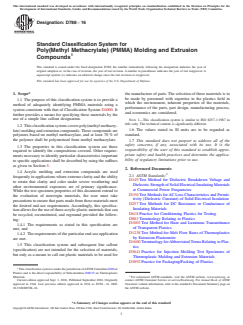
1.1 The purpose of this classification system is to provide a method of adequately identifying PMMA materials using a system consistent with that of Classification System D4000. It further provides a means for specifying these materials by the use of a simple line callout designation.
1.2 This classification system covers poly(methyl methacrylate) molding and extrusion compounds. These compounds are polymers based on methyl methacrylate, and at least 70 % of the polymer shall be polymerized from methyl methacrylate.
1.3 The properties in this classification system are those required to identify the compositions covered. Other requirements necessary to identify particular characteristics important to specific applications shall be described by using the suffixes as given in Section 5.
1.4 Acrylic molding and extrusion compounds are used frequently in applications where extreme clarity and the ability to retain that clarity and color under severe weathering and other environmental exposures are of primary significance. While the test specimen properties of this document extend to the evaluation of nonvirgin materials, the user must take precautions to ensure that parts made from these materials meet the desired end-use requirements. Accordingly, this specification allows for the use of those acrylic plastic materials that can be recycled, reconstituted, and reground provided the following:
1.4.1 The requirements as stated in this specification are met, and
1.4.2 The requirements of the particular end-use application are met.
1.5 This classification system and subsequent line callout (specification) are not intended for the selection of materials, but only as a means to call out plastic materials to be used for the manufacture of parts. The selection of these materials is to be made by personnel with expertise in the plastics field in which the environment, inherent properties of the materials, performance of the parts, part design, manufacturing process, and economics are considered.
Note 1: This classification system is similar to ISO 8257-1:1987 in title only. The technical content is significantly different.
1.6 The values stated in SI units are to be regarded as standard.
1.7 This standard does not purport to address all of the safety concerns, if any, associated with its use. It is the responsibility of the user of this standard to establish appropriate safety and health practices and determine the applicability of regulatory limitations prior to use.
- Status
- Published
- Publication Date
- 31-Aug-2016
- Technical Committee
- D20 - Plastics
- Drafting Committee
- D20.15 - Thermoplastic Materials
Buy Documents
ASTM D788-16 - Standard Classification System for Poly(Methyl Methacrylate) (PMMA) Molding and Extrusion Compounds
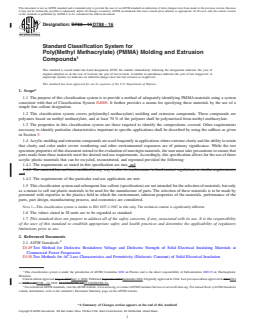
REDLINE ASTM D788-16 - Standard Classification System for Poly(Methyl Methacrylate) (PMMA) Molding and Extrusion Compounds
Overview
ASTM D788-16: Standard Classification System for Poly(Methyl Methacrylate) (PMMA) Molding and Extrusion Compounds establishes a method for identifying and specifying PMMA molding and extrusion materials. PMMA, also commonly known as acrylic, is renowned for its optical clarity, weather resistance, and versatility in a wide range of applications. This standard covers PMMA compounds where at least 70% of the polymer is derived from methyl methacrylate. The use of consistent terminology and classification makes it easier for manufacturers, suppliers, and product designers to specify and source PMMA materials that meet precise performance and quality criteria.
Key Topics
- Classification System: Provides a structured approach for categorizing PMMA materials by composition, class, and grade, in alignment with ASTM D4000.
- Material Groups and Grades: Outlines group, class, and grade distinctions, including unmodified, impact-modified, and heat-resistant variants.
- Functional Properties: Includes standards for optical clarity, UV transmission, weatherability, electrical properties, and melt flow rates.
- Sustainability: Allows for the use of recycled or reconstituted PMMA materials, provided all property and performance requirements are met.
- Specification Guidance: Enables material specification through a clear line callout system using standardized codes, making procurement and compliance straightforward.
Applications
PMMA molding and extrusion compounds classified by ASTM D788-16 are widely utilized in industries and end-use applications where clarity, stability, and durability are essential. Key applications include:
- Architectural Glazing and Lighting: PMMA is frequently used for windows, skylights, signage, and light diffusers due to its excellent light transmittance and weatherability.
- Automotive Components: Transparent and UV-stabilized grades are preferred for headlamp lenses, instrument clusters, and interior fitments.
- Electronic and Electrical Insulation: PMMA’s dielectric strength makes it suitable for insulating components and housings in electronics.
- Medical Devices: The clarity and safety of medical-grade PMMA are critical in devices such as diagnostic lenses and enclosures.
- Consumer Goods: Products such as optical discs, display screens, and protective covers often rely on PMMA’s transparency and impact resistance.
By standardizing material selection and quality, ASTM D788-16 helps ensure component reliability and safety across these industries.
Related Standards
Several related ASTM and ISO standards provide complementary test methods and definitions for PMMA materials:
- ASTM D4000 - Classification System for Specifying Plastic Materials
- ASTM D1003 - Test Method for Haze and Luminous Transmittance of Transparent Plastics
- ASTM D1238 - Test Method for Melt Flow Rates of Thermoplastics
- ASTM D3892 - Practice for Packaging/Packing of Plastics
- ISO 8257-1 - Plastics - Poly(Methyl Methacrylate) (PMMA) Moulding and Extrusion Materials
- ISO 527 - Plastics - Determination of Tensile Properties
- ISO 1133 - Plastics - Determination of the Melt Mass-Flow Rate (MFR)
These standards coordinate with ASTM D788-16 to create a robust framework for identifying, testing, and utilizing PMMA molding and extrusion compounds according to international best practices.
Keywords: ASTM D788-16, PMMA, poly(methyl methacrylate), acrylic molding, extrusion compounds, PMMA classification, optical plastics, transparent plastics, UV stabilized, plastic standards, material specification, recycled PMMA.
Relations
- Effective Date
- 01-Sep-2016
- Effective Date
- 01-Feb-2024
- Refers
ASTM D1238-23a - Standard Test Method for Melt Flow Rates of Thermoplastics by Extrusion Plastometer - Effective Date
- 15-Nov-2023
- Effective Date
- 01-Nov-2023
- Effective Date
- 01-Jan-2020
- Effective Date
- 01-Jan-2020
- Effective Date
- 01-Aug-2019
- Effective Date
- 15-Apr-2019
- Effective Date
- 01-Feb-2019
- Effective Date
- 01-Dec-2018
- Effective Date
- 01-Nov-2018
- Refers
ASTM D1600-18 - Standard Terminology for Abbreviated Terms Relating to Plastics (Withdrawn 2024) - Effective Date
- 01-Jan-2018
- Effective Date
- 15-Aug-2017
- Effective Date
- 01-Sep-2015
- Effective Date
- 01-Mar-2014
Buy Documents
ASTM D788-16 - Standard Classification System for Poly(Methyl Methacrylate) (PMMA) Molding and Extrusion Compounds
REDLINE ASTM D788-16 - Standard Classification System for Poly(Methyl Methacrylate) (PMMA) Molding and Extrusion Compounds
Get Certified
Connect with accredited certification bodies for this standard

DIN CERTCO
DIN Group product certification.

Smithers Quality Assessments
US management systems and product certification.
Sponsored listings
Frequently Asked Questions
ASTM D788-16 is a standard published by ASTM International. Its full title is "Standard Classification System for Poly(Methyl Methacrylate) (PMMA) Molding and Extrusion Compounds". This standard covers: ABSTRACT The purpose of this classification system is to provide a method of adequately identifying poly(methyl methacrylate) (PMMA) molding and extrusion compounds. These compounds are polymers based on methyl methacrylate, and at least 70 % of the polymer shall be polymerized from methyl methacrylate. Poly(methyl methacrylate) molding and extrusion compounds are classified into groups in accordance with their composition. These groups are subdivided into classes and grades: class 1, 2, 3, and 4; grade 1 - materials used where special ultraviolet transmission, filtering, or stabilization characteristics are not required, grade 2 - materials used for those specialized applications in which the greatest amount of transmission of UV light is required, and grade 3 - materials (transparent UV stabilized or transparent UV absorbing) used when either special resistance to slight color change over long exposure times or high-intensity UV radiation is required, or when the material is required to filter out ultraviolet light. The plastics composition shall be uniform and shall conform to the requirements specified. SCOPE 1.1 The purpose of this classification system is to provide a method of adequately identifying PMMA materials using a system consistent with that of Classification System D4000. It further provides a means for specifying these materials by the use of a simple line callout designation. 1.2 This classification system covers poly(methyl methacrylate) molding and extrusion compounds. These compounds are polymers based on methyl methacrylate, and at least 70 % of the polymer shall be polymerized from methyl methacrylate. 1.3 The properties in this classification system are those required to identify the compositions covered. Other requirements necessary to identify particular characteristics important to specific applications shall be described by using the suffixes as given in Section 5. 1.4 Acrylic molding and extrusion compounds are used frequently in applications where extreme clarity and the ability to retain that clarity and color under severe weathering and other environmental exposures are of primary significance. While the test specimen properties of this document extend to the evaluation of nonvirgin materials, the user must take precautions to ensure that parts made from these materials meet the desired end-use requirements. Accordingly, this specification allows for the use of those acrylic plastic materials that can be recycled, reconstituted, and reground provided the following: 1.4.1 The requirements as stated in this specification are met, and 1.4.2 The requirements of the particular end-use application are met. 1.5 This classification system and subsequent line callout (specification) are not intended for the selection of materials, but only as a means to call out plastic materials to be used for the manufacture of parts. The selection of these materials is to be made by personnel with expertise in the plastics field in which the environment, inherent properties of the materials, performance of the parts, part design, manufacturing process, and economics are considered. Note 1: This classification system is similar to ISO 8257-1:1987 in title only. The technical content is significantly different. 1.6 The values stated in SI units are to be regarded as standard. 1.7 This standard does not purport to address all of the safety concerns, if any, associated with its use. It is the responsibility of the user of this standard to establish appropriate safety and health practices and determine the applicability of regulatory limitations prior to use.
ABSTRACT The purpose of this classification system is to provide a method of adequately identifying poly(methyl methacrylate) (PMMA) molding and extrusion compounds. These compounds are polymers based on methyl methacrylate, and at least 70 % of the polymer shall be polymerized from methyl methacrylate. Poly(methyl methacrylate) molding and extrusion compounds are classified into groups in accordance with their composition. These groups are subdivided into classes and grades: class 1, 2, 3, and 4; grade 1 - materials used where special ultraviolet transmission, filtering, or stabilization characteristics are not required, grade 2 - materials used for those specialized applications in which the greatest amount of transmission of UV light is required, and grade 3 - materials (transparent UV stabilized or transparent UV absorbing) used when either special resistance to slight color change over long exposure times or high-intensity UV radiation is required, or when the material is required to filter out ultraviolet light. The plastics composition shall be uniform and shall conform to the requirements specified. SCOPE 1.1 The purpose of this classification system is to provide a method of adequately identifying PMMA materials using a system consistent with that of Classification System D4000. It further provides a means for specifying these materials by the use of a simple line callout designation. 1.2 This classification system covers poly(methyl methacrylate) molding and extrusion compounds. These compounds are polymers based on methyl methacrylate, and at least 70 % of the polymer shall be polymerized from methyl methacrylate. 1.3 The properties in this classification system are those required to identify the compositions covered. Other requirements necessary to identify particular characteristics important to specific applications shall be described by using the suffixes as given in Section 5. 1.4 Acrylic molding and extrusion compounds are used frequently in applications where extreme clarity and the ability to retain that clarity and color under severe weathering and other environmental exposures are of primary significance. While the test specimen properties of this document extend to the evaluation of nonvirgin materials, the user must take precautions to ensure that parts made from these materials meet the desired end-use requirements. Accordingly, this specification allows for the use of those acrylic plastic materials that can be recycled, reconstituted, and reground provided the following: 1.4.1 The requirements as stated in this specification are met, and 1.4.2 The requirements of the particular end-use application are met. 1.5 This classification system and subsequent line callout (specification) are not intended for the selection of materials, but only as a means to call out plastic materials to be used for the manufacture of parts. The selection of these materials is to be made by personnel with expertise in the plastics field in which the environment, inherent properties of the materials, performance of the parts, part design, manufacturing process, and economics are considered. Note 1: This classification system is similar to ISO 8257-1:1987 in title only. The technical content is significantly different. 1.6 The values stated in SI units are to be regarded as standard. 1.7 This standard does not purport to address all of the safety concerns, if any, associated with its use. It is the responsibility of the user of this standard to establish appropriate safety and health practices and determine the applicability of regulatory limitations prior to use.
ASTM D788-16 is classified under the following ICS (International Classification for Standards) categories: 83.140.99 - Other rubber and plastics products. The ICS classification helps identify the subject area and facilitates finding related standards.
ASTM D788-16 has the following relationships with other standards: It is inter standard links to ASTM D788-14, ASTM D883-24, ASTM D1238-23a, ASTM D883-23, ASTM D883-20, ASTM D149-20, ASTM D883-19c, ASTM D883-19a, ASTM D883-19, ASTM D883-18a, ASTM D883-18, ASTM D1600-18, ASTM D883-17, ASTM D3892-15, ASTM D3641-14. Understanding these relationships helps ensure you are using the most current and applicable version of the standard.
ASTM D788-16 is available in PDF format for immediate download after purchase. The document can be added to your cart and obtained through the secure checkout process. Digital delivery ensures instant access to the complete standard document.
Standards Content (Sample)
This international standard was developed in accordance with internationally recognized principles on standardization established in the Decision on Principles for the
Development of International Standards, Guides and Recommendations issued by the World Trade Organization Technical Barriers to Trade (TBT) Committee.
Designation:D788 −16
Standard Classification System for
Poly(Methyl Methacrylate) (PMMA) Molding and Extrusion
Compounds
This standard is issued under the fixed designation D788; the number immediately following the designation indicates the year of
original adoption or, in the case of revision, the year of last revision.Anumber in parentheses indicates the year of last reapproval.A
superscript epsilon (´) indicates an editorial change since the last revision or reapproval.
This standard has been approved for use by agencies of the U.S. Department of Defense.
1. Scope* the manufacture of parts. The selection of these materials is to
be made by personnel with expertise in the plastics field in
1.1 The purpose of this classification system is to provide a
which the environment, inherent properties of the materials,
method of adequately identifying PMMA materials using a
performance of the parts, part design, manufacturing process,
system consistent with that of Classification System D4000.It
and economics are considered.
further provides a means for specifying these materials by the
use of a simple line callout designation.
NOTE 1—This classification system is similar to ISO 8257-1:1987 in
title only. The technical content is significantly different.
1.2 Thisclassificationsystemcoverspoly(methylmethacry-
1.6 The values stated in SI units are to be regarded as
late) molding and extrusion compounds.These compounds are
standard.
polymers based on methyl methacrylate, and at least 70% of
the polymer shall be polymerized from methyl methacrylate.
1.7 This standard does not purport to address all of the
safety concerns, if any, associated with its use. It is the
1.3 The properties in this classification system are those
responsibility of the user of this standard to establish appro-
required to identify the compositions covered. Other require-
priate safety and health practices and determine the applica-
ments necessary to identify particular characteristics important
bility of regulatory limitations prior to use.
to specific applications shall be described by using the suffixes
as given in Section 5.
2. Referenced Documents
1.4 Acrylic molding and extrusion compounds are used
2.1 ASTM Standards:
frequentlyinapplicationswhereextremeclarityandtheability
D149Test Method for Dielectric Breakdown Voltage and
to retain that clarity and color under severe weathering and
DielectricStrengthofSolidElectricalInsulatingMaterials
other environmental exposures are of primary significance.
at Commercial Power Frequencies
While the test specimen properties of this document extend to
D150Test Methods forAC Loss Characteristics and Permit-
the evaluation of nonvirgin materials, the user must take
tivity (Dielectric Constant) of Solid Electrical Insulation
precautionstoensurethatpartsmadefromthesematerialsmeet
D257Test Methods for DC Resistance or Conductance of
the desired end-use requirements. Accordingly, this specifica-
Insulating Materials
tionallowsfortheuseofthoseacrylicplasticmaterialsthatcan
D618Practice for Conditioning Plastics for Testing
be recycled, reconstituted, and reground provided the follow-
D883Terminology Relating to Plastics
ing:
D1003Test Method for Haze and Luminous Transmittance
1.4.1 The requirements as stated in this specification are
of Transparent Plastics
met, and
D1238Test Method for Melt Flow Rates of Thermoplastics
1.4.2 Therequirementsoftheparticularend-useapplication
by Extrusion Plastometer
are met.
D1600TerminologyforAbbreviatedTermsRelatingtoPlas-
1.5 This classification system and subsequent line callout
tics
(specification) are not intended for the selection of materials,
D3641Practice for Injection Molding Test Specimens of
but only as a means to call out plastic materials to be used for
Thermoplastic Molding and Extrusion Materials
D3892Practice for Packaging/Packing of Plastics
ThisclassificationsystemisunderthejurisdictionofASTMCommitteeD20on
Plastics and is the direct responsibility of Subcommittee D20.15 on Thermoplastic
Materials. For referenced ASTM standards, visit the ASTM website, www.astm.org, or
Current edition approved Sept. 1, 2016. Published September 2016. Originally contact ASTM Customer Service at service@astm.org. For Annual Book of ASTM
approved in 1944. Last previous edition approved in 2014 as D788–14. DOI: Standards volume information, refer to the standard’s Document Summary page on
10.1520/D0788–16. the ASTM website.
*A Summary of Changes section appears at the end of this standard
Copyright © ASTM International, 100 Barr Harbor Drive, PO Box C700, West Conshohocken, PA 19428-2959. United States
D788−16
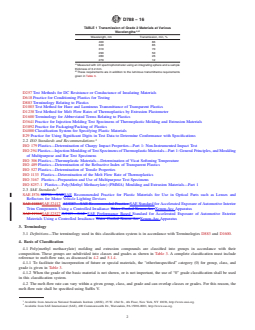
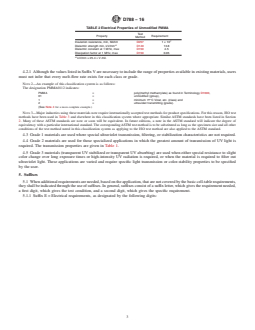
TABLE 1 Transmission of Grade 2 Materials at Various TABLE 2 Electrical Properties of Unmodified PMMA
A,B
Wavelengths
Test
Property Requirement
Wavelength, nm Transmission, min, % Method
400 86
Insulation resistance, min, Mohm D257 1×10
A
340 85 Dielectric strength min, kV/mm D149 13.8
310 70
Dielectric constant at 1 MHz, max D150 4.5
290 50
Dissipation factor at 1 MHz, max D150 0.05
280 26
A
kV/mm × 25.4 = V ⁄mil.
270 12
A
MeasuredwithUVspectrophotometerusinganintegratingsphereandasample
thickness of 3.2 mm.
B
These requirements are in addition to the luminous transmittance requirements
given in Table 3.
grades as shown in Table 3. A complete classification must
include reference to melt-flow rate, as discussed in 4.2 and
5.1.4.
D4000Classification System for Specifying Plastic Materi-
4.1.1 To facilitate the incorporation of future or special
als
materials,the“other/unspecified”category(0)forgroup,class,
E29Practice for Using Significant Digits in Test Data to
and grade is given in Table 3.
Determine Conformance with Specifications
4.1.2 When the grade of the basic material is not shown, or
2.2 ISO Standards and Recommendations:
is not important, the use of “0” grade classification shall be
ISO 179 Plastics—Determination of Charpy Impact
used in this classification system.
Properties—Part 1: Non-Instrumented Impact Test
ISO 294Plastics—Injection Moulding of Test Specimens of
4.2 The melt-flow rate can vary within a given group, class,
Thermoplastic Materials—Part 1: General Principles, and
and grade and can overlap classes or grades. For this reason,
Moulding of Multipurpose and Bar Test Specimens
the melt-flow rate shall be specified using Suffix V.
ISO306Plastics—ThermoplasticMaterials—Determination
4.2.1 AlthoughthevalueslistedinSuffixVarenecessaryto
of Vicat Softening Temperature
include the range of properties available in existing materials,
ISO 489Plastics—Determination of the Refractive Index of
users must not infer that every melt-flow rate exists for each
Transparent Plastics
class or grade.
ISO 527Plastics—Determination of Tensile Properties
NOTE 2—An example of this classification system is as follows:
ISO1133 Plastics—DeterminationoftheMeltFlowRateof
The designation PMMA0112 indicates:
Thermoplastics
PMMA = poly(methyl methacrylate) as found in Terminology D1600,
ISO3167 Plastics—Preparation and Use of Multipurpose
01 = unmodified (group),
Test Specimens
1 = minimum 77°C Vicat, etc. (class) and
2 = ultraviolet transmitting (grade).
ISO8257-1 Plastics—Poly(Methyl Methacrylate) (PMMA)
(See Note 4 for a more complete example.)
Moulding and Extrusion Materials—Part 1
NOTE 3—Major industries using these materials now require interna-
2.3 SAE Standards:
tionally accepted test methods for product specifications. For this reason,
SAEJ576SAERecommendedPracticeforPlasticMaterials
ISO test methods have been used in Table 3 and elsewhere in this
for Use in Optical Parts such as Lenses and Reflectors for
classification system where appropriate. Similar ASTM standards have
Motor Vehicle Lighting Devices
been listed in Section 2. Many of theseASTM standards are now or soon
SAEJ2412 SAE Standard for Accelerated Exposure of
will be equivalent. In future editions, a note in the ASTM standard will
indicatethedegreeofequivalencywithaparticularinternationalstandard.
AutomotiveInteriorTrimComponentsUsingaControlled
The corresponding ASTM test method is to be substituted as long as the
Irradiance Xenon-Arc Apparatus
specimen size and all other conditions of the test method noted in this
SAEJ2527SAE Performance Based Standard for Acceler-
classification system as applying to the ISO test method are also applied
ated Exposure of Automotive Exterior Materials Using a
to the ASTM standard.
Controlled Irradiance Xenon-Arc Apparatus
4.3 Grade 1 materials are used where special ultraviolet
transmission, filtering, or stabilization characteristics are not
3. Terminology
required.
3.1 Definitions—The terminology used in this classification
4.4 Grade 2 materials are used for those specialized appli-
system is in accordance with Terminologies D883 and D1600.
cations in which the greatest amount of transmission of UV
4. Basis of Classification lightisrequired.ThetransmissionpropertiesaregiveninTable
1.
4.1 Poly(methyl methacrylate) molding and extrusion com-
pounds are classified into groups in accordance with their 4.5 Grade 3 materials (transparent UV stabilized or trans-
composition. These groups are subdivided into classes and
parentUVabsorbing)areusedwheneitherspecialresistanceto
slight color change over long exposure times or high-intensity
UV radiation is required, or when the material is required to
Available fromAmerican National Standards Institute (ANSI), 25 W. 43rd St.,
filter out ultraviolet light. These applications are varied and
4th Floor, New York, NY 10036, http://www.ansi.org.
require specific light transmission or color-stability properties
AvailablefromSAEInternational(SAE),400CommonwealthDr.,Warrendale,
PA 15096-0001, http://www.sae.org. to be specified by the user.
D788−16
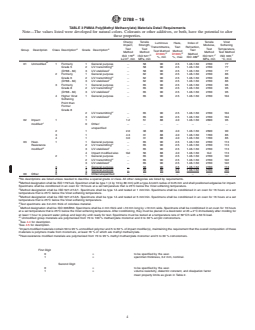
TABLE 3 PMMA Poly(Methyl Methacrylate) Materials Detail Requirements
Note—The values listed were developed for natural colors. Colorants or other additives, or both, have the potential to alter
these properties.
Charpy Tensile Tensile Vicat
Index of
Luminous Haze,
Impact, Strength, Modulus, Softening
Transmittance, Test Refraction,
A A Test Test Test Temperature,
Group Description Class Description Grade Description Test
Test Method Method
Method Method Method Test Method
E E
D1003, D1003, Method
B D C F
ISO 179 ISO 527, E ISO 527, ISO 306,
%, min %, max
ISO 489
kJ/m,min MPa, min MPa, min °C, min
G
01 Unmodified 1 Formerly 1 General purpose . 58 90 2.5 1.48-1.50 2700 77
H
Grade 5 2 UV transmitting . 58 90 2.5 1.48-1.50 2700 77
I
(D788 - 84) 3 UV stabilized . 58 90 2.5 1.48-1.50 2700 77
2 Formerly 1 General purpose . 62 90 2.5 1.48-1.50 2700 86
H
Grade 6 2 UV transmitting . 62 90 2.5 1.48-1.50 2700 86
I
(D788 - 84) 3 UV stabilized . 62 90 2.5 1.48-1.50 2700 86
3 Formerly 1 General purpose . 65 90 2.5 1.48-1.50 2700 95
H
Grade 8 2 UV transmitting . 65 90 2.5 1.48-1.50 2700 95
I
(D788 - 84) 3 UV stabilized . 65 90 2.5 1.48-1.50 2700 95
4 Higher Vicat 1 General purpose . 65 90 2.5 1.48-1.50 2700 104
Softening
Point than
Former
Grade 8
H
2 UV transmitting . 65 90 2.5 1.48-1.50 2700 104
I
3 UV stabilized . 65 90 2.5 1.48-1.50 2700 104
02 Impact 1 1 1.2 51 88 4.0 1.48-1.50 2600 95
J
modified 0 Other/ . . . . . . .
unspecified
2 1 2.0 38 88 4.0 1.48-1.50 2500 90
3 1 4.3 31 88 4.0 1.48-1.50 1700 85
4 1 3.0 31 88 4.0 1.48-1.50 1700 85
03 Heat- 1 1 General purpose . 65 90 2.5 1.48-1.50 2700 113
H
Resistance 2 UV transmitting . 65 90 2.5 1.48-1.50 2700 113
K
I
modified 3 UV stabilized . 65 90 2.5 1.48-1.50 2700 113
4 Impact modified also tbd 56 88 4.0 1.48-1.50 tbd 113
2 1 General purpose . 65 90 2.5 1.48-1.50 2700 122
H
2 UV transmitting . 65 90 2.5 1.48-1.50 2700 122
I
3 UV stabilized . 65 90 2.5 1.48-1.50 2700 122
3 1 General purpose . 58 90 2.5 1.48-1.52 2700 113
4 1 General purpose . 58 90 2.5 1.48-1.52 2700 122
00 Other 0 0 Other/unspecified . . . . . . .
A
No descriptions are listed unless needed to describe a special grade or class. All other categories are listed by requirements.
B
MethoddesignationshallbeISO179/1eA.Specimenshallbetype1(4by10by80 mm)withatypeAnotchradiusof0.25 mmandshallpositionededgewiseforimpact.
Specimens shall be conditioned in an oven for 16 hours at a set temperature that is 25°C below the Vicat softening temperature.
C
Method designation shall be ISO 527-2/1A/1. Specimens shall be type 1A and tested at 1 mm/min. Specimens shall be conditioned in an oven for
...
This document is not an ASTM standard and is intended only to provide the user of an ASTM standard an indication of what changes have been made to the previous version. Because
it may not be technically possible to adequately depict all changes accurately, ASTM recommends that users consult prior editions as appropriate. In all cases only the current version
of the standard as published by ASTM is to be considered the official document.
Designation: D788 − 14 D788 − 16
Standard Classification System for
Poly(Methyl Methacrylate) (PMMA) Molding and Extrusion
Compounds
This standard is issued under the fixed designation D788; the number immediately following the designation indicates the year of
original adoption or, in the case of revision, the year of last revision. A number in parentheses indicates the year of last reapproval. A
superscript epsilon (´) indicates an editorial change since the last revision or reapproval.
This standard has been approved for use by agencies of the U.S. Department of Defense.
1. Scope*
1.1 The purpose of this classification system is to provide a method of adequately identifying PMMA materials using a system
consistent with that of Classification System D4000. It further provides a means for specifying these materials by the use of a
simple line callout designation.
1.2 This classification system covers poly(methyl methacrylate) molding and extrusion compounds. These compounds are
polymers based on methyl methacrylate, and at least 70 % of the polymer shall be polymerized from methyl methacrylate.
1.3 The properties in this classification system are those required to identify the compositions covered. Other requirements
necessary to identify particular characteristics important to specific applications shall be described by using the suffixes as given
in Section 5.
1.4 Acrylic molding and extrusion compounds are used frequently in applications where extreme clarity and the ability to retain
that clarity and color under severe weathering and other environmental exposures are of primary significance. While the test
specimen properties of this document extend to the evaluation of nonvirgin materials, the user must take precautions to ensure that
parts made from these materials meet the desired end-use requirements. Accordingly, this specification allows for the use of those
acrylic plastic materials that can be recycled, reconstituted, and reground provided the following:
1.4.1 The requirements as stated in this specification are met, and
1.4.2 The material has not been modified in any way to alter its conformance to food contact regulations or similar requirements,
and
1.4.2 The requirements of the particular end-use application are met.
1.5 This classification system and subsequent line callout (specification) are not intended for the selection of materials, but only
as a means to call out plastic materials to be used for the manufacture of parts. The selection of these materials is to be made by
personnel with expertise in the plastics field in which the environment, inherent properties of the materials, performance of the
parts, part design, manufacturing process, and economics are considered.
NOTE 1—This classification system is similar to ISO 8257-1:1987 in title only. The technical content is significantly different.
1.6 The values stated in SI units are to be regarded as standard.
1.7 This standard does not purport to address all of the safety concerns, if any, associated with its use. It is the responsibility
of the user of this standard to establish appropriate safety and health practices and determine the applicability of regulatory
limitations prior to use.
2. Referenced Documents
2.1 ASTM Standards:
D149 Test Method for Dielectric Breakdown Voltage and Dielectric Strength of Solid Electrical Insulating Materials at
Commercial Power Frequencies
D150 Test Methods for AC Loss Characteristics and Permittivity (Dielectric Constant) of Solid Electrical Insulation
This classification system is under the jurisdiction of ASTM Committee D20 on Plastics and is the direct responsibility of Subcommittee D20.15 on Thermoplastic
Materials.
Current edition approved Aug. 1, 2014Sept. 1, 2016. Published September 2014September 2016. Originally approved in 1944. Last previous edition approved in 20122014
as D788 – 12.D788 – 14. DOI: 10.1520/D0788–14.10.1520/D0788–16.
For referenced ASTM standards, visit the ASTM website, www.astm.org, or contact ASTM Customer Service at service@astm.org. For Annual Book of ASTM Standards
volume information, refer to the standard’s Document Summary page on the ASTM website.
*A Summary of Changes section appears at the end of this standard
Copyright © ASTM International, 100 Barr Harbor Drive, PO Box C700, West Conshohocken, PA 19428-2959. United States
D788 − 16
TABLE 1 Transmission of Grade 2 Materials at Various
A,B
Wavelengths
Wavelength, nm Transmission, min, %
400 86
340 85
310 70
290 50
280 26
270 12
A
Measured with UV spectrophotometer using an integrating sphere and a sample
thickness of 3.2 mm.
B
These requirements are in addition to the luminous transmittance requirements
given in Table 3.
D257 Test Methods for DC Resistance or Conductance of Insulating Materials
D618 Practice for Conditioning Plastics for Testing
D883 Terminology Relating to Plastics
D1003 Test Method for Haze and Luminous Transmittance of Transparent Plastics
D1238 Test Method for Melt Flow Rates of Thermoplastics by Extrusion Plastometer
D1600 Terminology for Abbreviated Terms Relating to Plastics
D3641 Practice for Injection Molding Test Specimens of Thermoplastic Molding and Extrusion Materials
D3892 Practice for Packaging/Packing of Plastics
D4000 Classification System for Specifying Plastic Materials
E29 Practice for Using Significant Digits in Test Data to Determine Conformance with Specifications
2.2 ISO Standards and Recommendations:
ISO 179 Plastics—Determination of Charpy Impact Properties—Part 1: Non-Instrumented Impact Test
ISO 294 Plastics—Injection Moulding of Test Specimens of Thermoplastic Materials—Part 1: General Principles, and Moulding
of Multipurpose and Bar Test Specimens
ISO 306 Plastics—Thermoplastic Materials—Determination of Vicat Softening Temperature
ISO 489 Plastics—Determination of the Refractive Index of Transparent Plastics
ISO 527 Plastics—Determination of Tensile Properties
ISO 1133 Plastics—Determination of the Melt Flow Rate of Thermoplastics
ISO 3167 Plastics—Preparation and Use of Multipurpose Test Specimens
ISO 8257-1 Plastics—Poly(Methyl Methacrylate) (PMMA) Moulding and Extrusion Materials—Part 1
2.3 SAE Standards:
SAE J576 SEP86—SAESAE Recommended Practice for Plastic Materials for Use in Optical Parts such as Lenses and
Reflectors for Motor Vehicle Lighting Devices
SAE J1885SAE J2412 AUG87—SAE Recommended Practice SAE Standard for Accelerated Exposure of Automotive Interior
Trim Components Using a Controlled Irradiance Water Cooled Xenon Arc Xenon-Arc Apparatus
SAE J1960SAE J2527 JUN89—SAE SAE Performance Based Standard for Accelerated Exposure of Automotive Exterior
Materials Using a Controlled Irradiance Water Cooled Xenon Arc Xenon-Arc Apparatus
3. Terminology
3.1 Definitions—The terminology used in this classification system is in accordance with Terminologies D883 and D1600.
4. Basis of Classification
4.1 Poly(methyl methacrylate) molding and extrusion compounds are classified into groups in accordance with their
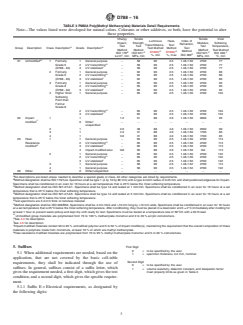
composition. These groups are subdivided into classes and grades as shown in Table 3. A complete classification must include
reference to melt-flow rate, as discussed in 4.2 and 5.1.4.
4.1.1 To facilitate the incorporation of future or special materials, the “other/unspecified” category (0) for group, class, and
grade is given in Table 3.
4.1.2 When the grade of the basic material is not shown, or is not important, the use of “0” grade classification shall be used
in this classification system.
4.2 The melt-flow rate can vary within a given group, class, and grade and can overlap classes or grades. For this reason, the
melt-flow rate shall be specified using Suffix V.
Available from American National Standards Institute (ANSI), 25 W. 43rd St., 4th Floor, New York, NY 10036, http://www.ansi.org.
Available from SAE International (SAE), 400 Commonwealth Dr., Warrendale, PA 15096-0001, http://www.sae.org.
D788 − 16
TABLE 2 Electrical Properties of Unmodified PMMA
Test
Property Requirement
Method
Insulation resistance, min, Mohm D257 1 × 10
A
Dielectric strength min, kV/mm D149 13.8
Dielectric constant at 1 MHz, max D150 4.5
Dissipation factor at 1 MHz, max D150 0.05
A
kV/mm × 25.4 = V ⁄mil.
4.2.1 Although the values listed in Suffix V are necessary to include the range of properties available in existing materials, users
must not infer that every melt-flow rate exists for each class or grade.
NOTE 2—An example of this classification system is as follows:
The designation PMMA0112 indicates:
PMMA = poly(methyl methacrylate) as found in Terminology D1600,
01 = unmodified (group),
1 = minimum 77°C Vicat, etc. (class) and
2 = ultraviolet transmitting (grade).
(See Note 4 for a more complete example.)
NOTE 3—Major industries using these materials now require internationally accepted test methods for product specifications. For this reason, ISO test
methods have been used in Table 3 and elsewhere in this classification system where appropriate. Similar ASTM standards have been listed in Section
2. Many of these ASTM standards are now or soon will be equivalent. In future editions, a note in the ASTM standard will indicate the degree of
equivalency with a particular international standard. The corresponding ASTM test method is to be substituted as long as the specimen size and all other
conditions of the test method noted in this classification system as applying to the ISO test method are also applied to the ASTM standard.
4.3 Grade 1 materials are used where special ultraviolet transmission, filtering, or stabilization characteristics are not required.
4.4 Grade 2 materials are used for those specialized applications in which the greatest amount of transmission of UV light is
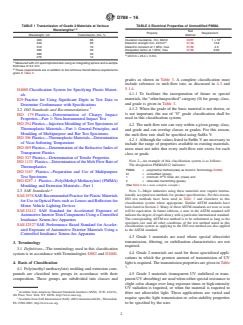
required. The transmission properties are given in Table 1.
4.5 Grade 3 materials (transparent UV stabilized or transparent UV absorbing) are used when either special resistance to slight
color change over long exposure times or high-intensity UV radiation is required, or when the material is required to filter out
ultraviolet light. These applications are varied and require specific light transmission or color-stability properties to be specified
by the user.
5. Suffixes
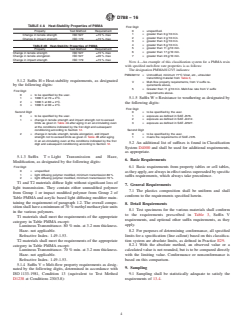
5.1 When additional requirements are needed, based on the application, that are not covered by the basic cell-table requirements,
they shall be indicated through the use of suffixes. In general, suffixes consist of a suffix letter, which gives the requirement needed,
a first digit, which gives the test condition, and a second digit, which gives the specific requirement.
5.1.1 Suffix E = Electrical requirements, as designated by the following digits:
D788 − 16
TABLE 3 PMMA Poly(Methyl Methacrylate) Materials Detail Requirements
Note—The values listed were developed for natural colors. Colorants or other additives, or both, have the potential to alter
these properties.
Charpy Tensile Tensile Vicat
Index of
Luminous Haze,
Impact, Strength, Modulus, Softening
Refraction,
Transmittance, Test
Test Test Test Temperature,
A A
Group Description Class Description Grade Description Test
Test Method Method
Method Method Method Test Method
E E
Method
D1003, D1003,
B D C F
ISO 179 ISO 527, ISO 527, ISO 306,
E
%, min %, max ISO 489
kJ/m , min MPa, min MPa, min °C, min
G
01 Unmodified 1 Formerly 1 General purpose . 58 90 2.5 1.48-1.50 2700 77
H
Grade 5 2 UV transmitting . 58 90 2.5 1.48-1.50 2700 77
I
(D788 - 84) 3 UV stabilized . 58 90 2.5 1.48-1.50 2700 77
2 Formerly 1 General purpose . 62 90 2.5 1.48-1.50 2700 86
H
Grade 6 2 UV transmitting . 62 90 2.5 1.48-1.50 2700 86
I
(D788 - 84) 3 UV stabilized . 62 90 2.5 1.48-1.50 2700 86
3 Formerly 1 General purpose . 65 90 2.5 1.48-1.50 2700 95
H
Grade 8 2 UV transmitting . 65 90 2.5 1.48-1.50 2700 95
I
(D788 - 84) 3 UV stabilized . 65 90 2.5 1.48-1.50 2700 95
4 Higher Vicat 1 General purpose . 65 90 2.5 1.48-1.50 2700 104
Softening
Point than
Former
Grade 8
H
2 UV transmitting . 65 90 2.5 1.48-1.50 2700 104
I
3 UV stabilized . 65 90 2.5 1.48-1.50 2700 104
02 Impact 1 1 1.2 51 88 4.0 1.48-1.50 2600 95
J
modified 0 Other/ . . . . . . .
unspecified
2 1 2.0 38 88 4.0 1.48-1.50 2500 90
3 1 4.3 31 88 4.0 1.48-1.50 1700 85
4 1 3.0 31 88 4.0 1.48-1.50 1700 85
03 Heat- 1 1 General purpose . 65 90 2.5 1.48-1.50 2700 113
H
Resistance 2 UV transmitting . 65 90 2.5 1.48-1.50 2700 113
K I
modified 3 UV stabilized . 65 90 2.5 1.48-1.50 2700 113
4 Impact modified also tbd 56 88 4.0 1.48-1.50 tbd 113
2 1 General purpose . 65 90 2.5 1.48-1.50 2700 122
H
2 UV transmitting . 65 90 2.5 1.48-1.50 2700 122
I
3 UV stabilized . 65 90 2.5 1.48-1.50 2700 122
3 1 General purpose . 58 90 2.5 1.48-1.52 2700 113
4 1 General purpose . 58 90 2.5 1.48-1.52 2700 122
00 Other 0 0 Other/unspecified . . . . . . .
A
No descriptions are listed unless needed to describe a special grade or class. All other categories are listed by requirements.
B
Method designation shall be ISO 179/1eA. Specimen shall be type 1 (4 by 10 by 80 mm) with a type A notch radi
...