


ASTM D2024-09(2017)
(Test Method)Standard Test Method for Cloud Point of Nonionic Surfactants
Standard Test Method for Cloud Point of Nonionic Surfactants
SIGNIFICANCE AND USE
3.1 The cloud point temperature is a reproducible characteristic of certain pure nonionic surfactants. It is also characteristic of certain nonionic surfactant formulated systems. This test method is appropriate for both systems.
Note 1: If the transition from a distinctly cloudy to a clear solution is not sharp, that is, if it does not take place within a range of 1°C, this test method is not appropriate.
SCOPE
1.1 This test method covers a procedure to determine the “cloud point” of nonionic surfactants or detergent systems. Cloud Point is the temperature at which dissolved components (solids or liquids) are no longer completely soluble, precipating as a second phase giving the fluid a cloudy appearance. It is limited to those surfactants and detergent systems for which the visible solubility change occurs over a range of 1°C or less at concentrations of 0.5 to 1.0 % in DI water between 30 and 95°C.
1.2 Chemical Limitations—Nonionic surfactants that exhibit a characteristic cloud point in general terms consist of a water-in-soluble moiety condensed with 50 to 75 % by weight of ethylene oxide. If the level of ethoxylation is too low the surfactant may not be water soluble at temperatures less than 30°C, and if it is too high no cloud point may exist.
1.3 This standard does not purport to address all of the safety concerns, if any, associated with its use. It is the responsibility of the user of this standard to establish appropriate safety and health practices and determine the applicability of regulatory limitations prior to use.
1.4 This international standard was developed in accordance with internationally recognized principles on standardization established in the Decision on Principles for the Development of International Standards, Guides and Recommendations issued by the World Trade Organization Technical Barriers to Trade (TBT) Committee.
General Information
Buy Standard
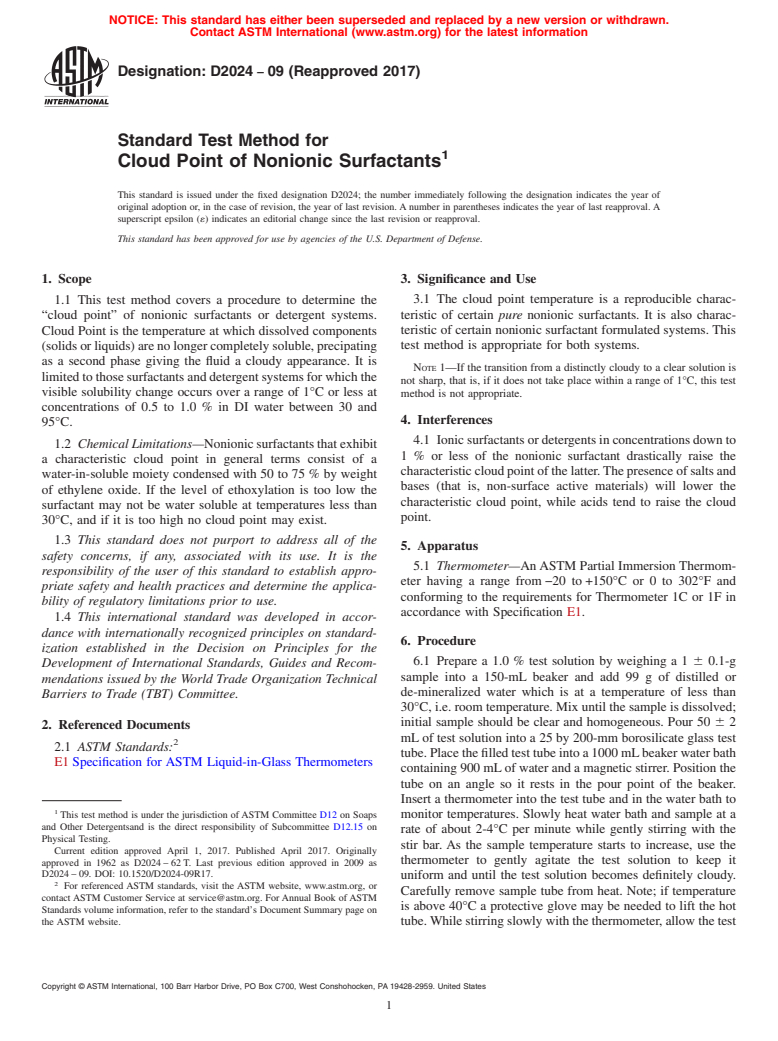
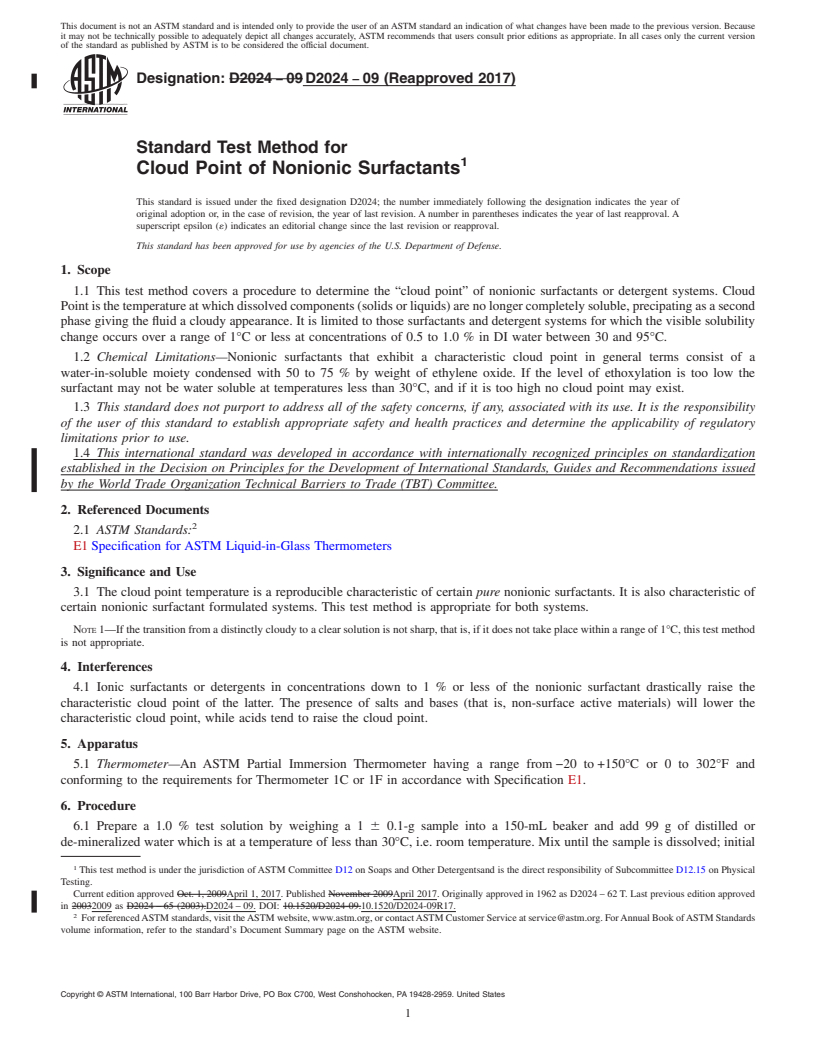
Standards Content (Sample)
NOTICE: This standard has either been superseded and replaced by a new version or withdrawn.
Contact ASTM International (www.astm.org) for the latest information
Designation: D2024 − 09 (Reapproved 2017)
Standard Test Method for
1
Cloud Point of Nonionic Surfactants
This standard is issued under the fixed designation D2024; the number immediately following the designation indicates the year of
original adoption or, in the case of revision, the year of last revision. A number in parentheses indicates the year of last reapproval. A
superscript epsilon (´) indicates an editorial change since the last revision or reapproval.
This standard has been approved for use by agencies of the U.S. Department of Defense.
1. Scope 3. Significance and Use
1.1 This test method covers a procedure to determine the 3.1 The cloud point temperature is a reproducible charac-
teristic of certain pure nonionic surfactants. It is also charac-
“cloud point” of nonionic surfactants or detergent systems.
Cloud Point is the temperature at which dissolved components teristic of certain nonionic surfactant formulated systems. This
test method is appropriate for both systems.
(solids or liquids) are no longer completely soluble, precipating
as a second phase giving the fluid a cloudy appearance. It is
NOTE 1—If the transition from a distinctly cloudy to a clear solution is
limited to those surfactants and detergent systems for which the
not sharp, that is, if it does not take place within a range of 1°C, this test
visible solubility change occurs over a range of 1°C or less at
method is not appropriate.
concentrations of 0.5 to 1.0 % in DI water between 30 and
4. Interferences
95°C.
4.1 Ionic surfactants or detergents in concentrations down to
1.2 Chemical Limitations—Nonionic surfactants that exhibit
1 % or less of the nonionic surfactant drastically raise the
a characteristic cloud point in general terms consist of a
characteristic cloud point of the latter. The presence of salts and
water-in-soluble moiety condensed with 50 to 75 % by weight
bases (that is, non-surface active materials) will lower the
of ethylene oxide. If the level of ethoxylation is too low the
characteristic cloud point, while acids tend to raise the cloud
surfactant may not be water soluble at temperatures less than
point.
30°C, and if it is too high no cloud point may exist.
1.3 This standard does not purport to address all of the
5. Apparatus
safety concerns, if any, associated with its use. It is the
5.1 Thermometer—An ASTM Partial Immersion Thermom-
responsibility of the user of this standard to establish appro-
eter having a range from −20 to +150°C or 0 to 302°F and
priate safety and health practices and determine the applica-
conforming to the requirements for Thermometer 1C or 1F in
bility of regulatory limitations prior to use.
accordance with Specification E1.
1.4 This international standard was developed in accor-
dance with internationally recognized principles on standard-
6. Procedure
ization established in the Decision on Principles for the
6.1 Prepare a 1.0 % test solution by weighing a 1 6 0.1-g
Development of International Standards, Guides and Recom-
sample into a 150-mL beaker and add 99 g of distilled or
mendations issued by the World Trade Organization Technical
de-mineralized water which is at a temperature of less than
Barriers to Trade (TBT) Committee.
30°C, i.e. room temperature. Mix until the sample is dissolved;
initial sample should be clear and homogeneous. Pour 50 6 2
2. Referenced Documents
mL of test solution into a 25 by 200-mm borosilicate glass test
2
2.1 ASTM Standards:
tube. Place the filled test tube into a 1000
...
This document is not an ASTM standard and is intended only to provide the user of an ASTM standard an indication of what changes have been made to the previous version. Because
it may not be technically possible to adequately depict all changes accurately, ASTM recommends that users consult prior editions as appropriate. In all cases only the current version
of the standard as published by ASTM is to be considered the official document.
Designation: D2024 − 09 D2024 − 09 (Reapproved 2017)
Standard Test Method for
1
Cloud Point of Nonionic Surfactants
This standard is issued under the fixed designation D2024; the number immediately following the designation indicates the year of
original adoption or, in the case of revision, the year of last revision. A number in parentheses indicates the year of last reapproval. A
superscript epsilon (´) indicates an editorial change since the last revision or reapproval.
This standard has been approved for use by agencies of the U.S. Department of Defense.
1. Scope
1.1 This test method covers a procedure to determine the “cloud point” of nonionic surfactants or detergent systems. Cloud
Point is the temperature at which dissolved components (solids or liquids) are no longer completely soluble, precipating as a second
phase giving the fluid a cloudy appearance. It is limited to those surfactants and detergent systems for which the visible solubility
change occurs over a range of 1°C or less at concentrations of 0.5 to 1.0 % in DI water between 30 and 95°C.
1.2 Chemical Limitations—Nonionic surfactants that exhibit a characteristic cloud point in general terms consist of a
water-in-soluble moiety condensed with 50 to 75 % by weight of ethylene oxide. If the level of ethoxylation is too low the
surfactant may not be water soluble at temperatures less than 30°C, and if it is too high no cloud point may exist.
1.3 This standard does not purport to address all of the safety concerns, if any, associated with its use. It is the responsibility
of the user of this standard to establish appropriate safety and health practices and determine the applicability of regulatory
limitations prior to use.
1.4 This international standard was developed in accordance with internationally recognized principles on standardization
established in the Decision on Principles for the Development of International Standards, Guides and Recommendations issued
by the World Trade Organization Technical Barriers to Trade (TBT) Committee.
2. Referenced Documents
2
2.1 ASTM Standards:
E1 Specification for ASTM Liquid-in-Glass Thermometers
3. Significance and Use
3.1 The cloud point temperature is a reproducible characteristic of certain pure nonionic surfactants. It is also characteristic of
certain nonionic surfactant formulated systems. This test method is appropriate for both systems.
NOTE 1—If the transition from a distinctly cloudy to a clear solution is not sharp, that is, if it does not take place within a range of 1°C, this test method
is not appropriate.
4. Interferences
4.1 Ionic surfactants or detergents in concentrations down to 1 % or less of the nonionic surfactant drastically raise the
characteristic cloud point of the latter. The presence of salts and bases (that is, non-surface active materials) will lower the
characteristic cloud point, while acids tend to raise the cloud point.
5. Apparatus
5.1 Thermometer—An ASTM Partial Immersion Thermometer having a range from −20 to +150°C or 0 to 302°F and
conforming to the requirements for Thermometer 1C or 1F in accordance with Specification E1.
6. Procedure
6.1 Prepare a 1.0 % test solution by weighing a 1 6 0.1-g sample into a 150-mL beaker and add 99 g of distilled or
de-mineralized water which is at a temperature of less than 30°C, i.e. room temperature. Mix until the sample is dissolved; initial
1
This test method is under the jurisdiction of ASTM Committee D12 on Soaps and Other Detergentsand is the direct responsibility of Subcommittee D12.15 on Physical
Testing.
Current edition approved Oct. 1, 2009April 1, 2017. Published November 2009April 2017. Originally approved in 1962 as D2024 – 62 T. Last previous edition approved
in 20032009 as D2024 – 65 (2003).D2024 – 09. DOI: 10.1520/D2024-09.10.1520/D2024-09R17.
2
For referenced ASTM standards, visit the ASTM website, www.astm.org, or contact ASTM Customer Service at service@astm.org. For Annual Book of ASTM Standards
volume information, refer to the standard’s Document Summary page on the ASTM website.
Copyright © ASTM International, 100 Barr Harbor Drive, PO Box C700, West Conshohocken, PA 19428-2959. United States
1
---------------------- Page: 1 ----------------------
D2024 − 09 (2017)
sample should be clear and homogeneous. Pour 50 6 2 mL of test solution into a 25 by 200-mm borosilicate glass test tube. Place
the filled test tube into a 1000 mL beaker water bath containing 900 mL of water and a magnetic stirrer. Position the tube on an
angle so it rests in the pour point of the beaker. Insert
...
Questions, Comments and Discussion
Ask us and Technical Secretary will try to provide an answer. You can facilitate discussion about the standard in here.