

ASTM C577-19
(Test Method)Standard Test Method for Permeability of Refractories
General Information
- Abstract
SIGNIFICANCE AND USE
3.1 This test method is used to measure the rate of flow of air or nitrogen through refractory brick and monoliths and to thus determine the permeability of tested products.
3.2 This test method is useful in research and development for establishing the relative permeability of products within comparable classes. It may also be used to identify acceptable products for design purposes and to establish permeability criteria for specification acceptance.
3.3 It must be recognized that permeability can vary in different directions and different parts of a refractory due to factors such as forming procedure, grain size and distribution, and heat treatment.
SCOPE
1.1 This test method covers determination of the permeability of refractory brick and monoliths, from which suitable specimens can be cut, at room temperature.
1.2 Units—The values stated in inch-pound units are to be regarded as standard. The values given in parentheses are mathematical conversions to SI units that are provided for information only and are not considered standard.
1.2.1 Exceptions—The apparatus used in this standard is only available in SI units (Section 4). Also, some of the calculations must use SI units only.
1.3 This standard does not purport to address all of the safety concerns, if any, associated with its use. It is the responsibility of the user of this standard to establish appropriate safety, health, and environmental practices and determine the applicability of regulatory limitations prior to use.
1.4 This international standard was developed in accordance with internationally recognized principles on standardization established in the Decision on Principles for the Development of International Standards, Guides and Recommendations issued by the World Trade Organization Technical Barriers to Trade (TBT) Committee.
- Status
- Published
- Publication Date
- 31-Oct-2019
- Technical Committee
- C08 - Refractories
- Drafting Committee
- C08.03 - Physical Properties
Overview
ASTM C577-19: Standard Test Method for Permeability of Refractories is an internationally recognized ASTM standard that specifies procedures for measuring the permeability of refractory bricks and monoliths at room temperature. Developed by ASTM Committee C08 on Refractories, this standard is vital in determining the rate at which gases such as air or nitrogen pass through refractory materials, providing essential data on their gas permeability. The information gathered ensures that refractory products meet design and performance requirements across a range of industrial applications.
Key Topics
- Permeability Testing: ASTM C577-19 lays out a clear methodology to measure the flow of air or nitrogen through cut specimens of refractory brick or monolithic materials. It ensures consistency in sample preparation, measurement, and data analysis.
- Directionality of Permeability: The standard highlights that permeability characteristics can vary based on direction within the material, affected by factors including forming processes, grain size distribution, and heat treatment history.
- Apparatus and Measurement:
- Use of a specially designed leakproof apparatus with a rubber gasket, flowmeters, and digital manometer.
- Tests are performed using 2-inch (51-mm) cubes of refractory material.
- Flow rates and differential pressures are precisely measured to calculate permeability in centidarcys.
- Specimen Preparation: Detailed guidelines ensure that specimens are cut, dried, and handled properly to obtain reliable and reproducible permeability results.
- Reporting and Precision: Results are averaged across multiple orientations to capture variability. Repeatability and reproducibility intervals are specified to assist labs in quality control and data comparison.
Applications
ASTM C577-19 plays a critical role in both research and quality control for the refractory industry. Typical applications include:
- Product Development and Selection: By comparing the permeability of various refractory products, researchers and engineers can select materials best suited for specific environments, such as high-temperature furnaces or reactors where gas-tight seals or controlled gas movement are required.
- Specification Compliance: The method facilitates specification acceptance by providing quantifiable permeability limits that products must meet-essential for contracts and regulatory requirements.
- Design Engineering: Knowing a refractory’s permeability helps in designing components that need specific gas flow characteristics, mitigating risks of chemical attack, erosion, or structural failure.
- Quality Control: Routine use of the method ensures that manufactured refractories consistently meet internal and external standards for gas permeability.
- Research and Development: Establishing permeability within comparable product classes supports innovation and improvement in refractory materials.
Related Standards
For organizations and professionals working with refractory materials and high-temperature applications, the following standards may also be relevant:
- ASTM C1095: Practice for Calculating Precision Data on Refractories from Interlaboratory Test Results (Withdrawn)
- ASTM C20: Standard Test Methods for Apparent Porosity, Water Absorption, Apparent Specific Gravity, and Bulk Density of Burned Refractory Brick and Shapes by Boiling Water
- ASTM C113: Standard Test Method for Reheat Change of Refractory Brick
- ISO 5017: International standard for the determination of apparent porosity, water absorption, apparent relative density, and bulk density of refractory products
Practical Value
Implementing ASTM C577-19 ensures objective assessment of gas permeability in refractories, supporting the production and use of materials that function reliably in demanding industrial settings. Accurate permeability testing helps minimize costly failures, optimizes product performance, and aids in innovation for enhanced refractory products. By adhering to this standard, industries maintain compliance with international best practices, enhancing product quality and operational safety.
Keywords: refractory permeability, permeability test, gas flow, ASTM C577-19, refractory materials, quality control, test method, centidarcy, industrial standards.
Relations
- Effective Date
- 01-Nov-2019
- Effective Date
- 01-Nov-2019
- Effective Date
- 01-Nov-2019
- Effective Date
- 01-Nov-2019
Frequently Asked Questions
ASTM C577-19 is a standard published by ASTM International. Its full title is "Standard Test Method for Permeability of Refractories". This standard covers: SIGNIFICANCE AND USE 3.1 This test method is used to measure the rate of flow of air or nitrogen through refractory brick and monoliths and to thus determine the permeability of tested products. 3.2 This test method is useful in research and development for establishing the relative permeability of products within comparable classes. It may also be used to identify acceptable products for design purposes and to establish permeability criteria for specification acceptance. 3.3 It must be recognized that permeability can vary in different directions and different parts of a refractory due to factors such as forming procedure, grain size and distribution, and heat treatment. SCOPE 1.1 This test method covers determination of the permeability of refractory brick and monoliths, from which suitable specimens can be cut, at room temperature. 1.2 Units—The values stated in inch-pound units are to be regarded as standard. The values given in parentheses are mathematical conversions to SI units that are provided for information only and are not considered standard. 1.2.1 Exceptions—The apparatus used in this standard is only available in SI units (Section 4). Also, some of the calculations must use SI units only. 1.3 This standard does not purport to address all of the safety concerns, if any, associated with its use. It is the responsibility of the user of this standard to establish appropriate safety, health, and environmental practices and determine the applicability of regulatory limitations prior to use. 1.4 This international standard was developed in accordance with internationally recognized principles on standardization established in the Decision on Principles for the Development of International Standards, Guides and Recommendations issued by the World Trade Organization Technical Barriers to Trade (TBT) Committee.
SIGNIFICANCE AND USE 3.1 This test method is used to measure the rate of flow of air or nitrogen through refractory brick and monoliths and to thus determine the permeability of tested products. 3.2 This test method is useful in research and development for establishing the relative permeability of products within comparable classes. It may also be used to identify acceptable products for design purposes and to establish permeability criteria for specification acceptance. 3.3 It must be recognized that permeability can vary in different directions and different parts of a refractory due to factors such as forming procedure, grain size and distribution, and heat treatment. SCOPE 1.1 This test method covers determination of the permeability of refractory brick and monoliths, from which suitable specimens can be cut, at room temperature. 1.2 Units—The values stated in inch-pound units are to be regarded as standard. The values given in parentheses are mathematical conversions to SI units that are provided for information only and are not considered standard. 1.2.1 Exceptions—The apparatus used in this standard is only available in SI units (Section 4). Also, some of the calculations must use SI units only. 1.3 This standard does not purport to address all of the safety concerns, if any, associated with its use. It is the responsibility of the user of this standard to establish appropriate safety, health, and environmental practices and determine the applicability of regulatory limitations prior to use. 1.4 This international standard was developed in accordance with internationally recognized principles on standardization established in the Decision on Principles for the Development of International Standards, Guides and Recommendations issued by the World Trade Organization Technical Barriers to Trade (TBT) Committee.
ASTM C577-19 is classified under the following ICS (International Classification for Standards) categories: 81.080 - Refractories. The ICS classification helps identify the subject area and facilitates finding related standards.
ASTM C577-19 has the following relationships with other standards: It is inter standard links to ASTM C577-07(2014), ASTM C781-20, ASTM C1783-15, ASTM C1793-15. Understanding these relationships helps ensure you are using the most current and applicable version of the standard.
ASTM C577-19 is available in PDF format for immediate download after purchase. The document can be added to your cart and obtained through the secure checkout process. Digital delivery ensures instant access to the complete standard document.
Standards Content (Sample)
This international standard was developed in accordance with internationally recognized principles on standardization established in the Decision on Principles for the
Development of International Standards, Guides and Recommendations issued by the World Trade Organization Technical Barriers to Trade (TBT) Committee.
Designation: C577 − 19
Standard Test Method for
Permeability of Refractories
This standard is issued under the fixed designation C577; the number immediately following the designation indicates the year of
original adoption or, in the case of revision, the year of last revision. A number in parentheses indicates the year of last reapproval. A
superscript epsilon (´) indicates an editorial change since the last revision or reapproval.
1. Scope 3.2 This test method is useful in research and development
for establishing the relative permeability of products within
1.1 This test method covers determination of the permeabil-
comparable classes. It may also be used to identify acceptable
ity of refractory brick and monoliths, from which suitable
products for design purposes and to establish permeability
specimens can be cut, at room temperature.
criteria for specification acceptance.
1.2 Units—The values stated in inch-pound units are to be
3.3 It must be recognized that permeability can vary in
regarded as standard. The values given in parentheses are
different directions and different parts of a refractory due to
mathematical conversions to SI units that are provided for
factors such as forming procedure, grain size and distribution,
information only and are not considered standard.
and heat treatment.
1.2.1 Exceptions—The apparatus used in this standard is
only available in SI units (Section 4). Also, some of the
4. Apparatus
calculations must use SI units only.
4.1 The apparatus shall provide a leakproof system for
1.3 This standard does not purport to address all of the
testing 2-in. (51-mm) cubes held in a pressurized rubber
safety concerns, if any, associated with its use. It is the
gasket, with means for controlling gas pressure and measuring
responsibility of the user of this standard to establish appro-
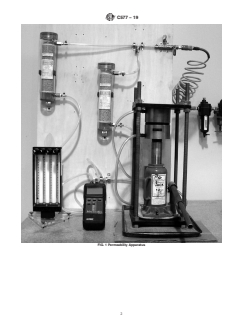
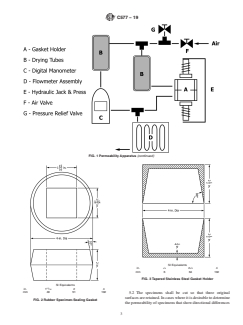
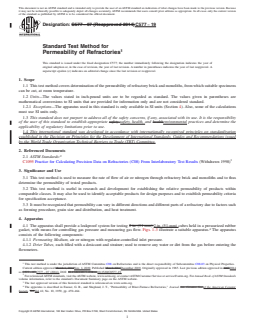
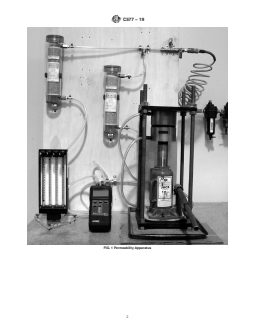
gas flow. Figs. 1-3 illustrate a suitable apparatus. The appa-
priate safety, health, and environmental practices and deter-
ratus consists of the following components:
mine the applicability of regulatory limitations prior to use.
4.1.1 Permeating Medium, air or nitrogen with regulator-
1.4 This international standard was developed in accor-
controlled inlet pressure.
dance with internationally recognized principles on standard-
4.1.2 Drier Tubes, each filled with a desiccant and strainer;
ization established in the Decision on Principles for the
used to remove any water or dirt from the gas before entering
Development of International Standards, Guides and Recom-
the flowmeters.
mendations issued by the World Trade Organization Technical
4.1.3 Flowmeters—They will measure the flow of permeat-
Barriers to Trade (TBT) Committee.
ing media in the range from 0 to 9000 cm /min. The flowme-
ters may be calibrated to read the flow directly of either air or
2. Referenced Documents
nitrogen. The range for each flowmeter is shown in Fig. 1.
2.1 ASTM Standards:
4.1.4 Manometer—Amultiple-scale digital manometer shall
C1095 Practice for Calculating Precision Data on Refracto-
be used to measure the differential pressure across the speci-
ries (C08) From Interlaboratory Test Results (Withdrawn
men.
1998)
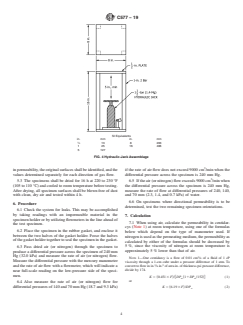
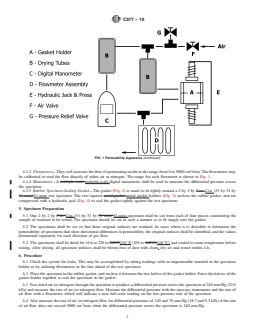
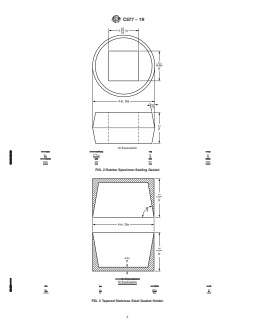
4.1.5 RubberSpecimen-SealingGasket—Thegasket(Fig.2)
3. Significance and Use is made to fit tightly arounda2by2by 2-in. (51 by 51 by
51-mm) test specimen. The two tapered metal gasket holders
3.1 This test method is used to measure the rate of flow of
(Fig. 3) enclose the rubber gasket, and are compressed with a
air or nitrogen through refractory brick and monoliths and to
hydraulic jack (Fig. 4) to seal the gasket tightly against the test
thus determine the permeability of tested products.
specimen.
This test method is under the jurisdiction of ASTM Committee C08 on
5. Specimen Preparation
Refractories and is the direct responsibility of Subcommittee C08.03 on Physical
Properties.
5.1 One2by2by2-in.(51by51by51-mm)specimenshall
Current edition approved Nov. 1, 2019. Published December 2019. Originally
be cut from each of four pieces constituting the sample of
approved in 1965. Last previous edition approved in 2014 as C577 – 07 (2014).
material to be tested. The specimen should be cut in such a
DOI: 10.1520/C0577-19.
For referenced ASTM standards, visit the ASTM website, www.astm.org, or
manner as to fit snugly into the gasket.
contact ASTM Customer Service at service@astm.org. For Annual Book of ASTM
Standards volume information, refer to the standard’s Document Summary page on
the ASTM website. The apparatus is described in Eusner, G. R., and Shapland, J. T., “Permeability
The last approved version of this historical standard is referenced on of Blast-Furnace Refractories,” Journal of the American Ceramic Society, Vol 42,
www.astm.org. No. 10, 1959, pp. 459–464.
Copyright © ASTM International, 100 Barr Harbor Drive, PO Box C700, West Conshohocken, PA 19428-2959. United States
C577 − 19
FIG. 1 Permeability Apparatus
C577 − 19
FIG. 1 Permeability Apparatus (continued)
SI Equivalents
1 1
in. ⁄4 2 ⁄2 4
mm 6 64 102
FIG. 3 Tapered Stainless Steel Gasket Holder
SI Equivalents
in. 1 ⁄16 24
mm 49 51 102
5.2 The specimens shall be cut so that three original
surfacesareretained.Incaseswhereitisdesirabletodetermine
FIG. 2 Rubber Specimen-Sealing Gasket
the permeability of specimens that show directional differences
C577 − 19
SI Equivalents
in. mm in. mm
⁄2 13 8 203
1 25 16 406
5 127
FIG. 4 Hydraulic-Jack Assemblage
inpermeability,theoriginalsurfacesshallbeidentified,andthe if the rate of air flow does not exceed 9000 cm /min when the
values determined separately for each direction of gas flow. differential pressure across the specimen is 240 mm Hg.
5.3 The specimens shall be dried for 16 h at 220 to 230 °F 6.5 If the air (or nitrogen) flow exceeds 9000 cm /min when
(105 to 110 °C) and cooled to room temperature before testing. the differential pressure across the specimen is 240 mm Hg,
After drying, all specimen surfaces shall be blown free of dust measure the rate of flow at differential pressures of 240, 140,
with clean, dry air and tested within 4 h. and 70 mm (2.3, 1.4, and 0.7 kPa) of water.
6.6 On specimens where directional permeability is to be
6. Procedure
dete
...
This document is not an ASTM standard and is intended only to provide the user of an ASTM standard an indication of what changes have been made to the previous version. Because
it may not be technically possible to adequately depict all changes accurately, ASTM recommends that users consult prior editions as appropriate. In all cases only the current version
of the standard as published by ASTM is to be considered the official document.
Designation: C577 − 07 (Reapproved 2014) C577 − 19
Standard Test Method for
Permeability of Refractories
This standard is issued under the fixed designation C577; the number immediately following the designation indicates the year of
original adoption or, in the case of revision, the year of last revision. A number in parentheses indicates the year of last reapproval. A
superscript epsilon (´) indicates an editorial change since the last revision or reapproval.
1. Scope
1.1 This test method covers determination of the permeability of refractory brick and monoliths, from which suitable specimens
can be cut, at room temperature.
1.2 Units—The values stated in inch-pound units are to be regarded as standard. The values given in parentheses are
mathematical conversions to SI units that are provided for information only and are not considered standard.
1.2.1 Exceptions—The apparatus used in this standard is only available in SI units (Section 4). Also, some of the calculations
must use SI units only.
1.3 This standard does not purport to address all of the safety concerns, if any, associated with its use. It is the responsibility
of the user of this standard to establish appropriate safety safety, health, and healthenvironmental practices and determine the
applicability of regulatory limitations prior to use.
1.4 This international standard was developed in accordance with internationally recognized principles on standardization
established in the Decision on Principles for the Development of International Standards, Guides and Recommendations issued
by the World Trade Organization Technical Barriers to Trade (TBT) Committee.
2. Referenced Documents
2.1 ASTM Standards:
C1095 Practice for Calculating Precision Data on Refractories (C08) From Interlaboratory Test Results (Withdrawn 1998)
3. Significance and Use
3.1 This test method is used to measure the rate of flow of air or nitrogen through refractory brick and monoliths and to thus
determine the permeability of tested products.
3.2 This test method is useful in research and development for establishing the relative permeability of products within
comparable classes. It may also be used to identify acceptable products for design purposes and to establish permeability criteria
for specification acceptance.
3.3 It must be recognized that permeability can vary in different directions and different parts of a refractory due to factors such
as forming procedure, grain size and distribution, and heat treatment.
4. Apparatus
4.1 The apparatus shall provide a leakproof system for testing 2 in. (51 mm) 2-in. (51-mm) cubes held in a pressurized rubber
gasket, with means for controlling gas pressure and measuring gas flow. Figs. 1-3 illustrate a suitable apparatus. The apparatus
consists of the following components:
4.1.1 Permeating Medium, air or nitrogen with regulator-controlled inlet pressure.
4.1.2 Drier Tubes, each filled with a desiccant and strainer; used to remove any water or dirt from the gas before entering the
flowmeters.
This test method is under the jurisdiction of ASTM Committee C08 on Refractories and is the direct responsibility of Subcommittee C08.03 on Physical Properties.
Current edition approved March 1, 2014Nov. 1, 2019. Published March 2014December 2019. Originally approved in 1965. Last previous edition approved in 20072014
as C577 – 07.C577 – 07 (2014). DOI: 10.1520/C0577-07R14.10.1520/C0577-19.
For referenced ASTM standards, visit the ASTM website, www.astm.org, or contact ASTM Customer Service at service@astm.org. For Annual Book of ASTM Standards
volume information, refer to the standard’s Document Summary page on the ASTM website.
The last approved version of this historical standard is referenced on www.astm.org.
The apparatus is described in Eusner, G. R., and Shapland, J. T., “Permeability of Blast-Furnace Refractories,” Journal Am. Ceramic Soc.of the American Ceramic
Society, Vol.Vol 42, No. 10, 1959, pp. 459–464.
Copyright © ASTM International, 100 Barr Harbor Drive, PO Box C700, West Conshohocken, PA 19428-2959. United States
C577 − 19
FIG. 1 Permeability Apparatus
C577 − 19
FIG. 1 Permeability Apparatus (continued)
4.1.3 Flowmeters—They will measure the flow of permeating media in the range from 0 to 9000 cm /min. The flowmeters may
be calibrated to read the flow directly of either air or nitrogen. The range for each flowmeter is shown in Fig. 1.
4.1.4 Manometer—A multiple scale multiple-scale digital manometer shall be used to measure the differential pressure across
the specimen.
4.1.5 Rubber Specimen-Sealing Gasket—The gasket (Fig. 2) is made to fit tightly around a 2 by 2 by 2 in. 2-in. (51 by 51 by
51 mm) 51-mm) test specimen. The two tapered metal-gasket metal gasket holders (Fig. 3) enclose the rubber gasket, and are
compressed with a hydraulic jack (Fig. 4) to seal the gasket tightly against the test specimen.
5. Specimen Preparation
5.1 One 2 by 2 by 2 in. 2-in. (51 by 51 by 51 mm) 51-mm) specimen shall be cut from each of four pieces constituting the
sample of material to be tested. The specimen should be cut in such a manner as to fit snugly into the gasket.
5.2 The specimens shall be cut so that three original surfaces are retained. In cases where it is desirable to determine the
permeability of specimens that show directional differences in permeability, the original surfaces shall be identified, and the values
determined separately for each direction of gas flow.
5.3 The specimens shall be dried for 16 h at 220 to 230°F230 °F (105 to 110°C)110 °C) and cooled to room temperature before
testing. After drying, all specimen surfaces shall be blown free of dust with clean, dry air and tested within 4 h.
6. Procedure
6.1 Check the system for leaks. This may be accomplished by taking readings with an impermeable material in the specimen
holder or by utilizing flowmeters in the line ahead of the test specimen.
6.2 Place the specimen in the rubber gasket, and enclose it between the two halves of the gasket holder. Force the halves of the
gasket holder together to seal the specimen in the gasket.
6.3 Pass dried air (or nitrogen) through the specimen to produce a differential pressure across the specimen of 240 mm Hg (32.0
kPa) and measure the rate of air (or nitrogen) flow. Measure the differential pressure with the mercury manometer and the rate of
air flow with a flowmeter, which will indicate a near full-scale reading on the low-pressure side of the specimen.
6.4 Also measure the ra
...