

ASTM C1534-22
(Specification)Standard Specification for Flexible Polymeric Foam Sheet Insulation Used as a Thermal and Sound Absorbing Liner for Duct Systems
General Information
- Abstract
ABSTRACT
This specification covers the composition, dimensions, and physical properties of flexible unfaced foam sheet, used to insulate interior surfaces of HVAC ducts, plenums and equipment used for the distribution of conditioned air. The flexible polymeric insulations of this specification are classified into Types I and II. Type I is a closed flexible foam. Type II is an open cell flexible foam. Following test methods shall be performed: apparent thermal conductivity; surface burning characteristics; hot service performance; water vapor sorption; water absorption; dimensional stability; odor emission; fungi resistance; erosion resistance; and sound absorption coefficient.
SCOPE
1.1 This specification covers the composition, dimensions, and physical properties of flexible unfaced foam sheet, used to insulate interior surfaces of HVAC ducts, plenums and equipment used for the distribution of conditioned air with a temperature of up to 250°F (121°C).
1.2 HVAC ducts, plenums and equipment systems typically operate between a temperature range of 50°F to 150°F (10°C to 65°C) and are designed to meet building code requirements of maximum temperatures of 250°F (121°C).
1.3 The values stated in inch-pound units are to be regarded as standard. The values given in parentheses are mathematical conversions to SI units that are provided for information only and are not considered standard.
1.4 This standard does not purport to address all of the safety concerns, if any, associated with its use. It is the responsibility of the user of this standard to establish appropriate safety, health, and environmental practices and determine the applicability of regulatory limitations prior to use.
1.5 This international standard was developed in accordance with internationally recognized principles on standardization established in the Decision on Principles for the Development of International Standards, Guides and Recommendations issued by the World Trade Organization Technical Barriers to Trade (TBT) Committee.
- Status
- Published
- Publication Date
- 31-Oct-2022
- Technical Committee
- C16 - Thermal Insulation
- Drafting Committee
- C16.22 - Organic and Nonhomogeneous Inorganic Thermal Insulations
Buy Documents

ASTM C1534-22 - Standard Specification for Flexible Polymeric Foam Sheet Insulation Used as a Thermal and Sound Absorbing Liner for Duct Systems
REDLINE ASTM C1534-22 - Standard Specification for Flexible Polymeric Foam Sheet Insulation Used as a Thermal and Sound Absorbing Liner for Duct Systems
Overview
ASTM C1534-22 is the standard specification for flexible polymeric foam sheet insulation used as a thermal and sound absorbing liner in duct systems. Issued by ASTM International, this standard sets forth the requirements for the composition, dimensions, and physical properties of flexible, unfaced foam sheets designed to insulate the interior surfaces of HVAC ducts, plenums, and related equipment. These insulations are specifically intended for the distribution of conditioned air and are applicable for systems operating with air temperatures up to 250°F (121°C).
Designed to enhance both thermal efficiency and sound attenuation within ductwork, flexible polymeric foam insulation as specified by ASTM C1534-22 plays a critical role in energy conservation and acoustic comfort in commercial, industrial, and residential HVAC installations.
Key Topics
- Material Classification: The standard classifies insulation into two types:
- Type I: Closed cell flexible foam, offering lower water absorption.
- Type II: Open cell flexible foam, providing greater sound absorption.
- Physical Properties: Key properties include:
- Apparent thermal conductivity
- Surface burning characteristics
- Hot surface performance
- Water vapor sorption and water absorption
- Dimensional stability
- Odor emission and fungi resistance
- Erosion resistance
- Sound absorption coefficient
- Testing Requirements: Includes procedures for thermal conductivity, fire performance (flame spread and smoke development), water interaction, mechanical stability, and acoustic effectiveness.
- Dimensional Tolerances and Workmanship: Sets precise tolerances for width, length, and thickness, and emphasizes high-quality fabrication with no service-affecting defects.
Applications
Flexible polymeric foam sheet insulation covered by ASTM C1534-22 is widely utilized in various HVAC and air distribution applications, including:
- HVAC Duct Liners: Used inside sheet metal ducts to provide both thermal insulation and sound attenuation, reducing heat loss/gain and minimizing noise transmission through ductwork.
- Plenums: Applied to the inner surfaces of air handling plenums, enhancing energy efficiency and acoustic comfort.
- Conditioned Air Equipment: Lining the interior of air handling units, fan coil units, and other HVAC equipment to maintain desired temperatures and reduce vibration-related noise.
- Commercial, Industrial, and Residential Installations: Suitable for office buildings, schools, hospitals, manufacturing facilities, and residential complexes where control over temperature and noise is critical.
- Building Code Compliance: Supports compliance with thermal performance, fire safety, and indoor environmental quality standards as required by local and national building codes.
Related Standards
ASTM C1534-22 references and aligns with a range of standards to ensure consistency in terminology, test methods, and quality benchmarks. Key related standards include:
- ASTM C168: Terminology Relating to Thermal Insulation
- ASTM C177, C518, C1114: Test Methods for Thermal Conductivity
- ASTM E84: Surface Burning Characteristics of Building Materials
- ASTM C423, E795: Sound Absorption and Mounting Practices
- ASTM C665: Specification for Mineral-Fiber Blanket Thermal Insulation
- ASTM C447, C411: Practices for Thermal Insulation Temperature Estimation and Hot-Surface Performance Testing
- ASTM C1304, C1338, G21: Methods for Odor Emission and Resistance to Fungi
- CAN/ULC-S102: Canadian Method of Testing for Surface Burning Characteristics
These referenced standards collectively establish a robust framework for evaluating the safety, performance, and suitability of flexible polymeric foam sheet insulation for HVAC ducts and related equipment.
Keywords: ASTM C1534-22, flexible polymeric foam, HVAC insulation, duct liner, closed cell foam, open cell foam, thermal insulation, sound absorbing, duct systems, building code compliance, fire safety, ASTM standards.
Relations
- Effective Date
- 15-Apr-2024
- Effective Date
- 01-Mar-2024
- Effective Date
- 01-Jan-2024
- Effective Date
- 01-Dec-2023
- Effective Date
- 01-Sep-2023
- Effective Date
- 01-May-2020
- Effective Date
- 15-Oct-2019
- Effective Date
- 15-Oct-2019
- Effective Date
- 01-Sep-2019
- Effective Date
- 01-Sep-2019
- Effective Date
- 01-Jul-2019
- Effective Date
- 15-Apr-2019
- Effective Date
- 01-Apr-2019
- Effective Date
- 01-Mar-2019
- Effective Date
- 01-Mar-2019
Buy Documents
ASTM C1534-22 - Standard Specification for Flexible Polymeric Foam Sheet Insulation Used as a Thermal and Sound Absorbing Liner for Duct Systems
REDLINE ASTM C1534-22 - Standard Specification for Flexible Polymeric Foam Sheet Insulation Used as a Thermal and Sound Absorbing Liner for Duct Systems
Get Certified
Connect with accredited certification bodies for this standard

DIBt (Deutsches Institut für Bautechnik)
German Institute for Building Technology.
DIN CERTCO
DIN Group product certification.

Aboma Certification B.V.
Specialized in construction, metal, and transport sectors.
Sponsored listings
Frequently Asked Questions
ASTM C1534-22 is a technical specification published by ASTM International. Its full title is "Standard Specification for Flexible Polymeric Foam Sheet Insulation Used as a Thermal and Sound Absorbing Liner for Duct Systems". This standard covers: ABSTRACT This specification covers the composition, dimensions, and physical properties of flexible unfaced foam sheet, used to insulate interior surfaces of HVAC ducts, plenums and equipment used for the distribution of conditioned air. The flexible polymeric insulations of this specification are classified into Types I and II. Type I is a closed flexible foam. Type II is an open cell flexible foam. Following test methods shall be performed: apparent thermal conductivity; surface burning characteristics; hot service performance; water vapor sorption; water absorption; dimensional stability; odor emission; fungi resistance; erosion resistance; and sound absorption coefficient. SCOPE 1.1 This specification covers the composition, dimensions, and physical properties of flexible unfaced foam sheet, used to insulate interior surfaces of HVAC ducts, plenums and equipment used for the distribution of conditioned air with a temperature of up to 250°F (121°C). 1.2 HVAC ducts, plenums and equipment systems typically operate between a temperature range of 50°F to 150°F (10°C to 65°C) and are designed to meet building code requirements of maximum temperatures of 250°F (121°C). 1.3 The values stated in inch-pound units are to be regarded as standard. The values given in parentheses are mathematical conversions to SI units that are provided for information only and are not considered standard. 1.4 This standard does not purport to address all of the safety concerns, if any, associated with its use. It is the responsibility of the user of this standard to establish appropriate safety, health, and environmental practices and determine the applicability of regulatory limitations prior to use. 1.5 This international standard was developed in accordance with internationally recognized principles on standardization established in the Decision on Principles for the Development of International Standards, Guides and Recommendations issued by the World Trade Organization Technical Barriers to Trade (TBT) Committee.
ABSTRACT This specification covers the composition, dimensions, and physical properties of flexible unfaced foam sheet, used to insulate interior surfaces of HVAC ducts, plenums and equipment used for the distribution of conditioned air. The flexible polymeric insulations of this specification are classified into Types I and II. Type I is a closed flexible foam. Type II is an open cell flexible foam. Following test methods shall be performed: apparent thermal conductivity; surface burning characteristics; hot service performance; water vapor sorption; water absorption; dimensional stability; odor emission; fungi resistance; erosion resistance; and sound absorption coefficient. SCOPE 1.1 This specification covers the composition, dimensions, and physical properties of flexible unfaced foam sheet, used to insulate interior surfaces of HVAC ducts, plenums and equipment used for the distribution of conditioned air with a temperature of up to 250°F (121°C). 1.2 HVAC ducts, plenums and equipment systems typically operate between a temperature range of 50°F to 150°F (10°C to 65°C) and are designed to meet building code requirements of maximum temperatures of 250°F (121°C). 1.3 The values stated in inch-pound units are to be regarded as standard. The values given in parentheses are mathematical conversions to SI units that are provided for information only and are not considered standard. 1.4 This standard does not purport to address all of the safety concerns, if any, associated with its use. It is the responsibility of the user of this standard to establish appropriate safety, health, and environmental practices and determine the applicability of regulatory limitations prior to use. 1.5 This international standard was developed in accordance with internationally recognized principles on standardization established in the Decision on Principles for the Development of International Standards, Guides and Recommendations issued by the World Trade Organization Technical Barriers to Trade (TBT) Committee.
ASTM C1534-22 is classified under the following ICS (International Classification for Standards) categories: 91.100.60 - Thermal and sound insulating materials. The ICS classification helps identify the subject area and facilitates finding related standards.
ASTM C1534-22 has the following relationships with other standards: It is inter standard links to ASTM C168-24, ASTM C390-08(2024), ASTM E176-24, ASTM E84-23d, ASTM E84-23c, ASTM C1763-20, ASTM C1763-19e1, ASTM C1763-19, ASTM C390-08(2019), ASTM C1104/C1104M-19, ASTM E84-19b, ASTM E84-19a, ASTM C1045-19, ASTM C1071-19, ASTM E84-19. Understanding these relationships helps ensure you are using the most current and applicable version of the standard.
ASTM C1534-22 is available in PDF format for immediate download after purchase. The document can be added to your cart and obtained through the secure checkout process. Digital delivery ensures instant access to the complete standard document.
Standards Content (Sample)
This international standard was developed in accordance with internationally recognized principles on standardization established in the Decision on Principles for the
Development of International Standards, Guides and Recommendations issued by the World Trade Organization Technical Barriers to Trade (TBT) Committee.
Designation: C1534 −22
Standard Specification for
Flexible Polymeric Foam Sheet Insulation Used as a
Thermal and Sound Absorbing Liner for Duct Systems
This standard is issued under the fixed designation C1534; the number immediately following the designation indicates the year of
original adoption or, in the case of revision, the year of last revision.Anumber in parentheses indicates the year of last reapproval.A
superscript epsilon (´) indicates an editorial change since the last revision or reapproval.
1. Scope C177Test Method for Steady-State Heat Flux Measure-
ments and Thermal Transmission Properties by Means of
1.1 This specification covers the composition, dimensions,
the Guarded-Hot-Plate Apparatus
and physical properties of flexible unfaced foam sheet, used to
C390Practice for Sampling and Acceptance of Thermal
insulate interior surfaces of HVAC ducts, plenums and equip-
Insulation Lots
ment used for the distribution of conditioned air with a
C411Test Method for Hot-Surface Performance of High-
temperature of up to 250°F (121°C).
Temperature Thermal Insulation
1.2 HVAC ducts, plenums and equipment systems typically
C423TestMethodforSoundAbsorptionandSoundAbsorp-
operatebetweenatemperaturerangeof50°Fto150°F(10°Cto
tion Coefficients by the Reverberation Room Method
65°C) and are designed to meet building code requirements of
C447Practice for Estimating the Maximum Use Tempera-
maximum temperatures of 250°F (121°C).
ture of Thermal Insulations
1.3 Thevaluesstatedininch-poundunitsaretoberegarded
C518Test Method for Steady-State Thermal Transmission
as standard. The values given in parentheses are mathematical
Properties by Means of the Heat Flow Meter Apparatus
conversions to SI units that are provided for information only
C634Terminology Relating to Building and Environmental
and are not considered standard.
Acoustics
1.4 This standard does not purport to address all of the
C665SpecificationforMineral-FiberBlanketThermalInsu-
safety concerns, if any, associated with its use. It is the
lation for Light Frame Construction and Manufactured
responsibility of the user of this standard to establish appro-
Housing
priate safety, health, and environmental practices and deter-
C1045Practice for Calculating Thermal Transmission Prop-
mine the applicability of regulatory limitations prior to use.
erties Under Steady-State Conditions
1.5 This international standard was developed in accor-
C1071Specification for Fibrous Glass Duct Lining Insula-
dance with internationally recognized principles on standard-
tion (Thermal and Sound Absorbing Material)
ization established in the Decision on Principles for the
C1104/C1104MTest Method for Determining the Water
Development of International Standards, Guides and Recom-
Vapor Sorption of Unfaced Mineral Fiber Insulation
mendations issued by the World Trade Organization Technical
C1114Test Method for Steady-State Thermal Transmission
Barriers to Trade (TBT) Committee.
Properties by Means of the Thin-Heater Apparatus
C1304Test Method for Assessing the Odor Emission of
2. Referenced Documents
Thermal Insulation Materials
2.1 ASTM Standards:
C1338Test Method for Determining Fungi Resistance of
C168Terminology Relating to Thermal Insulation
Insulation Materials and Facings
C1763Test Method for Water Absorption by Immersion of
Thermal Insulation Materials
E84Test Method for Surface Burning Characteristics of
This specification is under the jurisdiction of ASTM Committee C16 on
Thermal Insulation and is the direct responsibility of Subcommittee C16.22 on
Building Materials
Organic and Nonhomogeneous Inorganic Thermal Insulations.
E176Terminology of Fire Standards
Current edition approved Nov. 1, 2022. Published December 2022. Originally
E795Practices for Mounting Test Specimens During Sound
approved in 2002. Last previous edition approved in 2020 as C1534–20a. DOI:
10.1520/C1534-22. Absorption Tests
For referenced ASTM standards, visit the ASTM website, www.astm.org, or
E2231Practice for Specimen Preparation and Mounting of
contact ASTM Customer Service at service@astm.org. For Annual Book of ASTM
Pipe and Duct Insulation Materials to Assess Surface
Standards volume information, refer to the standard’s Document Summary page on
the ASTM website. Burning Characteristics
Copyright © ASTM International, 100 Barr Harbor Drive, PO Box C700, West Conshohocken, PA 19428-2959. United States
C1534 − 22
G21Practice for Determining Resistance of Synthetic Poly- 5.2 Flexible, polymeric cellular thermal insulations shall be
meric Materials to Fungi of uniform core density. These insulation materials are avail-
2.2 Other Standards: ablewithasmoothskinsurfaceorcoatingononeorbothsides,
CAN/ULC-S102 Standard Method of Test for Surface andtheyaretobeconsideredhomogeneousforthepurposesof
BurningCharacteristicsofBuildingMaterialsandAssem- determining thermal performance.
blies
6. Ordering Information
3. Terminology
6.1 Specific installation, insulation type, thickness, length,
3.1 The definitions of terms used in this specification shall
and width suited for the intended use shall be agreed upon by
beinaccordancewithTerminologiesC168,C634,andE176.In
the purchaser and supplier.
case of any conflicts,Terminology C168 shall be the authority.
3.2 Definitions of Terms Specific to This Standard:
7. Physical Properties—See Tables 1 and 2 for Summary
3.2.1 closed cell foam—a foam comprised of predominately of Requirements
individual non interconnecting cells.
7.1 Apparent Thermal Conductivity—The material shall be
3.2.2 flexible cellular—a cellular material that will not
tested for apparent thermal conductivity at 75°F (24°C) mean
rupturewithin60swhenaspecimen1×1×8in.inlength(25
temperatureinaccordancewith12.1.Thethermalconductivity
× 25 × 200 mm) is bent around a 1 in. (25 mm) diameter
for the average of any four randomly selected samples, shall
mandrelatauniformrateofonelapin5sintheformofahelix
not be more than 0.30 Btu-in./h-sq ft°F (0.043 W/m-K) when
at a temperature between 65 and 85°F (18 and 29°C).
tested in accordance with 12.1. See Table 1.
NOTE 2—Consult the local or state building codes for the minimum
3.2.3 open cell foam—afoammadeporousbyinterconnect-
installed thermal resistance, R-value, required to be installed.
ing cells.
7.2 Surface Burning Characteristics—Shall be in accor-
4. Classification
dance with 12.2. See Table 1 for requirements.
4.1 The flexible polymeric insulations of this specification
7.3 Hot Surface Performance—Theinsulationshallhaveno
areclassifiedintoTypesIandII.TypeIisaclosedcellflexible
evidence of flaming, glowing, smoldering, visible smoke,
foam. Type II is an open cell flexible foam.
delamination, cracking, melting, dripping or reduction in
thickness when tested in accordance with 12.3 at the tempera-
4.2 When referencing Specification C1534, type and grade
shall always be specified. ture specified in Table 1. Maximum allowed warpage is 0.5 in.
NOTE 1—The primary difference between Type I and Type II materials (12 mm).
are: Type I materials exhibit lower water absorption properties and Type
NOTE 3—Hot Surface Performance Characteristics for Type 1
II materials have greater acoustical properties as noted in Table 1 and
Material—When this type of material is used on hot applications, the
Table 2.
material’s characteristics will change and should be considered when
5. Materials selecting the material for an application. Heat will cause the elastomeric
insulation to harden. As the temperature approaches the stated high
5.1 These products shall be made of a homogeneous blend
temperature limit, the process occurs faster. This hardening will not
of natural or synthetic polymeric materials. Modifications with
negatively effect the thermal performance or water vapor transmission
properties of the product.The hardening will be most noticeable closer to
various thermoplastic or thermosetting resins, plasticizers,
the heat source. This effect is based on time and temperature.
modifiers, antioxidants, curatives, blowing agents and other
additives are allowed. These products do not melt when 7.4 Water Vapor Sorption—Shall be tested in accordance
exposed to heat and are considered to be thermoset materials. with 12.4. See Table 1.
TABLE 1 Physical Properties
Type II
Type I
Grade A Grade B
Maximum Apparent Thermal Conductivity Btu-in./h-ft –°F) max. 0.30 0.30 0.30
(W/m-K) max. (0.043) (0.043) (0.043)
A A A
Surface Burning Characteristics ( at maximum total installed thickness): (See ) (See ) (See )
Flame Spread Index, (max)# 25 15 25
Smoke Developed Index, (max)# 50 15 50
Water Vapor Sorption wt % gain by vol. (max.) 0.75 0.1 0.1
Water Absorption, wt % gain by vol. (max.) 0.2 4.0 4.0
Dimensional Stability % change
...
This document is not an ASTM standard and is intended only to provide the user of an ASTM standard an indication of what changes have been made to the previous version. Because
it may not be technically possible to adequately depict all changes accurately, ASTM recommends that users consult prior editions as appropriate. In all cases only the current version
of the standard as published by ASTM is to be considered the official document.
Designation: C1534 − 20a C1534 − 22
Standard Specification for
Flexible Polymeric Foam Sheet Insulation Used as a
Thermal and Sound Absorbing Liner for Duct Systems
This standard is issued under the fixed designation C1534; the number immediately following the designation indicates the year of
original adoption or, in the case of revision, the year of last revision. A number in parentheses indicates the year of last reapproval. A
superscript epsilon (´) indicates an editorial change since the last revision or reapproval.
1. Scope
1.1 This specification covers the composition, dimensions, and physical properties of flexible unfaced foam sheet, used to insulate
interior surfaces of HVAC ducts, plenums and equipment used for the distribution of conditioned air with a temperature of up to
250°F (121°C).
1.2 HVAC ducts, plenums and equipment systems typically operate between a temperature range of 50°F to 150°F (10°C to 65°C)
and are designed to meet building code requirements of maximum temperatures of 250°F (121°C).
1.3 The values stated in inch-pound units are to be regarded as standard. The values given in parentheses are mathematical
conversions to SI units that are provided for information only and are not considered standard.
1.4 This standard does not purport to address all of the safety concerns, if any, associated with its use. It is the responsibility
of the user of this standard to establish appropriate safety, health, and environmental practices and determine the applicability of
regulatory limitations prior to use.
1.5 This international standard was developed in accordance with internationally recognized principles on standardization
established in the Decision on Principles for the Development of International Standards, Guides and Recommendations issued
by the World Trade Organization Technical Barriers to Trade (TBT) Committee.
2. Referenced Documents
2.1 ASTM Standards:
C168 Terminology Relating to Thermal Insulation
C177 Test Method for Steady-State Heat Flux Measurements and Thermal Transmission Properties by Means of the
Guarded-Hot-Plate Apparatus
C390 Practice for Sampling and Acceptance of Thermal Insulation Lots
C411 Test Method for Hot-Surface Performance of High-Temperature Thermal Insulation
C423 Test Method for Sound Absorption and Sound Absorption Coefficients by the Reverberation Room Method
C447 Practice for Estimating the Maximum Use Temperature of Thermal Insulations
C518 Test Method for Steady-State Thermal Transmission Properties by Means of the Heat Flow Meter Apparatus
C634 Terminology Relating to Building and Environmental Acoustics
C665 Specification for Mineral-Fiber Blanket Thermal Insulation for Light Frame Construction and Manufactured Housing
This specification is under the jurisdiction of ASTM Committee C16 on Thermal Insulation and is the direct responsibility of Subcommittee C16.22 on Organic and
Nonhomogeneous Inorganic Thermal Insulations.
Current edition approved May 15, 2020Nov. 1, 2022. Published June 2020December 2022. Originally approved in 2002. Last previous edition approved in 2020 as
C1534 – 20.C1534 – 20a. DOI: 10.1520/C1534-20A.10.1520/C1534-22.
For referenced ASTM standards, visit the ASTM website, www.astm.org, or contact ASTM Customer Service at service@astm.org. For Annual Book of ASTM Standards
volume information, refer to the standard’s Document Summary page on the ASTM website.
Copyright © ASTM International, 100 Barr Harbor Drive, PO Box C700, West Conshohocken, PA 19428-2959. United States
C1534 − 22
C1045 Practice for Calculating Thermal Transmission Properties Under Steady-State Conditions
C1071 Specification for Fibrous Glass Duct Lining Insulation (Thermal and Sound Absorbing Material)
C1104/C1104M Test Method for Determining the Water Vapor Sorption of Unfaced Mineral Fiber Insulation
C1114 Test Method for Steady-State Thermal Transmission Properties by Means of the Thin-Heater Apparatus
C1304 Test Method for Assessing the Odor Emission of Thermal Insulation Materials
C1338 Test Method for Determining Fungi Resistance of Insulation Materials and Facings
C1763 Test Method for Water Absorption by Immersion of Thermal Insulation Materials
E84 Test Method for Surface Burning Characteristics of Building Materials
E176 Terminology of Fire Standards
E795 Practices for Mounting Test Specimens During Sound Absorption Tests
E2231 Practice for Specimen Preparation and Mounting of Pipe and Duct Insulation Materials to Assess Surface Burning
Characteristics
G21 Practice for Determining Resistance of Synthetic Polymeric Materials to Fungi
2.2 Other Standards:
CAN/ULC-S102 Standard Method of Test for Surface Burning Characteristics of Building Materials and Assemblies
3. Terminology
3.1 The definitions of terms used in this specification shall be in accordance with Terminologies C168, C634, and E176. In case
of any conflicts, Terminology C168 shall be the authority.
3.2 Definitions of Terms Specific to This Standard:
3.2.1 closed cell foam—a foam comprised of predominately individual non interconnecting cells.
3.2.2 flexible cellular—a cellular material that will not rupture within 60 s when a specimen 1 × 1 × 8 in. in length (25 × 25 ×
200 mm) is bent around a 1 in. (25 mm) diameter mandrel at a uniform rate of one lap in 5 s in the form of a helix at a temperature
between 65 and 85°F (18 and 29°C).
3.2.3 open cell foam—a foam made porous by interconnecting cells.
4. Classification
4.1 The flexible polymeric insulations of this specification are classified into Types I and II. Type I is a closed cell flexible foam.
Type II is an open cell flexible foam.
4.2 When referencing Specification C1534, type and grade shall always be specified.
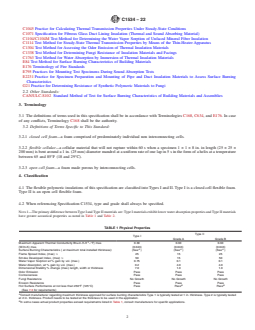
NOTE 1—The primary difference between Type I and Type II materials are: Type I materials exhibit lower water absorption properties and Type II materials
have greater acoustical properties as noted in Table 1 and Table 2.
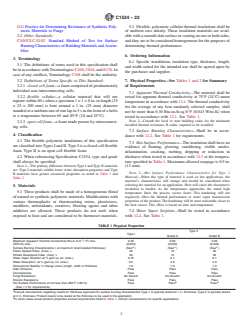
TABLE 1 Physical Properties
Type II
Type I
Grade A Grade B
Maximum Apparent Thermal Conductivity Btu-in./h-ft –°F) max. 0.30 0.30 0.30
(W/m-K) max. (0.043) (0.043) (0.043)
A A A
Surface Burning Characteristics ( at maximum total installed thickness): (See ) (See ) (See )
Flame Spread Index, (max) # 25 15 25
Smoke Developed Index, (max) # 50 15 50
Water Vapor Sorption wt % gain by vol. (max.) 0.75 0.1 0.1
Water Absorption, wt % gain by vol. (max.) 0.2 4.0 4.0
Dimensional Stability % change (max.) length, width or thickness 7.0 1.0 1.0
Odor Emission Pass Pass Pass
Corrosiveness Pass Pass Pass
Fungi Resistance No Growth No Growth No Growth
Erosion Resistance Pass Pass Pass
B B
Hot Surface Performance at not less than 250°F (125°C) Pass Pass Pass
(See 7.3 for requirements)
A
Consult manufacturer regarding maximum thickness approved for surface burning characteristics Type 1 is typically tested at 1 in. thickness. Type 2 is typically tested
at 2 in. thickness. Product needs to be tested at the thickness to be used in the application.
B
In some cases actual product properties exceed requirements listed in Table 1, consult manufacturers for specific applications.
C1534 − 22
A
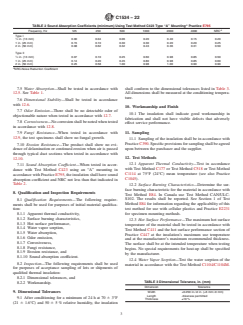
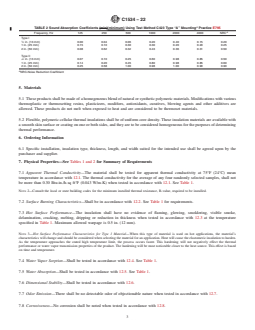
TABLE 2 Sound Absorption Coefficients (min)(minimum) Using Test Method C423 Type “A” Mounting Practice E795
A
Frequency, Hz 125 250 500 1000 2000 4000 NRC
Type I
⁄2 in. (13 mm) 0.00 0.04 0.06 0.20 0.40 0.15 0.20
1 in. (25 mm) 0.15 0.10 0.30 0.30 0.20 0.20 0.25
2 in. (50 mm) 0.08 0.62 0.32 0.43 0.36 0.31 0.50
Type II
⁄2 in. (13 mm) 0.07 0.10 0.25 0.60 0.98 0.85 0.50
1 in. (25 mm) 0.14 0.20 0.45 0.80 0.98 0.85 0.60
2 in. (50 mm) 0.25 0.58 1.00 0.98 1.00 0.90 0.90
A
NRC-Noise Reduction Coefficient
5. Materials
5.1 These products shall be made of a homogeneous blend of natural or synthetic polymeric materials. Modifications with various
thermoplastic or thermosetting resins, plasticizers, modifiers, antioxidants, curatives, blowing agents and other additives are
allowed. These products do not melt when exposed to heat and are considered to be thermoset materials.
5.2 Flexible, polymeric cellular thermal insulations shall be of uniform core density. These insulation materials are available with
a smooth skin surface or coating on one or both sides, and they are to be considered homogeneous for the purposes of determining
thermal performance.
6. Ordering Information
6.1 Specific installation, insulation type, thickness, length, and width suited for the intended use shall be agreed upon by the
purchaser and supplier.
7. Physical Properties—See Tables 1 and 2 for Summary of Requirements
7.1 Apparent Thermal Conductivity—The material shall be tested for apparent thermal conductivity at 75°F (24°C) mean
temperature in accordance with 12.1. The thermal conductivity for the average of any four randomly selected samples, shall not
be more than 0.30 Btu-in./
...