


ASTM F1183-96(2017)
(Specification)Standard Specification for Aluminum Alloy Chain Link Fence Fabric
Standard Specification for Aluminum Alloy Chain Link Fence Fabric
ABSTRACT
This specification covers the physical requirements for aluminum alloy chain link fence fabrics used for commercial, industrial, and residential applications. These fabrics shall meet the specified requirements for weave form, size of mesh, size of wire, height of fabric, selvage, breaking strength, finish, and standard leangth of rolls.
SCOPE
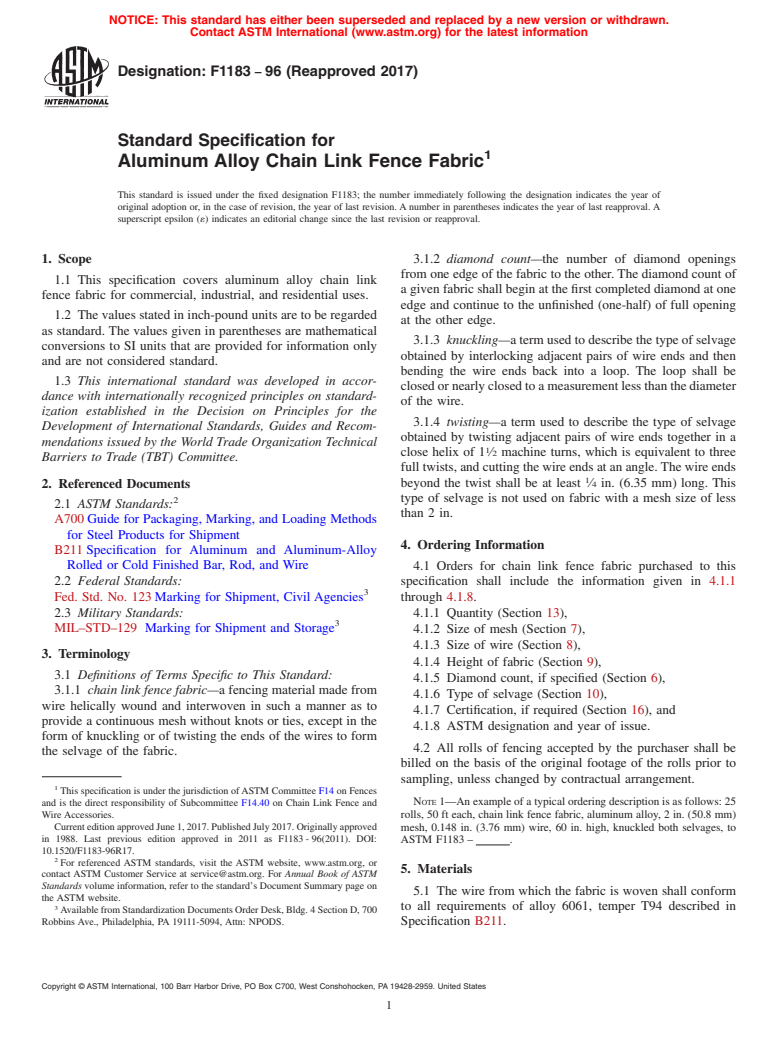
1.1 This specification covers aluminum alloy chain link fence fabric for commercial, industrial, and residential uses.
1.2 The values stated in inch-pound units are to be regarded as standard. The values given in parentheses are mathematical conversions to SI units that are provided for information only and are not considered standard.
1.3 This international standard was developed in accordance with internationally recognized principles on standardization established in the Decision on Principles for the Development of International Standards, Guides and Recommendations issued by the World Trade Organization Technical Barriers to Trade (TBT) Committee.
General Information
Buy Standard
Standards Content (Sample)
NOTICE: This standard has either been superseded and replaced by a new version or withdrawn.
Contact ASTM International (www.astm.org) for the latest information
Designation:F1183 −96 (Reapproved 2017)
Standard Specification for
Aluminum Alloy Chain Link Fence Fabric
This standard is issued under the fixed designation F1183; the number immediately following the designation indicates the year of
original adoption or, in the case of revision, the year of last revision. A number in parentheses indicates the year of last reapproval. A
superscript epsilon (´) indicates an editorial change since the last revision or reapproval.
1. Scope 3.1.2 diamond count—the number of diamond openings
from one edge of the fabric to the other. The diamond count of
1.1 This specification covers aluminum alloy chain link
a given fabric shall begin at the first completed diamond at one
fence fabric for commercial, industrial, and residential uses.
edge and continue to the unfinished (one-half) of full opening
1.2 The values stated in inch-pound units are to be regarded
at the other edge.
as standard. The values given in parentheses are mathematical
3.1.3 knuckling—a term used to describe the type of selvage
conversions to SI units that are provided for information only
obtained by interlocking adjacent pairs of wire ends and then
and are not considered standard.
bending the wire ends back into a loop. The loop shall be
1.3 This international standard was developed in accor-
closedornearlyclosedtoameasurementlessthanthediameter
dance with internationally recognized principles on standard-
of the wire.
ization established in the Decision on Principles for the
3.1.4 twisting—a term used to describe the type of selvage
Development of International Standards, Guides and Recom-
obtained by twisting adjacent pairs of wire ends together in a
mendations issued by the World Trade Organization Technical
close helix of 1 ⁄2 machine turns, which is equivalent to three
Barriers to Trade (TBT) Committee.
full twists, and cutting the wire ends at an angle.The wire ends
beyond the twist shall be at least ⁄4 in. (6.35 mm) long. This
2. Referenced Documents
2 type of selvage is not used on fabric with a mesh size of less
2.1 ASTM Standards:
than 2 in.
A700 Guide for Packaging, Marking, and Loading Methods
for Steel Products for Shipment
4. Ordering Information
B211 Specification for Aluminum and Aluminum-Alloy
Rolled or Cold Finished Bar, Rod, and Wire
4.1 Orders for chain link fence fabric purchased to this
2.2 Federal Standards: specification shall include the information given in 4.1.1
Fed. Std. No. 123 Marking for Shipment, Civil Agencies
through 4.1.8.
2.3 Military Standards:
4.1.1 Quantity (Section 13),
MIL–STD–129 Marking for Shipment and Storage
4.1.2 Size of mesh (Section 7),
4.1.3 Size of wire (Section 8),
3. Terminology
4.1.4 Height of fabric (Section 9),
3.1 Definitions of Terms Specific to This Standard:
4.1.5 Diamond count, if specified (Section 6),
3.1.1 chain link fence fabric—a fencing material made from
4.1.6 Type of selvage (Section 10),
wire helically wound and interwoven in such a manner as to
4.1.7 Certification, if required (Section 16), and
provide a continuous mesh without knots or ties, except in the
4.1.8 ASTM designation and year of issue.
form of knuckling or of twisting the ends of the wires to form
4.2 All rolls of fencing accepted by the purchaser shall be
the selvage of the fabric.
billed on the basis of the original footage of the rolls prior to
sampling, unless changed by contractual arrangement.
This specification is under the jurisdiction ofASTM Committee F14 on Fences
and is the direct responsibility of Subcommittee F14.40 on Chain Link Fence and NOTE 1—An example of a typical ordering description is as follows: 25
Wire Accessories.
rolls, 50 ft each, chain link fence fabric, aluminum alloy, 2 in. (50.8 mm)
CurrenteditionapprovedJune1,2017.PublishedJuly2017.Originallyapproved
mesh, 0.148 in. (3.76 mm) wire, 60 in. high, knuckled both selvages, to
in 1988. Last previous edition approved in 2011 as F1183 - 96(2011). DOI:
ASTM F1183 – .
10.1520/F1183-96R17.
For referenced ASTM standards, visit the ASTM website, www.astm.org, or
5. Materials
contact ASTM Customer Service at service@astm.org. For Annual Book of ASTM
Standards volume information, refer to the standard’s Document Summary page on
5.1 The wire from which the fabric is woven shall conform
the ASTM website.
to all requirements of alloy 6061, temper T94 described in
AvailablefromStandardizationDocumentsOrderDesk,Bldg.4SectionD,700
Robbins Ave., Philadelphia, PA 19111-5094, Attn: NPODS. Specification B211.
Copyright © ASTM International, 100 Barr Harbor Drive, PO Box C700, West Conshohocken, PA 19428-2959. United States
F1183−96 (2017)
A
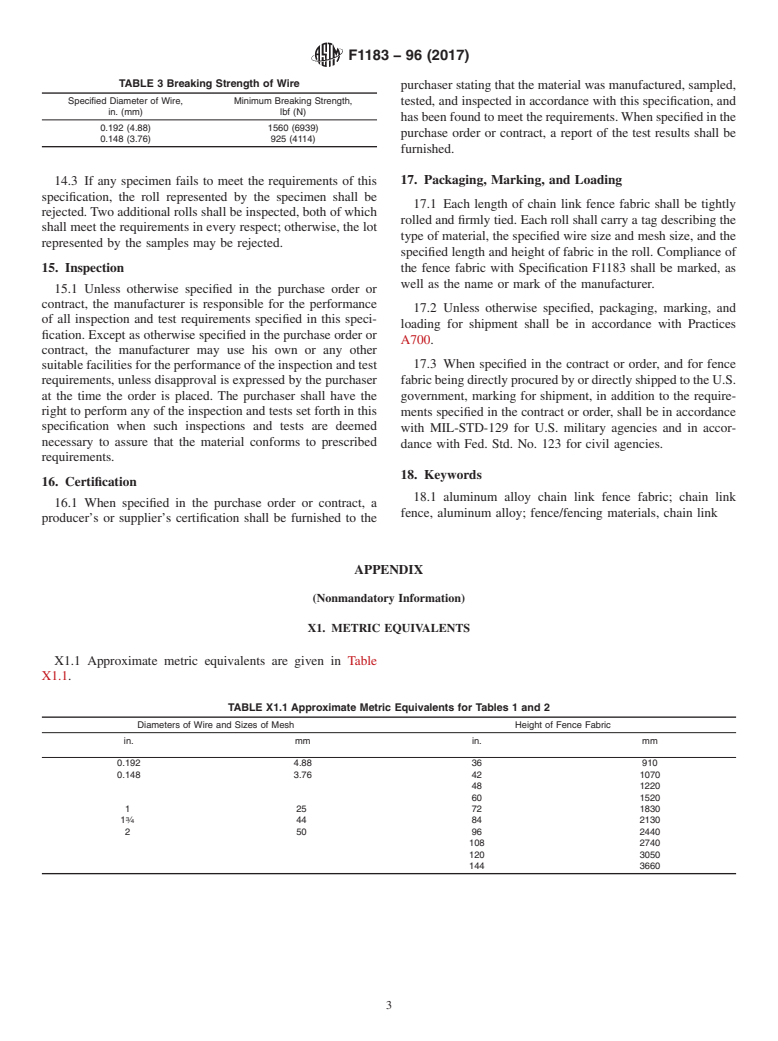
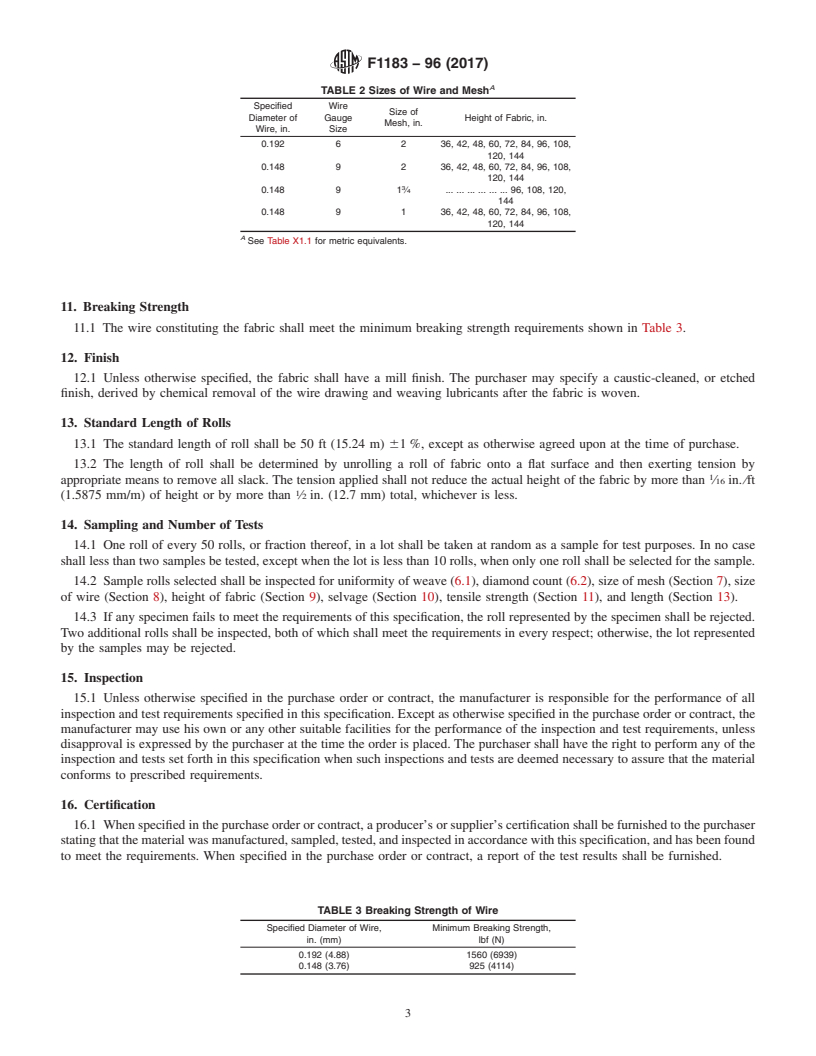
TABLE 2 Sizes of Wire and Mesh
6. Weave
Specified Wire
Size of
6.1 The wire shall be woven throughout in the form of
Diameter of Gauge Height of Fabric, in.
Mesh, in.
approximately uniform square mesh, having parallel sides and Wire, in. Size
horizontal and vertical diagonals of approximately uniform 0.192 6 2 36, 42, 48, 60, 72, 84, 96, 108,
120, 144
dimensions.The top and bottom of the fabric shall be knuckled
0.148 9 2 36, 42, 48, 60, 72, 84, 96, 108,
or twisted as specified in Section 10.
120, 144
0.148 9 1 ⁄4 . . . . . . 96, 108, 120,
6.2 A typical diamond count for each standard height is
shown in Table 1. Other diamond counts are permissible
0.148 9 1 36, 42, 48, 60, 72, 84, 96, 108,
120, 144
provided that they are consistent within a lot. The purchaser
A
See Table X1.1 for metric equivalents.
has the option to specify the diamond count (4.1.5).
7. Size of Mesh
7.1 The size of mesh shall be as indicated in Table 2.
7.2 The permissible variation from the specified size of
11. Breaking Strength
mesh shall be 6 ⁄8 in. (3.175 mm) for all mesh sizes except 1
11.1 The wire constituting the fabric shall meet the mini-
in. (25.4 mm), and 6 ⁄16 in. (1.5875 mm) for 1-in. (25.4 mm)
mum breaking strength requirements shown in Table 3.
mesh size.
7.3 The size of mesh shall be determined by measuring the
12. Finish
minimum clear distance between the wires forming the parallel
12.1 Unless otherwise specified, the fabric shall have a mill
sides of the mesh, and calculated as the average of two
finish. The purchaser may specify a caustic-cleaned, or etched
readings taken at right angles to each other.
finish, derived by chemical removal of the wire drawing and
weaving lubricants after the fabric is woven.
8. Size of Wire
8.1 Chainlinkfabricshallbefabricatedfromwirediameters
13. Standard Length of Rolls
as listed in Table 2, with a permissible variation from the
13.1 The standard length of roll shall be 50 ft (15.24 m)
specified diameter of 60.005 in. (0.127 mm).
61 %, except as otherwise agreed upon at the ti
...
This document is not an ASTM standard and is intended only to provide the user of an ASTM standard an indication of what changes have been made to the previous version. Because
it may not be technically possible to adequately depict all changes accurately, ASTM recommends that users consult prior editions as appropriate. In all cases only the current version
of the standard as published by ASTM is to be considered the official document.
Designation: F1183 − 96 (Reapproved 2011) F1183 − 96 (Reapproved 2017)
Standard Specification for
Aluminum Alloy Chain Link Fence Fabric
This standard is issued under the fixed designation F1183; the number immediately following the designation indicates the year of
original adoption or, in the case of revision, the year of last revision. A number in parentheses indicates the year of last reapproval. A
superscript epsilon (´) indicates an editorial change since the last revision or reapproval.
1. Scope
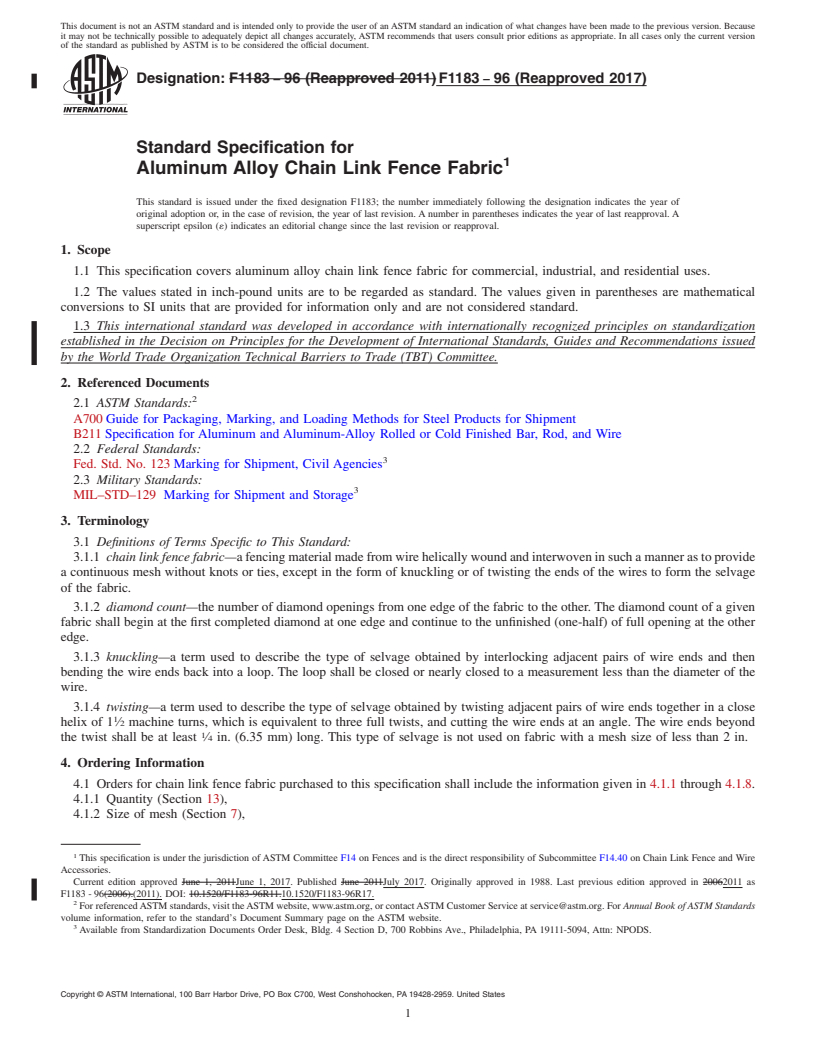
1.1 This specification covers aluminum alloy chain link fence fabric for commercial, industrial, and residential uses.
1.2 The values stated in inch-pound units are to be regarded as standard. The values given in parentheses are mathematical
conversions to SI units that are provided for information only and are not considered standard.
1.3 This international standard was developed in accordance with internationally recognized principles on standardization
established in the Decision on Principles for the Development of International Standards, Guides and Recommendations issued
by the World Trade Organization Technical Barriers to Trade (TBT) Committee.
2. Referenced Documents
2.1 ASTM Standards:
A700 Guide for Packaging, Marking, and Loading Methods for Steel Products for Shipment
B211 Specification for Aluminum and Aluminum-Alloy Rolled or Cold Finished Bar, Rod, and Wire
2.2 Federal Standards:
Fed. Std. No. 123 Marking for Shipment, Civil Agencies
2.3 Military Standards:
MIL–STD–129 Marking for Shipment and Storage
3. Terminology
3.1 Definitions of Terms Specific to This Standard:
3.1.1 chain link fence fabric—a fencing material made from wire helically wound and interwoven in such a manner as to provide
a continuous mesh without knots or ties, except in the form of knuckling or of twisting the ends of the wires to form the selvage
of the fabric.
3.1.2 diamond count—the number of diamond openings from one edge of the fabric to the other. The diamond count of a given
fabric shall begin at the first completed diamond at one edge and continue to the unfinished (one-half) of full opening at the other
edge.
3.1.3 knuckling—a term used to describe the type of selvage obtained by interlocking adjacent pairs of wire ends and then
bending the wire ends back into a loop. The loop shall be closed or nearly closed to a measurement less than the diameter of the
wire.
3.1.4 twisting—a term used to describe the type of selvage obtained by twisting adjacent pairs of wire ends together in a close
helix of 1 ⁄2 machine turns, which is equivalent to three full twists, and cutting the wire ends at an angle. The wire ends beyond
the twist shall be at least ⁄4 in. (6.35 mm) long. This type of selvage is not used on fabric with a mesh size of less than 2 in.
4. Ordering Information
4.1 Orders for chain link fence fabric purchased to this specification shall include the information given in 4.1.1 through 4.1.8.
4.1.1 Quantity (Section 13),
4.1.2 Size of mesh (Section 7),
This specification is under the jurisdiction of ASTM Committee F14 on Fences and is the direct responsibility of Subcommittee F14.40 on Chain Link Fence and Wire
Accessories.
Current edition approved June 1, 2011June 1, 2017. Published June 2011July 2017. Originally approved in 1988. Last previous edition approved in 20062011 as
F1183 - 96(2006).(2011). DOI: 10.1520/F1183-96R11.10.1520/F1183-96R17.
For referenced ASTM standards, visit the ASTM website, www.astm.org, or contact ASTM Customer Service at service@astm.org. For Annual Book of ASTM Standards
volume information, refer to the standard’s Document Summary page on the ASTM website.
Available from Standardization Documents Order Desk, Bldg. 4 Section D, 700 Robbins Ave., Philadelphia, PA 19111-5094, Attn: NPODS.
Copyright © ASTM International, 100 Barr Harbor Drive, PO Box C700, West Conshohocken, PA 19428-2959. United States
F1183 − 96 (2017)
4.1.3 Size of wire (Section 8),
4.1.4 Height of fabric (Section 9),
4.1.5 Diamond count, if specified (Section 6),
4.1.6 Type of selvage (Section 10),
4.1.7 Certification, if required (Section 16), and
4.1.8 ASTM designation and year of issue.
4.2 All rolls of fencing accepted by the purchaser shall be billed on the basis of the original footage of the rolls prior to
sampling, unless changed by contractual arrangement.
NOTE 1—An example of a typical ordering description is as follows: 25 rolls, 50 ft each, chain link fence fabric, aluminum alloy, 2 in. (50.8 mm) mesh,
0.148 in. (3.76 mm) wire, 60 in. high, knuckled both selvages, to ASTM F1183 – .
5. Materials
5.1 The wire from which the fabric is woven shall conform to all requirements of alloy 6061, temper T94 described in
Specification B211.
6. Weave
6.1 The wire shall be woven throughout in the form of approximately uniform square mesh, having parallel sides and horizontal
and vertical diagonals of approximately uniform dimensions. The top and bottom of the fabric shall be knuckled or twisted as
specified in Section 10.
6.2 A typical diamond count for each standard height is shown in Table 1. Other diamond counts are permissible provided that
they are consistent within a lot. The purchaser has the option to specify the diamond count (4.1.5).
7. Size of Mesh
7.1 The size of mesh shall be as indicated in Table 2.
7.2 The permissible variation from the specified size of mesh shall be 6 ⁄8 in. (3.175 mm) for all mesh sizes except 1 in. (25.4
mm), and 6 ⁄16 in. (1.5875 mm) for 1-in. (25.4 mm) mesh size.
7.3 The size of mesh shall be determined by measuring the minimum clear distance between the wires forming the parallel sides
of the mesh, and calculated as the average of two readings taken at right angles to each other.
8. Size of Wire
8.1 Chain link fabric shall be fabricated from wire diameters as listed in Table 2, with a permissible variation from the specified
diameter of 60.005 in. (0.127 mm).
9. Height of Fabric
9.1 Chain link fabric shall be furnished in the standard heights shown in Table 2. The height of fabric shall be the overall
dimension from ends of twists or knuckles. Permissible variation from the specified height shall be 61 in. (25.4 mm) for 1 ⁄4 in.
(44.45 mm) and 2 in. (50.8 mm) mesh and 6 ⁄2 in. (12.7 mm) for 1 in. (25.4 mm) mesh.
10. Selvage
10.1 Unless otherwise specified by the purchaser, fabrics with 2 in. (50.8 mm) mesh used in heights 60 in. (1524 mm) and under
shall be knuckled at both selvages. Fabric of heights 72 in. (1830 mm) and above shall be knuckled at one selvage and twisted
at the other.
10.2 The selvages of all fabrics with meshes of less than 2 in. shall be knuckled.
NOTE 2—Use of twisted selva
...
Questions, Comments and Discussion
Ask us and Technical Secretary will try to provide an answer. You can facilitate discussion about the standard in here.