


ASTM B998-17(2024)
(Guide)Standard Guide for Hot Isostatic Pressing (HIP) of Aluminum Alloy Castings
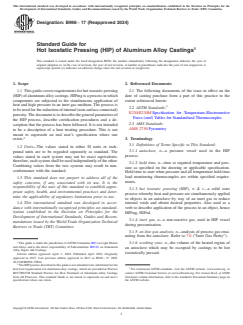
Standard Guide for Hot Isostatic Pressing (HIP) of Aluminum Alloy Castings
SIGNIFICANCE AND USE
4.1 HIP of castings should be performed in the as cast condition. Post HIP inspection of castings should result in a reduction of porosity that is evident in x-ray grade and properties.
4.2 HIP will not eliminate inclusions or surface-connected porosity in a casting.
SCOPE
1.1 This guide covers requirements for hot isostatic pressing (HIP) of aluminum alloy castings. HIPing is a process in which components are subjected to the simultaneous application of heat and high pressure in an inert gas medium. The process is to be used for the reduction of internal (non-surface connected) porosity. The document is to describe the general parameters of the HIP process, describe certification procedures and a description that the process has been followed. It is not intended to be a description of a heat treating procedure. This is not meant to supersede an end user’s specification where one exists.2
1.2 Units—The values stated in either SI units or inch-pound units are to be regarded separately as standard. The values stated in each system may not be exact equivalents; therefore, each system shall be used independently of the other. Combining values from the two systems may result in non-conformance with the standard.
1.3 This standard does not purport to address all of the safety concerns, if any, associated with its use. It is the responsibility of the user of this standard to establish appropriate safety, health, and environmental practices and determine the applicability of regulatory limitations prior to use.
1.4 This international standard was developed in accordance with internationally recognized principles on standardization established in the Decision on Principles for the Development of International Standards, Guides and Recommendations issued by the World Trade Organization Technical Barriers to Trade (TBT) Committee.
General Information
- Status
- Published
- Publication Date
- 31-Mar-2024
- Technical Committee
- B07 - Light Metals and Alloys
- Drafting Committee
- B07.01 - Aluminum Alloy Ingots and Castings
Relations
- Effective Date
- 01-Apr-2024
Overview
ASTM B998-17(2024), Standard Guide for Hot Isostatic Pressing (HIP) of Aluminum Alloy Castings, provides comprehensive guidance on the application of hot isostatic pressing to aluminum component castings. Developed by ASTM Committee B07 on Light Metals and Alloys, this standard outlines the requirements and benefits of HIPing - a process that applies heat and high pressure in an inert gas medium to reduce internal, non-surface-connected porosity in cast aluminum parts.
The guide delineates best practices for performing HIP, stressing the importance of the proper as-cast condition and post-process inspection. It distinguishes HIP from other processes, such as heat treating, and offers essential parameters for temperature, pressure, and processing duration. The standard serves industries seeking to improve the quality, integrity, and reliability of aluminum alloy castings through the reduction of internal voids.
Key Topics
- Hot Isostatic Pressing (HIP) Process: Describes the method of applying simultaneous heat and pressure using an inert gas in an autoclave, targeting the minimization of closed internal porosity without affecting inclusions or surface-connected voids.
- Required Equipment: Specifies the use of internally heated, cold wall autoclaves and compatible fixtures for batch processing.
- Process Parameters: Recommends detailed parameters for temperature, pressure, and hold time based on alloy types, with strict monitoring of process variables using calibrated thermocouples and pressure instruments.
- Inspection and Certification: Outlines the essentials of post-HIP non-destructive inspection (often x-ray), record keeping, and vendor certification to ensure documented compliance with the process.
- Gas Purity Requirements: Requires inert gas with a minimum purity of 99.70% and monitored impurity limits by on-line gas analysis, crucial for maintaining material properties and process efficiency.
- Quality Assurance: Stipulates recurring qualification and calibration of autoclaves, instrumentation, and process documentation for traceability and customer surveillance.
Applications
Implementing HIP according to ASTM B998-17(2024) is critical in industries where enhanced mechanical properties and consistency in aluminum castings are essential. Typical applications include:
- Aerospace: Engine and structural components benefit from reduced internal porosity, improving fatigue life and reliability.
- Automotive: Lightweight aluminum castings for powertrain and chassis applications gain improved strength and density.
- Defense: HIP enhances the integrity of mission-critical castings where failure due to internal voids is unacceptable.
- Industrial Equipment: High-performance machinery that demands precision and durability leverages HIP for better overall casting quality.
The standard’s approach ensures better performance, longer life, and reduced risk of failure for aluminum castings used in demanding environments.
Related Standards
Organizations implementing HIP for aluminum alloy castings may also reference these related standards:
- ASTM E230/E230M – Specification for Temperature-Electromotive Force (emf) Tables for Standardized Thermocouples
- AMS 2750 – Pyrometry, covering thermal process instrumentation requirements
- ASTM B917/B917M – Practice for Heat Treatment of Aluminum-Alloy Castings
- ISO and other ASTM standards related to metal casting inspection, material traceability, and quality management
Adhering to ASTM B998-17(2024) ensures alignment with internationally recognized guidance on process control, material quality, and documentation for hot isostatic pressing of aluminum castings. This comprehensive approach supports regulatory compliance and industry best practices in metals manufacturing.

Get Certified
Connect with accredited certification bodies for this standard

Element Materials Technology
Materials testing and product certification.

Inštitut za kovinske materiale in tehnologije
Institute of Metals and Technology. Materials testing, metallurgical analysis, NDT.
Sponsored listings
Frequently Asked Questions
ASTM B998-17(2024) is a guide published by ASTM International. Its full title is "Standard Guide for Hot Isostatic Pressing (HIP) of Aluminum Alloy Castings". This standard covers: SIGNIFICANCE AND USE 4.1 HIP of castings should be performed in the as cast condition. Post HIP inspection of castings should result in a reduction of porosity that is evident in x-ray grade and properties. 4.2 HIP will not eliminate inclusions or surface-connected porosity in a casting. SCOPE 1.1 This guide covers requirements for hot isostatic pressing (HIP) of aluminum alloy castings. HIPing is a process in which components are subjected to the simultaneous application of heat and high pressure in an inert gas medium. The process is to be used for the reduction of internal (non-surface connected) porosity. The document is to describe the general parameters of the HIP process, describe certification procedures and a description that the process has been followed. It is not intended to be a description of a heat treating procedure. This is not meant to supersede an end user’s specification where one exists.2 1.2 Units—The values stated in either SI units or inch-pound units are to be regarded separately as standard. The values stated in each system may not be exact equivalents; therefore, each system shall be used independently of the other. Combining values from the two systems may result in non-conformance with the standard. 1.3 This standard does not purport to address all of the safety concerns, if any, associated with its use. It is the responsibility of the user of this standard to establish appropriate safety, health, and environmental practices and determine the applicability of regulatory limitations prior to use. 1.4 This international standard was developed in accordance with internationally recognized principles on standardization established in the Decision on Principles for the Development of International Standards, Guides and Recommendations issued by the World Trade Organization Technical Barriers to Trade (TBT) Committee.
SIGNIFICANCE AND USE 4.1 HIP of castings should be performed in the as cast condition. Post HIP inspection of castings should result in a reduction of porosity that is evident in x-ray grade and properties. 4.2 HIP will not eliminate inclusions or surface-connected porosity in a casting. SCOPE 1.1 This guide covers requirements for hot isostatic pressing (HIP) of aluminum alloy castings. HIPing is a process in which components are subjected to the simultaneous application of heat and high pressure in an inert gas medium. The process is to be used for the reduction of internal (non-surface connected) porosity. The document is to describe the general parameters of the HIP process, describe certification procedures and a description that the process has been followed. It is not intended to be a description of a heat treating procedure. This is not meant to supersede an end user’s specification where one exists.2 1.2 Units—The values stated in either SI units or inch-pound units are to be regarded separately as standard. The values stated in each system may not be exact equivalents; therefore, each system shall be used independently of the other. Combining values from the two systems may result in non-conformance with the standard. 1.3 This standard does not purport to address all of the safety concerns, if any, associated with its use. It is the responsibility of the user of this standard to establish appropriate safety, health, and environmental practices and determine the applicability of regulatory limitations prior to use. 1.4 This international standard was developed in accordance with internationally recognized principles on standardization established in the Decision on Principles for the Development of International Standards, Guides and Recommendations issued by the World Trade Organization Technical Barriers to Trade (TBT) Committee.
ASTM B998-17(2024) is classified under the following ICS (International Classification for Standards) categories: 77.120.10 - Aluminium and aluminium alloys; 77.150.10 - Aluminium products. The ICS classification helps identify the subject area and facilitates finding related standards.
ASTM B998-17(2024) has the following relationships with other standards: It is inter standard links to ASTM B998-17. Understanding these relationships helps ensure you are using the most current and applicable version of the standard.
ASTM B998-17(2024) is available in PDF format for immediate download after purchase. The document can be added to your cart and obtained through the secure checkout process. Digital delivery ensures instant access to the complete standard document.
Standards Content (Sample)
This international standard was developed in accordance with internationally recognized principles on standardization established in the Decision on Principles for the
Development of International Standards, Guides and Recommendations issued by the World Trade Organization Technical Barriers to Trade (TBT) Committee.
Designation: B998 − 17 (Reapproved 2024)
Standard Guide for
Hot Isostatic Pressing (HIP) of Aluminum Alloy Castings
This standard is issued under the fixed designation B998; the number immediately following the designation indicates the year of
original adoption or, in the case of revision, the year of last revision. A number in parentheses indicates the year of last reapproval. A
superscript epsilon (´) indicates an editorial change since the last revision or reapproval.
1. Scope 2. Referenced Documents
1.1 This guide covers requirements for hot isostatic pressing 2.1 The following documents of the issue in effect on the
(HIP) of aluminum alloy castings. HIPing is a process in which date of casting purchase form a part of this practice to the
components are subjected to the simultaneous application of extent referenced herein:
heat and high pressure in an inert gas medium. The process is
2.2 ASTM Standards:
to be used for the reduction of internal (non-surface connected)
E230/E230M Specification for Temperature-Electromotive
porosity. The document is to describe the general parameters of
Force (emf) Tables for Standardized Thermocouples
the HIP process, describe certification procedures and a de-
2.3 AMS Standards:
scription that the process has been followed. It is not intended
AMS 2750 Pyrometry
to be a description of a heat treating procedure. This is not
meant to supersede an end user’s specification where one
3. Terminology
exists.
3.1 Definitions of Terms Specific to This Standard:
1.2 Units—The values stated in either SI units or inch-
3.1.1 autoclave, n—a pressure vessel used in the HIP
pound units are to be regarded separately as standard. The
process.
values stated in each system may not be exact equivalents;
therefore, each system shall be used independently of the other.
3.1.2 hold time, n—time at required temperature and pres-
Combining values from the two systems may result in non-
sure as specified on the drawing or applicable specification.
conformance with the standard.
Hold time to start when pressure and all temperature hold time
load monitoring thermocouples are within specified require-
1.3 This standard does not purport to address all of the
ments.
safety concerns, if any, associated with its use. It is the
responsibility of the user of this standard to establish appro-
3.1.3 hot isostatic pressing (HIP), n & v—a solid state
priate safety, health, and environmental practices and deter-
process whereby heat and pressure are simultaneously applied
mine the applicability of regulatory limitations prior to use.
to objects in an autoclave by way of an inert gas to reduce
1.4 This international standard was developed in accor-
internal voids and obtain desired properties. Also used as a
dance with internationally recognized principles on standard-
verb to describe application of the process to an object, hence
ization established in the Decision on Principles for the
HIPing, HIPed.
Development of International Standards, Guides and Recom-
3.1.4 inert gas, n—a non-reactive gas, used in HIP vessel
mendations issued by the World Trade Organization Technical
during pressurization.
Barriers to Trade (TBT) Committee.
3.1.5 on-line gas analysis, n—analysis of process gas ema-
nating from the autoclave. Refer to 7.6 (“Inert Gas Purity”).
This guide is under the jurisdiction of ASTM Committee B07 on Light Metals
3.1.6 working zone, n—the volume of the heated region of
and Alloys and is the direct responsibility of Subcommittee B07.01 on Aluminum
an autoclave which may be occupied by castings to be hot
Alloy Ingots and Castings.
isostatically pressed.
Current edition approved April 1, 2024. Published April 2024. Originally
approved in 2017. Last previous edition approved in 2017 as B998 – 17. DOI:
10.1520/B0998-17R24.
The HIP practice described in this guide is not intended to be substituted for the
heat treat requirements for aluminum alloy castings, which are provided in Practice For referenced ASTM standards, visit the ASTM website, www.astm.org, or
B917/B917M Standard Practice for Heat Treatment of Aluminum-Alloy Castings contact ASTM Customer Service at service@astm.org. For Annual Book of ASTM
from All Processes. This standard Guide is not meant to supersede an end user’s Standards volume information, refer to the standard’s Document Summary page on
specification where one exists. the ASTM website.
Copyright © ASTM International, 100 Barr Harbor Drive, PO Box C700, West Conshohocken, PA 19428-2959. United States
B998 − 17 (2024)
4. Significance and Use 7. General
4.1 HIP of castings should be performed in the as cast
7.1 All HIP equipment qualifications should be the respon-
condition. Post HIP inspection of castings should result in a
sibility of the hot isostatic pressing HIP Vendor. The Vendor
reduction of porosity that is evident in x-ray grade and
should be responsible for any testing required for HIP equip-
properties.
ment and should sign all necessary forms which certify that
qualification, in accordance with this guide, has been attained.
4.2 HIP will not eliminate inclusions or surface-connected
porosity in a casting.
7.2 Cleaning:
7.2.1 Castings to be treated, including fixtures, should be
5. Ordering Information
delivered to the Vendor clean and free of all surface contami-
5.1 Orders for HIPing of aluminum castings under this
nants which may be detrimental to the material being treated or
guide should include the following information:
to autoclave components. Prior to subsequent processing
5.1.1 This guide designation (which includes the number,
cycles the Vendor should ensure that fixtures, jigs, or tooling
year and revision letter, if applicable).
should be kept free of all surface contaminants which may be
5.1.2 The quantity in pieces.
detrimental to the material being treated or to the autoclave
5.1.3 Alloy.
components.
5.1.4 Temperature, pressure, hold time, including toler-
7.3 Instrumentation:
ances.
7.3.1 A minimum of three thermocouples should accom-
6. Equipment
pany the material during treatment. They should be located in
the hottest, coldest, and nominal temperature the castings. An
6.1 Autoclave:
alternate instrumentation plan may be used with prior approval
6.1.1 Autoclaves should be of the inert gas pressurization
from the purchaser.
type, internally heated, cold wall pressure vessel.
7.4 Pressure Environment:
6.2 Fixtures:
6.2.1 Suitable jigs, trays, or other fixtures should be pro-
7.4.1 Equipment—All pressure recording equipment should
vided as necessary for proper handling and positioning of parts
be calibrated in accordance with the instrument manufacturer’s
to be hot isostatic pressed. All fixtures should be made of
instructions.
suitable material which is compatible with the parts to be
7.4.2 Pressure—The chamber pressure during treatment
treated.
should be as specified on the drawing or applicable specifica-
6.3 Temperature Measurement and Control Devices: tion. During the heat up and hold, the chamber pressure should
6.3.1 Temperature Measurement—Temperature measuring be continuously monitored and data should be recorded at a
and recording devices should be provided for the autoclave.
maximum interval of no more than five (5) minutes.
The devices should be of the potentiometric type, should use
7.5 Thermal Treatment:
thermocouple sensors, and should provide permanent records
7.5.1 The times and temperatures for the thermal cycle
of the temperature during the entire treatment.
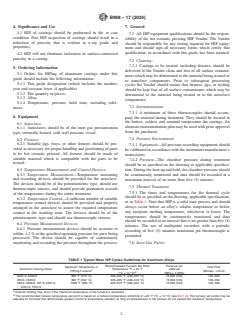
should be as specified on the drawing, applicable specification,
6.3.2 Temperature Control—A sufficient number of suitable
or in Table 1. Note that HIP is a solid state process and should
temperature control devices should be provided and properly
always occur below an alloy’s solidus temperature or below
arranged in the autoclave to assure the req
...
Questions, Comments and Discussion
Ask us and Technical Secretary will try to provide an answer. You can facilitate discussion about the standard in here.
Loading comments...