

ASTM F3128-23
(Specification)Standard Specification for Poly(Vinyl Chloride) (PVC) Schedule 40 Drain, Waste, and Vent Pipe with a Cellular Core
General Information
- Abstract
SCOPE
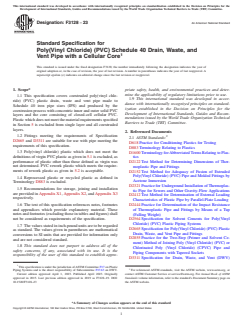
1.1 This specification covers coextruded poly(vinyl chloride) (PVC) plastic drain, waste and vent pipe made to Schedule 40 iron pipe sizes (IPS) and produced by the coextrusion process with concentric inner and outer solid PVC layers and the core consisting of closed-cell cellular PVC. Plastic which does not meet the material requirements specified in Section 5 is excluded from single layer and all coextruded layers.
1.2 Fittings meeting the requirements of Specification D2665 and D3311 are suitable for use with pipe meeting the requirements of this specification.
1.3 Poly(vinyl chloride) plastic which does not meet the definitions of virgin PVC plastic as given in 5.1 is excluded, as performance of plastic other than those defined as virgin was not determined. PVC rework plastic which meets the requirements of rework plastic as given in 5.2 is acceptable.
1.4 Reprocessed plastic or recycled plastic as defined in Terminology D883 is excluded.
1.5 Recommendations for storage, joining and installation are provided in Appendix X1, Appendix X2, and Appendix X3 respectively.
1.6 The text of this specification references notes, footnotes and appendices which provide explanatory material. These notes and footnotes (excluding those in tables and figures) shall not be considered as requirements of the specification.
1.7 The values stated in inch-pound units are to be regarded as standard. The values given in parentheses are mathematical conversions to SI units that are provided for information only and are not considered standard.
1.8 This standard does not purport to address all of the safety concerns, if any, associated with its use. It is the responsibility of the user of this standard to establish appropriate safety, health, and environmental practices and determine the applicability of regulatory limitations prior to use.
1.9 This international standard was developed in accordance with internationally recognized principles on standardization established in the Decision on Principles for the Development of International Standards, Guides and Recommendations issued by the World Trade Organization Technical Barriers to Trade (TBT) Committee.
- Status
- Published
- Publication Date
- 31-Mar-2023
- Technical Committee
- F17 - Plastic Piping Systems
- Drafting Committee
- F17.63 - DWV
Buy Documents
ASTM F3128-23 - Standard Specification for Poly(Vinyl Chloride) (PVC) Schedule 40 Drain, Waste, and Vent Pipe with a Cellular Core
REDLINE ASTM F3128-23 - Standard Specification for Poly(Vinyl Chloride) (PVC) Schedule 40 Drain, Waste, and Vent Pipe with a Cellular Core
Overview
The ASTM F3128-23 standard specification defines the requirements for coextruded poly(vinyl chloride) (PVC) Schedule 40 drain, waste, and vent (DWV) pipe featuring a cellular core structure. Developed by ASTM International for the construction and plumbing industry, this standard focuses on PVC DWV pipes produced by a coextrusion process, providing concentric inner and outer solid PVC layers with a core of closed-cell cellular PVC. The specification ensures that such pipes deliver reliable performance for drainage, waste, and venting applications, while outlining strict guidelines on acceptable materials, dimensions, performance, and installation.
Key Topics
- Material Requirements: Only virgin PVC or qualifying rework PVC material is permitted. The standard excludes reprocessed or recycled plastics to guarantee product consistency and performance.
- Pipe Construction: Pipes are coextruded, featuring:
- Solid PVC layers on the interior and exterior
- A closed-cell cellular PVC core for reduced weight and enhanced insulation
- Dimensional Standards: Pipes must meet Schedule 40 iron pipe size (IPS) dimensions, including strict tolerances for outside diameter, wall thickness, and out-of-roundness.
- Mechanical Performance:
- Minimum pipe stiffness values and impact resistance are specified, especially at low temperatures (32°F/0°C) to ensure durability during field handling.
- Pipes must be free of defects such as cracks, holes, or delamination.
- Bond Integrity: The bonding between coextruded layers must be strong and uniform, resisting separation during normal use.
- Marking and Identification: Each pipe is marked with manufacturer details, the ASTM F3128 designation, nominal size, and production codes for traceability and compliance.
Applications
ASTM F3128-23 PVC Schedule 40 DWV pipes are primarily used in:
- Building Drainage Systems: Removal of sewage and liquid waste from residential, commercial, and institutional buildings.
- Vent Systems: Airflow equalization and proper venting to prevent sewer gases from entering habitable spaces.
- Underground Installations: Suitable for below-ground applications per guidance on bedding, backfilling, and thermal expansion provided in the appendices.
- Retrofit and New Construction: Ideal for both new plumbing installations and upgrade projects due to their light weight, ease of handling, and compatibility with standard Schedule 40 fittings.
- Compatibility: Fittings compliant with ASTM D2665 and D3311 can be used with these pipes, and solvent cement joints are permitted following ASTM D2564 and D2855 practices.
Related Standards
ASTM F3128-23 references numerous supporting standards to provide comprehensive quality and compatibility across the plastic piping industry, such as:
- ASTM D2665/D3311: Specifications for PVC DWV pipe fittings
- ASTM D4396: Material requirements for rigid PVC and CPVC compounds
- ASTM D2412 & D2444: Test methods for pipe stiffness and impact resistance
- ASTM D2855 & D2564: Procedures for solvent cement joining of PVC pipes
- ASTM D2321: Installation practice for underground thermoplastic pipes
- Plastic Pipe Institute TR-7: Methods for calculating nominal weight of plastic pipe
Practical Value
This standard ensures that PVC DWV pipes with a cellular core provide:
- Consistent Quality: Strict material and manufacturing requirements guarantee long-term performance and safety.
- Lightweight Construction: Coextruded cellular core reduces weight, simplifies transport, and eases installation without sacrificing stiffness or strength.
- Cost Efficiency: Reliable and easy-to-handle pipes lower labor and shipping costs, making them an economical choice.
- Enhanced Durability: Specifications for impact resistance and bond integrity deliver pipes suited for demanding installation environments.
- Regulatory Compliance: Following ASTM F3128-23 helps plumbing engineers and contractors meet local, national, and international building codes and regulations.
ASTM F3128-23 is a critical specification for those sourcing, installing, or approving PVC Schedule 40 DWV piping systems, ensuring safe, efficient, and code-compliant water management in modern construction.
Relations
- Effective Date
- 01-Apr-2024
- Effective Date
- 01-Feb-2024
- Effective Date
- 01-Nov-2023
- Effective Date
- 01-Nov-2023
- Effective Date
- 01-Aug-2020
- Effective Date
- 01-Aug-2020
- Effective Date
- 01-Aug-2020
- Effective Date
- 01-Apr-2020
- Effective Date
- 15-Mar-2020
- Effective Date
- 01-Jan-2020
- Effective Date
- 01-Aug-2019
- Effective Date
- 15-Apr-2019
- Effective Date
- 01-Feb-2019
- Effective Date
- 01-Jan-2019
- Effective Date
- 01-Dec-2018
Buy Documents
ASTM F3128-23 - Standard Specification for Poly(Vinyl Chloride) (PVC) Schedule 40 Drain, Waste, and Vent Pipe with a Cellular Core
REDLINE ASTM F3128-23 - Standard Specification for Poly(Vinyl Chloride) (PVC) Schedule 40 Drain, Waste, and Vent Pipe with a Cellular Core
Get Certified
Connect with accredited certification bodies for this standard

Institut za varilstvo d.o.o. (Welding Institute)
Slovenia's leading welding institute since 1952. ISO 3834, EN 1090, pressure equipment certification, NDT personnel, welder qualification. Only IIW Au
Sponsored listings
Frequently Asked Questions
ASTM F3128-23 is a technical specification published by ASTM International. Its full title is "Standard Specification for Poly(Vinyl Chloride) (PVC) Schedule 40 Drain, Waste, and Vent Pipe with a Cellular Core". This standard covers: SCOPE 1.1 This specification covers coextruded poly(vinyl chloride) (PVC) plastic drain, waste and vent pipe made to Schedule 40 iron pipe sizes (IPS) and produced by the coextrusion process with concentric inner and outer solid PVC layers and the core consisting of closed-cell cellular PVC. Plastic which does not meet the material requirements specified in Section 5 is excluded from single layer and all coextruded layers. 1.2 Fittings meeting the requirements of Specification D2665 and D3311 are suitable for use with pipe meeting the requirements of this specification. 1.3 Poly(vinyl chloride) plastic which does not meet the definitions of virgin PVC plastic as given in 5.1 is excluded, as performance of plastic other than those defined as virgin was not determined. PVC rework plastic which meets the requirements of rework plastic as given in 5.2 is acceptable. 1.4 Reprocessed plastic or recycled plastic as defined in Terminology D883 is excluded. 1.5 Recommendations for storage, joining and installation are provided in Appendix X1, Appendix X2, and Appendix X3 respectively. 1.6 The text of this specification references notes, footnotes and appendices which provide explanatory material. These notes and footnotes (excluding those in tables and figures) shall not be considered as requirements of the specification. 1.7 The values stated in inch-pound units are to be regarded as standard. The values given in parentheses are mathematical conversions to SI units that are provided for information only and are not considered standard. 1.8 This standard does not purport to address all of the safety concerns, if any, associated with its use. It is the responsibility of the user of this standard to establish appropriate safety, health, and environmental practices and determine the applicability of regulatory limitations prior to use. 1.9 This international standard was developed in accordance with internationally recognized principles on standardization established in the Decision on Principles for the Development of International Standards, Guides and Recommendations issued by the World Trade Organization Technical Barriers to Trade (TBT) Committee.
SCOPE 1.1 This specification covers coextruded poly(vinyl chloride) (PVC) plastic drain, waste and vent pipe made to Schedule 40 iron pipe sizes (IPS) and produced by the coextrusion process with concentric inner and outer solid PVC layers and the core consisting of closed-cell cellular PVC. Plastic which does not meet the material requirements specified in Section 5 is excluded from single layer and all coextruded layers. 1.2 Fittings meeting the requirements of Specification D2665 and D3311 are suitable for use with pipe meeting the requirements of this specification. 1.3 Poly(vinyl chloride) plastic which does not meet the definitions of virgin PVC plastic as given in 5.1 is excluded, as performance of plastic other than those defined as virgin was not determined. PVC rework plastic which meets the requirements of rework plastic as given in 5.2 is acceptable. 1.4 Reprocessed plastic or recycled plastic as defined in Terminology D883 is excluded. 1.5 Recommendations for storage, joining and installation are provided in Appendix X1, Appendix X2, and Appendix X3 respectively. 1.6 The text of this specification references notes, footnotes and appendices which provide explanatory material. These notes and footnotes (excluding those in tables and figures) shall not be considered as requirements of the specification. 1.7 The values stated in inch-pound units are to be regarded as standard. The values given in parentheses are mathematical conversions to SI units that are provided for information only and are not considered standard. 1.8 This standard does not purport to address all of the safety concerns, if any, associated with its use. It is the responsibility of the user of this standard to establish appropriate safety, health, and environmental practices and determine the applicability of regulatory limitations prior to use. 1.9 This international standard was developed in accordance with internationally recognized principles on standardization established in the Decision on Principles for the Development of International Standards, Guides and Recommendations issued by the World Trade Organization Technical Barriers to Trade (TBT) Committee.
ASTM F3128-23 is classified under the following ICS (International Classification for Standards) categories: 23.040.20 - Plastics pipes. The ICS classification helps identify the subject area and facilitates finding related standards.
ASTM F3128-23 has the following relationships with other standards: It is inter standard links to ASTM D2665-24, ASTM D883-24, ASTM D883-23, ASTM D2152-23, ASTM D2855-20, ASTM D2665-20, ASTM D2564-20, ASTM F412-20, ASTM D2321-20, ASTM D883-20, ASTM D883-19c, ASTM D883-19a, ASTM D883-19, ASTM F412-19, ASTM D883-18a. Understanding these relationships helps ensure you are using the most current and applicable version of the standard.
ASTM F3128-23 is available in PDF format for immediate download after purchase. The document can be added to your cart and obtained through the secure checkout process. Digital delivery ensures instant access to the complete standard document.
Standards Content (Sample)
This international standard was developed in accordance with internationally recognized principles on standardization established in the Decision on Principles for the
Development of International Standards, Guides and Recommendations issued by the World Trade Organization Technical Barriers to Trade (TBT) Committee.
Designation: F3128 − 23 An American National Standard
Standard Specification for
Poly(Vinyl Chloride) (PVC) Schedule 40 Drain, Waste, and
Vent Pipe with a Cellular Core
This standard is issued under the fixed designation F3128; the number immediately following the designation indicates the year of
original adoption or, in the case of revision, the year of last revision. A number in parentheses indicates the year of last reapproval. A
superscript epsilon (´) indicates an editorial change since the last revision or reapproval.
1. Scope* priate safety, health, and environmental practices and deter-
mine the applicability of regulatory limitations prior to use.
1.1 This specification covers coextruded poly(vinyl chlo-
1.9 This international standard was developed in accor-
ride) (PVC) plastic drain, waste and vent pipe made to
dance with internationally recognized principles on standard-
Schedule 40 iron pipe sizes (IPS) and produced by the
ization established in the Decision on Principles for the
coextrusion process with concentric inner and outer solid PVC
Development of International Standards, Guides and Recom-
layers and the core consisting of closed-cell cellular PVC.
mendations issued by the World Trade Organization Technical
Plastic which does not meet the material requirements specified
Barriers to Trade (TBT) Committee.
in Section 5 is excluded from single layer and all coextruded
layers.
2. Referenced Documents
1.2 Fittings meeting the requirements of Specification
2.1 ASTM Standards:
D2665 and D3311 are suitable for use with pipe meeting the
D618 Practice for Conditioning Plastics for Testing
requirements of this specification.
D883 Terminology Relating to Plastics
1.3 Poly(vinyl chloride) plastic which does not meet the
D1600 Terminology for Abbreviated Terms Relating to Plas-
definitions of virgin PVC plastic as given in 5.1 is excluded, as
tics
performance of plastic other than those defined as virgin was
D2122 Test Method for Determining Dimensions of Ther-
not determined. PVC rework plastic which meets the require-
moplastic Pipe and Fittings
ments of rework plastic as given in 5.2 is acceptable.
D2152 Test Method for Adequacy of Fusion of Extruded
Poly(Vinyl Chloride) (PVC) Pipe and Molded Fittings by
1.4 Reprocessed plastic or recycled plastic as defined in
Acetone Immersion
Terminology D883 is excluded.
D2321 Practice for Underground Installation of Thermoplas-
1.5 Recommendations for storage, joining and installation
tic Pipe for Sewers and Other Gravity-Flow Applications
are provided in Appendix X1, Appendix X2, and Appendix X3
D2412 Test Method for Determination of External Loading
respectively.
Characteristics of Plastic Pipe by Parallel-Plate Loading
1.6 The text of this specification references notes, footnotes
D2444 Practice for Determination of the Impact Resistance
and appendices which provide explanatory material. These
of Thermoplastic Pipe and Fittings by Means of a Tup
notes and footnotes (excluding those in tables and figures) shall
(Falling Weight)
not be considered as requirements of the specification. D2564 Specification for Solvent Cements for Poly(Vinyl
Chloride) (PVC) Plastic Piping Systems
1.7 The values stated in inch-pound units are to be regarded
D2665 Specification for Poly(Vinyl Chloride) (PVC) Plastic
as standard. The values given in parentheses are mathematical
Drain, Waste, and Vent Pipe and Fittings
conversions to SI units that are provided for information only
D2855 Practice for the Two-Step (Primer and Solvent Ce-
and are not considered standard.
ment) Method of Joining Poly (Vinyl Chloride) (PVC) or
1.8 This standard does not purport to address all of the
Chlorinated Poly (Vinyl Chloride) (CPVC) Pipe and
safety concerns, if any, associated with its use. It is the
Piping Components with Tapered Sockets
responsibility of the user of this standard to establish appro-
D3311 Specification for Drain, Waste, and Vent (DWV)
This specification is under the jurisdiction of ASTM Committee F17 on Plastic
Piping Systems and is the direct responsibility of Subcommittee F17.63 on DWV. For referenced ASTM standards, visit the ASTM website, www.astm.org, or
Current edition approved April 1, 2023. Published April 2023. Originally contact ASTM Customer Service at service@astm.org. For Annual Book of ASTM
approved in 2015. Last previous edition approved in 2019 as F3128–19. DOI: Standards volume information, refer to the standard’s Document Summary page on
10.1520/F3128–23 the ASTM website.
*A Summary of Changes section appears at the end of this standard
Copyright © ASTM International, 100 Barr Harbor Drive, PO Box C700, West Conshohocken, PA 19428-2959. United States
F3128 − 23
Plastic Fittings Patterns 4. Classification
D4396 Specification for Rigid Poly(Vinyl Chloride) (PVC)
4.1 Pipe produced in accordance with this specification is
and Chlorinated Poly(Vinyl Chloride) (CPVC) Com-
intended to provide pipe suitable for the drainage and venting
pounds for Plastic Pipe and Fittings Used in Nonpressure
of sewage and certain other liquid wastes.
Applications
NOTE 1—Before installing pipe for waste disposal use, the approval of
F402 Practice for Safe Handling of Solvent Cements,
the cognizant building code authority should be obtained as conditions not
Primers, and Cleaners Used for Joining Thermoplastic
commonly found in normal use may be encountered and temperatures in
Pipe and Fittings
excess of 140ºF (60ºC) may be encountered.
F412 Terminology Relating to Plastic Piping Systems
NOTE 2—This specification does not include requirements for pipe
intended to be used to vent combustion gases.
F628 Specification for Acrylonitrile-Butadiene-Styrene
(ABS) Schedule 40 Plastic Drain, Waste, and Vent Pipe
5. Materials
With a Cellular Core
5.1 Material Specification—The PVC material shall con-
F656 Specification for Primers for Use in Solvent Cement
form to the requirements prescribed in Specification D4396
Joints of Poly(Vinyl Chloride) (PVC) Plastic Pipe and
with a cell classification of 11432. PVC material which has a
Fittings
higher cell class than that listed is acceptable.
2.2 Federal Standard:
5.2 Rework Material—The manufacturer shall use only his
Fed. Std. No. 123 Marking for Shipment (Civil Agencies)
3 own clean rework pipe material conforming with these cell
2.3 Military Standard:
class requirements. It shall be used only in the core layer if it
MIL-STD-129 Marking for Shipment and Storage
contains any residual blowing agent. The pipe produced shall
2.4 Plastic Pipe Institute
meet all requirements of this specification.
PPI-TR-7 Recommended Method For Calculation of Nomi-
5.3 Cellular Material—Cellular PVC used in the core layer
nal Weight of Plastic Pipe
shall be of a closed cell structure when tested in accordance
with 6.3.6.
3. Terminology
3.1 Definitions—Definitions are in accordance with Termi-
6. Requirements
nology F412 and abbreviations are in accordance with Termi-
6.1 Workmanship—The pipe shall be homogeneous
nology D1600, unless otherwise specified. The abbreviations
throughout and free of visible cracks, holes, foreign inclusions
for poly(vinyl chloride) plastic is PVC.
or other defects. The pipe shall be as uniform as commercially
3.2 coextruded pipe—pipe consisting of two or more con-
practicable in color, opacity, density and other physical prop-
centric layers of material bonded together in processing by any
erties.
combination of temperature, pressure, grafting, crosslinking or
6.2 Dimensions and Tolerances:
adhesion.
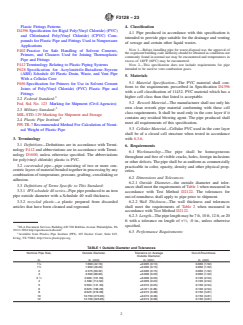
6.2.1 Outside Diameter—the outside diameter and toler-
3.3 Definitions of Terms Specific to This Standard:
ances shall meet the requirements of Table 1 when measured in
3.3.1 IPS schedule 40 series—Pipe pipe produced to an iron
accordance with Test Method D2122. The tolerances for
pipe outside diameter with a Schedule 40 wall thickness.
out-of-roundness shall apply to pipe prior to shipment.
6.2.2 Wall Thickness—The wall thickness and tolerances
3.3.2 recycled plastic—a plastic prepared from discarded
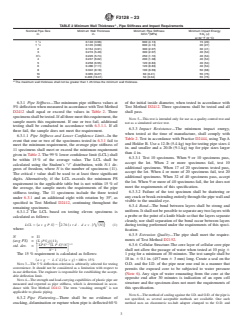
articles that have been cleaned and reground. shall meet the requirements of Table 2 when measured in
accordance with Test Method D2122.
6.2.3 Length—The pipe length may be 7 ft, 10 ft, 12 ft, or 20
ft with a tolerance on length of + ⁄2, -0 in., unless otherwise
specified.
DLA Document Services Building 4/D 700 Robbins Avenue Philadelphia, PA
19111-5094 http://quicksearch.dla.mil/
6.3 Performance Requirements:
Available from Plastics Pipe Institute (PPI), 105 Decker Court, Suite 825,
Irving, TX 75062, http://www.plasticpipe.org.
TABLE 1 Outside Diameter and Tolerances
Nominal Pipe Size, Outside Diameter, Tolerance on Average Out-of-Roundness
Outside Diameter,
in. in. (mm) in. (mm) in. (mm)
1 ⁄4 1.660 (42.16) ±0.005 (0.13) 0.060 (1.52)
1 ⁄2 1.900 (48.26) ±0.006 (0.15) 0.060 (1.52)
2 2.375 (60.32) ±0.006 (0.15) 0.060 (1.52)
3 3.500 (88.90) ±0.008 (0.20) 0.060 (1.52)
3 ⁄2 4.000 (101.60) ±0.008 (0.20) 0.100 (2.54)
4 4.500 (114.30) ±0.009 (0.23) 0.100 (2.54)
5 5.563 (141.30) ±0.010 (0.25) 0.100 (2.54)
6 6.625 (168.28) ±0.011 (0.28) 0.100 (2.54)
8 8.625 (219.08) ±0.015 (0.38) 0.150 (3.81)
10 10.750 (273.05) ±0.015 (0.38) 0.150 (3.81)
12 12.750 (323.85) ±0.015 (0.38) 0.150 (3.81)
F3128 − 23
A
TABLE 2 Minimum Wall Thickness , Pipe Stiffness and Impact Requirements
Nominal Pipe Size Minimum Wall Thickness Minimum Pipe Stiffness Minimum Impact Energy
in. in. lbf/in. (MPa) ft.lb (J)
f
at 32 °F (0 °C)
1 ⁄4 0.140 (3.56) 600 (4.13) 15 (20)
1 ⁄2 0.145 (3.68) 600 (4.13) 20 (27)
2 0.154 (3.91) 300 (2.07) 30 (41)
3 0.216 (5.49) 300 (2.07) 40 (54)
3 ⁄2 0.226 (5.74) 250 (1.72) 40 (54)
4 0.237 (6.02) 200 (1.38) 40 (54)
5 0.258 (6.55) 120 (0.83) 40 (54)
6 0.280 (7.11) 120 (0.83) 40 (54)
8 0.322 (8.18) 100 (0.69) 50 (68)
10 0.365 (9.27) 60 (0.41) 55 (75)
12 0.406 (10.31) 50 (0.34) 55 (75)
A
The maximum wall thickness shall not be greater than 1.25 times the minimum wall thickness.
6.3.1 Pipe Stiffness—The minimum pipe stiffness values at of the initial inside diameter, when tested in accordance with
5% deflection when measured in accordance with Test Method Test Method D2412. Three specimens shall be tested and all
D2412 shall equal or exceed the values in Table 2. Three shall pass.
specimens shall be tested. If all three meet this requirement, the
NOTE 5—This test is intended only for use as a quality control test and
sample meets this requirement. If one or two fail, additional
not as a simulated service test.
testing shall be conducted in accordance with 6.3.1.1. If all
6.3.3 Impact Resistance—The minimum impact energy,
three fail, the sample does not meet the requirement.
when tested at the time of manufacture, shall comply with
6.3.1.1 Pipe Stiffness and Lower Confidence Limit—In the
Table 2. Test in accordance with Practice D2444, using Tup A
event that one or two of the specimens tested in 6.3.1 fail to
and Holder B. Use a 12-lb (5.4-kg) tup for testing pipe sizes 4
meet the minimum requirement, the average pipe stiffness of
in. and smaller and a 20-lb (9.1-kg) tup for pipe sizes larger
11 specimens shall meet or exceed the minimum requirement
than 4 in.
given in Table 2. The 99 % lower confidence limit (LCL) shall
6.3.3.1 Test 10 specimens. When 9 or 10 specimens pass,
be within 15 % of the average value. The LCL shall be
accept the lot. When 2 or more specimens fail, test 10
calculated using the Student’s “t” distribution, with N-1 de-
additional specimens. When 17 of 20 specimens tested pass,
grees of freedom, where N is the number of specimens (11).
accept the lot. When 4 or more of 20 specimens fail, test 20
The critical t value shall be used to at least three significant
additional specimens. When 32 of 40 specimens pass, accept
digits. Alternatively, if the LCL exceeds the minimum PS
the lot. When 9 or more of 40 specimens fail, the lot does not
requirement in the applicable table but is not within 15 % of
meet the requirements of this specification.
the average, the sample meets the requirements of the pipe
6.3.3.2 Failure of the test specimen shall be shattering or
stiffness testing. The 11 specimens include the three tested
any crack or break extending entirely through the pipe wall and
under 6.3.1 and an additional eight with rotation by 35º, as
visible to the unaided eye.
specified in Test Method D2412, continuing throughout the
6.3.4 Bond—The bond between layers shall be strong and
remaining specimens.
uniform. It shall not be possible to separate any two layers with
6.3.1.2 The LCL based on testing eleven specimens is
a probe or the point of a knife blade so that the layers separate
calculated as follows:
cleanly, nor shall separation of the bond occur between layers
LCL 5 a v g P S 2 $2.76 s t d . d e v . ⁄= N % (1)
~ ! ~ ! ~ !
during testing performed under the requirements of this speci-
where:
fication.
6.3.5 Extrusion Quality—The pipe shall meet the require-
N = 11
ments of Test Method D2152.
(avg PS) = Σ PS ⁄ 11
@ ~ !# ~ !
i
2 2 1⁄2
ΣPS 2 Σ P S ⁄N 6.3.6 Cellular Structure-The core layer of cellular core pipe
~ !
std. dev. =
F G
shall not allow the passage of water when tested at 10 psig 6
N21
The 15 % requirement is calculated as follows:
1 psig for a minimum of 30 minutes. The test sample shall be
18 in. 6 0.1 in. (457 mm 6 3 mm) long. Create a seal on the
~a v g 2 L C L!⁄~a v g! × 100 # 15%
O.D. and the I.D. of the pipe near one end in a manner that
NOTE 3—The 5 % deflection criterion is arbitrarily selected for testing
convenience. It should not be considered as a limitation with respect to
permits the exposed core to be subjected to water pressure
in-use deflection. The engineer is responsible for establishing the accept-
(Note 6). Any sign of water emanating from the core at the
able deflection limit.
opposite end after 30 minutes is indication of an open cell
NOTE 4—The strength and load-carrying capabilities of plastic pipe are
structure and the specimen does not meet the requirements of
measured and reported as pipe stiffness, which is determined in accor-
this specification.
dance with Test Method D2412. The term “crushing strength” is not
applicable to plastic piping.
NOTE 6—The method of sealing against the I.D. and O.D. of the pipe is
6.3.2 Pipe Flattening—There shall be no evidence of
not specified, as several acceptable methods are available. One such
cracking, delamination or rupture when pipe is deflected 60 % method uses an elastomeric no-hub adapter clamped to the O.D. and
F3128 − 23
pneumatic or mechanical test plug to seal the I.D.
8. Retest and Rejection
6.4 Other Requirements:
8.1 If the results of any test(s) do not meet the requirements
6.4.1 Joining—Coextruded poly(vinyl chloride) PVC Cellu- of this specification, the test(s) shall be conducted again in
lar Core DWV Pipe is joined using fittings meeting the
accordance with an agreement between the purchaser and the
requirements of Specification D2665 and D3311 seller. There shall be no agreement to lower the minimum
6.4.2 Solvent Cement—In the assembly of solvent cement requirements of the specifications by such means as omitting
joints, the safety requirements of Practice F402 shall be test methods that are part of the specification, substitution, or
followed and the joint shall be assembled following Practice modifying test methods, or by changing the specification
D2855, using a cleaner or primer. limits. In retesting, the product requirements of this specifica-
tion shall be met, and the test methods designated in this
7. Sampling and Conditioning specification shall be followed. If, upon retest, failure occurs,
the quantity of product represented by the test(s) does not meet
7.1 Sampling—The selection of the sample or samples of
the requirements of this specification.
pipe shall be as agreed upon by the purchaser and seller. In case
of no prior agreement, any sample selected by the testing lab
9. Marking
shall be deemed adequate.
9.1 Quality of Marking—The marking shall be applied to
7.2 Conditioning:
the pipe for end-use application in such a manner that it
7.2.1 For referee testing at 73 °F (23 °C), condition the remains legible (easily read) after installation and inspection.
specimens prior to test at 73.4 °F 6 3.6 °F (23 °C 6 2 °C) and
9.2 Content of Marking—The pipe shall be marked at least
50 6 10% relative humidity in accordance with Practice D618, 3
every 5 ft (1.52 m) in letters not less than ⁄16 in. (4.76 mm)
Procedure A.
high and in a color that contrasts with the color of the pipe, and
7.2.2 For routine quality control testing at 73 °F (23 °C),
shall contain the following information:
condition the specimens at the temperature and humidity of the
9.2.1 Manufacturer’s name or trademark.
manufacturer’s testing facility for not less than 1 h or until the
9.2.2 This designation, ASTM F3128.
specimens are at the room temperature.
9.2.3 The wording “COEXTRUDED CELLULAR CORE
7.2.3 For referee and routine quality control testing at 32 °F
PVC DWV PIPE”.
(0 °C), condition the specimens at 32 °F 6 3.6 °F (0 °C 6
9.2.4 Nominal pipe size (for example: 2 in. IPS Schedule
2 °C) in air for at least 2 h, or in ice water for at least 1h.
40).
9.2.5 Manufacturer’s code for identifying lot number, date
7.3 Test Conditions:
and year of manufacture, or other information as needed.
7.3.1 For referee testing at 73 °F (23 °C), conduct tests in
the standard laboratory atmosphere of 73.4 °F 6 3.6 °F (23 °C
10. Quality Assurance
6 2 °C) and 50 6 10% relative humidity.
10.1 When the product is marked with this designation,
7.3.2 For routine quality control testing at 73 °F (23 °C),
F3128, the manufacturer affirms that the product was
conduct tests at the room temperature and humidity of the
manufactured, inspected, sampled and tested in accordance
manufacturer’s testing area.
with this specification and has been found to meet the
7.3.3 For referee and routine quality control testing at 32 °F
requirements of this specification.
(0 °C), complete the test as soon as possible after removal from
the conditioning atmosphere, but in any case within 15 s. 11. Keywords
7.4 Test Methods—Only specified ASTM test methods shall
11.1 cellular core; coextruded; DWV; PVC; Schedule 40;
be used. thermoplastic
SUPPLEMENTARY REQUIREMENTS
SUPPLEMENTARY REQUIREMENTS
GOVERNMENT/MILITARY PROCUREMENT
These requirem
...
This document is not an ASTM standard and is intended only to provide the user of an ASTM standard an indication of what changes have been made to the previous version. Because
it may not be technically possible to adequately depict all changes accurately, ASTM recommends that users consult prior editions as appropriate. In all cases only the current version
of the standard as published by ASTM is to be considered the official document.
Designation: F3128 − 19 F3128 − 23 An American National Standard
Standard Specification for
Poly(Vinyl Chloride) (PVC) Schedule 40 Drain, Waste, and
Vent Pipe with a Cellular Core
This standard is issued under the fixed designation F3128; the number immediately following the designation indicates the year of
original adoption or, in the case of revision, the year of last revision. A number in parentheses indicates the year of last reapproval. A
superscript epsilon (´) indicates an editorial change since the last revision or reapproval.
1. Scope*
1.1 This specification covers coextruded poly(vinyl chloride) (PVC) plastic drain, waste and vent pipe made to Schedule 40 iron
pipe sizes (IPS) and produced by the coextrusion process with concentric inner and outer solid PVC layers and the core consisting
of closed-cell cellular PVC. Plastic which does not meet the material requirements specified in Section 5 is excluded from single
layer and all coextruded layers.
1.2 Fittings meeting the requirements of Specification D2665 and D3311 are suitable for use with pipe meeting the requirements
of this specification.
1.3 Poly(vinyl chloride) plastic which does not meet the definitions of virgin PVC plastic as given in 5.1 is excluded, as
performance of plastic other than those defined as virgin was not determined. PVC rework plastic which meets the requirements
of rework plastic as given in 5.2 is acceptable.
1.4 Reprocessed plastic or recycled plastic as defined in Terminology D883 is excluded.
1.5 Recommendations for storage, joining and installation are provided in Appendix X1, Appendix X2, and Appendix X3
respectively.
1.6 The text of this specification references notes, footnotes and appendices which provide explanatory material. These notes and
footnotes (excluding those in tables and figures) shall not be considered as requirements of the specification.
1.7 The values stated in inch-pound units are to be regarded as standard. The values given in parentheses are mathematical
conversions to SI units that are provided for information only and are not considered standard.
1.8 This standard does not purport to address all of the safety concerns, if any, associated with its use. It is the responsibility
of the user of this standard to establish appropriate safety, health, and environmental practices and determine the applicability of
regulatory limitations prior to use.
1.9 This international standard was developed in accordance with internationally recognized principles on standardization
established in the Decision on Principles for the Development of International Standards, Guides and Recommendations issued
by the World Trade Organization Technical Barriers to Trade (TBT) Committee.
This specification is under the jurisdiction of ASTM Committee F17 on Plastic Piping Systems and is the direct responsibility of Subcommittee F17.63 on DWV.
Current edition approved March 1, 2019April 1, 2023. Published March 2019April 2023. Originally approved in 2015. Last previous edition approved in 20152019 as
F3128–15. DOI: 10.1520/F3128–19–19. DOI: 10.1520/F3128–23
*A Summary of Changes section appears at the end of this standard
Copyright © ASTM International, 100 Barr Harbor Drive, PO Box C700, West Conshohocken, PA 19428-2959. United States
F3128 − 23
2. Referenced Documents
2.1 ASTM Standards:
D618 Practice for Conditioning Plastics for Testing
D883 Terminology Relating to Plastics
D1600 Terminology for Abbreviated Terms Relating to Plastics
D2122 Test Method for Determining Dimensions of Thermoplastic Pipe and Fittings
D2152 Test Method for Adequacy of Fusion of Extruded Poly(Vinyl Chloride) (PVC) Pipe and Molded Fittings by Acetone
Immersion
D2321 Practice for Underground Installation of Thermoplastic Pipe for Sewers and Other Gravity-Flow Applications
D2412 Test Method for Determination of External Loading Characteristics of Plastic Pipe by Parallel-Plate Loading
D2444 Test Method Practice for Determination of the Impact Resistance of Thermoplastic Pipe and Fittings by Means of a Tup
(Falling Weight)
D2564 Specification for Solvent Cements for Poly(Vinyl Chloride) (PVC) Plastic Piping Systems
D2665 Specification for Poly(Vinyl Chloride) (PVC) Plastic Drain, Waste, and Vent Pipe and Fittings
D2855 Practice for the Two-Step (Primer and Solvent Cement) Method of Joining Poly (Vinyl Chloride) (PVC) or Chlorinated
Poly (Vinyl Chloride) (CPVC) Pipe and Piping Components with Tapered Sockets
D3311 Specification for Drain, Waste, and Vent (DWV) Plastic Fittings Patterns
D4396 Specification for Rigid Poly(Vinyl Chloride) (PVC) and Chlorinated Poly(Vinyl Chloride) (CPVC) Compounds for
Plastic Pipe and Fittings Used in Nonpressure Applications
F402 Practice for Safe Handling of Solvent Cements, Primers, and Cleaners Used for Joining Thermoplastic Pipe and Fittings
F412 Terminology Relating to Plastic Piping Systems
F628 Specification for Acrylonitrile-Butadiene-Styrene (ABS) Schedule 40 Plastic Drain, Waste, and Vent Pipe With a Cellular
Core
F656 Specification for Primers for Use in Solvent Cement Joints of Poly(Vinyl Chloride) (PVC) Plastic Pipe and Fittings
2.2 Federal Standard:
Fed. Std. No. 123 Marking for Shipment (Civil Agencies)
2.3 Military Standard:
MIL-STD-129 Marking for Shipment and Storage
2.4 ANSI Standards:
Z34.1 American National Standard for Certification-Third-Party Certification Program
Z34.2 American National Standard for Certification-Self-Certification by Producer or Supplier
2.4 Plastic Pipe Institute
PPI-TR-7 Recommended Method For Calculation of Nominal Weight of Plastic Pipe
3. Terminology
3.1 Definitions—Definitions are in accordance with Terminology F412 and abbreviations are in accordance with Terminology
D1600, unless otherwise specified. The abbreviations for poly(vinyl chloride) plastic is PVC.
3.2 coextruded pipe—pipe consisting of two or more concentric layers of material bonded together in processing by any
combination of temperature, pressure, grafting, crosslinking or adhesion.
3.3 Definitions of Terms Specific to This Standard:
3.3.1 IPS schedule 40 series—Pipe pipe produced to an iron pipe outside diameter with a Schedule 40 wall thickness.
3.3.2 recycled plastic—a plastic prepared from discarded articles that have been cleaned and reground.
4. Classification
4.1 Pipe produced in accordance with this specification is intended to provide pipe suitable for the drainage and venting of sewage
and certain other liquid wastes.
For referenced ASTM standards, visit the ASTM website, www.astm.org, or contact ASTM Customer Service at service@astm.org. For Annual Book of ASTM Standards
volume information, refer to the standard’s Document Summary page on the ASTM website.
DLA Document Services Building 4/D 700 Robbins Avenue Philadelphia, PA 19111-5094 http://quicksearch.dla.mil/
Available from Plastics Pipe Institute (PPI), 105 Decker Court, Suite 825, Irving, TX 75062, http://www.plasticpipe.org.
F3128 − 23
NOTE 1—Before installing pipe for waste disposal use, the approval of the cognizant building code authority should be obtained as conditions not
commonly found in normal use may be encountered and temperatures in excess of 140ºF (60ºC) may be encountered.
NOTE 2—This specification does not include requirements for pipe intended to be used to vent combustion gases.
5. Materials
5.1 Material Specification—The PVC material shall conform to the requirements prescribed in Specification D4396 with a cell
classification of 11432. PVC material which has a higher cell class than that listed is acceptable.
5.2 Rework Material—The manufacturer shall use only his own clean rework pipe material conforming with these cell class
requirements. It shall be used only in the core layer if it contains any residual blowing agent. The pipe produced shall meet all
requirements of this specification.
5.3 Cellular Material—Cellular PVC used in the core layer shall be of a closed cell structure when tested in accordance with 6.3.6.
6. Requirements
6.1 Workmanship—The pipe shall be homogeneous throughout and free of visible cracks, holes, foreign inclusions or other
defects. The pipe shall be as uniform as commercially practicable in color, opacity, density and other physical properties.
6.2 Dimensions and Tolerances:
6.2.1 Outside Diameter—the outside diameter and tolerances shall meet the requirements of Table 1 when measured in accordance
with Test Method D2122. The tolerances for out-of-roundness shall apply to pipe prior to shipment.
6.2.2 Wall Thickness—The wall thickness and tolerances shall meet the requirements of Table 2 when measured in accordance
with Test Method D2122.
6.2.3 Length—The pipe length may be 7, 10, 12, 7 ft, 10 ft, 12 ft, or 20 ft with a tolerance on length of + ⁄2, -0 in., unless otherwise
specified.
6.3 Performance Requirements:
6.3.1 Pipe Stiffness—The minimum pipe stiffness values at 5% deflection when measured in accordance with Test Method D2412
shall equal or exceed the values in Table 2. Three specimens shall be tested. If all three meet this requirement, the sample meets
this requirement. If one or two fail, additional testing shall be conducted in accordance with 6.3.1.1. If all three fail, the sample
does not meet the requirement.
6.3.1.1 Pipe Stiffness and Lower Confidence Limit—In the event that one or two of the specimens tested in 6.3.1 fail to meet the
minimum requirement, the average pipe stiffness of 11 specimens shall meet or exceed the minimum requirement given in Table
2. The 99%99 % lower confidence limit (LCL) shall be within 15%15 % of the average value. The LCL shall be calculated using
the Student’s “t” distribution, with N-1 degrees of freedom, where N is the number of specimens (11). The critical t value shall
TABLE 1 Outside Diameter and Tolerances
Nominal Pipe Size, Outside Diameter, Tolerance on Average Out-of-Roundness
Outside Diameter,
in. in. (mm) in. (mm) in. (mm)
1 ⁄4 1.660 (42.16) ±0.005 (0.13) 0.060 (1.52)
1 ⁄2 1.900 (48.26) ±0.006 (0.15) 0.060 (1.52)
2 2.375 (60.32) ±0.006 (0.15) 0.060 (1.52)
3 3.500 (88.90) ±0.008 (0.20) 0.060 (1.52)
3 ⁄2 4.000 (101.60) ±0.008 (0.20) 0.100 (2.54)
4 4.500 (114.30) ±0.009 (0.23) 0.100 (2.54)
5 5.563 (141.30) ±0.010 (0.25) 0.100 (2.54)
6 6.625 (168.28) ±0.011 (0.28) 0.100 (2.54)
8 8.625 (219.08) ±0.015 (0.38) 0.150 (3.81)
10 10.750 (273.05) ±0.015 (0.38) 0.150 (3.81)
12 12.750 (323.85) ±0.015 (0.38) 0.150 (3.81)
F3128 − 23
A
TABLE 2 Minimum Wall Thickness , Pipe Stiffness and Impact Requirements
Nominal Pipe Size Minimum Wall Thickness Minimum Pipe Stiffness Minimum Impact Energy
in. in. lbf/in. (MPa) ft.lb (J)
f
at 32 °F (0 °C)
1 ⁄4 0.140 (3.56) 600 (4.13) 15 (20)
1 ⁄2 0.145 (3.68) 600 (4.13) 20 (27)
2 0.154 (3.91) 300 (2.07) 30 (41)
3 0.216 (5.49) 300 (2.07) 40 (54)
3 ⁄2 0.226 (5.74) 250 (1.72) 40 (54)
4 0.237 (6.02) 200 (1.38) 40 (54)
5 0.258 (6.55) 120 (0.83) 40 (54)
6 0.280 (7.11) 120 (0.83) 40 (54)
8 0.322 (8.18) 100 (0.69) 50 (68)
10 0.365 (9.27) 60 (0.41) 55 (75)
12 0.406 (10.31) 50 (0.34) 55 (75)
A
The maximum wall thickness shall not be greater than 1.25 times the minimum wall thickness.
be used to at least three significant digits. Alternatively, if the LCL exceeds the minimum PS requirement in the applicable table
but is not within 15%15 % of the average, the sample meets the requirements of the pipe stiffness testing. The 11 specimens include
the three tested under 6.3.1 and an additional eight with rotation by 35º, as specified in Test Method D2412, continuing throughout
the remaining specimens.
6.3.1.2 The LCL based on testing eleven specimens is calculated as follows:
$ = %
LCL 5 ~a v g P S! 2 2.76 ~s t d . d e v .!⁄ ~N! (1)
where:
N = 11
(avg PS) = @Σ ~PS !#⁄~11!
i
2 2 1⁄2
ΣPS 2~Σ P S! ⁄N
std. dev. =
F G
N21
The 15%15 % requirement is calculated as follows:
a v g 2 L C L ⁄ a v g ×100 # 15%
~ ! ~ !
NOTE 3—The 5%5 % deflection criterion is arbitrarily selected for testing convenience. It should not be considered as a limitation with respect to in-use
deflection. The engineer is responsible for establishing the acceptable deflection limit.
NOTE 4—The strength and load-carrying capabilities of plastic pipe are measured and reported as pipe stiffness, which is determined in accordance with
Test Method D2412. The term “crushing strength” is not applicable to plastic piping.
6.3.2 Pipe Flattening—There shall be no evidence of cracking, delamination or rupture when pipe is deflected 60 % of the initial
inside diameter, when tested in accordance with Test Method D2412. Three specimens shall be tested and all shall pass.
NOTE 5—This test is intended only for use as a quality control test and not as a simulated service test.
6.3.3 Impact Resistance—The minimum impact energy, when tested at the time of manufacture, shall comply with Table 2. Test
in accordance with Test Method Practice D2444–99(2010),, using Tup A and Holder B. Use a 12-lb (5.4-kg) tup for testing pipe
sizes 4 in. and smaller and a 20-lb (9.1-kg) tup for pipe sizes larger than 4 in.
6.3.3.1 Test 10 specimens. When 9 or 10 specimens pass, accept the lot. When 2 or more specimens fail, test 10 additional
specimens. When 17 of 20 specimens tested pass, accept the lot. When 4 or more of 20 specimens fail, test 20 additional specimens.
When 32 of 40 specimens pass, accept the lot. When 9 or more of 40 specimens fail, the lot does not meet the requirements of
this specification.
6.3.3.2 Failure of the test specimen shall be shattering or any crack or break extending entirely through the pipe wall and visible
to the unaided eye.
6.3.4 Bond—The bond between layers shall be strong and uniform. It shall not be possible to separate any two layers with a probe
or the point of a knife blade so that the layers separate cleanly, nor shall separation of the bond occur between layers during testing
performed under the requirements of this specification.
F3128 − 23
6.3.5 Extrusion Quality—The pipe shall meet the requirements of Test Method D2152.
6.3.6 Cellular Structure-The core layer of cellular core pipe shall not allow the passage of water when tested at 10 psig 6 1 psig
for a minimum of 30 minutes. The test sample shall be 1818 in. 6 0.1 in. (457(457 mm 6 3 mm) long. Create a seal on the O.D.
and the I.D. of the pipe near one end in a manner that permits the exposed core to be subjected to water pressure (Note 6). Any
sign of water emanating from the core at the opposite end after 30 minutes is indication of an open cell structure and the specimen
does not meet the requirements of this specification.
NOTE 6—The method of sealing against the I.D. and O.D. of the pipe is not specified, as several acceptable methods are available. One such method uses
an elastomeric no-hub adapter clamped to the O.D. and pneumatic or mechanical test plug to seal the I.D.
6.4 Other Requirements:
6.4.1 Joining—Coextruded poly(vinyl chloride) PVC Cellular Core DWV Pipe is joined using fittings meeting the requirements
of Specification D2665 and D3311
6.4.2 Solvent Cement—In the assembly of solvent cement joints, the safety requirements of Practice F402 shall be followed and
the joint shall be assembled following Practice D2855, using a cleaner or primer.
7. Sampling and Conditioning
7.1 Sampling—The selection of the sample or samples of pipe shall be as agreed upon by the purchaser and seller. In case of no
prior agreement, any sample selected by the testing lab shall be deemed adequate.
7.2 Conditioning:
7.2.1 For referee testing at 73 °F (23 °C), condition the specimens prior to test at 73.473.4 °F 6 3.6 °F (23(23 °C 6 2 °C) and
50 6 10% relative humidity in accordance with Practice D618, Procedure A.
7.2.2 For routine quality control testing at 73 °F (23 °C), condition the specimens at the temperature and humidity of the
manufacturer’s testing facility for not less than 1 h or until the specimens are at the room temperature.
7.2.3 For referee and routine quality control testing at 32 °F (0 °C), condition the specimens at 3232 °F 6 3.6 °F (0(0 °C 6 2 °C)
in air for at least 2 h, or in ice water for at least 1h.
7.3 Test Conditions:
7.3.1 For referee testing at 73 °F (23 °C), conduct tests in the standard laboratory atmosphere of 73.473.4 °F 6 3.6 °F (23(23 °C
6 2 °C) and 50 6 10% relative humidity.
7.3.2 For routine quality control testing at 73 °F (23 °C), conduct tests at the room temperature and humidity of the manufacturer’s
testing area.
7.3.3 For referee and routine quality control testing at 32 °F (0 °C), complete the test as soon as possible after removal from the
conditioning atmosphere, but in any case within 15 s.
7.4 Test Methods—Only specified ASTM test methods shall be used.
8. Retest and Rejection
8.1 If the results of any test(s) do not meet the requirements of this specification, the test(s) shall be conducted again in accordance
with an agreement between the purchaser and the seller. There shall be no agreement to lower the minimum requirements of the
specifications by such means as omitting test methods that are part of the specification, substitution, or modifying test methods,
or by changing the specification limits. In retesting, the product requirements of this specification shall be met, and the test methods
designated in this specification shall be followed. If, upon retest, failure occurs, the quantity of product represented by the test(s)
does not meet the requirements of this specification.
F3128 − 23
9. Marking
9.1 Quality of Marking—The marking shall be applied to the pipe for end-use application in such a manner that it remains legible
(easily read) after installation and inspection.
9.2 Content of Marking—The pipe shall be marked at least every 5 ft (1.52 m) in letters not less than ⁄16 in. (4.76 mm) high and
in a color that contrasts with the color of the pipe, and shall contain the following information:
9.2.1 Manufacturer’s name or trademark.
9.2.2 This designation, ASTM F3128.
9.2.3 The wording “COEXTRUDED CELLULAR CORE PVC DWV PIPE”.
9.2.4 Nominal pipe size (for example: 2 in. IPS Schedule 40).
9.2.5 Manufacturer’s code for identifying lot number, date and year of manufacture, or other information as needed.
10. Quality Assurance
10.1 When the product is marked with this designation, F3128, the manufacturer affirms that the product was manufactured,
inspected, sampled and tested in accordance with this specification and has been found to meet the requirements of this
specification.
11. Keywords
11.1 cellular core; coextruded; DWV; PVC; Schedule 40; thermoplastic
SUPPLEMENTARY REQUIREMENTS
SUPPLEMENTARY REQUIREMENTS
GOVERNMENT/MILITARY PROCURE
...