

ASTM D7334-08(2022)
(Practice)Standard Practice for Surface Wettability of Coatings, Substrates and Pigments by Advancing Contact Angle Measurement
General Information
- Abstract
SIGNIFICANCE AND USE
5.1 This standard is useful for characterizing the wettability of surfaces. A surface that is easy to wet is one over which a coating is more likely to give good adhesion and appearance and less likely to suffer surface tension related defects such as crawling, cratering, pinholing and orange peel.
5.2 This standard also can be used to test pigment surfaces for wettability, particularly by potential surfactant- or resin-based dispersants or mill bases. Easily wetted pigments are more likely to be easy to disperse and dispersants/mill bases that wet pigments of interest are more likely to disperse those pigments well.
5.3 Although the contact angle is governed by the surface tensions of the test liquid and test surface, the angle cannot provide a surface tension value directly.
5.4 A low advancing contact angle value (
5.5 Water can be used as a test liquid to establish (via the advancing contact angle) whether a surface is hydrophilic (angle 90°) or somewhere in-between (angle of 45 to 90°). Water contact angles have been used to estimate surface cleanliness before and after cleaning operations, ease of wettability of surfaces by waterborne coatings and the effectiveness of rinsing processes.
5.6 An organic liquid such as a solvent also can be used to characterize a substrate, coating or pigment. The resultant contact angle will depend on the surface tensions of the liquid and the test surface. A low surface tension (energy) test surface will not be wet by a high surface tension liquid.
5.7 In addition to water and solvents, a surfactant dispersion or dispersant solution can be used to test a pigment surface. Any test liquid that is a potential dispersant for a test pigment must wet the pigment well or it will not work as a dispersant.
5.8 Contact angle measurements can be used to map surfaces in terms of hydrophilicity, presence of low surface tension components or contaminants, or variations in composition. Other analytical methods such as inf...
SCOPE
1.1 This practice covers the measurement of the angle of contact when a drop of liquid is applied to a coated surface, substrate, or preformed disk of pigment.
1.2 There are two types of contact angles, advancing and receding. This standard deals only with advancing contact angles.
1.3 This practice is intended to supplement the manufacturer’s instructions for the device being used to make the measurements, but is not intended to replace them.
1.4 A common test liquid is water, but many other liquids such as solvents, surfactant and dispersant solutions and even liquid paints can be used.
1.5 This practice is based on goniometry, which involves the observation of a sessile drop of test liquid on a solid substrate.
1.6 Although contact angles are governed by surface tension, this standard cannot be used to measure surface tension directly.
1.7 The values stated in SI units are to be regarded as the standard. The values given in parentheses are for information only.
1.8 This standard does not purport to address all of the safety concerns, if any, associated with its use. It is the responsibility of the user of this standard to establish appropriate safety, health, and environmental practices and determine the applicability of regulatory limitations prior to use.
1.9 This international standard was developed in accordance with internationally recognized principles on standardization established in the Decision on Principles for the Development of International Standards, Guides and Recommendations issued by the World Trade Organization Technical Barriers to Trade (TBT) Committee.
- Status
- Published
- Publication Date
- 31-Dec-2021
- Technical Committee
- D01 - Paint and Related Coatings, Materials, and Applications
- Drafting Committee
- D01.23 - Physical Properties of Applied Paint Films


Overview
ASTM D7334-08(2022) – Standard Practice for Surface Wettability of Coatings, Substrates and Pigments by Advancing Contact Angle Measurement provides a standardized methodology for evaluating the wettability of solid surfaces. Wettability assessment, determined by measuring the advancing contact angle, is critical for understanding how well liquids such as coatings, dispersants, or solvents interact with surfaces and pigments. High surface wettability typically indicates strong adhesion and reduced risk of defects like crawling, cratering, pinholing, or orange peel in coatings applications. This practice applies to coatings, substrates, and pressed pigment disks and is essential for industries concerned with quality and performance of surface treatments.
Key Topics
- Advancing Contact Angle: The primary metric recommended, representing the angle formed by a drop of liquid as it first contacts a solid surface and begins to advance.
- Sessile Drop Goniometry: The core method involves observing a drop of test liquid on the surface using a microscope or camera system to precisely measure the contact angle.
- Test Liquids: Water is commonly used, but solvents, surfactant solutions, mill bases, and even paints can be employed depending on the application.
- Surface Preparation: Clean, uncontaminated, and representative specimens are necessary for reproducible results. Pigments require pressing into disks.
- Wettability Indicators: A low advancing contact angle (<45°) indicates good wetting, while a high angle (>90°) suggests low wettability or hydrophobicity.
- Applications for Pigments: Easily wetted pigment surfaces indicate better dispersibility, guiding selection of dispersants or mill bases for paint and ink manufacturing.
- Surface Chemistry Insights: Trends in contact angles can reveal surface cleanliness, presence of low-energy components, or distribution of contaminants, although chemical identification requires supplementary means.
Applications
Implementing ASTM D7334-08(2022) provides measurable and actionable data for:
- Coatings Industry: Assessing the wettability of substrates before applying paints and coatings to ensure optimal adhesion and visual uniformity, and to minimize surface tension defects.
- Pigment and Dispersant Optimization: Evaluating how well pigments could disperse in formulations and selecting surfactant or resin-based dispersants that maximize pigment wetting.
- Surface Cleanliness Verification: Checking the effectiveness of cleaning or rinsing processes both in manufacturing and maintenance settings, using water contact angle as an indicator.
- Product Development and Quality Control: Comparative studies of different surfaces, coatings, or treatments to benchmark performance or troubleshoot issues related to wettability.
- Research and Development: Exploring new coatings, treatments, or additives where modifying surface properties (hydrophilicity/hydrophobicity) is a key functional goal.
Related Standards
For comprehensive surface analysis and wettability measurement practices, consider the following ASTM references:
- ASTM D1193: Specification for Reagent Water – Relevant for preparing test liquids.
- ASTM D5725: Test Method for Surface Wettability and Absorbency of Sheeted Materials Using an Automated Contact Angle Tester (Withdrawn 2010).
- Other International Standards: Harmonized principles referenced by the World Trade Organization Technical Barriers to Trade (TBT) Committee.
Keywords: contact angle measurement, wettability, coatings, substrates, pigments, advancing contact angle, goniometry, surface cleanliness, dispersants, hydrophobicity, hydrophilicity
By following ASTM D7334-08(2022), manufacturers and researchers can ensure consistent, reliable, and industry-accepted assessment of surface wettability, supporting quality control, product development, and technical investigations in the coatings and pigments industries.
Relations
- Effective Date
- 01-Mar-2006
- Effective Date
- 10-Feb-1999
- Effective Date
- 10-Feb-1999
Frequently Asked Questions
ASTM D7334-08(2022) is a standard published by ASTM International. Its full title is "Standard Practice for Surface Wettability of Coatings, Substrates and Pigments by Advancing Contact Angle Measurement". This standard covers: SIGNIFICANCE AND USE 5.1 This standard is useful for characterizing the wettability of surfaces. A surface that is easy to wet is one over which a coating is more likely to give good adhesion and appearance and less likely to suffer surface tension related defects such as crawling, cratering, pinholing and orange peel. 5.2 This standard also can be used to test pigment surfaces for wettability, particularly by potential surfactant- or resin-based dispersants or mill bases. Easily wetted pigments are more likely to be easy to disperse and dispersants/mill bases that wet pigments of interest are more likely to disperse those pigments well. 5.3 Although the contact angle is governed by the surface tensions of the test liquid and test surface, the angle cannot provide a surface tension value directly. 5.4 A low advancing contact angle value ( 5.5 Water can be used as a test liquid to establish (via the advancing contact angle) whether a surface is hydrophilic (angle 90°) or somewhere in-between (angle of 45 to 90°). Water contact angles have been used to estimate surface cleanliness before and after cleaning operations, ease of wettability of surfaces by waterborne coatings and the effectiveness of rinsing processes. 5.6 An organic liquid such as a solvent also can be used to characterize a substrate, coating or pigment. The resultant contact angle will depend on the surface tensions of the liquid and the test surface. A low surface tension (energy) test surface will not be wet by a high surface tension liquid. 5.7 In addition to water and solvents, a surfactant dispersion or dispersant solution can be used to test a pigment surface. Any test liquid that is a potential dispersant for a test pigment must wet the pigment well or it will not work as a dispersant. 5.8 Contact angle measurements can be used to map surfaces in terms of hydrophilicity, presence of low surface tension components or contaminants, or variations in composition. Other analytical methods such as inf... SCOPE 1.1 This practice covers the measurement of the angle of contact when a drop of liquid is applied to a coated surface, substrate, or preformed disk of pigment. 1.2 There are two types of contact angles, advancing and receding. This standard deals only with advancing contact angles. 1.3 This practice is intended to supplement the manufacturer’s instructions for the device being used to make the measurements, but is not intended to replace them. 1.4 A common test liquid is water, but many other liquids such as solvents, surfactant and dispersant solutions and even liquid paints can be used. 1.5 This practice is based on goniometry, which involves the observation of a sessile drop of test liquid on a solid substrate. 1.6 Although contact angles are governed by surface tension, this standard cannot be used to measure surface tension directly. 1.7 The values stated in SI units are to be regarded as the standard. The values given in parentheses are for information only. 1.8 This standard does not purport to address all of the safety concerns, if any, associated with its use. It is the responsibility of the user of this standard to establish appropriate safety, health, and environmental practices and determine the applicability of regulatory limitations prior to use. 1.9 This international standard was developed in accordance with internationally recognized principles on standardization established in the Decision on Principles for the Development of International Standards, Guides and Recommendations issued by the World Trade Organization Technical Barriers to Trade (TBT) Committee.
SIGNIFICANCE AND USE 5.1 This standard is useful for characterizing the wettability of surfaces. A surface that is easy to wet is one over which a coating is more likely to give good adhesion and appearance and less likely to suffer surface tension related defects such as crawling, cratering, pinholing and orange peel. 5.2 This standard also can be used to test pigment surfaces for wettability, particularly by potential surfactant- or resin-based dispersants or mill bases. Easily wetted pigments are more likely to be easy to disperse and dispersants/mill bases that wet pigments of interest are more likely to disperse those pigments well. 5.3 Although the contact angle is governed by the surface tensions of the test liquid and test surface, the angle cannot provide a surface tension value directly. 5.4 A low advancing contact angle value ( 5.5 Water can be used as a test liquid to establish (via the advancing contact angle) whether a surface is hydrophilic (angle 90°) or somewhere in-between (angle of 45 to 90°). Water contact angles have been used to estimate surface cleanliness before and after cleaning operations, ease of wettability of surfaces by waterborne coatings and the effectiveness of rinsing processes. 5.6 An organic liquid such as a solvent also can be used to characterize a substrate, coating or pigment. The resultant contact angle will depend on the surface tensions of the liquid and the test surface. A low surface tension (energy) test surface will not be wet by a high surface tension liquid. 5.7 In addition to water and solvents, a surfactant dispersion or dispersant solution can be used to test a pigment surface. Any test liquid that is a potential dispersant for a test pigment must wet the pigment well or it will not work as a dispersant. 5.8 Contact angle measurements can be used to map surfaces in terms of hydrophilicity, presence of low surface tension components or contaminants, or variations in composition. Other analytical methods such as inf... SCOPE 1.1 This practice covers the measurement of the angle of contact when a drop of liquid is applied to a coated surface, substrate, or preformed disk of pigment. 1.2 There are two types of contact angles, advancing and receding. This standard deals only with advancing contact angles. 1.3 This practice is intended to supplement the manufacturer’s instructions for the device being used to make the measurements, but is not intended to replace them. 1.4 A common test liquid is water, but many other liquids such as solvents, surfactant and dispersant solutions and even liquid paints can be used. 1.5 This practice is based on goniometry, which involves the observation of a sessile drop of test liquid on a solid substrate. 1.6 Although contact angles are governed by surface tension, this standard cannot be used to measure surface tension directly. 1.7 The values stated in SI units are to be regarded as the standard. The values given in parentheses are for information only. 1.8 This standard does not purport to address all of the safety concerns, if any, associated with its use. It is the responsibility of the user of this standard to establish appropriate safety, health, and environmental practices and determine the applicability of regulatory limitations prior to use. 1.9 This international standard was developed in accordance with internationally recognized principles on standardization established in the Decision on Principles for the Development of International Standards, Guides and Recommendations issued by the World Trade Organization Technical Barriers to Trade (TBT) Committee.
ASTM D7334-08(2022) is classified under the following ICS (International Classification for Standards) categories: 87.040 - Paints and varnishes. The ICS classification helps identify the subject area and facilitates finding related standards.
ASTM D7334-08(2022) has the following relationships with other standards: It is inter standard links to ASTM D1193-06, ASTM D1193-99e1, ASTM D1193-99. Understanding these relationships helps ensure you are using the most current and applicable version of the standard.
ASTM D7334-08(2022) is available in PDF format for immediate download after purchase. The document can be added to your cart and obtained through the secure checkout process. Digital delivery ensures instant access to the complete standard document.
Standards Content (Sample)
This international standard was developed in accordance with internationally recognized principles on standardization established in the Decision on Principles for the
Development of International Standards, Guides and Recommendations issued by the World Trade Organization Technical Barriers to Trade (TBT) Committee.
Designation: D7334 − 08 (Reapproved 2022)
Standard Practice for
Surface Wettability of Coatings, Substrates and Pigments
by Advancing Contact Angle Measurement
This standard is issued under the fixed designation D7334; the number immediately following the designation indicates the year of
original adoption or, in the case of revision, the year of last revision. A number in parentheses indicates the year of last reapproval. A
superscript epsilon (´) indicates an editorial change since the last revision or reapproval.
1. Scope 2. Referenced Documents
2.1 ASTM Standards:
1.1 This practice covers the measurement of the angle of
D1193 Specification for Reagent Water
contact when a drop of liquid is applied to a coated surface,
D5725 Test Method for Surface Wettability andAbsorbency
substrate, or preformed disk of pigment.
of Sheeted Materials Using an Automated Contact Angle
1.2 There are two types of contact angles, advancing and
Tester (Withdrawn 2010)
receding. This standard deals only with advancing contact
angles.
3. Terminology
1.3 This practice is intended to supplement the manufactur-
3.1 Definitions:
er’s instructions for the device being used to make the
3.1.1 advancing contact angle, n—the contact angle that is
measurements, but is not intended to replace them.
measured immediately after the sessile drop is placed on the
surface.
1.4 A common test liquid is water, but many other liquids
3.1.1.1 Discussion—The drop has the maximum volume
such as solvents, surfactant and dispersant solutions and even
allowable for the liquid-solid interfacial area: any addition will
liquid paints can be used.
make the drop expand and increase the liquid-solid interfacial
1.5 Thispracticeisbasedongoniometry,whichinvolvesthe
area. This can be thought of as the “wetting angle” because the
observation of a sessile drop of test liquid on a solid substrate.
drop is ready to wet additional area. This is the contact angle
used in this method and in most coating measurements.
1.6 Although contact angles are governed by surface
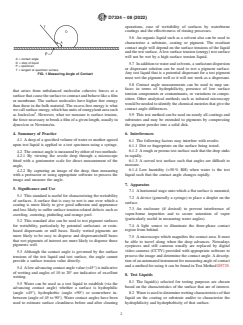
tension, this standard cannot be used to measure surface 3.1.2 contact angle, n—the interior angle that a drop makes
tension directly. between the substrate and a tangent drawn at the intersection
between the drop and the substrate as shown in Fig. 1.
1.7 The values stated in SI units are to be regarded as the
3.1.2.1 Discussion—This is the angle formed by a liquid at
standard. The values given in parentheses are for information
the three phase boundary where a liquid, gas (air) and solid
only.
intersect.
1.8 This standard does not purport to address all of the
3.1.3 receding contact angle, n—thecontactanglemeasured
safety concerns, if any, associated with its use. It is the
when material is removed from the drop so that it contracts.
responsibility of the user of this standard to establish appro-
3.1.3.1 Discussion—The liquid-solid interfacial area will
priate safety, health, and environmental practices and deter-
decrease. This is the “de-wetting angle.”
mine the applicability of regulatory limitations prior to use.
3.1.4 sessile drop, n—drop of liquid on the upper side of a
1.9 This international standard was developed in accor-
horizontal surface (as in Fig. 1).
dance with internationally recognized principles on standard-
3.1.5 surface tension, n, and surface energy, n—the terms
ization established in the Decision on Principles for the
surface tension and surface energy are often used interchange-
Development of International Standards, Guides and Recom-
ably.
mendations issued by the World Trade Organization Technical
3.1.5.1 Discussion—They are the same numerically, al-
Barriers to Trade (TBT) Committee.
thoughtheyhavedifferentunits.Theyaremeasuresofaneffect
1 2
This practice is under the jurisdiction of ASTM Committee D01 on Paint and For referenced ASTM standards, visit the ASTM website, www.astm.org, or
Related Coatings, Materials, and Applications and is the direct responsibility of contact ASTM Customer Service at service@astm.org. For Annual Book of ASTM
Subcommittee D01.23 on Physical Properties of Applied Paint Films. Standards volume information, refer to the standard’s Document Summary page on
Current edition approved Jan. 1, 2022. Published January 2022. Originally the ASTM website.
approved in 2008. Last previous edition approved in 2013 as D7334 – 08 (2013). The last approved version of this historical standard is referenced on
DOI: 10.1520/D7334-08R22. www.astm.org.
Copyright © ASTM International, 100 Barr Harbor Drive, PO Box C700, West Conshohocken, PA 19428-2959. United States
D7334 − 08 (2022)
operations, ease of wettability of surfaces by waterborne
coatings and the effectiveness of rinsing processes.
5.6 An organic liquid such as a solvent also can be used to
characterize a substrate, coating or pigment. The resultant
contact angle will depend on the surface tensions of the liquid
and the test surface.Alow surface tension (energy) test surface
will not be wet by a high surface tension liquid.
A = contact angle
D=dropofliquid
5.7 In addition to water and solvents, a surfactant dispersion
P = specimen
or dispersant solution can be used to test a pigment surface.
T = tangent at specimen surface
Any test liquid that is a potential dispersant for a test pigment
FIG. 1 Measuring Angle of Contact
must wet the pigment well or it will not work as a dispersant.
5.8 Contact angle measurements can be used to map sur-
faces in terms of hydrophilicity, presence of low surface
that arises from unbalanced molecular cohesive forces at a
tension components or contaminants, or variations in compo-
surface that cause the surface to contract and behave like a film
sition. Other analytical methods such as infrared microscopy
or membrane. The surface molecules have higher free energy
would be needed to identify the chemical moieties that give the
than those in the bulk material. The excess free energy is what
contact angle differences.
wecallsurfaceenergy,whichhasunitsofenergy/unitareasuch
as Joules/cm . However, what we measure is surface tension, 5.9 This test method can be used on nearly all coatings and
the force necessary to break a film of a given length, usually in substrates and may be extended to pigments by compressing
dynes/cm or Newtons/m. the pigment powder into a solid disk.
4. Summary of Practice
6. Interferences
4.1 Adrop of a specified volume of water or another agreed
6.1 The following factors may interfere with results:
upon test liquid is applied to a test specimen using a syringe.
6.1.1 Dirt or fingerprints on the surface being tested.
6.1.2 Arough or porous test surface such that the drop sinks
4.2 The contact angle is measured by either of two methods:
in rapidly.
4.2.1 By viewing the sessile drop through a microscope
6.1.3 A curved test surface such that angles are difficult to
fitted with a goniometer scale for direct measurement of the
measure.
angle,
4.2.2 By capturing an image of the drop, then measuring 6.1.4 Low humidity (<50 % RH) when water is the test
liquid such that
...