


ASTM D56-22
(Test Method)Standard Test Method for Flash Point by Tag Closed Cup Tester
Standard Test Method for Flash Point by Tag Closed Cup Tester
SIGNIFICANCE AND USE
5.1 Flash point measures the tendency of the specimen to form a flammable mixture with air under controlled laboratory conditions. It is only one of a number of properties that shall be considered in assessing the overall flammability hazard of a material.
5.2 Flash point is used in shipping and safety regulations to define flammable and combustible materials. One should consult the particular regulation involved for precise definitions of these classes.
5.3 Flash point can indicate the possible presence of highly volatile and flammable materials in a relatively nonvolatile or nonflammable material. For example, an abnormally low flash point on a sample of kerosene can indicate gasoline contamination.
SCOPE
1.1 This test method covers the determination of the flash point, by Tag manual and automated closed testers, of liquids with a viscosity below 5.5 mm2/s (cSt) at 40 °C (104 °F), or below 9.5 mm2/s (cSt) at 25 °C (77 °F), and a flash point below 93 °C (200 °F).
1.1.1 Two sets of test conditions are used within this test method: low temperature (LT) test conditions for expected flash points ≥ 60 °C.
1.1.2 For the closed-cup flash point of liquids with the following properties: a viscosity of 5.5 mm2/s (cSt) or more at 40 °C (104 °F); a viscosity of 9.5 mm2/s (cSt) or more at 25 °C (77 °F); a flash point of 93 °C (200 °F) or higher; a tendency to form a surface film under test conditions; or containing suspended solids, Test Method D93 can be used.
1.1.3 For cut-back asphalts refer to Test Methods D1310 and D3143.
Note 1: The U.S. Department of Transportation (RSTA)2 and U.S. Department of Labor (OSHA) have established that liquids with a flash point under 37.8 °C (100 °F) are flammable as determined by this test method for those liquids that have a viscosity less than 5.5 mm2/s (cSt) at 40 °C (104 °F) or 9.5 mm2/s (cSt) or less at 25 °C (77 °F), or do not contain suspended solids or do not have a tendency to form a surface film while under test. Other flash point classifications have been established by these departments for liquids using this test method.
1.2 This test method can be used to measure and describe the properties of materials, products, or assemblies in response to heat and flame under controlled laboratory conditions and cannot be used to describe or appraise the fire hazard or fire risk of materials, products, or assemblies under actual fire conditions. However, results of this test method can be used as elements of fire risk assessment that takes into account all of the factors that are pertinent to an assessment of the fire hazard of a particular end use.
1.3 Related standards are Test Methods D93, D1310, D3828, D3278, and D3941.
1.4 The values stated in SI units are to be regarded as standard. The values given in parentheses are for information only.
1.5 WARNING—Mercury has been designated by many regulatory agencies as a hazardous substance that can cause serious medical issues. Mercury, or its vapor, has been demonstrated to be hazardous to health and corrosive to materials. Use Caution when handling mercury and mercury-containing products. See the applicable product Safety Data Sheet (SDS) for additional information. The potential exists that selling mercury or mercury-containing products, or both, is prohibited by local or national law. Users must determine legality of sales in their location.
1.6 This standard does not purport to address all of the safety concerns, if any, associated with its use. It is the responsibility of the user of this standard to establish appropriate safety, health, and environmental practices and determine the applicability of regulatory limitations prior to use. For specific warning statements see 6.5, 7.1, 9.3, 11.1.4, and refer to Safety Data Sheets.
1.7 This international standard was developed in accordance with internationally recognized principles on standardization established in the Decision on Pr...
General Information
- Status
- Published
- Publication Date
- 30-Jun-2022
- Technical Committee
- D02 - Petroleum Products, Liquid Fuels, and Lubricants
- Drafting Committee
- D02.08 - Volatility
Relations
- Effective Date
- 01-Mar-2024
- Effective Date
- 01-Dec-2023
- Effective Date
- 01-Dec-2023
- Effective Date
- 01-Aug-2020
- Effective Date
- 01-Jun-2020
- Effective Date
- 01-Dec-2019
- Effective Date
- 15-Dec-2017
- Effective Date
- 15-Nov-2017
- Effective Date
- 01-Jan-2017
- Effective Date
- 01-Jun-2016
- Effective Date
- 01-Apr-2016
- Effective Date
- 01-Jun-2015
- Effective Date
- 15-Dec-2014
- Effective Date
- 01-Jun-2014
- Effective Date
- 01-Jun-2014
Overview
ASTM D56-22, Standard Test Method for Flash Point by Tag Closed Cup Tester, is a widely recognized method for determining the flash point of volatile liquids under controlled laboratory conditions. Developed by ASTM International, this standard specifically covers liquids with viscosities below 5.5 mm²/s at 40°C (104°F), or below 9.5 mm²/s at 25°C (77°F), and with flash points below 93°C (200°F). The Tag Closed Cup Tester can be used in both manual and automated formats. This method is crucial for industries handling flammable and combustible liquids, playing a critical role in regulatory compliance, shipping, and safety management.
Key Topics
- Flash Point Determination: The core of ASTM D56-22 is the evaluation of a liquid’s flash point, defined as the lowest temperature at which an ignition source causes vapors above the sample to ignite.
- Applicability: The standard is suitable for liquids with specific viscosity and flash point ranges. For liquids outside these ranges, alternative methods such as ASTM D93 may be recommended.
- Test Conditions: The method defines low temperature (LT) and high temperature (HT) test conditions depending on the expected flash point.
- Use in Regulations: Flash point data obtained by this method are used to classify materials as flammable or combustible in accordance with shipping and safety regulations (e.g., by OSHA and U.S. Department of Transportation).
- Sample Handling and Apparatus: The method details the proper preparation, handling, and equipment (Tag Closed Cup Tester, temperature measuring devices, ignition sources) to ensure accurate, reproducible results.
- Limitations: This method provides data under laboratory conditions and should not be used as the sole measure of fire hazard or risk in real-world scenarios.
Applications
ASTM D56-22 is extensively used in industries requiring precise control over the storage, transport, and handling of flammable and combustible liquids. Key applications include:
- Quality Control: Ensures uniformity in product batches by verifying that flash points meet required specifications.
- Regulatory Compliance: Supports classification of liquids for transportation and workplace safety according to international and national regulations. This is vital for compliance with OSHA and U.S. DOT rules.
- Contamination Detection: Atypical flash point values can indicate contamination (e.g., presence of volatile solvents like gasoline in kerosene), which assists in quality investigations and troubleshooting.
- Fire Risk Assessment: While not a measure of actual fire risk under operational conditions, flash point data is a foundational element in broader risk assessments and fire safety documentation.
- Product Specification: Used in technical data sheets, safety data sheets (SDS), and material certifications for downstream users in chemicals, fuels, paints, and lubricants industries.
Related Standards
ASTM D56-22 is part of a suite of ASTM standards for flash point determination. Relevant related standards include:
- ASTM D93: Flash Point by Pensky-Martens Closed Cup Tester - for liquids with higher viscosity or flash points above 93°C (200°F).
- ASTM D1310 and D3143: Methods for flash point testing of cut-back asphalts using open-cup techniques.
- ASTM D3278 and D3828: Small scale closed-cup methods for flash point determination.
- ASTM D3941: Equilibrium Method for Flash Point - provides a predictive alternative for certain substances.
- ISO 17034 and ISO Guide 35: International guidance for reference material producers and characterization, enhancing quality assurance practices in flash point testing.
By adhering to ASTM D56-22, laboratories and manufacturers ensure they are following globally recognized protocols for accurate determination of flash points in low-viscosity liquids, contributing to safer handling, storage, and transport of hazardous materials.
Buy Documents
ASTM D56-22 - Standard Test Method for Flash Point by Tag Closed Cup Tester
REDLINE ASTM D56-22 - Standard Test Method for Flash Point by Tag Closed Cup Tester
Get Certified
Connect with accredited certification bodies for this standard

ABS Quality Evaluations Inc.
American Bureau of Shipping quality certification.

Element Materials Technology
Materials testing and product certification.

ABS Group Brazil
ABS Group certification services in Brazil.
Sponsored listings
Frequently Asked Questions
ASTM D56-22 is a standard published by ASTM International. Its full title is "Standard Test Method for Flash Point by Tag Closed Cup Tester". This standard covers: SIGNIFICANCE AND USE 5.1 Flash point measures the tendency of the specimen to form a flammable mixture with air under controlled laboratory conditions. It is only one of a number of properties that shall be considered in assessing the overall flammability hazard of a material. 5.2 Flash point is used in shipping and safety regulations to define flammable and combustible materials. One should consult the particular regulation involved for precise definitions of these classes. 5.3 Flash point can indicate the possible presence of highly volatile and flammable materials in a relatively nonvolatile or nonflammable material. For example, an abnormally low flash point on a sample of kerosene can indicate gasoline contamination. SCOPE 1.1 This test method covers the determination of the flash point, by Tag manual and automated closed testers, of liquids with a viscosity below 5.5 mm2/s (cSt) at 40 °C (104 °F), or below 9.5 mm2/s (cSt) at 25 °C (77 °F), and a flash point below 93 °C (200 °F). 1.1.1 Two sets of test conditions are used within this test method: low temperature (LT) test conditions for expected flash points ≥ 60 °C. 1.1.2 For the closed-cup flash point of liquids with the following properties: a viscosity of 5.5 mm2/s (cSt) or more at 40 °C (104 °F); a viscosity of 9.5 mm2/s (cSt) or more at 25 °C (77 °F); a flash point of 93 °C (200 °F) or higher; a tendency to form a surface film under test conditions; or containing suspended solids, Test Method D93 can be used. 1.1.3 For cut-back asphalts refer to Test Methods D1310 and D3143. Note 1: The U.S. Department of Transportation (RSTA)2 and U.S. Department of Labor (OSHA) have established that liquids with a flash point under 37.8 °C (100 °F) are flammable as determined by this test method for those liquids that have a viscosity less than 5.5 mm2/s (cSt) at 40 °C (104 °F) or 9.5 mm2/s (cSt) or less at 25 °C (77 °F), or do not contain suspended solids or do not have a tendency to form a surface film while under test. Other flash point classifications have been established by these departments for liquids using this test method. 1.2 This test method can be used to measure and describe the properties of materials, products, or assemblies in response to heat and flame under controlled laboratory conditions and cannot be used to describe or appraise the fire hazard or fire risk of materials, products, or assemblies under actual fire conditions. However, results of this test method can be used as elements of fire risk assessment that takes into account all of the factors that are pertinent to an assessment of the fire hazard of a particular end use. 1.3 Related standards are Test Methods D93, D1310, D3828, D3278, and D3941. 1.4 The values stated in SI units are to be regarded as standard. The values given in parentheses are for information only. 1.5 WARNING—Mercury has been designated by many regulatory agencies as a hazardous substance that can cause serious medical issues. Mercury, or its vapor, has been demonstrated to be hazardous to health and corrosive to materials. Use Caution when handling mercury and mercury-containing products. See the applicable product Safety Data Sheet (SDS) for additional information. The potential exists that selling mercury or mercury-containing products, or both, is prohibited by local or national law. Users must determine legality of sales in their location. 1.6 This standard does not purport to address all of the safety concerns, if any, associated with its use. It is the responsibility of the user of this standard to establish appropriate safety, health, and environmental practices and determine the applicability of regulatory limitations prior to use. For specific warning statements see 6.5, 7.1, 9.3, 11.1.4, and refer to Safety Data Sheets. 1.7 This international standard was developed in accordance with internationally recognized principles on standardization established in the Decision on Pr...
SIGNIFICANCE AND USE 5.1 Flash point measures the tendency of the specimen to form a flammable mixture with air under controlled laboratory conditions. It is only one of a number of properties that shall be considered in assessing the overall flammability hazard of a material. 5.2 Flash point is used in shipping and safety regulations to define flammable and combustible materials. One should consult the particular regulation involved for precise definitions of these classes. 5.3 Flash point can indicate the possible presence of highly volatile and flammable materials in a relatively nonvolatile or nonflammable material. For example, an abnormally low flash point on a sample of kerosene can indicate gasoline contamination. SCOPE 1.1 This test method covers the determination of the flash point, by Tag manual and automated closed testers, of liquids with a viscosity below 5.5 mm2/s (cSt) at 40 °C (104 °F), or below 9.5 mm2/s (cSt) at 25 °C (77 °F), and a flash point below 93 °C (200 °F). 1.1.1 Two sets of test conditions are used within this test method: low temperature (LT) test conditions for expected flash points ≥ 60 °C. 1.1.2 For the closed-cup flash point of liquids with the following properties: a viscosity of 5.5 mm2/s (cSt) or more at 40 °C (104 °F); a viscosity of 9.5 mm2/s (cSt) or more at 25 °C (77 °F); a flash point of 93 °C (200 °F) or higher; a tendency to form a surface film under test conditions; or containing suspended solids, Test Method D93 can be used. 1.1.3 For cut-back asphalts refer to Test Methods D1310 and D3143. Note 1: The U.S. Department of Transportation (RSTA)2 and U.S. Department of Labor (OSHA) have established that liquids with a flash point under 37.8 °C (100 °F) are flammable as determined by this test method for those liquids that have a viscosity less than 5.5 mm2/s (cSt) at 40 °C (104 °F) or 9.5 mm2/s (cSt) or less at 25 °C (77 °F), or do not contain suspended solids or do not have a tendency to form a surface film while under test. Other flash point classifications have been established by these departments for liquids using this test method. 1.2 This test method can be used to measure and describe the properties of materials, products, or assemblies in response to heat and flame under controlled laboratory conditions and cannot be used to describe or appraise the fire hazard or fire risk of materials, products, or assemblies under actual fire conditions. However, results of this test method can be used as elements of fire risk assessment that takes into account all of the factors that are pertinent to an assessment of the fire hazard of a particular end use. 1.3 Related standards are Test Methods D93, D1310, D3828, D3278, and D3941. 1.4 The values stated in SI units are to be regarded as standard. The values given in parentheses are for information only. 1.5 WARNING—Mercury has been designated by many regulatory agencies as a hazardous substance that can cause serious medical issues. Mercury, or its vapor, has been demonstrated to be hazardous to health and corrosive to materials. Use Caution when handling mercury and mercury-containing products. See the applicable product Safety Data Sheet (SDS) for additional information. The potential exists that selling mercury or mercury-containing products, or both, is prohibited by local or national law. Users must determine legality of sales in their location. 1.6 This standard does not purport to address all of the safety concerns, if any, associated with its use. It is the responsibility of the user of this standard to establish appropriate safety, health, and environmental practices and determine the applicability of regulatory limitations prior to use. For specific warning statements see 6.5, 7.1, 9.3, 11.1.4, and refer to Safety Data Sheets. 1.7 This international standard was developed in accordance with internationally recognized principles on standardization established in the Decision on Pr...
ASTM D56-22 is classified under the following ICS (International Classification for Standards) categories: 75.080 - Petroleum products in general; 87.040 - Paints and varnishes. The ICS classification helps identify the subject area and facilitates finding related standards.
ASTM D56-22 has the following relationships with other standards: It is inter standard links to ASTM D6300-24, ASTM D6299-23a, ASTM D6300-23a, ASTM D93-20, ASTM D3941-20, ASTM D6300-19a, ASTM D6299-17b, ASTM D6299-17a, ASTM D6299-17, ASTM D3828-16, ASTM D6300-16, ASTM D6300-15, ASTM D3941-14, ASTM D6300-14ae1, ASTM D6300-14a. Understanding these relationships helps ensure you are using the most current and applicable version of the standard.
ASTM D56-22 is available in PDF format for immediate download after purchase. The document can be added to your cart and obtained through the secure checkout process. Digital delivery ensures instant access to the complete standard document.
Standards Content (Sample)
This international standard was developed in accordance with internationally recognized principles on standardization established in the Decision on Principles for the
Development of International Standards, Guides and Recommendations issued by the World Trade Organization Technical Barriers to Trade (TBT) Committee.
Designation: D56 − 22
Standard Test Method for
Flash Point by Tag Closed Cup Tester
ThisstandardisissuedunderthefixeddesignationD56;thenumberimmediatelyfollowingthedesignationindicatestheyearoforiginal
adoption or, in the case of revision, the year of last revision.Anumber in parentheses indicates the year of last reapproval.Asuperscript
epsilon (´) indicates an editorial change since the last revision or reapproval.
This standard has been approved for use by agencies of the U.S. Department of Defense.
INTRODUCTION
This dynamic flash point test method employs a prescribed rate of temperature rise for the material
undertest.Therateofheatingmaynotinallcasesgivetheprecisionquotedinthetestmethodbecause
of the low thermal conductivity of certain materials. To improve the prediction of flammability, Test
Method D3941, which utilizes a slower heating rate, was developed. Test Method D3941 provides
conditions closer to equilibrium where the vapor above the liquid and the liquid are at about the same
temperature. If a specification requires Test Method D56, do not change to Test Method D3941 or
other test method without permission from the specifier.
Flash point values are a function of the apparatus design, the condition of the apparatus used, and
the operational procedure carried out. Flash point can therefore only be defined in terms of a standard
test method, and no general valid correlation can be guaranteed between results obtained by different
test methods, or with test apparatus different from that specified.
NOTE 1—The U.S. Department of Transportation (RSTA) and U.S.
1. Scope*
Department of Labor (OSHA) have established that liquids with a flash
1.1 This test method covers the determination of the flash
point under 37.8 °C (100 °F) are flammable as determined by this test
point, by Tag manual and automated closed testers, of liquids method for those liquids that have a viscosity less than 5.5 mm /s (cSt) at
40 °C (104 °F) or 9.5 mm /s (cSt) or less at 25 °C (77 °F), or do not
with a viscosity below 5.5 mm /s (cSt) at 40 °C (104 °F), or
2 contain suspended solids or do not have a tendency to form a surface film
below9.5 mm /s(cSt)at25 °C(77 °F),andaflashpointbelow
while under test. Other flash point classifications have been established by
93 °C (200 °F).
these departments for liquids using this test method.
1.1.1 Two sets of test conditions are used within this test
1.2 This test method can be used to measure and describe
method: low temperature (LT) test conditions for expected
the properties of materials, products, or assemblies in response
flash points < 60 °C, and high temperature (HT) test conditions
to heat and flame under controlled laboratory conditions and
for expected flash points of ≥ 60 °C.
cannot be used to describe or appraise the fire hazard or fire
1.1.2 For the closed-cup flash point of liquids with the
2 risk of materials, products, or assemblies under actual fire
following properties: a viscosity of 5.5 mm /s (cSt) or more at
2 conditions. However, results of this test method can be used as
40 °C (104 °F); a viscosity of 9.5 mm /s (cSt) or more at 25 °C
elements of fire risk assessment that takes into account all of
(77 °F);aflashpointof93 °C(200 °F)orhigher;atendencyto
the factors that are pertinent to an assessment of the fire hazard
form a surface film under test conditions; or containing
of a particular end use.
suspended solids, Test Method D93 can be used.
1.1.3 For cut-back asphalts refer to Test Methods D1310 1.3 Related standards are Test Methods D93, D1310,
D3828, D3278, and D3941.
and D3143.
1 2
This test method is under the jurisdiction of ASTM Committee D02 on ForinformationonUnitedStatesDepartmentofTransportationregulations,see
Petroleum Products, Liquid Fuels, and Lubricants and is the direct responsibility of Codes of United States Regulation 49 CFR Chapter 1 and for information on United
Subcommittee D02.08 on Volatility. States Department of Labor regulations, see Code of United States Regulation 29
Current edition approved July 1, 2022. Published July 2022. Originally approved CFR Chapter XVII. Each of these items are revised annually and may be procured
in 1918. Last previous edition approved in 2021 as D56 – 21a. DOI: 10.1520/ from the Superintendent of Documents, Government Printing Office, Washington,
D0056-22. DC 20402.
*A Summary of Changes section appears at the end of this standard
Copyright © ASTM International, 100 Barr Harbor Drive, PO Box C700, West Conshohocken, PA 19428-2959. United States
D56−22
1.4 The values stated in SI units are to be regarded as 2.2 Federal Test Method Standards:
standard. The values given in parentheses are for information Method 1101, Federal Test Method Standard No. 791b
only. Method 4291, Federal Test Method Standard No. 141A
2.3 ISO Standards:
1.5 WARNING—Mercury has been designated by many
ISO 17034 General requirements for the competence of
regulatory agencies as a hazardous substance that can cause
reference material producers
serious medical issues. Mercury, or its vapor, has been dem-
ISO Guide 35 Reference materials—Guidance for character-
onstrated to be hazardous to health and corrosive to materials.
ization and assessment of homogeneity and stability
Use Caution when handling mercury and mercury-containing
products. See the applicable product Safety Data Sheet (SDS)
3. Terminology
for additional information. The potential exists that selling
mercury or mercury-containing products, or both, is prohibited
3.1 Definitions:
by local or national law. Users must determine legality of sales
3.1.1 flash point, n—in flash point test methods, the lowest
in their location.
temperature of the test specimen, adjusted to account for
variations in atmospheric pressure from 101.3 kPa, at which
1.6 This standard does not purport to address all of the
application of an ignition source causes the vapors of the test
safety concerns, if any, associated with its use. It is the
specimen to ignite under specified conditions of test.
responsibility of the user of this standard to establish appro-
3.1.1.1 Discussion—The specimen is deemed to have
priate safety, health, and environmental practices and deter-
flashed when a flame appears and instantaneously propagates
mine the applicability of regulatory limitations prior to use.
itself over the entire surface of the fluid.
For specific warning statements see 6.5, 7.1, 9.3, 11.1.4, and
3.1.1.2 Discussion—When the ignition source is a test
refer to Safety Data Sheets.
flame, the application of the test flame may cause a blue halo
1.7 This international standard was developed in accor-
or an enlarged flame prior to the actual flash point. This is not
dance with internationally recognized principles on standard-
a flash and should be ignored.
ization established in the Decision on Principles for the
Development of International Standards, Guides and Recom-
3.2 Definitions of Terms Specific to This Standard:
mendations issued by the World Trade Organization Technical
3.2.1 dynamic (non-equilibrium)—in this type of flash point
Barriers to Trade (TBT) Committee.
apparatus, the condition of the vapor above the specimen and
the specimen are not at the same temperature at the time that
2. Referenced Documents
the ignition source is applied.
2.1 ASTM Standards: 3.2.1.1 Discussion—This is primarily caused by the heating
D93 Test Methods for Flash Point by Pensky-Martens of the specimen at the constant prescribed rate with the vapor
Closed Cup Tester
temperature lagging behind the specimen temperature. The
D1310 TestMethodforFlashPointandFirePointofLiquids resultant flash point temperature is generally within the repro-
by Tag Open-Cup Apparatus
ducibility of the test method.
D3143 Test Method for Flash Point of CutbackAsphalt with
3.2.2 equilibrium—in that type of flash point apparatus or
Tag Open-Cup Apparatus
test method, the vapor above the specimen and the specimen
D3278 Test Methods for Flash Point of Liquids by Small
are at the same temperature at the time the ignition source is
Scale Closed-Cup Apparatus
applied.
D3828 Test Methods for Flash Point by Small Scale Closed
3.2.2.1 Discussion—This condition may not be fully
Cup Tester
achieved in practice, since the temperature is not uniform
D3941 Test Method for Flash Point by the Equilibrium
throughout the specimen and the test cover and shutter are
Method With a Closed-Cup Apparatus
generally cooler.
D4057 Practice for Manual Sampling of Petroleum and
Petroleum Products
4. Summary of Test Method
D6299 Practice for Applying Statistical Quality Assurance
4.1 The specimen is placed in the cup of the tester and, with
and Control Charting Techniques to Evaluate Analytical
thelidclosed,heatedataslowconstantrate.Anignitionsource
Measurement System Performance
is directed into the cup at regular intervals. The flash point is
D6300 Practice for Determination of Precision and Bias
taken as the lowest temperature at which application of the
Data for Use in Test Methods for Petroleum Products,
ignition source causes the vapor above the specimen to ignite.
Liquid Fuels, and Lubricants
E1 Specification for ASTM Liquid-in-Glass Thermometers
5. Significance and Use
E502 Test Method for Selection and Use of ASTM Stan-
5.1 Flash point measures the tendency of the specimen to
dards for the Determination of Flash Point of Chemicals
form a flammable mixture with air under controlled laboratory
by Closed Cup Methods
3 4
For referenced ASTM standards, visit the ASTM website, www.astm.org, or Available from Superintendent of Documents, U.S. Government Printing
contact ASTM Customer Service at service@astm.org. For Annual Book of ASTM Office, Washington, DC 20402.
Standards volume information, refer to the standard’s Document Summary page on Available fromAmerican National Standards Institute (ANSI), 25 W. 43rd St.,
the ASTM website. 4th Floor, New York, NY 10036, http://www.ansi.org.
D56−22
conditions.Itisonlyoneofanumberofpropertiesthatshallbe the test in accordance with Section 11. The dimensions for the
considered in assessing the overall flammability hazard of a test cup and test cover are shown in Fig. A1.1 and Fig. A1.2.
material.
6.3 Shield—A shield 460 mm (18 in.) square and 610 mm
5.2 Flash point is used in shipping and safety regulations to (24 in.) high, open in front, is recommended.
define flammable and combustible materials. One should
6.4 Temperature Measuring Device—A liquid-in-glass
consult the particular regulation involved for precise defini-
thermometer, as prescribed in Table 1, or an electronic tem-
tions of these classes.
perature measuring device such as a resistance device or
5.3 Flash point can indicate the possible presence of highly thermocouple. The device shall exhibit the same temperature
volatile and flammable materials in a relatively nonvolatile or response as the liquid-in-glass thermometer.
nonflammable material. For example, an abnormally low flash
NOTE2—WheneverthermometerscomplyingwithASTMrequirements
point on a sample of kerosene can indicate gasoline contami-
are not available, thermometers complying with the requirements for The
nation.
Institute of Petroleum thermometer IP 15C PM-Low can be used.
6.5 Ignition Source—Natural gas flame, bottled gas flame,
6. Apparatus
and electric ignitors (hot wire) have been found acceptable for
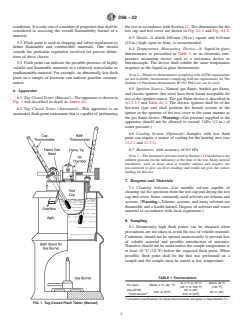
6.1 Tag Closed Tester (Manual)—The apparatus is shown in
use as the ignition source. The gas flame device is described in
Fig. 1 and described in detail in Annex A1.
A1.1.3.3 and Table A1.1. The electric ignitors shall be of the
hot-wire type and shall position the heated section of the
6.2 Tag Closed Tester (Automated)—This apparatus is an
ignitor in the aperture of the test cover in the same manner as
automated flash point instrument that is capable of performing
the gas flame device. (Warning—Gas pressure supplied to the
apparatus should not be allowed to exceed 3 kPa (12 in.) of
water pressure.)
6.6 Cooling System (Optional)—Samples with low flash
point can require a source of cooling for the heating area (see
11.2.1 and 11.3.1).
6.7 Barometer, with accuracy of 0.5 kPa
NOTE 3—The barometric pressure used in Section 12 Calculation is the
ambient pressure for the laboratory at the time of the test. Many aneroid
barometers, such as those used at weather stations and airports, are
pre-corrected to give sea level readings and would not give the correct
reading for this test.
7. Reagents and Materials
7.1 Cleaning Solvents—Use suitable solvent capable of
cleaning out the specimen from the test cup and drying the test
cup and cover. Some commonly used solvents are toluene and
acetone. (Warning—Toluene, acetone, and many solvents are
flammable and a health hazard. Dispose of solvents and waste
material in accordance with local regulations.)
8. Sampling
8.1 Erroneously high flash points can be obtained when
precautions are not taken to avoid the loss of volatile material.
Containers should not be opened unnecessarily to prevent loss
of volatile material and possible introduction of moisture.
Transfers should not be made unless the sample temperature is
at least 10 °C (18 °F) below the expected flash point. When
possible, flash point shall be the first test performed on a
sample and the sample must be stored at low temperature.
TABLE 1 Thermometers
At 4°Cto49°C Above 49 °C
For tests Below 4 °C (40 °F)
(40 °F to 120 °F) (120 °F)
Use ASTM 9C or (9F)
57C or (57F) 9C or (9F)
A
Thermometer 57C or (57F)
A
Complete specifications for these thermometers are given in Specification E1.
FIG. 1 Tag Closed Flash Tester (Manual)
D56−22
8.2 Do not store samples in gas-permeable containers since 10.2 Once the performance of the apparatus has been
volatile materials may diffuse through the walls of the enclo- verified, the flash point of secondary working standards
sure. Samples in leaky containers are suspect and not a source (SWSs) can be determined along with their control limits.
of valid results. These secondary materials can then be utilized for more
frequent performance checks (see Annex A2).
8.3 At least 50 mLof sample is required for each test. Refer
to sampling information in Practice D4057. 10.3 When the flash point obtained is not within the limits
stated in 10.1 or 10.2, check the condition and operation of the
9. Preparation of Apparatus apparatus to ensure conformity with the details listed in Annex
A1, especially with regard to tightness of the lid (see A1.1.3),
9.1 Support the apparatus on a level steady surface, such as
the action of the shutter, the position of the ignition source (see
a table.
A1.1.3.3), and the angle and position of the temperature
9.2 Tests are to be performed in a draft-free room or
measuring device (see A1.1.3.4). After any adjustment, repeat
compartment. Tests made in a laboratory hood or in any
the test in 10.1 using a fresh test specimen, with special
location where drafts occur are not reliable.
attentiontotheproceduraldetailsprescribedinthetestmethod.
NOTE 4—A shield (6.3), having an open front is recommended to
11. Procedure
prevent drafts from disturbing the vapors above the test cup.
NOTE 5—With some samples whose vapors or products of pyrolysis are
11.1 General:
objectionable, it is permissible to place the apparatus along with a draft
11.1.1 Low Temperature (LT) Test Conditions—When the
shield in a ventilation hood, the draft of which is adjustable so that vapors
can be withdrawn without causing air currents over the test cup during the expected flash point of the sample is < 60 °C (140 °F), the heat
ignition source application period.
shall be applied and adjusted during the test so that the
temperature of the test specimen rises at a rate of 1 °C
9.3 When using a liquid bath (A1.1.4), for expected flash
(2 °F)⁄min 6 6 s.When the temperature of the specimen in the
points < 13 °C (55 °F) or≥ 60 °C (140 °F), use as a bath liquid
test cup reaches 5 °C (9 °F) below its expected flash point, the
a 1 + 1 mixture of water and ethylene glycol (Warning—
ignition source shall be applied and then repeated after each
Ethylene Glycol—Poison. Harmful or fatal if swallowed.
0.5 °C (1 °F) rise in temperature of the specimen.
Vapor harmful. Avoid contact with skin.) For expected flash
11.1.2 High Temperature (HT) Test Conditions—When the
points ≥ 13 °C (55 °F) and < 60 °C (140 °F), either water or a
expected flash point of the sample is≥ 60 °C (140 °F), the heat
water-glycol mixture can be used as bath liquid. The tempera-
shall be applied and adjusted during the test so that the
ture of the liquid in the bath shall be at least 10 °C (18 °F)
temperature of the specimen rises at a rate of 3 °C (5 °F)⁄min
belowtheexpectedflashpointatthetimeofintroductionofthe
6 6 s. When the temperature of the specimen in the test cup
specimen into the test cup. Do not cool bath liquid by direct
reached 5 °C (9 °F) below its expected flash point, the ignition
contact with dry ice (solid carbon dioxide).
sourceshallbeappliedandthenrepeatedaftereach1 °C(2 °F)
NOTE 6—For flash points < 0 °C (32 °F) the formation of ice on the
rise in temperature of the specimen.
slide and ignitor dipping mechanism can be minimized by the use of a
11.1.3 When using LT test conditions, a corrected flash
high vacuum silicone lubricant.
point < 60.0 °C is considered to meet the conditions and does
9.4 Prepare the manual apparatus or the automated appara-
not require a retest. A corrected flash point ≥ 60.0 °C shall be
tus for operation in accordance with the manufacturer’s in-
retested under HT test conditions.
structions for calibrating, checking, and operating the equip-
11.1.4 When using HT test conditions, a corrected flash
ment.
point of < 60.0 °C shall be retested under LT test conditions.
9.5 Thoroughly clean and dry all parts of the test cup and
NOTE 7—In practice heating rates are not achieved immediately after
its accessories before starting the test, to ensure the removal of
application of the heat due to the thermal inertia of the apparatus.
any solvent which had been used to clean the apparatus. Use
11.1.5 (Warning—For certain mixtures containing haloge-
suitable solvent (7.1) capable of removing all of the specimen
nated hydrocarbons, such as, methylene chloride or
from the test cup and drying the test cup and cover.
trichloroethylene, no distinct flash, as defined, is observed.
Instead a significant enlargement of the test flame (not halo
10. Verification of Apparatus
effect) and change in color of the test flame from blue to
10.1 Verify the performance of apparatus at least once per
yellowish-orange occurs. Continued heating and testing of
year by determining the flash point of a certified reference
these samples above ambient temperature can result in signifi-
material (CRM), such as those listed in Annex A2, which is
cant burning of vapors outside the test cup, and can be a
reasonably close to the expected temperature range of the
potential fire hazard. See Appendix X1 and Appendix X2 for
samples to be tested. The material shall be tested according to
more information.)
the procedure of this test method and the observed flash point
11.2 Manual Apparatus:
obtained in 11.2 or 11.3 shall be corrected for barometric
pressure (see Section 12). The flash point obtained shall be 11.2.1 Fill the liquid bath (see A1.1.4) with bath liquid in
within the limits stated in TableA2.1 for the identified CRM or accordance with 9.3 or use a suitable external cooling system
within the limits calculated for an unlisted CRM (see Annex (6.6). The bath liquid shall be at an initial temperature
A2). necessary for the heating area to be at least 10 °C (18 °F)
D56−22
below the expected flash point, in accordance with the speci- 11.3.1 Adjust the external cooling system, if required, to a
men temperature requirements shown below. Using a gradu- temperature necessary to cool the heating area 10 °C below the
expected flash point.
ated cylinder and taking care to avoid wetting the cup above
11.3.2 Place the test cup in position in the instrument.
the final liquid level, measure 50 mL 6 0.5 mL of the sample
into the cup, both the sample and graduated cylinder being 11.3.3 Enter the Expected Flash Point; this will allow the
precooled,whennecessary,sothatthespecimentemperatureat heating area to be set to the required minimum starting
temperature.
the time of measurement will be 27 °C 6 5 °C (80 °F 6 9 °F)
or at least 10 °C (18 °F) below the expected flash point,
NOTE 8—To avoid an abnormal heating rate when the specimen is at a
whichever is lower. It is essential that the sample temperature
lowtemperature,itisrecommendedtoprecoolthetestcupandcover.This
be maintained at least 10 °C (18 °F) below the expected flash may be accomplished by placing the assembly into position in the
instrument while it is cooling to 10 °C (18 °F) below the programmed
point during the transfers from the sample container to the
Expected Flash Point.
cylinder and from the cylinder to the test cup. Destroy air
NOTE 9—Flash Point results determined in an “unknown Expected
bubbles on the surface of the specimens by use of knife point
Flash Point mode” should be considered approximate. This value can be
or other suitable device. Wipe the inside of the cover with a
used as the Expected Flash Point when a fresh specimen is tested in the
standard mode of operation.
clean cloth or absorbent tissue paper; then attach the cover,
with the temperature measuring device in place, to the bath
11.3.4 Using a graduated cylinder and taking care to avoid
collar.
wetting the cup above the final liquid level, measure
11.2.2 Light the test flame, when used, adjusting it to the 50 mL 6 0.5 mL of the sample into the cup, both the sample
andthegraduatedcylinderbeingprecooled,whennecessary,so
size of the small bead on the cover. Commence the heating and
that the specimen temperature at the time of the measurement
test in accordance with 11.1.1 or 11.1.2 as appropriate. When
is 27 °C 6 5 °C (80 °F 6 9 °F) or at least 10 °C (18 °F) below
the temperature of the specimen in the test cup reaches 5 °C
the expected flash point, whichever is lower. It is essential that
(9 °F) below the expected flash point, operate the mechanism
the sample temperature be maintained at least 10 °C (18 °F)
on the cover in such a manner as to introduce (dip) the ignition
below the expected flash point during the transfers from the
source into the vapor space of the cup, and immediately bring
sample container to the cylinder and from the cylinder to the
it up again.The time consumed for the full operation should be
test cup. Destroy air bubbles on the surface of the specimen by
1 s,allowingequaltimeperiodsfortheintroductionandreturn.
use of knife point or other suitable device. Wipe the inside of
Avoid any hesitation in the ope
...
This document is not an ASTM standard and is intended only to provide the user of an ASTM standard an indication of what changes have been made to the previous version. Because
it may not be technically possible to adequately depict all changes accurately, ASTM recommends that users consult prior editions as appropriate. In all cases only the current version
of the standard as published by ASTM is to be considered the official document.
Designation: D56 − 21a D56 − 22
Standard Test Method for
Flash Point by Tag Closed Cup Tester
This standard is issued under the fixed designation D56; the number immediately following the designation indicates the year of original
adoption or, in the case of revision, the year of last revision. A number in parentheses indicates the year of last reapproval. A superscript
epsilon (´) indicates an editorial change since the last revision or reapproval.
This standard has been approved for use by agencies of the U.S. Department of Defense.
INTRODUCTION
This dynamic flash point test method employs a prescribed rate of temperature rise for the material
under test. The rate of heating may not in all cases give the precision quoted in the test method because
of the low thermal conductivity of certain materials. To improve the prediction of flammability, Test
Method D3941, which utilizes a slower heating rate, was developed. Test Method D3941 provides
conditions closer to equilibrium where the vapor above the liquid and the liquid are at about the same
temperature. If a specification requires Test Method D56, do not change to Test Method D3941 or
other test method without permission from the specifier.
Flash point values are a function of the apparatus design, the condition of the apparatus used, and
the operational procedure carried out. Flash point can therefore only be defined in terms of a standard
test method, and no general valid correlation can be guaranteed between results obtained by different
test methods, or with test apparatus different from that specified.
1. Scope*
1.1 This test method covers the determination of the flash point, by Tag manual and automated closed testers, of liquids with a
2 2
viscosity below 5.5 mm /s (cSt) at 40 °C (104 °F), or below 9.5 mm /s (cSt) at 25 °C (77 °F), and a flash point below 93 °C
(200 °F).
1.1.1 Two sets of test conditions are used within this test method: low temperature (LT) test conditions for expected flash points
< 60 °C, and high temperature (HT) test conditions for expected flash points of ≥ 60 °C.
1.1.2 For the closed-cup flash point of liquids with the following properties: a viscosity of 5.5 mm /s (cSt) or more at 40 °C
(104 °F); a viscosity of 9.5 mm /s (cSt) or more at 25 °C (77 °F); a flash point of 93 °C (200 °F) or higher; a tendency to form
a surface film under test conditions; or containing suspended solids, Test Method D93 can be used.
1.1.3 For cut-back asphalts refer to Test Methods D1310 and D3143.
NOTE 1—The U.S. Department of Transportation (RSTA) and U.S. Department of Labor (OSHA) have established that liquids with a flash point under
37.8 °C (100 °F) are flammable as determined by this test method for those liquids that have a viscosity less than 5.5 mm /s (cSt) at 40 °C (104 °F) or
9.5 mm /s (cSt) or less at 25 °C (77 °F), or do not contain suspended solids or do not have a tendency to form a surface film while under test. Other flash
This test method is under the jurisdiction of ASTM Committee D02 on Petroleum Products, Liquid Fuels, and Lubricants and is the direct responsibility of Subcommittee
D02.08 on Volatility.
Current edition approved Dec. 1, 2021July 1, 2022. Published December 2021July 2022. Originally approved in 1918. Last previous edition approved in 2021 as D56 –
21.21a. DOI: 10.1520/D0056-21A.10.1520/D0056-22.
For information on United States Department of Transportation regulations, see Codes of United States Regulation 49 CFR Chapter 1 and for information on United States
Department of Labor regulations, see Code of United States Regulation 29 CFR Chapter XVII. Each of these items are revised annually and may be procured from the
Superintendent of Documents, Government Printing Office, Washington, DC 20402.
*A Summary of Changes section appears at the end of this standard
Copyright © ASTM International, 100 Barr Harbor Drive, PO Box C700, West Conshohocken, PA 19428-2959. United States
D56 − 22
point classifications have been established by these departments for liquids using this test method.
1.2 This test method can be used to measure and describe the properties of materials, products, or assemblies in response to heat
and flame under controlled laboratory conditions and cannot be used to describe or appraise the fire hazard or fire risk of materials,
products, or assemblies under actual fire conditions. However, results of this test method can be used as elements of fire risk
assessment that takes into account all of the factors that are pertinent to an assessment of the fire hazard of a particular end use.
1.3 Related standards are Test Methods D93, D1310, D3828, D3278, and D3941.
1.4 The values stated in SI units are to be regarded as standard. The values given in parentheses are for information only.
1.5 WARNING—Mercury has been designated by many regulatory agencies as a hazardous substance that can cause serious
medical issues. Mercury, or its vapor, has been demonstrated to be hazardous to health and corrosive to materials. Use Caution
when handling mercury and mercury-containing products. See the applicable product Safety Data Sheet (SDS) for additional
information. The potential exists that selling mercury or mercury-containing products, or both, is prohibited by local or national
law. Users must determine legality of sales in their location.
1.6 This standard does not purport to address all of the safety concerns, if any, associated with its use. It is the responsibility
of the user of this standard to establish appropriate safety, health, and environmental practices and determine the applicability of
regulatory limitations prior to use. For specific warning statements see 6.5, 7.1, 9.3, 11.1.4, and refer to Safety Data Sheets.
1.7 This international standard was developed in accordance with internationally recognized principles on standardization
established in the Decision on Principles for the Development of International Standards, Guides and Recommendations issued
by the World Trade Organization Technical Barriers to Trade (TBT) Committee.
2. Referenced Documents
2.1 ASTM Standards:
D93 Test Methods for Flash Point by Pensky-Martens Closed Cup Tester
D1310 Test Method for Flash Point and Fire Point of Liquids by Tag Open-Cup Apparatus
D3143 Test Method for Flash Point of Cutback Asphalt with Tag Open-Cup Apparatus
D3278 Test Methods for Flash Point of Liquids by Small Scale Closed-Cup Apparatus
D3828 Test Methods for Flash Point by Small Scale Closed Cup Tester
D3941 Test Method for Flash Point by the Equilibrium Method With a Closed-Cup Apparatus
D4057 Practice for Manual Sampling of Petroleum and Petroleum Products
D6299 Practice for Applying Statistical Quality Assurance and Control Charting Techniques to Evaluate Analytical Measure-
ment System Performance
D6300 Practice for Determination of Precision and Bias Data for Use in Test Methods for Petroleum Products, Liquid Fuels, and
Lubricants
E1 Specification for ASTM Liquid-in-Glass Thermometers
E502 Test Method for Selection and Use of ASTM Standards for the Determination of Flash Point of Chemicals by Closed Cup
Methods
2.2 Federal Test Method Standards:
Method 1101, Federal Test Method Standard No. 791b
Method 4291, Federal Test Method Standard No. 141A
2.3 ISO Standards:
ISO 17034 General requirements for the competence of reference material producers
ISO Guide 35 Reference materials—Guidance for characterization and assessment of homogeneity and stability
3. Terminology
3.1 Definitions:
3.1.1 flash point, n—in flash point test methods, the lowest temperature of the test specimen, adjusted to account for variations in
atmospheric pressure from 101.3 kPa, at which application of an ignition source causes the vapors of the test specimen to ignite
under specified conditions of test.
For referenced ASTM standards, visit the ASTM website, www.astm.org, or contact ASTM Customer Service at service@astm.org. For Annual Book of ASTM Standards
volume information, refer to the standard’s Document Summary page on the ASTM website.
Available from Superintendent of Documents, U.S. Government Printing Office, Washington, DC 20402.
Available from American National Standards Institute (ANSI), 25 W. 43rd St., 4th Floor, New York, NY 10036, http://www.ansi.org.
D56 − 22
3.1.1.1 Discussion—
The specimen is deemed to have flashed when a flame appears and instantaneously propagates itself over the entire surface of the
fluid.
3.1.1.2 Discussion—
When the ignition source is a test flame, the application of the test flame may cause a blue halo or an enlarged flame prior to the
actual flash point. This is not a flash and should be ignored.
3.2 Definitions of Terms Specific to This Standard:
3.2.1 dynamic (non-equilibrium)—in this type of flash point apparatus, the condition of the vapor above the specimen and the
specimen are not at the same temperature at the time that the ignition source is applied.
3.2.1.1 Discussion—
This is primarily caused by the heating of the specimen at the constant prescribed rate with the vapor temperature lagging behind
the specimen temperature. The resultant flash point temperature is generally within the reproducibility of the test method.
3.2.2 equilibrium—in that type of flash point apparatus or test method, the vapor above the specimen and the specimen are at the
same temperature at the time the ignition source is applied.
3.2.2.1 Discussion—
This condition may not be fully achieved in practice, since the temperature is not uniform throughout the specimen and the test
cover and shutter are generally cooler.
4. Summary of Test Method
4.1 The specimen is placed in the cup of the tester and, with the lid closed, heated at a slow constant rate. An ignition source is
directed into the cup at regular intervals. The flash point is taken as the lowest temperature at which application of the ignition
source causes the vapor above the specimen to ignite.
5. Significance and Use
5.1 Flash point measures the tendency of the specimen to form a flammable mixture with air under controlled laboratory
conditions. It is only one of a number of properties that shall be considered in assessing the overall flammability hazard of a
material.
5.2 Flash point is used in shipping and safety regulations to define flammable and combustible materials. One should consult the
particular regulation involved for precise definitions of these classes.
5.3 Flash point can indicate the possible presence of highly volatile and flammable materials in a relatively nonvolatile or
nonflammable material. For example, an abnormally low flash point on a sample of kerosene can indicate gasoline contamination.
6. Apparatus
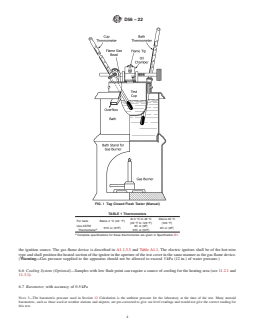
6.1 Tag Closed Tester (Manual)—The apparatus is shown in Fig. 1 and described in detail in Annex A1.
6.2 Tag Closed Tester (Automated)—This apparatus is an automated flash point instrument that is capable of performing the test
in accordance with Section 11. The dimensions for the test cup and test cover are shown in Fig. A1.1 and Fig. A1.2.
6.3 Shield—A shield 460 mm (18 in.) square and 610 mm (24 in.) high, open in front, is recommended.
6.4 Temperature Measuring Device—A liquid-in-glass thermometer, as prescribed in Table 1, or an electronic temperature
measuring device such as a resistance device or thermocouple. The device shall exhibit the same temperature response as the
liquid-in-glass thermometer.
NOTE 2—Whenever thermometers complying with ASTM requirements are not available, thermometers complying with the requirements for The Institute
of Petroleum thermometer IP 15C PM-Low can be used.
6.5 Ignition Source—Natural gas flame, bottled gas flame, and electric ignitors (hot wire) have been found acceptable for use as
D56 − 22
FIG. 1 Tag Closed Flash Tester (Manual)
TABLE 1 Thermometers
At 4 °C to 49 °C Above 49 °C
For tests Below 4 °C (40 °F)
(40 °F to 120 °F) (120 °F)
Use ASTM 9C or (9F)
57C or (57F) 9C or (9F)
A
Thermometer 57C or (57F)
A
Complete specifications for these thermometers are given in Specification E1.
the ignition source. The gas flame device is described in A1.1.3.3 and Table A1.1. The electric ignitors shall be of the hot-wire
type and shall position the heated section of the ignitor in the aperture of the test cover in the same manner as the gas flame device.
(Warning—Gas pressure supplied to the apparatus should not be allowed to exceed 3 kPa (12 in.) of water pressure.)
6.6 Cooling System (Optional)—Samples with low flash point can require a source of cooling for the heating area (see 11.2.1 and
11.3.1).
6.7 Barometer, with accuracy of 0.5 kPa
NOTE 3—The barometric pressure used in Section 12 Calculation is the ambient pressure for the laboratory at the time of the test. Many aneroid
barometers, such as those used at weather stations and airports, are pre-corrected to give sea level readings and would not give the correct reading for
this test.
D56 − 22
7. Reagents and Materials
7.1 Cleaning Solvents—Use suitable solvent capable of cleaning out the specimen from the test cup and drying the test cup and
cover. Some commonly used solvents are toluene and acetone. (Warning—Toluene, acetone, and many solvents are flammable
and a health hazard. Dispose of solvents and waste material in accordance with local regulations.)
8. Sampling
8.1 Erroneously high flash points can be obtained when precautions are not taken to avoid the loss of volatile material. Containers
should not be opened unnecessarily to prevent loss of volatile material and possible introduction of moisture. Transfers should not
be made unless the sample temperature is at least 10 °C (18 °F) below the expected flash point. When possible, flash point shall
be the first test performed on a sample and the sample must be stored at low temperature.
8.2 Do not store samples in gas-permeable containers since volatile materials may diffuse through the walls of the enclosure.
Samples in leaky containers are suspect and not a source of valid results.
8.3 At least 50 mL of sample is required for each test. Refer to sampling information in Practice D4057.
9. Preparation of Apparatus
9.1 Support the apparatus on a level steady surface, such as a table.
9.2 Tests are to be performed in a draft-free room or compartment. Tests made in a laboratory hood or in any location where drafts
occur are not reliable.
NOTE 4—A shield (6.3), having an open front is recommended to prevent drafts from disturbing the vapors above the test cup.
NOTE 5—With some samples whose vapors or products of pyrolysis are objectionable, it is permissible to place the apparatus along with a draft shield
in a ventilation hood, the draft of which is adjustable so that vapors can be withdrawn without causing air currents over the test cup during the ignition
source application period.
9.3 When using a liquid bath (A1.1.4), for expected flash points < 13 °C (55 °F) or ≥ 60 °C (140 °F), use as a bath liquid a 1 + 1
mixture of water and ethylene glycol (Warning—Ethylene Glycol—Poison. Harmful or fatal if swallowed. Vapor harmful. Avoid
contact with skin.) For expected flash points ≥ 13 °C (55 °F) and < 60 °C (140 °F), either water or a water-glycol mixture can be
used as bath liquid. The temperature of the liquid in the bath shall be at least 10 °C (18 °F) below the expected flash point at the
time of introduction of the specimen into the test cup. Do not cool bath liquid by direct contact with dry ice (solid carbon dioxide).
NOTE 6—For flash points < 0 °C (32 °F) the formation of ice on the slide and ignitor dipping mechanism can be minimized by the use of a high vacuum
silicone lubricant.
9.4 Prepare the manual apparatus or the automated apparatus for operation in accordance with the manufacturer’s instructions for
calibrating, checking, and operating the equipment.
9.5 Thoroughly clean and dry all parts of the test cup and its accessories before starting the test, to ensure the removal of any
solvent which had been used to clean the apparatus. Use suitable solvent (7.1) capable of removing all of the specimen from the
test cup and drying the test cup and cover.
10. Verification of Apparatus
10.1 Verify the performance of apparatus at least once per year by determining the flash point of a certified reference material
(CRM), such as those listed in Annex A2, which is reasonably close to the expected temperature range of the samples to be tested.
The material shall be tested according to the procedure of this test method and the observed flash point obtained in 11.2 or 11.3
shall be corrected for barometric pressure (see Section 12). The flash point obtained shall be within the limits stated in Table A2.1
for the identified CRM or within the limits calculated for an unlisted CRM (see Annex A2).
D56 − 22
10.2 Once the performance of the apparatus has been verified, the flash point of secondary working standards (SWSs) can be
determined along with their control limits. These secondary materials can then be utilized for more frequent performance checks
(see Annex A2).
10.3 When the flash point obtained is not within the limits stated in 10.1 or 10.2, check the condition and operation of the
apparatus to ensure conformity with the details listed in Annex A1, especially with regard to tightness of the lid (see A1.1.3), the
action of the shutter, the position of the ignition source (see A1.1.3.3), and the angle and position of the temperature measuring
device (see A1.1.3.4). After any adjustment, repeat the test in 10.1 using a fresh test specimen, with special attention to the
procedural details prescribed in the test method.
11. Procedure
11.1 General:
11.1.1 Low Temperature (LT) Test Conditions—When the expected flash point of the sample is < 60 °C (140 °F), the heat shall be
applied and adjusted during the test so that the temperature of the test specimen rises at a rate of 1 °C (2 °F) ⁄min 6 6 s. When
the temperature of the specimen in the test cup reaches 5 °C (9 °F) below its expected flash point, the ignition source shall be
applied and then repeated after each 0.5 °C (1 °F) rise in temperature of the specimen.
11.1.2 High Temperature (HT) Test Conditions—When the expected flash point of the sample is ≥ 60 °C (140 °F), the heat shall
be applied and adjusted during the test so that the temperature of the specimen rises at a rate of 3 °C (5 °F) ⁄min 6 6 s. When the
temperature of the specimen in the test cup reached 5 °C (9 °F) below its expected flash point, the ignition source shall be applied
and then repeated after each 1 °C (2 °F) rise in temperature of the specimen.
11.1.3 When using LT test conditions, a corrected flash point < 60.0 °C is considered to meet the conditions and does not require
a retest. A corrected flash point ≥ 60.0 °C shall be retested under HT test conditions.
11.1.4 When using HT test conditions, a corrected flash point of < 60.0 °C shall be retested under LT test conditions.
NOTE 7—In practice heating rates are not achieved immediately after application of the heat due to the thermal inertia of the apparatus.
11.1.5 (Warning—For certain mixtures containing halogenated hydrocarbons, such as, methylene chloride or trichloroethylene,
no distinct flash, as defined, is observed. Instead a significant enlargement of the test flame (not halo effect) and change in color
of the test flame from blue to yellowish-orange occurs. Continued heating and testing of these samples above ambient temperature
can result in significant burning of vapors outside the test cup, and can be a potential fire hazard. See Appendix X1 and Appendix
X2 for more information.)
11.2 Manual Apparatus:
11.2.1 Fill the liquid bath (see A1.1.4) with bath liquid in accordance with 9.3 or use a suitable external cooling system (6.6). The
bath liquid shall be at an initial temperature necessary for the heating area to be at least 10 °C (18 °F) below the expected flash
point, in accordance with the specimen temperature requirements shown below. Using a graduated cylinder and taking care to
avoid wetting the cup above the final liquid level, measure 50 mL 6 0.5 mL 50 mL 6 0.5 mL of the sample into the cup, both the
sample and graduated cylinder being precooled, when necessary, so that the specimen temperature at the time of measurement will
be 27 °C 6 5 °C (80 °F 6 9 °F) or at least 10 °C (18 °F) below the expected flash point, whichever is lower. It is essential that
the sample temperature be maintained at least 10 °C (18 °F) below the expected flash point during the transfers from the sample
container to the cylinder and from the cylinder to the test cup. Destroy air bubbles on the surface of the specimens by use of knife
point or other suitable device. Wipe the inside of the cover with a clean cloth or absorbent tissue paper; then attach the cover, with
the temperature measuring device in place, to the bath collar.
11.2.2 Light the test flame, when used, adjusting it to the size of the small bead on the cover. Commence the heating and test in
accordance with 11.1.1 or 11.1.2 as appropriate. When the temperature of the specimen in the test cup reaches 5 °C (9 °F) below
the expected flash point, operate the mechanism on the cover in such a manner as to introduce (dip) the ignition source into the
vapor space of the cup, and immediately bring it up again. The time consumed for the full operation should be 1 s, allowing equal
time periods for the introduction and return. Avoid any hesitation in the operation of depressing and raising the ignition source.
D56 − 22
If a flash is observed on the initial operation of the dipping mechanism, discontinue the test and discard the result. In this case,
repeat the test from 11.2.1 using a fresh specimen using an expected flash point 10 °C (18 °F) below the previous expected flash
point value.
11.2.2.1 Exercise care when using a test flame, if the flame is extinguished it cannot ignite the specimen and the gas entering the
vapor space can influence the result. When the flame is prematurely extinguished the test shall be discontinued and any result
discarded.
11.2.3 When the application of the ignition source causes a distinct flash in the interior of the cup, as defined in 3.1.1, observe
and record the temperature of the specimen as the observed flash point. Do not confuse the true flash with the bluish halo that
sometimes surrounds the ignition source during applications immediately preceding the actual flash.
11.2.4 Discontinue the test and remove the source of heat. Lift the lid and wipe the temperature measuring device bulb. Remove
the test cup, empty, and wipe dry.
11.2.5 If, at any time between the first introduction of the ignition source and the observation of the flash point, the rise in
temperature of the specimen is not within the specified rate, discontinue the test, discard the result and repeat the test, adjusting
the source of heat to secure the proper rate of temperature rise, or using a modified “expected flash point,” or both, as required.
11.2.6 Never make a repe
...
Questions, Comments and Discussion
Ask us and Technical Secretary will try to provide an answer. You can facilitate discussion about the standard in here.
Loading comments...