

ASTM E1461-13(2022)
(Test Method)Standard Test Method for Thermal Diffusivity by the Flash Method
General Information
- Abstract
SIGNIFICANCE AND USE
5.1 Thermal diffusivity is an important transient thermal property, required for such purposes such as design applications, determination of safe operating temperature, process control, and quality assurance.
5.2 The flash method is used to measure values of thermal diffusivity, α, of a wide range of solid materials. It is particularly advantageous because of simple specimen geometry, small specimen size requirements, rapidity of measurement and ease of handling.
5.3 Under certain strict conditions, specific heat capacity of a homogeneous isotropic opaque solid specimen can be determined when the method is used in a quantitative fashion (see Appendix X2).
5.4 Thermal diffusivity results, together with related values of specific heat capacity (Cp) and density (ρ) values, can be used in many cases to derive thermal conductivity (λ), according to the relationship:
SCOPE
1.1 This test method covers the determination of the thermal diffusivity of primarily homogeneous isotropic solid materials. Thermal diffusivity values ranging from 0.1 to 1000 (mm)2 s-1 are measurable by this test method from about 75 to 2800 K.
1.2 Practice E2585 is adjunct to this test method and contains detailed information regarding the use of the flash method. The two documents are complementing each other.
1.3 This test method is a more detailed form of Test Method C714, having applicability to much wider ranges of materials, applications, and temperatures, with improved accuracy of measurements.
1.4 This test method is intended to allow a wide variety of apparatus designs. It is not practical in a test method of this type to establish details of construction and procedures to cover all contingencies that might offer difficulties to a person without pertinent technical knowledge, or to restrict research and development for improvements in the basic technique.
1.5 This test method is applicable to the measurements performed on essentially fully dense (preferably, but low porosity would be acceptable), homogeneous, and isotropic solid materials that are opaque to the applied energy pulse. Experience shows that some deviation from these strict guidelines can be accommodated with care and proper experimental design, substantially broadening the usefulness of the method.
1.6 The values stated in SI units are to be regarded as standard. No other units of measurement are included in this standard.
1.7 For systems employing lasers as power sources, it is imperative that the safety requirement be fully met.
1.8 This standard does not purport to address all of the safety concerns, if any, associated with its use. It is the responsibility of the user of this standard to establish appropriate safety, health, and environmental practices and determine the applicability of regulatory limitations prior to use.
1.9 This international standard was developed in accordance with internationally recognized principles on standardization established in the Decision on Principles for the Development of International Standards, Guides and Recommendations issued by the World Trade Organization Technical Barriers to Trade (TBT) Committee.
- Status
- Published
- Publication Date
- 31-Mar-2022
- Technical Committee
- E37 - Thermal Measurements
- Drafting Committee
- E37.05 - Thermophysical Properties
Overview
ASTM E1461-13(2022), titled Standard Test Method for Thermal Diffusivity by the Flash Method, is an internationally recognized testing procedure used to determine the thermal diffusivity of primarily homogeneous and isotropic solid materials. Developed by ASTM International, this standard is widely used for materials testing in applications where understanding transient thermal properties is critical, including design, process control, quality assurance, and determining safe operating temperatures.
The flash method, as described in this standard, offers a reliable, rapid, and effective approach for measuring thermal diffusivity over a wide temperature range (approximately 75 to 2800 K) and for a broad spectrum of solid materials.
Key Topics
- Thermal Diffusivity Measurement: The standard defines procedures for accurately measuring thermal diffusivity (α), a key transient thermal property, using the flash method.
- Specimen Requirements: Measurement is intended for specimens that are essentially fully dense, homogeneous, isotropic, and opaque to the applied energy pulse.
- Flash Method Advantages:
- Simplified specimen geometry
- Minimal material requirements
- Rapid measurement capabilities
- Adaptability to various apparatus designs
- Accuracy and Correction Factors: The method details considerations for systematic errors-such as specimen condition, temperature measurement, and pulse duration-and provides guidance on minimizing uncertainties.
- Supporting Calculations: When combined with specific heat capacity (Cp) and density (ρ) measurements, thermal diffusivity data can be used to calculate thermal conductivity (λ), a crucial property in material selection and heat transfer analysis.
- Safety Considerations: Special safety protocols are outlined for systems using lasers as energy sources, with instructions for mitigating health and environmental hazards.
Applications
ASTM E1461-13(2022) is applicable across a wide range of industrial, engineering, and research fields where control of thermal properties is vital. Common applications include:
- Material Development: Assessing thermal performance of metals, ceramics, composites, and other advanced materials.
- Quality Assurance: Ensuring materials meet thermal design specifications for application in high-performance components.
- Process Control: Monitoring consistency of thermal properties in manufacturing processes.
- Thermal Design: Providing essential data for engineers to determine optimal operating temperatures, cooling rates, or insulation requirements.
- Research and Development: Facilitating comparative studies of new materials by providing standardized, repeatable thermal diffusivity measurements.
- Derivation of Thermal Conductivity: Enabling calculation of thermal conductivity when combined with measurements of specific heat capacity and density, supporting comprehensive thermal characterization.
Related Standards
- ASTM E2585: Practice for Thermal Diffusivity by the Flash Method - Contains detailed guidance and complements E1461.
- ASTM E228: Standard Test Method for Linear Thermal Expansion - Often referenced for determining specimen dimensions with temperature.
- ASTM C714: Test Method for Thermal Diffusivity of Carbon and Graphite by Thermal Pulse Method - Focuses on specific materials using similar principles.
- ISO and Other International Standards: E1461 aligns with global standardization principles set by the World Trade Organization Technical Barriers to Trade (TBT) Committee, ensuring international acceptance and comparability.
Practical Value
Adhering to ASTM E1461-13(2022) ensures precise, repeatable, and internationally accepted measurements of thermal diffusivity for solid materials. The flash method’s speed and versatility make it ideal for high-throughput testing environments and research settings alike. By providing a standardized approach, this test method supports material innovation, enhances product reliability, and underpins critical engineering decisions across multiple industries.
Keywords: thermal diffusivity, flash method, ASTM E1461, heat transfer, material testing, thermal conductivity, quality assurance, process control, thermal properties, international standards.
Relations
- Refers
ASTM C714-23 - Standard Guide for Thermal Diffusivity of Carbon and Graphite by Thermal Pulse Method - Effective Date
- 01-Oct-2023
- Effective Date
- 01-May-2017
- Effective Date
- 01-Sep-2016
- Effective Date
- 01-Oct-2015
- Effective Date
- 01-May-2010
- Effective Date
- 15-Mar-2009
- Effective Date
- 01-Sep-2006
- Effective Date
- 01-Nov-2005
- Effective Date
- 01-Nov-2005
- Effective Date
- 10-Apr-2000
- Effective Date
- 01-Jan-1995
Get Certified
Connect with accredited certification bodies for this standard

BSMI (Bureau of Standards, Metrology and Inspection)
Taiwan's standards and inspection authority.
Sponsored listings
Frequently Asked Questions
ASTM E1461-13(2022) is a standard published by ASTM International. Its full title is "Standard Test Method for Thermal Diffusivity by the Flash Method". This standard covers: SIGNIFICANCE AND USE 5.1 Thermal diffusivity is an important transient thermal property, required for such purposes such as design applications, determination of safe operating temperature, process control, and quality assurance. 5.2 The flash method is used to measure values of thermal diffusivity, α, of a wide range of solid materials. It is particularly advantageous because of simple specimen geometry, small specimen size requirements, rapidity of measurement and ease of handling. 5.3 Under certain strict conditions, specific heat capacity of a homogeneous isotropic opaque solid specimen can be determined when the method is used in a quantitative fashion (see Appendix X2). 5.4 Thermal diffusivity results, together with related values of specific heat capacity (Cp) and density (ρ) values, can be used in many cases to derive thermal conductivity (λ), according to the relationship: SCOPE 1.1 This test method covers the determination of the thermal diffusivity of primarily homogeneous isotropic solid materials. Thermal diffusivity values ranging from 0.1 to 1000 (mm)2 s-1 are measurable by this test method from about 75 to 2800 K. 1.2 Practice E2585 is adjunct to this test method and contains detailed information regarding the use of the flash method. The two documents are complementing each other. 1.3 This test method is a more detailed form of Test Method C714, having applicability to much wider ranges of materials, applications, and temperatures, with improved accuracy of measurements. 1.4 This test method is intended to allow a wide variety of apparatus designs. It is not practical in a test method of this type to establish details of construction and procedures to cover all contingencies that might offer difficulties to a person without pertinent technical knowledge, or to restrict research and development for improvements in the basic technique. 1.5 This test method is applicable to the measurements performed on essentially fully dense (preferably, but low porosity would be acceptable), homogeneous, and isotropic solid materials that are opaque to the applied energy pulse. Experience shows that some deviation from these strict guidelines can be accommodated with care and proper experimental design, substantially broadening the usefulness of the method. 1.6 The values stated in SI units are to be regarded as standard. No other units of measurement are included in this standard. 1.7 For systems employing lasers as power sources, it is imperative that the safety requirement be fully met. 1.8 This standard does not purport to address all of the safety concerns, if any, associated with its use. It is the responsibility of the user of this standard to establish appropriate safety, health, and environmental practices and determine the applicability of regulatory limitations prior to use. 1.9 This international standard was developed in accordance with internationally recognized principles on standardization established in the Decision on Principles for the Development of International Standards, Guides and Recommendations issued by the World Trade Organization Technical Barriers to Trade (TBT) Committee.
SIGNIFICANCE AND USE 5.1 Thermal diffusivity is an important transient thermal property, required for such purposes such as design applications, determination of safe operating temperature, process control, and quality assurance. 5.2 The flash method is used to measure values of thermal diffusivity, α, of a wide range of solid materials. It is particularly advantageous because of simple specimen geometry, small specimen size requirements, rapidity of measurement and ease of handling. 5.3 Under certain strict conditions, specific heat capacity of a homogeneous isotropic opaque solid specimen can be determined when the method is used in a quantitative fashion (see Appendix X2). 5.4 Thermal diffusivity results, together with related values of specific heat capacity (Cp) and density (ρ) values, can be used in many cases to derive thermal conductivity (λ), according to the relationship: SCOPE 1.1 This test method covers the determination of the thermal diffusivity of primarily homogeneous isotropic solid materials. Thermal diffusivity values ranging from 0.1 to 1000 (mm)2 s-1 are measurable by this test method from about 75 to 2800 K. 1.2 Practice E2585 is adjunct to this test method and contains detailed information regarding the use of the flash method. The two documents are complementing each other. 1.3 This test method is a more detailed form of Test Method C714, having applicability to much wider ranges of materials, applications, and temperatures, with improved accuracy of measurements. 1.4 This test method is intended to allow a wide variety of apparatus designs. It is not practical in a test method of this type to establish details of construction and procedures to cover all contingencies that might offer difficulties to a person without pertinent technical knowledge, or to restrict research and development for improvements in the basic technique. 1.5 This test method is applicable to the measurements performed on essentially fully dense (preferably, but low porosity would be acceptable), homogeneous, and isotropic solid materials that are opaque to the applied energy pulse. Experience shows that some deviation from these strict guidelines can be accommodated with care and proper experimental design, substantially broadening the usefulness of the method. 1.6 The values stated in SI units are to be regarded as standard. No other units of measurement are included in this standard. 1.7 For systems employing lasers as power sources, it is imperative that the safety requirement be fully met. 1.8 This standard does not purport to address all of the safety concerns, if any, associated with its use. It is the responsibility of the user of this standard to establish appropriate safety, health, and environmental practices and determine the applicability of regulatory limitations prior to use. 1.9 This international standard was developed in accordance with internationally recognized principles on standardization established in the Decision on Principles for the Development of International Standards, Guides and Recommendations issued by the World Trade Organization Technical Barriers to Trade (TBT) Committee.
ASTM E1461-13(2022) is classified under the following ICS (International Classification for Standards) categories: 17.200.10 - Heat. Calorimetry. The ICS classification helps identify the subject area and facilitates finding related standards.
ASTM E1461-13(2022) has the following relationships with other standards: It is inter standard links to ASTM C714-23, ASTM C714-17, ASTM E228-11(2016), ASTM C714-05(2015), ASTM C714-05(2010), ASTM E2585-09, ASTM E228-06, ASTM C714-05e1, ASTM C714-05, ASTM C714-85(2000), ASTM E228-95. Understanding these relationships helps ensure you are using the most current and applicable version of the standard.
ASTM E1461-13(2022) is available in PDF format for immediate download after purchase. The document can be added to your cart and obtained through the secure checkout process. Digital delivery ensures instant access to the complete standard document.
Standards Content (Sample)
This international standard was developed in accordance with internationally recognized principles on standardization established in the Decision on Principles for the
Development of International Standards, Guides and Recommendations issued by the World Trade Organization Technical Barriers to Trade (TBT) Committee.
Designation: E1461 − 13 (Reapproved 2022)
Standard Test Method for
Thermal Diffusivity by the Flash Method
This standard is issued under the fixed designation E1461; the number immediately following the designation indicates the year of
original adoption or, in the case of revision, the year of last revision. A number in parentheses indicates the year of last reapproval. A
superscript epsilon (´) indicates an editorial change since the last revision or reapproval.
1. Scope 1.9 This international standard was developed in accor-
dance with internationally recognized principles on standard-
1.1 Thistestmethodcoversthedeterminationofthethermal
ization established in the Decision on Principles for the
diffusivity of primarily homogeneous isotropic solid materials.
2 -1 Development of International Standards, Guides and Recom-
Thermal diffusivity values ranging from 0.1 to 1000 (mm) s
mendations issued by the World Trade Organization Technical
are measurable by this test method from about 75 to 2800 K.
Barriers to Trade (TBT) Committee.
1.2 Practice E2585 is adjunct to this test method and
contains detailed information regarding the use of the flash 2. Referenced Documents
method. The two documents are complementing each other. 2
2.1 ASTM Standards:
1.3 This test method is a more detailed form ofTest Method C714 Test Method for Thermal Diffusivity of Carbon and
C714, having applicability to much wider ranges of materials, Graphite by Thermal Pulse Method
applications, and temperatures, with improved accuracy of E228 Test Method for Linear Thermal Expansion of Solid
measurements. Materials With a Push-Rod Dilatometer
E2585 Practice for Thermal Diffusivity by the Flash Method
1.4 This test method is intended to allow a wide variety of
apparatus designs. It is not practical in a test method of this
3. Terminology
typetoestablishdetailsofconstructionandprocedurestocover
3.1 Definitions of Terms Specific to This Standard:
all contingencies that might offer difficulties to a person
3.1.1 thermal conductivity, λ, of a solid material—the time
without pertinent technical knowledge, or to restrict research
rate of steady heat flow through unit thickness of an infinite
and development for improvements in the basic technique.
slab of a homogeneous material in a direction perpendicular to
1.5 This test method is applicable to the measurements
the surface, induced by unit temperature difference. The
performed on essentially fully dense (preferably, but low
property must be identified with a specific mean temperature,
porosity would be acceptable), homogeneous, and isotropic
since it varies with temperature.
solid materials that are opaque to the applied energy pulse.
3.1.2 thermal diffusivity, α, of a solid material—the property
Experience shows that some deviation from these strict guide-
givenbythethermalconductivitydividedbytheproductofthe
lines can be accommodated with care and proper experimental
density and heat capacity per unit mass.
design, substantially broadening the usefulness of the method.
3.2 Description of Symbols and Units Specific to This
1.6 The values stated in SI units are to be regarded as
Standard:
standard. No other units of measurement are included in this
3.2.1 D—diameter, m.
standard.
-1 -1
3.2.2 C —specific heat capacity, J·g ·K .
p
1.7 For systems employing lasers as power sources, it is
3.2.3 k—constant depending on percent rise.
imperative that the safety requirement be fully met.
3.2.4 K—correction factors.
1.8 This standard does not purport to address all of the
safety concerns, if any, associated with its use. It is the
3.2.5 K,K —constants depending on β.
1 2
responsibility of the user of this standard to establish appro-
3.2.6 L—specimen thickness, mm.
priate safety, health, and environmental practices and deter-
3.2.7 t—response time, s.
mine the applicability of regulatory limitations prior to use.
3.2.8 t —half-rise time or time required for the rear face
1/2
temperature rise to reach one half of its maximum value, s.
ThistestmethodisunderthejurisdictionofASTMCommitteeE37onThermal
Measurements and is the direct responsibility of Subcommittee E37.05 on Thermo-
physical Properties. For referenced ASTM standards, visit the ASTM website, www.astm.org, or
Current edition approved April 1, 2022. Published April 2022. Originally contact ASTM Customer Service at service@astm.org. For Annual Book of ASTM
approved in 1992. Last previous edition approved in 2013 as E1461 – 13. DOI: Standards volume information, refer to the standard’s Document Summary page on
10.1520/E1461-13R22. the ASTM website.
Copyright © ASTM International, 100 Barr Harbor Drive, PO Box C700, West Conshohocken, PA 19428-2959. United States
E1461 − 13 (2022)
3.2.9 t*—dimensionless time (t*=4α t/D ).
s T
3.2.10 T—temperature, K.
3.2.11 α—thermal diffusivity, (mm) /s.
3.2.12 β—fraction of pulse duration required to reach maxi-
mum intensity.
3.2.13 ρ—density, g/(cm) .
-1 -1
3.2.14 λ—thermal conductivity, W·m ·K .
1 1
3.2.15 ∆t —T(5t ⁄2)/T(t ⁄2 ).
FIG. 2 Schematic of the Flash Method
1 1
3.2.16 ∆t —T(10t ⁄2)/T(t ⁄2 ).
3.2.17 ∆T —temperature difference between baseline and
max
maximum rise, K.
3.2.18 τ—pulse duration (see Fig. 1).
3.3 Description of Subscripts Specific to This Standard:
3.3.1 x—percent rise.
3.3.2 R—ratio.
3.3.3 max—maximum.
3.3.4 p—constant pressure.
4. Summary of Test Method
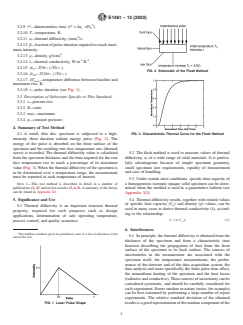
4.1 A small, thin disc specimen is subjected to a high- FIG. 3 Characteristic Thermal Curve for the Flash Method
intensity short duration radiant energy pulse (Fig. 2). The
energy of the pulse is absorbed on the front surface of the
specimen and the resulting rear face temperature rise (thermal
curve) is recorded. The thermal diffusivity value is calculated 5.2 The flash method is used to measure values of thermal
diffusivity, α, of a wide range of solid materials. It is particu-
from the specimen thickness and the time required for the rear
face temperature rise to reach a percentage of its maximum larly advantageous because of simple specimen geometry,
value (Fig. 3). When the thermal diffusivity of the specimen is small specimen size requirements, rapidity of measurement
to be determined over a temperature range, the measurement and ease of handling.
must be repeated at each temperature of interest.
5.3 Under certain strict conditions, specific heat capacity of
a homogeneous isotropic opaque solid specimen can be deter-
NOTE 1—This test method is described in detail in a number of
publications (1, 2) and review articles (3, 4, 5).Asummary of the theory
mined when the method is used in a quantitative fashion (see
can be found in Appendix X1.
Appendix X2).
5.4 Thermal diffusivity results, together with related values
5. Significance and Use
of specific heat capacity (C ) and density (ρ) values, can be
p
5.1 Thermal diffusivity is an important transient thermal
used in many cases to derive thermal conductivity (λ), accord-
property, required for such purposes such as design
ing to the relationship:
applications, determination of safe operating temperature,
λ 5 α C ρ (1)
process control, and quality assurance.
p
6. Interferences
The boldface numbers given in parentheses refer to a list of references at the
6.1 In principle, the thermal diffusivity is obtained from the
end of the text.
thickness of the specimen and from a characteristic time
function describing the propagation of heat from the front
surface of the specimen to its back surface. The sources of
uncertainties in the measurement are associated with the
specimen itself, the temperature measurements, the perfor-
mance of the detector and of the data acquisition system, the
data analysis and more specifically the finite pulse time effect,
the nonuniform heating of the specimen and the heat losses
(radiativeandconductive).Thesesourcesofuncertaintycanbe
considered systematic, and should be carefully considered for
each experiment. Errors random in nature (noise, for example)
can be best estimated by performing a large number of repeat
experiments. The relative standard deviation of the obtained
FIG. 1 Laser Pulse Shape resultsisagoodrepresentationoftherandomcomponentofthe
E1461 − 13 (2022)
uncertainty associated with the measurement. Guidelines in 7.5.1 The data acquisition system must be of an adequate
performing a rigorous evaluation of these factors are given in speed to ensure that resolution in determining half-rise time on
(6). the thermal curve is no more than 1 % of the half-rise time, for
the fastest thermal curve for which the system is qualified.
7. Apparatus
7.6 Measurement of specimen’s temperature is performed
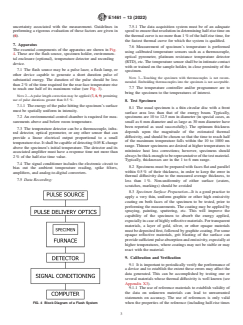
The essential components of the apparatus are shown in Fig.
using calibrated temperature sensors such as a thermocouple,
4. These are the flash source, specimen holder, environmen-
optical pyrometer, platinum resistance temperature detector
tal enclosure (optional), temperature detector and recording
(RTD), etc.The temperature sensor shall be in intimate contact
device.
with or trained on the sample holder, in close proximity of the
7.1 The flash source may be a pulse laser, a flash lamp, or
specimen.
other device capable to generate a short duration pulse of
NOTE 3—Touching the specimen with thermocouples is not recom-
substantial energy. The duration of the pulse should be less
mended. Embedding thermocouples into the specimen is not acceptable.
than 2 % of the time required for the rear face temperature rise
7.7 The temperature controller and/or programmer are to
to reach one half of its maximum value (see Fig. 3).
bring the specimen to the temperatures of interest.
NOTE 2—Apulse length correction may be applied (7, 8, 9) permitting
use of pulse durations greater than 0.5 %.
8. Test Specimen
7.1.1 The energy of the pulse hitting the specimen’s surface
8.1 The usual specimen is a thin circular disc with a front
must be spatially uniform in intensity.
surface area less than that of the energy beam. Typically,
7.2 An environmental control chamber is required for mea- specimens are 10 to 12.5 mm in diameter (in special cases, as
surements above and below room temperature. small as 6 mm diameter and as large as 30 mm diameter have
been reported as used successfully). The optimum thickness
7.3 The temperature detector can be a thermocouple, infra-
depends upon the magnitude of the estimated thermal
red detector, optical pyrometer, or any other sensor that can
diffusivity, and should be chosen so that the time to reach half
provide a linear electrical output proportional to a small
of the maximum temperature falls within the 10 to 1000 ms
temperature rise. It shall be capable of detecting 0.05 K change
range. Thinner specimens are desired at higher temperatures to
above the specimen’s initial temperature. The detector and its
minimize heat loss corrections; however, specimens should
associated amplifier must have a response time not more than
alwaysbethickenoughtoberepresentativeofthetestmaterial.
2 % of the half-rise time value.
Typically, thicknesses are in the 1 to 6 mm range.
7.4 The signal conditioner includes the electronic circuit to
8.2 Specimens must be prepared with faces flat and parallel
bias out the ambient temperature reading, spike filters,
within 0.5 % of their thickness, in order to keep the error in
amplifiers, and analog-to-digital converters.
thermal diffusivity due to the measured average thickness, to
7.5 Data Recording:
less than 1 %. Non-uniformity of either surface (craters,
scratches, markings) should be avoided
8.3 Specimen Surface Preparation—It is a good practice to
apply a very thin, uniform graphite or other high emissivity
coating on both faces of the specimen to be tested, prior to
performing the measurements. The coating may be applied by
spraying, painting, sputtering, etc. This will improve the
capability of the specimen to absorb the energy applied,
especiallyincaseofhighlyreflectivematerials.Fortransparent
materials, a layer of gold, silver, or other opaque materials
mustbedepositedfirst,followedbygraphitecoating.Forsome
opaque reflective materials, grit blasting of the surface can
provide sufficient pulse absorption and emissivity, especially at
higher temperatures, where coatings may not be stable or may
react with the material.
9. Calibration and Verification
9.1 It is important to periodically verify the performance of
a device and to establish the extent these errors may affect the
data generated. This can be accomplished by testing one or
several materials whose thermal diffusivity is well known (see
Appendix X3).
9.1.1 The use of reference materials to establish validity of
the data on unknown materials can lead to unwarranted
statements on accuracy. The use of references is only valid
FIG. 4 Block Diagram of a Flash System when the properties of the reference (including half-rise times
E1461 − 13 (2022)
and thermal diffusivity values) are similar to those of the α 5 0.13879L /t (2)
½
unknown and the temperature-rise curves are determined in an
Check the validity of the experiment by calculating α at a
identical manner for the reference and unknown.
minimum of two other points on the rise curve.The equation is
9.1.2 An important check of the validity of data (in addition
as follows:
to the comparison of the rise curve with the theoretical model),
α 5 k L /t (3)
x x
when corrections have been applied, is to vary the specimen
thickness. Since the half times vary as L , decreasing the
where:
specimen thickness by one-half should decrease the half time
t = the time required for the temperature rise to reach x
x
toone-fourthofitsoriginalvalue.Thus,ifoneobtainsthesame
percent of ∆T . Values of k are given in Table 1.
max x
thermal diffusivity value (appropriate heat loss corrections
11.1.1 Ideally, the calculated values of α for different values
being applied) with representative specimens from the same
of x should all be the same. If the values at 25, 50 and 75 %
materialofsignificantlydifferentthicknesses,theresultscanbe
∆T liewithin 62 %,theoverallaccuracyisprobablywithin
max
assumed valid.
65 % at the half-rise time. If the α values lie outside of this
range, the response curve should be analyzed further to see if
10. Procedure
thermal radiation heat loss, finite-pulse time or non-uniform
10.1 For commercially produced systems, follow manufac-
heating effects are present.
turer’s instructions.
11.1.2 Thermal radiation heat loss effects are most readily
10.2 The testing procedure must contain the following determined from the temperature of the specimen and the
rear-face temperature response after 4t by plotting the
functions:
1/2
10.2.1 Determine and record the specimen thickness. experimental values of ∆T/∆T versus t/t along with the
max 1/2
values for the theoretical model. Some numbers for the
10.2.2 Mount the specimen in its holder.
10.2.3 Establish vacuum or inert gas environment in the theoretical model are given in Table 2.
11.1.3 Prepare a display of the normalized experimental
chamber if necessary.
10.2.4 Determine specimen temperature unless the system data and the theoretical model using the tabulated values of
∆T/∆T and t/t and the corresponding experimental data at
will do it automatically.
max 1/2
several percent levels of the rise. All normalized experimental
10.2.5 Especially at low temperatures, use the lowest level
curves must pass through ∆T/∆T = 0.5 and t/t = 1.0.
of power for the energy pulse able to generate a measurable
max 1/2
Calculations including the 25 to 35 % and 65 to 80 % ranges
temperature rise, in order to ensure that the detector functions
are required to compare the experimental data with the
within its linear range.
theoretical curve.
10.2.6 After the pulse delivery, monitor the raw or pro-
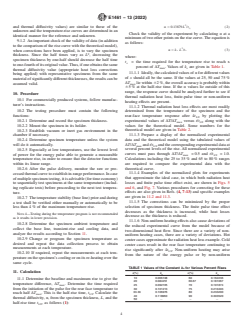
11.1.4 Examples of the normalized plots for experiments
cessedthermalcurvetoestablishin-rangeperformance.Incase
that approximate the ideal case, in which both radiation heat
ofmultiplespecimentesting,itisadvisable(fortimeeconomy)
losses and finite pulse time effect exist, are shown in Figs. 5
to sequentially test specimens at the same temperature (includ-
and 6, and Fig. 7. Various procedures for correcting for these
ing replicate tests) before proceeding to the next test tempera-
effects are also given in Refs. (4, 7-13) and specific examples
ture.
are given in 11.2 and 11.3.
10.2.7 The temperature stability (base line) prior and during
11.1.5 The corrections can be minimized by the proper
a test shall be verified either manually or automatically to be
selection of specimen thickness. The finite pulse time effect
less than 4 % of the maximum temperature rise.
decreases as the thickness is increased, while heat losses
NOTE 4—Testing during the temperature program is not recommended
decrease as the thickness is reduced.
as it results in lower precision.
11.1.6 Non-uniform heating effects also cause deviations of
10.2.8 Determine the specimen ambient temperature and
the reduced experimental curve from the model because of
collect the base line, transient-rise and cooling data, and
two-dimensional heat flow. Since there are a variety of non-
analyze the results according to Section 11.
uniform heating cases, there are a variety of deviations. Hot
10.2.9 Change or program the specimen temperature as
center cases approximate the radiation heat loss example. Cold
desired and repeat the data collection process to obtain
center cases result in the rear face temperature continuing to
measurements at each temperature.
rise significantly after 4t . Non-uniform heating may arise
1/2
10.2.10 If required, repeat the measurements at each tem-
from the nature of the energy pulse or by non-uniform
peratureonthespecimen’scoolingoronitsre-heatingoverthe
same cycle.
TABLE 1 Values of the Constant k for Various Percent Rises
x
11. Calculation
x(%) k x(%) k
x x
10 0.066108 60 0.162236
11.1 Determine the baseline and maximum rise to give the
20 0.084251 66.67 0.181067
temperature difference, ∆T . Determine the time required
max
25 0.092725 70 0.191874
from the initiation of the pulse for the rear face temperature to 30 0.101213 75 0.210493
33.33 0.106976 80 0.233200
reach half ∆T . This is the half-rise time, t . Calculate the
max 1/2
40 0.118960 90 0.303520
thermal diffusivity, α, from the specimen thickness, L, and the
50 . . .
half-rise time t , as follows (1):
1/2
E1461 − 13 (2022)
TABLE 2 Values of Normalized Temperature Versus Time for
Theoretical Model
1 1
∆ T/∆T t/t ⁄2 ∆ T/∆T t/t ⁄2
max max
0 0 0.7555 1.5331
0.0117 0.2920 0.7787 1.6061
0.1248 0.5110 0.7997 1.6791
0.1814 0.5840 0.8187 1.7521
0.2409 0.6570 0.8359 1.8251
0.3006 0.7300 0.8515 1.8981
0.3587 0.8030 0.8656 1.9711
0.4140 0.8760 0.8900 2.1171
0.4660 0.9490 0.9099 2.2631
0.5000 1.0000 0.9262 2.4091
0.5587 1.0951 0.9454 2.6281
0.5995 1.1681 0.9669 2.9931
0.6369 1.2411 0.9865 3.6502
0.6709 1.3141 0.9950 4.3802
0.7019 1.3871 0.9982 5.1102
0.7300 1.4601 . . FIG. 7 Normalized Rear Face Temperature Rise: Comparison of
Mathematical Model (No Heat Loss) to Experimental Values with
Radiation Heat Losses
For this to be valid, the evolution of the pulse intensity must
be representable by a triangle of duration τ and time to
maximum intensity of βτ as shown in Fig. 1. The pulse shape
forthelasermaybedeterminedusinganopticaldetector.From
the pulse shape so determined, β and τ are obtained. Values of
the two constants K and K for various values of β are given
1 2
in Table 3 for correcting α .
x
11.3 Heat loss corrections can be performed using proce-
dures proposed in a (12, 13), for example. Both of these
corrections are affected by non-uniform heating effects. Cor-
rections given in (12) by Cowan are affected by conduction
heatlossestotheholdersinadditiontotheradiationheatlosses
FIG. 5 Comparison of Non-dimensionalized Temperature Re-
from the specimen surfaces. Thus, the errors in the correction
sponse Curve to Mathematical Model
procedures are affected by different physical phenomena and a
comparison of thermal diffusivity values corrected by the two
procedures is useful in determining the presence or absence of
these phenomena.
11.3.1 Determine the ratio of the net rise time values at
times that are five and ten times the experimental half-rise time
valuetothenetriseatthehalf-risetimevalue (12).Theseratios
are designated as ∆t and ∆t . If there are no heat losses ∆t
5 10 5
= ∆t = 2.0. The correction factors (K ) for the five and ten
10 C
half-rise time cases are calculated from the polynomial fits:
2 3 4
K 5 A1B ~∆t!1C ~∆t! 1D ~∆t! 1E ~∆t! (5)
C
5 6 7
1F ∆t 1G ∆t 1H ∆t
~ ! ~ ! ~ !
where:
values for the coefficients A through H are given in Table 4.
Corrected values for thermal diffusivity are calculated from the
FIG. 6 Normalized Rear Face Temperature Rise: Comparison of
following relation:
Mathematical Model (No Finite Pulse Time Effect) to Experimen-
tal Values with Finite Pulse Time
α 5 α K /0.13885 (6)
corrected 0.5 C
absorption on the front surface of the specimen. The former
TABLE 3 Finite Pulse Time Factors
case must be eliminated by altering the energy source, while
the latter may be eliminated by adding an absorbing layer and β K K
1 2
0.15 0.34844 2.5106
using two-layer mathematics (4, 14).
0.28 0.31550 2.2730
11.2 Finite pulse time effects usually can be corrected for
0.29 0.31110 2.2454
0.30 0.30648 2.2375
using the equation:
0.50 0.27057 1.9496
α 5 K L / K t 2 τ (4)
~ !
1 2 x
E1461 − 13 (2022)
TABLE 4 Coefficients for Cowan Corrections
12.2.1 Statement that the response time of the detector,
Coefficients Five Half Times Ten Half Times including the associated electronics was adequately checked,
A −0.1037162 0.054825246 and the method used;
B 1.239040 0.16697761
12.2.2 Energy pulse source;
C −3.974433 −0.28603437
D 6.888738 0.28356337
12.2.3 Beam uniformity;
E −6.804883 −0.13403286
12.2.4 Type of temperature detector;
F 3.856663 0.024077586
G −1.167799 0.0
12.2.5 Manufacturer and model of the instrument used;
H 0.1465332 0.0
12.2.6 Dated version of this test method used.
13. Precision and Bias
where:
13.1 Theprecisionandbiasinformationforthisstandardare
α = the uncorrected thermal diffusivity value calculated
0.5
obtained from literature meta-analysis performed in 2013. The
using the experimental half-rise time.
results of study are on file at ASTM Headquarters.
11.3.2 Heatlosscorrectionsbasedontheproceduregivenin
13.2 Precision:
Clark and Taylor (12) also use ratio techniques. For the
t /t ratio, that is, the time to reach 75 % of the maximum 13.2.1 Within laboratory variability may be described using
0.75 0.25
divided by the time to reach 25 % of the maximum, the ideal the repeatability value (r) obtained by multiplying the repeat-
ability standard deviation by 2.8. The repeatability value
valueis2.272.Determinethisratiofromtheexperimentaldata.
Then calculate the correction factor (K ) from the following estimates the 95 % confidence limit. That is, two results from
R
the same laboratory should be considered suspect (at the 95 %
equation:
confidence level) if they differ by more than the repeatability
K 520.346146710.361578~t /t ! (7)
R 0.75 0.25
value.
20.06520543 t /t
~ ! 13.2.1.1 The within laboratory repeatability relative stan-
0.75 0.25
darddeviationfromresultsobtainedat673and870Kis2.0%.
Thecorrectedvalueforthethermaldiffusivityatthehalf-rise
13.2.1.2 The within laboratory repeatability relative stan-
time is α = α K /0.13885. Corrections based on
corrected 0.5 R
dard deviation is reported in the literature to be temperature
many other ratios can also be used.
dependent and to decrease with increasing temperature (15).
11.4 If the measurements are performed at temperatures
13.2.2 Between laboratory variability may be described
different from that where the specimen thickness has been
using the reproducibility value (R) obtained by multiplying the
determined, consider the presence of the linear thermal expan-
reproducibility standard deviation by 2.8. The reproducibility
sion effects. If these effects are not negligible, calculate the
value estimates the 95 % confidence limit. That is, results
specimen thickness at each temperature and apply the usual
obtained in two different laboratories should be considered
procedure as described above.
suspect (at the 95 % confidence level) if they differ by more
11.5 Other parameter estimation methods may also be used,
than the r
...