

ASTM C714-23
(Guide)Standard Guide for Thermal Diffusivity of Carbon and Graphite by Thermal Pulse Method
General Information
- Abstract
SIGNIFICANCE AND USE
5.1 Thermal diffusivity is an important property required for such purposes as design applications under transient heat flow conditions, determination of safe operating temperature, process control, and quality assurance.
5.2 The flash method is used to measure values of thermal diffusivity (α) of a wide range of solid materials. It is particularly advantageous because of the simple specimen geometry, small specimen size requirements, rapidity of measurement, and ease of handling materials having a wide range of thermal diffusivity values over a large temperature range with a single apparatus. The short measurement times involved reduce the chances of contamination and change of specimen properties due to exposure to high temperature environments.
5.3 Thermal diffusivity results in many cases can be combined with values for specific heat (Cp) and density (ρ) to derive thermal conductivity (λ) from the relation λ = αCpρ. For guidance on converting thermal diffusivity to thermal conductivity, refer to Practice C781.
5.4 This test method described in this guide can be used to characterize graphite for design purposes.
5.5 Test Method E1461 is a more detailed form of this test method described in this guide and has applicability to much wider ranges of materials, applications, and temperatures.
SCOPE
1.1 This guide covers the determination of the thermal diffusivity of carbons and graphite at temperatures up to 500 °C. It is applicable only to small easily fabricated specimens. Thermal diffusivity values in the range from 0.04 cm2/s to 2.0 cm2/s are readily measurable by this guide; however, for the reason outlined in Section 7, for materials outside this range this guide may not be applicable.
1.2 Units—The values stated in SI units are to be regarded as the standard. No other units of measurement are included in this standard.
1.3 This standard does not purport to address all of the safety concerns, if any, associated with its use. It is the responsibility of the user of this standard to establish appropriate safety, health, and environmental practices and determine the applicability of regulatory limitations prior to use.
1.4 This international standard was developed in accordance with internationally recognized principles on standardization established in the Decision on Principles for the Development of International Standards, Guides and Recommendations issued by the World Trade Organization Technical Barriers to Trade (TBT) Committee.
- Status
- Published
- Publication Date
- 30-Sep-2023
- Technical Committee
- D02 - Petroleum Products, Liquid Fuels, and Lubricants
- Drafting Committee
- D02.F0 - Manufactured Carbon and Graphite Products
Buy Documents
ASTM C714-23 - Standard Guide for Thermal Diffusivity of Carbon and Graphite by Thermal Pulse Method
REDLINE ASTM C714-23 - Standard Guide for Thermal Diffusivity of Carbon and Graphite by Thermal Pulse Method
Overview
ASTM C714-23 is the latest edition of the "Standard Guide for Thermal Diffusivity of Carbon and Graphite by Thermal Pulse Method," published by ASTM International. This guide details a methodology for determining the thermal diffusivity of carbon and graphite materials using a thermal pulse, or "flash," technique. Thermal diffusivity is a key property for understanding how these materials conduct and store thermal energy, and the flash method offers a fast, reliable approach with minimal specimen requirements. This standard is applicable to small, easily fabricated samples, particularly in industrial, research, and design applications where knowledge of thermal properties is essential.
Key Topics
- Thermal Diffusivity Measurement: Explains how the flash (thermal pulse) method is used to measure the rate at which heat spreads through carbon and graphite specimens.
- Specimen Requirements: The standard focuses on small, disk-shaped specimens (typically 2-4 mm thick, 6-12 mm diameter) with strict flatness and parallelism to ensure accurate readings.
- Temperature Range: Measurements can be made at temperatures up to 500 °C, making it suitable for various high-temperature applications.
- Advantages of the Flash Method:
- Simple specimen geometry and compact size
- Rapid data collection minimizes risk of contamination and structural changes
- Single apparatus can assess a wide range of thermal diffusivity values
- Calculations: Provides guidance on calculating thermal diffusivity and references the ability to derive thermal conductivity using values for specific heat and density.
- Quality Assurance and Calibration: Includes best practices for ensuring instrument accuracy, specimen handling, and environmental control during testing.
Applications
ASTM C714-23 is widely applicable across industries where precise measurement of thermal properties in carbon and graphite is crucial. Typical use cases include:
- Material selection for high-temperature components: Designers can select appropriate grades of carbon or graphite for applications subject to transient heat flow, such as heat exchangers, electrical contacts, and thermal shields.
- Safe operating temperatures: Understanding thermal diffusivity helps define limits for thermal cycling and operating conditions.
- Process control and quality assurance: Manufacturers of carbon and graphite materials can use this method for quality control, ensuring products meet required thermal performance specifications.
- Research and development: Laboratories evaluating advanced or nuclear-grade graphites can characterize new materials efficiently, especially when only small sample quantities are available.
Related Standards
The following ASTM standards complement or provide additional guidance relevant to ASTM C714-23:
- ASTM C781: Practice for Testing Graphite Materials for Gas-Cooled Nuclear Reactor Components - guidance on converting thermal diffusivity measurements to thermal conductivity.
- ASTM D4175: Terminology Relating to Petroleum Products, Liquid Fuels, and Lubricants - definitions referenced throughout the standard.
- ASTM D7775: Guide for Measurements on Small Graphite Specimens - best practices for property measurements and dealing with non-standard specimen sizes.
- ASTM E1461: Test Method for Thermal Diffusivity by the Flash Method - a more detailed and versatile method applicable to a broader range of materials and temperature conditions.
Practical Value
By adhering to ASTM C714-23, users benefit from:
- Consistent and credible results in thermal analysis of carbon and graphite materials
- Reduced measurement time, lowering the risk of sample degradation at elevated temperatures
- Standardized reporting of procedures, conditions, and results, supporting regulatory and quality requirements
- Enhanced comparability of data with previous studies and across different laboratories
Keywords: ASTM C714, thermal diffusivity, carbon, graphite, flash method, high-temperature materials, quality control, thermal conductivity, material testing, industrial standards.
Relations
- Effective Date
- 01-Oct-2023
- Refers
ASTM D4175-23a - Standard Terminology Relating to Petroleum Products, Liquid Fuels, and Lubricants - Effective Date
- 15-Dec-2023
- Refers
ASTM D4175-23 - Standard Terminology Relating to Petroleum Products, Liquid Fuels, and Lubricants - Effective Date
- 01-Jul-2023
- Refers
ASTM D4175-23e1 - Standard Terminology Relating to Petroleum Products, Liquid Fuels, and Lubricants - Effective Date
- 01-Jul-2023
- Effective Date
- 01-Oct-2023
- Effective Date
- 01-Oct-2023
- Effective Date
- 01-Oct-2023
- Effective Date
- 01-Oct-2023
- Effective Date
- 01-Oct-2023
Buy Documents
ASTM C714-23 - Standard Guide for Thermal Diffusivity of Carbon and Graphite by Thermal Pulse Method
REDLINE ASTM C714-23 - Standard Guide for Thermal Diffusivity of Carbon and Graphite by Thermal Pulse Method
Get Certified
Connect with accredited certification bodies for this standard

ECOCERT
Organic and sustainability certification.

Eurofins Food Testing Global
Global leader in food, environment, and pharmaceutical product testing.

Intertek Bangladesh
Intertek certification and testing services in Bangladesh.
Sponsored listings
Frequently Asked Questions
ASTM C714-23 is a guide published by ASTM International. Its full title is "Standard Guide for Thermal Diffusivity of Carbon and Graphite by Thermal Pulse Method". This standard covers: SIGNIFICANCE AND USE 5.1 Thermal diffusivity is an important property required for such purposes as design applications under transient heat flow conditions, determination of safe operating temperature, process control, and quality assurance. 5.2 The flash method is used to measure values of thermal diffusivity (α) of a wide range of solid materials. It is particularly advantageous because of the simple specimen geometry, small specimen size requirements, rapidity of measurement, and ease of handling materials having a wide range of thermal diffusivity values over a large temperature range with a single apparatus. The short measurement times involved reduce the chances of contamination and change of specimen properties due to exposure to high temperature environments. 5.3 Thermal diffusivity results in many cases can be combined with values for specific heat (Cp) and density (ρ) to derive thermal conductivity (λ) from the relation λ = αCpρ. For guidance on converting thermal diffusivity to thermal conductivity, refer to Practice C781. 5.4 This test method described in this guide can be used to characterize graphite for design purposes. 5.5 Test Method E1461 is a more detailed form of this test method described in this guide and has applicability to much wider ranges of materials, applications, and temperatures. SCOPE 1.1 This guide covers the determination of the thermal diffusivity of carbons and graphite at temperatures up to 500 °C. It is applicable only to small easily fabricated specimens. Thermal diffusivity values in the range from 0.04 cm2/s to 2.0 cm2/s are readily measurable by this guide; however, for the reason outlined in Section 7, for materials outside this range this guide may not be applicable. 1.2 Units—The values stated in SI units are to be regarded as the standard. No other units of measurement are included in this standard. 1.3 This standard does not purport to address all of the safety concerns, if any, associated with its use. It is the responsibility of the user of this standard to establish appropriate safety, health, and environmental practices and determine the applicability of regulatory limitations prior to use. 1.4 This international standard was developed in accordance with internationally recognized principles on standardization established in the Decision on Principles for the Development of International Standards, Guides and Recommendations issued by the World Trade Organization Technical Barriers to Trade (TBT) Committee.
SIGNIFICANCE AND USE 5.1 Thermal diffusivity is an important property required for such purposes as design applications under transient heat flow conditions, determination of safe operating temperature, process control, and quality assurance. 5.2 The flash method is used to measure values of thermal diffusivity (α) of a wide range of solid materials. It is particularly advantageous because of the simple specimen geometry, small specimen size requirements, rapidity of measurement, and ease of handling materials having a wide range of thermal diffusivity values over a large temperature range with a single apparatus. The short measurement times involved reduce the chances of contamination and change of specimen properties due to exposure to high temperature environments. 5.3 Thermal diffusivity results in many cases can be combined with values for specific heat (Cp) and density (ρ) to derive thermal conductivity (λ) from the relation λ = αCpρ. For guidance on converting thermal diffusivity to thermal conductivity, refer to Practice C781. 5.4 This test method described in this guide can be used to characterize graphite for design purposes. 5.5 Test Method E1461 is a more detailed form of this test method described in this guide and has applicability to much wider ranges of materials, applications, and temperatures. SCOPE 1.1 This guide covers the determination of the thermal diffusivity of carbons and graphite at temperatures up to 500 °C. It is applicable only to small easily fabricated specimens. Thermal diffusivity values in the range from 0.04 cm2/s to 2.0 cm2/s are readily measurable by this guide; however, for the reason outlined in Section 7, for materials outside this range this guide may not be applicable. 1.2 Units—The values stated in SI units are to be regarded as the standard. No other units of measurement are included in this standard. 1.3 This standard does not purport to address all of the safety concerns, if any, associated with its use. It is the responsibility of the user of this standard to establish appropriate safety, health, and environmental practices and determine the applicability of regulatory limitations prior to use. 1.4 This international standard was developed in accordance with internationally recognized principles on standardization established in the Decision on Principles for the Development of International Standards, Guides and Recommendations issued by the World Trade Organization Technical Barriers to Trade (TBT) Committee.
ASTM C714-23 is classified under the following ICS (International Classification for Standards) categories: 71.060.10 - Chemical elements. The ICS classification helps identify the subject area and facilitates finding related standards.
ASTM C714-23 has the following relationships with other standards: It is inter standard links to ASTM C714-17, ASTM D4175-23a, ASTM D4175-23, ASTM D4175-23e1, ASTM C1793-15, ASTM D7775-21, ASTM E1461-13(2022), ASTM C1783-15, ASTM C1470-20. Understanding these relationships helps ensure you are using the most current and applicable version of the standard.
ASTM C714-23 is available in PDF format for immediate download after purchase. The document can be added to your cart and obtained through the secure checkout process. Digital delivery ensures instant access to the complete standard document.
Standards Content (Sample)
This international standard was developed in accordance with internationally recognized principles on standardization established in the Decision on Principles for the
Development of International Standards, Guides and Recommendations issued by the World Trade Organization Technical Barriers to Trade (TBT) Committee.
Designation: C714 − 23
Standard Guide for
Thermal Diffusivity of Carbon and Graphite by Thermal
Pulse Method
This standard is issued under the fixed designation C714; the number immediately following the designation indicates the year of
original adoption or, in the case of revision, the year of last revision. A number in parentheses indicates the year of last reapproval. A
superscript epsilon (´) indicates an editorial change since the last revision or reapproval.
1. Scope* 3. Terminology
1.1 This guide covers the determination of the thermal 3.1 Definitions:
diffusivity of carbons and graphite at temperatures up to 3.1.1 For definitions of terms used in this guide, refer to
500 °C. It is applicable only to small easily fabricated speci-
Terminology D4175.
mens. Thermal diffusivity values in the range from 0.04 cm /s
3.1.2 thermal conductivity, n—the rate at which heat passes
to 2.0 cm /s are readily measurable by this guide; however, for
through a material, expressed as the amount of heat that flows
the reason outlined in Section 7, for materials outside this
per unit time through a unit area with a temperature gradient of
range this guide may not be applicable.
one degree per unit distance.
1.2 Units—The values stated in SI units are to be regarded 3.1.3 thermal diffusivity, n—a measure of the ability of a
as the standard. No other units of measurement are included in
material to conduct thermal energy relative to its ability to store
this standard. thermal energy; it is equal to the thermal conductivity divided
by density and specific heat capacity at constant pressure.
1.3 This standard does not purport to address all of the
safety concerns, if any, associated with its use. It is the
4. Summary of Guide
responsibility of the user of this standard to establish appro-
priate safety, health, and environmental practices and deter-
4.1 A high-intensity short-duration thermal pulse from a
mine the applicability of regulatory limitations prior to use.
flash lamp is absorbed on the front surface of a specimen; and
1.4 This international standard was developed in accor-
the rear surface temperature change as a function of time is
dance with internationally recognized principles on standard-
recorded. The pulse raises the average temperature of the
ization established in the Decision on Principles for the
specimen only a few degrees above its initial value. The
Development of International Standards, Guides and Recom-
ambient temperature of the specimen is controlled by a furnace
mendations issued by the World Trade Organization Technical
or cryostat. Thermal diffusivity is calculated from the specimen
Barriers to Trade (TBT) Committee.
thickness and the time required for the temperature of the back
surface to rise to one half of its maximum value (1).
2. Referenced Documents
4.2 The critical factors in this guide are:
2.1 ASTM Standards:
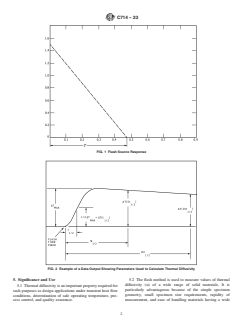
4.2.1 τ/t ⁄2 must be 0.02 or less. τ is the pulse time as defined
C781 Practice for Testing Graphite Materials for Gas-Cooled
in Fig. 1 and t ⁄2 is the time for the rear surface temperature to
Nuclear Reactor Components
rise to one half of its maximum value (see Fig. 2).
D4175 Terminology Relating to Petroleum Products, Liquid
4.2.2 Heat losses from the specimen via radiation,
Fuels, and Lubricants
convection, or conduction to the specimen holder must be
D7775 Guide for Measurements on Small Graphite Speci-
small. Whether or not this condition is violated can be
mens
determined experimentally from the data output, an example of
E1461 Test Method for Thermal Diffusivity by the Flash
1 1
which is shown in Fig. 2. If ΔT(10 t ⁄2 )/ΔT(t ⁄2 ) > 1.98, the heat
Method
losses are assumed to be zero.
1 4.2.3 The measurement must be such that ΔT , ΔT(10t ⁄2 ),
This guide is under the jurisdiction of ASTM Committee D02 on Petroleum
max
Products, Liquid Fuels, and Lubricants and is the direct responsibility of Subcom-
and t ⁄2 can be determined to 62 %.
mittee D02.F0 on Manufactured Carbon and Graphite Products.
4.2.4 The other conditions are less critical, and the experi-
Current edition approved Oct. 1, 2023. Published October 2023. Originally
menter is left to their discretion.
approved in 1972. Last previous edition approved in 2017 as C714 – 17. DOI:
10.1520/C0714-23.
For referenced ASTM standards, visit the ASTM website, www.astm.org, or
contact ASTM Customer Service at service@astm.org. For Annual Book of ASTM
Standards volume information, refer to the standard’s Document Summary page on The boldface numbers in parentheses refer to the list of references at the end of
the ASTM website. this guide.
*A Summary of Changes section appears at the end of this standard
Copyright © ASTM International, 100 Barr Harbor Drive, PO Box C700, West Conshohocken, PA 19428-2959. United States
C714 − 23
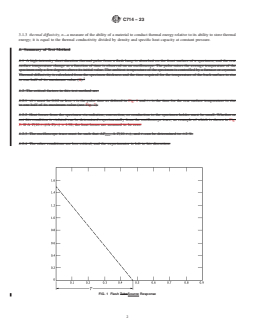
FIG. 1 Flash Source Response
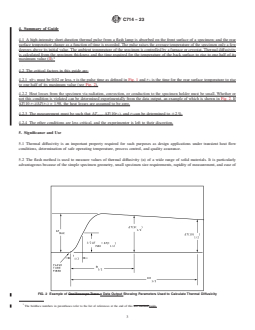
FIG. 2 Example of a Data Output Showing Parameters Used to Calculate Thermal Diffusivity
5. Significance and Use 5.2 The flash method is used to measure values of thermal
diffusivity (α) of a wide range of solid materials. It is
5.1 Thermal diffusivity is an important property required for
particularly advantageous because of the simple specimen
such purposes as design applications under transient heat flow
geometry, small specimen size requirements, rapidity of
conditions, determination of safe operating temperature, pro-
measurement, and ease of handling materials having a wide
cess control, and quality assurance.
C714 − 23
range of thermal diffusivity values over a large temperature 6.4 Flash Source—The experimenter has considerable lati-
range with a single apparatus. The short measurement times tude in their choice of flash source. A typical 1000 J unit raises
involved reduce the chances of contamination and change of
the specimen temperature from 1 °C to 3 °C. The power supply
specimen properties due to exposure to high temperature
for such a unit might consist of a 125 μF capacitor bank
environments.
charged to 4000 V; discharge time would be about 1 ms. Either
an external trigger device or a delayed trigger pulse from a
5.3 Thermal diffusivity results in many cases can be com-
control unit may be used to initiate the flash source.
bined with values for specific heat (C ) and density (ρ) to
p
derive thermal conductivity (λ) from the relation λ = αC ρ. For
p
guidance on converting thermal diffusivity to thermal 7. Test Specimen
conductivity, refer to Practice C781.
7.1 A typical specimen is a circular disk, 2 mm to 4 mm
5.4 This test method described in this guide can be used to
thick and 6 mm to 12 mm in diameter; however, several things
characterize graphite for design purposes.
must be considered in choosing specimen dimensions. The
5.5 Test Method E1461 is a more detailed form of this test diameter is fairly arbitrary except that it must not be too large
method described in this guide and has applicability to much
relative to the flash source because the front surface of the
wider ranges of materials, application
...
This document is not an ASTM standard and is intended only to provide the user of an ASTM standard an indication of what changes have been made to the previous version. Because
it may not be technically possible to adequately depict all changes accurately, ASTM recommends that users consult prior editions as appropriate. In all cases only the current version
of the standard as published by ASTM is to be considered the official document.
Designation: C714 − 17 C714 − 23
Standard Test Method Guide for
Thermal Diffusivity of Carbon and Graphite by Thermal
Pulse Method
This standard is issued under the fixed designation C714; the number immediately following the designation indicates the year of
original adoption or, in the case of revision, the year of last revision. A number in parentheses indicates the year of last reapproval. A
superscript epsilon (´) indicates an editorial change since the last revision or reapproval.
1. Scope*
1.1 This test method guide covers the determination of the thermal diffusivity of carbons and graphite at temperatures up to
500 °C. It requires only ais applicable only to small easily fabricated specimen.specimens. Thermal diffusivity values in the range
2 2
from 0.04 cm /s to 2.0 cm /s are readily measurable by this test method; guide; however, for the reason outlined in Section 7, for
materials outside this range this test method may require modification. guide may not be applicable.
1.2 Units—The values stated in SI units are to be regarded as the standard. No other units of measurement are included in this
standard.
1.3 This standard does not purport to address all of the safety concerns, if any, associated with its use. It is the responsibility
of the user of this standard to establish appropriate safety and healthsafety, health, and environmental practices and determine
the applicability of regulatory limitations prior to use.
1.4 This international standard was developed in accordance with internationally recognized principles on standardization
established in the Decision on Principles for the Development of International Standards, Guides and Recommendations issued
by the World Trade Organization Technical Barriers to Trade (TBT) Committee.
2. Referenced Documents
2.1 ASTM Standards:
C781 Practice for Testing Graphite Materials for Gas-Cooled Nuclear Reactor Components
D4175 Terminology Relating to Petroleum Products, Liquid Fuels, and Lubricants
D7775 Guide for Measurements on Small Graphite Specimens
E1461 Test Method for Thermal Diffusivity by the Flash Method
3. Terminology
3.1 Definitions:
3.1.1 For definitions of terms used in this guide, refer to Terminology D4175.
3.1.2 thermal conductivity, n—the rate at which heat passes through a material, expressed as the amount of heat that flows per unit
time through a unit area with a temperature gradient of one degree per unit distance.
This test method guide is under the jurisdiction of ASTM Committee D02 on Petroleum Products, Liquid Fuels, and Lubricants and is the direct responsibility of
Subcommittee D02.F0 on Manufactured Carbon and Graphite Products.
Current edition approved May 1, 2017Oct. 1, 2023. Published May 2017October 2023. Originally approved in 1972. Last previous edition approved in 20152017 as
C714 – 05 (2015).C714 – 17. DOI: 10.1520/C0714-17.10.1520/C0714-23.
For referenced ASTM standards, visit the ASTM website, www.astm.org, or contact ASTM Customer Service at service@astm.org. For Annual Book of ASTM Standards
volume information, refer to the standard’s Document Summary page on the ASTM website.
*A Summary of Changes section appears at the end of this standard
Copyright © ASTM International, 100 Barr Harbor Drive, PO Box C700, West Conshohocken, PA 19428-2959. United States
C714 − 23
3.1.3 thermal diffusivity, n—a measure of the ability of a material to conduct thermal energy relative to its ability to store thermal
energy; it is equal to the thermal conductivity divided by density and specific heat capacity at constant pressure.
4. Summary of Test Method
4.1 A high-intensity short-duration thermal pulse from a flash lamp is absorbed on the front surface of a specimen; and the rear
surface temperature change as a function of time is observed on an oscilloscope. The pulse raises the average temperature of the
specimen only a few degrees above its initial value. The ambient temperature of the specimen is controlled by a furnace or cryostat.
Thermal diffusivity is calculated from the specimen thickness and the time required for the temperature of the back surface to rise
to one half of its maximum value (1).
4.2 The critical factors in this test method are:
1 1
4.2.1 τ/t ⁄2 must be 0.02 or less. τ is the pulse time as defined in Fig. 1 and t ⁄2 is the time for the rear surface temperature to rise
to one half of its maximum value (see Fig. 2).
4.2.2 Heat losses from the specimen via radiation, convection, or conduction to the specimen holder must be small. Whether or
not this condition is violated can be determined experimentally from the oscilloscope trace, an example of which is shown in Fig.
1 1
2. If Δ T(10 t ⁄2)/Δ T(t ⁄2) > 1.98, the heat losses are assumed to be zero.
1 1
4.2.3 The oscilloscope trace must be such that ΔT , Δ T(10 t ⁄2), and t ⁄2can be determined to 62 %.
max
4.2.4 The other conditions are less critical, and the experimenter is left to his discretion.
FIG. 1 Flash TubeSource Response
C714 − 23
4. Summary of Guide
4.1 A high-intensity short-duration thermal pulse from a flash lamp is absorbed on the front surface of a specimen; and the rear
surface temperature change as a function of time is recorded. The pulse raises the average temperature of the specimen only a few
degrees above its initial value. The ambient temperature of the specimen is controlled by a furnace or cryostat. Thermal diffusivity
is calculated from the specimen thickness and the time required for the temperature of the back surface to rise to one half of its
maximum value (1).
4.2 The critical factors in this guide are:
1 1
4.2.1 τ/t ⁄2 must be 0.02 or less. τ is the pulse time as defined in Fig. 1 and t ⁄2 is the time for the rear surface temperature to rise
to one half of its maximum value (see Fig. 2).
4.2.2 Heat losses from the specimen via radiation, convection, or conduction to the specimen holder must be small. Whether or
not this condition is violated can be determined experimentally from the data output, an example of which is shown in Fig. 2. If
1 1
ΔT(10 t ⁄2)/ΔT(t ⁄2) > 1.98, the heat losses are assumed to be zero.
1 1
4.2.3 The measurement must be such that ΔT , ΔT(10t ⁄2), and t ⁄2can be determined to 62 %.
max
4.2.4 The other conditions are less critical, and the experimenter is left to their discretion.
5. Significance and Use
5.1 Thermal diffusivity is an important property required for such purposes as design applications under transient heat flow
conditions, determination of safe operating temperature, process control, and quality assurance.
5.2 The flash method is used to measure values of thermal diffusivity (α) of a wide range of solid materials. It is particularly
advantageous because of the simple specimen geometry, small specimen size requirements, rapidity of measurement, and ease of
FIG. 2 Example of Oscilloscope Trace a Data Output Showing Parameters Used to Calculate Thermal Diffusivity
The boldface numbers in parentheses refer to the list of references at the end of this test method.guide.
C714 − 23
handling materials having a wide range of thermal diffusivity values over a large temperature range with a single apparatus. The
short measurement times involved reduce the chances of contamination and change of specimen properties due to exposure to high
temperature environments.
5.3 Thermal diffusivity results in many cases can be combined with values for specific heat (C ) and density (ρ) to derive thermal
p
conductivity (λ) from the relation λ = αC ρ. For guidance on converting thermal diffusivity to thermal conductivity, refer to
p
Practice C781.
5.4 This test method described in this guide can be used to characterize graphite for design purposes.
5.5 Test Method E1461 is a more detailed form of this test method described in this guide and has applicability to much wider
ranges of materials, applications, and temperatures.
6. Apparatus
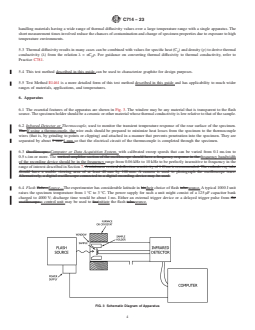
6.1 The essential features of the apparatus are shown in Fig. 3. The window may be any material that is transparent to the flash
source. The specimen holder should be a ceramic or other material whose therma
...