

ASTM D2047-17
(Test Method)Standard Test Method for Static Coefficient of Friction of Polish-Coated Flooring Surfaces as Measured by the James Machine
General Information
- Abstract
SIGNIFICANCE AND USE
4.1 Test Method D2047 establishes a compliance criterion relating static coefficient of friction measurements of flooring surfaces with human locomotion safety. The compliance criterion is based on extensive experiential data from residential, commercial, industrial and institutional walkway surfaces since 1942.
4.2 Polishes and other floor maintenance coatings having a static coefficient of friction of not less than 0.5, as measured by this test method, have been recognized as providing nonhazardous walkways.
Note 1: The value of 0.5 meets the requirements for compliance with Rule 5 on “The use of terms slip retardant, slip resistant, or terms of similar import,” of the Proposed Trade Practice Rules for the Floor Wax and Floor Polish Industry as issued by the Federal Trade Commission on March 17, 1953.
4.3 The 0.5 static coefficient of friction compliance criterion of this test method is only appropriate for polish-coated surfaces tested in accordance with this machine and test method. The use of this compliance criterion with other test methods, other test instruments, and other surfaces is improper, because they are not a part of the body of experiential data upon which the conformance criterion is based.
Note 2: The conformance criteria of this test method may be valid for other surfaces and surface coatings tested by this test method, but this has not been substantiated by correlation with experiential data.
SCOPE
1.1 This laboratory test method covers the use of the James Machine for the measurement of the static coefficient of friction of polish-coated flooring surfaces with respect to human locomotion safety. Further, this test method also establishes a compliance criterion to meet the requirement for a nonhazardous polished walkway surface. The test method is not intended for use on “wet” surfaces or on surfaces wherein the texture, projections, profile or clearance between the sculptured pattern of the surface does not permit adequate contact between the machine foot and the test surface.
1.2 This test method is the only method appropriate for testing polishes for specification compliance with the floor polish static coefficient of friction criterion.
1.3 The values stated in inch-pound units are to be regarded as standard. The values given in parentheses are mathematical conversions to SI units that are provided for information only and are not considered standard.
1.4 This standard does not purport to address all of the safety concerns, if any, associated with its use. It is the responsibility of the user of this standard to establish appropriate safety, health, and environmental practices and determine the applicability of regulatory limitations prior to use.
1.5 This international standard was developed in accordance with internationally recognized principles on standardization established in the Decision on Principles for the Development of International Standards, Guides and Recommendations issued by the World Trade Organization Technical Barriers to Trade (TBT) Committee.
- Status
- Published
- Publication Date
- 31-Oct-2017
- Technical Committee
- D21 - Polishes
- Drafting Committee
- D21.06 - Slip Resistance
Buy Documents
ASTM D2047-17 - Standard Test Method for Static Coefficient of Friction of Polish-Coated Flooring Surfaces as Measured by the James Machine
REDLINE ASTM D2047-17 - Standard Test Method for Static Coefficient of Friction of Polish-Coated Flooring Surfaces as Measured by the James Machine
Overview
ASTM D2047-17 is the internationally recognized standard test method for measuring the static coefficient of friction (COF) of polish-coated flooring surfaces using the James Machine. Developed by ASTM International, this test method specifically assesses the slip resistance of floor finishes in relation to human locomotion safety. Since its original adoption, ASTM D2047 has served as a compliance benchmark for evaluating whether floor polishes and coatings meet the minimum safety criteria required for nonhazardous walkway surfaces. This standard is essential for flooring manufacturers, maintenance professionals, safety inspectors, and regulatory authorities committed to accident prevention and occupational safety.
Key Topics
- Static Coefficient of Friction: Measures the resistance to motion between two solid surfaces at the point just before movement begins; critical for slip resistance assessment.
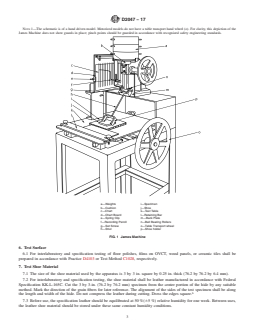
- James Machine Usage: The James Machine is the specified apparatus for this method, providing accurate static COF measurements on polish-coated surfaces.
- Compliance Criterion: Floor finishes achieving a static COF of at least 0.5 (as measured by this method) are recognized as providing nonhazardous, slip-resistant walkways.
- Scope Limitations: This method applies solely to polish-coated surfaces and is not intended for wet conditions or for surfaces where the machine cannot achieve adequate contact.
- Substrate and Foot Material Specifications: Test substrates include vinyl composition tile, wood panels, or ceramic tile, and the standard shoe material is vegetable or chrome-tanned leather, to ensure test consistency.
- Safety and Reporting: Adherence to laboratory safety protocols and detailed reporting procedures are integral parts of the standard.
Applications
ASTM D2047-17 is widely used across multiple sectors to ensure flooring safety and support compliance with industry and regulatory requirements:
- Floor Polish Manufacturers: To certify products as "slip resistant" or "nonhazardous," meeting or exceeding the standardized COF criteria.
- Facility Maintenance: For evaluating the safety of walkways in residential, commercial, industrial, and institutional settings; critical for injury prevention.
- Safety Compliance Audits: Used by safety inspectors and regulatory agencies for validating that floor coatings meet minimum slip resistance requirements.
- Product Certification: Supports marketing claims regarding slip resistance and can be referenced in procurement specifications or legal standards.
- Research and Development: Assists in comparing the performance of different flooring polishes and coatings during product development.
By following ASTM D2047-17, organizations benefit from enhanced pedestrian safety, reduced liability risk, and alignment with best practices for floor surface evaluation.
Related Standards
Understanding ASTM D2047-17 is strengthened by familiarity with other related standards in the field of slip resistance and floor testing:
- ASTM D1436: Test Methods for Application of Emulsion Floor Polishes to Substrates for Testing Purposes.
- ASTM D1630: Test Method for Rubber Property-Abrasion Resistance (Footwear Abrader).
- ASTM D2825: Terminology Relating to Polishes and Related Materials.
- ASTM D4103: Practice for Preparation of Substrate Surfaces for Coefficient of Friction Testing.
- ASTM D6205: Practice for Calibration of the James Static Coefficient of Friction Machine.
- ASTM E29: Practice for Using Significant Digits in Test Data to Determine Conformance with Specifications.
- ASTM E456: Terminology Relating to Quality and Statistics.
These documents offer complementary guidance, terminology, and procedures, supporting consistent, reliable measurement and reporting throughout the floor finish and maintenance industries.
Keywords: ASTM D2047-17, static coefficient of friction, James Machine, slip resistance, floor polishes, flooring safety, nonhazardous walkways, floor coatings, pedestrian safety, ASTM standards
Relations
- Effective Date
- 01-Nov-2017
- Effective Date
- 01-Apr-2022
- Effective Date
- 01-Oct-2017
- Effective Date
- 01-Oct-2017
- Effective Date
- 01-Mar-2017
- Effective Date
- 01-Mar-2017
- Effective Date
- 01-Oct-2016
- Effective Date
- 01-Nov-2015
- Effective Date
- 15-Nov-2013
- Effective Date
- 15-Nov-2013
- Effective Date
- 15-Nov-2013
- Effective Date
- 15-Nov-2013
- Effective Date
- 15-Aug-2013
- Effective Date
- 01-Jan-2013
- Effective Date
- 01-Oct-2012
Buy Documents
ASTM D2047-17 - Standard Test Method for Static Coefficient of Friction of Polish-Coated Flooring Surfaces as Measured by the James Machine
REDLINE ASTM D2047-17 - Standard Test Method for Static Coefficient of Friction of Polish-Coated Flooring Surfaces as Measured by the James Machine
Get Certified
Connect with accredited certification bodies for this standard

ECOCERT
Organic and sustainability certification.

Eurofins Food Testing Global
Global leader in food, environment, and pharmaceutical product testing.

Intertek Bangladesh
Intertek certification and testing services in Bangladesh.
Sponsored listings
Frequently Asked Questions
ASTM D2047-17 is a standard published by ASTM International. Its full title is "Standard Test Method for Static Coefficient of Friction of Polish-Coated Flooring Surfaces as Measured by the James Machine". This standard covers: SIGNIFICANCE AND USE 4.1 Test Method D2047 establishes a compliance criterion relating static coefficient of friction measurements of flooring surfaces with human locomotion safety. The compliance criterion is based on extensive experiential data from residential, commercial, industrial and institutional walkway surfaces since 1942. 4.2 Polishes and other floor maintenance coatings having a static coefficient of friction of not less than 0.5, as measured by this test method, have been recognized as providing nonhazardous walkways. Note 1: The value of 0.5 meets the requirements for compliance with Rule 5 on “The use of terms slip retardant, slip resistant, or terms of similar import,” of the Proposed Trade Practice Rules for the Floor Wax and Floor Polish Industry as issued by the Federal Trade Commission on March 17, 1953. 4.3 The 0.5 static coefficient of friction compliance criterion of this test method is only appropriate for polish-coated surfaces tested in accordance with this machine and test method. The use of this compliance criterion with other test methods, other test instruments, and other surfaces is improper, because they are not a part of the body of experiential data upon which the conformance criterion is based. Note 2: The conformance criteria of this test method may be valid for other surfaces and surface coatings tested by this test method, but this has not been substantiated by correlation with experiential data. SCOPE 1.1 This laboratory test method covers the use of the James Machine for the measurement of the static coefficient of friction of polish-coated flooring surfaces with respect to human locomotion safety. Further, this test method also establishes a compliance criterion to meet the requirement for a nonhazardous polished walkway surface. The test method is not intended for use on “wet” surfaces or on surfaces wherein the texture, projections, profile or clearance between the sculptured pattern of the surface does not permit adequate contact between the machine foot and the test surface. 1.2 This test method is the only method appropriate for testing polishes for specification compliance with the floor polish static coefficient of friction criterion. 1.3 The values stated in inch-pound units are to be regarded as standard. The values given in parentheses are mathematical conversions to SI units that are provided for information only and are not considered standard. 1.4 This standard does not purport to address all of the safety concerns, if any, associated with its use. It is the responsibility of the user of this standard to establish appropriate safety, health, and environmental practices and determine the applicability of regulatory limitations prior to use. 1.5 This international standard was developed in accordance with internationally recognized principles on standardization established in the Decision on Principles for the Development of International Standards, Guides and Recommendations issued by the World Trade Organization Technical Barriers to Trade (TBT) Committee.
SIGNIFICANCE AND USE 4.1 Test Method D2047 establishes a compliance criterion relating static coefficient of friction measurements of flooring surfaces with human locomotion safety. The compliance criterion is based on extensive experiential data from residential, commercial, industrial and institutional walkway surfaces since 1942. 4.2 Polishes and other floor maintenance coatings having a static coefficient of friction of not less than 0.5, as measured by this test method, have been recognized as providing nonhazardous walkways. Note 1: The value of 0.5 meets the requirements for compliance with Rule 5 on “The use of terms slip retardant, slip resistant, or terms of similar import,” of the Proposed Trade Practice Rules for the Floor Wax and Floor Polish Industry as issued by the Federal Trade Commission on March 17, 1953. 4.3 The 0.5 static coefficient of friction compliance criterion of this test method is only appropriate for polish-coated surfaces tested in accordance with this machine and test method. The use of this compliance criterion with other test methods, other test instruments, and other surfaces is improper, because they are not a part of the body of experiential data upon which the conformance criterion is based. Note 2: The conformance criteria of this test method may be valid for other surfaces and surface coatings tested by this test method, but this has not been substantiated by correlation with experiential data. SCOPE 1.1 This laboratory test method covers the use of the James Machine for the measurement of the static coefficient of friction of polish-coated flooring surfaces with respect to human locomotion safety. Further, this test method also establishes a compliance criterion to meet the requirement for a nonhazardous polished walkway surface. The test method is not intended for use on “wet” surfaces or on surfaces wherein the texture, projections, profile or clearance between the sculptured pattern of the surface does not permit adequate contact between the machine foot and the test surface. 1.2 This test method is the only method appropriate for testing polishes for specification compliance with the floor polish static coefficient of friction criterion. 1.3 The values stated in inch-pound units are to be regarded as standard. The values given in parentheses are mathematical conversions to SI units that are provided for information only and are not considered standard. 1.4 This standard does not purport to address all of the safety concerns, if any, associated with its use. It is the responsibility of the user of this standard to establish appropriate safety, health, and environmental practices and determine the applicability of regulatory limitations prior to use. 1.5 This international standard was developed in accordance with internationally recognized principles on standardization established in the Decision on Principles for the Development of International Standards, Guides and Recommendations issued by the World Trade Organization Technical Barriers to Trade (TBT) Committee.
ASTM D2047-17 is classified under the following ICS (International Classification for Standards) categories: 71.100.99 - Other products of the chemical industry; 97.080 - Cleaning appliances. The ICS classification helps identify the subject area and facilitates finding related standards.
ASTM D2047-17 has the following relationships with other standards: It is inter standard links to ASTM D2047-11, ASTM E456-13a(2022)e1, ASTM E456-13A(2017)e1, ASTM E456-13A(2017)e3, ASTM D1436-17, ASTM D4103-17, ASTM D4103-90(2016), ASTM D1436-97(2015), ASTM E456-13ae1, ASTM E456-13ae2, ASTM E456-13ae3, ASTM E456-13a, ASTM E456-13, ASTM D2825-13, ASTM D6205-12. Understanding these relationships helps ensure you are using the most current and applicable version of the standard.
ASTM D2047-17 is available in PDF format for immediate download after purchase. The document can be added to your cart and obtained through the secure checkout process. Digital delivery ensures instant access to the complete standard document.
Standards Content (Sample)
This international standard was developed in accordance with internationally recognized principles on standardization established in the Decision on Principles for the
Development of International Standards, Guides and Recommendations issued by the World Trade Organization Technical Barriers to Trade (TBT) Committee.
Designation: D2047 − 17
Standard Test Method for
Static Coefficient of Friction of Polish-Coated Flooring
Surfaces as Measured by the James Machine
This standard is issued under the fixed designation D2047; the number immediately following the designation indicates the year of
original adoption or, in the case of revision, the year of last revision. A number in parentheses indicates the year of last reapproval. A
superscript epsilon (´) indicates an editorial change since the last revision or reapproval.
1. Scope C1028 TestMethodforDeterminingtheStaticCoefficientof
Friction of Ceramic Tile and Other Like Surfaces by the
1.1 This laboratory test method covers the use of the James
Horizontal Dynamometer Pull-Meter Method (Withdrawn
Machine for the measurement of the static coefficient of
2014)
friction of polish-coated flooring surfaces with respect to
D1436 Test Methods for Application of Emulsion Floor
human locomotion safety. Further, this test method also estab-
Polishes to Substrates for Testing Purposes
lishes a compliance criterion to meet the requirement for a
D1630 Test Method for Rubber Property—Abrasion Resis-
nonhazardous polished walkway surface. The test method is
tance (Footwear Abrader)
not intended for use on “wet” surfaces or on surfaces wherein
D2825 Terminology Relating to Polishes and Related Mate-
the texture, projections, profile or clearance between the
rials
sculptured pattern of the surface does not permit adequate
D4103 Practice for Preparation of Substrate Surfaces for
contact between the machine foot and the test surface.
Coefficient of Friction Testing
1.2 This test method is the only method appropriate for
D6205 Practice for Calibration of the James Static Coeffi-
testing polishes for specification compliance with the floor
cient of Friction Machine
polish static coefficient of friction criterion.
E29 Practice for Using Significant Digits in Test Data to
Determine Conformance with Specifications
1.3 The values stated in inch-pound units are to be regarded
as standard. The values given in parentheses are mathematical E456 Terminology Relating to Quality and Statistics
2.2 Federal Specification:
conversions to SI units that are provided for information only
and are not considered standard. KK-L-165C Leather, Cattlehide, Vegetable Tanned and
Chrome Retanned, Impregnated, and Soles. Type 1–Fac-
1.4 This standard does not purport to address all of the
tory (for Shoe Making), Class 6–Strips
safety concerns, if any, associated with its use. It is the
responsibility of the user of this standard to establish appro-
3. Terminology
priate safety, health, and environmental practices and deter-
3.1 Definitions—See also Teminologies D1436 and D2825.
mine the applicability of regulatory limitations prior to use.
3.1.1 friction, n—the resistance to relative motion devel-
1.5 This international standard was developed in accor-
oped between two solid contacting bodies at, and parallel to,
dance with internationally recognized principles on standard-
the sliding plane.
ization established in the Decision on Principles for the
3.1.2 coeffıcient of friction, n—the ratio of the horizontal
Development of International Standards, Guides and Recom-
(shear) component of force required to overcome friction, to
mendations issued by the World Trade Organization Technical
the vertical (normal) component of force applied.
Barriers to Trade (TBT) Committee.
3.1.3 static coeffıcient of friction, n—the ratio of the hori-
2. Referenced Documents
zontal component of force applied to a body that just over-
comes the friction or resistance to sliding, to the vertical
2.1 ASTM Standards:
component of force applied.
3.1.4 dynamic coeffıcient of friction, n—the ratio of the
horizontal component of force required to cause a body to
ThistestmethodisunderthejurisdictionofASTMCommitteeD21onPolishes
and is the direct responsibility of Subcommittee D21.06 on Slip Resistance.
continue to slide at a constant velocity, to the vertical compo-
Current edition approved Nov. 1, 2017. Published March 2018. Originally
nent of force applied.
approved in 1964 as D2047–64T. Last previous edition approved in 2011 as
D2047 – 11. DOI: 10.1520/D2047-17.
2 3
For referenced ASTM standards, visit the ASTM website, www.astm.org, or The last approved version of this historical standard is referenced on
contact ASTM Customer Service at service@astm.org. For Annual Book of ASTM www.astm.org.
Standards volume information, refer to the standard’s Document Summary page on AvailablefromStandardizationDocumentsOrderDesk,Bldg.4SectionD,700
the ASTM website. Robbins Ave., Philadelphia, PA 19111-5094, Attn: NPODS.
Copyright © ASTM International, 100 Barr Harbor Drive, PO Box C700, West Conshohocken, PA 19428-2959. United States
D2047 − 17
3.1.5 slip resistance, n—the frictional force opposing move- and 3). To date, compliance criterion values for polish inter-
ment of an object across its surface, usually with reference to faces with other shoe materials have not been determined with
the sole or heel of a shoe on a floor. A surface having a static respect to establishing minimum requirements for nonhazard-
coefficient of friction of 0.5 or greater as measured by this test ous walkways. If a standard rubber shoe material is required,
method is considered to have adequate slip resistance. That is, the test rubber should be in accordance with Test Method
it will provide the required traction for preventing or markedly D1630.
reducing the probability of slipping while walking.
NOTE 3—The static coefficient of friction measured with elastomeric
compositions are frequently as much as 0.3 to 0.5 higher than leather.
4. Significance and Use
5.3 Substrate—For interlaboratory and specification testing,
7 8 9
4.1 Test Method D2047 establishes a compliance criterion
OVCT ,woodpanels ,orstandardceramictiles shallbeused.
relating static coefficient of friction measurements of flooring
5.3.1 If substrates other than the above standards are to be
surfaces with human locomotion safety. The compliance crite-
used, they should be of uniform porosity and free of surface
rion is based on extensive experiential data from residential,
irregularities which would interlock the shoe material with the
commercial, industrial and institutional walkway surfaces
surface or otherwise impede smooth sliding of the shoe over
since 1942.
the film surface.
4.2 Polishes and other floor maintenance coatings having a
6. Test Surface
static coefficient of friction of not less than 0.5, as measured by
this test method, have been recognized as providing nonhaz- 6.1 For interlaboratory and specification testing of floor
ardous walkways.
polishes,filmsonOVCT,woodpanels,orceramictilesshallbe
prepared in accordance with Practice D4103 or Test Method
NOTE 1—The value of 0.5 meets the requirements for compliance with
C1028, respectively.
Rule 5 on “The use of terms slip retardant, slip resistant, or terms of
similar import,” of the Proposed Trade Practice Rules for the Floor Wax
7. Test Shoe Material
and Floor Polish Industry as issued by the Federal Trade Commission on
March 17, 1953.
7.1 The size of the shoe material used by the apparatus is 3
4.3 The0.5staticcoefficientoffrictioncompliancecriterion
by 3 in. square by 0.25 in. thick (76.2 by 76.2 by 6.4 mm).
of this test method is only appropriate for polish-coated
7.2 For interlaboratory and specification testing, the shoe
surfaces tested in accordance with this machine and test
material shall be leather manufactured in accordance with
method. The use of this compliance criterion with other test
Federal Specification KK-L-165C. Cut the 3 by 3-in. (76.2 by
methods,othertestinstruments,andothersurfacesisimproper,
76.2 mm) specimen from the center portion of the hide by any
because they are not a part of the body of experiential data
suitable method. Mark the direction of the grain fibers for later
upon which the conformance criterion is based.
reference.The alignment of the sides of the test specimen shall
NOTE 2—The conformance criteria of this test method may be valid for be along the length and width of the hide. Do not compress the
other surfaces and surface coatings tested by this test method, but this has
leather during cutting. Dress the edges square.
not been substantiated by correlation with experiential data.
7.3 Before use, the specification leather should be equili-
5. Apparatus brated at 50 %(65 %) relative humidity for one week. Be-
tween uses, the leather shoe material should be stored under
5.1 James Machine —See Fig. 1.
these same constant humidity conditions.
5.2 Shoe Material —For interlaboratory and specification
7.4 Other shoe materials may be used for individual and
testingtheshoematerialshallbeleather,conformingtoFederal
specific testing purposes. If rubber is used, a standard rubber
Specification KK-L-165C. Other materials commonly em-
compound conforming to Test Method D1630, Section 7.1, is
ployed as footwear sole or heel material may be used.
recommended. It is further recommended that the thickness of
However, it should be understood that the 0.5 static coefficient
the shoe material not be greater than 0.25 in. (6.4 mm) or less
offrictioncompliancecriterionvalueisnotrelevantwhensuch
than 0.20 in. (5.1 mm).
materials are substituted for the specification leather (Notes 2
7.5 Gently sand the inside (flesh) surface of the leather to
produce a uniform thickness. The final sanding in this process
Assembled, motorized machines are available from Michelman, Inc., 9080
Shell Road, Cincinnati, OH 45236–1229. Assembled, non-motorized machines are
available from Quadra, Inc., 1833 Oakdale Ave., Racine, WI 53405. Engineering/ OVCT tile may be obtained through Armstrong Flooring from various home
machinist drawings are available from Consumer Specialty Products Association, improvement stores. The following Armstrong tile substrates have been found
900 17th Street NW, Washington, DC 20006. These are the sole sources of supply suitabletoperformadequatelyforthistestmethod:ArmstrongExcelonFeatureTile:
of the apparatus known to the committee at this time. If you are aware of alternative Black (56790), http://www. armstrong.com/commflooringna/product_details_
suppliers, please provide this information to ASTM International Headquarters. toolbox_magnify.jsp?item_id=47394.
Your comments will receive careful consideration at a meeting of the responsibl
...
This document is not an ASTM standard and is intended only to provide the user of an ASTM standard an indication of what changes have been made to the previous version. Because
it may not be technically possible to adequately depict all changes accurately, ASTM recommends that users consult prior editions as appropriate. In all cases only the current version
of the standard as published by ASTM is to be considered the official document.
Designation: D2047 − 11 D2047 − 17
Standard Test Method for
Static Coefficient of Friction of Polish-Coated Flooring
Surfaces as Measured by the James Machine
This standard is issued under the fixed designation D2047; the number immediately following the designation indicates the year of
original adoption or, in the case of revision, the year of last revision. A number in parentheses indicates the year of last reapproval. A
superscript epsilon (´) indicates an editorial change since the last revision or reapproval.
1. Scope
1.1 This laboratory test method covers the use of the James Machine for the measurement of the static coefficient of friction
of polish-coated flooring surfaces with respect to human locomotion safety. Further, this test method also establishes a compliance
criterion to meet the requirement for a nonhazardous polished walkway surface. The test method is not intended for use on “wet”
surfaces or on surfaces wherein the texture, projections, profile or clearance between the sculptured pattern of the surface does not
permit adequate contact between the machine foot and the test surface.
1.2 This test method is the only method appropriate for testing polishes for specification compliance with the floor polish static
coefficient of friction criterion.
1.3 The values stated in inch-pound units are to be regarded as standard. The values given in parentheses are mathematical
conversions to SI units that are provided for information only and are not considered standard.
1.4 This standard does not purport to address all of the safety problems,concerns, if any, associated with its use. It is the
responsibility of the user of this standard to establish appropriate safety safety, health, and healthenvironmental practices and
determine the applicability of regulatory limitations prior to use.
1.5 This international standard was developed in accordance with internationally recognized principles on standardization
established in the Decision on Principles for the Development of International Standards, Guides and Recommendations issued
by the World Trade Organization Technical Barriers to Trade (TBT) Committee.
2. Referenced Documents
2.1 ASTM Standards:
C1028 Test Method for Determining the Static Coefficient of Friction of Ceramic Tile and Other Like Surfaces by the Horizontal
Dynamometer Pull-Meter Method (Withdrawn 2014)
D1436 Test Methods for Application of Emulsion Floor Polishes to Substrates for Testing Purposes
D1630 Test Method for Rubber Property—Abrasion Resistance (Footwear Abrader)
D2825 Terminology Relating to Polishes and Related Materials
D4103 Practice for Preparation of Substrate Surfaces for Coefficient of Friction Testing
D6205 Practice for Calibration of the James Static Coefficient of Friction Machine
E29 Practice for Using Significant Digits in Test Data to Determine Conformance with Specifications
E456 Terminology Relating to Quality and Statistics
2.2 Federal Specification:
KK-L-165C Leather, Cattlehide, Vegetable Tanned and Chrome Retanned, Impregnated, and Soles. Type 1–Factory (for Shoe
Making), Class 6–Strips
3. Terminology
3.1 Definitions—See also Teminologies D1436 and D2825.
This test method is under the jurisdiction of ASTM Committee D21 on Polishes and is the direct responsibility of Subcommittee D21.06 on Slip Resistance.
Current edition approved Oct. 1, 2011Nov. 1, 2017. Published November 2011March 2018. Originally approved in 1964 as D2047–64T. Last previous edition approved
in 20042011 as D2047 – 04.D2047 – 11. DOI: 10.1520/D2047-11.10.1520/D2047-17.
For referenced ASTM standards, visit the ASTM website, www.astm.org, or contact ASTM Customer Service at service@astm.org. For Annual Book of ASTM Standards
volume information, refer to the standard’s Document Summary page on the ASTM website.
The last approved version of this historical standard is referenced on www.astm.org.
Available from Standardization Documents Order Desk, Bldg. 4 Section D, 700 Robbins Ave., Philadelphia, PA 19111-5094, Attn: NPODS.
Copyright © ASTM International, 100 Barr Harbor Drive, PO Box C700, West Conshohocken, PA 19428-2959. United States
D2047 − 17
3.1.1 friction, n—the resistance to relative motion developed between two solid contacting bodies at, and parallel to, the sliding
plane.
3.1.2 coeffıcient of friction, n—the ratio of the horizontal (shear) component of force required to overcome friction, to the
vertical (normal) component of force applied.
3.1.3 static coeffıcient of friction, n—the ratio of the horizontal component of force applied to a body that just overcomes the
friction or resistance to sliding, to the vertical component of force applied.
3.1.4 dynamic coeffıcient of friction, n—the ratio of the horizontal component of force required to cause a body to continue to
slide at a constant velocity, to the vertical component of force applied.
3.1.5 slip resistance, n—the frictional force opposing movement of an object across its surface, usually with reference to the
sole or heel of a shoe on a floor. A surface having a static coefficient of friction of 0.5 or greater as measured by this test method
is considered to have adequate slip resistance. That is, it will provide the required traction for preventing or markedly reducing
the probability of slipping while walking.
4. Significance and Use
4.1 Test Method D2047 establishes a compliance criterion relating static coefficient of friction measurements of flooring
surfaces with human locomotion safety. The compliance criterion is based on extensive experiential data from residential,
commercial, industrial and institutional walkway surfaces since 1942.
4.2 Polishes and other floor maintenance coatings having a static coefficient of friction of not less than 0.5, as measured by this
test method, have been recognized as providing nonhazardous walkways.
NOTE 1—The value of 0.5 meets the requirements for compliance with Rule 5 on “The use of terms slip retardant, slip resistant, or terms of similar
import,” of the Proposed Trade Practice Rules for the Floor Wax and Floor Polish Industry as issued by the Federal Trade Commission on March 17,
1953.
4.3 The 0.5 static coefficient of friction compliance criterion of this test method is only appropriate for polish-coated surfaces
tested in accordance with this machine and test method. The use of this compliance criterion with other test methods, other test
instruments, and other surfaces is improper, because they are not a part of the body of experiential data upon which the
conformance criterion is based.
NOTE 2—The conformance criteria of this test method may be valid for other surfaces and surface coatings tested by this test method, but this has not
been substantiated by correlation with experiential data.
5. Apparatus
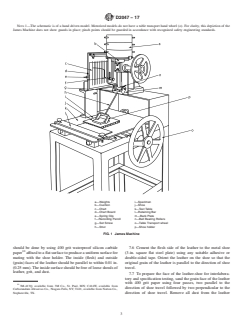
5.1 James Machine —See Fig. 1.
5.2 Shoe Material —For interlaboratory and specification testing the shoe material shall be leather, conforming to Federal
Specification KK-L-165C. Other materials commonly employed as footwear sole or heel material may be used. However, it should
be understood that the 0.5 static coefficient of friction compliance criterion value is not relevant when such materials are substituted
for the specification leather (Notes 2 and 3). To date, compliance criterion values for polish interfaces with other shoe materials
have not been determined with respect to establishing minimum requirements for nonhazardous walkways. If a standard rubber
shoe material is required, the test rubber should be in accordance with Test Method D1630.
NOTE 3—The static coefficient of friction measured with elastomeric compositions are frequently as much as 0.3 to 0.5 higher than leather.
7 8 9
5.3 Substrate—For interlaboratory and specification testing, OVCT , wood panels , or standard ceramic tiles shall be used.
5.3.1 If substrates other than the above standards are to be used, they should be of uniform porosity and free of surface
irregularities which would interlock the shoe material with the surface or otherwise impede smooth sliding of the shoe over the
film surface.
Assembled, motorized machines are available from Michelman, Inc., 9080 Shell Road, Cincinnati, OH 45236–1229. Assembled, non-motorized machines are available
from Quadra, Inc., 1833 Oakdale Ave., Racine, WI 53405. Engineering/machinist drawings are available from Consumer Specialty Products Association, 900 17th Street NW,
Washington, DC 20006. These are the sole sources of supply of the apparatus known to the committee at this time. If you are aware of alternative suppliers, please provide
this information to ASTM International Headquarters. Your comments will receive careful consideration at a meeting of the responsible technical committee, which you may
attend.
Precut The sole source of supply of the precut specification leather material known to the committee at this time is available from Consumer Specialty Products
Association , 900 17th Street NW, Washington DC 20006. If you are aware of alternative suppliers, please provide this information to ASTM International Headquarters. Your
comments will receive careful consideration at a meeting of the responsible technical committee, which you may attend.
OVCT, Official Vinyl Composition Tile, is available from Consumer Specialty Products Association, 900 17th Street NW, Washington, DC 20006.OVCT tile may be
obtained through Armstrong Flooring from various home improvement stores. The following Armstrong tile substrates have been found suitable to perform adequately for
this test method: Armstrong Excelon Feature Tile: Black (56790), http://www. armstrong.com/commflooringna/product_details_toolbox_magnify.jsp?item_id=47394.
Wood panels may be constructed from assembled Rock Maple shorts (Second Grade, or better), available from Robbins, Inc., 4777 Eastern Ave., Cincinnati, OH 45226,
or from local distributors for Bruce Hardwood Floors, or Harris-Tarkett Floors. Alternatively, panels may be cut from 3/4 in. (19.1 mm) furniture grade maple veneer plywood,
available from local lumberyards or millworks.
Available from the Tile Council of America, P.O. Box 1787, Clemson, SC 29633. The tiles should be prepared for coating in accordance with the procedure in Test Method
C1028.
D2047 − 17
NOTE 1—The schematic is of a hand driven model. Motorized models do not have a table transport hand wheel (o). For clarity, this depiction of the
James Machine does not show guards in place; pinch points should be g
...