

ASTM F851-87(2020)
(Test Method)Standard Test Method for Self-Rising Seat Mechanisms
General Information
- Abstract
SIGNIFICANCE AND USE
3.1 This test method provides the criteria for a practical, reproducible test for assuring the proper life-cycle of self-rising or automatic-lifting seat mechanisms of chairs.
3.2 This test method should be considered suitable for the testing required for design purposes, manufacturing control, service evaluation, specification acceptance, and regulatory statutes.
SCOPE
1.1 This test method evaluates the performance of self-rising or automatic-lifting seat mechanisms of chairs in places of assembly.
1.2 This test method addresses only the raising of the seat. It does not address the load that may be placed on that seat. Committee F15 is considering a standard addressing this load.
1.3 The values as stated in inch-pound units are to be regarded as the standard. The values in parentheses are provided for information only.
1.4 This standard does not purport to address all of the safety concerns, if any, associated with its use. It is the responsibility of the user of this standard to establish appropriate safety, health, and environmental practices and determine the applicability of regulatory limitations prior to use.
1.5 This international standard was developed in accordance with internationally recognized principles on standardization established in the Decision on Principles for the Development of International Standards, Guides and Recommendations issued by the World Trade Organization Technical Barriers to Trade (TBT) Committee.
- Status
- Published
- Publication Date
- 30-Apr-2020
- Technical Committee
- F15 - Consumer Products
- Drafting Committee
- F15.23 - Auditorium Seating


Overview
ASTM F851-87(2020), titled Standard Test Method for Self-Rising Seat Mechanisms, provides a comprehensive and practical procedure for evaluating the performance and life-cycle reliability of self-rising or automatic-lifting seat mechanisms in chairs. Developed by ASTM International, this standard is widely recognized for ensuring that self-rising seat mechanisms-commonly used in assembly spaces like auditoriums, theaters, and stadiums-meet stringent durability and performance requirements. By following this reproducible test method, manufacturers, designers, and regulators can confidently assess the quality and functionality of seat-lifting mechanisms to ensure safe and long-lasting operation.
Key Topics
Test Scope and Purpose
- Focuses exclusively on the lifting mechanism of self-rising seat assemblies
- Does not evaluate load-bearing capabilities; a separate standard for that is under consideration
Test Procedure
- Utilizes an apparatus with motor-powered rotating arms and rollers to simulate seat operations
- Seats are repeatedly lowered and allowed to return automatically to the raised position for a specified number of cycles (typically 100,000), replicating long-term use
Sampling
- Requires three randomly selected seat mechanisms from a standard production run
- Ensures that all specimens represent typical manufacturing processes and materials
Pass/Fail Criteria
- Mechanism must complete 100,000 cycles within 14 calendar days without failure
- Dimensional deviation of the seat in the raised position must not exceed 1/2 inch (38.1 mm) from the original placement
Reporting
- Test reports must include details such as manufacturer, model, test dates, apparatus description, cycle count, and any measurement deviations
Units of Measurement
- Inch-pound units are the standard, with metric values provided for reference
International Compliance
- Developed in line with globally recognized standardization principles, supporting regulatory acceptance and market access
Applications
ASTM F851-87(2020) is essential in settings where self-rising seats are subject to frequent and long-term use, such as:
- Auditoriums and Theaters: Validates mechanisms for seating that requires automatic lift for safety and cleaning
- Stadiums and Arenas: Ensures seat mechanisms withstand heavy usage over years of events
- Lecture Halls and Assembly Spaces: Supports maintenance and operational reliability for high-traffic institutional seating
Practical uses include:
- Design Validation: Aids manufacturers and designers in verifying new or modified seat mechanisms before market launch
- Quality Control: Supports ongoing testing to ensure consistency during mass production
- Service Evaluation: Helps facilities managers assess the longevity and effectiveness of existing seating installations
- Specification Acceptance: Facilitates procurement by offering clear, reproducible test results for bid compliance
- Regulatory Compliance: Ensures products meet safety, durability, and performance requirements for approval in various jurisdictions
Related Standards
- ASTM F851-87(2020) is part of a wider family of ASTM standards for seating, particularly those overseen by Committee F15 on Consumer Products and Subcommittee F15.23 on Auditorium Seating.
- Additional standards (in development or existing) may address related aspects such as seat load capacity or specific safety considerations.
- The standard is developed to align with the World Trade Organization’s TBT Committee principles on international standardization, enhancing its applicability for global markets.
By adhering to ASTM F851-87(2020), manufacturers and facility operators can ensure their self-rising seat mechanisms offer reliable, long-lasting, and safe performance for users.
Relations
- Effective Date
- 01-May-2020
Get Certified
Connect with accredited certification bodies for this standard

TÜV Rheinland
TÜV Rheinland is a leading international provider of technical services.

TÜV SÜD
TÜV SÜD is a trusted partner of choice for safety, security and sustainability solutions.

DEKRA Certification Inc.
DEKRA US certification services.
Sponsored listings
Frequently Asked Questions
ASTM F851-87(2020) is a standard published by ASTM International. Its full title is "Standard Test Method for Self-Rising Seat Mechanisms". This standard covers: SIGNIFICANCE AND USE 3.1 This test method provides the criteria for a practical, reproducible test for assuring the proper life-cycle of self-rising or automatic-lifting seat mechanisms of chairs. 3.2 This test method should be considered suitable for the testing required for design purposes, manufacturing control, service evaluation, specification acceptance, and regulatory statutes. SCOPE 1.1 This test method evaluates the performance of self-rising or automatic-lifting seat mechanisms of chairs in places of assembly. 1.2 This test method addresses only the raising of the seat. It does not address the load that may be placed on that seat. Committee F15 is considering a standard addressing this load. 1.3 The values as stated in inch-pound units are to be regarded as the standard. The values in parentheses are provided for information only. 1.4 This standard does not purport to address all of the safety concerns, if any, associated with its use. It is the responsibility of the user of this standard to establish appropriate safety, health, and environmental practices and determine the applicability of regulatory limitations prior to use. 1.5 This international standard was developed in accordance with internationally recognized principles on standardization established in the Decision on Principles for the Development of International Standards, Guides and Recommendations issued by the World Trade Organization Technical Barriers to Trade (TBT) Committee.
SIGNIFICANCE AND USE 3.1 This test method provides the criteria for a practical, reproducible test for assuring the proper life-cycle of self-rising or automatic-lifting seat mechanisms of chairs. 3.2 This test method should be considered suitable for the testing required for design purposes, manufacturing control, service evaluation, specification acceptance, and regulatory statutes. SCOPE 1.1 This test method evaluates the performance of self-rising or automatic-lifting seat mechanisms of chairs in places of assembly. 1.2 This test method addresses only the raising of the seat. It does not address the load that may be placed on that seat. Committee F15 is considering a standard addressing this load. 1.3 The values as stated in inch-pound units are to be regarded as the standard. The values in parentheses are provided for information only. 1.4 This standard does not purport to address all of the safety concerns, if any, associated with its use. It is the responsibility of the user of this standard to establish appropriate safety, health, and environmental practices and determine the applicability of regulatory limitations prior to use. 1.5 This international standard was developed in accordance with internationally recognized principles on standardization established in the Decision on Principles for the Development of International Standards, Guides and Recommendations issued by the World Trade Organization Technical Barriers to Trade (TBT) Committee.
ASTM F851-87(2020) is classified under the following ICS (International Classification for Standards) categories: 43.040.60 - Bodies and body components. The ICS classification helps identify the subject area and facilitates finding related standards.
ASTM F851-87(2020) has the following relationships with other standards: It is inter standard links to ASTM F851-87(2013). Understanding these relationships helps ensure you are using the most current and applicable version of the standard.
ASTM F851-87(2020) is available in PDF format for immediate download after purchase. The document can be added to your cart and obtained through the secure checkout process. Digital delivery ensures instant access to the complete standard document.
Standards Content (Sample)
This international standard was developed in accordance with internationally recognized principles on standardization established in the Decision on Principles for the
Development of International Standards, Guides and Recommendations issued by the World Trade Organization Technical Barriers to Trade (TBT) Committee.
Designation: F851 − 87 (Reapproved 2020)
Standard Test Method for
Self-Rising Seat Mechanisms
ThisstandardisissuedunderthefixeddesignationF851;thenumberimmediatelyfollowingthedesignationindicatestheyearoforiginal
adoption or, in the case of revision, the year of last revision.Anumber in parentheses indicates the year of last reapproval.Asuperscript
epsilon (´) indicates an editorial change since the last revision or reapproval.
1. Scope 3. Significance and Use
1.1 This test method evaluates the performance of self- 3.1 This test method provides the criteria for a practical,
rising or automatic-lifting seat mechanisms of chairs in places reproducibletestforassuringtheproperlife-cycleofself-rising
of assembly. or automatic-lifting seat mechanisms of chairs.
1.2 This test method addresses only the raising of the seat. 3.2 This test method should be considered suitable for the
It does not address the load that may be placed on that seat. testing required for design purposes, manufacturing control,
Committee F15 is considering a standard addressing this load. service evaluation, specification acceptance, and regulatory
statutes.
1.3 The values as stated in inch-pound units are to be
regarded as the standard. The values in parentheses are
4. Apparatus
provided for information only.
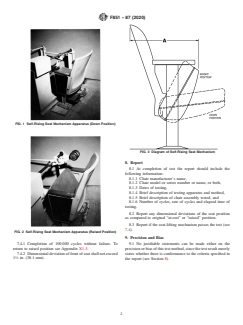
4.1 A representative apparatus capable of performing this
1.4 This standard does not purport to address all of the
test is shown in Figs. 1 and 2. This unit consists of a
safety concerns, if any, associated with its use. It is the
motor-powered rotating arm with adjustable length and two
responsibility of the user of this standard to establish appro-
3 ⁄2-in. (88.9 mm) roller wheels fastened to the end of the arm.
priate safety, health, and environmental practices and deter-
4.2 Other suitable apparatus may be used.
mine the applicability of regulatory limitations prior to use.
1.5 This international standard was developed in accor-
5. Sampling
dance with internationally recognized principles on standard-
ization established in the Decision on Principles for the
5.1 Test Specimen—Each test specimen shall consist of a
Development of International Standards, Guides and Recom-
self-rising seat mechanism contained in a single chair.
mendations issued by the World Trade Organization Technical
5.2 Sample Size—The sample size shall consist of three test
Barriers to Trade (TBT) Committee.
specimens selected at random from a standard production run
(see Appendix X1.1). All components of the test specimens
2. Summary of Test Method
must be manufactured using that manufacturer’s standard
2.1 The principle of the test method is to test the reliability
materials, methods, and design.
of the seat-lifting mechanism.
2.2 This test method consists of using hard rubber rollers 6. Specimen Preparation
attached dually to the end of an actuating bar to lower the seat.
6.1 Assemble and mount the test specimen to simulate
Theseatisthenreleasedandallowedtoliftautomaticallytothe
installation conditions, following manufacturer’s assembly in-
“at-rest” or “raised” position. The test method requires the seat
structions. Record dimensional position of seat in “raised”
to be cycled at a specified rate, and allows for the number of
position relative to the back of the chair (see Fig. 3).
cycles completed, without failure, to be measured.
7. Procedure
2.3 The “at-rest” position for an auditorium chair is the
“raised” position. The seat is lowered to allow the occupant to
7.1 Design the apparatus to lower the seat to its complete
be seated. When released, the seat is automatically returned to
“down” position.
the “raised” position by use of a spring return mechanism or
7.2 The apparatus then releases the seat. This allows the
counter-weight for gravity lift (see Figs. 1 and 2).
seat-lifting mechanism to function, returning the seat to the
“at-rest” or “raised” position, completing one cycle.
This test method is under the jurisdiction of ASTM Committee F15 on
7.3 Continue for 100 000 cycles to be completed within a
Consumer Products and is the direct responsibility of Subcommittee F15.23 on
Auditorium Seating. period not to exceed 14 calendar days (see Appendix X1.2).
Current edition approved May 1, 2020. Published May 2020. Originally
7.4 The seat-lifting mechanism passes the test if the three
approved in 1983. Last previous edition approved in 2013 as F851 – 87 (2013).
DOI: 10.1520/F0851-87R20. specimens meet the following conditions:
Copyright © ASTM International, 100 Barr Harbor Drive, PO Box C700, West Conshohocken, PA 19428-2959. United States
F851 − 87 (2020)
FIG. 1 Self-Rising Seat Mechanis
...