

ASTM D5132-20
(Test Method)Standard Test Method for Horizontal Burning Rate of Polymeric Materials Used in Occupant Compartments of Motor Vehicles
General Information
- Abstract
SIGNIFICANCE AND USE
5.1 This test method provides a standard laboratory procedure for measuring and comparing the burning rates of polymeric materials under specified controlled conditions.
5.2 The rate of burning is affected by such factors as density, direction of rise, and type and amount of surface treatments. The thickness of the finished specimens must also be taken into account. These factors must be considered in order to compare materials on the same basis.
5.3 In this procedure, the specimens are subjected to one or more specific sets of laboratory test conditions. If different test conditions are substituted or the end-use conditions are changed, it is not always possible by or from this test method to predict changes in the fire-test-response characteristics measured. Therefore, the results are valid only for the fire test exposure conditions described in this procedure.
SCOPE
1.1 This test method is intended for use as a small-scale laboratory procedure for comparing the relative horizontal burning rates of polymeric materials used in occupant compartments of motor vehicles.
1.2 During the course of combustion, gases or vapors, or both, are evolved that are potentially hazardous to personnel. Adequate precautions shall be taken to protect the operator.
1.3 Units—The values stated in SI units are to be regarded as standard.
1.4 This test method, Federal Safety Standard MVSS 302, SAE J369, and ISO 3795 address the same subject matter, but differ in technical content.
1.5 This standard is used to measure and describe the response of materials, products, or assemblies to heat and flame under controlled conditions, but does not by itself incorporate all factors required for fire hazards or fire risk assessment of materials, products, or assemblies under actual fire conditions.
1.6 This standard does not purport to address all of the safety concerns, if any, associated with its use. It is the responsibility of the user of this standard to establish appropriate safety, health, and environmental practices and determine the applicability of regulatory limitations prior to use. Specific hazard statements are given in Section 7.
1.7 Fire testing is inherently hazardous. Adequate safeguards for personnel and property shall be employed in conducting these tests.
Note 1: There is no known ISO equivalent to this standard.
1.8 This international standard was developed in accordance with internationally recognized principles on standardization established in the Decision on Principles for the Development of International Standards, Guides and Recommendations issued by the World Trade Organization Technical Barriers to Trade (TBT) Committee.
- Status
- Published
- Publication Date
- 31-Jan-2020
- Technical Committee
- D20 - Plastics
- Drafting Committee
- D20.30 - Thermal Properties
Buy Documents
ASTM D5132-20 - Standard Test Method for Horizontal Burning Rate of Polymeric Materials Used in Occupant Compartments of Motor Vehicles
REDLINE ASTM D5132-20 - Standard Test Method for Horizontal Burning Rate of Polymeric Materials Used in Occupant Compartments of Motor Vehicles
Overview
ASTM D5132-20 is the Standard Test Method for Horizontal Burning Rate of Polymeric Materials Used in Occupant Compartments of Motor Vehicles, published by ASTM International. This standard establishes a small-scale laboratory procedure to measure and compare the horizontal burning rate of polymeric materials, particularly those installed in vehicle interiors. The focus is on evaluating material behavior under controlled conditions simulating fire exposure, thereby supporting materials selection and safety compliance for manufacturers and suppliers in the automotive industry.
Key Topics
- Horizontal Burning Rate: The standard specifically addresses the determination of the horizontal burning rate, providing a consistent basis for evaluating and comparing the flammability of plastics and other polymeric materials used in motor vehicle occupant compartments.
- Material and Specimen Considerations: Factors such as specimen density, orientation, thickness, and surface treatments can affect the burning rate. These must be carefully controlled and documented to ensure the validity and comparability of test results.
- Test Method Overview:
- Specimens are cut from uniform, representative sections of the material up to 13 mm thick.
- The test involves exposing the sample to a prescribed flame and measuring the distance burned within a set time.
- Reporting: Results are reported as burning rate (mm/min), along with observations on burning characteristics such as melting, dripping, or charring. Details regarding material type, conditioning, preparation, and testing directionality must also be included.
- Safety and Hazards: Combustion of materials can emit hazardous gases or vapors. Proper laboratory safety practices and controls must be in place to protect personnel and property during testing.
- Applicability: While the test provides standardized data for controlled conditions, results are specific to the test environment and may not directly translate to real-world fire risk assessments.
Applications
- Automotive Material Selection: Manufacturers use ASTM D5132-20 to verify that plastics and synthetic materials intended for vehicle interiors meet required horizontal burning rate thresholds, supporting regulatory and safety compliance.
- Product Development and Quality Assurance: Material developers rely on this method when screening new formulations or treatments to ensure fire safety performance of interior components.
- Regulatory Compliance: The test is commonly referenced for demonstrating adherence to national and international vehicle safety regulations relating to interior flammability.
- Comparative Analysis: Enables direct comparison of the fire response among different polymeric materials and configurations under standardized conditions.
Related Standards
- Federal Motor Vehicle Safety Standard (FMVSS) 302: This U.S. regulation covers the flammability of materials used in the occupant compartments of vehicles.
- SAE J369: Provides a similar horizontal test method for flammability of polymeric interior materials.
- ISO 3795: International standard for determining the burning behavior of interior materials in road vehicles, as well as tractors and agricultural machinery.
- ASTM D883, ASTM D5025, ASTM E176, ASTM E456, and ASTM E691: Referenced for terminology, test apparatus specification, and statistical practices.
- ISO 13943: Provides fire safety vocabulary relevant to numerous standards.
Practical Value
ASTM D5132-20 plays a critical role in fire safety and regulatory processes for automotive interiors. By standardizing the method for measuring horizontal burning rate, it aids manufacturers, test laboratories, and regulatory agencies in ensuring that motor vehicle occupant compartment materials meet rigorous safety requirements. Effective use of this standard helps reduce fire hazards, enhances passenger safety, and facilitates compliance with essential flammability performance benchmarks.
Relations
- Effective Date
- 01-Feb-2020
- Effective Date
- 01-Feb-2024
- Effective Date
- 01-Jan-2024
- Effective Date
- 01-Nov-2023
- Effective Date
- 01-Apr-2022
- Effective Date
- 01-Mar-2020
- Effective Date
- 01-Feb-2020
- Effective Date
- 01-Jan-2020
- Effective Date
- 01-Aug-2019
- Effective Date
- 15-Apr-2019
- Effective Date
- 01-Feb-2019
- Effective Date
- 15-Dec-2018
- Effective Date
- 01-Dec-2018
- Effective Date
- 01-Nov-2018
- Effective Date
- 01-Mar-2018
Buy Documents
ASTM D5132-20 - Standard Test Method for Horizontal Burning Rate of Polymeric Materials Used in Occupant Compartments of Motor Vehicles
REDLINE ASTM D5132-20 - Standard Test Method for Horizontal Burning Rate of Polymeric Materials Used in Occupant Compartments of Motor Vehicles
Get Certified
Connect with accredited certification bodies for this standard

TÜV Rheinland
TÜV Rheinland is a leading international provider of technical services.

TÜV SÜD
TÜV SÜD is a trusted partner of choice for safety, security and sustainability solutions.

Control Union Certifications
Global certification for agriculture and sustainability.
Sponsored listings
Frequently Asked Questions
ASTM D5132-20 is a standard published by ASTM International. Its full title is "Standard Test Method for Horizontal Burning Rate of Polymeric Materials Used in Occupant Compartments of Motor Vehicles". This standard covers: SIGNIFICANCE AND USE 5.1 This test method provides a standard laboratory procedure for measuring and comparing the burning rates of polymeric materials under specified controlled conditions. 5.2 The rate of burning is affected by such factors as density, direction of rise, and type and amount of surface treatments. The thickness of the finished specimens must also be taken into account. These factors must be considered in order to compare materials on the same basis. 5.3 In this procedure, the specimens are subjected to one or more specific sets of laboratory test conditions. If different test conditions are substituted or the end-use conditions are changed, it is not always possible by or from this test method to predict changes in the fire-test-response characteristics measured. Therefore, the results are valid only for the fire test exposure conditions described in this procedure. SCOPE 1.1 This test method is intended for use as a small-scale laboratory procedure for comparing the relative horizontal burning rates of polymeric materials used in occupant compartments of motor vehicles. 1.2 During the course of combustion, gases or vapors, or both, are evolved that are potentially hazardous to personnel. Adequate precautions shall be taken to protect the operator. 1.3 Units—The values stated in SI units are to be regarded as standard. 1.4 This test method, Federal Safety Standard MVSS 302, SAE J369, and ISO 3795 address the same subject matter, but differ in technical content. 1.5 This standard is used to measure and describe the response of materials, products, or assemblies to heat and flame under controlled conditions, but does not by itself incorporate all factors required for fire hazards or fire risk assessment of materials, products, or assemblies under actual fire conditions. 1.6 This standard does not purport to address all of the safety concerns, if any, associated with its use. It is the responsibility of the user of this standard to establish appropriate safety, health, and environmental practices and determine the applicability of regulatory limitations prior to use. Specific hazard statements are given in Section 7. 1.7 Fire testing is inherently hazardous. Adequate safeguards for personnel and property shall be employed in conducting these tests. Note 1: There is no known ISO equivalent to this standard. 1.8 This international standard was developed in accordance with internationally recognized principles on standardization established in the Decision on Principles for the Development of International Standards, Guides and Recommendations issued by the World Trade Organization Technical Barriers to Trade (TBT) Committee.
SIGNIFICANCE AND USE 5.1 This test method provides a standard laboratory procedure for measuring and comparing the burning rates of polymeric materials under specified controlled conditions. 5.2 The rate of burning is affected by such factors as density, direction of rise, and type and amount of surface treatments. The thickness of the finished specimens must also be taken into account. These factors must be considered in order to compare materials on the same basis. 5.3 In this procedure, the specimens are subjected to one or more specific sets of laboratory test conditions. If different test conditions are substituted or the end-use conditions are changed, it is not always possible by or from this test method to predict changes in the fire-test-response characteristics measured. Therefore, the results are valid only for the fire test exposure conditions described in this procedure. SCOPE 1.1 This test method is intended for use as a small-scale laboratory procedure for comparing the relative horizontal burning rates of polymeric materials used in occupant compartments of motor vehicles. 1.2 During the course of combustion, gases or vapors, or both, are evolved that are potentially hazardous to personnel. Adequate precautions shall be taken to protect the operator. 1.3 Units—The values stated in SI units are to be regarded as standard. 1.4 This test method, Federal Safety Standard MVSS 302, SAE J369, and ISO 3795 address the same subject matter, but differ in technical content. 1.5 This standard is used to measure and describe the response of materials, products, or assemblies to heat and flame under controlled conditions, but does not by itself incorporate all factors required for fire hazards or fire risk assessment of materials, products, or assemblies under actual fire conditions. 1.6 This standard does not purport to address all of the safety concerns, if any, associated with its use. It is the responsibility of the user of this standard to establish appropriate safety, health, and environmental practices and determine the applicability of regulatory limitations prior to use. Specific hazard statements are given in Section 7. 1.7 Fire testing is inherently hazardous. Adequate safeguards for personnel and property shall be employed in conducting these tests. Note 1: There is no known ISO equivalent to this standard. 1.8 This international standard was developed in accordance with internationally recognized principles on standardization established in the Decision on Principles for the Development of International Standards, Guides and Recommendations issued by the World Trade Organization Technical Barriers to Trade (TBT) Committee.
ASTM D5132-20 is classified under the following ICS (International Classification for Standards) categories: 13.220.40 - Ignitability and burning behaviour of materials and products; 43.040.60 - Bodies and body components; 65.060.10 - Agricultural tractors and trailed vehicles. The ICS classification helps identify the subject area and facilitates finding related standards.
ASTM D5132-20 has the following relationships with other standards: It is inter standard links to ASTM D5132-19, ASTM D883-24, ASTM E176-24, ASTM D883-23, ASTM E456-13a(2022)e1, ASTM D5025-20a, ASTM D5025-20, ASTM D883-20, ASTM D883-19c, ASTM D883-19a, ASTM D883-19, ASTM E176-18a, ASTM D883-18a, ASTM D883-18, ASTM E176-18. Understanding these relationships helps ensure you are using the most current and applicable version of the standard.
ASTM D5132-20 is available in PDF format for immediate download after purchase. The document can be added to your cart and obtained through the secure checkout process. Digital delivery ensures instant access to the complete standard document.
Standards Content (Sample)
This international standard was developed in accordance with internationally recognized principles on standardization established in the Decision on Principles for the
Development of International Standards, Guides and Recommendations issued by the World Trade Organization Technical Barriers to Trade (TBT) Committee.
Designation: D5132 − 20
Standard Test Method for
Horizontal Burning Rate of Polymeric Materials Used in
Occupant Compartments of Motor Vehicles
This standard is issued under the fixed designation D5132; the number immediately following the designation indicates the year of
original adoption or, in the case of revision, the year of last revision. A number in parentheses indicates the year of last reapproval. A
superscript epsilon (´) indicates an editorial change since the last revision or reapproval.
1. Scope* 2. Referenced Documents
1.1 This test method is intended for use as a small-scale 2.1 ASTM Standards:
laboratory procedure for comparing the relative horizontal D883 Terminology Relating to Plastics
burning rates of polymeric materials used in occupant com- D5025 Specification for Laboratory Burner Used for Small-
partments of motor vehicles. Scale Burning Tests on Plastic Materials
E176 Terminology of Fire Standards
1.2 During the course of combustion, gases or vapors, or
E456 Terminology Relating to Quality and Statistics
both, are evolved that are potentially hazardous to personnel.
E691 Practice for Conducting an Interlaboratory Study to
Adequate precautions shall be taken to protect the operator.
Determine the Precision of a Test Method
1.3 Units—The values stated in SI units are to be regarded
E2935 Practice for Conducting Equivalence Testing in
as standard.
Laboratory Applications
1.4 This test method, Federal Safety Standard MVSS 302,
2.2 Federal Safety Standard:
SAE J369, and ISO 3795 address the same subject matter, but
MVSS 302 (49 CFR 571.302) Flammability of Interior
differ in technical content.
Materials-Passenger Cars, Multipurpose Passenger
Vehicles, Trucks and Buses
1.5 This standard is used to measure and describe the
response of materials, products, or assemblies to heat and
2.3 SAE Standard:
flame under controlled conditions, but does not by itself
SAE J369 Flammability of Polymeric Interior Materials -
incorporate all factors required for fire hazards or fire risk
Horizontal Test Method
assessment of materials, products, or assemblies under actual
2.4 ISO Standard:
fire conditions.
ISO 3795 Road vehicles, and tractors and machinery for
1.6 This standard does not purport to address all of the
agriculture and forestry—Determination of burning be-
safety concerns, if any, associated with its use. It is the
havior of interior materials
responsibility of the user of this standard to establish appro-
ISO 13943 Fire Safety—Vocabulary
priate safety, health, and environmental practices and deter-
mine the applicability of regulatory limitations prior to use.
3. Terminology
Specific hazard statements are given in Section 7.
3.1 Definitions—For definitions of terms relating to plastics,
1.7 Fire testing is inherently hazardous. Adequate safe-
the definitions in this test method are in accordance with
guards for personnel and property shall be employed in
Terminology D883. For terms relating to fire, the definitions in
conducting these tests.
this test method are in accordance with Terminology E176 and
NOTE 1—There is no known ISO equivalent to this standard.
ISO 13943. In case of conflict, the definitions given in
1.8 This international standard was developed in accor-
Terminology E176 shall prevail. For terms relating to precision
dance with internationally recognized principles on standard-
ization established in the Decision on Principles for the
Development of International Standards, Guides and Recom-
For referenced ASTM standards, visit the ASTM website, www.astm.org, or
mendations issued by the World Trade Organization Technical
contact ASTM Customer Service at service@astm.org. For Annual Book of ASTM
Barriers to Trade (TBT) Committee.
Standards volume information, refer to the standard’s Document Summary page on
the ASTM website.
United States Code of Federal Regulations, 49 CFR 571.302, 36 FR 28991,
This test method is under the jurisdiction ofASTM Committee D20 on Plastics available from Superintendent of Documents, U.S. Government Printing Office,
and is the direct responsibility of Subcommittee D20.30 on Thermal Properties. Washington, DC 20402.
Current edition approved Feb. 1, 2020. Published March 2020. Originally Available from Society of Automotive Engineers (SAE), 400 Commonwealth
approved in 1990. Last previous edition approved in 2019 as D5132 – 19. DOI: Dr., Warrendale, PA 15096-0001.
10.1520/D5132-20.
*A Summary of Changes section appears at the end of this standard
Copyright © ASTM International, 100 Barr Harbor Drive, PO Box C700, West Conshohocken, PA 19428-2959. United States
D5132 − 20
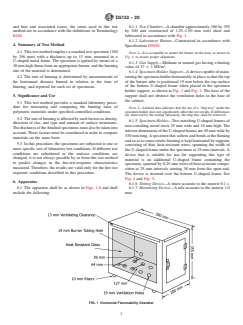
and bias and associated issues, the terms used in this test 6.1.1 Test Chamber—Achamber approximately 380 by 355
method are in accordance with the definitions in Terminology by 200 mm constructed of 1.25–1.50 mm steel sheet and
E456. fabricated in accordance with Fig. 1.
6.1.2 Laboratory Burner—Constructed in accordance with
4. Summary of Test Method
Specification D5025.
4.1 This test method employs a standard test specimen (100
NOTE 2—It is acceptable to mount the burner on the door, as shown in
by 356 mm) with a thickness up to 13 mm, mounted in a Fig. 6, to ensure proper alignment.
U-shaped metal frame. The specimen is ignited by means of a
6.1.3 Gas Supply—Methane or natural gas having a heating
38 mm high flame from an appropriate burner, and the burning
value of 37 6 1 MJ/m .
rate of the material is determined.
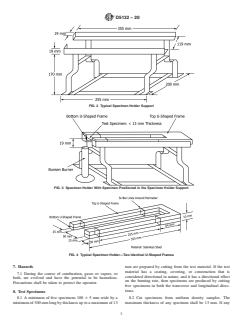
6.1.4 Specimen Holder Support—Adevice capable of main-
tainingthespecimenholderhorizontallyinplacesothatthetop
4.2 The rate of burning is determined by measurements of
of the burner tube is positioned 19 mm below the top surface
the horizontal distance burned in relation to the time of
of the bottom U-shaped frame when placed in the specimen
burning, and reported for each set of specimens.
holder support, as shown in Fig. 2 and Fig. 3. The base of the
5. Significance and Use support shall not obstruct the ventilation holes in the base of
the cabinet.
5.1 This test method provides a standard laboratory proce-
dure for measuring and comparing the burning rates of
NOTE 3—Limited data indicates that the use of a “drip tray” under the
specimen holder does not significantly affect the test results. If differences
polymeric materials under specified controlled conditions.
are observed by the testing laboratory, the drip tray shall be removed.
5.2 Therateofburningisaffectedbysuchfactorsasdensity,
6.1.5 Specimen Holder—Two matching U-shaped frames of
direction of rise, and type and amount of surface treatments.
non-corroding metal stock 25 mm wide and 10 mm high. The
Thethicknessofthefinishedspecimensmustalsobetakeninto
interior dimensions of the U-shaped frames are 50 mm wide by
account. These factors must be considered in order to compare
330 mm long.Aspecimen that softens and bends at the flaming
materials on the same basis.
endsoastocauseerraticburningiskepthorizontalbysupports
5.3 In this procedure, the specimens are subjected to one or
consisting of thin, heat-resistant wires, spanning the width of
more specific sets of laboratory test conditions. If different test
the U-shaped frame under the specimen at 25-mm intervals.A
conditions are substituted or the end-use conditions are
device that is suitable for use for supporting this type of
changed, it is not always possible by or from this test method
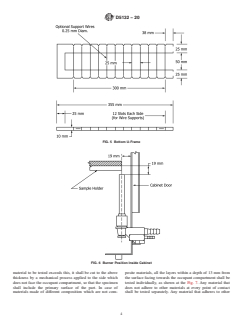
material is an additional U-shaped frame containing the
to predict changes in the fire-test-response characteristics
specimen, spanned by 0.25-mm wires of heat-resistant compo-
measured. Therefore, the results are valid only for the fire test
sition at 25 mm intervals starting 38 mm from the open end.
exposure conditions described in this procedure.
The device is inserted over the bottom U-shaped frame. See
Fig. 4 and Fig. 5.
6. Apparatus
6.1.6 Timing Device—A timer accurate to the nearest 0.1 s.
6.1 The apparatus shall be as shown in Figs. 1-6 and shall 6.1.7 Measuring Device—A rule accurate to the nearest 1.0
include the following: mm.
FIG. 1 Horizontal Flammability Chamber
D5132 − 20
FIG. 2 Typical Specimen Holder Support
FIG. 3 Specimen Holder With Specimen Positioned in the Specimen Holder Support
FIG. 4 Typical Specimen Holder—Two Identical U-Shaped Frames
7. Hazards mm are prepared by cutting from the test material. If the test
material has a coating, covering, or construction that is
7.1 During the course of combustion, gases or vapors, or
considered directional in nature, and it has a directional effect
both, are evolved and have the potential to be hazardous.
on the burning rate, then specimens are produced by cutting
Precautions shall be taken to protect the operator.
five specimens in both the transverse and longitudinal direc-
tions.
8. Test Specimens
8.1 A minimum of five specimens 100 6 5 mm wide by a 8.2 Cut specimens from uniform density samples. The
minimumof300mmlongbythicknessuptoamaximumof13 maximum thickness of any specimen shall be 13 mm. If any
D5132 − 20
FIG. 5 Bottom U-Frame
FIG. 6 Burner Position Inside Cabinet
material to be tested exceeds this, it shall be cut to the above posite materials, all the layers within a depth of 13 mm from
thickness by a mechanical process applied to the side which the surface facing towards the occupant compartment shall be
does not face the occupant compartment, so that the specimen tested individually, as shown at the Fig. 7. Any material that
shall include the primary surface of the part. In case of does not adhere to other materials at every point of contact
materials made of different composition which are not com- shall be tested separately. Any material that adheres to other
D5132 − 20
NOTE 1—Material A has a non-adhering interface with material B and is tested separately. Part of material B is within 13.0 mm of the occupant
compartment air space, and materials B and C adhere at every point of contact; therefore B and C are tested as a composite. The cut is in material C as
shown, to make a specimen 13.0 mm thick.
FIG. 7 Specimen Preparation (Illustrative Example)
materials at every point of contact shall be tested as a 10.2 Place samples with napped or tufted surface on a flat
composite with other material(s). Record the information on surface and comb twice against the nap using the metal comb
specimen preparation in the test report.
at least 110 mm in length, with seven to eight teeth per 25 mm.
8.3 Where it is not possible to obtain a flat specimen
10.3 Place the test specimen between the two matching
because of the component configuration, cut the specimen to
U-shaped frames so that the frames hold both long sides and
the maximum thickness of 13 mm at any point, from the area
one end of the specimen.
with the least curvature, and in such a manner as to include the
10.4 Place the burner remote from t
...
This document is not an ASTM standard and is intended only to provide the user of an ASTM standard an indication of what changes have been made to the previous version. Because
it may not be technically possible to adequately depict all changes accurately, ASTM recommends that users consult prior editions as appropriate. In all cases only the current version
of the standard as published by ASTM is to be considered the official document.
Designation: D5132 − 19 D5132 − 20
Standard Test Method for
Horizontal Burning Rate of Polymeric Materials Used in
Occupant Compartments of Motor Vehicles
This standard is issued under the fixed designation D5132; the number immediately following the designation indicates the year of
original adoption or, in the case of revision, the year of last revision. A number in parentheses indicates the year of last reapproval. A
superscript epsilon (´) indicates an editorial change since the last revision or reapproval.
1. Scope*
1.1 This test method is intended for use as a small-scale laboratory procedure for comparing the relative horizontal burning rates
of polymeric materials used in occupant compartments of motor vehicles.
1.2 During the course of combustion, gases or vapors, or both, are evolved that are potentially hazardous to personnel. Adequate
precautions shall be taken to protect the operator.
1.3 Units—The values stated in SI units are to be regarded as standard.
1.4 This test method, Federal Safety Standard MVSS 302, SAE J369, and ISO 3795 address the same subject matter, but differ
in technical content.
1.5 This standard is used to measure and describe the response of materials, products, or assemblies to heat and flame under
controlled conditions, but does not by itself incorporate all factors required for fire hazards or fire risk assessment of materials,
products, or assemblies under actual fire conditions.
1.6 This standard does not purport to address all of the safety concerns, if any, associated with its use. It is the responsibility
of the user of this standard to establish appropriate safety, health, and environmental practices and determine the applicability of
regulatory limitations prior to use. Specific hazard statements are given in Section 7.
1.7 Fire testing is inherently hazardous. Adequate safeguards for personnel and property shall be employed in conducting these
tests.
NOTE 1—There is no known ISO equivalent to this standard.
1.8 This international standard was developed in accordance with internationally recognized principles on standardization
established in the Decision on Principles for the Development of International Standards, Guides and Recommendations issued
by the World Trade Organization Technical Barriers to Trade (TBT) Committee.
2. Referenced Documents
2.1 ASTM Standards:
D883 Terminology Relating to Plastics
D5025 Specification for Laboratory Burner Used for Small-Scale Burning Tests on Plastic Materials
E176 Terminology of Fire Standards
E456 Terminology Relating to Quality and Statistics
E691 Practice for Conducting an Interlaboratory Study to Determine the Precision of a Test Method
E2935 Practice for Conducting Equivalence Testing in Laboratory Applications
2.2 Federal Safety Standard:
MVSS 302 (49 CFR 571.302) Flammability of Interior Materials-Passenger Cars, Multipurpose Passenger Vehicles, Trucks and
Buses
This test method is under the jurisdiction of ASTM Committee D20 on Plastics and is the direct responsibility of Subcommittee D20.30 on Thermal Properties.
Current edition approved Dec. 1, 2019Feb. 1, 2020. Published January 2020March 2020. Originally approved in 1990. Last previous edition approved in 20172019 as
D5132 – 17.D5132 – 19. DOI: 10.1520/D5132-19.10.1520/D5132-20.
For referenced ASTM standards, visit the ASTM website, www.astm.org, or contact ASTM Customer Service at service@astm.org. For Annual Book of ASTM Standards
volume information, refer to the standard’s Document Summary page on the ASTM website.
United States Code of Federal Regulations, 49 CFR 571.302, 36 FR 28991, available from Superintendent of Documents, U.S. Government Printing Office, Washington,
DC 20402.
*A Summary of Changes section appears at the end of this standard
Copyright © ASTM International, 100 Barr Harbor Drive, PO Box C700, West Conshohocken, PA 19428-2959. United States
D5132 − 20
2.3 SAE Standard:
SAE J369 Flammability of Polymeric Interior Materials - Horizontal Test Method
2.4 ISO Standard:
ISO 3795 Road vehicles, and tractors and machinery for agriculture and forestry—Determination of burning behavior of interior
materials
ISO 13943 Fire Safety—Vocabulary
3. Terminology
3.1 Definitions—Terms used in this standard are defined For definitions of terms relating to plastics, the definitions in this test
method are in accordance with D883,Terminology D883unless otherwise specified. . For terms relating to precision and bias and
associated issues, the terms used in this standard are defined fire, the definitions in this test method are in accordance with
Terminology E456E176. and ISO 13943. In case of conflict, the definitions given in Terminology E176 shall prevail. For terms
relating to fire, precision and bias and associated issues, the terms used in this standard test method are defined in accordance with
the definitions in Terminology E176E456.
4. Summary of Test Method
4.1 This test method employs a standard test specimen (100 by 356 mm) with a thickness up to 13 mm, mounted in a U-shaped
metal frame. The specimen is ignited by means of a 38 mm high flame from an appropriate burner, and the burning rate of the
material is determined.
4.2 The rate of burning is determined by measurements of the horizontal distance burned in relation to the time of burning, and
reported for each set of specimens.
5. Significance and Use
5.1 This test method provides a standard laboratory procedure for measuring and comparing the burning rates of polymeric
materials under specified controlled conditions.
5.2 The rate of burning is affected by such factors as density, direction of rise, and type and amount of surface treatments. The
thickness of the finished specimens must also be taken into account. These factors must be considered in order to compare materials
on the same basis.
5.3 In this procedure, the specimens are subjected to one or more specific sets of laboratory test conditions. If different test
conditions are substituted or the end-use conditions are changed, it is not always possible by or from this test method to predict
changes in the fire-test-response characteristics measured. Therefore, the results are valid only for the fire test exposure conditions
described in this procedure.
FIG. 1 Horizontal Flammability Chamber
Available from Society of Automotive Engineers (SAE), 400 Commonwealth Dr., Warrendale, PA 15096-0001.
Available from International Organization for Standardization (ISO), 1 rue de Varembé, Case postale 56, CH-1211, Geneva 20, Switzerland.
D5132 − 20
6. Apparatus
6.1 The apparatus shall be as shown in Figs. 1-6 and shall include the following:
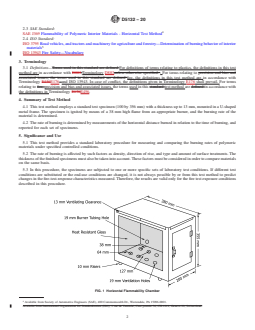
6.1.1 Test Chamber—A chamber approximately 380 by 355 by 200 mm constructed of 1.25–1.50 mm steel sheet and fabricated
in accordance with Fig. 1.
6.1.2 Laboratory Burner—Constructed in accordance with Specification D5025.
NOTE 2—It is acceptable to mount the burner on the door, as shown in Fig. 6, to ensure proper alignment.
6.1.3 Gas Supply—Methane or natural gas having a heating value of 37 6 1 MJ/m .
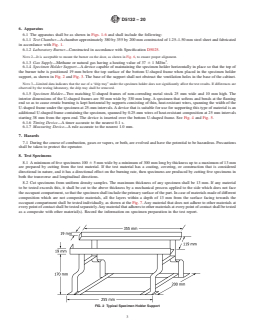
6.1.4 Specimen Holder Support—A device capable of maintaining the specimen holder horizontally in place so that the top of
the burner tube is positioned 19 mm below the top surface of the bottom U-shaped frame when placed in the specimen holder
support, as shown in Fig. 2 and Fig. 3. The base of the support shall not obstruct the ventilation holes in the base of the cabinet.
NOTE 3—Limited data indicates that the use of a “drip tray” under the specimen holder does not significantly affect the test results. If differences are
observed by the testing laboratory, the drip tray shall be removed.
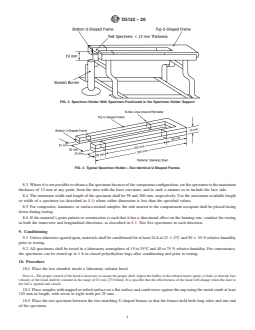
6.1.5 Specimen Holder—Two matching U-shaped frames of non-corroding metal stock 25 mm wide and 10 mm high. The
interior dimensions of the U-shaped frames are 50 mm wide by 330 mm long. A specimen that softens and bends at the flaming
end so as to cause erratic burning is kept horizontal by supports consisting of thin, heat-resistant wires, spanning the width of the
U-shaped frame under the specimen at 25-mm intervals. A device that is suitable for use for supporting this type of material is an
additional U-shaped frame containing the specimen, spanned by 0.25-mm wires of heat-resistant composition at 25 mm intervals
starting 38 mm from the open end. The device is inserted over the bottom U-shaped frame. See Fig. 4 and Fig. 5.
6.1.6 Timing Device—A timer accurate to the nearest 0.1 s.
6.1.7 Measuring Device—A rule accurate to the nearest 1.0 mm.
7. Hazards
7.1 During the course of combustion, gases or vapors, or both, are evolved and have the potential to be hazardous. Precautions
shall be taken to protect the operator.
8. Test Specimens
8.1 A minimum of five specimens 100 6 5 mm wide by a minimum of 300 mm long by thickness up to a maximum of 13 mm
are prepared by cutting from the test material. If the test material has a coating, covering, or construction that is considered
directional in nature, and it has a directional effect on the burning rate, then specimens are produced by cutting five specimens in
both the transverse and longitudinal directions.
8.2 Cut specimens from uniform density samples. The maximum thickness of any specimen shall be 13 mm. If any material
to be tested exceeds this, it shall be cut to the above thickness by a mechanical process applied to the side which does not face
the occupant compartment, so that the specimen shall include the primary surface of the part. In case of materials made of different
composition which are not composite materials, all the layers within a depth of 13 mm from the surface facing towards the
occupant compartment shall be tested individually, as shown at the Fig. 7. Any material that does not adhere to other materials at
every point of contact shall be tested separately. Any material that adheres to other materials at every point of contact shall be tested
as a composite with other material(s). Record the information on specimen preparation in the test report.
FIG. 2 Typical Specimen Holder Support
D5132 − 20
FIG. 3 Specimen Holder With Specimen Positioned in the Specimen Holder Support
FIG. 4 Typical Specimen Holder—Two Identical U-Shaped Frames
8.3 Where it is not possible to obtain a flat specimen because of the component configuration, cut the specimen to the maximum
thickness of 13 mm at any point, from the area with the least curvature, and in such a manner as to include the face side.
8.4 The minimum width and length of the specimen shall be 95 and 300 mm, respectively. Use the maximum available length
or width of a specimen (as described in 8.1) where either dimension is less than the specified values.
8.5 For composites, laminates, or surface-treated samples, the side nearest to the compartment occupant shall be placed facing
down during testing.
8.6 If the material’s grain pattern or construction is such that it has a directional effect on the burning rate, conduct the testing
in both the transverse and longitudinal directions, as described in 8.1. Test five specimens in each direction.
9. Conditioning
9.
...