

ASTM D6478-10(2019)
(Test Method)Standard Test Method for Determining Specific Packability of Fabrics Used in Inflatable Restraints
General Information
- Abstract
SIGNIFICANCE AND USE
5.1 This test method is useful for determining the specific packability of uncoated and coated airbag fabrics. Fabric packability is an important factor in the design of airbag modules due to their inherent spacial constraints.
5.2 A folded specimen exhibits better specific packability if it occupies a lower total volume at the specified loads compared to another specimen.
5.3 The time required to test one sample (four specimens from the same lot of fabric) is approximately 1.5 h using this test method. Due to the length of time required by this test method to perform a single test, this test method is most suitable for use in design and development analysis or for inclusion in a list of required tests conducted for annual certification of an airbag fabric.
SCOPE
1.1 This test method covers procedures for determining the ability to fold and pack fabrics used for inflatable restraints using an index of specific packability.
1.2 Procedures in this test method describe operator techniques that must be followed closely to obtain repeatable and accurate results. Since these techniques are difficult to convey in writing, supplemental training for operators is required. A training video is available from ASTM (see Adjuncts ADJD6478 and ADJD6478A).
1.3 The values stated in SI units are to be regarded as standard. No other units of measurement are included in this standard.
1.4 Procedures and apparatus other than those stated in this practice may be used as agreed upon between the purchaser and the supplier with specific deviations from this practice acknowledged in the report.
1.5 This standard does not purport to address all of the safety concerns, if any, associated with its use. It is the responsibility of the user of this standard to establish appropriate safety, health, and environmental practices and determine the applicability of regulatory limitations prior to use.
1.6 This international standard was developed in accordance with internationally recognized principles on standardization established in the Decision on Principles for the Development of International Standards, Guides and Recommendations issued by the World Trade Organization Technical Barriers to Trade (TBT) Committee.
- Status
- Published
- Publication Date
- 31-Dec-2018
- Technical Committee
- D13 - Textiles
- Drafting Committee
- D13.20 - Inflatable Restraints
Overview
ASTM D6478-10(2019) is the internationally recognized standard for evaluating the specific packability of fabrics used in inflatable restraints, such as airbags. Developed by ASTM International, this test method provides a consistent approach to determining how well both coated and uncoated airbag fabrics can be folded and packed within the spatial restrictions typical for airbag modules. Given the importance of efficient space utilization in vehicle safety systems, understanding fabric packability supports optimized airbag design and reliable deployment.
Key Topics
- Specific Packability: This test method focuses on the volume occupied by a folded fabric specimen at specified loads, providing a quantitative index to compare fabrics’ packability.
- Test Scope: The method applies to both uncoated and coated textile fabrics intended for use in inflatable restraints.
- Operator Training: Due to the detailed techniques required for folding and packing specimens accurately, supplemental operator training is necessary. ASTM provides supporting materials such as training videos and detailed drawings.
- SI Units: All measurements and calculations are standardized in SI units to ensure consistency and traceability.
- Procedural Flexibility: While the standard details equipment and procedure requirements, alternative apparatus or methods may be used if agreed upon by both purchaser and supplier, with deviations suitably documented.
- Test Duration: Testing a single sample, which consists of four specimens from the same fabric lot, generally requires about 1.5 hours.
Applications
Practical uses of ASTM D6478-10(2019) include:
- Airbag Fabric Selection: Engineers and designers use the standard to compare the packability of different airbag fabrics, ensuring that selected materials will properly fit within confined module spaces.
- Product Development & Certification: Packability testing aids in developing new airbag fabrics and forms part of annual quality certification testing before production or deployment.
- Supplier Evaluation: By providing an objective measurement system, this standard facilitates supplier comparisons and product approvals within the automotive safety industry.
- Research & Development: Textile and automotive researchers apply the method during material innovation to meet evolving safety and spatial requirements in vehicles.
Related Standards
To ensure robust and valid testing procedures, ASTM D6478-10(2019) references several related standards, including:
- ASTM D1776: Practice for Conditioning and Testing Textiles
- ASTM D123: Terminology Relating to Textiles
- ASTM D6799: Terminology Relating to Inflatable Restraints
- ASTM E691: Practice for Conducting an Interlaboratory Study to Determine the Precision of a Test Method
These references support harmonized terminology, specimen conditioning, and precision measurement across textile testing for inflatable restraint applications.
By following ASTM D6478-10(2019), manufacturers, laboratories, and automotive engineers can ensure airbag fabrics meet stringent performance and packaging requirements, contributing to safer, space-efficient, and compliant restraint systems. For optimal accuracy and repeatability, adhere closely to the prescribed methodology and ensure operators are properly trained using ASTM’s supplementary resources.
Relations
- Effective Date
- 01-Jan-2019
- Effective Date
- 01-Mar-2017
- Effective Date
- 15-Sep-2015
- Effective Date
- 01-Sep-2015
- Effective Date
- 01-Apr-2015
- Effective Date
- 15-Jun-2013
- Effective Date
- 15-Jun-2013
- Effective Date
- 15-May-2013
- Effective Date
- 01-May-2013
- Effective Date
- 01-Jan-2013
- Effective Date
- 01-Jan-2013
- Effective Date
- 01-Feb-2012
- Effective Date
- 01-Feb-2012
- Effective Date
- 01-Nov-2011
- Effective Date
- 15-Jan-2009
Get Certified
Connect with accredited certification bodies for this standard

TÜV Rheinland
TÜV Rheinland is a leading international provider of technical services.

TÜV SÜD
TÜV SÜD is a trusted partner of choice for safety, security and sustainability solutions.

Control Union Certifications
Global certification for agriculture and sustainability.
Sponsored listings
Frequently Asked Questions
ASTM D6478-10(2019) is a standard published by ASTM International. Its full title is "Standard Test Method for Determining Specific Packability of Fabrics Used in Inflatable Restraints". This standard covers: SIGNIFICANCE AND USE 5.1 This test method is useful for determining the specific packability of uncoated and coated airbag fabrics. Fabric packability is an important factor in the design of airbag modules due to their inherent spacial constraints. 5.2 A folded specimen exhibits better specific packability if it occupies a lower total volume at the specified loads compared to another specimen. 5.3 The time required to test one sample (four specimens from the same lot of fabric) is approximately 1.5 h using this test method. Due to the length of time required by this test method to perform a single test, this test method is most suitable for use in design and development analysis or for inclusion in a list of required tests conducted for annual certification of an airbag fabric. SCOPE 1.1 This test method covers procedures for determining the ability to fold and pack fabrics used for inflatable restraints using an index of specific packability. 1.2 Procedures in this test method describe operator techniques that must be followed closely to obtain repeatable and accurate results. Since these techniques are difficult to convey in writing, supplemental training for operators is required. A training video is available from ASTM (see Adjuncts ADJD6478 and ADJD6478A). 1.3 The values stated in SI units are to be regarded as standard. No other units of measurement are included in this standard. 1.4 Procedures and apparatus other than those stated in this practice may be used as agreed upon between the purchaser and the supplier with specific deviations from this practice acknowledged in the report. 1.5 This standard does not purport to address all of the safety concerns, if any, associated with its use. It is the responsibility of the user of this standard to establish appropriate safety, health, and environmental practices and determine the applicability of regulatory limitations prior to use. 1.6 This international standard was developed in accordance with internationally recognized principles on standardization established in the Decision on Principles for the Development of International Standards, Guides and Recommendations issued by the World Trade Organization Technical Barriers to Trade (TBT) Committee.
SIGNIFICANCE AND USE 5.1 This test method is useful for determining the specific packability of uncoated and coated airbag fabrics. Fabric packability is an important factor in the design of airbag modules due to their inherent spacial constraints. 5.2 A folded specimen exhibits better specific packability if it occupies a lower total volume at the specified loads compared to another specimen. 5.3 The time required to test one sample (four specimens from the same lot of fabric) is approximately 1.5 h using this test method. Due to the length of time required by this test method to perform a single test, this test method is most suitable for use in design and development analysis or for inclusion in a list of required tests conducted for annual certification of an airbag fabric. SCOPE 1.1 This test method covers procedures for determining the ability to fold and pack fabrics used for inflatable restraints using an index of specific packability. 1.2 Procedures in this test method describe operator techniques that must be followed closely to obtain repeatable and accurate results. Since these techniques are difficult to convey in writing, supplemental training for operators is required. A training video is available from ASTM (see Adjuncts ADJD6478 and ADJD6478A). 1.3 The values stated in SI units are to be regarded as standard. No other units of measurement are included in this standard. 1.4 Procedures and apparatus other than those stated in this practice may be used as agreed upon between the purchaser and the supplier with specific deviations from this practice acknowledged in the report. 1.5 This standard does not purport to address all of the safety concerns, if any, associated with its use. It is the responsibility of the user of this standard to establish appropriate safety, health, and environmental practices and determine the applicability of regulatory limitations prior to use. 1.6 This international standard was developed in accordance with internationally recognized principles on standardization established in the Decision on Principles for the Development of International Standards, Guides and Recommendations issued by the World Trade Organization Technical Barriers to Trade (TBT) Committee.
ASTM D6478-10(2019) is classified under the following ICS (International Classification for Standards) categories: 43.040.60 - Bodies and body components; 59.080.30 - Textile fabrics. The ICS classification helps identify the subject area and facilitates finding related standards.
ASTM D6478-10(2019) has the following relationships with other standards: It is inter standard links to ASTM D6478-10(2014), ASTM D123-17, ASTM D123-15b, ASTM D123-15a, ASTM D123-15, ASTM D123-13ae1, ASTM D123-13a, ASTM D123-13, ASTM E691-13, ASTM D6799-13, ASTM D6799-13e1, ASTM D123-12, ASTM D123-12e1, ASTM E691-11, ASTM D123-09e1. Understanding these relationships helps ensure you are using the most current and applicable version of the standard.
ASTM D6478-10(2019) is available in PDF format for immediate download after purchase. The document can be added to your cart and obtained through the secure checkout process. Digital delivery ensures instant access to the complete standard document.
Standards Content (Sample)
This international standard was developed in accordance with internationally recognized principles on standardization established in the Decision on Principles for the
Development of International Standards, Guides and Recommendations issued by the World Trade Organization Technical Barriers to Trade (TBT) Committee.
Designation:D6478 −10 (Reapproved 2019)
Standard Test Method for
Determining Specific Packability of Fabrics Used in
Inflatable Restraints
This standard is issued under the fixed designation D6478; the number immediately following the designation indicates the year of
original adoption or, in the case of revision, the year of last revision.Anumber in parentheses indicates the year of last reapproval.A
superscript epsilon (´) indicates an editorial change since the last revision or reapproval.
1. Scope D1776Practice for Conditioning and Testing Textiles
D2904Practice for Interlaboratory Testing of a Textile Test
1.1 This test method covers procedures for determining the
Method that Produces Normally Distributed Data (With-
ability to fold and pack fabrics used for inflatable restraints
drawn 2008)
using an index of specific packability.
D6799Terminology Relating to Inflatable Restraints
1.2 Procedures in this test method describe operator tech-
E691Practice for Conducting an Interlaboratory Study to
niques that must be followed closely to obtain repeatable and
Determine the Precision of a Test Method
accurate results. Since these techniques are difficult to convey
2.2 ASTM Adjuncts:
in writing, supplemental training for operators is required. A
ADJD6478 — 17 Detailed Drawings
training video is available from ASTM (see Adjuncts
ADJD6478A — Videotape-Supplemental Training
ADJD6478 and ADJD6478A).
1.3 The values stated in SI units are to be regarded as 3. Terminology
standard. No other units of measurement are included in this
3.1 For all terminology relating to D13.20, Inflatable
standard.
restraints, refer to Terminology D6799.
1.4 Procedures and apparatus other than those stated in this 3.1.1 The following terms are relevant to this standard:
practice may be used as agreed upon between the purchaser inflatable restraint, packability, specific packability.
and the supplier with specific deviations from this practice
3.2 For all other terms related to textiles, see Terminology
acknowledged in the report.
D123.
1.5 This standard does not purport to address all of the
4. Summary of Test Method
safety concerns, if any, associated with its use. It is the
responsibility of the user of this standard to establish appro-
4.1 Afabricspecimenisfoldeduniformlyina“Z”patternin
priate safety, health, and environmental practices and deter-
the warp and fill directions.
mine the applicability of regulatory limitations prior to use.
4.2 The folded specimen is placed into a transparent box
1.6 This international standard was developed in accor-
that confines the specimen securely during compression.
dance with internationally recognized principles on standard-
ization established in the Decision on Principles for the
4.3 Thefoldedspecimeniscompressedusingatensiletester
Development of International Standards, Guides and Recom- outfitted with special hardware, and the resulting volume is
mendations issued by the World Trade Organization Technical
recorded at specified loads. The total of all the individual
Barriers to Trade (TBT) Committee. volumes recorded at each specified cell is the specific pack-
ability of the fabric.
2. Referenced Documents
5. Significance and Use
2.1 ASTM Standards:
D123Terminology Relating to Textiles
5.1 This test method is useful for determining the specific
packability of uncoated and coated airbag fabrics. Fabric
packability is an important factor in the design of airbag
ThistestmethodisunderthejurisdictionofASTMCommitteeD13onTextiles
modules due to their inherent spacial constraints.
and is the direct responsibility of Subcommittee D13.20 on Inflatable Restraints.
Current edition approved Jan. 1, 2019. Published January 2019. Originally
approved in 1999. Last previous edition approved in 2014 as D6478–10 (2014).
DOI: 10.1520/D6478-10R19. The last approved version of this historical standard is referenced on
For referenced ASTM standards, visit the ASTM website, www.astm.org, or www.astm.org.
contact ASTM Customer Service at service@astm.org. For Annual Book of ASTM Available from ASTM International Headquarters. For 17 Detailed CAD
Standards volume information, refer to the standard’s Document Summary page on Drawings, Order Adjunct No. ADJD6478. For Videotape-Supplemental Training,
the ASTM website. Order ADJD6478A.
Copyright © ASTM International, 100 Barr Harbor Drive, PO Box C700, West Conshohocken, PA 19428-2959. United States
D6478−10 (2019)
5.2 Afolded specimen exhibits better specific packability if dimension aligned in the warp direction and the cuts aligned
it occupies a lower total volume at the specified loads com- with the warp and weft yarns in the fabric.
pared to another specimen.
7.3 Write the fabric sample identification and the specimen
5.3 The time required to test one sample (four specimens number on the lower right corner of the specimen (warp yarns
from the same lot of fabric) is approximately 1.5 h using this
running up/down and weft yarns running right/left relative to
test method. Due to the length of time required by this test the operator) at a location about 50 mm from the bottom edge
method to perform a single test, this test method is most
and 50 mm from the right edge.
suitable for use in design and development analysis or for
inclusion in a list of required tests conducted for annual
8. Procedure
certification of an airbag fabric.
8.1 Tensile Tester Set-Up and Calibration Check: (See
X1.1.)
6. Apparatus
8.1.1 Set tensile tester for compression mode, install load
6.1 Tensile Tester, outfitted with a rigid base to support the
cellwithmaximumforceratingof200to1000N,setcrosshead
specimen box, and a compression foot attached to the load cell
speedto25.0 61.0mm/min,setdataacquisitionequipmentto
with a coupling having adjustment and locking capability to
record thickness with an accuracy of 0.1 mm at loads of 20 to
maintain fixed parallel alignment to the base. Tensile tester
180N in 20N increments (nine total points), set sampling
shouldbecalibratedannuallybyanindependentagencywhose
frequency at ≥ 25 Hz and set test endpoint at 200N
results are traceable to the National Institute of Science and
8.1.2 Mounttherigidbasetothetensiletesterframe,mount
Technology (NIST) or other national standards laboratory.
thecouplingtotheloadcell,andattachthecompressionfootto
NOTE 1—The frame of the tensile tester can be used as the rigid base if thecoupling,leavingtheadjustmentlockingmechanismloose.
itisasolidmetalsurfacewhichcansupportcompressionloadingof200N
(See Note 1)
withoutdeforming,isperfectlyflat,andsupportstheentirefootprintofthe
8.1.3 Lower the crosshead slowly until 200 6 50N force is
specimen box.
achieved and lock the compression foot into position. (See
6.2 Apparatus Manufactured in Accordance With Drawings
X1.1.1.)
(See Fig. 1):
8.1.4 Raise the crosshead until there is a gap of approxi-
6.2.1 RectangularBox,100by15060.1mmwith99by149
mately 1 mm between the compression foot and the base and
60.1mmcoverplateconstructedoftransparentpolycarbonate
visually check for parallel alignment in both directions. (See
material.
X1.1.2.)
6.2.2 RectangularTemplateandRotaryCuttingPad,750by
8.1.5 Raise the crosshead, place the specimen box on the
800mm 60.5mm,forcuttingspecimensfromfabricsamples
tensile tester base, and insert the top cover plate into the box.
(optional).
8.1.6 Raisethespecimenboxbyhanduntilthecompression
6.2.3 Jig, consisting of two sets of slats (wide and narrow)
foot is inside the box, then lower the crosshead and box
formakingthefoldsandaframethatholdstheslatsinposition
together until the box rests on the support base and the
during folding.
compression foot is not touching the cover plate. Position the
6.2.4 Compression Gage Blocks, with thickness of 10, 20,
box so that the compression foot is in the approximate center
and 30 6 0.1 mm.
of the box.
6.2.5 All dimensions shall be verified at time of manufac-
tureusingmeasuringdevicestraceabletotheNationalInstitute NOTE 2—Exercise caution to avoid possible operator injury from the
pinch-point between the compression foot and the specimen box.
of Science and Technology (NIST) or other national standards
laboratory.
8.1.7 Lower the crosshead until a force of 100 6 30N is
achieved and set zero.
6.3 Rotary Razor Cutter.
NOTE 3—An alternate zero can be used to simplify the test. To use the
6.4 Large Paperclips (Three), preferably with a serrated
alternate zero, set the true zero as specified, raise the crosshead to the
surface to improve gripping capability.
desired point, and zero the crosshead position again. The position of the
6.5 Permanent Marking Pen, pen with fine tip.
alternate zero should be selected such that the compression foot does not
touch the cover plate when the fabric specimen is in the box. A position
7. Specimen Preparation of +35 mm is suitable for most airbag fabrics.
8.1.8 Raise the crosshead, place the specimen box on the
7.1 Condition fabric samples for a minimum of3hinthe
tensile tester base, insert the 10-mm gage block and then the
standard atmosphere for testing textiles in accordance with
cover plate into the box.
Practice D1776.
8.1.9 Raisethespecimenboxbyhanduntilthecompression
7.2 Withoutfrayingorfusingtheedges,cutfour750by800
foot is inside the box, then lower the crosshead and box
6 5-mm specimens from each sample, with the 800-mm
together until the box rests on the support base and the
compression foot is not touching the cover plate. Position the
Equipment designed by AlliedSignal Performance Fibers, is manufactured
box so that the compression foot is in the approximate center
according to drawing #61-27A-7906-2 and is available from Precision Machine
of the box. (See X1.1.3.)
Company,Inc.,2915WestLehighStreet,Richmond,VA23230.CopyrightforCAD
8.1.10 Initiate the compression test and record thickness at
drawings held by AlliedSignal and provided to ASTM with full unlimited authori-
zation to distribute copies and/or to designate other parties to distribute copies. all specified loads.
D6478−10 (2019)
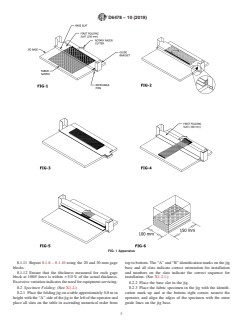
FIG. 1Apparatus
8.1.11 Repeat 8.1.8 – 8.1.10 using the 20 and 30-mm gage top to bottom.The “A” and “B” identification marks on the jig
blocks. base and all slats indicate correct orientation for installation
8.1.12 Ensure that the thickness measured for each gage and numbers on the slats indicate the correct sequence for
block at 100N force is within 65.0% of the actual thickness. installation. (See X1.2.1.)
Excessivevariationindicatestheneedforequipmentservicing.
8.2.2 Place the base slat in the jig.
8.2 Specimen Folding: (See X1.2.) 8.2.3 Place the fabric specimen in the jig with the identifi-
8.2.1 Placethefoldingjigonatableapproximately0.8min cation mark up and at the bottom right corner, nearest the
heightwiththe“A”sideofthejigtotheleftoftheoperatorand operator, and align the edges of the specimen with the outer
place all slats on the table in ascending numerical order from guide lines on the jig base.
D6478−10 (2019)
8.2.4 Fold the specimen using the wide slats, #1 to #5, 8.2.13 Fold the specimen using the narrow slats #1 to #7,
visually inspecting and adjusting at each step to ensure that all visually inspecting and adjusting at each step to insure that all
folds are straight, are aligned to within 61 mm and that the folds are straight, are aligned to within 61 mm and that the
fabric is tight around the slats. fabric is tight around the slats. (See X1.2.8.)
NOTE 5—If slippage or misalignment occurs, the procedure below can
NOTE 4—If slippage or misalignment occurs, the following procedure
berepeatedusingthesamespecimenifthereissufficientfabricremaining
can be repeated using the same specimen if there is sufficient fabric
for the trimming step at the beginning and end of the folding process.
remaining for the trimming step at the beginning and end of the folding
process.
8.2.13.1 Install slat #1 on top of the fabric specimen. Slide
8.2.4.1 Install slat #1 on top of the fabric specimen. Slide thespecimenintopositionsothatthefabricprotrudesapproxi-
thespecimenintopositionsothatthefabricprotrudesapproxi-
mately 5 mm under the back edge of the slat.
mately 5 mm under the back edge of the slat. 8.2.13.2 Check and adjust the relative alignment of the
8.2.4.2 Run the rotary razor cutter along the back edge of folded edges under slat #1 so that they are directly on top of
each other.
slat #1 and remove the trimmed excess fabric. (See X1.2.2.)
8.2.13.3 Use the back edge of slat #1 to hold the folded
8.2.4.3 Pullthefabricfronttobackacrossthetopofslat#1,
specimen in position and remove the paperclip under the slat.
and install slat #2.
8.2.13.4 Run the rotary razor cutter along the back edge of
8.2.4.4 Pull the fabric from back to front across the top of
slat #1 and remove the trimmed excess fabric. (See X1.2.9.)
slat #2, and install slat #3. (See X1.2.3.)
8.2.13.5 Pull the fabric from
...