

ASTM E2781-24
(Practice)Standard Practice for Evaluation of Methods for Determination of Kinetic Parameters by Calorimetry and Differential Scanning Calorimetry
General Information
- Abstract
SIGNIFICANCE AND USE
5.1 The kinetic parameters provided in this practice may be used to evaluate the performance of a standard, apparatus, technique, or software for the determination parameters (such as Test Methods E698, E1641, E2041, or E2070) using thermal analysis techniques such as differential scanning calorimetry, and accelerating rate calorimetry (Guide E1981). The results obtained may be compared to the values provided by this practice.
Note 4: Not all reference materials are suitable for each measurement technique.
SCOPE
1.1 The purpose of this practice is to provide kinetic parameters for reference materials used to evaluate thermal analysis methods, apparatus, and software where enthalpy and temperature are measured. This practice addresses both exothermic and endothermic, nth order, and autocatalytic reactions.
1.2 The values stated in SI units are to be regarded as standard. No other units of measurement are included in this standard.
1.3 This standard does not purport to address all of the safety concerns, if any, associated with its use. It is the responsibility of the user of this standard to establish appropriate safety, health, and environmental practices and determine the applicability of regulatory limitations prior to use.
1.4 This international standard was developed in accordance with internationally recognized principles on standardization established in the Decision on Principles for the Development of International Standards, Guides and Recommendations issued by the World Trade Organization Technical Barriers to Trade (TBT) Committee.
- Status
- Published
- Publication Date
- 14-Mar-2024
- Technical Committee
- E37 - Thermal Measurements
- Drafting Committee
- E37.02 - Reference Materials
Buy Documents
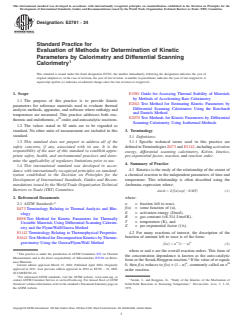
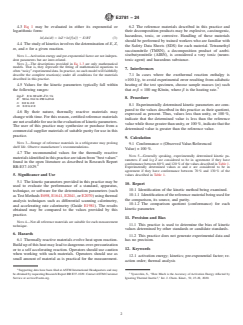


ASTM E2781-24 - Standard Practice for Evaluation of Methods for Determination of Kinetic Parameters by Calorimetry and Differential Scanning Calorimetry
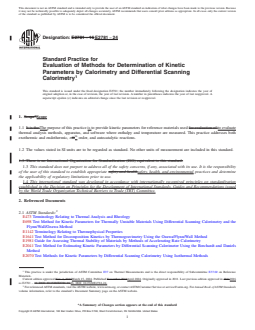
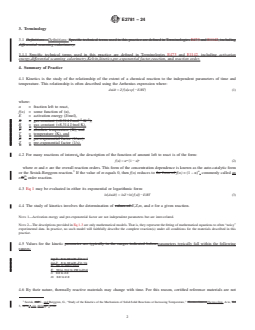
REDLINE ASTM E2781-24 - Standard Practice for Evaluation of Methods for Determination of Kinetic Parameters by Calorimetry and Differential Scanning Calorimetry
Overview
ASTM E2781-24 is the international reference standard for the evaluation of methods used to determine kinetic parameters by calorimetry and differential scanning calorimetry (DSC). Developed by ASTM Committee E37 on Thermal Measurements, this practice provides guidance for assessing the performance of thermal analysis techniques-such as calorimetry, DSC, and software used to measure enthalpy and temperature-through the use of reference materials and comparison of kinetic parameters. Applicable to both exothermic and endothermic, nth order, and autocatalytic reactions, ASTM E2781-24 is essential for laboratories, manufacturers, and researchers engaged in thermal analysis and kinetic studies across a range of industries.
Key Topics
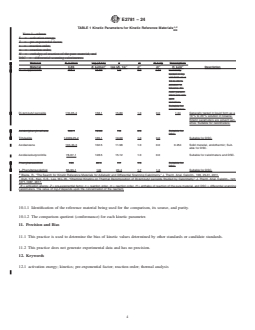
- Kinetic Parameter Evaluation: The standard details how to evaluate kinetic parameters including activation energy (E), pre-exponential factor (Z), and reaction order (m, n) using calorimetry and DSC.
- Reference Materials: Guidance is provided for the selection and use of reference materials, with tabulated kinetic parameter ranges for common compounds.
- Comparison and Conformance: The practice enables users to compare experimentally determined kinetic values to reference values, assisting in assessing the accuracy and performance of thermal analysis methods and devices.
- Thermal Analysis Techniques: Relevance to both differential scanning calorimetry (DSC) and accelerating rate calorimetry (ARC), with recommendations for method selection based on material and measurement needs.
- Safety and Handling: The standard addresses the safe handling of thermally reactive and potentially hazardous reference materials, emphasizing the importance of trained personnel and adherence to safety protocols.
- Parameter Ranges:
- Activation energy (E): 50 to 250 kJ/mol
- Pre-exponential factor (log Z, 1/s): 8 to 30
- Reaction orders (n, m): 0.0 to 2.0
Applications
ASTM E2781-24 delivers practical value in various settings where the determination and validation of kinetic parameters by calorimetry and DSC are critical:
- Laboratory Quality Control: Assure the accuracy and calibration of thermal analysis instruments by comparison against defined kinetic parameter standards.
- Method Validation: Validate new or existing methods, techniques, and software to ensure robust determination of kinetic parameters in chemical processes or material evaluations.
- Research and Development: Optimize chemical process safety and product development by benchmarking kinetic data and reaction behavior with established reference values.
- Industrial Safety Assessment: Evaluate the thermal stability of materials, enabling improved hazard identification and risk management in pharmaceuticals, chemicals, life sciences, and materials manufacturing.
- Regulatory Compliance: Support documentation and compliance for products subject to international or national regulatory standards in thermal measurements and kinetics.
Related Standards
ASTM E2781-24 operates within a broader framework of thermal analysis and kinetic evaluation standards. Key associated ASTM standards include:
- ASTM E473: Terminology Relating to Thermal Analysis and Rheology
- ASTM E698: Test Method for Kinetic Parameters for Thermally Unstable Materials Using DSC and the Flynn/Wall/Ozawa Method
- ASTM E1641: Test Method for Decomposition Kinetics by Thermogravimetry Using the Ozawa/Flynn/Wall Method
- ASTM E2041: Test Method for Estimating Kinetic Parameters by DSC Using the Borchardt and Daniels Method
- ASTM E2070: Test Methods for Kinetic Parameters by DSC Using Isothermal Methods
- ASTM E1981: Guide for Assessing Thermal Stability of Materials by Accelerating Rate Calorimetry
Adoption of ASTM E2781-24, in conjunction with related standards, ensures a consistent, reliable approach to kinetic parameter evaluation in thermal analysis, supporting high-quality, reproducible results across scientific, industrial, and regulatory applications.
Relations
- Effective Date
- 15-Mar-2024
- Effective Date
- 15-Mar-2024
- Effective Date
- 15-Mar-2024
Buy Documents
ASTM E2781-24 - Standard Practice for Evaluation of Methods for Determination of Kinetic Parameters by Calorimetry and Differential Scanning Calorimetry
REDLINE ASTM E2781-24 - Standard Practice for Evaluation of Methods for Determination of Kinetic Parameters by Calorimetry and Differential Scanning Calorimetry
Get Certified
Connect with accredited certification bodies for this standard

BSMI (Bureau of Standards, Metrology and Inspection)
Taiwan's standards and inspection authority.
Sponsored listings
Frequently Asked Questions
ASTM E2781-24 is a standard published by ASTM International. Its full title is "Standard Practice for Evaluation of Methods for Determination of Kinetic Parameters by Calorimetry and Differential Scanning Calorimetry". This standard covers: SIGNIFICANCE AND USE 5.1 The kinetic parameters provided in this practice may be used to evaluate the performance of a standard, apparatus, technique, or software for the determination parameters (such as Test Methods E698, E1641, E2041, or E2070) using thermal analysis techniques such as differential scanning calorimetry, and accelerating rate calorimetry (Guide E1981). The results obtained may be compared to the values provided by this practice. Note 4: Not all reference materials are suitable for each measurement technique. SCOPE 1.1 The purpose of this practice is to provide kinetic parameters for reference materials used to evaluate thermal analysis methods, apparatus, and software where enthalpy and temperature are measured. This practice addresses both exothermic and endothermic, nth order, and autocatalytic reactions. 1.2 The values stated in SI units are to be regarded as standard. No other units of measurement are included in this standard. 1.3 This standard does not purport to address all of the safety concerns, if any, associated with its use. It is the responsibility of the user of this standard to establish appropriate safety, health, and environmental practices and determine the applicability of regulatory limitations prior to use. 1.4 This international standard was developed in accordance with internationally recognized principles on standardization established in the Decision on Principles for the Development of International Standards, Guides and Recommendations issued by the World Trade Organization Technical Barriers to Trade (TBT) Committee.
SIGNIFICANCE AND USE 5.1 The kinetic parameters provided in this practice may be used to evaluate the performance of a standard, apparatus, technique, or software for the determination parameters (such as Test Methods E698, E1641, E2041, or E2070) using thermal analysis techniques such as differential scanning calorimetry, and accelerating rate calorimetry (Guide E1981). The results obtained may be compared to the values provided by this practice. Note 4: Not all reference materials are suitable for each measurement technique. SCOPE 1.1 The purpose of this practice is to provide kinetic parameters for reference materials used to evaluate thermal analysis methods, apparatus, and software where enthalpy and temperature are measured. This practice addresses both exothermic and endothermic, nth order, and autocatalytic reactions. 1.2 The values stated in SI units are to be regarded as standard. No other units of measurement are included in this standard. 1.3 This standard does not purport to address all of the safety concerns, if any, associated with its use. It is the responsibility of the user of this standard to establish appropriate safety, health, and environmental practices and determine the applicability of regulatory limitations prior to use. 1.4 This international standard was developed in accordance with internationally recognized principles on standardization established in the Decision on Principles for the Development of International Standards, Guides and Recommendations issued by the World Trade Organization Technical Barriers to Trade (TBT) Committee.
ASTM E2781-24 is classified under the following ICS (International Classification for Standards) categories: 17.200.10 - Heat. Calorimetry. The ICS classification helps identify the subject area and facilitates finding related standards.
ASTM E2781-24 has the following relationships with other standards: It is inter standard links to ASTM E2781-16, ASTM E2041-23, ASTM E698-23. Understanding these relationships helps ensure you are using the most current and applicable version of the standard.
ASTM E2781-24 is available in PDF format for immediate download after purchase. The document can be added to your cart and obtained through the secure checkout process. Digital delivery ensures instant access to the complete standard document.
Standards Content (Sample)
This international standard was developed in accordance with internationally recognized principles on standardization established in the Decision on Principles for the
Development of International Standards, Guides and Recommendations issued by the World Trade Organization Technical Barriers to Trade (TBT) Committee.
Designation: E2781 − 24
Standard Practice for
Evaluation of Methods for Determination of Kinetic
Parameters by Calorimetry and Differential Scanning
Calorimetry
This standard is issued under the fixed designation E2781; the number immediately following the designation indicates the year of
original adoption or, in the case of revision, the year of last revision. A number in parentheses indicates the year of last reapproval. A
superscript epsilon (´) indicates an editorial change since the last revision or reapproval.
1. Scope E1981 Guide for Assessing Thermal Stability of Materials
by Methods of Accelerating Rate Calorimetry
1.1 The purpose of this practice is to provide kinetic
E2041 Test Method for Estimating Kinetic Parameters by
parameters for reference materials used to evaluate thermal
Differential Scanning Calorimeter Using the Borchardt
analysis methods, apparatus, and software where enthalpy and
and Daniels Method
temperature are measured. This practice addresses both exo-
th E2070 Test Methods for Kinetic Parameters by Differential
thermic and endothermic, n order, and autocatalytic reactions.
Scanning Calorimetry Using Isothermal Methods
1.2 The values stated in SI units are to be regarded as
3. Terminology
standard. No other units of measurement are included in this
standard.
3.1 Definitions:
1.3 This standard does not purport to address all of the 3.1.1 Specific technical terms used in this practice are
safety concerns, if any, associated with its use. It is the defined in Terminologies E473 and E1142, including activation
responsibility of the user of this standard to establish appro- energy, differential scanning calorimetry, Kelvin, kinetics,
priate safety, health, and environmental practices and deter- pre-exponential factor, reaction, and reaction order.
mine the applicability of regulatory limitations prior to use.
4. Summary of Practice
1.4 This international standard was developed in accor-
dance with internationally recognized principles on standard- 4.1 Kinetics is the study of the relationship of the extent of
a chemical reaction to the independent parameters of time and
ization established in the Decision on Principles for the
Development of International Standards, Guides and Recom- temperature. This relationship is often described using the
mendations issued by the World Trade Organization Technical Arrhenius expression where:
Barriers to Trade (TBT) Committee.
dα/dt 5 Z f~α!exp~2E/RT! (1)
2. Referenced Documents
where:
α = fraction left to react,
2.1 ASTM Standards:
f(α) = some function of (α),
E473 Terminology Relating to Thermal Analysis and Rhe-
E = activation energy (J/mol),
ology
R = gas constant (=8.314 J ⁄mol·K),
E698 Test Method for Kinetic Parameters for Thermally
T = temperature (K), and
Unstable Materials Using Differential Scanning Calorim-
Z = pre-exponential factor (1/s).
etry and the Flynn/Wall/Ozawa Method
4.2 For many reactions of interest, the description of the
E1142 Terminology Relating to Thermophysical Properties
function of amount left to react is of the form:
E1641 Test Method for Decomposition Kinetics by Thermo-
gravimetry Using the Ozawa/Flynn/Wall Method m n
f α 5 α 1 2 α (2)
~ ! ~ !
where m and n are the overall reaction orders. This form of
This practice is under the jurisdiction of ASTM Committee E37 on Thermal
the concentration dependence is known as the auto-catalytic
Measurements and is the direct responsibility of Subcommittee E37.02 on Refer-
form or the Sestak-Berggren reaction. If the value of m equals
ence Materials.
n th
Current edition approved March 15, 2024. Published April 2024. Originally 0, then f(α) reduces to f(α) = (1 – α) , commonly called an n
approved in 2011. Last previous edition approved in 2016 as E2781 – 16. DOI:
order reaction.
10.1520/E2781-24.
For referenced ASTM standards, visit the ASTM website, www.astm.org, or
contact ASTM Customer Service at service@astm.org. For Annual Book of ASTM Sestak, J., and Berggren, G., “Study of the Kinetics of the Mechanism of
Standards volume information, refer to the standard’s Document Summary page on Solid-Solid Reactions at Increasing Temperature,” Thermochim. Acta, 3, 1–12,
the ASTM website. 1971.
Copyright © ASTM International, 100 Barr Harbor Drive, PO Box C700, West Conshohocken, PA 19428-2959. United States
E2781 − 24
4.3 Eq 1 may be evaluated in either its exponential or 6.2 The reference materials described in this practice and
logarithmic form: their decomposition products may be explosive, carcinogenic,
hazardous, toxic, or corrosive. Handling of these materials
ln dα/dt 5 lnZ1ln f α 2 E/RT (3)
~ ! ~ ~ !!
should be performed by trained workers who are familiar with
4.4 The study of kinetics involves the determination of E, Z,
the Safety Data Sheets (SDS) for each material. Tetramethyl
m, and n for a given reaction.
succinonitrile (TMSN), a decomposition product of azobi-
sisobutyronitrile (AIBN), is considered a very toxic (neuro-
NOTE 1—Activation energy and pre-exponential factor are not indepen-
dent parameters but are inter-related.
toxic agent) and hazardous substance.
NOTE 2—The descriptions provided in Eq 1-3 are only mathematical
models. That is, they represent the fitting of mathematical equations to
7. Interferences
often “noisy” experimental data. In practice, no such model will faithfully
describe the complete reaction(s) under all conditions for the materials 7.1 In cases where the exothermal reaction enthalpy is
described in this practice.
>100 J ⁄g, to avoid experimental error resulting from adiabatic
heating of the test specimen, choose sample masses (m) such
4.5 Values for the kinetic parameters typically fall within
that m·β < 100 mg·K/min, where β is the heating rate.
the following ranges:
log Z: 8 to 3
...
This document is not an ASTM standard and is intended only to provide the user of an ASTM standard an indication of what changes have been made to the previous version. Because
it may not be technically possible to adequately depict all changes accurately, ASTM recommends that users consult prior editions as appropriate. In all cases only the current version
of the standard as published by ASTM is to be considered the official document.
Designation: E2781 − 16 E2781 − 24
Standard Practice for
Evaluation of Methods for Determination of Kinetic
Parameters by Calorimetry and Differential Scanning
Calorimetry
This standard is issued under the fixed designation E2781; the number immediately following the designation indicates the year of
original adoption or, in the case of revision, the year of last revision. A number in parentheses indicates the year of last reapproval. A
superscript epsilon (´) indicates an editorial change since the last revision or reapproval.
1. Scope*Scope
1.1 It is the The purpose of this practice is to provide kinetic parameters for reference materials used for evaluation of to evaluate
thermal analysis methods, apparatus, and software where enthalpy and temperature are measured. This practice addresses both
th
exothermic and endothermic, nth order, and autocatalytic reactions.
1.2 The values stated in SI units are to be regarded as standard. No other units of measurement are included in this standard.
1.3 There is no International Organization for Standardization (ISO) equivalent to this standard.
1.3 This standard does not purport to address all of the safety concerns, if any, associated with its use. It is the responsibility
of the user of this standard to establish appropriate safety and healthsafety, health, and environmental practices and determine
the applicability of regulatory limitations prior to use.
1.4 This international standard was developed in accordance with internationally recognized principles on standardization
established in the Decision on Principles for the Development of International Standards, Guides and Recommendations issued
by the World Trade Organization Technical Barriers to Trade (TBT) Committee.
2. Referenced Documents
2.1 ASTM Standards:
E473 Terminology Relating to Thermal Analysis and Rheology
E698 Test Method for Kinetic Parameters for Thermally Unstable Materials Using Differential Scanning Calorimetry and the
Flynn/Wall/Ozawa Method
E1142 Terminology Relating to Thermophysical Properties
E1641 Test Method for Decomposition Kinetics by Thermogravimetry Using the Ozawa/Flynn/Wall Method
E1981 Guide for Assessing Thermal Stability of Materials by Methods of Accelerating Rate Calorimetry
E2041 Test Method for Estimating Kinetic Parameters by Differential Scanning Calorimeter Using the Borchardt and Daniels
Method
E2070 Test Methods for Kinetic Parameters by Differential Scanning Calorimetry Using Isothermal Methods
This practice is under the jurisdiction of ASTM Committee E37 on Thermal Measurements and is the direct responsibility of Subcommittee E37.02 on Reference
Materials.
Current edition approved Nov. 1, 2016March 15, 2024. Published November 2016April 2024. Originally approved in 2011. Last previous edition approved in 20112016
as E2781 – 11. DOI: 10.1520/E2781-16.16. DOI: 10.1520/E2781-24.
For referenced ASTM standards, visit the ASTM website, www.astm.org, or contact ASTM Customer Service at service@astm.org. For Annual Book of ASTM Standards
volume information, refer to the standard’s Document Summary page on the ASTM website.
*A Summary of Changes section appears at the end of this standard
Copyright © ASTM International, 100 Barr Harbor Drive, PO Box C700, West Conshohocken, PA 19428-2959. United States
E2781 − 24
3. Terminology
3.1 Definitions—Definitions: Specific technical terms used in this practice are defined in Terminologies E473 and E1142, including
differential scanning calorimetry.
3.1.1 Specific technical terms used in this practice are defined in Terminologies E473 and E1142, including activation
energy,differential scanning calorimetry,Kelvin,kinetics,pre-exponential factor,reaction, and reaction order.
4. Summary of Practice
4.1 Kinetics is the study of the relationship of the extent of a chemical reaction to the independent parameters of time and
temperature. This relationship is often described using the Arrhenius expression where:
dα/dt 5 Z f~α!exp~2E/RT! (1)
where:
α = fraction left to react,
f(α) = some function of (α),
E = activation energy (J/mol),
–1 –1
R = gas constant (=8.314 J mol K ),
R = gas constant (=8.314 J ⁄mol·K),
T = absolute temperature (K), and
T = temperature (K), and
Z = pre-exponential factor (1/sec).
Z = pre-exponential factor (1/s).
4.2 For many reactions of interest, the description of the function of amount left to react is of the form:
m n
f α 5 α 12 α (2)
~ ! ~ !
where m and n are the overall reaction orders. This form of the concentration dependence is known as the auto-catalytic form
3 n
or the Sestak-Berggren reaction. If the value of m equals 0, then f(α) reduces to the form of f(α) = (1 – α) , commonly called an
th
nth order reaction.
4.3 Eq 1 may be evaluated in either its exponential or logarithmic form:
ln dα/dt 5 lnZ1ln f α 2E/RT (3)
~ ! ~ ~ !!
4.4 The study of kinetics involves the determination of values of E,Z,m, and n for a given reaction.
NOTE 1—Activation energy and pre-exponential factor are not independent parameters but are inter-related.
NOTE 2—The descriptions provided in Eq 1-3 are only mathematical models. That is, they represent the fitting of mathematical equations to often “noisy”
experimental data. In practice, no such model will faithfully describe the complete reaction(s) under all conditions for the materials described in this
practice.
4.5 Values for the kinetic parameter are typically in the ranges indicated below:parameters typically fall within the following
ranges:
–1
log Z: 8 to 30 with Z in s
log Z: 8 to 30 with Z in 1/s
E: 50 to 250 kJ/mol
E: 50 kJ ⁄mol to 250 kJ/mol
n: 0.0 to 2.0
m: 0.0 to 2.0
4.6 By their nature, thermally reactive materials may change with time. For this reason, certified reference materials are not
Sestak, and J., and Berggren, G., “Study of the Kinetics of the Mechanism of Solid-Solid Reactions at Increasing Temperature,” ThermochimicaThermochim. Acta, Vol
3, 19711,–12, 1971pp. .1–12.
E2781 − 24
available for use in the evaluation of kinetic parameters. The user of this practice may synthesize or purchase from a commercial
laboratory supply house supplier materials of suitable purity for use in this practice.
NOTE 3—Storage of reference materials in a refrigerator may prolong shelf life. Observe manufacturer’s recommendations.
4.7 The recommended values for the thermally reactive materials identified in this practice are taken from “best values” found in
the open literature as described in Research Report RR:E37-1029.
5. Significance and Use
5.1 The kinetic parameters provided in this practice may be used to evaluate the performance of a standard, apparatus,
techniques,technique, or software for the determination parameters (such as Test Methods E698,
...