

ASTM D8388/D8388M-22
(Practice)Standard Practice for Flexural Residual Strength Testing of Damaged Sandwich Constructions
General Information
- Abstract
SIGNIFICANCE AND USE
5.1 This practice provides supplemental instructions that allow the use of Test Method D7249/D7249M to determine residual compressive or tensile strength properties of damaged sandwich constructions. Susceptibility to damage from concentrated out-of-plane forces is one of the major design concerns of many structures made using sandwich constructions. Knowledge of the residual strength properties of a sandwich panel is useful for product development, establishing design allowables, and material selection.
5.2 The residual compressive or tensile strength data obtained using this test practice is most commonly used in material selection, research and development activities, and establishing design allowables.
5.3 The properties obtained using this test practice can provide guidance in regard to the anticipated compressive or tensile residual strength capability of sandwich constructions of similar facesheet and core material, adhesive, facesheet and core thickness, facesheet stacking sequence, and so forth. However, it must be understood that the residual strength of sandwich constructions is highly dependent upon several factors including geometry, thickness, stiffness, support conditions, and so forth. Significant differences in the relationships between the damage state and the residual compressive or tensile strength can result due to differences in these parameters.
5.4 The compression strength from this test may not be equivalent to the compression strength of sandwich structures subjected to pure edgewise (in-plane) compression.
5.5 The reporting section requires items that tend to influence residual strength to be reported; these include the following: facesheet and core materials, core density, cell size and wall thickness if applicable, film adhesive, methods of material fabrication, accuracy of lay-up orientation, facesheet stacking sequence and thickness, core thickness, overall specimen thickness, specimen geometry, specimen preparation, specim...
SCOPE
1.1 This practice provides instructions for modifying the long beam flexure test method to determine the tensile or compressive residual strength properties of sandwich constructions that have been subjected to quasi-static indentation or drop-weight impact per Practice D7766/D7766M. The tensile or compressive strength result is determined by which facesheet contains the damage, either the loaded-span or support-span facesheet, based on how the specimen is positioned in the fixture.
1.2 This practice supplements Test Method D7249/D7249M with provisions for testing damaged sandwich specimens. Several important test specimen parameters (for example, facesheet thickness, core thickness and core density) are not mandated by this practice; however, repeatable results require that these parameters be specified and reported.
1.3 Units—The values stated in either SI units or inch-pound units are to be regarded separately as standard. The values stated in each system are not necessarily exact equivalents; therefore, to ensure conformance with the standard, each system shall be used independently of the other, and values from the two systems shall not be combined.
1.3.1 Within the text, the inch-pound units are shown in brackets.
1.4 This standard does not purport to address all of the safety concerns, if any, associated with its use. It is the responsibility of the user of this standard to establish appropriate safety, health, and environmental practices and determine the applicability of regulatory limitations prior to use.
1.5 This international standard was developed in accordance with internationally recognized principles on standardization established in the Decision on Principles for the Development of International Standards, Guides and Recommendations issued by the World Trade Organization Technical Barriers to Trade (TBT) Committee.
- Status
- Published
- Publication Date
- 30-Apr-2022
- Technical Committee
- D30 - Composite Materials
- Drafting Committee
- D30.09 - Sandwich Construction
Overview
ASTM D8388/D8388M-22: Standard Practice for Flexural Residual Strength Testing of Damaged Sandwich Constructions provides comprehensive instructions for assessing the residual tensile or compressive strength of sandwich panels after they have been damaged. Developed by ASTM International, this standard extends the long beam flexure test method, enabling materials engineers and designers to evaluate the structural integrity of sandwich constructions following quasi-static indentation or drop-weight impact.
Sandwich structures-commonly featuring a lightweight core between strong facesheets-are widely used in aerospace, automotive, marine, and construction industries due to their high strength-to-weight ratio. Ensuring continued performance after localized damage from out-of-plane forces is a critical design consideration. This standard supplies practical methods to quantify the residual strength of such constructions, supporting effective product development and informed material selection.
Key Topics
- Residual Strength Evaluation: Outlines procedures for measuring compressive and tensile strength of sandwich composites post-damage, following modifications to the long beam flexure test.
- Damage Simulation: Covers imparting damage using quasi-static indentation or drop-weight impact, as per ASTM D7766/D7766M.
- Specimen Handling: Addresses critical factors in specimen preparation, geometry, and alignment to ensure meaningful, repeatable test results.
- Reporting Requirements: Details essential reporting items, such as facesheet and core material properties, geometry, fabrication method, and precise test configurations that influence residual strength outcomes.
- Influencing Factors: Notes that results are highly dependent on construction geometry, facesheet stacking, core thickness/density, support conditions, and environmental exposure.
- Failure Mode Classification: Provides guidance for identifying and reporting failure modes, ensuring clarity and consistency in residual strength testing.
- Units of Measure: Permits use of both SI and inch-pound units, with specific guidance to avoid mixing unit systems in data collection and reporting.
Applications
The methodologies in ASTM D8388/D8388M-22 are used extensively in the following contexts:
- Product Development: Enables manufacturers and engineers to assess how sandwich panels perform after suffering typical service damage, aiding in the refinement of composite designs.
- Material Selection: Supports comparative evaluation of different facesheet and core combinations, adhesives, and manufacturing processes under realistic damage scenarios.
- Research and Development: Provides a reliable framework for collecting quantitative residual strength data, essential for innovation in composite materials engineering.
- Design Allowables Establishment: Assists in determining conservative values for residual compressive or tensile strength, influencing permissible loading conditions in structural designs.
- Damage Tolerance Certification: Supports validation that sandwich constructions meet industry safety and reliability standards, particularly in regulated sectors like aerospace.
Related Standards
- ASTM D7249/D7249M: Test Method for Facesheet Properties of Sandwich Constructions by Long Beam Flexure - the foundational test method supplemented by D8388/D8388M for damaged specimens.
- ASTM D7766/D7766M: Practice for Damage Resistance Testing of Sandwich Constructions - referenced for imparting controlled damage prior to residual strength assessment.
- ASTM D3410/D3410M: Test Method for Compressive Properties of Polymer Matrix Composite Materials - informs compressive test procedures.
- ASTM D5687/D5687M: Guide for Preparation of Flat Composite Panels - essential for recommended specimen preparation practices.
- Terminology Standards: Includes ASTM D3878 (composite materials), D883 (plastics), E6 (mechanical testing), and E456/E177 (statistics and quality terms).
Practical Value
Implementing ASTM D8388/D8388M-22 helps organizations:
- Quantify the real-world performance of sandwich structures after damage
- Improve safety and reliability in lightweight composite applications
- Standardize testing protocols, facilitating data comparison across materials and products
- Support compliance with industry regulations and international standardization requirements
Keywords: sandwich construction, residual strength, flexural testing, compressive strength, tensile strength, composites, damage tolerance, ASTM D8388/D8388M, quasi-static indentation, drop-weight impact, material selection, structural testing.
Relations
- Effective Date
- 01-Feb-2024
- Effective Date
- 01-Nov-2023
- Effective Date
- 01-Apr-2022
- Effective Date
- 01-Feb-2020
- Effective Date
- 01-Jan-2020
- Effective Date
- 15-Oct-2019
- Effective Date
- 01-Aug-2019
- Effective Date
- 15-Apr-2019
- Effective Date
- 15-Apr-2019
- Effective Date
- 01-Feb-2019
- Effective Date
- 01-Dec-2018
- Effective Date
- 01-Nov-2018
- Effective Date
- 01-Apr-2018
- Effective Date
- 01-Apr-2018
- Effective Date
- 01-Oct-2017
Get Certified
Connect with accredited certification bodies for this standard

DIBt (Deutsches Institut für Bautechnik)
German Institute for Building Technology.
DIN CERTCO
DIN Group product certification.

Aboma Certification B.V.
Specialized in construction, metal, and transport sectors.
Sponsored listings
Frequently Asked Questions
ASTM D8388/D8388M-22 is a standard published by ASTM International. Its full title is "Standard Practice for Flexural Residual Strength Testing of Damaged Sandwich Constructions". This standard covers: SIGNIFICANCE AND USE 5.1 This practice provides supplemental instructions that allow the use of Test Method D7249/D7249M to determine residual compressive or tensile strength properties of damaged sandwich constructions. Susceptibility to damage from concentrated out-of-plane forces is one of the major design concerns of many structures made using sandwich constructions. Knowledge of the residual strength properties of a sandwich panel is useful for product development, establishing design allowables, and material selection. 5.2 The residual compressive or tensile strength data obtained using this test practice is most commonly used in material selection, research and development activities, and establishing design allowables. 5.3 The properties obtained using this test practice can provide guidance in regard to the anticipated compressive or tensile residual strength capability of sandwich constructions of similar facesheet and core material, adhesive, facesheet and core thickness, facesheet stacking sequence, and so forth. However, it must be understood that the residual strength of sandwich constructions is highly dependent upon several factors including geometry, thickness, stiffness, support conditions, and so forth. Significant differences in the relationships between the damage state and the residual compressive or tensile strength can result due to differences in these parameters. 5.4 The compression strength from this test may not be equivalent to the compression strength of sandwich structures subjected to pure edgewise (in-plane) compression. 5.5 The reporting section requires items that tend to influence residual strength to be reported; these include the following: facesheet and core materials, core density, cell size and wall thickness if applicable, film adhesive, methods of material fabrication, accuracy of lay-up orientation, facesheet stacking sequence and thickness, core thickness, overall specimen thickness, specimen geometry, specimen preparation, specim... SCOPE 1.1 This practice provides instructions for modifying the long beam flexure test method to determine the tensile or compressive residual strength properties of sandwich constructions that have been subjected to quasi-static indentation or drop-weight impact per Practice D7766/D7766M. The tensile or compressive strength result is determined by which facesheet contains the damage, either the loaded-span or support-span facesheet, based on how the specimen is positioned in the fixture. 1.2 This practice supplements Test Method D7249/D7249M with provisions for testing damaged sandwich specimens. Several important test specimen parameters (for example, facesheet thickness, core thickness and core density) are not mandated by this practice; however, repeatable results require that these parameters be specified and reported. 1.3 Units—The values stated in either SI units or inch-pound units are to be regarded separately as standard. The values stated in each system are not necessarily exact equivalents; therefore, to ensure conformance with the standard, each system shall be used independently of the other, and values from the two systems shall not be combined. 1.3.1 Within the text, the inch-pound units are shown in brackets. 1.4 This standard does not purport to address all of the safety concerns, if any, associated with its use. It is the responsibility of the user of this standard to establish appropriate safety, health, and environmental practices and determine the applicability of regulatory limitations prior to use. 1.5 This international standard was developed in accordance with internationally recognized principles on standardization established in the Decision on Principles for the Development of International Standards, Guides and Recommendations issued by the World Trade Organization Technical Barriers to Trade (TBT) Committee.
SIGNIFICANCE AND USE 5.1 This practice provides supplemental instructions that allow the use of Test Method D7249/D7249M to determine residual compressive or tensile strength properties of damaged sandwich constructions. Susceptibility to damage from concentrated out-of-plane forces is one of the major design concerns of many structures made using sandwich constructions. Knowledge of the residual strength properties of a sandwich panel is useful for product development, establishing design allowables, and material selection. 5.2 The residual compressive or tensile strength data obtained using this test practice is most commonly used in material selection, research and development activities, and establishing design allowables. 5.3 The properties obtained using this test practice can provide guidance in regard to the anticipated compressive or tensile residual strength capability of sandwich constructions of similar facesheet and core material, adhesive, facesheet and core thickness, facesheet stacking sequence, and so forth. However, it must be understood that the residual strength of sandwich constructions is highly dependent upon several factors including geometry, thickness, stiffness, support conditions, and so forth. Significant differences in the relationships between the damage state and the residual compressive or tensile strength can result due to differences in these parameters. 5.4 The compression strength from this test may not be equivalent to the compression strength of sandwich structures subjected to pure edgewise (in-plane) compression. 5.5 The reporting section requires items that tend to influence residual strength to be reported; these include the following: facesheet and core materials, core density, cell size and wall thickness if applicable, film adhesive, methods of material fabrication, accuracy of lay-up orientation, facesheet stacking sequence and thickness, core thickness, overall specimen thickness, specimen geometry, specimen preparation, specim... SCOPE 1.1 This practice provides instructions for modifying the long beam flexure test method to determine the tensile or compressive residual strength properties of sandwich constructions that have been subjected to quasi-static indentation or drop-weight impact per Practice D7766/D7766M. The tensile or compressive strength result is determined by which facesheet contains the damage, either the loaded-span or support-span facesheet, based on how the specimen is positioned in the fixture. 1.2 This practice supplements Test Method D7249/D7249M with provisions for testing damaged sandwich specimens. Several important test specimen parameters (for example, facesheet thickness, core thickness and core density) are not mandated by this practice; however, repeatable results require that these parameters be specified and reported. 1.3 Units—The values stated in either SI units or inch-pound units are to be regarded separately as standard. The values stated in each system are not necessarily exact equivalents; therefore, to ensure conformance with the standard, each system shall be used independently of the other, and values from the two systems shall not be combined. 1.3.1 Within the text, the inch-pound units are shown in brackets. 1.4 This standard does not purport to address all of the safety concerns, if any, associated with its use. It is the responsibility of the user of this standard to establish appropriate safety, health, and environmental practices and determine the applicability of regulatory limitations prior to use. 1.5 This international standard was developed in accordance with internationally recognized principles on standardization established in the Decision on Principles for the Development of International Standards, Guides and Recommendations issued by the World Trade Organization Technical Barriers to Trade (TBT) Committee.
ASTM D8388/D8388M-22 is classified under the following ICS (International Classification for Standards) categories: 91.080.99 - Other structures. The ICS classification helps identify the subject area and facilitates finding related standards.
ASTM D8388/D8388M-22 has the following relationships with other standards: It is inter standard links to ASTM D883-24, ASTM D883-23, ASTM E456-13a(2022)e1, ASTM D7249/D7249M-20, ASTM D883-20, ASTM D3878-19a, ASTM D883-19c, ASTM D883-19a, ASTM D3878-19, ASTM D883-19, ASTM D883-18a, ASTM D883-18, ASTM D3878-18, ASTM D7249/D7249M-18, ASTM E456-13A(2017)e3. Understanding these relationships helps ensure you are using the most current and applicable version of the standard.
ASTM D8388/D8388M-22 is available in PDF format for immediate download after purchase. The document can be added to your cart and obtained through the secure checkout process. Digital delivery ensures instant access to the complete standard document.
Standards Content (Sample)
This international standard was developed in accordance with internationally recognized principles on standardization established in the Decision on Principles for the
Development of International Standards, Guides and Recommendations issued by the World Trade Organization Technical Barriers to Trade (TBT) Committee.
Designation: D8388/D8388M − 22
Standard Practice for
Flexural Residual Strength Testing of Damaged Sandwich
Constructions
This standard is issued under the fixed designation D8388/D8388M; the number immediately following the designation indicates the
year of original adoption or, in the case of revision, the year of last revision. A number in parentheses indicates the year of last
reapproval. A superscript epsilon (´) indicates an editorial change since the last revision or reapproval.
1. Scope 2. Referenced Documents
2.1 ASTM Standards:
1.1 This practice provides instructions for modifying the
long beam flexure test method to determine the tensile or D883 Terminology Relating to Plastics
D3410/D3410M Test Method for Compressive Properties of
compressive residual strength properties of sandwich construc-
tions that have been subjected to quasi-static indentation or Polymer Matrix Composite Materials with Unsupported
Gage Section by Shear Loading
drop-weight impact per Practice D7766/D7766M. The tensile
or compressive strength result is determined by which D3878 Terminology for Composite Materials
D5687/D5687M Guide for Preparation of Flat Composite
facesheet contains the damage, either the loaded-span or
support-span facesheet, based on how the specimen is posi- Panels with Processing Guidelines for Specimen Prepara-
tioned in the fixture. tion
D7249/D7249M Test Method for Facesheet Properties of
1.2 This practice supplementsTest Method D7249/D7249M
Sandwich Constructions by Long Beam Flexure
with provisions for testing damaged sandwich specimens.
D7766/D7766M Practice for Damage Resistance Testing of
Several important test specimen parameters (for example,
Sandwich Constructions
facesheet thickness, core thickness and core density) are not
E6 Terminology Relating to Methods of Mechanical Testing
mandated by this practice; however, repeatable results require
E122 Practice for Calculating Sample Size to Estimate,With
that these parameters be specified and reported.
Specified Precision, the Average for a Characteristic of a
1.3 Units—The values stated in either SI units or inch-
Lot or Process
pound units are to be regarded separately as standard. The
E177 Practice for Use of the Terms Precision and Bias in
values stated in each system are not necessarily exact equiva-
ASTM Test Methods
lents; therefore, to ensure conformance with the standard, each
E456 Terminology Relating to Quality and Statistics
system shall be used independently of the other, and values
from the two systems shall not be combined. 3. Terminology
1.3.1 Within the text, the inch-pound units are shown in
3.1 Definitions—Terminology D3878 defines terms relating
brackets.
to high-modulus fibers and their composites, as well as terms
1.4 This standard does not purport to address all of the
relating to sandwich constructions. Terminology D883 defines
safety concerns, if any, associated with its use. It is the
terms relating to plastics. Terminology E6 defines terms
responsibility of the user of this standard to establish appro-
relating to mechanical testing. Terminology E456 and Practice
priate safety, health, and environmental practices and deter-
E177 define terms relating to statistics. In the event of a
mine the applicability of regulatory limitations prior to use.
conflict between terms, Terminology D3878 shall have prece-
1.5 This international standard was developed in accor-
dence over the other terminologies.
dance with internationally recognized principles on standard-
NOTE 1—If the term represents a physical quantity, its analytical
ization established in the Decision on Principles for the
dimensionsarestatedimmediatelyfollowingtheterm(orlettersymbol)in
Development of International Standards, Guides and Recom-
fundamental dimension form, using the following ASTM standard sym-
mendations issued by the World Trade Organization Technical bology for fundamental dimensions, shown within square brackets: [M]
for mass, [L] for length, [T] for time, [θ] for thermodynamic temperature,
Barriers to Trade (TBT) Committee.
and[nd]fornon-dimensionalquantities.Useofthesesymbolsisrestricted
to analytical dimensions when used with square brackets, as the symbols
This practice is under the jurisdiction ofASTM Committee D30 on Composite
Materials and is the direct responsibility of Subcommittee D30.09 on Sandwich For referenced ASTM standards, visit the ASTM website, www.astm.org, or
Construction. contact ASTM Customer Service at service@astm.org. For Annual Book of ASTM
Current edition approved May 1, 2022. Published June 2022. DOI: 10.1520/ Standards volume information, refer to the standard’s Document Summary page on
D8388_D8388M-22. the ASTM website.
Copyright © ASTM International, 100 Barr Harbor Drive, PO Box C700, West Conshohocken, PA 19428-2959. United States
D8388/D8388M − 22
may have other definitions when used without the brackets.
5.2 The residual compressive or tensile strength data ob-
tained using this test practice is most commonly used in
3.2 Symbols:
material selection, research and development activities, and
b—specimen width
establishing design allowables.
c—calculated core thickness
CV—coefficient of variation statistic of a sample population
5.3 The properties obtained using this test practice can
for a given property (in percent)
provide guidance in regard to the anticipated compressive or
d—sandwich total thickness
tensile residual strength capability of sandwich constructions
CAI
F —facesheet ultimate residual strength (compressive)
of similar facesheet and core material, adhesive, facesheet and
TAI
F —facesheet ultimate residual strength (tensile)
core thickness, facesheet stacking sequence, and so forth.
k—core shear strength factor to ensure facesheet failure
However, it must be understood that the residual strength of
L—length of loading span sandwich constructions is highly dependent upon several
l —length of loading pad factors including geometry, thickness, stiffness, support
pad
n—number of specimens conditions, and so forth. Significant differences in the relation-
P—applied force shipsbetweenthedamagestateandtheresidualcompressiveor
tensile strength can result due to differences in these param-
P —maximum force carried by test specimen before
max
failure eters.
S—length of support span
5.4 The compression strength from this test may not be
S —standard deviation statistic of a sample population for
n–1
equivalent to the compression strength of sandwich structures
a given property
subjected to pure edgewise (in-plane) compression.
σ—facesheet stress
5.5 The reporting section requires items that tend to influ-
t —facesheet thickness
ence residual strength to be reported; these include the follow-
x —test result for an individual specimen from the sample
ing: facesheet and core materials, core density, cell size and
population for a given property
wall thickness if applicable, film adhesive, methods of material
x¯—mean or average (estimate of mean) of a sample popu-
fabrication, accuracy of lay-up orientation, facesheet stacking
lation for a given property
sequence and thickness, core thickness, overall specimen
thickness,specimengeometry,specimenpreparation,specimen
4. Summary of Practice
conditioning, environment of testing, type, size and location of
4.1 This test practice consists of subjecting a long beam of damage (including method of non-destructive inspection),
sandwich construction to a bending moment normal to the
specimen/fixture alignment, time at temperature, and speed of
plane of the sandwich, using a 4-point loading fixture in testing.
accordance with Test Method D7249/D7249M. The sandwich
beam has been damaged and inspected prior to testing. The
6. Interferences
damage state is imparted through out-of-plane loading caused
6.1 The response of a damaged specimen is dependent upon
by quasi-static indentation or drop-weight impact.
many factors, such as facesheet material, facesheet thickness,
4.1.1 Quasi-Static Indentation—The rectangular beam is
facesheet ply thickness, facesheet stacking sequence, facesheet
damaged due to application of an out-of-plane static indenta-
surface flatness (toolside or bagside surface), core material,
tion force in accordance with Practice D7766/D7766M Proce-
core thickness, core density, cell size, cell wall thickness,
dure A or Procedure B.
adhesive, construction methods, environment, damage type,
4.1.2 Drop-Weight Impact—The rectangular beam is dam-
damage geometry, damage location, and loading/support con-
aged due to application of an out-of-plane drop-weight impact
ditions. Consequently, comparisons cannot be made between
in accordance with Practice D7766/D7766M Procedure C.
materials unless identical test configurations, test conditions,
4.2 Preferred failure modes pass through the damage in the
and sandwich constructions are used. Therefore, all deviations
sandwich beam. However, acceptable failures may initiate from the standard test configuration shall be reported in the
away from the damage site in instances when the damage
results. Specific structural configurations and boundary condi-
produces a relatively low stress concentration, if the extent of tions must be considered when applying the data generated
damage is small, or both.
using this practice to design applications.
6.2 Material and Specimen Preparation—Poormaterialfab-
5. Significance and Use
rication practices, lack of control of fiber alignment, and
5.1 This practice provides supplemental instructions that damage induced by improper specimen machining are known
allow the use of Test Method D7249/D7249M to determine causes of high material data scatter in composites in general.
residual compressive or tensile strength properties of damaged Specific material factors that affect sandwich constructions
sandwichconstructions.Susceptibilitytodamagefromconcen- include variability in core density and degree of cure of resin
trated out-of-plane forces is one of the major design concerns in both the facesheet matrix material and core bonding adhe-
of many structures made using sandwich constructions. sive. Important aspects of sandwich panel specimen prepara-
Knowledge of the residual strength properties of a sandwich tion that contribute to data scatter are incomplete or nonuni-
panel is useful for product development, establishing design form core bonding to facesheets, misalignment of core and
allowables, and material selection. facesheet elements, the existence of joints, voids or other core
D8388/D8388M − 22
and facesheet discontinuities, out-of-plane curvature, facesheet the specimen, and two loading bars that span the specimen
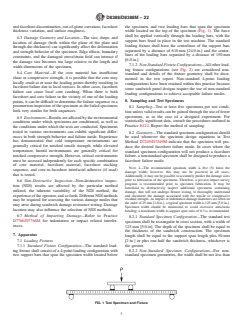
thickness variation, and surface roughness. width located on the top of the specimen (Fig. 1). The force
shall be applied vertically through the loading bars, with the
6.3 Damage Geometry and Location—The size, shape, and
support bars fixed in place in the test machine. The standard
location of damage (both within the plane of the plate and
loading fixture shall have the centerlines of the support bars
through-the-thickness) can significantly affect the deformation
separated by a distance of 610 mm [24.0 in.] and the center-
and strength behavior of the specimen. Edge effects, boundary
lines of the loading bars separated by a distance of 150 mm
constraints, and the damaged stress/strain field can interact if
[6.0 in.].
the damage size becomes too large relative to the length and
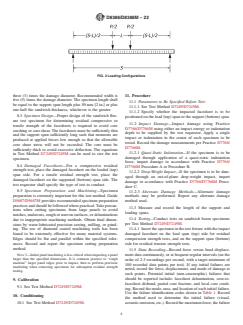
7.1.2 Non-Standard Fixture Configurations—Allotherload-
width dimensions of the specimen.
ing fixture configurations (see Fig. 2) are considered non-
6.4 Core Material—If the core material has insufficient
standard and details of the fixture geometry shall be docu-
shear or compressive strength, it is possible that the core may
mented in the test report. Non-standard 4-point loading
locally crush at or near the loading points thereby resulting in
configurations have been retained within this practice because
facesheet failure due to local stresses. In other cases, facesheet
some sandwich panel designs require the use of non-standard
failure can cause local core crushing. When there is both
loading configurations to achieve acceptable failure modes.
facesheet and core failure in the vicinity of one of the loading
8. Sampling and Test Specimens
points, it can be difficult to determine the failure sequence in a
postmortem inspection of the specimen as the failed specimens
8.1 Sampling—Test at least five specimens per test condi-
look very similar for both sequences.
tion unless valid results can be gained through the use of fewer
specimens, as in the case of a designed experiment. For
6.5 Environment—Resultsareaffectedbytheenvironmental
statistically significant data, consult the procedures outlined in
conditions under which specimens are conditioned, as well as
Practice E122. Report the method of sampling.
the conditions under which the tests are conducted. Specimens
tested in various environments can exhibit significant differ-
8.2 Geometry—The standard specimen configuration should
ences in both strength behavior and failure mode. Experience
be used whenever the specimen design equations in Test
has demonstrated that cold temperature environments are
Method D7249/D7249M indicate that the specimen will pro-
generally critical for notched tensile stren
...