

ASTM B725-22
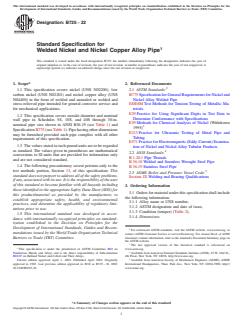
(Specification)Standard Specification for Welded Nickel and Nickel Copper Alloy Pipe
General Information
- Abstract
ABSTRACT
This specification covers UNS N02200 nickel alloy and UNS N02201 and N04400 low carbon nickel alloy welded pipes intended for general corrosive service and for mechanical applications. Each pipe should either be welded and annealed or welded and stress relieved and made from the flat-rolled alloys by an automatic welding process without any filler metal additions. The pipes should also be cold worked after welding to ensure the development of optimum corrosion resistance in the weld area and base metal during the final heat treatment.
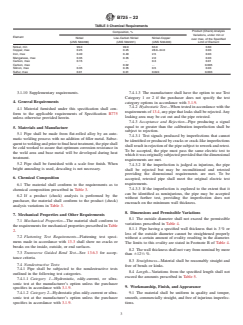
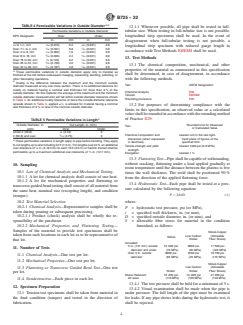
SCOPE
1.1 This specification covers nickel (UNS N02200), low carbon nickel (UNS N02201) and nickel copper alloy (UNS N04400) in the form of welded and annealed or welded and stress relieved pipe intended for general corrosive service and for mechanical applications.
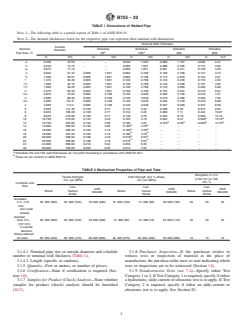
1.2 This specification covers outside diameter and nominal wall pipe in Schedules 5S, 10S, and 40S through 30-in. nominal pipe size shown in ANSI B36.19 (see Table 1) and Specification B775 (see Table 1). Pipe having other dimensions may be furnished provided such pipe complies with all other requirements of this specification.
1.3 The values stated in inch-pound units are to be regarded as standard. The values given in parentheses are mathematical conversions to SI units that are provided for information only and are not considered standard.
1.4 The following precautionary caveat pertains only to the test methods portion, Section 13, of this specification: This standard does not purport to address all of the safety problems, if any, associated with its use. It is the responsibility of the user of this standard to become familiar with all hazards including those identified in the appropriate Safety Data Sheet (SDS) for this product/material as provided by the manufacturer, to establish appropriate safety, health, and environmental practices, and determine the applicability of regulatory limitations prior to use.
1.5 This international standard was developed in accordance with internationally recognized principles on standardization established in the Decision on Principles for the Development of International Standards, Guides and Recommendations issued by the World Trade Organization Technical Barriers to Trade (TBT) Committee.
- Status
- Published
- Publication Date
- 31-Mar-2022
- Technical Committee
- B02 - Nonferrous Metals and Alloys
- Drafting Committee
- B02.07 - Refined Nickel and Cobalt and Their Alloys
Buy Documents
ASTM B725-22 - Standard Specification for Welded Nickel and Nickel Copper Alloy Pipe
REDLINE ASTM B725-22 - Standard Specification for Welded Nickel and Nickel Copper Alloy Pipe
Overview
ASTM B725-22: Standard Specification for Welded Nickel and Nickel Copper Alloy Pipe is developed by ASTM International to set the requirements for welded nickel (UNS N02200, UNS N02201) and nickel-copper alloy (UNS N04400) pipes. This specification primarily addresses pipes intended for general corrosive service and mechanical applications where superior corrosion resistance and mechanical integrity are required.
This ASTM standard details manufacturing, chemical composition, mechanical properties, dimensions, testing, and inspection procedures for welded pipes made from flat-rolled nickel and nickel-copper alloys. Pipes must be either welded and annealed or welded and stress relieved, using an automatic welding process without added filler metal. Cold working after welding is required to achieve optimal corrosion resistance in both the weld and base metal during final heat treatment.
Key Topics
Material Grades Covered
- Nickel (UNS N02200)
- Low carbon nickel (UNS N02201)
- Nickel-copper alloy (UNS N04400)
Product Forms and Sizes
- Welded and annealed or welded and stress relieved pipes
- Outside diameter and nominal wall thickness in Schedules 5S, 10S, 40S, and larger
- Compatible with sizes outlined in ANSI B36.19 and ASTM B775
- Non-standard sizes may be supplied if all requirements are met
Welding and Heat Treatment
- Pipes manufactured via automatic welding with no filler metal
- Mandatory cold working post-welding for enhanced corrosion resistance
- Final heat treatment ensures consistent material properties
Dimensional and Mechanical Requirements
- Strict tolerances for diameter, length, straightness, and wall thickness
- Minimum mechanical property requirements for tensile strength, yield strength, and elongation
Testing and Inspection
- Comprehensive nondestructive testing: hydrostatic, eddy-current, and ultrasonic tests
- Flattening and bend tests to assess weld and material integrity
- Inclusion of product certification and markings for traceability
Supplemental and Optional Requirements
- Ability to specify additional product checks and supplementary provisions as needed for critical applications
Applications
ASTM B725-22 pipes are essential in a variety of industries that demand reliable performance in corrosive or high-stress environments. Typical applications include:
Chemical Process Industries
- Transport of aggressive chemicals and corrosive fluids, thanks to the inherent corrosion resistance of nickel and nickel-copper alloys
Oil and Gas Sector
- Piping systems exposed to harsh conditions in offshore and onshore facilities
Power Generation
- Heat exchanger tubes and piping systems requiring dimensional stability and corrosion resistance
Marine Engineering
- Seawater piping, desalination plants, and shipbuilding
Pharmaceutical and Food Processing
- Hygienic and corrosion-resistant piping for pure water and specialty process lines
Related Standards
To ensure comprehensive implementation and compliance, ASTM B725-22 references and aligns with several related standards:
- ASTM B775 - General requirements for nickel and nickel alloy welded pipe
- ASTM E8/E8M - Test methods for tension testing of metallic materials
- ASTM E213 - Practice for ultrasonic testing of metal pipe and tubing
- ASTM E571 - Practice for electromagnetic (eddy-current) examination of nickel and nickel alloy tubular products
- ANSI B36.19 - Stainless steel pipe dimensions
- ASME Boiler and Pressure Vessel Code, Section IX - Welding and brazing qualifications
By following ASTM B725-22, manufacturers and end-users can ensure high quality, reliable welded nickel and nickel-copper alloy pipe, suitable for demanding industrial applications requiring both mechanical and corrosion resistance performance.
Relations
- Effective Date
- 01-Jan-2024
- Effective Date
- 01-Jul-2019
- Effective Date
- 15-Jul-2016
- Effective Date
- 01-Oct-2015
- Effective Date
- 01-Feb-2015
- Effective Date
- 01-Jun-2013
- Effective Date
- 01-Feb-2013
- Effective Date
- 01-Aug-2012
- Effective Date
- 01-Dec-2011
- Effective Date
- 01-Jun-2009
- Effective Date
- 01-Oct-2008
- Effective Date
- 01-Apr-2008
- Effective Date
- 01-Dec-2007
- Effective Date
- 15-Nov-2006
- Effective Date
- 15-Sep-2006
Buy Documents
ASTM B725-22 - Standard Specification for Welded Nickel and Nickel Copper Alloy Pipe
REDLINE ASTM B725-22 - Standard Specification for Welded Nickel and Nickel Copper Alloy Pipe
Get Certified
Connect with accredited certification bodies for this standard

Element Materials Technology
Materials testing and product certification.

Inštitut za kovinske materiale in tehnologije
Institute of Metals and Technology. Materials testing, metallurgical analysis, NDT.
Sponsored listings
Frequently Asked Questions
ASTM B725-22 is a technical specification published by ASTM International. Its full title is "Standard Specification for Welded Nickel and Nickel Copper Alloy Pipe". This standard covers: ABSTRACT This specification covers UNS N02200 nickel alloy and UNS N02201 and N04400 low carbon nickel alloy welded pipes intended for general corrosive service and for mechanical applications. Each pipe should either be welded and annealed or welded and stress relieved and made from the flat-rolled alloys by an automatic welding process without any filler metal additions. The pipes should also be cold worked after welding to ensure the development of optimum corrosion resistance in the weld area and base metal during the final heat treatment. SCOPE 1.1 This specification covers nickel (UNS N02200), low carbon nickel (UNS N02201) and nickel copper alloy (UNS N04400) in the form of welded and annealed or welded and stress relieved pipe intended for general corrosive service and for mechanical applications. 1.2 This specification covers outside diameter and nominal wall pipe in Schedules 5S, 10S, and 40S through 30-in. nominal pipe size shown in ANSI B36.19 (see Table 1) and Specification B775 (see Table 1). Pipe having other dimensions may be furnished provided such pipe complies with all other requirements of this specification. 1.3 The values stated in inch-pound units are to be regarded as standard. The values given in parentheses are mathematical conversions to SI units that are provided for information only and are not considered standard. 1.4 The following precautionary caveat pertains only to the test methods portion, Section 13, of this specification: This standard does not purport to address all of the safety problems, if any, associated with its use. It is the responsibility of the user of this standard to become familiar with all hazards including those identified in the appropriate Safety Data Sheet (SDS) for this product/material as provided by the manufacturer, to establish appropriate safety, health, and environmental practices, and determine the applicability of regulatory limitations prior to use. 1.5 This international standard was developed in accordance with internationally recognized principles on standardization established in the Decision on Principles for the Development of International Standards, Guides and Recommendations issued by the World Trade Organization Technical Barriers to Trade (TBT) Committee.
ABSTRACT This specification covers UNS N02200 nickel alloy and UNS N02201 and N04400 low carbon nickel alloy welded pipes intended for general corrosive service and for mechanical applications. Each pipe should either be welded and annealed or welded and stress relieved and made from the flat-rolled alloys by an automatic welding process without any filler metal additions. The pipes should also be cold worked after welding to ensure the development of optimum corrosion resistance in the weld area and base metal during the final heat treatment. SCOPE 1.1 This specification covers nickel (UNS N02200), low carbon nickel (UNS N02201) and nickel copper alloy (UNS N04400) in the form of welded and annealed or welded and stress relieved pipe intended for general corrosive service and for mechanical applications. 1.2 This specification covers outside diameter and nominal wall pipe in Schedules 5S, 10S, and 40S through 30-in. nominal pipe size shown in ANSI B36.19 (see Table 1) and Specification B775 (see Table 1). Pipe having other dimensions may be furnished provided such pipe complies with all other requirements of this specification. 1.3 The values stated in inch-pound units are to be regarded as standard. The values given in parentheses are mathematical conversions to SI units that are provided for information only and are not considered standard. 1.4 The following precautionary caveat pertains only to the test methods portion, Section 13, of this specification: This standard does not purport to address all of the safety problems, if any, associated with its use. It is the responsibility of the user of this standard to become familiar with all hazards including those identified in the appropriate Safety Data Sheet (SDS) for this product/material as provided by the manufacturer, to establish appropriate safety, health, and environmental practices, and determine the applicability of regulatory limitations prior to use. 1.5 This international standard was developed in accordance with internationally recognized principles on standardization established in the Decision on Principles for the Development of International Standards, Guides and Recommendations issued by the World Trade Organization Technical Barriers to Trade (TBT) Committee.
ASTM B725-22 is classified under the following ICS (International Classification for Standards) categories: 77.120.40 - Nickel, chromium and their alloys. The ICS classification helps identify the subject area and facilitates finding related standards.
ASTM B725-22 has the following relationships with other standards: It is inter standard links to ASTM E8/E8M-24, ASTM E571-19, ASTM E8/E8M-16, ASTM B775-15, ASTM E8/E8M-15, ASTM E8/E8M-13, ASTM B775-13, ASTM E571-12, ASTM E8/E8M-11, ASTM E213-09, ASTM E29-08, ASTM B775-08, ASTM E571-98(2007)e1, ASTM E29-06b, ASTM E29-06a. Understanding these relationships helps ensure you are using the most current and applicable version of the standard.
ASTM B725-22 is available in PDF format for immediate download after purchase. The document can be added to your cart and obtained through the secure checkout process. Digital delivery ensures instant access to the complete standard document.
Standards Content (Sample)
This international standard was developed in accordance with internationally recognized principles on standardization established in the Decision on Principles for the
Development of International Standards, Guides and Recommendations issued by the World Trade Organization Technical Barriers to Trade (TBT) Committee.
Designation:B725 −22
Standard Specification for
Welded Nickel and Nickel Copper Alloy Pipe
This standard is issued under the fixed designation B725; the number immediately following the designation indicates the year of
original adoption or, in the case of revision, the year of last revision. A number in parentheses indicates the year of last reapproval. A
superscript epsilon (´) indicates an editorial change since the last revision or reapproval.
1. Scope* 2. Referenced Documents
1.1 This specification covers nickel (UNS N02200), low 2.1 ASTM Standards:
carbon nickel (UNS N02201) and nickel copper alloy (UNS B775 Specification for General Requirements for Nickel and
N04400) in the form of welded and annealed or welded and Nickel Alloy Welded Pipe
stress relieved pipe intended for general corrosive service and E8/E8M Test Methods for Tension Testing of Metallic Ma-
for mechanical applications. terials
E29 Practice for Using Significant Digits in Test Data to
1.2 This specification covers outside diameter and nominal
Determine Conformance with Specifications
wall pipe in Schedules 5S, 10S, and 40S through 30-in.
E39 Methods for Chemical Analysis of Nickel (Withdrawn
nominal pipe size shown in ANSI B36.19 (see Table 1) and
1995)
SpecificationB775(seeTable1).Pipehavingotherdimensions
E213 Practice for Ultrasonic Testing of Metal Pipe and
may be furnished provided such pipe complies with all other
Tubing
requirements of this specification.
E571 PracticeforElectromagnetic(Eddy-Current)Examina-
1.3 The values stated in inch-pound units are to be regarded
tion of Nickel and Nickel Alloy Tubular Products
as standard. The values given in parentheses are mathematical
2.2 ANSI Standards:
conversions to SI units that are provided for information only
B 1.20.1 Pipe Threads
and are not considered standard.
B 36.10 Welded and Seamless Wrought Steel Pipe
1.4 The following precautionary caveat pertains only to the
B 36.19 Stainless Steel Pipe
test methods portion, Section 13, of this specification: This 5
2.3 ASME Boiler and Pressure Vessel Code:
standard does not purport to address all of the safety problems,
Section IX Welding and Brazing Qualifications
if any, associated with its use. It is the responsibility of the user
of this standard to become familiar with all hazards including
3. Ordering Information
those identified in the appropriate Safety Data Sheet (SDS) for
3.1 Orders for material under this specification shall include
this product/material as provided by the manufacturer, to
the following information:
establish appropriate safety, health, and environmental
3.1.1 Alloy name or UNS number,
practices, and determine the applicability of regulatory limi-
3.1.2 ASTM designation and date of issue,
tations prior to use.
3.1.3 Condition (temper) (Table 2),
1.5 This international standard was developed in accor-
3.1.4 Dimensions:
dance with internationally recognized principles on standard-
ization established in the Decision on Principles for the
Development of International Standards, Guides and Recom-
For referenced ASTM standards, visit the ASTM website, www.astm.org, or
mendations issued by the World Trade Organization Technical
contact ASTM Customer Service at service@astm.org. For Annual Book of ASTM
Barriers to Trade (TBT) Committee. Standards volume information, refer to the standard’s Document Summary page on
the ASTM website.
The last approved version of this historical standard is referenced on
This specification is under the jurisdiction of ASTM Committee B02 on www.astm.org.
Nonferrous Metals and Alloys and is the direct responsibility of Subcommittee Available fromAmerican National Standards Institute (ANSI), 25 W. 43rd St.,
B02.07 on Refined Nickel and Cobalt and Their Alloys. 4th Floor, New York, NY 10036, http://www.ansi.org.
Current edition approved April 1, 2022. Published April 2022. Originally Available from American Society of Mechanical Engineers (ASME), ASME
approved in 1983. Last previous edition approved in 2018 as B725 – 18. DOI: International Headquarters, Three Park Ave., New York, NY 10016-5990, http://
10.1520/B0725-22. www.asme.org.
*A Summary of Changes section appears at the end of this standard
Copyright © ASTM International, 100 Barr Harbor Drive, PO Box C700, West Conshohocken, PA 19428-2959. United States
B725−22
TABLE 1 Dimensions of Welded Pipe
NOTE 1—The following table is a partial reprint of Table 1 of ANSI B36.19.
NOTE 2—The decimal thicknesses listed for the respective pipe size represent their nominal wall dimensions.
Nominal Wall Thickness
Outside
Nominal Schedule Schedule Schedule Schedule
Diameter
A A
Pipe Size, in. 5S 10S 40S 80S
in. mm in. mm in. mm in. mm in. mm
⁄8 0.405 10.29 . . 0.049 1.245 0.068 1.727 0.095 2.41
⁄4 0.540 13.72 . . 0.065 1.651 0.088 2.235 0.119 3.02
⁄8 0.675 17.15 . 0.065 1.651 0.091 2.311 0.126 3.20
⁄2 0.840 21.34 0.065 1.651 0.083 2.108 0.109 2.768 0.147 3.73
⁄4 1.050 26.67 0.065 1.651 0.083 2.108 0.113 2.870 0.154 3.91
1 1.315 33.40 0.065 1.651 0.109 2.768 0.133 3.378 0.179 4.55
1 ⁄4 1.660 42.16 0.065 1.651 0.109 2.768 0.140 3.556 0.191 4.85
1 ⁄2 1.900 48.26 0.065 1.651 0.109 2.768 0.145 3.683 0.200 5.08
2 2.375 60.33 0.065 1.651 0.109 2.768 0.154 3.912 0.218 5.54
2 ⁄2 2.875 73.03 0.083 2.108 0.120 3.048 0.203 5.156 0.276 7.01
3 3.500 88.90 0.083 2.108 0.120 3.048 0.216 5.486 0.300 7.62
3 ⁄2 4.000 101.6 0.083 2.108 0.120 3.048 0.226 5.740 0.318 8.08
4 4.500 114.3 0.083 2.108 0.120 3.048 0.237 6.020 0.337 8.56
5 5.563 141.30 0.109 2.77 0.134 3.40 0.258 6.55 0.375 9.52
6 6.625 168.28 0.109 2.77 0.134 3.40 0.280 7.11 0.432 10.97
8 8.625 219.08 0.109 2.77 0.148 3.76 0.322 8.18 0.500 12.70
B B
10 10.750 273.05 0.134 3.40 0.165 4.19 0.365 9.27 0.500 12.70
B B B B
12 12.750 323.85 0.156 3.96 0.180 4.57 0.375 9.52 0.500 12.70
B B
14 14.000 355.60 0.156 3.96 0.188 4.78 . . . . . .
B B
16 16.000 406.40 0.165 4.19 0.188 4.78 . . . .
B B
18 18.000 457.20 0.165 4.19 0.188 4.78 . . . .
B B
20 20.000 508.00 0.188 4.78 0.218 5.54 . . . .
B B
22 22.000 558.80 0.188 4.78 0.218 5.54 . . . .
24 24.000 609.60 0.218 5.54 0.250 6.35 . . . .
30 30.000 762.00 0.250 6.35 0.312 7.92 . . . .
A
Schedules 5S and 10S wall thicknesses do not permit threading in accordance with ANSI B1.20.1.
B
These do not conform to ANSI B36.10.
TABLE 2 Mechanical Properties of Pipe and Tube
Elongation in 2 in.
Tensile Strength, Yield Strength (0.2 % offset),
or 50 mm (or 4D),
min, psi (MPa) min, psi (MPa)
min, %
Condition and
Size
Low- Low- Low-
UNS UNS UNS
Nickel Carbon Nickel Carbon Nickel Carbon
N04400 N04400 N04400
Nickel Nickel Nickel
Annealed
5 in. (127 55 000 (380) 50 000 (345) 70 000 (480) 15 000 (105) 12 000 (80) 28 000 (195) 35 35 35
mm)
and under
outside
diameter
Over 5 in. 55 000 (380) 50 000 (345) 70 000 (480) 12 000 (80) 10 000 (70) 25 000 (170) 40 40 35
(127 mm)
in outside
diameter
Stress-relieved
All sizes 65 000 (450) 60 000 (415) 85 000 (585) 40 000 (275) 30 000 (205) 55 000 (380) 15 15 15
3.1.4.1 Nominal pipe size or outside diameter and schedule 3.1.8 Purchaser Inspection—If the purchaser wishes to
number or nominal wall thickness (Table 1), witness tests or inspection of material at the place of
3.1.4.2 Length (specific or random), manufacture, the purchase order must so state indicating which
3.1.5 Quantity—Feet or metres, or number of pieces, tests or inspections are to be witnessed (Section 14),
3.1.6 Certification—State if certification is required (Sec- 3.1.9 Nondestructive Tests (see 7.4)—Specify either Test
tion 16), Category 1 or 2. IfTest Category 1 is required, specify if either
3.1.7 Samples for Product (Check) Analysis—State whether a hydrostatic, eddy-current or ultrasonic test is to apply. If Test
samples for product (check) analysis should be furnished Category 2 is required, specify if either an eddy-current or
(10.2), ultrasonic test is to apply. See Section S1.
B725−22
TABLE 3 Chemical Requirements
Product (Check) Analysis
Composition, %
Variations, under min or
Element
Nickel Low-Carbon Nickel Nickel-Copper
over max, of the Specified
(UNS N02200) (UNS N02201) (UNS N04400)
Limit of Element
Nickel, min 99.0 99.0 63.0 0.60
Copper, max 0.25 0.25 28.0–34.0 0.03
Iron, max 0.40 0.40 2.5 0.03
Manganese, max 0.35 0.35 2.0 0.03
Carbon, max 0.15 . 0.3 0.01
Carbon, max . 0.02 . 0.005
Silicon, max 0.35 0.35 0.5 0.03
Sulfur, max 0.01 0.01 0.024 0.003
3.1.10 Supplementary requirements. 7.4.1.3 The manufacturer shall have the option to use Test
Category 1 or 2 if the purchaser does not specify the test
4. General Requirements
category options in accordance with 3.1.9.
7.4.2 Hydrostatic Test—When tested in accordance with the
4.1 Material furnished under this specification shall con-
requirements of 13.4, any pipe that leaks shall be rejected.Any
form to the applicable requirements of Specification B775
leaking area may be cut out and the pipe retested.
unless otherwise provided herein.
7.4.3 Acceptance and Rejection—Pipe producing a signal
equal to or greater than the calibration imperfection shall be
5. Materials and Manufacture
subject to rejection.
5.1 Pipe shall be made from flat-rolled alloy by an auto-
7.4.3.1 Test signals produced by imperfections that cannot
matic welding process with no addition of filler metal. Subse-
be identified or produced by cracks or crack-like imperfections
quenttoweldingandpriortofinalheattreatment,thepipeshall
shall result in rejection of the pipe subject to rework and retest.
be cold worked to assure that optimum corrosion resistance in
To be accepted, the pipe must pass the same electric test to
the weld area and base metal will be developed during heat
whichitwasoriginallysubjectedprovidedthatthedimensional
treatment.
requirements are met.
5.2 Pipe shall be furnished with a scale free finish. When
7.4.3.2 If the imperfection is judged as injurious, the pipe
bright annealing is used, descaling is not necessary.
shall be rejected but may be reconditioned and retested
providing the dimensional requirements are met. To be
6. Chemical Composition
accepted, retested pipe shall meet the original electric test
requirements.
6.1 The material shall conform to the requirements as to
7.4.3.3 If the imperfection is explored to the extent that it
chemical composition prescribed in Table 3.
can be identified as noninjurious, the pipe may be accepted
6.2 If a product (check) analysis is performed by the
without further test, providing the imperfection does not
purchaser, the material shall conform to the product (check)
encroach on the minimum wall thickness.
analysis variations in Table 3.
8. Dimensions and Permissible Variations
7. Mechanical Properties and Other Requirements
8.1 The outside diameter shall not exceed the permissible
7.1 Mechanical Properties—The material shall conform to
variations prescribed in Table 4.
the requirements for mechanical properties prescribed in Table
8.1.1 Pipe having a specified wall thickness that is 3 % or
2.
less of the outside diameter cannot be straightened properly
7.2 Flattening Test Requirements—Flattening test speci-
without a certain amount of ovality resulting in the diameter.
mens made in accordance with 13.3 shall show no cracks or
The limits to this ovality are stated in Footnote B of Table 4.
breaks on the inside, outside, or end surfaces.
8.2 The wall thickness shall not vary from nominal by more
7.3 Transverse Guided Bend Test—See 13.6.3 for accep- 1
than 612 ⁄2 %.
tance criteria.
8.3 Straightness—Material shall be reasonably straight and
7.4 Nondestructive Tests:
free of bends or kinks.
7.4.1 Pipe shall be subjected to the nondestructive tests
8.4 Length—Variations from the specified length shall not
outlined in the following test categories.
exceed the amounts prescribed in Table 5.
7.4.1.1 Category 1—Hydrostatic, eddy-current, or ultra-
sonic test at the manufacturer’s option unless the purchaser
9. Workmanship, Finish, and Appearance
specifies in accordance with 3.1.9.
7.4.1.2 Category 2—Hydrostatic plus eddy-current or ultra- 9.1 The material shall be uniform in quality and temper,
sonic test at the manufacturer’s option unless the purchaser smooth, commercially straight, and free of injurious imperfec-
specifies in accordance with 3.1.9. tions.
B725−22
A,B
TABLE 4 Permissible Variations in Outside Diameter
12.1.1 Whenever possible,
...
This document is not an ASTM standard and is intended only to provide the user of an ASTM standard an indication of what changes have been made to the previous version. Because
it may not be technically possible to adequately depict all changes accurately, ASTM recommends that users consult prior editions as appropriate. In all cases only the current version
of the standard as published by ASTM is to be considered the official document.
Designation: B725 − 18 B725 − 22
Standard Specification for
Welded Nickel (UNS N02200/UNS N02201) and Nickel
Copper Alloy (UNS N04400) Pipe
This standard is issued under the fixed designation B725; the number immediately following the designation indicates the year of
original adoption or, in the case of revision, the year of last revision. A number in parentheses indicates the year of last reapproval. A
superscript epsilon (´) indicates an editorial change since the last revision or reapproval.
1. Scope*
1.1 This specification covers nickel (UNS N02200) and N02200), low carbon nickel (UNS N02201 and UNS N02201) and nickel
copper alloy (UNS N04400) in the form of welded and annealed or welded and stress relieved pipe intended for general corrosive
service and for mechanical applications.
1.2 This specification covers outside diameter and nominal wall pipe in Schedules 5S, 10S, and 40S through 30-in. nominal pipe
size shown in ANSI B36.19 (see Table 1) and Specification B775 (see Table 1). Pipe having other dimensions may be furnished
provided such pipe complies with all other requirements of this specification.
1.3 The values stated in inch-pound units are to be regarded as standard. The values given in parentheses are mathematical
conversions to SI units that are provided for information only and are not considered standard.
1.4 The following precautionary caveat pertains only to the test methods portion, Section 1213, of this specification: This
standard does not purport to address all of the safety problems, if any, associated with its use. It is the responsibility of the user
of this standard to become familiar with all hazards including those identified in the appropriate Safety Data Sheet (SDS) for this
product/material as provided by the manufacturer, to establish appropriate safety, health, and environmental practices, and
determine the applicability of regulatory limitations prior to use.
1.5 This international standard was developed in accordance with internationally recognized principles on standardization
established in the Decision on Principles for the Development of International Standards, Guides and Recommendations issued
by the World Trade Organization Technical Barriers to Trade (TBT) Committee.
2. Referenced Documents
2.1 ASTM Standards:
B775 Specification for General Requirements for Nickel and Nickel Alloy Welded Pipe
E8E8/E8M Test Methods for Tension Testing of Metallic Materials [Metric] E0008_E0008M
E29 Practice for Using Significant Digits in Test Data to Determine Conformance with Specifications
E39 Methods for Chemical Analysis of Nickel (Withdrawn 1995)
E213 Practice for Ultrasonic Testing of Metal Pipe and Tubing
E571 Practice for Electromagnetic (Eddy-Current) Examination of Nickel and Nickel Alloy Tubular Products
This specification is under the jurisdiction of ASTM Committee B02 on Nonferrous Metals and Alloys and is the direct responsibility of Subcommittee B02.07 on Refined
Nickel and Cobalt and Their Alloys.
Current edition approved April 1, 2018April 1, 2022. Published April 2018April 2022. Originally approved in 1983. Last previous edition approved in 20142018 as
ɛ1
B725 – 05 (2014)B725 – 18. . DOI: 10.1520/B0725-18.10.1520/B0725-22.
For referenced ASTM standards, visit the ASTM website, www.astm.org, or contact ASTM Customer Service at service@astm.org. For Annual Book of ASTM Standards
volume information, refer to the standard’s Document Summary page on the ASTM website.
The last approved version of this historical standard is referenced on www.astm.org.
*A Summary of Changes section appears at the end of this standard
Copyright © ASTM International, 100 Barr Harbor Drive, PO Box C700, West Conshohocken, PA 19428-2959. United States
B725 − 22
TABLE 1 Dimensions of Welded Pipe
NOTE 1—The following table is a partial reprint of Table 1 of ANSI B36.19.
NOTE 2—The decimal thicknesses listed for the respective pipe size represent their nominal wall dimensions.
Nominal Wall Thickness
Outside
Nominal Schedule Schedule Schedule Schedule
Diameter
A A
Pipe Size, in. 5S 10S 40S 80S
in. mm in. mm in. mm in. mm in. mm
⁄8 0.405 10.29 . . 0.049 1.245 0.068 1.727 0.095 2.41
⁄4 0.540 13.72 . . 0.065 1.651 0.088 2.235 0.119 3.02
⁄8 0.675 17.15 . 0.065 1.651 0.091 2.311 0.126 3.20
⁄2 0.840 21.34 0.065 1.651 0.083 2.108 0.109 2.768 0.147 3.73
⁄4 1.050 26.67 0.065 1.651 0.083 2.108 0.113 2.870 0.154 3.91
1 1.315 33.40 0.065 1.651 0.109 2.768 0.133 3.378 0.179 4.55
1 ⁄4 1.660 42.16 0.065 1.651 0.109 2.768 0.140 3.556 0.191 4.85
1 ⁄2 1.900 48.26 0.065 1.651 0.109 2.768 0.145 3.683 0.200 5.08
2 2.375 60.33 0.065 1.651 0.109 2.768 0.154 3.912 0.218 5.54
2 ⁄2 2.875 73.03 0.083 2.108 0.120 3.048 0.203 5.156 0.276 7.01
3 3.500 88.90 0.083 2.108 0.120 3.048 0.216 5.486 0.300 7.62
3 ⁄2 4.000 101.6 0.083 2.108 0.120 3.048 0.226 5.740 0.318 8.08
4 4.500 114.3 0.083 2.108 0.120 3.048 0.237 6.020 0.337 8.56
5 5.563 141.30 0.109 2.77 0.134 3.40 0.258 6.55 0.375 9.52
6 6.625 168.28 0.109 2.77 0.134 3.40 0.280 7.11 0.432 10.97
8 8.625 219.08 0.109 2.77 0.148 3.76 0.322 8.18 0.500 12.70
B B
10 10.750 273.05 0.134 3.40 0.165 4.19 0.365 9.27 0.500 12.70
B B B B
12 12.750 323.85 0.156 3.96 0.180 4.57 0.375 9.52 0.500 12.70
B B
14 14.000 355.60 0.156 3.96 0.188 4.78 . . . . . .
B B
16 16.000 406.40 0.165 4.19 0.188 4.78 . . . .
B B
18 18.000 457.20 0.165 4.19 0.188 4.78 . . . .
B B
20 20.000 508.00 0.188 4.78 0.218 5.54 . . . .
B B
22 22.000 558.80 0.188 4.78 0.218 5.54 . . . .
24 24.000 609.60 0.218 5.54 0.250 6.35 . . . .
30 30.000 762.00 0.250 6.35 0.312 7.92 . . . .
A
Schedules 5S and 10S wall thicknesses do not permit threading in accordance with ANSI B1.20.1.
B
These do not conform to ANSI B36.10.
2.2 ANSI Standards:
B 1.20.1 Pipe Threads
B 36.10 Welded and Seamless Wrought Steel Pipe
B 36.19 Stainless Steel Pipe
2.3 ASME Boiler and Pressure Vessel Code:
Section IX Welding and Brazing Qualifications
3. Ordering Information
3.1 Orders for material under this specification shall include the following information:
3.1.1 Alloy name or UNS number,
3.1.2 ASTM designation and date of issue,
3.1.3 Condition (temper) (Table 2),
3.1.4 Dimensions:
3.1.4.1 Nominal pipe size or outside diameter and schedule number or nominal wall thickness (Table 1),
3.1.4.2 Length (specific or random),
3.1.5 Quantity—feetFeet or metres, or number of pieces,
Available from American National Standards Institute (ANSI), 25 W. 43rd St., 4th Floor, New York, NY 10036, http://www.ansi.org.
Available from American Society of Mechanical Engineers (ASME), ASME International Headquarters, Three Park Ave., New York, NY 10016-5990, http://
www.asme.org.
B725 − 22
TABLE 2 Mechanical Properties of Pipe and Tube
Elongation in 2 in.
Tensile Strength, Yield Strength (0.2 % offset),
or 50 mm (or 4D),
min, psi (MPa) min, psi (MPa)
min, %
Condition and
Size
Low- Low- Low-
UNS UNS UNS
Nickel Carbon Nickel Carbon Nickel Carbon
N04400 N04400 N04400
Nickel Nickel Nickel
Annealed
5 in. (127 55 000 (380) 50 000 (345) 70 000 (480) 15 000 (105) 12 000 (80) 28 000 (195) 35 35 35
mm)
and under
outside
diameter
Over 5 in. 55 000 (380) 50 000 (345) 70 000 (480) 12 000 (80) 10 000 (70) 25 000 (170) 40 40 35
(127 mm)
in outside
diameter
Stress-relieved
All sizes 65 000 (450) 60 000 (415) 85 000 (585) 40 000 (275) 30 000 (205) 55 000 (380) 15 15 15
TABLE 3 Chemical Requirements
Product (Check) Analysis
Composition, %
Variations, under min or
Element
Nickel Low-Carbon Nickel Nickel-Copper
over max, of the Specified
(UNS N02200) (UNS N02201) (UNS N04400)
Limit of Element
Nickel, min 99.0 99.0 63.0 0.60
Copper, max 0.25 0.25 28.0–34.0 0.03
Iron, max 0.40 0.40 2.5 0.03
Manganese, max 0.35 0.35 2.0 0.03
Carbon, max 0.15 . 0.3 0.01
Carbon, max . 0.02 . 0.005
Silicon, max 0.35 0.35 0.5 0.03
Sulfur, max 0.01 0.01 0.024 0.003
3.1.6 Certification—State if certification is required (Section 1516),
3.1.7 Samples for Product (Check) Analysis—State whether samples for product (check) analysis should be furnished (9.210.2),
3.1.8 Purchaser Inspection—If the purchaser wishes to witness tests or inspection of material at the place of manufacture, the
purchase order must so state indicating which tests or inspections are to be witnessed (Section 1314),
3.1.9 Nondestructive Tests (see 6.47.4)—Specify either Test Category 1 or 2. If Test Category 1 is required, specify if either a
hydrostatic, eddy-current or ultrasonic test is to apply. If Test Category 2 is required, specify if either an eddy-current or ultrasonic
test is to apply. See Section S1.
3.1.10 Supplementary Requirements.requirements.
4. General Requirements
4.1 Material furnished under this specification shall conform to the applicable requirements of Specification B775 unless otherwise
provided herein.
5. Materials and Manufacture
5.1 Pipe shall be made from flat-rolled alloy by an automatic welding process with no addition of filler metal. Subsequent to
welding and prior to final heat treatment, the pipe shall be cold worked to assure that optimum corrosion resistance in the weld
area and base metal will be developed during heat treatment.
5.2 Pipe shall be furnished with a scale free finish. When bright annealing is used, descaling is not necessary.
B725 − 22
6. Chemical Composition
6.1 The material shall conform to the requirements as to chemical composition prescribed in Table 3.
6.2 If a product (check) analysis is performed by the purchaser, the material shall conform to the product (check) analysis
variations in Table 3.
7. Mechanical Properties and Other Requirements
7.1 Mechanical Properties—The material shall conform to the requirements for mechanical properties prescribed in Table 2.
7.2 Flattening Test Requirements—Flattening test specimens made in accordance with 12.313.3 shall show no cracks or breaks on
the inside, outside, or end surfaces.
7.3 Transverse Guided Bend Test—See 12.6.313.6.3 for acceptance criteria.
7.4 Nondestructive Tests:
7.4.1 Pipe shall be subjected to the nondestructive tests outlined in the following test categories.
7.4.1.1 Category 1—Hydrostatic, eddy-current, or ultrasonic test at the manufacturer’s option unless the purchaser specifies in
accordance with 3.1.9.
7.4.1.2 Category 2—Hydrostatic plus eddy-current or ultrasonic test at the manufacturer’s option unless the purchaser specifies
in accordance with 3.1.9.
7.4.1.3 The manufacturer shall have the option to use Test Category 1 or 2 if the purchaser does not specify the test category
options in accordance with 3.1.9.
7.4.2 Hydrostatic Test—When tested in accordance with the requirements of 12.413.4, any pipe that leaks shall be rejected. Any
leaking area may be cut out and the pipe retested.
7.4.3 Acceptance and Rejection—Pipe producing a signal equal to or greater than the calibration imperfection shall be subject to
rejection.
7.4.3.1 Test signals produced by imperfections that cannot be identified or produced by cracks or crack-like imperfections shall
result in rejection of the pipe subject to rework and retest. To be accepted, the pipe must pass the same electric test to which it
was originally subjected provided that the dimensional requirements are met.
7.4.3.2 If the imperfection is judged as injurious, the pipe shall be rejected but may be reconditioned and retested providing the
dimensional requirements are met. To be accepted, retested pipe shall meet the original electric test requirements.
7.4.3.3 If the imperfection is explored to the extent that it can be identified as noninjurious, the pipe may be accepted without
further test, providing the imperfection does not encroach on the minimum wall thickness.
8. Dimensions and Permissible Variations
8.1 The outside diameter shall not exceed the permissible variations prescribed in Table 4.
8.1.1 Pipe having a specified wall thickness that is 3 % or less of the outside diameter cannot be straightened properly without
a certain amount of ovality resulting in the diameter. The limits to this ovality are stated in Footnote B of Table 4.
8.2 The wall thickness shall not vary from nominal by more than 612 ⁄2 %.
8.3 Straightness—Material shall be reasonably straight and free of bends or kinks.
B725 − 22
A,B
TABLE 4 Permissible Variations in Outside Diameter
Permissible Variations in Outside Diameter
NPS Designator Over Under
in. mm in. mm
1 1 1 1
⁄8 to 1 ⁄2, incl ⁄64 (0.015) 0.4 ⁄32 (0.031) 0.8
1 1 1
Over 1 ⁄2 to 4, incl ⁄32 (0.031) 0.8 ⁄32 (0.031) 0.8
1 1
Over 4 to 8, incl ⁄16 (0.062) 1.6 ⁄32 (0.031) 0.8
3 1
Over 8 to 18, incl ⁄32 (0.093)
...