


ASTM D871-96(2019)
(Test Method)Standard Test Methods of Testing Cellulose Acetate
Standard Test Methods of Testing Cellulose Acetate
SIGNIFICANCE AND USE
4.1 Moisture content of the cellulose ester can be used to estimate the dry weight of the cellulose ester. Since cellulose esters are desiccants, their moisture content can vary greatly depending on storage.
SCOPE
1.1 These test methods cover procedures for testing cellulose acetate.
1.2 The test procedures appear in the following sections:
Sections
Ash
8 to 11
Color and Haze
67 to 72
Combined Acetyl or Acetic Acid Content
Test Method A. Solution Method
17, 19 to 23
Test Method B. Heterogeneous Saponification Method
17, 24 to 26
Free Acidity
12 to 16
Heat Stability
47 to 56
Hydroxyl Content
27 to 33
Intrinsic Viscosity
57 to 62
Moisture Content
4 to 7
Primary Hydroxyl Content
34 to 39
Sulfur or Sulfate Content
40 to 45
Viscosity
63 to 66
1.3 The values stated in SI units are to be regarded as the standard. The values given in parentheses are for information only.
1.4 This standard does not purport to address all of the safety concerns, if any, associated with its use. It is the responsibility of the user of this standard to establish appropriate safety, health, and environmental practices and determine the applicability of regulatory limitations prior to use.
1.5 This international standard was developed in accordance with internationally recognized principles on standardization established in the Decision on Principles for the Development of International Standards, Guides and Recommendations issued by the World Trade Organization Technical Barriers to Trade (TBT) Committee.
General Information
Relations
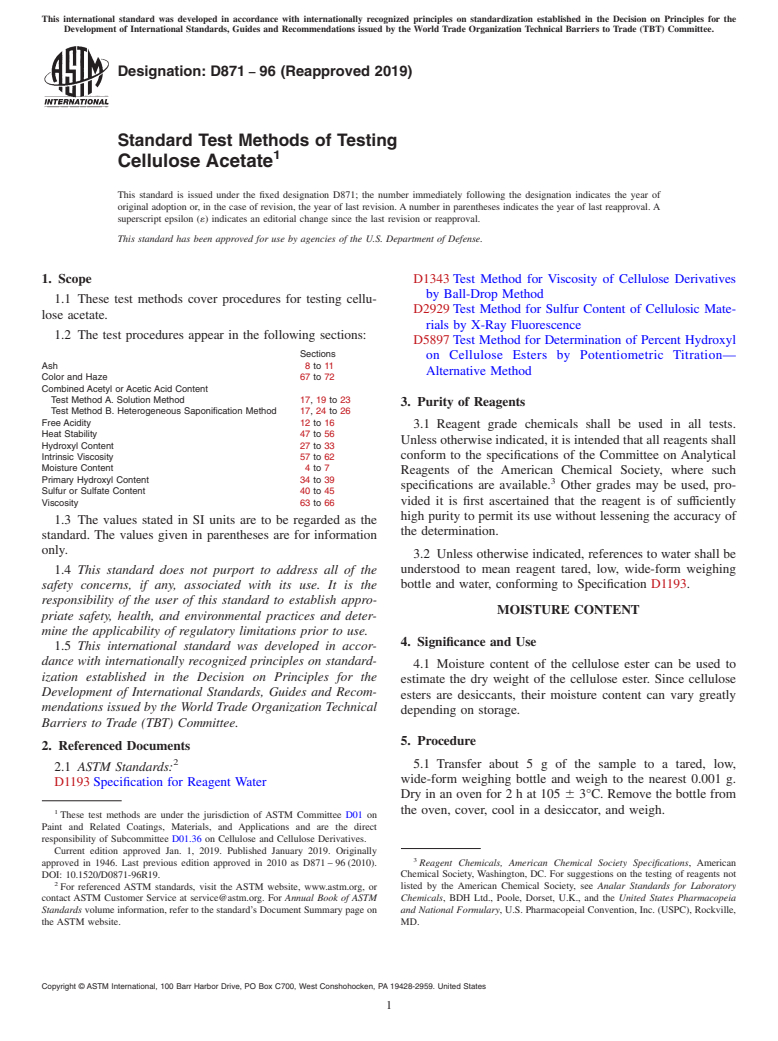
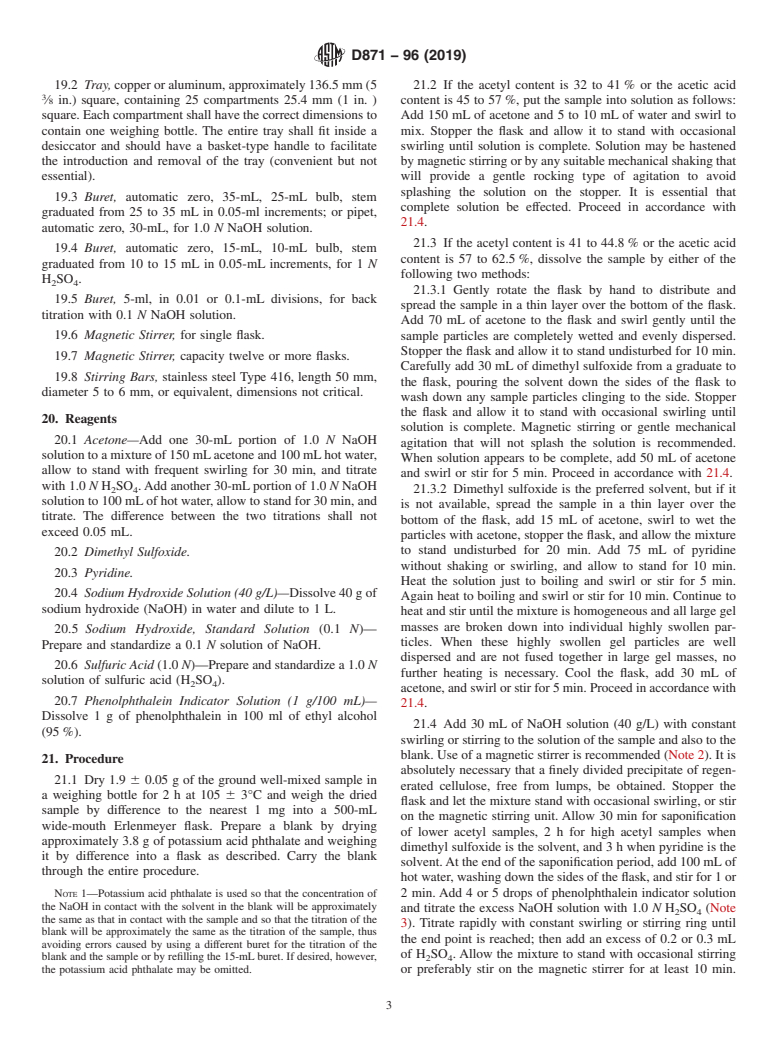
Standards Content (Sample)
This international standard was developed in accordance with internationally recognized principles on standardization established in the Decision on Principles for the
Development of International Standards, Guides and Recommendations issued by the World Trade Organization Technical Barriers to Trade (TBT) Committee.
Designation: D871 − 96 (Reapproved 2019)
Standard Test Methods of Testing
1
Cellulose Acetate
This standard is issued under the fixed designation D871; the number immediately following the designation indicates the year of
original adoption or, in the case of revision, the year of last revision. A number in parentheses indicates the year of last reapproval. A
superscript epsilon (´) indicates an editorial change since the last revision or reapproval.
This standard has been approved for use by agencies of the U.S. Department of Defense.
1. Scope D1343 Test Method for Viscosity of Cellulose Derivatives
by Ball-Drop Method
1.1 These test methods cover procedures for testing cellu-
D2929 Test Method for Sulfur Content of Cellulosic Mate-
lose acetate.
rials by X-Ray Fluorescence
1.2 The test procedures appear in the following sections:
D5897 Test Method for Determination of Percent Hydroxyl
Sections
on Cellulose Esters by Potentiometric Titration—
Ash 8 to 11
Alternative Method
Color and Haze 67 to 72
Combined Acetyl or Acetic Acid Content
Test Method A. Solution Method 17, 19 to 23
3. Purity of Reagents
Test Method B. Heterogeneous Saponification Method 17, 24 to 26
Free Acidity 12 to 16
3.1 Reagent grade chemicals shall be used in all tests.
Heat Stability 47 to 56
Unless otherwise indicated, it is intended that all reagents shall
Hydroxyl Content 27 to 33
conform to the specifications of the Committee on Analytical
Intrinsic Viscosity 57 to 62
Moisture Content 4 to 7
Reagents of the American Chemical Society, where such
Primary Hydroxyl Content 34 to 39
3
specifications are available. Other grades may be used, pro-
Sulfur or Sulfate Content 40 to 45
Viscosity 63 to 66 vided it is first ascertained that the reagent is of sufficiently
high purity to permit its use without lessening the accuracy of
1.3 The values stated in SI units are to be regarded as the
the determination.
standard. The values given in parentheses are for information
only.
3.2 Unless otherwise indicated, references to water shall be
1.4 This standard does not purport to address all of the understood to mean reagent tared, low, wide-form weighing
bottle and water, conforming to Specification D1193.
safety concerns, if any, associated with its use. It is the
responsibility of the user of this standard to establish appro-
MOISTURE CONTENT
priate safety, health, and environmental practices and deter-
mine the applicability of regulatory limitations prior to use.
4. Significance and Use
1.5 This international standard was developed in accor-
dance with internationally recognized principles on standard-
4.1 Moisture content of the cellulose ester can be used to
ization established in the Decision on Principles for the
estimate the dry weight of the cellulose ester. Since cellulose
Development of International Standards, Guides and Recom-
esters are desiccants, their moisture content can vary greatly
mendations issued by the World Trade Organization Technical
depending on storage.
Barriers to Trade (TBT) Committee.
5. Procedure
2. Referenced Documents
2
5.1 Transfer about5gofthe sample to a tared, low,
2.1 ASTM Standards:
wide-form weighing bottle and weigh to the nearest 0.001 g.
D1193 Specification for Reagent Water
Dry in an oven for2hat105 6 3°C. Remove the bottle from
the oven, cover, cool in a desiccator, and weigh.
1
These test methods are under the jurisdiction of ASTM Committee D01 on
Paint and Related Coatings, Materials, and Applications and are the direct
responsibility of Subcommittee D01.36 on Cellulose and Cellulose Derivatives.
Current edition approved Jan. 1, 2019. Published January 2019. Originally
3
approved in 1946. Last previous edition approved in 2010 as D871 – 96 (2010). Reagent Chemicals, American Chemical Society Specifications, American
DOI: 10.1520/D0871-96R19. Chemical Society, Washington, DC. For suggestions on the testing of reagents not
2
For referenced ASTM standards, visit the ASTM website, www.astm.org, or listed by the American Chemical Society, see Analar Standards for Laboratory
contact ASTM Customer Service at service@astm.org. For Annual Book of ASTM Chemicals, BDH Ltd., Poole, Dorset, U.K., and the United States Pharmacopeia
Standards volume information, refer to the standard’s Document Summary page on and National Formulary, U.S. Pharmacopeial Convention, Inc. (USPC), Rockville,
the ASTM website. MD.
Copyright © ASTM International, 100 Barr Harbor Drive, PO Box C700, West Conshohocken, PA 19428-2959. United States
1
---------------------- Page: 1 ----------------------
D871 − 96 (2019)
6. Calculation potentially detrimental to the melt processing of the ester and
can impact the odor of the ester.
6
...
Questions, Comments and Discussion
Ask us and Technical Secretary will try to provide an answer. You can facilitate discussion about the standard in here.