

ASTM D8348-21a
(Guide)Standard Guide for Requirements for Transportation and Logistics Related Professions Within the Cannabis and Hemp Industries
General Information
- Abstract
SIGNIFICANCE AND USE
5.1 As the cannabis and hemp industries expand and their products become more available as consumable products, the following requirements and expectations within the industry become increasingly significant (Practice E2659, Terminology E2708), requiring:
5.1.1 The safety, reliability, and quality of its products;
5.1.2 Worker safety;
5.1.3 Environmental sustainability;
5.1.4 Regulatory compliance;
5.1.5 The need for different levels of qualified professionals; and
5.1.6 Development of qualified training and certificate programs.
5.2 The primary objectives of this guide are as follows:
5.2.1 Provide a general overview of the BoK required for the professions listed in Section 7; and
5.2.2 Provide recommendations to form the foundation for training and subsequent recognition/certificate systems that enable consumers, employers, organizational management, government agencies, and others who rely upon a skilled workforce to distinguish between qualified and non-qualified workers.
5.2.3 Recommend requirements that agencies can use to develop and document the specific criteria used for training or certificate programs.
5.3 Users of this guide shall document deviations from the recommended requirements to inform their clients of the criteria applied in either the training, certificate, or certification programs offered. As the cannabis and hemp industries mature, this guide will be updated to reflect current thinking and requirements.
5.4 The Bok elements are applicable to certificate Programs, while the BoK, experiential and educational elements are applicable to certification process requirements.
SCOPE
1.1 This guide can provide certification bodies, training providers, employers, and certificate issuers, with best-practice guidance for administering their respective programs for transportation and logistics-related professions within the cannabis and hemp industries.
1.2 This guide recommends requirements for experience, training, education, and the body of knowledge (BoK) necessary for transportation-related professions within the cannabis and hemp industries listed in Table 1.
1.3 This guide provides recommendations for articulating professional requirements for training and education or earning certificates. Its content does not supersede requirements for training or earning a certificate defined by jurisdictional entities such as government or other regional regulatory bodies.
1.4 This standard does not purport to address all of the safety concerns, if any, associated with its use. It is the responsibility of the user of this standard to establish appropriate safety, health, and environmental practices and determine the applicability of regulatory limitations prior to use.
1.5 This international standard was developed in accordance with internationally recognized principles on standardization established in the Decision on Principles for the Development of International Standards, Guides and Recommendations issued by the World Trade Organization Technical Barriers to Trade (TBT) Committee.
- Status
- Published
- Publication Date
- 31-Oct-2021
- Technical Committee
- D37 - Cannabis
- Drafting Committee
- D37.06 - Personnel Training, Assessment, Credentialing
Buy Documents
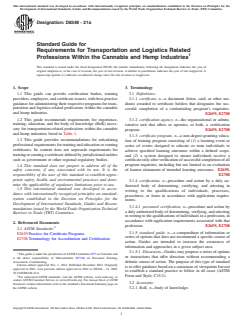
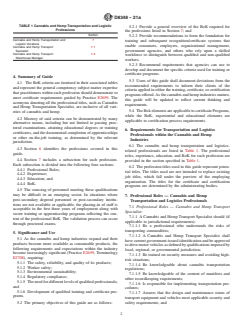


ASTM D8348-21a - Standard Guide for Requirements for Transportation and Logistics Related Professions Within the Cannabis and Hemp Industries
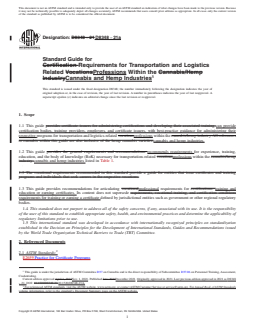
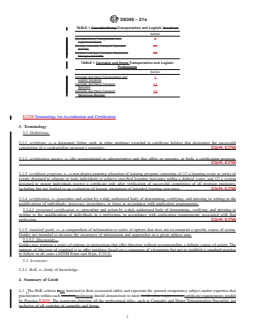
REDLINE ASTM D8348-21a - Standard Guide for Requirements for Transportation and Logistics Related Professions Within the Cannabis and Hemp Industries
Overview
ASTM D8348-21a: Standard Guide for Requirements for Transportation and Logistics Related Professions Within the Cannabis and Hemp Industries sets forth best-practice recommendations for training, certification, and qualification of professionals involved in the transportation and logistics sectors of the cannabis and hemp industries. As legal cannabis and hemp markets expand, there is a growing industry need for safety, reliability, regulatory compliance, and the development of a highly qualified, professional workforce. This standard provides foundational guidance to employers, certification bodies, and training organizations on essential requirements and expectations for transportation and logistics roles, fostering operational excellence, worker safety, and customer confidence across the cannabis and hemp supply chains.
Key Topics
- Certification Programs: Guidance for the development and administration of credible certificate and certification systems for transportation and logistics professionals, including recognition of required knowledge, educational background, and on-job experience.
- Body of Knowledge (BoK): Outline of core competencies and subject matter expertise necessary for key roles such as the Cannabis and Hemp Transport Specialist and Transport Warehouse Manager.
- Professional Requirements: Recommendations for educational levels, training, experience, and competency assessment for cannabis and hemp logistics roles.
- Regulatory Compliance: Consideration of varying jurisdictional requirements for workforce qualifications, recordkeeping, product handling, insurance, and safety.
- Workforce Safety & Sustainability: Emphasis on workplace practices that uphold safety, quality, worker protection, and environmental responsibility.
Applications
The implementation of ASTM D8348-21a offers substantial practical value for several stakeholder groups:
- Certification Bodies & Training Providers
- Use this standard to design and document certificate or certification programs that meet industry expectations and regulatory requirements for cannabis and hemp logistics professionals.
- Establish curricula and assessment criteria aligned with the outlined Body of Knowledge.
- Employers & Organizational Management
- Reference requirements when recruiting, training, and evaluating transport and warehousing staff.
- Ensure that workforce qualifications support safe, compliant, and efficient movement of cannabis and hemp products.
- Credential Issuers
- Develop and maintain transparent, recognized systems for issuing certifications, helping distinguish qualified personnel in the cannabis and hemp logistics sector.
- Government Agencies & Regulators
- Consult this guide when setting regulations or reviewing compliance for transportation and logistics operators in cannabis and hemp.
- Consumer Confidence
- With defined professional requirements in place, downstream customers gain trust in the supply chain's safety, reliability, and handling of consumable cannabis and hemp goods.
Related Standards
For comprehensive program development and broader compliance, consider these related ASTM standards:
- ASTM E2659 - Practice for Certificate Programs
Provides the structure for non-degree certificate programs, including curriculum validation and learner outcome requirements. - ASTM E2708 - Terminology for Accreditation and Certification
Offers vital definitions crucial for understanding accreditation and certification processes referenced in D8348-21a.
In addition, staying aware of evolving regional, national, and international regulatory guidelines is essential for ongoing compliance in the dynamic cannabis and hemp sectors.
Keywords: ASTM D8348-21a, cannabis transportation, hemp logistics, logistics certification, transport specialist, warehouse manager, cannabis industry standards, hemp supply chain, certification requirements, professional qualifications, body of knowledge, regulatory compliance, worker safety.
Relations
- Effective Date
- 01-Nov-2023
- Effective Date
- 01-Apr-2018
- Effective Date
- 01-Jan-2018
- Effective Date
- 15-Feb-2017
- Effective Date
- 01-Jan-2017
- Effective Date
- 01-Feb-2016
- Effective Date
- 01-Mar-2015
- Effective Date
- 01-Feb-2010
- Effective Date
- 01-Apr-2009
- Effective Date
- 01-Apr-2009
Buy Documents
ASTM D8348-21a - Standard Guide for Requirements for Transportation and Logistics Related Professions Within the Cannabis and Hemp Industries
REDLINE ASTM D8348-21a - Standard Guide for Requirements for Transportation and Logistics Related Professions Within the Cannabis and Hemp Industries
Get Certified
Connect with accredited certification bodies for this standard

BSI Group
BSI (British Standards Institution) is the business standards company that helps organizations make excellence a habit.

Bureau Veritas
Bureau Veritas is a world leader in laboratory testing, inspection and certification services.

DNV
DNV is an independent assurance and risk management provider.
Sponsored listings
Frequently Asked Questions
ASTM D8348-21a is a guide published by ASTM International. Its full title is "Standard Guide for Requirements for Transportation and Logistics Related Professions Within the Cannabis and Hemp Industries". This standard covers: SIGNIFICANCE AND USE 5.1 As the cannabis and hemp industries expand and their products become more available as consumable products, the following requirements and expectations within the industry become increasingly significant (Practice E2659, Terminology E2708), requiring: 5.1.1 The safety, reliability, and quality of its products; 5.1.2 Worker safety; 5.1.3 Environmental sustainability; 5.1.4 Regulatory compliance; 5.1.5 The need for different levels of qualified professionals; and 5.1.6 Development of qualified training and certificate programs. 5.2 The primary objectives of this guide are as follows: 5.2.1 Provide a general overview of the BoK required for the professions listed in Section 7; and 5.2.2 Provide recommendations to form the foundation for training and subsequent recognition/certificate systems that enable consumers, employers, organizational management, government agencies, and others who rely upon a skilled workforce to distinguish between qualified and non-qualified workers. 5.2.3 Recommend requirements that agencies can use to develop and document the specific criteria used for training or certificate programs. 5.3 Users of this guide shall document deviations from the recommended requirements to inform their clients of the criteria applied in either the training, certificate, or certification programs offered. As the cannabis and hemp industries mature, this guide will be updated to reflect current thinking and requirements. 5.4 The Bok elements are applicable to certificate Programs, while the BoK, experiential and educational elements are applicable to certification process requirements. SCOPE 1.1 This guide can provide certification bodies, training providers, employers, and certificate issuers, with best-practice guidance for administering their respective programs for transportation and logistics-related professions within the cannabis and hemp industries. 1.2 This guide recommends requirements for experience, training, education, and the body of knowledge (BoK) necessary for transportation-related professions within the cannabis and hemp industries listed in Table 1. 1.3 This guide provides recommendations for articulating professional requirements for training and education or earning certificates. Its content does not supersede requirements for training or earning a certificate defined by jurisdictional entities such as government or other regional regulatory bodies. 1.4 This standard does not purport to address all of the safety concerns, if any, associated with its use. It is the responsibility of the user of this standard to establish appropriate safety, health, and environmental practices and determine the applicability of regulatory limitations prior to use. 1.5 This international standard was developed in accordance with internationally recognized principles on standardization established in the Decision on Principles for the Development of International Standards, Guides and Recommendations issued by the World Trade Organization Technical Barriers to Trade (TBT) Committee.
SIGNIFICANCE AND USE 5.1 As the cannabis and hemp industries expand and their products become more available as consumable products, the following requirements and expectations within the industry become increasingly significant (Practice E2659, Terminology E2708), requiring: 5.1.1 The safety, reliability, and quality of its products; 5.1.2 Worker safety; 5.1.3 Environmental sustainability; 5.1.4 Regulatory compliance; 5.1.5 The need for different levels of qualified professionals; and 5.1.6 Development of qualified training and certificate programs. 5.2 The primary objectives of this guide are as follows: 5.2.1 Provide a general overview of the BoK required for the professions listed in Section 7; and 5.2.2 Provide recommendations to form the foundation for training and subsequent recognition/certificate systems that enable consumers, employers, organizational management, government agencies, and others who rely upon a skilled workforce to distinguish between qualified and non-qualified workers. 5.2.3 Recommend requirements that agencies can use to develop and document the specific criteria used for training or certificate programs. 5.3 Users of this guide shall document deviations from the recommended requirements to inform their clients of the criteria applied in either the training, certificate, or certification programs offered. As the cannabis and hemp industries mature, this guide will be updated to reflect current thinking and requirements. 5.4 The Bok elements are applicable to certificate Programs, while the BoK, experiential and educational elements are applicable to certification process requirements. SCOPE 1.1 This guide can provide certification bodies, training providers, employers, and certificate issuers, with best-practice guidance for administering their respective programs for transportation and logistics-related professions within the cannabis and hemp industries. 1.2 This guide recommends requirements for experience, training, education, and the body of knowledge (BoK) necessary for transportation-related professions within the cannabis and hemp industries listed in Table 1. 1.3 This guide provides recommendations for articulating professional requirements for training and education or earning certificates. Its content does not supersede requirements for training or earning a certificate defined by jurisdictional entities such as government or other regional regulatory bodies. 1.4 This standard does not purport to address all of the safety concerns, if any, associated with its use. It is the responsibility of the user of this standard to establish appropriate safety, health, and environmental practices and determine the applicability of regulatory limitations prior to use. 1.5 This international standard was developed in accordance with internationally recognized principles on standardization established in the Decision on Principles for the Development of International Standards, Guides and Recommendations issued by the World Trade Organization Technical Barriers to Trade (TBT) Committee.
ASTM D8348-21a is classified under the following ICS (International Classification for Standards) categories: 03.100.30 - Management of human resources. The ICS classification helps identify the subject area and facilitates finding related standards.
ASTM D8348-21a has the following relationships with other standards: It is inter standard links to ASTM E2708-23, ASTM E2708-18, ASTM E2659-18, ASTM E2708-17, ASTM E2659-17, ASTM E2708-16, ASTM E2659-15, ASTM E2708-10, ASTM E2659-09e1, ASTM E2659-09. Understanding these relationships helps ensure you are using the most current and applicable version of the standard.
ASTM D8348-21a is available in PDF format for immediate download after purchase. The document can be added to your cart and obtained through the secure checkout process. Digital delivery ensures instant access to the complete standard document.
Standards Content (Sample)
This international standard was developed in accordance with internationally recognized principles on standardization established in the Decision on Principles for the
Development of International Standards, Guides and Recommendations issued by the World Trade Organization Technical Barriers to Trade (TBT) Committee.
Designation: D8348 − 21a
Standard Guide for
Requirements for Transportation and Logistics Related
Professions Within the Cannabis and Hemp Industries
This standard is issued under the fixed designation D8348; the number immediately following the designation indicates the year of
original adoption or, in the case of revision, the year of last revision. A number in parentheses indicates the year of last reapproval. A
superscript epsilon (´) indicates an editorial change since the last revision or reapproval.
1. Scope 3. Terminology
1.1 This guide can provide certification bodies, training 3.1 Definitions:
providers, employers, and certificate issuers, with best-practice
3.1.1 certificate, n—a document (letter, card, or other me-
guidance for administering their respective programs for trans-
dium) awarded to certificate holders that designates the suc-
portation and logistics-related professions within the cannabis
cessful completion of a credentialing program’s requisites.
and hemp industries.
E2659, E2708
1.2 This guide recommends requirements for experience,
3.1.2 certification agency, n—the organizational or admin-
training, education, and the body of knowledge (BoK) neces-
istrative unit that offers or operates, or both, a certification
sary for transportation-related professions within the cannabis
program. E2659, E2708
and hemp industries listed in Table 1.
3.1.3 certificate program, n—a non-degree-granting educa-
1.3 This guide provides recommendations for articulating
tion of training program consisting of (1) a learning event or
professional requirements for training and education or earning
series of events designed to educate or train individuals to
certificates. Its content does not supersede requirements for
achieve specified learning outcomes within a defined scope,
trainingorearningacertificatedefinedbyjurisdictionalentities
and (2) a system designed to ensure individuals receive a
such as government or other regional regulatory bodies.
certificateonlyafterverificationofsuccessfulcompletionofall
program requisites, including but not limited to an evaluation
1.4 This standard does not purport to address all of the
of learner attainment of intended learning outcomes. E2659,
safety concerns, if any, associated with its use. It is the
E2708
responsibility of the user of this standard to establish appro-
priate safety, health, and environmental practices and deter-
3.1.4 certification, n—procedure and action by a duly au-
mine the applicability of regulatory limitations prior to use.
thorized body of determining, certifying, and attesting in
1.5 This international standard was developed in accor-
writing to the qualifications of individuals, processes,
dance with internationally recognized principles on standard-
procedures, or items in accordance with application require-
ization established in the Decision on Principles for the
ments.
Development of International Standards, Guides and Recom-
3.1.4.1 personnel certification, n—procedure and action by
mendations issued by the World Trade Organization Technical
a duly authorized body of determining, verifying, and attesting
Barriers to Trade (TBT) Committee.
in writing to the qualifications of individuals in a profession, in
accordance with application requirements associated with that
2. Referenced Documents
profession. E2659, E2708
2.1 ASTM Standards:
3.1.5 standard guide, n—a compendium of information or
E2659 Practice for Certificate Programs
series of options that does not recommend a specific course of
E2708 Terminology for Accreditation and Certification
action. Guides are intended to increase the awareness of
information and approaches in a given subject area.
3.1.5.1 Discussion—Guides may propose a series of options
This guide is under the jurisdiction ofASTM Committee D37 on Cannabis and
or instructions that offer direction without recommending a
is the direct responsibility of Subcommittee D37.06 on Personnel Training,
Assessment, Credentialing. definite course of action. The purpose of this type of standard
Current edition approved Nov. 1, 2021. Published December 2021. Originally
is to offer guidance based on a consensus of viewpoints but not
approved in 2021. Last previous edition approved in 2021 as D8348 – 21. DOI:
to establish a standard practice to follow in all cases (ASTM
10.1520/D8348-21A.
Form and Style, C15.2).
For referenced ASTM standards, visit the ASTM website, www.astm.org, or
contact ASTM Customer Service at service@astm.org. For Annual Book of ASTM
3.2 Acronyms:
Standards volume information, refer to the standard’s Document Summary page on
the ASTM website. 3.2.1 BoK, n—body of knowledge.
Copyright © ASTM International, 100 Barr Harbor Drive, PO Box C700, West Conshohocken, PA 19428-2959. United States
D8348 − 21a
TABLE 1 Cannabis and Hemp Transportation and Logistic
5.2.1 Provide a general overview of the BoK required for
Professions
the professions listed in Section 7; and
Section
5.2.2 Provide recommendations to form the foundation for
Cannabis and Hemp Transportation and 7
training and subsequent recognition/certificate systems that
Logistic Vocations
enable consumers, employers, organizational management,
Cannabis and Hemp Transport 7.1
Specialist government agencies, and others who rely upon a skilled
Cannabis and Hemp Transport 7.2
workforce to distinguish between qualified and non-qualified
Warehouse Manager
workers.
5.2.3 Recommend requirements that agencies can use to
develop and document the specific criteria used for training or
certificate programs.
4. Summary of Guide
5.3 Users of this guide shall document deviations from the
4.1 The BoK criteria are itemized in their associated tables
recommended requirements to inform their clients of the
and represent the general competency subject matter expertise
criteria applied in either the training, certificate, or certification
that practitioners within each profession should demonstrate to
programs offered.As the cannabis and hemp industries mature,
meet certificate requirements guided by Practice E2659. The
this guide will be updated to reflect current thinking and
acronyms denoting all the professional titles, such as Cannabis
requirements.
and Hemp Transportation Specialist, are inclusive of all vari-
5.4 TheBokelementsareapplicabletocertificatePrograms,
eties of cannabis and hemp.
while the BoK, experiential and educational elements are
4.2 Mastery of said criteria can be demonstrated by many
applicable to certification process requirements.
alternative means, including but not limited to passing proc-
tored examinations, attaining educational degrees or training
6. Requirements for Transportation and Logistics
certificates, and the documented completion of apprenticeships
Professionals within the Cannabis and Hemp
or other on-the-job training, as determined by the relevant
Industries
jurisdiction.
6.1 The cannabis and hemp transportation and logistics-
4.3 Section 6 identifies the professions covered in this
related professionals are listed in Table 1. The professional
guide.
roles, experience, education, and BoK for each profession are
4.4 Section 7 includes a subsection for each profession.
provided in the section specified in Table 1.
Each subsection is divided into the fol
...
This document is not an ASTM standard and is intended only to provide the user of an ASTM standard an indication of what changes have been made to the previous version. Because
it may not be technically possible to adequately depict all changes accurately, ASTM recommends that users consult prior editions as appropriate. In all cases only the current version
of the standard as published by ASTM is to be considered the official document.
Designation: D8348 − 21 D8348 − 21a
Standard Guide for
Certification Requirements for Transportation and Logistics
Related VocationsProfessions Within the Cannabis/Hemp
IndustryCannabis and Hemp Industries
This standard is issued under the fixed designation D8348; the number immediately following the designation indicates the year of
original adoption or, in the case of revision, the year of last revision. A number in parentheses indicates the year of last reapproval. A
superscript epsilon (´) indicates an editorial change since the last revision or reapproval.
1. Scope
1.1 This guide provides certificate issuers for administering certifications and developing their associated training can provide
certification bodies, training providers, employers, and certificate issuers, with best-practice guidance for administering their
respective programs for transportation and logistics-related vocationsprofessions within the cannabis/hemp industry. All references
to cannabis within this guide are also inclusive of the hemp cannabis varieties.cannabis and hemp industries.
1.2 This guide provides the general requirements and recommendations recommends requirements for experience, training,
education, and the body of knowledge (BoK) necessary for transportation-related vocationsprofessions within the cannabis/hemp
industry cannabis and hemp industries listed in Table 1.
1.3 The vocational requirements recommended in this standard provide a guide for entities that issue certificates and training
programs and individuals that seek careers in the respective vocations.
1.3 This guide provides recommendations for articulating vocationalprofessional requirements for certifications. training and
education or earning certificates. Its content does not supersede requirements, vocational training, and certification conditions
requirements for training or earning a certificate defined by jurisdictional entities such as government or other regional regulatory
bodies.
1.4 This standard does not purport to address all of the safety concerns, if any, associated with its use. It is the responsibility
of the user of this standard to establish appropriate safety, health, and environmental practices and determine the applicability of
regulatory limitations prior to use.
1.5 This international standard was developed in accordance with internationally recognized principles on standardization
established in the Decision on Principles for the Development of International Standards, Guides and Recommendations issued
by the World Trade Organization Technical Barriers to Trade (TBT) Committee.
2. Referenced Documents
2.1 ASTM Standards:
E2659 Practice for Certificate Programs
This guide is under the jurisdiction of ASTM Committee D37 on Cannabis and is the direct responsibility of Subcommittee D37.06 on Personnel Training, Assessment,
Credentialing.
Current edition approved April 1, 2021Nov. 1, 2021. Published June 2021December 2021. Originally approved in 2021. Last previous edition approved in 2021 as D8348
– 21. DOI: 10.1520/D8348-21.10.1520/D8348-21A.
For referenced ASTM standards, visit the ASTM website, www.astm.org, or contact ASTM Customer Service at service@astm.org. For Annual Book of ASTM Standards
volume information, refer to the standard’s Document Summary page on the ASTM website.
Copyright © ASTM International, 100 Barr Harbor Drive, PO Box C700, West Conshohocken, PA 19428-2959. United States
D8348 − 21a
TABLE 1 Cannabis/Hemp Transportation and Logistic Vocations
Section
Cannabis/Hemp Transportation and 6
Logistic Vocations
Certified Cannabis Transport Specialist 6.1
(CCTrS)
Certified Cannabis Transport Warehouse 6.2
Manager (CCTWM)
TABLE 1 Cannabis and Hemp Transportation and Logistic
Professions
Section
Cannabis and Hemp Transportation and 7
Logistic Vocations
Cannabis and Hemp Transport 7.1
Specialist
Cannabis and Hemp Transport 7.2
Warehouse Manager
E2708 Terminology for Accreditation and Certification
3. Terminology
3.1 Definitions:
3.1.1 certificate, n—a document (letter, card, or other medium) awarded to certificate holders that designates the successful
completion of a credentialing program’s requisites. E2659, E2708
3.1.2 certification agency, n—the organizational or administrative unit that offers or operates, or both, a certification program.
E2659, E2708
3.1.3 certificate program, n—a non-degree-granting education of training program consisting of (1) a learning event or series of
events designed to educate or train individuals to achieve specified learning outcomes within a defined scope, and (2) a system
designed to ensure individuals receive a certificate only after verification of successful completion of all program requisites,
including but not limited to an evaluation of learner attainment of intended learning outcomes. E2659, E2708
3.1.4 certification, n—procedure and action by a duly authorized body of determining, certifying, and attesting in writing to the
qualifications of individuals, processes, procedures, or items in accordance with application requirements.
3.1.4.1 personnel certification, n—procedure and action by a duly authorized body of determining, verifying, and attesting in
writing to the qualifications of individuals in a profession, in accordance with application requirements associated with that
profession. E2659, E2708
3.1.5 standard guide, n—a compendium of information or series of options that does not recommend a specific course of action.
Guides are intended to increase the awareness of information and approaches in a given subject area.
3.1.5.1 Discussion—
Guides may propose a series of options or instructions that offer direction without recommending a definite course of action. The
purpose of this type of standard is to offer guidance based on a consensus of viewpoints but not to establish a standard practice
to follow in all cases (ASTM Form and Style, C15.2).
3.2 Acronyms:
3.2.1 BoK, n—body of knowledge.
4. Summary of Guide
4.1 The BoK criteria isare itemized in their associated tables and represent the general competency subject matter expertise that
practitioners within each vocationprofession should demonstrate to meet certification requirements.certificate requirements guided
by Practice E2659. The acronyms denoting all the professional titles, such as Cannabis and Hemp Transportation Specialist, are
inclusive of all varieties of cannabis and hemp.
D8348 − 21a
3.2 For brevity purposes, the acronyms denoting the vocational titles, such as Certified Cannabis Transportation Specialist
(CCTrS), are inclusive of the hemp varieties of cannabis.
4.2 Mastery of said criteria can be demonstrated by many alternative means, including but not limited to passing proctored
examinations, attaining educational degrees or training certificates, and the documented completion of apprenticeships or other
on-the-job training, as determined by the relevant jurisdiction.
4.3 Section 56 identifies the vocationsprofessions covered in this standard.guide.
4.4 Section 67 includes a subsection for each vocation.profession. Each subsection is divided into the following four sections:
4.4.1 General Requirements;Professional Roles;
4.4.2 Experience;
4.4.3 Education; and
4.4.4 BoK.
4.5 The sourcing of personnel meeting these qualifications may be difficult in an emerging sector. In situations where
post-secondary degreed personnel or post-secondary institutions are not available or applicable, the phasing-in of staff is acceptable
in the first three years of employment along with sector training or apprenticeship programs reflecting the content of the
vocationalprofessional BoK. The validation process can occur through proctored exams.
5. Significance and Use
5.1 As the cannabis/hemp cannabis and hemp industries expand and their products become more available as consumable
products, the following requirements and expectations within the industry become increasingly significant, significant (Practice
E2659, Terminology E2708), requiring:
5.1.1 The safety, reliability, and quality of its products;
5.1.2 Worker safety;
5.1.3 Environmental sustainability;
5.1.4 Regulatory compliance;
5.1.5 The need for different levels of qualified professionals; and
5.1.6 Development of qualified training and certificationcertificate programs.
5.2 The primary objectives of this standardguide are as follows:
5.2.1 To provide Provide a general overview of the BoK required for the professional vocations professions listed in Section 57
(; Table 1); and
5.2.2 This guide provides recommendations for vocations Provide recommendations to form the foundation for training and
subsequent recognition/certification or accreditation systems, or both, recognition/certificate systems that enable consumers,
employers, o
...