

ASTM D7755-11(2022)
(Practice)Standard Practice for Determining the Wear Volume on Standard Test Pieces Used by High-Frequency, Linear-Oscillation (SRV) Test Machine
General Information
- Abstract
SIGNIFICANCE AND USE
5.1 The determination of the wear volume becomes in tribological testing a key element, as it is more discriminative than the wear scar diameter, because an optically visible wear scar diameter may or may not indicate wear on the surface of the ball and the wear track as an irreversible loss of material. Users of this test method should determine whether results correlate with field performance or other applications.
Note 3: It is believed, that tactile stylus tip profilometer determines the most realistic figure and are more frequent in use, than it can be achieved by optical profilometers operating in a non-contacting mode.
SCOPE
1.1 This practice covers a procedure for determining the wear volume WV of wear scars and tracks on test pieces tribologically stresses under high-frequency, linear-oscillation motion using a SRV test machine by means of stylus tip profilometry.
1.2 The values stated in SI units are to be regarded as standard. No other units of measurement are included in this standard.
1.3 This standard does not purport to address all of the safety concerns, if any, associated with its use. It is the responsibility of the user of this standard to establish appropriate safety, health, and environmental practices and determine the applicability of regulatory limitations prior to use.
1.4 This international standard was developed in accordance with internationally recognized principles on standardization established in the Decision on Principles for the Development of International Standards, Guides and Recommendations issued by the World Trade Organization Technical Barriers to Trade (TBT) Committee.
- Status
- Published
- Publication Date
- 30-Jun-2022
- Technical Committee
- D02 - Petroleum Products, Liquid Fuels, and Lubricants
- Drafting Committee
- D02.L0.11 - Tribological Properties of Industrial Fluids and Lubricates
Overview
ASTM D7755-11(2022), titled Standard Practice for Determining the Wear Volume on Standard Test Pieces Used by High-Frequency, Linear-Oscillation (SRV) Test Machine, is an international standard developed by ASTM International. This practice outlines a reproducible procedure for determining the wear volume of wear scars and tracks on test specimens subjected to high-frequency, linear-oscillation motion using an SRV (Schwingung, Reibung, Verschleiß) test machine. The methodology relies on stylus tip profilometry to achieve accurate and quantitative wear volume analysis, addressing the limitations of solely using wear scar diameter as a measurement. By providing a more discriminative assessment of material loss, ASTM D7755 is essential for researchers and industries engaged in tribological testing, specifically for lubricants and materials exposed to friction and wear.
Key Topics
- Tribological Wear Measurement: The standard focuses on quantifying irreversible material loss (wear volume) on test pieces under tribological stress in SRV machines.
- Stylus Tip Profilometry: Emphasizes the use of a tactile stylus tip profilometer, which provides realistic and widely accepted measurements of wear volume, as opposed to non-contact optical profilometers.
- Differentiation from Scar Diameter: Highlights the importance of volumetric analysis over simple wear scar diameter, noting that visually detected scars may not represent actual material loss.
- Test Piece Preparation: Includes specimen cleaning protocols using appropriate non-chlorinated solvents and guidelines for preparing the measurement apparatus.
- Measurement Process: Details the process for measuring wear scars and tracks, selecting measurement parameters, and calculating wear volume based on the planimetric area of wear.
- SI Units: All values and measurements are stated in International System (SI) units, ensuring global applicability.
Applications
ASTM D7755-11(2022) is widely applicable in industries and research environments where evaluation of friction, wear, and lubrication efficacy is critical. Key areas of use include:
- Lubricant and Additive Testing: Assessing the performance of lubricating oils and greases under conditions simulating real-world sliding contacts.
- Materials Research: Quantifying material resistance to wear in tribological applications, enabling comparison between different materials and surface treatments.
- Quality Assurance: Enabling manufacturers of mechanical components to reliably assess component durability and optimize material selection.
- Failure Analysis: Supporting root cause analysis in scenarios where premature wear or material loss is observed in field applications.
- Product Development: Providing data-driven insights to improve the formulation of lubricants or to enhance material surfaces for longer lifecycle and better performance.
Related Standards
ASTM D7755-11(2022) references and complements several related ASTM and international standards relevant to friction, wear testing, and lubricant evaluation:
- ASTM D5706: Test Method for Determining Extreme Pressure Properties of Lubricating Greases Using a High-Frequency, Linear-Oscillation (SRV) Test Machine.
- ASTM D5707: Test Method for Measuring Friction and Wear Properties of Lubricating Grease Using an SRV Test Machine.
- ASTM D6425: Test Method for Evaluating Friction and Wear Properties of Extreme Pressure Lubricating Oils Using the SRV Test Machine.
- DIN 51834-3: Testing of lubricants - Tribological test in translatory oscillation apparatus - Part 3: Determination of tribological behaviour of materials in cooperation with lubricants.
- DIN EN ISO 13565-2: Geometrical Product Specifications (GPS) - Surface texture: Profile method; surfaces having stratified functional properties.
By adhering to ASTM D7755-11(2022), organizations can ensure consistency, reliability, and international recognition in their assessment of tribological wear, making it a valuable standard for quality control, product development, and research in wear and friction analysis.
Relations
- Refers
ASTM D4175-23a - Standard Terminology Relating to Petroleum Products, Liquid Fuels, and Lubricants - Effective Date
- 15-Dec-2023
- Effective Date
- 01-Dec-2023
- Effective Date
- 01-Nov-2023
- Effective Date
- 01-Nov-2023
- Refers
ASTM D4175-23e1 - Standard Terminology Relating to Petroleum Products, Liquid Fuels, and Lubricants - Effective Date
- 01-Jul-2023
- Effective Date
- 15-Dec-2019
- Effective Date
- 01-Dec-2019
- Effective Date
- 01-May-2019
- Effective Date
- 01-May-2019
- Effective Date
- 01-Oct-2017
- Effective Date
- 15-Nov-2016
- Effective Date
- 01-Oct-2016
- Effective Date
- 01-May-2014
- Effective Date
- 01-May-2014
- Effective Date
- 01-May-2014
Get Certified
Connect with accredited certification bodies for this standard

Element Materials Technology
Materials testing and product certification.

ABS Group Brazil
ABS Group certification services in Brazil.

ABS Quality Evaluations Inc.
American Bureau of Shipping quality certification.
Sponsored listings
Frequently Asked Questions
ASTM D7755-11(2022) is a standard published by ASTM International. Its full title is "Standard Practice for Determining the Wear Volume on Standard Test Pieces Used by High-Frequency, Linear-Oscillation (SRV) Test Machine". This standard covers: SIGNIFICANCE AND USE 5.1 The determination of the wear volume becomes in tribological testing a key element, as it is more discriminative than the wear scar diameter, because an optically visible wear scar diameter may or may not indicate wear on the surface of the ball and the wear track as an irreversible loss of material. Users of this test method should determine whether results correlate with field performance or other applications. Note 3: It is believed, that tactile stylus tip profilometer determines the most realistic figure and are more frequent in use, than it can be achieved by optical profilometers operating in a non-contacting mode. SCOPE 1.1 This practice covers a procedure for determining the wear volume WV of wear scars and tracks on test pieces tribologically stresses under high-frequency, linear-oscillation motion using a SRV test machine by means of stylus tip profilometry. 1.2 The values stated in SI units are to be regarded as standard. No other units of measurement are included in this standard. 1.3 This standard does not purport to address all of the safety concerns, if any, associated with its use. It is the responsibility of the user of this standard to establish appropriate safety, health, and environmental practices and determine the applicability of regulatory limitations prior to use. 1.4 This international standard was developed in accordance with internationally recognized principles on standardization established in the Decision on Principles for the Development of International Standards, Guides and Recommendations issued by the World Trade Organization Technical Barriers to Trade (TBT) Committee.
SIGNIFICANCE AND USE 5.1 The determination of the wear volume becomes in tribological testing a key element, as it is more discriminative than the wear scar diameter, because an optically visible wear scar diameter may or may not indicate wear on the surface of the ball and the wear track as an irreversible loss of material. Users of this test method should determine whether results correlate with field performance or other applications. Note 3: It is believed, that tactile stylus tip profilometer determines the most realistic figure and are more frequent in use, than it can be achieved by optical profilometers operating in a non-contacting mode. SCOPE 1.1 This practice covers a procedure for determining the wear volume WV of wear scars and tracks on test pieces tribologically stresses under high-frequency, linear-oscillation motion using a SRV test machine by means of stylus tip profilometry. 1.2 The values stated in SI units are to be regarded as standard. No other units of measurement are included in this standard. 1.3 This standard does not purport to address all of the safety concerns, if any, associated with its use. It is the responsibility of the user of this standard to establish appropriate safety, health, and environmental practices and determine the applicability of regulatory limitations prior to use. 1.4 This international standard was developed in accordance with internationally recognized principles on standardization established in the Decision on Principles for the Development of International Standards, Guides and Recommendations issued by the World Trade Organization Technical Barriers to Trade (TBT) Committee.
ASTM D7755-11(2022) is classified under the following ICS (International Classification for Standards) categories: 75.100 - Lubricants, industrial oils and related products. The ICS classification helps identify the subject area and facilitates finding related standards.
ASTM D7755-11(2022) has the following relationships with other standards: It is inter standard links to ASTM D4175-23a, ASTM D5706-23, ASTM D6425-23, ASTM D5707-23, ASTM D4175-23e1, ASTM D6425-19, ASTM D5707-19, ASTM D3702-94(2019), ASTM D2714-94(2019), ASTM D6425-17, ASTM D5706-16, ASTM D5707-16, ASTM D3702-94(2014), ASTM D2714-94(2014), ASTM D2782-02(2014)e1. Understanding these relationships helps ensure you are using the most current and applicable version of the standard.
ASTM D7755-11(2022) is available in PDF format for immediate download after purchase. The document can be added to your cart and obtained through the secure checkout process. Digital delivery ensures instant access to the complete standard document.
Standards Content (Sample)
This international standard was developed in accordance with internationally recognized principles on standardization established in the Decision on Principles for the
Development of International Standards, Guides and Recommendations issued by the World Trade Organization Technical Barriers to Trade (TBT) Committee.
Designation: D7755 − 11 (Reapproved 2022)
Standard Practice for
Determining the Wear Volume on Standard Test Pieces Used
by High-Frequency, Linear-Oscillation (SRV) Test Machine
This standard is issued under the fixed designation D7755; the number immediately following the designation indicates the year of
original adoption or, in the case of revision, the year of last revision.Anumber in parentheses indicates the year of last reapproval.A
superscript epsilon (´) indicates an editorial change since the last revision or reapproval.
1. Scope D5620Test Method for Evaluating Thin Film Fluid Lubri-
cantsinaDrainandDryModeUsingaPinandVeeBlock
1.1 This practice covers a procedure for determining the
Test Machine (Withdrawn 2010)
wear volume W of wear scars and tracks on test pieces
V
D5706Test Method for Determining Extreme Pressure
tribologically stresses under high-frequency, linear-oscillation
Properties of Lubricating Greases Using a High-
motion using a SRV test machine by means of stylus tip
Frequency, Linear-Oscillation (SRV) Test Machine
profilometry.
D5707Test Method for Measuring Friction and Wear Prop-
1.2 The values stated in SI units are to be regarded as
erties of Lubricating Grease Using a High-Frequency,
standard. No other units of measurement are included in this
Linear-Oscillation (SRV) Test Machine
standard.
D6425Test Method for Measuring Friction and Wear Prop-
1.3 This standard does not purport to address all of the
erties of Extreme Pressure (EP) Lubricating Oils Using
safety concerns, if any, associated with its use. It is the SRV Test Machine
responsibility of the user of this standard to establish appro-
2.2 DIN Standards:
priate safety, health, and environmental practices and deter- DIN 51631:1999-04Special-boiling-point spirit – Require-
mine the applicability of regulatory limitations prior to use.
ments and testing
1.4 This international standard was developed in accor- DIN 51834-3:2008-12Testing of lubricants – Tribological
dance with internationally recognized principles on standard-
test in translatory oscillation apparatus – Part 3: Determi-
ization established in the Decision on Principles for the nation of tribological behaviour of materials in co-
Development of International Standards, Guides and Recom-
operation with lubricants
mendations issued by the World Trade Organization Technical DIN EN ISO 13565-2:1998Geometrical Product Specifica-
Barriers to Trade (TBT) Committee.
tions (GPS) – Surface texture: Profile method; Surfaces
having stratified functional properties – Part 2: Height
2. Referenced Documents
characterizationusinglinearmaterialratiocurve(replaces
of DIN 4776:1990: Measurement of surface roughness;
2.1 ASTM Standards:
parameters R ,R ,R ,M ,M for the description of
D2714Test Method for Calibration and Operation of the
K PK VK r1 r2
the material portion)
Falex Block-on-Ring Friction and Wear Testing Machine
D2782Test Method for Measurement of Extreme-Pressure
3. Terminology
Properties of Lubricating Fluids (Timken Method)
3.1 Definitions:
D3702Test Method for Wear Rate and Coefficient of Fric-
3.1.1 Hertzian contact area, n—the apparent area of contact
tion of Materials in Self-Lubricated Rubbing Contact
betweentwonon-conformingsolidbodiespressedagainsteach
Using a Thrust Washer Testing Machine
other.
D4175Terminology Relating to Petroleum Products, Liquid
Fuels, and Lubricants
3.1.2 Hertzian contact pressure, n—magnitude of the pres-
sure at any specified location in a Hertzian contact area, as
calculated from Hertz’s equations of elastic deformation. The
This practice is under the jurisdiction ofASTM Committee D02 on Petroleum
Hertzian contact pressure can also be calculated and reported
Products, Liquid Fuels, and Lubricants and is the direct responsibility of Subcom-
as maximum value P in the centre of the contact or as
mittee D02.L0.11 on Tribological Properties of Industrial Fluids and Lubricates.
max
Current edition approved July 1, 2022. Published August 2022. Originally
P as average over the total contact area. D4175
average
approved in 2011. Last previous edition approved in 2017 as D7755–11(2017).
DOI: 10.1520/D7755-11R22.
2 3
For referenced ASTM standards, visit the ASTM website, www.astm.org, or The last approved version of this historical standard is referenced on
contact ASTM Customer Service at service@astm.org. For Annual Book of ASTM www.astm.org.
Standards volume information, refer to the standard’s Document Summary page on Available from Deutsches Institut fur Normung e.V.(DIN), Beuth Verlag
the ASTM website. GmbH, Burggrafenstraße 6, D-10787 Berlin 30, Germany, http://www.din.de.
Copyright © ASTM International, 100 Barr Harbor Drive, PO Box C700, West Conshohocken, PA 19428-2959. United States
D7755 − 11 (2022)
¯
NOTE 1—R is smaller than R. The wear volumes are marked in blue.
FIG. 2 Schematic Illustration of the Segmentation of the Wear
FIG. 1 Ball–Comparison of Iso-wear Scar Diameters with Wear Track
Volume in Relation to the Initial Radius R and the Radius in the
¯
Scar R at Test End
elastic constants for AISI 52100 (100Cr6H) and F = 200N, the initial
N
Hertzian contact diameter calculates to 0.374mm and for F = 300N is
N
0.428mm.Whennowunloadingtheballaftertest,theelasticdeformation
is released and the initial shape recovers, showing, for example, no wear,
3.1.3 seizure, n—localized fusion of metal between the
but a marked wear scar, which is reported as wear scar diameter, even no,
rubbing surfaces of the test pieces. D5706
less or minor wear can be detected by means of stylus tip profilometry.
3.1.3.1 Discussion—Seizure is usually indicated by a sharp
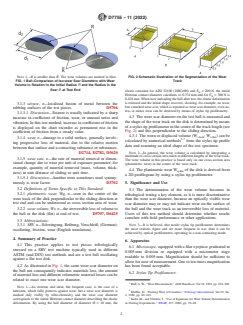
4.3 The wear scar diameter on the test ball is measured and
increase in coefficient of friction, wear, or unusual noise and
the shape of the wear track on the disk is determined by means
vibration. In this test method, increase in coefficient of friction
ofastylustipprofilometerinthecentreofthetracklength(see
is displayed on the chart recorder as permanent rise in the
Fig. 2) and this perpendicular to the sliding direction.
coefficient of friction from a steady value.
4.3.1 The worn or displaced volume (W ;W ) can be
v,ball v,flat
3.1.4 wear, n—damage to a solid surface, generally involv-
5-7
calculated by numerical methods from the stylus tip profile
ing progressive loss of material, due to the relative motion
data and assuming an ideal shape of the test specimen.
between that surface and a contacting substance or substances.
D2714, D2782, D5620 NOTE 2—In general, the wear volume is calculated by integrating a
multitudeofcrosssectionareatakenatdifferentlengthsoftheweartrack.
3.1.5 wear rate, n—the rate of material removal or dimen-
The wear volume in this practice is based only on one cross section area
sional change due to wear per unit of exposure parameter; for
(planimetric wear) in the centre of the wear track.
example, quantity of material removed (mass, volume, thick-
4.4 The planimetric wear W of the disk is derived from
q,flat
ness) in unit distance of sliding or unit time.
a 2D-profilogram by using a stylus tip profilometer.
3.1.5.1 Discussion—Another term sometimes used synony-
mously is wear factor. D3702
5. Significance and Use
3.2 Definitions of Terms Specific to This Standard:
5.1 The determination of the wear volume becomes in
3.2.1 planimetric wear, Wq, n—seen in the center of the
tribological testing a key element, as it is more discriminative
wear track of the disk perpendicular to the sliding direction at
than the wear scar diameter, because an optically visible wear
test end and can be understood as cross section area of wear.
scar diameter may or may not indicate wear on the surface of
the ball and the wear track as an irreversible loss of material.
3.2.2 wear volume, Wv, n—theirreversiblelossofvolumeto
Users of this test method should determine whether results
the ball or the disk (flat) at end of test. D5707, D6425
correlate with field performance or other applications.
3.3 Abbreviations:
3.3.1 SRV, n—Schwingung, Reibung,Verschleiß, (German); NOTE 3—It is believed, that tactile stylus tip profilometer determines
the most realistic figure and a
...