


ASTM E3383-24
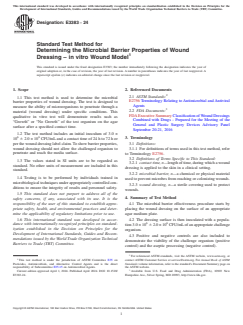
(Test Method)Standard Test Method for Determining the Microbial Barrier Properties of Wound Dressing – in vitro Wound Model
Standard Test Method for Determining the Microbial Barrier Properties of Wound Dressing – in vitro Wound Model
SIGNIFICANCE AND USE
5.1 An ideal wound dressing absorbs wound exudates, reduces the bioburden within/on the dressing, and protects wounds from microbial penetration through the dressing. Microbial barrier effectiveness testing is performed to measure the ability of microorganisms to penetrate through a material under specific conditions.
5.2 The test may be used for solid wound dressings with or without the addition of antimicrobial agents where the manufacturer is claiming microbial barrier properties in their performance claim. Barriers can be physical (polyurethane) and/or chemical (antimicrobial barrier).
5.2.1 Five (5) commonly used solid wound dressings are (1) hydrogel, (2) hydrocolloid, (3) film, (4) foam, and (5) alginate. Liquid adhesives also protect the wound from being infected by microorganisms. Liquid adhesive dressings contain cyanoacrylate or polyacrylate, which polymerizes quickly to create a solid barrier and protect the wound from contamination.
5.3 This qualitative test method can be used to determine the microbial barrier properties of solid wound dressings including liquid adhesive.
5.3.1 The test represents an in vitro wound model by using a nutrient-rich medium to mimic the wound, the contact time will represent the maximum period of use for a single dressing application on the wound, and an incubation temperature of 37 °C ± 2 °C represents the human body temperature.
5.4 Results are documented as “Growth” or “No Growth.”
5.4.1 No growth underneath the dressing indicates the barrier properties of the wound dressing are effective at preventing microbial penetration through the dressing.
5.4.2 Growth underneath the dressing demonstrates that the challenge organism was able to penetrate the dressing and reach the media surface, indicating that microorganisms can reach the wound by penetrating through the dressing from the outside environment.
SCOPE
1.1 This test method is used to determine the microbial barrier properties of wound dressing. The test is designed to measure the ability of microorganisms to penetrate through a material (wound dressing) under specific conditions. This qualitative in vitro test will demonstrate results such as “Growth” or “No Growth” of the test organism on the agar surface after a specified contact time.
1.2 The test method includes an initial inoculum of 3.0 × 10⁶ ± 2.0 × 10⁶ CFU/mL and a contact time of 24 h to 72 h or per the wound dressing label claim. To show barrier properties, wound dressing should not allow the challenged organism to penetrate and reach the media surface.
1.3 The values stated in SI units are to be regarded as standard. No other units of measurement are included in this standard.
1.4 Testing is to be performed by individuals trained in microbiological techniques under appropriately controlled conditions to ensure the integrity of results and personnel safety.
1.5 This standard does not purport to address all of the safety concerns, if any, associated with its use. It is the responsibility of the user of this standard to establish appropriate safety, health, and environmental practices and determine the applicability of regulatory limitations prior to use.
1.6 This international standard was developed in accordance with internationally recognized principles on standardization established in the Decision on Principles for the Development of International Standards, Guides and Recommendations issued by the World Trade Organization Technical Barriers to Trade (TBT) Committee.
General Information
- Status
- Published
- Publication Date
- 31-Mar-2024
- Technical Committee
- E35 - Pesticides, Antimicrobials, and Alternative Control Agents
- Drafting Committee
- E35.15 - Antimicrobial Agents
Overview
ASTM E3383-24 is the international standard test method for determining the microbial barrier properties of wound dressing materials using an in vitro wound model. Published by ASTM International, this standard provides a procedure to assess how well wound dressings prevent the penetration of microorganisms, ensuring protection and supporting wound care claims related to microbial barrier efficacy.
Testing the microbial barrier effectiveness of wound dressings is crucial in healthcare and wound management, as maintaining a sterile environment around wounds reduces infection risks. This qualitative method is appropriate for both solid wound dressings (such as hydrogel, hydrocolloid, film, foam, or alginate) and liquid adhesive dressings, including products with or without added antimicrobial agents.
Key Topics
- Purpose: To measure the ability of microorganisms to penetrate different wound management materials, thereby evaluating their microbial barrier properties.
- Qualitative Results: The test yields results reported as “Growth” or “No Growth” underneath the dressing, indicating whether the material effectively blocks microbial transfer.
- Applications: Applies to wound dressings where the manufacturer claims microbial barrier effectiveness, for both physical (e.g., polyurethane) and chemical (antimicrobial) protections.
- Test Organisms: Includes representative gram-positive and gram-negative bacteria, yeast, and mold to ensure comprehensive evaluation.
- In Vitro Simulation: Uses a nutrient-rich medium at controlled temperature to mimic real wound conditions, with standardized inoculum and contact time tailored to the product’s use.
Applications
ASTM E3383-24 is essential for:
- Manufacturers: Supporting performance claims regarding microbial protection on new or existing wound dressing products. It verifies whether products meet regulatory and market expectations for infection control in wound care.
- Healthcare Providers: Helping clinicians and purchasers select wound dressings with proven microbial barrier properties, contributing to infection prevention strategies and improved patient outcomes.
- Regulatory Compliance: Assisting in submissions to regulatory bodies such as the FDA by offering a recognized and harmonized method for assessing barrier effectiveness.
- Product Development: Influencing research and development of advanced wound care products, including traditional dressings and innovative liquid adhesive barriers containing cyanoacrylate or polyacrylate.
- Quality Assurance: Enabling ongoing quality control and comparative assessment among different types of wound dressings and barrier materials.
Related Standards
- ASTM E2756: Terminology Relating to Antimicrobial and Antiviral Agents, providing consistent definitions for key terms in microbial testing.
- FDA Guidance: Classification and performance review of wound dressings combined with drugs, enhancing the regulatory framework for advanced wound care materials.
Practical Value
Adhering to ASTM E3383-24 ensures that wound dressings are evaluated with a reproducible, internationally accepted method for microbial barrier assessment. This standard benefits manufacturers, healthcare providers, and patients by improving infection prevention, supporting informed product selection, and facilitating regulatory approval processes.
Keywords: ASTM E3383-24, microbial barrier, wound dressing, infection prevention, wound care standard, in vitro test method, antimicrobial barrier, healthcare safety, medical dressings testing, qualitative microbial assessment.
Frequently Asked Questions
ASTM E3383-24 is a standard published by ASTM International. Its full title is "Standard Test Method for Determining the Microbial Barrier Properties of Wound Dressing – in vitro Wound Model". This standard covers: SIGNIFICANCE AND USE 5.1 An ideal wound dressing absorbs wound exudates, reduces the bioburden within/on the dressing, and protects wounds from microbial penetration through the dressing. Microbial barrier effectiveness testing is performed to measure the ability of microorganisms to penetrate through a material under specific conditions. 5.2 The test may be used for solid wound dressings with or without the addition of antimicrobial agents where the manufacturer is claiming microbial barrier properties in their performance claim. Barriers can be physical (polyurethane) and/or chemical (antimicrobial barrier). 5.2.1 Five (5) commonly used solid wound dressings are (1) hydrogel, (2) hydrocolloid, (3) film, (4) foam, and (5) alginate. Liquid adhesives also protect the wound from being infected by microorganisms. Liquid adhesive dressings contain cyanoacrylate or polyacrylate, which polymerizes quickly to create a solid barrier and protect the wound from contamination. 5.3 This qualitative test method can be used to determine the microbial barrier properties of solid wound dressings including liquid adhesive. 5.3.1 The test represents an in vitro wound model by using a nutrient-rich medium to mimic the wound, the contact time will represent the maximum period of use for a single dressing application on the wound, and an incubation temperature of 37 °C ± 2 °C represents the human body temperature. 5.4 Results are documented as “Growth” or “No Growth.” 5.4.1 No growth underneath the dressing indicates the barrier properties of the wound dressing are effective at preventing microbial penetration through the dressing. 5.4.2 Growth underneath the dressing demonstrates that the challenge organism was able to penetrate the dressing and reach the media surface, indicating that microorganisms can reach the wound by penetrating through the dressing from the outside environment. SCOPE 1.1 This test method is used to determine the microbial barrier properties of wound dressing. The test is designed to measure the ability of microorganisms to penetrate through a material (wound dressing) under specific conditions. This qualitative in vitro test will demonstrate results such as “Growth” or “No Growth” of the test organism on the agar surface after a specified contact time. 1.2 The test method includes an initial inoculum of 3.0 × 10⁶ ± 2.0 × 10⁶ CFU/mL and a contact time of 24 h to 72 h or per the wound dressing label claim. To show barrier properties, wound dressing should not allow the challenged organism to penetrate and reach the media surface. 1.3 The values stated in SI units are to be regarded as standard. No other units of measurement are included in this standard. 1.4 Testing is to be performed by individuals trained in microbiological techniques under appropriately controlled conditions to ensure the integrity of results and personnel safety. 1.5 This standard does not purport to address all of the safety concerns, if any, associated with its use. It is the responsibility of the user of this standard to establish appropriate safety, health, and environmental practices and determine the applicability of regulatory limitations prior to use. 1.6 This international standard was developed in accordance with internationally recognized principles on standardization established in the Decision on Principles for the Development of International Standards, Guides and Recommendations issued by the World Trade Organization Technical Barriers to Trade (TBT) Committee.
SIGNIFICANCE AND USE 5.1 An ideal wound dressing absorbs wound exudates, reduces the bioburden within/on the dressing, and protects wounds from microbial penetration through the dressing. Microbial barrier effectiveness testing is performed to measure the ability of microorganisms to penetrate through a material under specific conditions. 5.2 The test may be used for solid wound dressings with or without the addition of antimicrobial agents where the manufacturer is claiming microbial barrier properties in their performance claim. Barriers can be physical (polyurethane) and/or chemical (antimicrobial barrier). 5.2.1 Five (5) commonly used solid wound dressings are (1) hydrogel, (2) hydrocolloid, (3) film, (4) foam, and (5) alginate. Liquid adhesives also protect the wound from being infected by microorganisms. Liquid adhesive dressings contain cyanoacrylate or polyacrylate, which polymerizes quickly to create a solid barrier and protect the wound from contamination. 5.3 This qualitative test method can be used to determine the microbial barrier properties of solid wound dressings including liquid adhesive. 5.3.1 The test represents an in vitro wound model by using a nutrient-rich medium to mimic the wound, the contact time will represent the maximum period of use for a single dressing application on the wound, and an incubation temperature of 37 °C ± 2 °C represents the human body temperature. 5.4 Results are documented as “Growth” or “No Growth.” 5.4.1 No growth underneath the dressing indicates the barrier properties of the wound dressing are effective at preventing microbial penetration through the dressing. 5.4.2 Growth underneath the dressing demonstrates that the challenge organism was able to penetrate the dressing and reach the media surface, indicating that microorganisms can reach the wound by penetrating through the dressing from the outside environment. SCOPE 1.1 This test method is used to determine the microbial barrier properties of wound dressing. The test is designed to measure the ability of microorganisms to penetrate through a material (wound dressing) under specific conditions. This qualitative in vitro test will demonstrate results such as “Growth” or “No Growth” of the test organism on the agar surface after a specified contact time. 1.2 The test method includes an initial inoculum of 3.0 × 10⁶ ± 2.0 × 10⁶ CFU/mL and a contact time of 24 h to 72 h or per the wound dressing label claim. To show barrier properties, wound dressing should not allow the challenged organism to penetrate and reach the media surface. 1.3 The values stated in SI units are to be regarded as standard. No other units of measurement are included in this standard. 1.4 Testing is to be performed by individuals trained in microbiological techniques under appropriately controlled conditions to ensure the integrity of results and personnel safety. 1.5 This standard does not purport to address all of the safety concerns, if any, associated with its use. It is the responsibility of the user of this standard to establish appropriate safety, health, and environmental practices and determine the applicability of regulatory limitations prior to use. 1.6 This international standard was developed in accordance with internationally recognized principles on standardization established in the Decision on Principles for the Development of International Standards, Guides and Recommendations issued by the World Trade Organization Technical Barriers to Trade (TBT) Committee.
ASTM E3383-24 is available in PDF format for immediate download after purchase. The document can be added to your cart and obtained through the secure checkout process. Digital delivery ensures instant access to the complete standard document.
Standards Content (Sample)
This international standard was developed in accordance with internationally recognized principles on standardization established in the Decision on Principles for the
Development of International Standards, Guides and Recommendations issued by the World Trade Organization Technical Barriers to Trade (TBT) Committee.
Designation: E3383 − 24
Standard Test Method for
Determining the Microbial Barrier Properties of Wound
Dressing – in vitro Wound Model
This standard is issued under the fixed designation E3383; the number immediately following the designation indicates the year of
original adoption or, in the case of revision, the year of last revision. A number in parentheses indicates the year of last reapproval. A
superscript epsilon (´) indicates an editorial change since the last revision or reapproval.
1. Scope 2. Referenced Documents
2.1 ASTM Standards:
1.1 This test method is used to determine the microbial
E2756 Terminology Relating to Antimicrobial and Antiviral
barrier properties of wound dressing. The test is designed to
Agents
measure the ability of microorganisms to penetrate through a
2.2 FDA Documents:
material (wound dressing) under specific conditions. This
FDA Executive Summary Classification of Wound Dressings
qualitative in vitro test will demonstrate results such as
Combined with Drugs - Prepared for the Meeting of the
“Growth” or “No Growth” of the test organism on the agar
General and Plastic Surgery Devices Advisory Panel
surface after a specified contact time.
September 20-21, 2016
1.2 The test method includes an initial inoculum of 3.0 ×
6 6
3. Terminology
10 6 2.0 × 10 CFU/mL and a contact time of 24 h to 72 h or
per the wound dressing label claim. To show barrier properties,
3.1 Definitions:
wound dressing should not allow the challenged organism to
3.1.1 For definitions of terms used in this test method, refer
penetrate and reach the media surface.
to Terminology E2756.
3.2 Definitions of Terms Specific to This Standard:
1.3 The values stated in SI units are to be regarded as
3.2.1 contact time, n—length of time, during which a wound
standard. No other units of measurement are included in this
dressing is applied to the skin in a clinical setting.
standard.
3.2.2 microbial barrier, n—a chemical or physical material
1.4 Testing is to be performed by individuals trained in
used to prevent microbes from reaching or colonizing wounds.
microbiological techniques under appropriately controlled con-
3.2.3 wound dressing, n—a sterile covering used to protect
ditions to ensure the integrity of results and personnel safety.
wounds.
1.5 This standard does not purport to address all of the
4. Summary of Test Method
safety concerns, if any, associated with its use. It is the
responsibility of the user of this standard to establish appro- 4.1 The microbial barrier effectiveness procedure starts by
placing the wound dressing on the surface of an appropriate
priate safety, health, and environmental practices and deter-
mine the applicability of regulatory limitations prior to use. agar medium plate.
1.6 This international standard was developed in accor-
4.2 The dressing surface is then inoculated with a popula-
6 6
dance with internationally recognized principles on standard-
tion 3.0 × 10 6 2.0 × 10 CFU/mL of an appropriate challenge
ization established in the Decision on Principles for the
organism.
Development of International Standards, Guides and Recom-
4.3 Positive and negative controls are also included to
mendations issued by the World Trade Organization Technical
demonstrate the viability of the challenge organism (positive
Barriers to Trade (TBT) Committee.
control) and the aseptic processing (negative control).
For referenced ASTM standards, visit the ASTM website, www.astm.org, or
This test method is under the jurisdiction of ASTM Committee E35 on contact ASTM Customer Service at service@astm.org. For Annual Book of ASTM
Pesticides, Antimicrobials, and Alternative Control Agents and is the direct Standards volume information, refer to the standard’s Document Summary page on
responsibility of Subcommittee E35.15 on Antimicrobial Agents. the ASTM website.
Current edition approved April 1, 2024. Published April 2024. DOI: 10.1520/ Available from U.S. Food and Drug Administration (FDA), 10903 New
E3383-24. Hampshire Ave., Silver Spring, MD 20993, http://www.fda.gov.
Copyright © ASTM International, 100 Barr Harbor Drive, PO Box C700, West Conshohocken, PA 19428-2959. United States
E3383 − 24
4.4 Test and control plates are incubated upright at 37 °C 6 6.3 Cuvette, sterile, appropriate size that can fit into spec-
2 °C for 24 h to 72 h or any other time point listed on the label trophotometer cuvette chamber.
claim. After incubation, the wound dressing is carefully re-
6.4 Forceps, sterile.
moved and the agar media plate is re-incubated for 48 h or
6.5 Glass Wool.
other suitable time for the growth of the target microorganism.
6.6 Gloves, sterile.
NOTE 1—If the media contains the growth indicator, re-incubation is not
needed.
6.7 Hypodermic Needle, 16G.
4.5 After the additional incubation period, the agar plate is
6.8 Incubators, capable of maintaining temperatures of
examined for growth of the challenge organism, and the result
37 °C 6 2 ºC, 22.5 °C 6 2.5 °C.
is documented as “Growth” or “No Growth” to measure the
6.9 Inoculating Loops, (10 μL).
effectiveness of the dressing’s barrier properties.
6.10 ISO Class 5 Environment: Laminar Airflow Hood
5. Significance and Use (LAF) / Biosafety Cabinet (BSC).
5.1 An ideal wound dressing absorbs wound exudates, 6.11 Micropipetor and Sterile Pipette Tips, (1.0 mL, 0.1 mL,
reduces the bioburden within/on the dressing, and protects and 0.01 mL).
wounds from microbial penetration through the dressing.
6.12 McFarland Standard, (1.0).
Microbial barrier effectiveness testing is performed to measure
6.13 Paraffın Film.
the ability of microorganisms to penetrate through a material
under specific conditions. 6.14 Petri Plates, 15 mm by 60 mm, 15 mm by 100 mm,
15 mm by 150 mm.
5.2 The test may be used for solid wound dressings with or
without the addition of antimicrobial agents where the manu- 6.15 Polypropylene Tubes, 50 mL.
facturer is claiming microbial barrier properties in their per-
6.16 Refrigerator, capable of maintaining the temperature of
formance claim. Barriers can be physical (polyurethane) and/or
5 °C 6 3 °C.
chemical (antimicrobial barrier).
6.17 Scissors, sterile.
5.2.1 Five (5) commonly used solid wound dressings are (1)
hydrogel, (2) hydrocolloid, (3) film, (4) foam, and (5) alginate.
6.18 Spectrophotometer, capable of measuring an absor-
Liquid adhesives also protect the wound from being infected
bance of 475 nm.
by microorganisms. Liquid adhesive dressings contain cyano-
6.19 Tubes, sterile, ~14 mL (screw cap or snap cap).
acrylate or polyacrylate, which polymerizes quickly to create a
6.20 Timer.
solid barrier and protect the wound from contamination.
6.21 Vortex Mixer.
5.3 This qualitative test method can be used to determine
the microbial barrier properties of solid wound dressings
7. Reagents and Materials
including liquid adhesive.
5.3.1 The test represents an in vitro wound model by using
7.1 Growth Media (1):
a nutrient-rich medium to mimic the wound, the contact time
7.1.1 Blood Agar.
will represent the maximum period of use for a single dressing
7.1.2 Cetrimide Agar Plates.
application on the wound, and an incubation temperature of
7.1.3 Dey-Engley Agar (D/E Agar).
37 °C 6 2 °C represents the human body temperature.
7.1.4 Sabouraud Dextrose Agar (SDA) Plates.
7.1.5 Tryptic Soy Agar (TSA).
5.4 Results are documented as “Growth” or “No Growth.”
7.1.6 Tryptic Soy Broth (TSB), 10 mL.
5.4.1 No growth underneath the dressing indicates the
barrier properties of the wound dressing are effective at
7.2 Sterile Physiological Saline, (0.9 % sodium chloride,
preventing microbial penetration through the dressing.
pH 5.5).
5.4.2 Growth underneath the dressing demonstrates that the
7.3 Sterile Saline, containing 0.05 % polysorbate 80.
challenge organism was able to penetrate the dressing and
reach the media surface, indicating that microorganisms can
8. Test Organisms
reach the wound by penetrating through the dressing from the
8.1 The study should include at least three gram-positive,
outside environment.
three gram-negative (motile and non-motile), one yeast, and
one mold. Cultures shall not be more than five passages
6. Apparatus
removed from the original ATCC culture. Organisms listed
6.1 Centrifuge, non-refrigerated benchtop capable of run-
below are used as examples as other organisms can also be
ning 2000 × g.
included in the test.
6.2 Cover film, that does not affect the growth of the test
8.2 Gram-Positive Bacteria:
organism or absorb water, made of polyethylene,
polypropylene, or polyester (poly(ethylene terephthalate)). A
film that is 0.05 mm to 0.1 mm thick.
Atlas, R.M., Handbook of Microbiological Media, fourth edition, CRC Press,
NOTE 2—Films cut from sterile lab blender bags are also suitable. Boca Raton, FL, 2010, pp, 343, 589, 1530, 1821, and 1822.
E3383 − 24
8.2.1 Staphylococcus aureus, American Type Culture Col- using glass wool to remove hyphae. Centrifuge the spore
lection (ATCC) No. 6538 – BSL-2. suspension for 15 min at 2000 × g. Discard the supernatant and
8.2.2 Methicillin resistant Staphylococcus epidermidis, resuspend the pellet with 5 mL of saline to obtain a population
5 8
American Type Culture Collection (ATCC) No. 51625 – of 10 CFU/mL. Perform serial dilution using saline to adjust
6 6
BSL-2. the population down to 3.0 × 10 6 2.0 × 10 CFU/mL.
8.2.3 Methicillin resistant Staphylococcus aureus, American
9.4 Verify the population of each microorganism by prepar-
Type Culture Collection (ATCC) No. 43300 – BSL-2.
ing serial dilutions in sterile physiological saline. Plate appro-
8.2.4 Vancomycin resistant Enterococcus faecalis, Ameri-
priate dilutions in duplicate to obtain the number of colony
can Type Culture Collection (ATCC) No. 51575 – BSL-2.
forming units in the countable range. Pour plates with appro-
8.3 Gram-Negative Bacteria:
priate molten media (TSA/SDA) and allow plates to solidify.
8.3.1 Pseudomonas aeruginosa, American Type Culture
Other plating methods can also be used to verify the popula-
Collection (ATCC) No. 9027 – BSL-2.
tion. Incubate bacterial plates at 37 °C 6 2 °C for 36 h 6 12 h,
8.3.2 Escherichia coli, American Type Culture Collection
yeast plates at 22.5 °C 6 2.5 °C for 4 6 1 days, and mold
(ATCC) No. 8739 – BSL-1.
plates at 22.5 °C 6 2.5 °C for 5 6 2 days. Use the bacterial and
8.3.3 Enterobacter cloacae, American Type Culture Collec-
yeast suspensions within 2 h, or 24 h if stored at 5 °C 6 3 °C.
tion (ATCC) No. 13047 – BSL-1.
A stable spore suspension can be prepared and then maintained
8.3.4 Acinetobacter baumannii, American Type Culture
at 5 °C 6 3 °C for up to 7 days.
Collection (ATCC) No. 19606 – BSL-2.
9.5 Report the inoculum population per challenge organism
8.4 Fungal Organisms:
in the final report. If the microbial population does not fall in
6 6
8.4.1 Yeast: Candida albicans, American Type Culture Col-
the range of 3.0 × 10 6 2.0 × 10 CFU/mL, repeat the entire
lection (ATCC) No. 10231 – BSL-1.
study.
8.4.2 Mold: Aspergillus brasiliensis, American Type Cul-
ture Collection (ATCC) No. 16404 – BSL-1.
10. Selection of Test Medium
10.1 It is important to use appr
...
Questions, Comments and Discussion
Ask us and Technical Secretary will try to provide an answer. You can facilitate discussion about the standard in here.
Loading comments...