

ASTM C1556-22
(Test Method)Standard Test Method for Determining the Apparent Chloride Diffusion Coefficient of Cementitious Mixtures by Bulk Diffusion
General Information
- Abstract
SIGNIFICANCE AND USE
5.1 This test method is applicable to cementitious mixtures that have not been exposed to external chloride ions, other than the negligible quantity of chloride ion exposure from sample preparation using potable water, prior to the test.
5.2 The calculation procedure described in this test method is applicable only to laboratory test specimens exposed to a sodium chloride solution as described in this test method. This calculation procedure is not applicable to specimens exposed to chloride ions during cyclic wetting and drying.
Note 1: The diffusion of ionic species in concrete occurs within the fluid-filled pores, cracks and void spaces. The concentration and valence of other ionic species in the pore fluid also influence the rate of chloride diffusion, and therefore, the apparent diffusion coefficient as determined by this test procedure.
5.3 In most cases, the value of the apparent chloride diffusion coefficient for cementitious mixtures changes over time (see Note 2). Therefore, apparent diffusion coefficients obtained at early ages may not be representative of performance in service.
Note 2: The rate of change of the apparent diffusion coefficient for cementitious mixtures containing pozzolans or blast-furnace slag is typically different than that for mixtures containing only portland cement.
5.4 The apparent chloride diffusion coefficient is used in Fick's second law of diffusion to estimate chloride penetration into cementitious mixtures that are in a saturated condition.
5.5 The apparent chloride diffusion coefficient is commonly used in chloride ingress models based on Fick's second law of diffusion. The apparent diffusion coefficient determined by this method includes bound chloride, so proper use of the apparent chloride diffusion coefficient to predict chloride ingress requires consideration of chloride binding.
5.6 The resistance to chloride penetration is affected by such factors as the environment, finishing, mixture composition, w...
SCOPE
1.1 This test method covers the laboratory determination of the apparent chloride diffusion coefficient for hardened cementitious mixtures.
1.2 The values stated in SI units are to be regarded as standard. No other units of measurement are included in this standard.
1.3 This standard does not purport to address all of the safety concerns, if any, associated with its use. It is the responsibility of the user of this standard to establish appropriate safety, health, and environmental practices and determine the applicability of regulatory limitations prior to use.
1.4 This international standard was developed in accordance with internationally recognized principles on standardization established in the Decision on Principles for the Development of International Standards, Guides and Recommendations issued by the World Trade Organization Technical Barriers to Trade (TBT) Committee.
- Status
- Published
- Publication Date
- 30-Sep-2022
- Technical Committee
- C09 - Concrete and Concrete Aggregates
- Drafting Committee
- C09.66 - Concrete's Resistance to Fluid Penetration
Buy Documents
ASTM C1556-22 - Standard Test Method for Determining the Apparent Chloride Diffusion Coefficient of Cementitious Mixtures by Bulk Diffusion
REDLINE ASTM C1556-22 - Standard Test Method for Determining the Apparent Chloride Diffusion Coefficient of Cementitious Mixtures by Bulk Diffusion
Overview
ASTM C1556-22 is the internationally recognized standard test method for determining the apparent chloride diffusion coefficient of cementitious mixtures by bulk diffusion. Published by ASTM International, this method provides laboratory procedures for evaluating how chloride ions penetrate hardened concrete, mortar, or grout, which is crucial in assessing their durability and resistance to corrosion.
The standard is relevant wherever concrete structures are exposed to external chloride sources, especially in environments such as bridges, parking decks, marine structures, and roadways. The main outcome of the test is the apparent chloride diffusion coefficient, a key parameter used to estimate chloride ingress and forecast the potential risk of steel corrosion and deterioration in reinforced concrete structures.
Key Topics
- Chloride Diffusion in Cementitious Mixtures: The test quantifies chloride transport through saturated concrete using bulk diffusion, focusing on laboratory specimens not previously exposed to significant external chloride sources.
- Specimen Preparation & Conditioning: The method specifies strict conditioning requirements for test specimens, including curing, saturation, and sealing protocols to ensure consistency in results.
- Exposure to Sodium Chloride Solution: Specimens are immersed in a controlled sodium chloride solution for a minimum of 35 days to simulate natural chloride ingress conditions.
- Profile Grinding and Chloride Analysis: After exposure, thin layers are ground from the specimen, and the acid-soluble chloride content is measured at various depths to generate a chloride profile.
- Data Analysis: The apparent diffusion coefficient is determined by fitting measured chloride profiles to Fick’s second law of diffusion, taking into account both free and bound chloride ions.
- Use of SI Units: All measurements and calculations are standardized in SI units, facilitating global use and comparison of results.
Applications
- Durability Assessment: The test method is widely used to evaluate the expected service life of concrete structures exposed to deicing salts or marine environments, providing engineers with data to select durable mix designs and protective measures.
- Chloride Ingress Modeling: Results support predictive models for chloride penetration, enabling accurate estimation of time to corrosion initiation in steel-reinforced structures.
- Quality Control: Concrete producers and contractors can use the method for verifying the effectiveness of admixtures, supplementary cementitious materials, or mix design changes intended to enhance chloride resistance.
- Comparative Studies: The standard allows for comparative testing of different materials, curing processes, and finishing techniques to optimize resistance to chloride-induced corrosion.
- Regulatory Compliance: Compliance with ASTM C1556-22 is often required or referenced in specifications for infrastructure projects where chloride exposure is a concern.
Related Standards
- ASTM C31/C31M: Practice for Making and Curing Concrete Test Specimens in the Field.
- ASTM C42/C42M: Test Method for Obtaining and Testing Drilled Cores and Sawed Beams of Concrete.
- ASTM C1152/C1152M: Test Method for Acid-Soluble Chloride in Mortar and Concrete.
- ASTM C1202: Test Method for Electrical Indication of Concrete’s Ability to Resist Chloride Ion Penetration.
- ASTM C125: Terminology Relating to Concrete and Concrete Aggregates.
- NORDTEST NT BUILD 443: Related European standard for accelerated chloride penetration testing.
Practical Value
By adopting ASTM C1556-22, stakeholders ensure a consistent and reliable approach to assessing chloride transport in cementitious materials. This underpins the design and construction of longer-lasting, lower-maintenance concrete structures in chloride-laden environments, supporting sustainable infrastructure and reducing costly repairs due to corrosion-related damage.
Keywords: ASTM C1556, chloride diffusion, cementitious mixtures, concrete durability, chloride penetration, corrosion resistance, bulk diffusion test, international concrete standards, service life prediction.
Relations
- Refers
ASTM C31/C31M-24a - Standard Practice for Making and Curing Concrete Test Specimens in the Field - Effective Date
- 01-Apr-2024
- Effective Date
- 01-Feb-2024
- Refers
ASTM C31/C31M-24 - Standard Practice for Making and Curing Concrete Test Specimens in the Field - Effective Date
- 01-Jan-2024
- Effective Date
- 01-Jan-2024
- Effective Date
- 15-Dec-2019
- Effective Date
- 01-Jan-2019
- Effective Date
- 01-Oct-2018
- Effective Date
- 01-Jul-2018
- Effective Date
- 01-Jul-2018
- Effective Date
- 15-Mar-2018
- Refers
ASTM C31/C31M-18 - Standard Practice for Making and Curing Concrete Test Specimens in the Field - Effective Date
- 01-Jan-2018
- Effective Date
- 01-Jan-2018
- Effective Date
- 01-Dec-2017
- Effective Date
- 15-Jun-2017
- Effective Date
- 15-Dec-2016
Buy Documents
ASTM C1556-22 - Standard Test Method for Determining the Apparent Chloride Diffusion Coefficient of Cementitious Mixtures by Bulk Diffusion
REDLINE ASTM C1556-22 - Standard Test Method for Determining the Apparent Chloride Diffusion Coefficient of Cementitious Mixtures by Bulk Diffusion
Get Certified
Connect with accredited certification bodies for this standard

ECOCERT
Organic and sustainability certification.

Eurofins Food Testing Global
Global leader in food, environment, and pharmaceutical product testing.

Intertek Bangladesh
Intertek certification and testing services in Bangladesh.
Sponsored listings
Frequently Asked Questions
ASTM C1556-22 is a standard published by ASTM International. Its full title is "Standard Test Method for Determining the Apparent Chloride Diffusion Coefficient of Cementitious Mixtures by Bulk Diffusion". This standard covers: SIGNIFICANCE AND USE 5.1 This test method is applicable to cementitious mixtures that have not been exposed to external chloride ions, other than the negligible quantity of chloride ion exposure from sample preparation using potable water, prior to the test. 5.2 The calculation procedure described in this test method is applicable only to laboratory test specimens exposed to a sodium chloride solution as described in this test method. This calculation procedure is not applicable to specimens exposed to chloride ions during cyclic wetting and drying. Note 1: The diffusion of ionic species in concrete occurs within the fluid-filled pores, cracks and void spaces. The concentration and valence of other ionic species in the pore fluid also influence the rate of chloride diffusion, and therefore, the apparent diffusion coefficient as determined by this test procedure. 5.3 In most cases, the value of the apparent chloride diffusion coefficient for cementitious mixtures changes over time (see Note 2). Therefore, apparent diffusion coefficients obtained at early ages may not be representative of performance in service. Note 2: The rate of change of the apparent diffusion coefficient for cementitious mixtures containing pozzolans or blast-furnace slag is typically different than that for mixtures containing only portland cement. 5.4 The apparent chloride diffusion coefficient is used in Fick's second law of diffusion to estimate chloride penetration into cementitious mixtures that are in a saturated condition. 5.5 The apparent chloride diffusion coefficient is commonly used in chloride ingress models based on Fick's second law of diffusion. The apparent diffusion coefficient determined by this method includes bound chloride, so proper use of the apparent chloride diffusion coefficient to predict chloride ingress requires consideration of chloride binding. 5.6 The resistance to chloride penetration is affected by such factors as the environment, finishing, mixture composition, w... SCOPE 1.1 This test method covers the laboratory determination of the apparent chloride diffusion coefficient for hardened cementitious mixtures. 1.2 The values stated in SI units are to be regarded as standard. No other units of measurement are included in this standard. 1.3 This standard does not purport to address all of the safety concerns, if any, associated with its use. It is the responsibility of the user of this standard to establish appropriate safety, health, and environmental practices and determine the applicability of regulatory limitations prior to use. 1.4 This international standard was developed in accordance with internationally recognized principles on standardization established in the Decision on Principles for the Development of International Standards, Guides and Recommendations issued by the World Trade Organization Technical Barriers to Trade (TBT) Committee.
SIGNIFICANCE AND USE 5.1 This test method is applicable to cementitious mixtures that have not been exposed to external chloride ions, other than the negligible quantity of chloride ion exposure from sample preparation using potable water, prior to the test. 5.2 The calculation procedure described in this test method is applicable only to laboratory test specimens exposed to a sodium chloride solution as described in this test method. This calculation procedure is not applicable to specimens exposed to chloride ions during cyclic wetting and drying. Note 1: The diffusion of ionic species in concrete occurs within the fluid-filled pores, cracks and void spaces. The concentration and valence of other ionic species in the pore fluid also influence the rate of chloride diffusion, and therefore, the apparent diffusion coefficient as determined by this test procedure. 5.3 In most cases, the value of the apparent chloride diffusion coefficient for cementitious mixtures changes over time (see Note 2). Therefore, apparent diffusion coefficients obtained at early ages may not be representative of performance in service. Note 2: The rate of change of the apparent diffusion coefficient for cementitious mixtures containing pozzolans or blast-furnace slag is typically different than that for mixtures containing only portland cement. 5.4 The apparent chloride diffusion coefficient is used in Fick's second law of diffusion to estimate chloride penetration into cementitious mixtures that are in a saturated condition. 5.5 The apparent chloride diffusion coefficient is commonly used in chloride ingress models based on Fick's second law of diffusion. The apparent diffusion coefficient determined by this method includes bound chloride, so proper use of the apparent chloride diffusion coefficient to predict chloride ingress requires consideration of chloride binding. 5.6 The resistance to chloride penetration is affected by such factors as the environment, finishing, mixture composition, w... SCOPE 1.1 This test method covers the laboratory determination of the apparent chloride diffusion coefficient for hardened cementitious mixtures. 1.2 The values stated in SI units are to be regarded as standard. No other units of measurement are included in this standard. 1.3 This standard does not purport to address all of the safety concerns, if any, associated with its use. It is the responsibility of the user of this standard to establish appropriate safety, health, and environmental practices and determine the applicability of regulatory limitations prior to use. 1.4 This international standard was developed in accordance with internationally recognized principles on standardization established in the Decision on Principles for the Development of International Standards, Guides and Recommendations issued by the World Trade Organization Technical Barriers to Trade (TBT) Committee.
ASTM C1556-22 is classified under the following ICS (International Classification for Standards) categories: 71.060.99 - Other inorganic chemicals. The ICS classification helps identify the subject area and facilitates finding related standards.
ASTM C1556-22 has the following relationships with other standards: It is inter standard links to ASTM C31/C31M-24a, ASTM C670-24a, ASTM C31/C31M-24, ASTM C670-24, ASTM C125-19a, ASTM C125-19, ASTM C125-18b, ASTM C1202-18, ASTM C125-18a, ASTM C42/C42M-18, ASTM C31/C31M-18, ASTM C125-18, ASTM C1202-17a, ASTM C1202-17, ASTM C125-16. Understanding these relationships helps ensure you are using the most current and applicable version of the standard.
ASTM C1556-22 is available in PDF format for immediate download after purchase. The document can be added to your cart and obtained through the secure checkout process. Digital delivery ensures instant access to the complete standard document.
Standards Content (Sample)
This international standard was developed in accordance with internationally recognized principles on standardization established in the Decision on Principles for the
Development of International Standards, Guides and Recommendations issued by the World Trade Organization Technical Barriers to Trade (TBT) Committee.
Designation: C1556 − 22
Standard Test Method for
Determining the Apparent Chloride Diffusion Coefficient of
Cementitious Mixtures by Bulk Diffusion
This standard is issued under the fixed designation C1556; the number immediately following the designation indicates the year of
original adoption or, in the case of revision, the year of last revision.Anumber in parentheses indicates the year of last reapproval.A
superscript epsilon (´) indicates an editorial change since the last revision or reapproval.
1. Scope* Mortar and Concrete
C1202Test Method for Electrical Indication of Concrete’s
1.1 This test method covers the laboratory determination of
Ability to Resist Chloride Ion Penetration
theapparentchloridediffusioncoefficientforhardenedcemen-
2.2 NORDTEST Standards:
titious mixtures.
NT BUILD 443Approved 1995-11, Concrete, Hardened:
1.2 The values stated in SI units are to be regarded as
Accelerated Chloride Penetration (in English)
standard. No other units of measurement are included in this
3. Terminology
standard.
1.3 This standard does not purport to address all of the
3.1 Definitions:
safety concerns, if any, associated with its use. It is the 3.1.1 For definitions of terms used in this test method, refer
responsibility of the user of this standard to establish appro-
to Terminology C125.
priate safety, health, and environmental practices and deter-
3.2 Definitions of Terms Specific to This Standard:
mine the applicability of regulatory limitations prior to use.
3.2.1 apparent chloride diffusion coeffıcient, D,n—a chlo-
a
1.4 This international standard was developed in accor-
ride transport parameter calculated from acid-soluble chloride
dance with internationally recognized principles on standard-
profile data obtained from saturated specimens exposed to
ization established in the Decision on Principles for the
chloridesolutions,withoutcorrectionforchloridebinding,that
Development of International Standards, Guides and Recom-
provides an indication of the ease of chloride penetration into
mendations issued by the World Trade Organization Technical
cementitious mixtures.
Barriers to Trade (TBT) Committee.
3.2.2 chloride binding, v—the chemical process by which
chloride ion is removed from solution and incorporated into
2. Referenced Documents
cementitious binder hydration products.
2.1 ASTM Standards:
3.2.2.1 Discussion—Chloride binding is primarily associ-
C31/C31MPractice for Making and Curing Concrete Test
ated with hydration products formed by the aluminate phase of
Specimens in the Field
cement and mixtures containing ground granulated blast fur-
C42/C42MTest Method for Obtaining and Testing Drilled
nace slag.
Cores and Sawed Beams of Concrete
3.2.3 chloride penetration, v—the ingress of chloride ions
C125Terminology Relating to Concrete and Concrete Ag-
due to exposure to external sources.
gregates
C192/C192MPractice for Making and Curing ConcreteTest 3.2.4 exposure liquid, n—the sodium chloride solution in
Specimens in the Laboratory which test specimens are stored prior to obtaining a chloride
C670Practice for Preparing Precision and Bias Statements profile.
for Test Methods for Construction Materials
3.2.5 exposure time, n—the time that the test specimen is
C1152/C1152MTest Method for Acid-Soluble Chloride in
stored in the solution containing chloride ion.
3.2.6 initial chloride-ion content, C ,n—the ratio of the
i
1 massofchlorideiontothemassofconcreteforatestspecimen
This test method is under the jurisdiction of ASTM Committee C09 on
Concrete and ConcreteAggregatesand is the direct responsibility of Subcommittee that has not been exposed to external chloride sources.
C09.66 on Concrete’s Resistance to Fluid Penetration.
3.2.7 profile grinding, v—the process of grinding off and
Current edition approved Oct. 1, 2022. Published November 2022. Originally
collectingapowdersampleinthinsuccessivelayersfromatest
approved in 2003. Last previous edition approved in 2016 as C1556 – 11a(2016).
DOI: 10.1520/C1556-22.
specimen using a dry process.
For referenced ASTM standards, visit the ASTM website, www.astm.org, or
contact ASTM Customer Service at service@astm.org. For Annual Book of ASTM
Standards volume information, refer to the standard’s Document Summary page on Published by NORDTEST, P.O. Box 116 FIN-02151 ESPOO Finland, Project
the ASTM website. 1154-94, e-mail: nordtest @vtt.fi, website: http://www.vtt.fi/nordtest
*A Summary of Changes section appears at the end of this standard
Copyright © ASTM International, 100 Barr Harbor Drive, PO Box C700, West Conshohocken, PA 19428-2959. United States
C1556 − 22
3.2.8 surface chloride content, C,n—thetheoreticalratioof 6. Apparatus
s
themassofchlorideiontothemassofconcreteattheinterface
6.1 Balance, accurate to at least 60.01 g.
between the exposure liquid and the test specimen.
6.2 Thermometer, accurate to at least 61.0 °C.
4. Summary of Test Method
6.3 Controlled Temperature Laboratory or Chamber. The
4.1 Obtain a representative sample of the cementitious laboratory or chamber shall maintain the temperature of a
mixturepriortoexposuretochlorideion.Separateeachsample
water bath at 23°C 6 2 °C.
into a test specimen and an initial chloride-ion content speci-
6.4 Plastic Container, with tight-fitting lid. Select a con-
men. Crush the initial chloride-ion content specimen and
tainer size in accordance with provisions in 9.1.2.
determine the initial acid-soluble chloride-ion content. Seal all
6.5 Equipment for grinding off and collecting powder from
sides of the test specimen, except the test surface, with a
concrete,mortar,orgroutspecimensinlayersofapproximately
suitable barrier coating. Saturate the sealed specimen in a
2 mm thickness. Refer to Figs. 1 and 2 for examples of
calcium hydroxide solution, rinse with tap water, and then
satisfactory equipment (see Note 3).
place in a sodium chloride solution.After a specified exposure
NOTE 3—A lathe or milling machine equipped with a short-barrel
time, the test specimen is removed from the sodium chloride
carbide-tipped, or diamond-tipped, core drill bit has been found satisfac-
solution and thin layers are ground off parallel to the exposed
tory for profile grinding.
faceofthespecimen.Theacid-solublechloridecontentofeach
6.6 Resealable Polyethylene Bags,200mmto300mmwide
layer is determined.The apparent chloride diffusion coefficient
by 250mm to 300mm long, and sheet thickness not less than
and the projected surface chloride-ion concentration are then
0.1 mm.
calculatedusingtheinitialchloride-ioncontent,andatleastsix
6.7 Equipment for crushing concrete, mortar or grout. Suit-
related values for chloride-ion content and depth below the
able equipment is described in Test Method C1152/C1152M.
exposed surface.
6.8 Equipment for chloride analysis as described in Test
5. Significance and Use
Method C1152/C1152M.
5.1 This test method is applicable to cementitious mixtures
6.9 Slide Caliper, accurate to at least 6 0.1 mm.
thathavenotbeenexposedtoexternalchlorideions,otherthan
the negligible quantity of chloride ion exposure from sample
7. Reagents and Materials
preparation using potable water, prior to the test.
7.1 Distilled or De-ionized Water.
5.2 The calculation procedure described in this test method
7.2 Calcium Hydroxide [Ca(OH) ], technical grade.
is applicable only to laboratory test specimens exposed to a
sodium chloride solution as described in this test method. This
7.3 Calcium Hydroxide Solution, saturated, (approx. 3 g/L).
calculationprocedureisnotapplicabletospecimensexposedto
7.4 Sodium Chloride [NaCl], technical grade.
chloride ions during cyclic wetting and drying.
7.5 Exposure Liquid—An aqueous NaCl solution prepared
NOTE 1—The diffusion of ionic species in concrete occurs within the
with a concentration of 165g 6 1 g NaCl per L of solution.
fluid-filled pores, cracks and void spaces. The concentration and valence
of other ionic species in the pore fluid also influence the rate of chloride 7.6 Two-component Polyurethane or Epoxy-resin Based
diffusion, and therefore, the apparent diffusion coefficient as determined
Paint, capable of forming a barrier membrane that is resistant
by this test procedure.
to chloride ion diffusion.
5.3 In most cases, the value of the apparent chloride
8. Test Specimens
diffusion coefficient for cementitious mixtures changes over
time (see Note 2). Therefore, apparent diffusion coefficients
8.1 Drilled cores, molded cylinders, or molded cubes are
obtained at early ages may not be representative of perfor-
acceptable test specimens. One sample consists of at least two
mance in service.
test specimens representative of the cementitious mixture
NOTE 2—The rate of change of the apparent diffusion coefficient for
under test. Specimens must be free of defects such as voids or
cementitious mixtures containing pozzolans or blast-furnace slag is
cracks visible to the unaided eye (see Note 5). The minimum
typically different than that for mixtures containing only portland cement.
dimension across the exposed surface of each test specimen
5.4 The apparent chloride diffusion coefficient is used in
must be at least 75 mm, but not less than three times the
Fick’s second law of diffusion to estimate chloride penetration
nominalmaximumaggregateparticlesize.Thespecimendepth
into cementitious mixtures that are in a saturated condition.
must be at least 75 mm.
5.5 The apparent chloride diffusion coefficient is commonly NOTE 4—Specimens with voids deeper than the profile layer thickness
can increase the apparent rate of chloride penetration, and increases test
used in chloride ingress models based on Fick’s second law of
variability.
diffusion.Theapparentdiffusioncoefficientdeterminedbythis
NOTE 5—The quality of the concrete between the exposed surface and
method includes bound chloride, so proper use of the apparent
the outermost layer of reinforcement can deviate from that in the rest of
chloride diffusion coefficient to predict chloride ingress re-
the system, as this region is often affected by construction practices.
quires consideration of chloride binding.
8.2 Unless otherwise specified, provide 28 days of labora-
5.6 Theresistancetochloridepenetrationisaffectedbysuch tory standard moist curing in accordance with Practice C31/
factors as the environment, finishing, mixture composition, C31M or C192/C192M prior to sample preparation for immer-
workmanship, curing, and age. sion in the exposure liquid.
C1556 − 22
FIG. 1 Profile Grinding Using a Milling Machine
FIG. 2 Profile Grinding Using a Lathe
8.2.1 Describe any variance from standard curing practice of at least 75 mm thickness is used as the test specimen with
in the report. theexposedsurfaceat50mmdepthfromthetopoftheoriginal
cast specimen (see Fig. 3).
8.3 Fordrilledcoresobtainedfromstructuresnotpreviously
exposed to chlorides according to Test Method C42/C42M, 8.4 For specimens prepared in accordance with Practice
prepare the test specimen by cutting off and discarding the C31/C31M or C192/C192M, the test specimen is prepared by
outermost 50 mm of the core (see Note 5). The next segment cuttingparalleltothefinishedsurface.Thetop50mmiscutoff
C1556 − 22
FIG. 3 Sketch of Specimens Obtained from a Typical Sample Not Previously Exposed to Chlorides
anddiscarded.Thenextsegmentofatleast75mmthicknessis 8.8 Determinetheinitialmassofthetestspecimenwhenthe
used as the test specimen with the exposed surface at 50 mm coating has hardened.
depth from the top of the original cast specimen (see Fig. 3).
8.9 Immerse the test specimen in the saturated calcium
8.5 From the remainder of the drilled core, or molded
hydroxidewaterbathat23°C 62°Cinatightlyclosedplastic
specimen, cut a slice that is at least 20mm thick. Use this slice container. The container must be filled to the top to prevent
to determine the initial chloride-ion content, C either by
carbonation. After 24 h of immersion, remove the specimen,
i
crushingtheentiresliceorbygrindingoffalayeratleast2mm blotthesurfacedrywithapapertowel,anddeterminethemass
thick.Alternately,iftheprofilefromthediffusiontestspecimen
of the specimen in the surface-dry condition.
is ground deep enough such that the last 2 successive layers
8.10 The test specimen is immersed in a saturated calcium
taken have chloride contents within 0.01 % by mass of
hydroxide water bath until the mass does not change by more
concrete of each other, it is permitted to extrapolate the best-fit
than 0.1% in 24 h (see Note 7). An acceptable alternative
equationofthechlorideprofiletoobtaintheinitialchloride-ion
procedure is to vacuum saturate the specimens with saturated
content, C.
i
calciumhydroxidesolutionusingavacuumchambersimilarto
8.6 Rinse the specimens with tap water immediately after
the system described in Test Method C1202.
NOTE7—Typically,themassofmoist-curedspecimensstabilizeswithin
cutting. Scrub the surface with a stiff nylon brush, and rinse
48 h.
again. Prior to sealing specimen surfaces, air dry until no
moisture can be removed from the surface with a dry paper
9. Procedure
towel (see Note 6).
8.6.1 Exposure specimens must be surface-dry but inter-
9.1 Exposure:
nally mois
...
This document is not an ASTM standard and is intended only to provide the user of an ASTM standard an indication of what changes have been made to the previous version. Because
it may not be technically possible to adequately depict all changes accurately, ASTM recommends that users consult prior editions as appropriate. In all cases only the current version
of the standard as published by ASTM is to be considered the official document.
Designation: C1556 − 11a (Reapproved 2016) C1556 − 22
Standard Test Method for
Determining the Apparent Chloride Diffusion Coefficient of
Cementitious Mixtures by Bulk Diffusion
This standard is issued under the fixed designation C1556; the number immediately following the designation indicates the year of
original adoption or, in the case of revision, the year of last revision. A number in parentheses indicates the year of last reapproval. A
superscript epsilon (´) indicates an editorial change since the last revision or reapproval.
1. Scope*
1.1 This test method covers the laboratory determination of the apparent chloride diffusion coefficient for hardened cementitious
mixtures.
1.2 The values stated in SI units are to be regarded as standard. No other units of measurement are included in this standard.
1.3 This standard does not purport to address all of the safety concerns, if any, associated with its use. It is the responsibility
of the user of this standard to establish appropriate safety safety, health, and healthenvironmental practices and determine the
applicability of regulatory limitations prior to use.
1.4 This international standard was developed in accordance with internationally recognized principles on standardization
established in the Decision on Principles for the Development of International Standards, Guides and Recommendations issued
by the World Trade Organization Technical Barriers to Trade (TBT) Committee.
2. Referenced Documents
2.1 ASTM Standards:
C31/C31M Practice for Making and Curing Concrete Test Specimens in the Field
C42/C42M Test Method for Obtaining and Testing Drilled Cores and Sawed Beams of Concrete
C125 Terminology Relating to Concrete and Concrete Aggregates
C192/C192M Practice for Making and Curing Concrete Test Specimens in the Laboratory
C670 Practice for Preparing Precision and Bias Statements for Test Methods for Construction Materials
C1152/C1152M Test Method for Acid-Soluble Chloride in Mortar and Concrete
C1202 Test Method for Electrical Indication of Concrete’s Ability to Resist Chloride Ion Penetration
2.2 NORDTEST Standards:
NT BUILD 443 Approved 1995-11, Concrete, Hardened: Accelerated Chloride Penetration (in English)
3. Terminology
3.1 Definitions:
3.1.1 For definitions of terms used in this test method, refer to Terminology C125.
This test method is under the jurisdiction of ASTM Committee C09 on Concrete and Concrete Aggregates and is the direct responsibility of Subcommittee C09.66 on
Concrete’s Resistance to Fluid Penetration.
Current edition approved April 1, 2016Oct. 1, 2022. Published May 2016November 2022. Originally approved in 2003. Last previous edition approved in 20112016 as
C1556 – 11a.11a(2016). DOI: 10.1520/C1556-11AR16.10.1520/C1556-22.
For referenced ASTM standards, visit the ASTM website, www.astm.org, or contact ASTM Customer Service at service@astm.org. For Annual Book of ASTM Standards
volume information, refer to the standard’s Document Summary page on the ASTM website.
Published by NORDTEST, P.O. Box 116 FIN-02151 ESPOO Finland, Project 1154-94, e-mail: nordtest @vtt.fi, website: http://www.vtt.fi/nordtest
*A Summary of Changes section appears at the end of this standard
Copyright © ASTM International, 100 Barr Harbor Drive, PO Box C700, West Conshohocken, PA 19428-2959. United States
C1556 − 22
3.2 Definitions of Terms Specific to This Standard:
3.2.1 apparent chloride diffusion coeffıcient, D ,n—a chloride transport parameter calculated from acid-soluble chloride profile
a
data obtained from saturated specimens exposed to chloride solutions, without correction for chloride binding, that provides an
indication of the ease of chloride penetration into cementitious mixtures.
3.2.2 chloride binding, v—the chemical process by which chloride ion is removed from solution and incorporated into
cementitious binder hydration products.
3.2.2.1 Discussion—
Chloride binding is primarily associated with hydration products formed by the aluminate phase of cement and mixtures containing
ground granulated blast furnace slag.
3.2.3 chloride penetration, v—the ingress of chloride ions due to exposure to external sources.
3.2.4 exposure liquid, n—the sodium chloride solution in which test specimens are stored prior to obtaining a chloride profile.
3.2.5 exposure time, n—the time that the test specimen is stored in the solution containing chloride ion.
3.2.6 initial chloride-ion content, C ,n—the ratio of the mass of chloride ion to the mass of concrete for a test specimen that has
i
not been exposed to external chloride sources.
3.2.7 profile grinding, v—the process of grinding off and collecting a powder sample in thin successive layers from a test specimen
using a dry process.
3.2.8 surface chloride content, C ,n—the theoretical ratio of the mass of chloride ion to the mass of concrete at the interface
s
between the exposure liquid and the test specimen.
4. Summary of Test Method
4.1 Obtain a representative sample of the cementitious mixture prior to exposure to chloride ion. Separate each sample into a test
specimen and an initial chloride-ion content specimen. Crush the initial chloride-ion content specimen and determine the initial
acid-soluble chloride-ion content. Seal all sides of the test specimen, except the finishedtest surface, with a suitable barrier coating.
Saturate the sealed specimen in a calcium hydroxide solution, rinse with tap water, and then place in a sodium chloride solution.
After a specified exposure time, the test specimen is removed from the sodium chloride solution and thin layers are ground off
parallel to the exposed face of the specimen. The acid-soluble chloride content of each layer is determined. The apparent chloride
diffusion coefficient and the projected surface chloride-ion concentration are then calculated using the initial chloride-ion content,
and at least six related values for chloride-ion content and depth below the exposed surface.
5. Significance and Use
5.1 This test method is applicable to cementitious mixtures that have not been exposed to external chloride ions, other than the
negligible quantity of chloride ion exposure from sample preparation using potable water, prior to the test.
5.2 The calculation procedure described in this test method is applicable only to laboratory test specimens exposed to a sodium
chloride solution as described in this test method. This calculation procedure is not applicable to specimens exposed to chloride
ions during cyclic wetting and drying.
NOTE 1—The diffusion of ionic species in concrete occurs within the fluid-filled pores, cracks and void spaces. The concentration and valence of other
ionic species in the pore fluid also influence the rate of chloride diffusion, and therefore, the apparent diffusion coefficient as determined by this test
procedure.
5.3 In most cases, the value of the apparent chloride diffusion coefficient for cementitious mixtures changes over time (see Note
2). Therefore, apparent diffusion coefficients obtained at early ages may not be representative of performance in service.
NOTE 2—The rate of change of the apparent diffusion coefficient for cementitious mixtures containing pozzolans or blast-furnace slag is typically different
than that for mixtures containing only portland cement.
C1556 − 22
5.4 The apparent chloride diffusion coefficient is used in Fick’s second law of diffusion to estimate chloride penetration into
cementitious mixtures that are in a saturated condition.
5.5 The apparent chloride diffusion coefficient is commonly used in chloride ingress models based on Fick’s second law of
diffusion. The apparent diffusion coefficient determined by this method includes bound chloride, so proper use of the apparent
chloride diffusion coefficient to predict chloride ingress requires consideration of chloride binding.
5.6 The resistance to chloride penetration is affected by such factors as the environment, finishing, mixture composition,
workmanship, curing, and age.
6. Apparatus
6.1 Balance, accurate to at least 60.01 g.
6.2 Thermometer, accurate to at least 61.0 °C.
6.3 Controlled Temperature Laboratory or Chamber. The laboratory or chamber shall maintain the temperature of a water bath
at 2323 °C 6 2 °C.
6.4 Plastic Container, with tight-fitting lid. Select a container size in accordance with provisions in 9.1.2.
6.5 Equipment for grinding off and collecting powder from concrete, mortar, or grout specimens in layers of approximately 2 mm
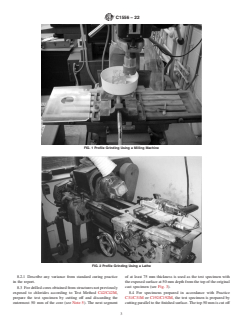
thickness. Refer to Figs. 1 and 2 for examples of satisfactory equipment (see Note 3).
NOTE 3—A lathe or milling machine equipped with a short-barrel carbide-tipped, or diamond-tipped, core drill bit has been found satisfactory for profile
grinding.
FIG. 1 Profile Grinding Using a Milling Machine
C1556 − 22
FIG. 2 Profile Grinding Using a Lathe
6.6 Resealable Polyethylene Bags, 200-200 mm to 300-mm300 mm wide by 250-250 mm to 300-mm300 mm long, and sheet
thickness not less than 0.1 mm.
6.7 Equipment for crushing concrete, mortar or grout. Suitable equipment is described in Test Method C1152/C1152M.
6.8 Equipment for chloride analysis as described in Test Method C1152/C1152M.
6.9 Slide Caliper, accurate to at least 6 0.1 mm.
7. Reagents and Materials
7.1 Distilled or De-ionized Water.
7.2 Calcium Hydroxide [Ca(OH) ], technical grade.
7.3 Calcium Hydroxide Solution, saturated, (approx. 3 g/L).
7.4 Sodium Chloride [NaCl], technical grade.
7.5 Exposure Liquid—An aqueous NaCl solution prepared with a concentration of 165165 g 6 1 g NaCl per L of solution.
7.6 Two-component Polyurethane or Epoxy-resin Based Paint, capable of forming a barrier membrane that is resistant to chloride
ion diffusion.
8. Test Specimens
8.1 Drilled cores, molded cylinders, or molded cubes are acceptable test specimens. One sample consists of at least two test
specimens representative of the cementitious mixture under test (see test. Note 4). Specimens must be free of defects such as voids
C1556 − 22
or cracks visible to the unaided eye (see Note 5). The minimum dimension across the finishedexposed surface of each test specimen
must be at least 75 mm, but not less than three times the nominal maximum aggregate particle size. The specimen depth must be
at least 75 mm.
NOTE 4—Specimens with voids deeper than the profile layer thickness can increase the apparent rate of chloride penetration, and increases test variability.
NOTE 5—The material quality of the concrete between the exposed surface and the outermost layer of reinforcement is often of interest because it is here
that the protection against chloride penetration is needed. Furthermore, the quality of the material in this particular area can deviate from that in the rest
of the system, as this region is often affected by construction practices.
NOTE 5—Specimens with voids deeper than the profile layer thickness can increase the apparent rate of chloride penetration, and increases test variability.
8.2 Unless otherwise specified, provide 28 days of laboratory standard moist curing in accordance with Practice C31/C31M or
C192/C192M prior to sample preparation for immersion in the exposure liquid.
8.2.1 Describe any variance from standard curing practice in the report.
8.3 For drilled cores obtained from structures not previously exposed to chlorides according to Test Method C42/C42M, prepare
the test specimen by cutting off and discarding the outermost 75 mm 50 mm of the core. core (see Note 5The test specimen thus
obtained has one face that is the original finished surface, and the other face that is a sawn surface as shown in ). The next segment
of at least 75 mm thickness is used as the test specimen with the exposed surface at 50 mm depth from the top of the original cast
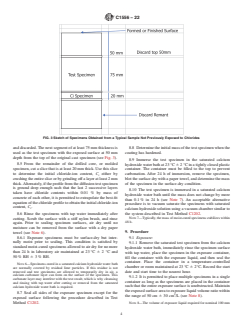
specimen (see Fig. 3.).
8.4 For specimens prepared in accordance with Practice C31/C31M or C192/C192M, the test specimen is prepared by cutting
parallel to the finished surface. The top 75 mm 50 mm is cut off and discarded. The next segment of at least 75 mm thickness is
used as the test specimen with the exposed surface at 50 mm depth from the top of the original cast specimen (see Fig. 3).
8.5 From the remainder of the drilled core, or molded specimen, cut a slice that is at least 20-mm20 mm thick. Use this slice to
determine the initial chloride-ion content, C either by crushing the entire slice or by grinding off a layer at least 2-mm2 mm thick.
i
Alternately, if the profile from the diffusion test specimen is ground deep enough such that the last 2 successive layers taken have
chloride contents within 0.01 % by mass of concrete of each other, it is permitted to extrapolate the best-fit equation of the chloride
profile to obtain the initial chloride-ion content, C .
i
FIG. 3 Sketch of Specimens Obtained from a Typical Sample Not Previously Exposed to Chlorides
C1556 − 22
8.6 Rinse the specimens with tap water immediately after cutting. Scrub the surface with a stiff nylon brush, and rinse again. Prior
to sealing specimen surfaces, air dry until no moisture can be removed from the surface with a dry paper towel (see Note 6).
8.6.1 Exposure specimens must be surface-dry but internally moist prior to sealing. This condition is satisfied by standard
moist-cured specimens allowed to air dry for no more than 24 h in laboratory air maintained at 2323 °C 6 2 °C and 50 50 % RH
6 3 % RH.
NOTE 6—Specimens cured in a saturated calcium hydroxide water bath are normally covered by residual lime particles. If this residue is not removed
and test specimens are allowed to temporarily dry in air, a calcium carbonate layer can form on the surface of the specimen. This carbonate layer may
interfere with the test result, which is why cleansing and rinsing with tap water after cutting or removal from the saturated calcium hydroxide water bath
is r
...